

.avif)
.avif)

Accounts Payable Outsourcing Guide 2026


.svg)

Quick Summary: Accounts payable outsourcing transfers invoice processing, payment execution, vendor management, and reconciliation to a third-party provider, typically costing $2.00 per invoice or $500–$800 monthly for standard services. It can unlock cost savings and free internal resources, but requires careful provider selection, clear SLAs, and strong data security protocols to succeed.
Managing accounts payable in-house drains resources from strategic work. Processing invoices, chasing approvals, handling vendor inquiries, reconciling discrepancies—it's necessary work that rarely moves the business forward.
More companies are handing this function to specialized providers. But outsourcing accounts payable isn't just about cutting costs. It's about accessing expertise, scaling operations without hiring, and reducing errors that damage vendor relationships.
This guide walks through what accounts payable outsourcing actually involves, when it makes sense, what it costs, and how to choose a provider that fits your business. No fluff—just the information finance teams need to make an informed decision.
What Is Accounts Payable Outsourcing?
Accounts payable outsourcing means transferring some or all AP functions to an external provider. Instead of maintaining an in-house team to process invoices and manage payments, a third-party service handles these tasks on your behalf.
The scope varies widely. Some businesses outsource only invoice data entry. Others hand over the entire AP workflow—from receipt to payment to vendor communication to month-end reporting.
Core Functions Typically Outsourced
Most accounts payable outsourcing arrangements cover these core activities:
- Invoice receipt and digitization: Providers receive invoices via email, portal, or mail, then convert paper documents to digital format using OCR technology.
- Data entry and coding: Invoice details get entered into your accounting system with proper GL coding, cost center assignment, and project tags.
- Three-way matching: Invoices are matched against purchase orders and receiving documentation to catch discrepancies before payment.
- Approval routing: Invoices route to appropriate managers for approval based on predefined workflows and authorization limits.
- Payment execution: Approved invoices are paid via ACH, EFT, check, or virtual card according to payment terms and cash flow requirements.
- Vendor communication: Providers field vendor inquiries about payment status, resolve invoice disputes, and maintain vendor relationships.
- Reconciliation and reporting: Month-end AP reconciliation, aging reports, cash flow forecasts, and spend analytics get delivered on schedule.
Payment processing itself can quickly become overwhelming, especially when each vendor has different payment requests and methods. Outsourced AP professionals manage the physical payment process, including submitting ACH, EFT, and other electronic payments while monitoring all external payment activities for fraud prevention.
How AP Outsourcing Differs from AP Automation
These terms get used interchangeably, but they're fundamentally different solutions.
Accounts payable automation refers to software that digitizes and streamlines the AP process within your organization. You still own the process—automation just makes it faster and less manual. Your team still manages the system, handles exceptions, and oversees vendor relationships.
Accounts payable outsourcing transfers ownership of the process to an external provider. They bring their own team, their own systems, and their own expertise. You're no longer responsible for staffing, training, or managing the day-to-day workflow.
Many outsourcing providers use automation technology as part of their service delivery. But the key distinction is who owns and operates the process.
Why Businesses Outsource Accounts Payable
The decision to outsource AP typically stems from one or more specific pain points. Understanding which drivers apply to your situation helps determine if outsourcing makes sense.
Cost Reduction
Cost savings remain the most cited reason for outsourcing accounts payable. Industry reports suggest businesses can unlock cost savings compared to maintaining an in-house AP department.
Here's how the math typically works. In-house AP staff typically cost $20–$30 per hour plus employer taxes, benefits, office space, equipment, and software licenses. Outsourced services can range from $15 per hour with varying cost structures depending on service level and requirements.
For per-invoice pricing, providers typically charge around $2.00 per invoice processed (though rates range from $1.50–$6.00 depending on service level). A company processing 200 invoices monthly might pay $300–$1,200 depending on pricing model and service scope.
The cost advantage grows as complexity increases. Three-way matching, multi-entity processing, and international payments require more skilled staff in-house, but outsourcing providers handle this complexity at the same rate structure.
Talent Shortage and Retention Challenges
According to the Bureau of Labor Statistics, employment of bookkeeping and accounting clerks is projected to decline 6% through 2034. Finding and keeping good AP staff has become increasingly difficult.
High turnover in AP roles creates constant disruption. Training new hires takes weeks. Knowledge walks out the door with each departure. Error rates spike during transition periods.
Outsourcing providers absorb these staffing challenges. They maintain bench strength, cross-train team members, and implement knowledge management systems that preserve institutional knowledge regardless of individual turnover.
Scalability Without Hiring
Business growth creates AP volume spikes that in-house teams struggle to absorb. A company acquiring another business might double its invoice volume overnight. Seasonal businesses face predictable surges that require temporary staffing.
Hiring full-time staff for peak periods leaves them underutilized during slow months. Temporary staffing introduces quality concerns and training overhead.
Outsourcing providers scale capacity up or down based on actual volume. Processing 100 invoices one month and 500 the next doesn't require hiring decisions—the provider adjusts resources accordingly.
Process Improvement and Expertise
Specialized AP providers process millions of invoices annually across hundreds of clients. They've seen every edge case, optimized every workflow, and built best practices from extensive pattern recognition.
This expertise typically exceeds what an in-house team can develop, especially in small to mid-size organizations where AP might be one person wearing multiple hats.
Providers bring standardized processes, quality control mechanisms, and continuous improvement methodologies that most internal teams lack the bandwidth to implement.
Compliance and Controls
Regulatory compliance around financial controls continues to tighten. Sarbanes-Oxley requirements affect public companies, but private companies face increasing scrutiny from lenders, investors, and auditors.
According to SEC requirements under Sarbanes-Oxley Act Section 404, organizations must maintain adequate internal control over financial reporting with proper oversight mechanisms.
Establishing proper controls in-house requires expertise many small finance teams don't possess. Outsourcing providers build SOC-compliant processes, maintain detailed audit trails, and provide documentation that satisfies external auditors.
For contractors and vendors receiving over $600 annually, businesses need to issue 1099s—a compliance requirement that trips up many organizations. Outsourcing providers typically include 1099 preparation and filing as part of full-service packages.

Streamline Accounts Payable Support with NeoWork
Accounts payable outsourcing helps companies manage recurring invoice, vendor, and payment support workflows without adding more work to internal finance teams. NeoWork provides remote teammates who can support accounts payable tasks, records management, document handling, and operational follow-up. NeoWork handles recruitment, benefits, training, and ongoing engagement, while teammates integrate into the client’s systems and workflows. Its 91% annualized teammate retention rate and 3.2% candidate selectivity rate reflect a focus on selective hiring and longer-term team stability.
NeoWork's accounts payable support model offers:
- accounts payable and invoice support
- integration with the client’s tools and processes
- recruitment and ongoing teammate support
Contact NeoWork to add accounts payable support that fits your existing finance operations.
What Accounts Payable Outsourcing Actually Costs
Pricing models for AP outsourcing vary significantly based on service scope, transaction volume, and complexity. Understanding the fee structures helps with accurate budgeting and provider comparison.
Common Pricing Models
Most providers use one of three approaches:
- Per-invoice pricing charges a flat rate for each invoice processed, typically around $2.00 per invoice. Simple and transparent, but costs scale directly with volume. If invoice counts jump from 100 to 200 monthly, costs balloon from $200 to $400—something to consider for growing businesses.
- Hourly rates bill for actual time spent on AP activities, usually $15–$25 per hour depending on service complexity and provider location. Works well for businesses with unpredictable volume or complex invoices requiring significant manual intervention.
- Monthly flat fees provide unlimited processing up to a specified invoice count. Basic processing-only services might start around $500 monthly, while full-service packages run $400–$800 depending on features.
Factors That Affect Pricing
Several variables push costs up or down from baseline rates:
- Invoice complexity: Simple invoices with clear line items cost less to process than complex documents requiring GL allocation across multiple departments, projects, or entities.
- Payment methods: ACH and EFT payments are typically included in base rates. Check printing and mailing add $1–$2 per payment. International wire transfers often incur additional fees.
- Integration requirements: Direct integration with your ERP or accounting system might require one-time setup fees of $1,000–$5,000 depending on system complexity.
- Approval workflows: Multi-level approval routing with complex authorization matrices requires more configuration and management than simple single-approver workflows.
- Exception handling: High rates of mismatched invoices, disputed charges, or missing documentation increase processing time and costs.
- Reporting requirements: Standard aging reports and payment summaries are typically included. Custom dashboards, detailed spend analytics, or real-time reporting may cost extra.
Hidden Costs to Watch For
Transparent providers disclose all fees upfront, but some costs only surface during contract review or after service begins:
- Setup and onboarding fees that vary based on complexity
- Per-user fees for portal access or approval workflow seats
- Minimum monthly commitments that exceed actual usage during slow periods
- Early termination penalties (common in contracts under 12 months)
- Storage fees for document retention beyond standard periods
- Support charges for requests outside normal service scope
Real talk: if a provider's pricing seems too good to be true, dig into the contract details. The cheapest headline rate often comes with the longest list of additional charges.
Key Benefits of Outsourcing Accounts Payable
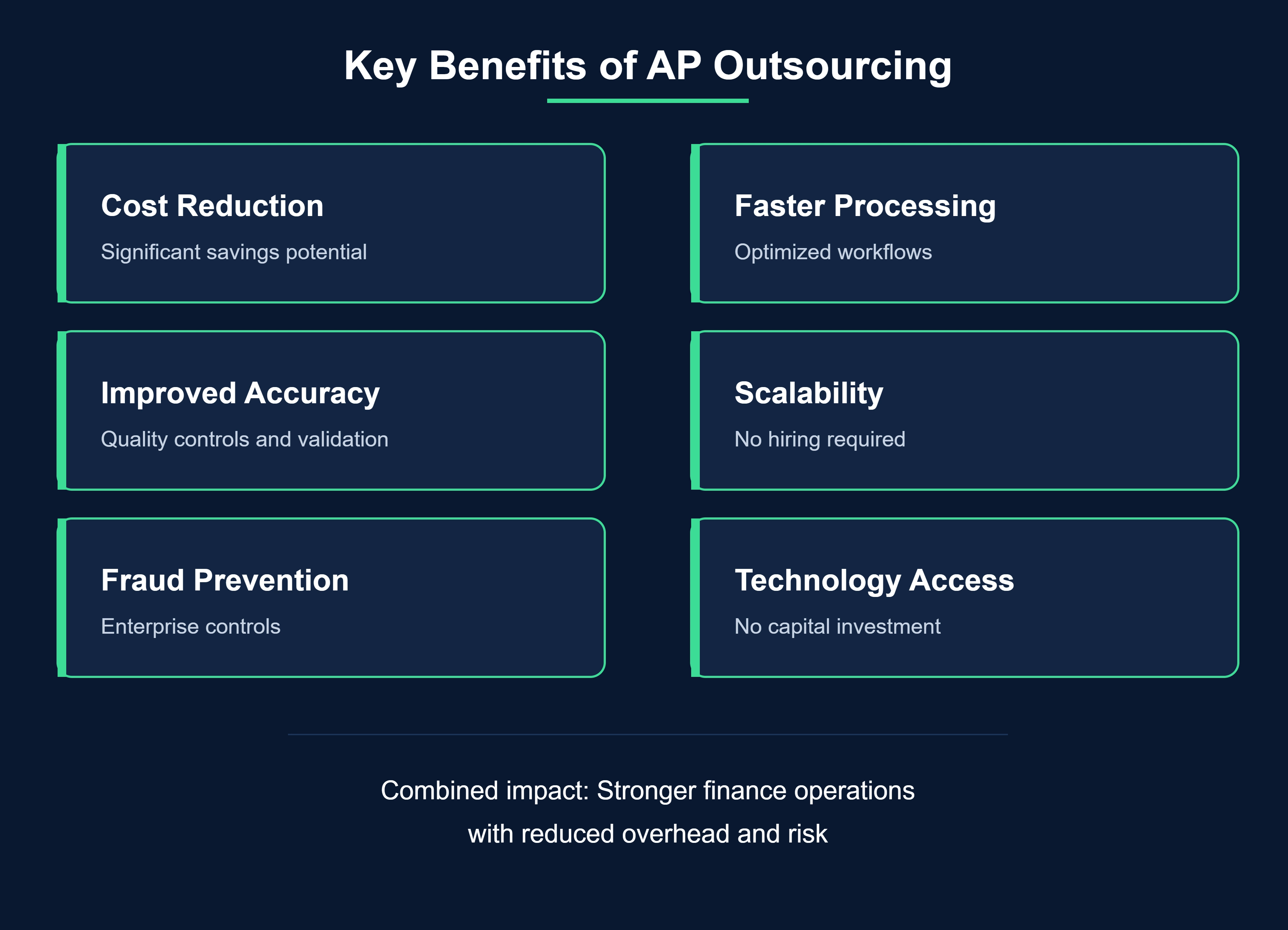
Beyond cost savings, AP outsourcing delivers several operational advantages that improve overall finance function performance.
Faster Processing and Payment Cycles
Specialized providers often process invoices faster than in-house teams through optimized workflows and dedicated resources. Dedicated resources, optimized workflows, and automation technology combine to eliminate bottlenecks.
Faster processing enables businesses to capture early payment discounts more consistently. A 2/10 net 30 discount on a $10,000 invoice equals $200 saved—repeated across hundreds of invoices, these discounts add up quickly.
Vendors appreciate reliable, on-time payments. Strong payment performance builds goodwill that translates to better terms, priority service during supply constraints, and more flexible arrangements when cash flow challenges arise.
Improved Accuracy and Reduced Errors
Manual AP processing generates errors. Transposed numbers, incorrect GL codes, duplicate payments, missed discounts—these mistakes cost money and damage credibility.
Outsourcing providers implement multi-layer quality controls. Automated data validation catches obvious errors. Three-way matching flags discrepancies. Supervisory review adds a final check before payment execution.
Error rates typically improve after transitioning to an outsourced model through multi-layer quality controls and automated validation.
Better Cash Flow Visibility
Many businesses lack clear visibility into upcoming payment obligations. AP sits in spreadsheets, email inboxes, and filing cabinets rather than a centralized system.
Outsourcing providers deliver regular reporting on outstanding payables, upcoming due dates, and cash requirements. Finance teams can forecast cash needs accurately and optimize payment timing to manage working capital.
This visibility improves relationships with treasury and banking partners, supports better borrowing decisions, and prevents costly surprises.
Enhanced Fraud Prevention
AP fraud remains a significant risk. The Association of Certified Fraud Examiners consistently reports that billing schemes rank among the most common types of occupational fraud.
Common fraud vectors include:
- Fictitious vendor schemes where employees create fake suppliers and submit fraudulent invoices
- Payment diversion where legitimate vendor payments get redirected to accounts controlled by fraudsters
- Duplicate payment schemes that exploit weak controls around invoice matching
- Expense reimbursement fraud involving inflated or fabricated business expenses
Outsourcing providers implement robust fraud controls including vendor validation, payment verification, segregation of duties, and anomaly detection that most small internal teams can't match.
Access to Technology Without Capital Investment
Modern AP automation platforms require significant licensing and implementation investment depending on features and scale. Implementation requires additional investment in configuration, integration, training, and ongoing maintenance.
Outsourcing providers absorb these technology costs. Clients benefit from enterprise-grade OCR, workflow automation, payment processing, and reporting tools without licensing fees or implementation projects.
As technology evolves, providers upgrade systems and capabilities automatically. Internal teams avoid the endless cycle of evaluating, purchasing, implementing, and maintaining AP software.
Potential Drawbacks and Risks
Outsourcing isn't universally beneficial. Several legitimate concerns and potential downsides deserve consideration before making the transition.
Loss of Direct Control
Handing AP to an external provider means surrendering day-to-day control over invoice processing and payment execution. Management can't walk down the hall to check on a specific invoice or make immediate adjustments to payment priorities.
Some finance leaders feel uncomfortable with this distance. The discomfort intensifies during the transition period when processes are still stabilizing and communication patterns haven't solidified.
This concern is most acute in businesses where AP serves strategic functions beyond basic transaction processing—negotiating payment terms, managing vendor relationships, optimizing working capital.
Data Security and Privacy Concerns
Outsourcing requires sharing sensitive financial data with a third party. Invoice details, payment information, vendor relationships, and spend patterns all leave the organization's direct custody.
A security breach at the provider exposes your data. Inadequate access controls might allow unauthorized viewing of confidential information. Poor vendor onboarding could enable fraudulent payment diversion.
These risks are real, though the severity depends heavily on provider selection. Reputable providers maintain SOC 2 Type II certification, implement robust encryption, enforce strict access controls, and carry cybersecurity insurance.
Still, any external relationship introduces risk that doesn't exist with in-house processing. Organizations in highly regulated industries or handling exceptionally sensitive information may decide this risk exceeds the benefits.
Communication Delays
Response time matters in AP. Vendors call with urgent payment questions. Controllers need immediate answers about outstanding obligations. Buyers need invoice status to resolve receiving disputes.
Outsourced providers add communication latency. Questions route through ticketing systems or scheduled calls rather than instant conversations. Time zone differences can delay responses by hours or days.
Quality providers minimize this friction through dedicated account managers, online portals with real-time status visibility, and clear escalation paths. But communication is rarely as immediate as walking to a colleague's desk.
Service Dependency and Switching Costs
Once AP runs through an external provider, switching back in-house or to a different vendor creates significant disruption. Historical knowledge sits with the provider. Workflows are configured in their systems. Staff who previously handled AP have moved to other roles or left the company.
This dependency gives providers leverage in contract renewals. Unfavorable pricing or service degradation becomes harder to address when switching costs are high.
Longer contract terms compound this issue. Three-year commitments with early termination penalties effectively lock organizations into relationships that may not serve them well as circumstances change.
Culture and Knowledge Loss
AP teams often possess deep institutional knowledge about vendor relationships, invoice quirks, approval preferences, and business context that isn't documented in procedures manuals.
When AP moves outside, this knowledge can evaporate. The context that prevents errors and enables judgment calls on exceptions gets replaced with standardized procedures that may not capture important nuances.
For businesses where AP staff serve broader roles—vendor negotiation, purchase order management, expense policy enforcement—outsourcing can hollow out capabilities that matter beyond just processing transactions.
When Accounts Payable Outsourcing Makes Sense
Outsourcing works brilliantly for some organizations and poorly for others. Certain business characteristics and situations signal strong fit.
High Transaction Volume with Low Complexity
Companies processing hundreds of similar invoices monthly are ideal outsourcing candidates. The repetitive nature plays to provider strengths—standardized workflows, automation, and economies of scale.
Conversely, businesses with low volume but highly complex transactions (detailed cost allocations, extensive approvals, frequent exceptions) may find that outsourcing costs more than in-house processing because providers charge premium rates for complexity.
Growth Phase or Scaling Operations
Rapidly growing businesses face a dilemma: hire AP staff to handle increasing volume, or find ways to scale without adding headcount.
Outsourcing solves this cleanly. Capacity grows automatically with transaction volume. No recruiting, no training, no management overhead. Finance leadership focuses on strategy rather than staffing.
The same logic applies during contraction or restructuring. Outsourcing provides a path to right-size AP capacity without layoffs or severance costs.
Limited Internal AP Expertise
Small businesses often assign AP responsibilities to administrative staff who lack formal accounting training. Processing happens, but controls are weak, errors are common, and opportunities for optimization go unrecognized.
Outsourcing providers bring professional expertise these organizations couldn't otherwise afford. Proper procedures, segregation of duties, and best practices get implemented by default.
Seasonal or Variable Invoice Volume
Retailers, hospitality businesses, and other seasonal operations face dramatic swings in AP volume. Hiring full-time staff for peak capacity means paying for idle resources during slow periods.
Temporary staffing helps but introduces quality and security concerns. Training temps for what might be six or eight weeks of work doesn't make sense.
Outsourcing providers adjust resources dynamically. High-volume months cost more, slow months cost less, but service quality remains consistent year-round.
During System Transitions or Implementations
Companies implementing new ERP systems face a difficult transition period. The old system is being retired, the new one isn't fully operational, and AP still needs to function.
Outsourcing providers can absorb processing during transitions, maintaining continuity while internal teams focus on implementation. Once the new system stabilizes, processing can return in-house or continue with the provider depending on long-term strategy.
Post-Merger Integration
Acquiring another company often means inheriting disparate AP systems, processes, and staff. Integrating these quickly while maintaining business continuity challenges even experienced finance teams.
Outsourcing provides a clean integration path. Both legacy AP operations transition to a single provider who standardizes processes, consolidates reporting, and eliminates redundant systems.
Choosing the Right AP Outsourcing Provider
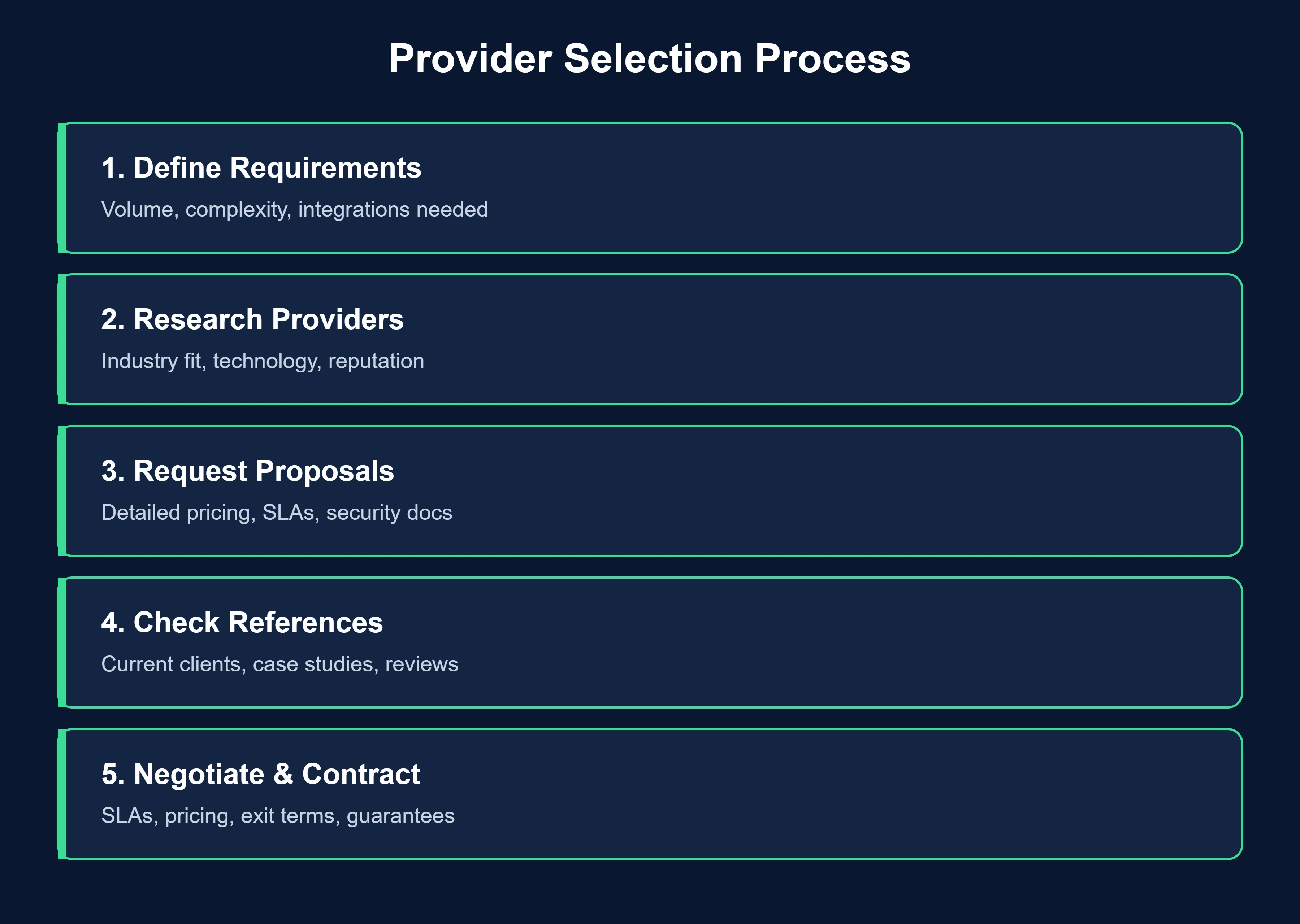
Provider selection makes or breaks the outsourcing experience. The cheapest option rarely delivers the best outcome, but the most expensive doesn't guarantee success either.
Essential Evaluation Criteria
- Industry experience: Providers with deep experience in your industry understand typical transaction patterns, common challenges, and regulatory requirements. Generic business process outsourcers may lack context that prevents costly mistakes.
- Technology platform: The provider's systems determine how smoothly processing flows. Evaluate the invoice capture technology, approval workflow capabilities, payment execution methods, and reporting tools. Ask for demos with real data, not sanitized marketing examples.
- Integration capabilities: Direct integration with your ERP, accounting system, and banking platforms eliminates manual data transfer and reduces error risk. Understand what integrations exist out-of-the-box versus what requires custom development.
- Security and compliance: SOC 2 Type II certification should be baseline. Ask about data encryption methods, access controls, employee background checks, and cybersecurity insurance coverage. For regulated industries, verify specific compliance capabilities (HIPAA, PCI-DSS, etc.).
- Service level agreements: Clear SLAs define expectations around processing timeframes, accuracy rates, support response times, and escalation procedures. Service providers should maintain customer satisfaction benchmarks with improvement plans triggered by performance below acceptable thresholds.
- Scalability and flexibility: Confirm the provider can handle volume increases without service degradation. Understand how pricing adjusts with scale. Ask about surge capacity during peak periods.
- Geographic considerations: Onshore, nearshore, and offshore providers offer different trade-offs around cost, communication, and time zone alignment. Domestic providers cost more but simplify collaboration. Offshore options maximize savings but may introduce communication friction.
- References and reputation: Speaking with current clients reveals more than marketing materials. Ask references about responsiveness, accuracy, problem resolution, and whether they'd choose the same provider again.
Red Flags to Watch For
Several warning signs should trigger additional scrutiny or disqualification:
- Reluctance to provide references or allow site visits
- Vague answers about security practices or compliance certifications
- Pricing that seems significantly below market without clear explanation
- Long-term contracts with high termination penalties before service quality is proven
- Limited integration capabilities requiring extensive manual workarounds
- Poor financial stability or recent management turnover at the provider
- Outsized promises about cost savings or performance improvements without substantiation
Questions to Ask During Provider Evaluation
Thorough vetting requires asking pointed questions that reveal true capabilities:
- How do you handle invoice exceptions and discrepancies?
- What's your average invoice processing time from receipt to payment?
- How are GL codes validated and maintained as our chart of accounts evolves?
- What fraud prevention controls are built into your process?
- How do you ensure segregation of duties between invoice approval and payment execution?
- What visibility do we have into real-time AP status and upcoming payment obligations?
- How are vendor inquiries routed and tracked?
- What happens if your system goes down or you experience a service disruption?
- How do you handle the transition—what's required from our team during onboarding?
- What's your staff turnover rate and how do you manage continuity?
Implementing AP Outsourcing Successfully
Even with the right provider, implementation quality determines long-term success. Poor transitions create chaos that takes months to stabilize.
Pre-Implementation Planning
Successful implementations start with thorough planning before the provider touches a single invoice.
- Process documentation: Document current workflows, approval hierarchies, GL coding structures, vendor payment terms, and exception handling procedures. This baseline helps the provider replicate what works and improve what doesn't.
- Data cleanup: Clean up vendor master files, standardize GL codes, resolve outstanding invoice disputes, and clear any backlog. Starting with messy data extends implementation timelines and increases error risk.
- Stakeholder communication: Inform vendors about the change, including new invoice submission addresses or portals. Brief internal approvers on new workflows. Prepare accounting staff for their shifting responsibilities.
- Integration testing: Test system integrations in a sandbox environment before processing live transactions. Verify that invoice data flows correctly, GL codes map properly, and payment files generate in the right format.
Phased Rollout Strategy
Big bang implementations—switching all AP processing to the provider overnight—maximize disruption risk. Phased approaches allow course correction before problems cascade.
Common phased strategies include:
- Pilot by vendor: Start with a subset of vendors whose invoices are straightforward and predictable. Expand to more complex vendors as the process stabilizes.
- Pilot by entity: For multi-entity organizations, transition one legal entity or business unit first, then roll out to others using lessons learned.
- Pilot by function: Begin with invoice processing and approval, keeping payment execution in-house initially. Add payment processing once upstream activities run smoothly.
Regardless of approach, plan for parallel processing during transition—both in-house and provider handling invoices temporarily. This safety net catches anything that slips through during changeover.
Change Management
People challenges often exceed technical challenges during outsourcing transitions.
AP staff face uncertainty about their roles. Some will transition to other finance functions, others may face redundancy. Addressing these concerns directly and compassionately maintains morale and cooperation during transition.
Approvers need training on new approval workflows. If the process differs significantly from current practice, expect resistance and budget time for re-training.
Vendors may struggle with new invoice submission processes. Expect higher inquiry volume during the first few months. Clear communication and responsive support minimize vendor friction.
Ongoing Governance
Outsourcing doesn't mean abandoning oversight. Effective governance maintains quality and alignment over time.
- Regular performance reviews: Monthly or quarterly meetings to review KPIs—processing times, error rates, vendor satisfaction, cost per invoice, discount capture rate.
- SLA monitoring: Track provider performance against contractual SLAs. Address misses immediately before they become patterns.
- Process improvement discussions: Outsourcing shouldn't freeze the process in place. Regular discussions about optimization opportunities keep the service evolving with business needs.
- Audit and compliance: Periodic audits verify that controls remain effective and fraud prevention measures work as intended. External auditors should review provider controls annually.
Alternatives to Full AP Outsourcing
Outsourcing the entire AP function isn't the only option. Several alternative approaches address specific pain points without complete handoff.
AP Automation Software
Implementing AP automation software keeps processing in-house while eliminating manual work. OCR technology captures invoice data automatically. Workflow automation routes approvals. Electronic payment eliminates check printing.
Automation works well for organizations with capable AP staff who need better tools. It doesn't solve staffing shortages or provide external expertise, but it dramatically improves efficiency without surrendering control.
Cost structures differ fundamentally from outsourcing. Software requires upfront licensing and implementation investment, typically $10,000–$50,000 depending on scale, plus ongoing subscription fees. Outsourcing has minimal upfront cost but higher per-transaction operating cost.
Partial Outsourcing
Some organizations outsource specific AP components while keeping others in-house. Common split models include:
- Invoice processing only: Provider handles data entry and coding; internal team manages approvals and payments. This addresses the most labor-intensive component while maintaining control over cash disbursements.
- Overflow processing: Internal team handles normal volume; provider absorbs surge periods during month-end, quarter-end, or seasonal peaks. This provides scalability without full outsourcing.
- International or multi-currency processing: Provider handles complex international invoices requiring currency conversion, international payment rails, and foreign tax compliance. Domestic processing stays in-house.
These hybrid models offer middle-ground solutions but introduce complexity in determining handoff points and maintaining clear responsibility boundaries.
Temporary Staffing
Bringing in temporary AP specialists addresses short-term needs—covering vacations, managing implementations, absorbing temporary volume increases—without long-term commitment.
Temps work well for bridging defined gaps but less well for sustained operations. Finding qualified candidates takes time, training introduces overhead, and turnover creates continuity problems.
Shared Services Centers
Large organizations sometimes consolidate AP processing from multiple locations or business units into a centralized internal shared services center.
Shared services capture many outsourcing benefits—standardization, specialization, economies of scale—while keeping operations under direct company control. But they require significant scale to justify the investment in centralized facilities, systems, and management structure.
Making the Right Decision for Your Organization
Accounts payable outsourcing delivers significant value in the right circumstances. Cost savings, improved accuracy, scalability, and access to expertise make it attractive for many businesses.
But it's not universally appropriate. Loss of control, communication friction, and service dependency create legitimate concerns that some organizations can't accept.
The decision framework comes down to honest assessment of current state and future needs:
- Do current AP operations function well or struggle with quality, capacity, or cost issues?
- Does the finance team have bandwidth to manage AP or is it distracting from higher-value work?
- Is invoice volume predictable and manageable or volatile and challenging?
- Does the organization have resources to implement and maintain AP automation internally?
- Are controls and compliance requirements being met or are there gaps?
- Is the business growing, stable, or contracting—and how does that affect AP needs?
Organizations experiencing AP pain with limited internal resources to fix it make natural outsourcing candidates. Those with strong AP operations and strategic reasons to maintain direct control probably don't.
The middle ground—businesses where AP functions adequately but could improve—requires careful cost-benefit analysis. Calculate total current costs including staff, technology, and error-related expenses. Compare against detailed outsourcing proposals. Factor in strategic considerations beyond pure cost.
According to Harvard Business School analysis on cost-benefit decisions, a structured four-step process helps evaluate major operational changes: define the scope, identify costs and benefits, quantify what can be measured, and make the decision incorporating both quantitative and qualitative factors.
For accounts payable outsourcing specifically, that means looking beyond hourly rates or per-invoice fees to total impact on finance function effectiveness.
Frequently Asked Questions
Topics
Accounts Payable Outsourcing Guide 2026

Quick Summary: Accounts payable outsourcing transfers invoice processing, payment execution, vendor management, and reconciliation to a third-party provider, typically costing $2.00 per invoice or $500–$800 monthly for standard services. It can unlock cost savings and free internal resources, but requires careful provider selection, clear SLAs, and strong data security protocols to succeed.
Managing accounts payable in-house drains resources from strategic work. Processing invoices, chasing approvals, handling vendor inquiries, reconciling discrepancies—it's necessary work that rarely moves the business forward.
More companies are handing this function to specialized providers. But outsourcing accounts payable isn't just about cutting costs. It's about accessing expertise, scaling operations without hiring, and reducing errors that damage vendor relationships.
This guide walks through what accounts payable outsourcing actually involves, when it makes sense, what it costs, and how to choose a provider that fits your business. No fluff—just the information finance teams need to make an informed decision.
What Is Accounts Payable Outsourcing?
Accounts payable outsourcing means transferring some or all AP functions to an external provider. Instead of maintaining an in-house team to process invoices and manage payments, a third-party service handles these tasks on your behalf.
The scope varies widely. Some businesses outsource only invoice data entry. Others hand over the entire AP workflow—from receipt to payment to vendor communication to month-end reporting.
Core Functions Typically Outsourced
Most accounts payable outsourcing arrangements cover these core activities:
- Invoice receipt and digitization: Providers receive invoices via email, portal, or mail, then convert paper documents to digital format using OCR technology.
- Data entry and coding: Invoice details get entered into your accounting system with proper GL coding, cost center assignment, and project tags.
- Three-way matching: Invoices are matched against purchase orders and receiving documentation to catch discrepancies before payment.
- Approval routing: Invoices route to appropriate managers for approval based on predefined workflows and authorization limits.
- Payment execution: Approved invoices are paid via ACH, EFT, check, or virtual card according to payment terms and cash flow requirements.
- Vendor communication: Providers field vendor inquiries about payment status, resolve invoice disputes, and maintain vendor relationships.
- Reconciliation and reporting: Month-end AP reconciliation, aging reports, cash flow forecasts, and spend analytics get delivered on schedule.
Payment processing itself can quickly become overwhelming, especially when each vendor has different payment requests and methods. Outsourced AP professionals manage the physical payment process, including submitting ACH, EFT, and other electronic payments while monitoring all external payment activities for fraud prevention.
How AP Outsourcing Differs from AP Automation
These terms get used interchangeably, but they're fundamentally different solutions.
Accounts payable automation refers to software that digitizes and streamlines the AP process within your organization. You still own the process—automation just makes it faster and less manual. Your team still manages the system, handles exceptions, and oversees vendor relationships.
Accounts payable outsourcing transfers ownership of the process to an external provider. They bring their own team, their own systems, and their own expertise. You're no longer responsible for staffing, training, or managing the day-to-day workflow.
Many outsourcing providers use automation technology as part of their service delivery. But the key distinction is who owns and operates the process.
Why Businesses Outsource Accounts Payable
The decision to outsource AP typically stems from one or more specific pain points. Understanding which drivers apply to your situation helps determine if outsourcing makes sense.
Cost Reduction
Cost savings remain the most cited reason for outsourcing accounts payable. Industry reports suggest businesses can unlock cost savings compared to maintaining an in-house AP department.
Here's how the math typically works. In-house AP staff typically cost $20–$30 per hour plus employer taxes, benefits, office space, equipment, and software licenses. Outsourced services can range from $15 per hour with varying cost structures depending on service level and requirements.
For per-invoice pricing, providers typically charge around $2.00 per invoice processed (though rates range from $1.50–$6.00 depending on service level). A company processing 200 invoices monthly might pay $300–$1,200 depending on pricing model and service scope.
The cost advantage grows as complexity increases. Three-way matching, multi-entity processing, and international payments require more skilled staff in-house, but outsourcing providers handle this complexity at the same rate structure.
Talent Shortage and Retention Challenges
According to the Bureau of Labor Statistics, employment of bookkeeping and accounting clerks is projected to decline 6% through 2034. Finding and keeping good AP staff has become increasingly difficult.
High turnover in AP roles creates constant disruption. Training new hires takes weeks. Knowledge walks out the door with each departure. Error rates spike during transition periods.
Outsourcing providers absorb these staffing challenges. They maintain bench strength, cross-train team members, and implement knowledge management systems that preserve institutional knowledge regardless of individual turnover.
Scalability Without Hiring
Business growth creates AP volume spikes that in-house teams struggle to absorb. A company acquiring another business might double its invoice volume overnight. Seasonal businesses face predictable surges that require temporary staffing.
Hiring full-time staff for peak periods leaves them underutilized during slow months. Temporary staffing introduces quality concerns and training overhead.
Outsourcing providers scale capacity up or down based on actual volume. Processing 100 invoices one month and 500 the next doesn't require hiring decisions—the provider adjusts resources accordingly.
Process Improvement and Expertise
Specialized AP providers process millions of invoices annually across hundreds of clients. They've seen every edge case, optimized every workflow, and built best practices from extensive pattern recognition.
This expertise typically exceeds what an in-house team can develop, especially in small to mid-size organizations where AP might be one person wearing multiple hats.
Providers bring standardized processes, quality control mechanisms, and continuous improvement methodologies that most internal teams lack the bandwidth to implement.
Compliance and Controls
Regulatory compliance around financial controls continues to tighten. Sarbanes-Oxley requirements affect public companies, but private companies face increasing scrutiny from lenders, investors, and auditors.
According to SEC requirements under Sarbanes-Oxley Act Section 404, organizations must maintain adequate internal control over financial reporting with proper oversight mechanisms.
Establishing proper controls in-house requires expertise many small finance teams don't possess. Outsourcing providers build SOC-compliant processes, maintain detailed audit trails, and provide documentation that satisfies external auditors.
For contractors and vendors receiving over $600 annually, businesses need to issue 1099s—a compliance requirement that trips up many organizations. Outsourcing providers typically include 1099 preparation and filing as part of full-service packages.
Streamline Accounts Payable Support with NeoWork
Accounts payable outsourcing helps companies manage recurring invoice, vendor, and payment support workflows without adding more work to internal finance teams. NeoWork provides remote teammates who can support accounts payable tasks, records management, document handling, and operational follow-up. NeoWork handles recruitment, benefits, training, and ongoing engagement, while teammates integrate into the client’s systems and workflows. Its 91% annualized teammate retention rate and 3.2% candidate selectivity rate reflect a focus on selective hiring and longer-term team stability.
NeoWork's accounts payable support model offers:
- accounts payable and invoice support
- integration with the client’s tools and processes
- recruitment and ongoing teammate support
Contact NeoWork to add accounts payable support that fits your existing finance operations.
What Accounts Payable Outsourcing Actually Costs
Pricing models for AP outsourcing vary significantly based on service scope, transaction volume, and complexity. Understanding the fee structures helps with accurate budgeting and provider comparison.
Common Pricing Models
Most providers use one of three approaches:
- Per-invoice pricing charges a flat rate for each invoice processed, typically around $2.00 per invoice. Simple and transparent, but costs scale directly with volume. If invoice counts jump from 100 to 200 monthly, costs balloon from $200 to $400—something to consider for growing businesses.
- Hourly rates bill for actual time spent on AP activities, usually $15–$25 per hour depending on service complexity and provider location. Works well for businesses with unpredictable volume or complex invoices requiring significant manual intervention.
- Monthly flat fees provide unlimited processing up to a specified invoice count. Basic processing-only services might start around $500 monthly, while full-service packages run $400–$800 depending on features.
Factors That Affect Pricing
Several variables push costs up or down from baseline rates:
- Invoice complexity: Simple invoices with clear line items cost less to process than complex documents requiring GL allocation across multiple departments, projects, or entities.
- Payment methods: ACH and EFT payments are typically included in base rates. Check printing and mailing add $1–$2 per payment. International wire transfers often incur additional fees.
- Integration requirements: Direct integration with your ERP or accounting system might require one-time setup fees of $1,000–$5,000 depending on system complexity.
- Approval workflows: Multi-level approval routing with complex authorization matrices requires more configuration and management than simple single-approver workflows.
- Exception handling: High rates of mismatched invoices, disputed charges, or missing documentation increase processing time and costs.
- Reporting requirements: Standard aging reports and payment summaries are typically included. Custom dashboards, detailed spend analytics, or real-time reporting may cost extra.
Hidden Costs to Watch For
Transparent providers disclose all fees upfront, but some costs only surface during contract review or after service begins:
- Setup and onboarding fees that vary based on complexity
- Per-user fees for portal access or approval workflow seats
- Minimum monthly commitments that exceed actual usage during slow periods
- Early termination penalties (common in contracts under 12 months)
- Storage fees for document retention beyond standard periods
- Support charges for requests outside normal service scope
Real talk: if a provider's pricing seems too good to be true, dig into the contract details. The cheapest headline rate often comes with the longest list of additional charges.
Key Benefits of Outsourcing Accounts Payable
Beyond cost savings, AP outsourcing delivers several operational advantages that improve overall finance function performance.
Faster Processing and Payment Cycles
Specialized providers often process invoices faster than in-house teams through optimized workflows and dedicated resources. Dedicated resources, optimized workflows, and automation technology combine to eliminate bottlenecks.
Faster processing enables businesses to capture early payment discounts more consistently. A 2/10 net 30 discount on a $10,000 invoice equals $200 saved—repeated across hundreds of invoices, these discounts add up quickly.
Vendors appreciate reliable, on-time payments. Strong payment performance builds goodwill that translates to better terms, priority service during supply constraints, and more flexible arrangements when cash flow challenges arise.
Improved Accuracy and Reduced Errors
Manual AP processing generates errors. Transposed numbers, incorrect GL codes, duplicate payments, missed discounts—these mistakes cost money and damage credibility.
Outsourcing providers implement multi-layer quality controls. Automated data validation catches obvious errors. Three-way matching flags discrepancies. Supervisory review adds a final check before payment execution.
Error rates typically improve after transitioning to an outsourced model through multi-layer quality controls and automated validation.
Better Cash Flow Visibility
Many businesses lack clear visibility into upcoming payment obligations. AP sits in spreadsheets, email inboxes, and filing cabinets rather than a centralized system.
Outsourcing providers deliver regular reporting on outstanding payables, upcoming due dates, and cash requirements. Finance teams can forecast cash needs accurately and optimize payment timing to manage working capital.
This visibility improves relationships with treasury and banking partners, supports better borrowing decisions, and prevents costly surprises.
Enhanced Fraud Prevention
AP fraud remains a significant risk. The Association of Certified Fraud Examiners consistently reports that billing schemes rank among the most common types of occupational fraud.
Common fraud vectors include:
- Fictitious vendor schemes where employees create fake suppliers and submit fraudulent invoices
- Payment diversion where legitimate vendor payments get redirected to accounts controlled by fraudsters
- Duplicate payment schemes that exploit weak controls around invoice matching
- Expense reimbursement fraud involving inflated or fabricated business expenses
Outsourcing providers implement robust fraud controls including vendor validation, payment verification, segregation of duties, and anomaly detection that most small internal teams can't match.
Access to Technology Without Capital Investment
Modern AP automation platforms require significant licensing and implementation investment depending on features and scale. Implementation requires additional investment in configuration, integration, training, and ongoing maintenance.
Outsourcing providers absorb these technology costs. Clients benefit from enterprise-grade OCR, workflow automation, payment processing, and reporting tools without licensing fees or implementation projects.
As technology evolves, providers upgrade systems and capabilities automatically. Internal teams avoid the endless cycle of evaluating, purchasing, implementing, and maintaining AP software.
Potential Drawbacks and Risks
Outsourcing isn't universally beneficial. Several legitimate concerns and potential downsides deserve consideration before making the transition.
Loss of Direct Control
Handing AP to an external provider means surrendering day-to-day control over invoice processing and payment execution. Management can't walk down the hall to check on a specific invoice or make immediate adjustments to payment priorities.
Some finance leaders feel uncomfortable with this distance. The discomfort intensifies during the transition period when processes are still stabilizing and communication patterns haven't solidified.
This concern is most acute in businesses where AP serves strategic functions beyond basic transaction processing—negotiating payment terms, managing vendor relationships, optimizing working capital.
Data Security and Privacy Concerns
Outsourcing requires sharing sensitive financial data with a third party. Invoice details, payment information, vendor relationships, and spend patterns all leave the organization's direct custody.
A security breach at the provider exposes your data. Inadequate access controls might allow unauthorized viewing of confidential information. Poor vendor onboarding could enable fraudulent payment diversion.
These risks are real, though the severity depends heavily on provider selection. Reputable providers maintain SOC 2 Type II certification, implement robust encryption, enforce strict access controls, and carry cybersecurity insurance.
Still, any external relationship introduces risk that doesn't exist with in-house processing. Organizations in highly regulated industries or handling exceptionally sensitive information may decide this risk exceeds the benefits.
Communication Delays
Response time matters in AP. Vendors call with urgent payment questions. Controllers need immediate answers about outstanding obligations. Buyers need invoice status to resolve receiving disputes.
Outsourced providers add communication latency. Questions route through ticketing systems or scheduled calls rather than instant conversations. Time zone differences can delay responses by hours or days.
Quality providers minimize this friction through dedicated account managers, online portals with real-time status visibility, and clear escalation paths. But communication is rarely as immediate as walking to a colleague's desk.
Service Dependency and Switching Costs
Once AP runs through an external provider, switching back in-house or to a different vendor creates significant disruption. Historical knowledge sits with the provider. Workflows are configured in their systems. Staff who previously handled AP have moved to other roles or left the company.
This dependency gives providers leverage in contract renewals. Unfavorable pricing or service degradation becomes harder to address when switching costs are high.
Longer contract terms compound this issue. Three-year commitments with early termination penalties effectively lock organizations into relationships that may not serve them well as circumstances change.
Culture and Knowledge Loss
AP teams often possess deep institutional knowledge about vendor relationships, invoice quirks, approval preferences, and business context that isn't documented in procedures manuals.
When AP moves outside, this knowledge can evaporate. The context that prevents errors and enables judgment calls on exceptions gets replaced with standardized procedures that may not capture important nuances.
For businesses where AP staff serve broader roles—vendor negotiation, purchase order management, expense policy enforcement—outsourcing can hollow out capabilities that matter beyond just processing transactions.
When Accounts Payable Outsourcing Makes Sense
Outsourcing works brilliantly for some organizations and poorly for others. Certain business characteristics and situations signal strong fit.
High Transaction Volume with Low Complexity
Companies processing hundreds of similar invoices monthly are ideal outsourcing candidates. The repetitive nature plays to provider strengths—standardized workflows, automation, and economies of scale.
Conversely, businesses with low volume but highly complex transactions (detailed cost allocations, extensive approvals, frequent exceptions) may find that outsourcing costs more than in-house processing because providers charge premium rates for complexity.
Growth Phase or Scaling Operations
Rapidly growing businesses face a dilemma: hire AP staff to handle increasing volume, or find ways to scale without adding headcount.
Outsourcing solves this cleanly. Capacity grows automatically with transaction volume. No recruiting, no training, no management overhead. Finance leadership focuses on strategy rather than staffing.
The same logic applies during contraction or restructuring. Outsourcing provides a path to right-size AP capacity without layoffs or severance costs.
Limited Internal AP Expertise
Small businesses often assign AP responsibilities to administrative staff who lack formal accounting training. Processing happens, but controls are weak, errors are common, and opportunities for optimization go unrecognized.
Outsourcing providers bring professional expertise these organizations couldn't otherwise afford. Proper procedures, segregation of duties, and best practices get implemented by default.
Seasonal or Variable Invoice Volume
Retailers, hospitality businesses, and other seasonal operations face dramatic swings in AP volume. Hiring full-time staff for peak capacity means paying for idle resources during slow periods.
Temporary staffing helps but introduces quality and security concerns. Training temps for what might be six or eight weeks of work doesn't make sense.
Outsourcing providers adjust resources dynamically. High-volume months cost more, slow months cost less, but service quality remains consistent year-round.
During System Transitions or Implementations
Companies implementing new ERP systems face a difficult transition period. The old system is being retired, the new one isn't fully operational, and AP still needs to function.
Outsourcing providers can absorb processing during transitions, maintaining continuity while internal teams focus on implementation. Once the new system stabilizes, processing can return in-house or continue with the provider depending on long-term strategy.
Post-Merger Integration
Acquiring another company often means inheriting disparate AP systems, processes, and staff. Integrating these quickly while maintaining business continuity challenges even experienced finance teams.
Outsourcing provides a clean integration path. Both legacy AP operations transition to a single provider who standardizes processes, consolidates reporting, and eliminates redundant systems.
Choosing the Right AP Outsourcing Provider
Provider selection makes or breaks the outsourcing experience. The cheapest option rarely delivers the best outcome, but the most expensive doesn't guarantee success either.
Essential Evaluation Criteria
- Industry experience: Providers with deep experience in your industry understand typical transaction patterns, common challenges, and regulatory requirements. Generic business process outsourcers may lack context that prevents costly mistakes.
- Technology platform: The provider's systems determine how smoothly processing flows. Evaluate the invoice capture technology, approval workflow capabilities, payment execution methods, and reporting tools. Ask for demos with real data, not sanitized marketing examples.
- Integration capabilities: Direct integration with your ERP, accounting system, and banking platforms eliminates manual data transfer and reduces error risk. Understand what integrations exist out-of-the-box versus what requires custom development.
- Security and compliance: SOC 2 Type II certification should be baseline. Ask about data encryption methods, access controls, employee background checks, and cybersecurity insurance coverage. For regulated industries, verify specific compliance capabilities (HIPAA, PCI-DSS, etc.).
- Service level agreements: Clear SLAs define expectations around processing timeframes, accuracy rates, support response times, and escalation procedures. Service providers should maintain customer satisfaction benchmarks with improvement plans triggered by performance below acceptable thresholds.
- Scalability and flexibility: Confirm the provider can handle volume increases without service degradation. Understand how pricing adjusts with scale. Ask about surge capacity during peak periods.
- Geographic considerations: Onshore, nearshore, and offshore providers offer different trade-offs around cost, communication, and time zone alignment. Domestic providers cost more but simplify collaboration. Offshore options maximize savings but may introduce communication friction.
- References and reputation: Speaking with current clients reveals more than marketing materials. Ask references about responsiveness, accuracy, problem resolution, and whether they'd choose the same provider again.
Red Flags to Watch For
Several warning signs should trigger additional scrutiny or disqualification:
- Reluctance to provide references or allow site visits
- Vague answers about security practices or compliance certifications
- Pricing that seems significantly below market without clear explanation
- Long-term contracts with high termination penalties before service quality is proven
- Limited integration capabilities requiring extensive manual workarounds
- Poor financial stability or recent management turnover at the provider
- Outsized promises about cost savings or performance improvements without substantiation
Questions to Ask During Provider Evaluation
Thorough vetting requires asking pointed questions that reveal true capabilities:
- How do you handle invoice exceptions and discrepancies?
- What's your average invoice processing time from receipt to payment?
- How are GL codes validated and maintained as our chart of accounts evolves?
- What fraud prevention controls are built into your process?
- How do you ensure segregation of duties between invoice approval and payment execution?
- What visibility do we have into real-time AP status and upcoming payment obligations?
- How are vendor inquiries routed and tracked?
- What happens if your system goes down or you experience a service disruption?
- How do you handle the transition—what's required from our team during onboarding?
- What's your staff turnover rate and how do you manage continuity?
Implementing AP Outsourcing Successfully
Even with the right provider, implementation quality determines long-term success. Poor transitions create chaos that takes months to stabilize.
Pre-Implementation Planning
Successful implementations start with thorough planning before the provider touches a single invoice.
- Process documentation: Document current workflows, approval hierarchies, GL coding structures, vendor payment terms, and exception handling procedures. This baseline helps the provider replicate what works and improve what doesn't.
- Data cleanup: Clean up vendor master files, standardize GL codes, resolve outstanding invoice disputes, and clear any backlog. Starting with messy data extends implementation timelines and increases error risk.
- Stakeholder communication: Inform vendors about the change, including new invoice submission addresses or portals. Brief internal approvers on new workflows. Prepare accounting staff for their shifting responsibilities.
- Integration testing: Test system integrations in a sandbox environment before processing live transactions. Verify that invoice data flows correctly, GL codes map properly, and payment files generate in the right format.
Phased Rollout Strategy
Big bang implementations—switching all AP processing to the provider overnight—maximize disruption risk. Phased approaches allow course correction before problems cascade.
Common phased strategies include:
- Pilot by vendor: Start with a subset of vendors whose invoices are straightforward and predictable. Expand to more complex vendors as the process stabilizes.
- Pilot by entity: For multi-entity organizations, transition one legal entity or business unit first, then roll out to others using lessons learned.
- Pilot by function: Begin with invoice processing and approval, keeping payment execution in-house initially. Add payment processing once upstream activities run smoothly.
Regardless of approach, plan for parallel processing during transition—both in-house and provider handling invoices temporarily. This safety net catches anything that slips through during changeover.
Change Management
People challenges often exceed technical challenges during outsourcing transitions.
AP staff face uncertainty about their roles. Some will transition to other finance functions, others may face redundancy. Addressing these concerns directly and compassionately maintains morale and cooperation during transition.
Approvers need training on new approval workflows. If the process differs significantly from current practice, expect resistance and budget time for re-training.
Vendors may struggle with new invoice submission processes. Expect higher inquiry volume during the first few months. Clear communication and responsive support minimize vendor friction.
Ongoing Governance
Outsourcing doesn't mean abandoning oversight. Effective governance maintains quality and alignment over time.
- Regular performance reviews: Monthly or quarterly meetings to review KPIs—processing times, error rates, vendor satisfaction, cost per invoice, discount capture rate.
- SLA monitoring: Track provider performance against contractual SLAs. Address misses immediately before they become patterns.
- Process improvement discussions: Outsourcing shouldn't freeze the process in place. Regular discussions about optimization opportunities keep the service evolving with business needs.
- Audit and compliance: Periodic audits verify that controls remain effective and fraud prevention measures work as intended. External auditors should review provider controls annually.
Alternatives to Full AP Outsourcing
Outsourcing the entire AP function isn't the only option. Several alternative approaches address specific pain points without complete handoff.
AP Automation Software
Implementing AP automation software keeps processing in-house while eliminating manual work. OCR technology captures invoice data automatically. Workflow automation routes approvals. Electronic payment eliminates check printing.
Automation works well for organizations with capable AP staff who need better tools. It doesn't solve staffing shortages or provide external expertise, but it dramatically improves efficiency without surrendering control.
Cost structures differ fundamentally from outsourcing. Software requires upfront licensing and implementation investment, typically $10,000–$50,000 depending on scale, plus ongoing subscription fees. Outsourcing has minimal upfront cost but higher per-transaction operating cost.
Partial Outsourcing
Some organizations outsource specific AP components while keeping others in-house. Common split models include:
- Invoice processing only: Provider handles data entry and coding; internal team manages approvals and payments. This addresses the most labor-intensive component while maintaining control over cash disbursements.
- Overflow processing: Internal team handles normal volume; provider absorbs surge periods during month-end, quarter-end, or seasonal peaks. This provides scalability without full outsourcing.
- International or multi-currency processing: Provider handles complex international invoices requiring currency conversion, international payment rails, and foreign tax compliance. Domestic processing stays in-house.
These hybrid models offer middle-ground solutions but introduce complexity in determining handoff points and maintaining clear responsibility boundaries.
Temporary Staffing
Bringing in temporary AP specialists addresses short-term needs—covering vacations, managing implementations, absorbing temporary volume increases—without long-term commitment.
Temps work well for bridging defined gaps but less well for sustained operations. Finding qualified candidates takes time, training introduces overhead, and turnover creates continuity problems.
Shared Services Centers
Large organizations sometimes consolidate AP processing from multiple locations or business units into a centralized internal shared services center.
Shared services capture many outsourcing benefits—standardization, specialization, economies of scale—while keeping operations under direct company control. But they require significant scale to justify the investment in centralized facilities, systems, and management structure.
Making the Right Decision for Your Organization
Accounts payable outsourcing delivers significant value in the right circumstances. Cost savings, improved accuracy, scalability, and access to expertise make it attractive for many businesses.
But it's not universally appropriate. Loss of control, communication friction, and service dependency create legitimate concerns that some organizations can't accept.
The decision framework comes down to honest assessment of current state and future needs:
- Do current AP operations function well or struggle with quality, capacity, or cost issues?
- Does the finance team have bandwidth to manage AP or is it distracting from higher-value work?
- Is invoice volume predictable and manageable or volatile and challenging?
- Does the organization have resources to implement and maintain AP automation internally?
- Are controls and compliance requirements being met or are there gaps?
- Is the business growing, stable, or contracting—and how does that affect AP needs?
Organizations experiencing AP pain with limited internal resources to fix it make natural outsourcing candidates. Those with strong AP operations and strategic reasons to maintain direct control probably don't.
The middle ground—businesses where AP functions adequately but could improve—requires careful cost-benefit analysis. Calculate total current costs including staff, technology, and error-related expenses. Compare against detailed outsourcing proposals. Factor in strategic considerations beyond pure cost.
According to Harvard Business School analysis on cost-benefit decisions, a structured four-step process helps evaluate major operational changes: define the scope, identify costs and benefits, quantify what can be measured, and make the decision incorporating both quantitative and qualitative factors.
For accounts payable outsourcing specifically, that means looking beyond hourly rates or per-invoice fees to total impact on finance function effectiveness.
Frequently Asked Questions
Topics
Related Blogs
Related Podcasts


.webp)

.webp)
.webp)



