

.avif)
.avif)

AI Team Augmentation Guide: Scale Smart in 2026


.svg)

Quick Summary: AI team augmentation lets organizations integrate specialized AI talent into existing teams on a flexible, temporary basis without permanent hiring. This guide covers when augmentation makes sense, how to evaluate partners, common pitfalls, and implementation best practices for scaling AI capabilities in 2026.
Your AI team hit capacity three sprints ago. The roadmap keeps growing. Recruiting for that senior ML engineer role has stretched into month five, and the product launch won't wait.
Sound familiar?
This is where AI team augmentation enters the picture. Instead of pausing projects or compromising on quality, you bring in vetted specialists who integrate directly into your existing workflows.
But augmentation isn't just "rent a developer." Done poorly, it creates coordination overhead, knowledge silos, and budget surprises. Done well, it's how enterprises scale AI capabilities without permanent headcount commitments.
This guide walks through what AI team augmentation actually involves, when it makes strategic sense, how to evaluate partners, and the implementation practices that separate smooth scaling from expensive mistakes.
What Is AI Team Augmentation?
AI team augmentation is a flexible outsourcing model where external AI professionals—machine learning engineers, data scientists, AI researchers, MLOps specialists—work directly within your existing team structure.
Unlike traditional project outsourcing where you hand off entire deliverables to a vendor, augmented staff integrate into your workflows. They use your tools, attend your standups, report to your managers, and collaborate with your core team daily.
The key distinction: you retain full management control. The augmented talent operates as an extension of your in-house team, not as a separate vendor team working in parallel.
How Augmentation Differs from Other Models
Three common workforce models get confused:
Staff augmentation sits between permanent hiring and outsourcing. You get the control and integration of a direct hire without the permanence or the recruiting timeline.
What AI Talent Can You Augment?
AI team augmentation isn't limited to one role. Organizations augment across the full AI development stack:
- Machine Learning Engineers: Model development, training pipelines, feature engineering
- Data Scientists: Exploratory analysis, statistical modeling, experiment design
- AI Researchers: Novel algorithm development, academic literature review, prototyping
- MLOps Engineers: Model deployment, monitoring, CI/CD for ML systems
- Data Engineers: Pipeline architecture, data quality, infrastructure for training datasets
- NLP Specialists: Language models, text processing, conversational AI
- Computer Vision Engineers: Image recognition, object detection, video analysis
The augmentation market has matured enough that niche specializations—reinforcement learning, edge AI optimization, fairness auditing—are now available through established partners.
When AI Team Augmentation Makes Strategic Sense
Augmentation isn't the right answer for every capacity problem. It works best in specific scenarios.
Scenario 1: Specialized Skills for Defined Timelines
Your team needs a reinforcement learning specialist for a six-month initiative. Hiring permanent headcount for temporary needs creates future overhead. Augmentation lets you access the expertise for the project duration, then scale back when it wraps.
Scenario 2: Experimental Initiatives Before Full Commitment
Your organization wants to test a new AI capability—recommendation systems, predictive maintenance, generative content tools. Augmentation lets you staff the experiment without committing to permanent headcount before proving ROI.
Scenario 3: Scaling Capacity Without Scaling Overhead
Your AI roadmap shows three major initiatives launching in Q3, tapering to maintenance mode by Q1 next year. Permanent hires create fixed costs that outlast the workload spike. Augmented staff scale up and down with actual demand.
When Augmentation Doesn't Fit
Augmentation struggles in a few contexts:
- Core, long-term capabilities: If the role is central to your product for years, hire permanently.
- Deep institutional knowledge requirements: Roles requiring months of proprietary context don't suit short-term augmentation.
- Highly sensitive IP environments: Some augmentation partners can navigate strict IP controls, but many can't.

Expand AI Capacity with NeoWork
AI team augmentation helps companies add specialized talent for AI-related work without building every capability internally. NeoWork provides remote professionals who support AI training, data labeling, and technical workflows as part of existing teams. The company handles recruitment, benefits, training, and ongoing teammate engagement while clients manage daily priorities. Its 91% annualized teammate retention rate and 3.2% candidate selectivity rate reflect a focus on selective hiring and longer-term team stability.
NeoWork's AI team model offers:
- AI training and data labeling support
- integration with existing teams and workflows
- recruitment and ongoing teammate support
Contact NeoWork to build an AI team that grows with your business.
AI Team Augmentation Cost Models
Pricing structures vary by partner, geography, and seniority level. Understanding cost benchmarks prevents budget surprises.
Hourly Rate Structures
Most augmentation partners bill hourly. Rates cluster into three geographic tiers:
Typical cost advantages versus onshore range from 30% to 50% for nearshore, and 50% to 70% for offshore arrangements, based on corroborated market data.
Hidden Costs to Budget For
The hourly rate isn't the total cost. Factor in:
- Management overhead: Expect to spend 10% to 20% of a senior engineer's time managing each augmented developer.
- Onboarding time: Augmented staff need two to four weeks to reach productivity, during which you're paying for ramp-up.
- Tooling and access: Licenses, VPN access, hardware (if applicable) add incremental costs.
- Communication tools: Time zone overlap may require premium meeting times or shift differentials.
Contract Structures
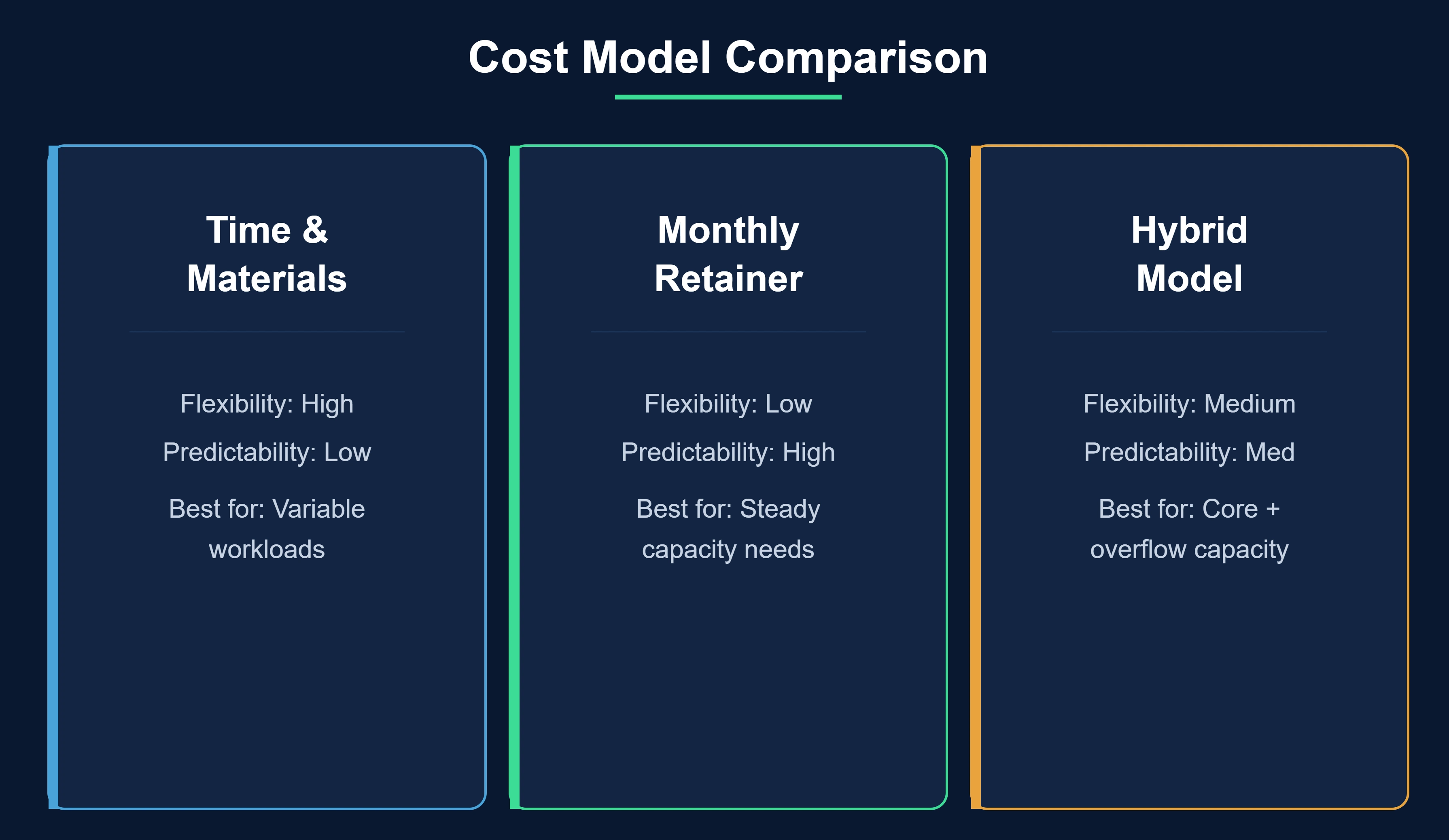
Most partners offer three contract models:
- Time and materials: Pay for hours worked. Maximum flexibility, less cost predictability.
- Monthly retainer: Fixed monthly fee for dedicated capacity (e.g., one full-time equivalent). Predictable budgeting, less flexibility.
- Hybrid: Core retainer plus overflow T&M. Balances predictability and flex capacity.
How to Choose the Right Augmentation Partner
Not all augmentation partners deliver equivalent value. Vetting criteria separate reliable partners from risky ones.
Technical Vetting Process
The partner's screening process determines the quality of talent you receive. Ask:
- What's your technical screening pass rate? Partners with pass rates above 20% likely aren't screening rigorously.
- Who conducts technical interviews? Senior engineers should lead technical assessments, not recruiters.
- Can I review your assessment framework? Reputable partners will share their evaluation rubrics.
- Do you assess for my specific tech stack? Generic assessments don't predict performance on specialized AI frameworks.
Domain Specialization
AI augmentation requires different domain expertise than general software augmentation. Look for partners with:
- Track record placing ML engineers, data scientists, or AI researchers (not just web developers)
- Understanding of AI-specific toolchains (PyTorch, TensorFlow, MLflow, Kubeflow, etc.)
- Experience with AI project lifecycles (experimentation, training, deployment, monitoring)
Geographic and Time Zone Considerations
Time zone overlap matters more for augmentation than for outsourcing, since augmented staff participate in daily collaboration.
Nearshore arrangements balance cost savings with synchronous collaboration. Offshore works better when asynchronous handoffs are acceptable.
Replacement and Performance Guarantees
Even with rigorous screening, some placements don't work out. Strong partners offer:
- Fast replacement: If a placement underperforms, how quickly can they provide an alternative? (Look for commitments under two weeks.)
- Trial periods: The ability to evaluate fit during a paid trial (typically two to four weeks) before long-term commitment.
- Performance monitoring: Regular check-ins where the partner proactively surfaces issues.
Contract Terms That Protect You
Pay attention to:
- Termination clauses: Can you end the arrangement with reasonable notice (30 days or less) if needs change?
- IP ownership: Ensure all work product is explicitly assigned to your organization.
- Non-compete restrictions: Some contracts prohibit hiring augmented staff. If you might want to convert strong performers to permanent roles, negotiate that option upfront.
- Data security and compliance: For regulated industries, confirm the partner meets relevant standards (SOC 2, GDPR, HIPAA, etc.).
Setting Your Augmented Team Up for Success
The partner delivers vetted talent. But integration success depends on how you onboard and manage augmented staff.
Onboarding That Accelerates Productivity
Augmented staff should follow the same onboarding process as permanent hires, adapted for their temporary status.
Week 1: Environment and access
- Development environment setup and tool access
- Codebase walkthrough and architecture overview
- Introduction to team rituals (standups, sprint planning, retros)
Week 2: First tasks and context building
- Small, well-defined starter tasks to build familiarity
- Pair programming sessions with core team members
- Access to documentation, runbooks, and knowledge repositories
Week 3-4: Ramping to full capacity
- Ownership of a feature or component
- Participation in code reviews and design discussions
- Regular 1:1s with assigned manager or mentor
Organizations implementing structured onboarding report faster time-to-productivity compared to ad-hoc approaches.
Management Practices for Augmented Staff
Augmented team members aren't independent contractors. They need the same management attention as permanent employees.
- Assign a dedicated point of contact. Each augmented staff member should have one person they report to directly—usually an engineering manager or tech lead.
- Set clear expectations. Define success metrics, deliverable timelines, and communication norms from day one.
- Include them in team rituals. Augmented staff attend standups, sprint planning, and retrospectives. Excluding them creates information asymmetry and disengagement.
- Provide regular feedback. Bi-weekly 1:1s keep performance issues from festering and reinforce what's working.
Knowledge Transfer and Documentation
Augmented staff eventually rotate off. Minimize knowledge loss:
- Require documentation as part of delivery: Every feature includes architecture decision records, setup guides, and troubleshooting notes.
- Rotate ownership before departure: Two weeks before an augmented engineer rolls off, assign their work to a permanent team member for shadowing.
- Conduct exit interviews: Capture lessons learned and process friction points before the person leaves.
Organizations that implement systematic knowledge capture practices improve knowledge retention when augmented staff rotate, compared to teams with informal documentation approaches.
Common Augmentation Pitfalls and How to Avoid Them
Even experienced teams make predictable mistakes when scaling through augmentation.
Pitfall 1: Treating Augmented Staff as Disposable
When augmented team members are excluded from planning, kept out of strategic discussions, or given only grunt work, engagement drops. Productivity suffers.
The fix: Treat augmented staff like any other team member. They should understand the product vision, contribute to design decisions, and own meaningful work.
Pitfall 2: Skipping Onboarding to Save Time
Throwing augmented staff directly into tickets without context creates false urgency. They produce code that doesn't fit architectural patterns, ask repetitive questions, and require constant correction.
The fix: Invest two weeks in structured onboarding. The productivity gains over the engagement duration far outweigh the upfront time cost.
Pitfall 3: No Clear Ownership or Reporting Structure
When augmented staff report to "the team" without a designated manager, accountability dissolves. Nobody tracks performance, provides feedback, or unblocks issues.
The fix: Assign one manager or tech lead as the direct point of contact. That person owns regular 1:1s, performance feedback, and escalation paths.
Pitfall 4: Poor Documentation Hygiene
If institutional knowledge lives only in Slack threads and hallway conversations, augmented staff can't access it. They reinvent wheels or make decisions based on incomplete information.
The fix: Maintain updated architecture docs, runbooks, and decision logs. Make documentation a required deliverable for every feature.
Pitfall 5: Geographic Mismatches for Collaboration Needs
Offshore augmentation delivers strong cost savings but struggles when real-time collaboration is critical. Asynchronous handoffs add latency to fast-moving projects.
The fix: Match geography to collaboration requirements. For work requiring frequent synchronous discussion, prioritize nearshore or onshore partners. Reserve offshore for more independent work streams.
Measuring Success: Metrics That Matter
Track these metrics to evaluate whether augmentation delivers expected value.
Time to Productivity
How many weeks until augmented staff contribute at full capacity? Baseline expectation: three to four weeks for complex systems, two weeks for well-documented codebases.
Delivery Velocity
Measure sprint velocity or story points completed before and after augmentation. Look for gradual increases as augmented staff ramp, stabilizing at 30% to 50% velocity gain per added team member (accounting for coordination overhead).
Knowledge Retention After Rotation
When augmented staff roll off, can permanent team members maintain and extend their work without significant rework? Low retention indicates poor documentation or insufficient knowledge transfer.
Cost per Delivered Feature
Total augmentation cost (hourly rate plus management overhead) divided by features shipped. Compare against historical cost per feature with permanent-only teams. Effective augmentation can reduce cost per feature through faster delivery timelines.
Manager Satisfaction
Regularly survey managers working with augmented staff. Are they satisfied with quality, communication, and collaboration? Low satisfaction predicts retention risk and productivity drag.
AI Team Augmentation Myths, Busted
Several misconceptions persist about AI team augmentation.
Myth 1: Augmented Staff Are Lower Quality Than Permanent Hires
Quality depends on the partner's vetting process, not the employment model. Top augmentation partners apply screening standards as rigorous as enterprise hiring bars. Conversely, rushed permanent hiring produces weak performers too.
Myth 2: Augmentation Always Costs Less Than Hiring
Augmentation trades permanent headcount costs for hourly rates plus overhead. For engagements shorter than six months, augmentation typically wins. For multi-year needs, permanent hiring often delivers better total cost of ownership.
Myth 3: Augmented Teams Can't Handle Complex AI Work
Augmentation partners now place specialists in niche AI domains—reinforcement learning, fairness auditing, edge optimization. Complexity isn't a barrier if the partner maintains the right talent network.
Myth 4: You Lose Control with Augmentation
Unlike outsourcing, augmentation gives full management control. Augmented staff report to your managers, work in your systems, and follow your processes. Control is identical to permanent staff.
Myth 5: Augmentation Is Only for Short-Term Needs
While augmentation excels at temporary capacity, some organizations maintain long-term augmented roles when flexibility matters more than permanence. Multi-year augmentation arrangements exist, especially for specialized skills with variable demand.
The Role of AI in Augmentation Itself
AI tools are reshaping how augmentation partners source, screen, and match talent.
AI-Enhanced Screening
Traditional resume screening relies on recruiter judgment, introducing inconsistency. AI-assisted tools rank candidates based on skill alignment, flag gaps, and surface non-obvious matches.
AI-assisted screening can improve placement quality and reduce mismatches compared to traditional screening approaches.
Predictive Placement Matching
AI systems analyze historical placement data to predict which candidates will succeed in specific team contexts. Factors include tech stack alignment, communication style fit, and past performance patterns.
This doesn't replace human judgment. But it surfaces candidates recruiters might overlook and flags risks before placement.
Continuous Performance Monitoring
Some augmentation platforms use AI to monitor engagement signals—code commit frequency, communication patterns, velocity trends—and alert managers to early performance degradation.
Real talk: this only works if implemented transparently and ethically. Opaque surveillance damages trust and drives disengagement.
Building Long-Term Augmentation Capability
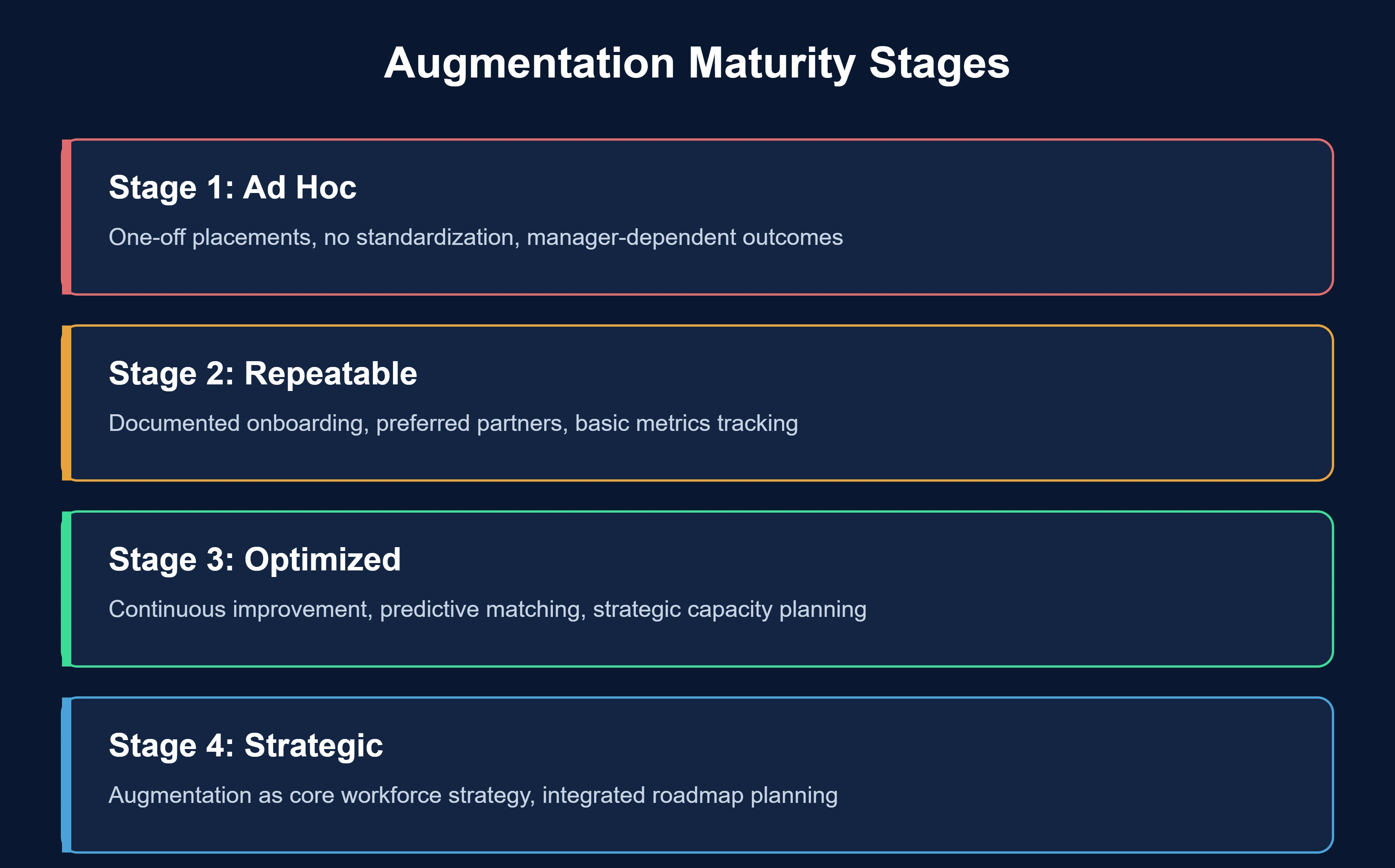
One-off augmentation solves immediate capacity problems. But organizations that build repeatable augmentation processes unlock sustained flexibility.
Standardize Onboarding
Create a documented onboarding checklist, environment setup scripts, and orientation materials. Every augmented placement starts from the same baseline, reducing manager workload and accelerating ramp time.
Cultivate Partner Relationships
Working with the same augmentation partner across multiple engagements builds familiarity. The partner learns your tech stack, team culture, and performance expectations. Subsequent placements ramp faster and fit better.
Develop Internal Augmentation Expertise
Assign one engineering manager or operations lead to own the augmentation program. They maintain partner relationships, track performance metrics, and refine processes. Distributed ownership leads to fragmented practices.
Create Feedback Loops
After each augmentation engagement, conduct a retrospective: What worked? What created friction? How can the next placement improve? Share learnings with the partner to refine their matching process.
Augmentation in Regulated and High-Security Environments
Organizations in finance, healthcare, defense, or other regulated sectors face additional augmentation constraints.
Compliance Considerations
Augmented staff may need to comply with:
- Data residency requirements: Some regulations mandate that certain data never leaves specific geographies. Offshore augmentation may be prohibited for those workloads.
- Background checks and clearances: Government contracts or financial services often require security clearances or extensive background checks.
- Audit trails: Regulated environments need detailed logs of who accessed what data and when. Augmentation partners must support audit-compliant access controls.
IP Protection Strategies
For organizations with sensitive intellectual property:
- Tiered access: Limit augmented staff access to only the systems and data required for their specific role.
- Code review gates: Require permanent team members to review all augmented staff contributions before merging.
- Non-disclosure and IP assignment agreements: Ensure contracts explicitly assign all work product to your organization and prohibit disclosure.
Some augmentation partners specialize in high-security placements and maintain certifications like SOC 2 Type II, ISO 27001, or FedRAMP compliance.
Conclusion
AI team augmentation isn't a replacement for permanent hiring. It's a complementary strategy for scaling capacity flexibly, accessing specialized skills temporarily, and bridging hiring timelines that conflict with delivery deadlines.
Done well, augmentation delivers cost savings of 30% to 50%, accelerates delivery by weeks or months, and provides the flexibility to scale teams up and down with actual demand.
Done poorly, it creates management overhead, knowledge silos, and coordination friction that negate any cost advantage.
The difference lies in partner selection, structured onboarding, clear management ownership, and treating augmented staff as integrated team members rather than disposable contractors.
Organizations that build repeatable augmentation capabilities—standardized processes, cultivated partner relationships, feedback loops—unlock sustained workforce flexibility. They can pursue aggressive roadmaps without permanent headcount commitments, experiment with new AI capabilities before full investment, and weather hiring market volatility.
Start with one small, low-risk augmentation engagement. Measure time to productivity, delivery velocity, and manager satisfaction. Refine the process. Scale what works.
The teams that master flexible workforce models won't just ship faster. They'll outmaneuver competitors constrained by rigid hiring processes and capacity ceilings.
Frequently Asked Questions
Topics
AI Team Augmentation Guide: Scale Smart in 2026

Quick Summary: AI team augmentation lets organizations integrate specialized AI talent into existing teams on a flexible, temporary basis without permanent hiring. This guide covers when augmentation makes sense, how to evaluate partners, common pitfalls, and implementation best practices for scaling AI capabilities in 2026.
Your AI team hit capacity three sprints ago. The roadmap keeps growing. Recruiting for that senior ML engineer role has stretched into month five, and the product launch won't wait.
Sound familiar?
This is where AI team augmentation enters the picture. Instead of pausing projects or compromising on quality, you bring in vetted specialists who integrate directly into your existing workflows.
But augmentation isn't just "rent a developer." Done poorly, it creates coordination overhead, knowledge silos, and budget surprises. Done well, it's how enterprises scale AI capabilities without permanent headcount commitments.
This guide walks through what AI team augmentation actually involves, when it makes strategic sense, how to evaluate partners, and the implementation practices that separate smooth scaling from expensive mistakes.
What Is AI Team Augmentation?
AI team augmentation is a flexible outsourcing model where external AI professionals—machine learning engineers, data scientists, AI researchers, MLOps specialists—work directly within your existing team structure.
Unlike traditional project outsourcing where you hand off entire deliverables to a vendor, augmented staff integrate into your workflows. They use your tools, attend your standups, report to your managers, and collaborate with your core team daily.
The key distinction: you retain full management control. The augmented talent operates as an extension of your in-house team, not as a separate vendor team working in parallel.
How Augmentation Differs from Other Models
Three common workforce models get confused:
Staff augmentation sits between permanent hiring and outsourcing. You get the control and integration of a direct hire without the permanence or the recruiting timeline.
What AI Talent Can You Augment?
AI team augmentation isn't limited to one role. Organizations augment across the full AI development stack:
- Machine Learning Engineers: Model development, training pipelines, feature engineering
- Data Scientists: Exploratory analysis, statistical modeling, experiment design
- AI Researchers: Novel algorithm development, academic literature review, prototyping
- MLOps Engineers: Model deployment, monitoring, CI/CD for ML systems
- Data Engineers: Pipeline architecture, data quality, infrastructure for training datasets
- NLP Specialists: Language models, text processing, conversational AI
- Computer Vision Engineers: Image recognition, object detection, video analysis
The augmentation market has matured enough that niche specializations—reinforcement learning, edge AI optimization, fairness auditing—are now available through established partners.
When AI Team Augmentation Makes Strategic Sense
Augmentation isn't the right answer for every capacity problem. It works best in specific scenarios.
Scenario 1: Specialized Skills for Defined Timelines
Your team needs a reinforcement learning specialist for a six-month initiative. Hiring permanent headcount for temporary needs creates future overhead. Augmentation lets you access the expertise for the project duration, then scale back when it wraps.
Scenario 2: Experimental Initiatives Before Full Commitment
Your organization wants to test a new AI capability—recommendation systems, predictive maintenance, generative content tools. Augmentation lets you staff the experiment without committing to permanent headcount before proving ROI.
Scenario 3: Scaling Capacity Without Scaling Overhead
Your AI roadmap shows three major initiatives launching in Q3, tapering to maintenance mode by Q1 next year. Permanent hires create fixed costs that outlast the workload spike. Augmented staff scale up and down with actual demand.
When Augmentation Doesn't Fit
Augmentation struggles in a few contexts:
- Core, long-term capabilities: If the role is central to your product for years, hire permanently.
- Deep institutional knowledge requirements: Roles requiring months of proprietary context don't suit short-term augmentation.
- Highly sensitive IP environments: Some augmentation partners can navigate strict IP controls, but many can't.
Expand AI Capacity with NeoWork
AI team augmentation helps companies add specialized talent for AI-related work without building every capability internally. NeoWork provides remote professionals who support AI training, data labeling, and technical workflows as part of existing teams. The company handles recruitment, benefits, training, and ongoing teammate engagement while clients manage daily priorities. Its 91% annualized teammate retention rate and 3.2% candidate selectivity rate reflect a focus on selective hiring and longer-term team stability.
NeoWork's AI team model offers:
- AI training and data labeling support
- integration with existing teams and workflows
- recruitment and ongoing teammate support
Contact NeoWork to build an AI team that grows with your business.
AI Team Augmentation Cost Models
Pricing structures vary by partner, geography, and seniority level. Understanding cost benchmarks prevents budget surprises.
Hourly Rate Structures
Most augmentation partners bill hourly. Rates cluster into three geographic tiers:
Typical cost advantages versus onshore range from 30% to 50% for nearshore, and 50% to 70% for offshore arrangements, based on corroborated market data.
Hidden Costs to Budget For
The hourly rate isn't the total cost. Factor in:
- Management overhead: Expect to spend 10% to 20% of a senior engineer's time managing each augmented developer.
- Onboarding time: Augmented staff need two to four weeks to reach productivity, during which you're paying for ramp-up.
- Tooling and access: Licenses, VPN access, hardware (if applicable) add incremental costs.
- Communication tools: Time zone overlap may require premium meeting times or shift differentials.
Contract Structures
Most partners offer three contract models:
- Time and materials: Pay for hours worked. Maximum flexibility, less cost predictability.
- Monthly retainer: Fixed monthly fee for dedicated capacity (e.g., one full-time equivalent). Predictable budgeting, less flexibility.
- Hybrid: Core retainer plus overflow T&M. Balances predictability and flex capacity.
How to Choose the Right Augmentation Partner
Not all augmentation partners deliver equivalent value. Vetting criteria separate reliable partners from risky ones.
Technical Vetting Process
The partner's screening process determines the quality of talent you receive. Ask:
- What's your technical screening pass rate? Partners with pass rates above 20% likely aren't screening rigorously.
- Who conducts technical interviews? Senior engineers should lead technical assessments, not recruiters.
- Can I review your assessment framework? Reputable partners will share their evaluation rubrics.
- Do you assess for my specific tech stack? Generic assessments don't predict performance on specialized AI frameworks.
Domain Specialization
AI augmentation requires different domain expertise than general software augmentation. Look for partners with:
- Track record placing ML engineers, data scientists, or AI researchers (not just web developers)
- Understanding of AI-specific toolchains (PyTorch, TensorFlow, MLflow, Kubeflow, etc.)
- Experience with AI project lifecycles (experimentation, training, deployment, monitoring)
Geographic and Time Zone Considerations
Time zone overlap matters more for augmentation than for outsourcing, since augmented staff participate in daily collaboration.
Nearshore arrangements balance cost savings with synchronous collaboration. Offshore works better when asynchronous handoffs are acceptable.
Replacement and Performance Guarantees
Even with rigorous screening, some placements don't work out. Strong partners offer:
- Fast replacement: If a placement underperforms, how quickly can they provide an alternative? (Look for commitments under two weeks.)
- Trial periods: The ability to evaluate fit during a paid trial (typically two to four weeks) before long-term commitment.
- Performance monitoring: Regular check-ins where the partner proactively surfaces issues.
Contract Terms That Protect You
Pay attention to:
- Termination clauses: Can you end the arrangement with reasonable notice (30 days or less) if needs change?
- IP ownership: Ensure all work product is explicitly assigned to your organization.
- Non-compete restrictions: Some contracts prohibit hiring augmented staff. If you might want to convert strong performers to permanent roles, negotiate that option upfront.
- Data security and compliance: For regulated industries, confirm the partner meets relevant standards (SOC 2, GDPR, HIPAA, etc.).
Setting Your Augmented Team Up for Success
The partner delivers vetted talent. But integration success depends on how you onboard and manage augmented staff.
Onboarding That Accelerates Productivity
Augmented staff should follow the same onboarding process as permanent hires, adapted for their temporary status.
Week 1: Environment and access
- Development environment setup and tool access
- Codebase walkthrough and architecture overview
- Introduction to team rituals (standups, sprint planning, retros)
Week 2: First tasks and context building
- Small, well-defined starter tasks to build familiarity
- Pair programming sessions with core team members
- Access to documentation, runbooks, and knowledge repositories
Week 3-4: Ramping to full capacity
- Ownership of a feature or component
- Participation in code reviews and design discussions
- Regular 1:1s with assigned manager or mentor
Organizations implementing structured onboarding report faster time-to-productivity compared to ad-hoc approaches.
Management Practices for Augmented Staff
Augmented team members aren't independent contractors. They need the same management attention as permanent employees.
- Assign a dedicated point of contact. Each augmented staff member should have one person they report to directly—usually an engineering manager or tech lead.
- Set clear expectations. Define success metrics, deliverable timelines, and communication norms from day one.
- Include them in team rituals. Augmented staff attend standups, sprint planning, and retrospectives. Excluding them creates information asymmetry and disengagement.
- Provide regular feedback. Bi-weekly 1:1s keep performance issues from festering and reinforce what's working.
Knowledge Transfer and Documentation
Augmented staff eventually rotate off. Minimize knowledge loss:
- Require documentation as part of delivery: Every feature includes architecture decision records, setup guides, and troubleshooting notes.
- Rotate ownership before departure: Two weeks before an augmented engineer rolls off, assign their work to a permanent team member for shadowing.
- Conduct exit interviews: Capture lessons learned and process friction points before the person leaves.
Organizations that implement systematic knowledge capture practices improve knowledge retention when augmented staff rotate, compared to teams with informal documentation approaches.
Common Augmentation Pitfalls and How to Avoid Them
Even experienced teams make predictable mistakes when scaling through augmentation.
Pitfall 1: Treating Augmented Staff as Disposable
When augmented team members are excluded from planning, kept out of strategic discussions, or given only grunt work, engagement drops. Productivity suffers.
The fix: Treat augmented staff like any other team member. They should understand the product vision, contribute to design decisions, and own meaningful work.
Pitfall 2: Skipping Onboarding to Save Time
Throwing augmented staff directly into tickets without context creates false urgency. They produce code that doesn't fit architectural patterns, ask repetitive questions, and require constant correction.
The fix: Invest two weeks in structured onboarding. The productivity gains over the engagement duration far outweigh the upfront time cost.
Pitfall 3: No Clear Ownership or Reporting Structure
When augmented staff report to "the team" without a designated manager, accountability dissolves. Nobody tracks performance, provides feedback, or unblocks issues.
The fix: Assign one manager or tech lead as the direct point of contact. That person owns regular 1:1s, performance feedback, and escalation paths.
Pitfall 4: Poor Documentation Hygiene
If institutional knowledge lives only in Slack threads and hallway conversations, augmented staff can't access it. They reinvent wheels or make decisions based on incomplete information.
The fix: Maintain updated architecture docs, runbooks, and decision logs. Make documentation a required deliverable for every feature.
Pitfall 5: Geographic Mismatches for Collaboration Needs
Offshore augmentation delivers strong cost savings but struggles when real-time collaboration is critical. Asynchronous handoffs add latency to fast-moving projects.
The fix: Match geography to collaboration requirements. For work requiring frequent synchronous discussion, prioritize nearshore or onshore partners. Reserve offshore for more independent work streams.
Measuring Success: Metrics That Matter
Track these metrics to evaluate whether augmentation delivers expected value.
Time to Productivity
How many weeks until augmented staff contribute at full capacity? Baseline expectation: three to four weeks for complex systems, two weeks for well-documented codebases.
Delivery Velocity
Measure sprint velocity or story points completed before and after augmentation. Look for gradual increases as augmented staff ramp, stabilizing at 30% to 50% velocity gain per added team member (accounting for coordination overhead).
Knowledge Retention After Rotation
When augmented staff roll off, can permanent team members maintain and extend their work without significant rework? Low retention indicates poor documentation or insufficient knowledge transfer.
Cost per Delivered Feature
Total augmentation cost (hourly rate plus management overhead) divided by features shipped. Compare against historical cost per feature with permanent-only teams. Effective augmentation can reduce cost per feature through faster delivery timelines.
Manager Satisfaction
Regularly survey managers working with augmented staff. Are they satisfied with quality, communication, and collaboration? Low satisfaction predicts retention risk and productivity drag.
AI Team Augmentation Myths, Busted
Several misconceptions persist about AI team augmentation.
Myth 1: Augmented Staff Are Lower Quality Than Permanent Hires
Quality depends on the partner's vetting process, not the employment model. Top augmentation partners apply screening standards as rigorous as enterprise hiring bars. Conversely, rushed permanent hiring produces weak performers too.
Myth 2: Augmentation Always Costs Less Than Hiring
Augmentation trades permanent headcount costs for hourly rates plus overhead. For engagements shorter than six months, augmentation typically wins. For multi-year needs, permanent hiring often delivers better total cost of ownership.
Myth 3: Augmented Teams Can't Handle Complex AI Work
Augmentation partners now place specialists in niche AI domains—reinforcement learning, fairness auditing, edge optimization. Complexity isn't a barrier if the partner maintains the right talent network.
Myth 4: You Lose Control with Augmentation
Unlike outsourcing, augmentation gives full management control. Augmented staff report to your managers, work in your systems, and follow your processes. Control is identical to permanent staff.
Myth 5: Augmentation Is Only for Short-Term Needs
While augmentation excels at temporary capacity, some organizations maintain long-term augmented roles when flexibility matters more than permanence. Multi-year augmentation arrangements exist, especially for specialized skills with variable demand.
The Role of AI in Augmentation Itself
AI tools are reshaping how augmentation partners source, screen, and match talent.
AI-Enhanced Screening
Traditional resume screening relies on recruiter judgment, introducing inconsistency. AI-assisted tools rank candidates based on skill alignment, flag gaps, and surface non-obvious matches.
AI-assisted screening can improve placement quality and reduce mismatches compared to traditional screening approaches.
Predictive Placement Matching
AI systems analyze historical placement data to predict which candidates will succeed in specific team contexts. Factors include tech stack alignment, communication style fit, and past performance patterns.
This doesn't replace human judgment. But it surfaces candidates recruiters might overlook and flags risks before placement.
Continuous Performance Monitoring
Some augmentation platforms use AI to monitor engagement signals—code commit frequency, communication patterns, velocity trends—and alert managers to early performance degradation.
Real talk: this only works if implemented transparently and ethically. Opaque surveillance damages trust and drives disengagement.
Building Long-Term Augmentation Capability
One-off augmentation solves immediate capacity problems. But organizations that build repeatable augmentation processes unlock sustained flexibility.
Standardize Onboarding
Create a documented onboarding checklist, environment setup scripts, and orientation materials. Every augmented placement starts from the same baseline, reducing manager workload and accelerating ramp time.
Cultivate Partner Relationships
Working with the same augmentation partner across multiple engagements builds familiarity. The partner learns your tech stack, team culture, and performance expectations. Subsequent placements ramp faster and fit better.
Develop Internal Augmentation Expertise
Assign one engineering manager or operations lead to own the augmentation program. They maintain partner relationships, track performance metrics, and refine processes. Distributed ownership leads to fragmented practices.
Create Feedback Loops
After each augmentation engagement, conduct a retrospective: What worked? What created friction? How can the next placement improve? Share learnings with the partner to refine their matching process.
Augmentation in Regulated and High-Security Environments
Organizations in finance, healthcare, defense, or other regulated sectors face additional augmentation constraints.
Compliance Considerations
Augmented staff may need to comply with:
- Data residency requirements: Some regulations mandate that certain data never leaves specific geographies. Offshore augmentation may be prohibited for those workloads.
- Background checks and clearances: Government contracts or financial services often require security clearances or extensive background checks.
- Audit trails: Regulated environments need detailed logs of who accessed what data and when. Augmentation partners must support audit-compliant access controls.
IP Protection Strategies
For organizations with sensitive intellectual property:
- Tiered access: Limit augmented staff access to only the systems and data required for their specific role.
- Code review gates: Require permanent team members to review all augmented staff contributions before merging.
- Non-disclosure and IP assignment agreements: Ensure contracts explicitly assign all work product to your organization and prohibit disclosure.
Some augmentation partners specialize in high-security placements and maintain certifications like SOC 2 Type II, ISO 27001, or FedRAMP compliance.
Conclusion
AI team augmentation isn't a replacement for permanent hiring. It's a complementary strategy for scaling capacity flexibly, accessing specialized skills temporarily, and bridging hiring timelines that conflict with delivery deadlines.
Done well, augmentation delivers cost savings of 30% to 50%, accelerates delivery by weeks or months, and provides the flexibility to scale teams up and down with actual demand.
Done poorly, it creates management overhead, knowledge silos, and coordination friction that negate any cost advantage.
The difference lies in partner selection, structured onboarding, clear management ownership, and treating augmented staff as integrated team members rather than disposable contractors.
Organizations that build repeatable augmentation capabilities—standardized processes, cultivated partner relationships, feedback loops—unlock sustained workforce flexibility. They can pursue aggressive roadmaps without permanent headcount commitments, experiment with new AI capabilities before full investment, and weather hiring market volatility.
Start with one small, low-risk augmentation engagement. Measure time to productivity, delivery velocity, and manager satisfaction. Refine the process. Scale what works.
The teams that master flexible workforce models won't just ship faster. They'll outmaneuver competitors constrained by rigid hiring processes and capacity ceilings.
Frequently Asked Questions
Topics
Related Blogs
Related Podcasts


.webp)

.webp)
.webp)



