

.avif)
.avif)

Customer Service Outsourcing Guide 2026


.svg)

Quick Summary: Customer service outsourcing involves partnering with specialized third-party providers to handle customer support operations, offering businesses access to 24/7 coverage, multilingual support, and cost savings of 30-70% compared to in-house teams. With the global outsourcing market reaching $525 billion and 90% of small businesses planning to outsource, choosing the right partner and model—whether offshore, nearshore, onshore, or hybrid—requires careful evaluation of expertise, technology integration, and cultural alignment.
The customer service landscape has shifted dramatically. Customer expectations are higher than ever, operating hours stretch across time zones, and staffing costs continue climbing.
That's pushed customer service outsourcing from a niche strategy to a $525 billion global industry. According to 2023 research, the BPO and customer service outsourcing market is anticipated to expand at a CAGR of 9.4% from 2023 to 2030.
But here's the thing—outsourcing customer support isn't just about cost reduction anymore. It's about accessing specialized expertise, scaling efficiently, and delivering the kind of always-on, multilingual support that modern customers demand.
This guide breaks down everything: what customer service outsourcing actually involves, when it makes sense for your business, how to choose the right partner, what you'll pay, and how to set up for success from day one.
What Is Customer Service Outsourcing?
Customer service outsourcing means contracting a third-party company to handle some or all of your customer support operations. Instead of hiring, training, and managing an internal team, businesses partner with specialized providers who bring the infrastructure, talent, and technology needed to deliver customer support.
These outsourcing partners—often called Business Process Outsourcing (BPO) providers or contact centers—handle customer inquiries through various channels: phone, email, live chat, social media, and increasingly, messaging apps.
The scope can range from handling overflow during peak seasons to completely owning the customer service function. Some companies outsource tier-one support while keeping complex escalations in-house. Others hand off everything.
Types of Customer Service Outsourcing Models
Not all outsourcing arrangements look the same. The right model depends on your budget, customer base, and service complexity.
- Offshore outsourcing places customer service teams in distant countries—typically India, the Philippines, or other regions with significantly lower labor costs. Outsourcing to India or the Philippines costs $8-$11 per hour, making this the most cost-effective option.
- Nearshore outsourcing uses providers in nearby countries with similar time zones. For US companies, that often means Latin America. For European businesses, Eastern Europe. Outsourcing to Eastern Europe or Latin America costs between $10-$15 per hour, offering a middle ground between cost and proximity.
- Onshore outsourcing keeps operations within your home country. Outsourcing to North America or Western Europe typically runs $20-$35 per hour. The premium buys cultural alignment, native language speakers, and easier oversight.
- Hybrid models mix these approaches—perhaps onshore for complex B2B support and offshore for high-volume transactional inquiries.
Why Businesses Outsource Customer Service
The decision to outsource customer support stems from multiple business drivers. Cost reduction remains a major factor—70% of companies who outsource do so to reduce costs—but it's rarely the only reason.
Cost Savings That Go Beyond Labor
The math on outsourcing can be compelling. Building an in-house customer service team requires significant upfront investment: recruiting costs, salaries, benefits, training programs, office space, equipment, technology platforms, and management overhead.
Outsourcing converts these fixed costs into variable expenses. Partners already have the infrastructure, technology, and trained agents. Businesses pay for the service hours they need without the capital expenditure or long-term commitments of hiring.
For small businesses especially, this matters. Basic answering services typically cost $1 to $2 per minute plus a monthly fee, while comprehensive support programs can run $8-$35 per hour depending on location and complexity—still substantially less than the fully loaded cost of an employee.
Access to Specialized Expertise
Customer service outsourcing providers focus on support 100% of the time. They've built expertise in specific industries, mastered support technologies, developed quality assurance frameworks, and refined training methodologies.
That specialization translates into better performance. Outsourcing teams who focus on customer service and customer experience 100% of the time tend to deliver more consistent results than generalist in-house teams juggling multiple priorities.
Some providers bring deep vertical expertise—healthcare compliance, SaaS technical support, e-commerce logistics, financial services regulations. That domain knowledge would take years to build internally.
24/7 Coverage and Scalability
Modern customers expect support outside traditional business hours. Delivering true 24/7 coverage with an in-house team means running three shifts, managing overnight staffing, and handling weekend schedules—operationally complex and expensive.
Outsourcing partners operate continuously, often across multiple time zones. They handle overnight and weekend coverage as standard service.
Scalability works both ways. During peak seasons—Black Friday, tax season, product launches—support volumes spike. Outsourcing partners can rapidly scale capacity up or down without the lag time and risk of hiring temporary staff.
Multilingual Support
Serving global customers often requires multilingual capabilities. Building in-house teams fluent in Spanish, French, German, Mandarin, and other languages is challenging in most markets.
Many outsourcing providers maintain multilingual teams as core competency, giving businesses instant access to native speakers across dozens of languages.
When Customer Service Outsourcing Makes Sense
Outsourcing isn't universally appropriate. Some situations create strong fit; others suggest keeping support in-house.
- High-volume, transactional support outsources well. Password resets, order status inquiries, basic troubleshooting, account updates—these repeatable interactions follow clear scripts and don't require deep product expertise.
- Seasonal fluctuations favor outsourcing. Retailers facing holiday rushes, tax software companies during filing season, or any business with predictable volume spikes can flex capacity without permanent headcount increases.
- Rapid growth phases strain in-house teams. When customer volume is growing 20-30% quarterly, outsourcing provides breathing room while the business figures out long-term support strategy.
- Cost pressure drives evaluation, especially for startups and SMBs. If support headcount is consuming disproportionate budget, outsourcing economics become attractive.
- After-hours coverage needs without after-hours budget make outsourcing practical. Small teams can maintain business-hours expertise in-house while outsourcing overnight and weekend coverage.
When to Think Twice
Highly complex, consultative support often stays in-house. Enterprise B2B customers expect deep product expertise and relationship continuity that's harder to deliver through outsourced teams.
Early-stage products still finding product-market fit benefit from in-house support. The customer insights, rapid iteration, and product feedback loops matter more than efficiency at that stage.
Situations requiring tight integration with other departments—engineering, product, sales—work better with internal teams who can walk down the hall for collaboration.

Scale Customer Support with NeoWork
Customer service outsourcing helps businesses handle growing support volumes without expanding their internal team. NeoWork provides customer support professionals who work as an extension of existing operations. The company manages recruitment, benefits, training, and ongoing teammate engagement, while clients retain day-to-day oversight. Its 91% annualized teammate retention rate and 3.2% candidate selectivity rate reflect a focus on selective hiring and longer-term team stability.
NeoWork's customer service model offers:
- dedicated customer support professionals
- integration with existing tools and workflows
- recruitment and ongoing teammate support
Contact NeoWork to build a customer support team that fits your operations.
Choosing the Right Customer Service Outsourcing Partner
Partner selection determines outsourcing success more than any other factor. The wrong choice creates customer satisfaction problems that outweigh any cost savings.
Industry Experience and Specialization
Look for providers with demonstrated experience in your industry. SaaS support differs fundamentally from healthcare, e-commerce, or financial services.
Ask for case studies, client references, and specific examples of similar engagements. A provider handling 4,000+ intricate issues in your vertical brings more value than generic call center experience.
Technology Stack and Integration Capabilities
The outsourcing partner needs to integrate seamlessly with your existing systems: CRM platforms, helpdesk software, knowledge bases, e-commerce systems, and communication tools.
Evaluate their technology stack. Do they use modern omnichannel platforms? Can they handle chat, email, phone, social media, and messaging apps? Do they have AI-powered tools for automation and agent assistance?
Integration complexity varies. Some providers plug directly into Zendesk, Salesforce, or Shopify with minimal configuration. Others require custom API work or operate on separate systems that create data silos.
Quality Assurance and Metrics
Ask detailed questions about quality programs. How do they monitor agent performance? What's their QA sampling rate? How do they handle coaching and improvement?
Request their standard reporting package. Look for comprehensive metrics: first-contact resolution, customer satisfaction scores (CSAT), average handle time, ticket backlog, SLA compliance, and Net Promoter Score.
The best providers offer real-time dashboards and regular business reviews, not just monthly spreadsheet dumps.
Cultural Alignment and Communication
Cultural fit matters enormously. Agents represent your brand to customers—misalignment in tone, values, or communication style damages customer relationships.
During the selection process, evaluate responsiveness and communication quality. Providers who are slow, unclear, or difficult during the sales process won't improve after signing.
Pricing Structure and Contract Terms
Pricing models vary. Common structures include per-minute billing, per-ticket pricing, dedicated agent fees, or hourly rates.
Understand what's included in base pricing versus add-ons. Some providers charge extra for reporting, quality assurance, training, or technology integrations.
Watch for hidden fees and long lock-in periods. The best partnerships include reasonable ramp-down provisions if the fit doesn't work.
The True Cost of Customer Service Outsourcing
Outsourcing costs extend beyond the hourly rate. Understanding the full economic picture prevents surprises and enables accurate ROI calculations.
Direct Service Costs
The core expense is the per-hour, per-minute, or per-ticket fee charged by the provider. As mentioned earlier, this ranges from $8-$11 per hour for offshore providers to $20-$35 for onshore teams.
Volume commitments often affect pricing. Providers offer better rates for guaranteed minimum hours or long-term contracts.
Setup and Onboarding Costs
Most partnerships involve initial setup fees covering technology integration, knowledge base development, training program creation, and process documentation.
These one-time costs typically range from a few thousand dollars for simple implementations to $20,000+ for complex enterprise deployments.
Technology and Integration Expenses
Some providers include technology platforms in their base pricing. Others charge separately for helpdesk licenses, telephony systems, quality monitoring tools, or reporting dashboards.
Custom integrations with proprietary systems can add development costs if APIs don't exist or require specialized configuration.
Ongoing Management Overhead
Outsourcing doesn't eliminate internal involvement. Someone on your team needs to manage the relationship, review performance, update processes, handle escalations, and ensure alignment.
For smaller engagements, this might be 5-10 hours weekly. Larger partnerships can require dedicated program managers.
Hidden Costs to Watch
Quality problems create indirect costs. Poor outsourced support drives customer churn, damages brand reputation, and generates internal escalations that consume product and engineering time.
Transition costs include knowledge transfer, process documentation, dual-running periods, and the productivity dip during migration.
Scope creep happens when initially excluded services—special projects, reporting requests, additional training—get added without clear pricing.
Setting Up Your Outsourcing Program for Success
Implementation determines whether outsourcing delivers the promised benefits or becomes a source of frustration. Successful programs share common setup characteristics.
Comprehensive Documentation
Outsourcing partners can't read minds. They need exhaustive documentation covering brand voice, product knowledge, common scenarios, escalation procedures, edge cases, and troubleshooting guides.
Create detailed playbooks for every support situation. Document not just what to do, but why—the reasoning behind policies helps agents handle variations intelligently.
Many companies underestimate documentation requirements. Plan for 40-60 hours of intensive knowledge transfer during initial setup.
Thorough Training Programs
Generic call center training isn't sufficient. The outsourcing team needs product-specific training, industry context, customer segment understanding, and brand immersion.
Effective programs combine self-paced learning, live training sessions, shadowing experienced agents, and practical exercises. Some companies bring outsourced agents onsite for initial training or conduct product immersion experiences.
Training doesn't end after launch. Continuous education on product updates, new features, policy changes, and performance feedback maintains quality over time.
Clear SLAs and Performance Metrics
Establish specific, measurable service level agreements covering response times, resolution times, customer satisfaction targets, quality scores, and escalation handling.
Define exactly how each metric is measured, what constitutes success, and how often reporting occurs. Ambiguous SLAs create friction when expectations aren't met.
Balance efficiency metrics with quality measures. Focusing solely on average handle time or ticket closure speed encourages agents to rush customers rather than solving problems thoroughly.
Escalation Paths and Edge Case Handling
Not every situation fits the playbook. Create clear escalation procedures for complex technical issues, angry customers, legal matters, security concerns, and scenarios outside normal scope.
Define who handles escalations, expected response times, and how escalated cases flow back to the outsourcing team for closure.
Regular Communication Rhythms
Establish structured communication cadences: daily status updates during launch, weekly operational reviews, monthly business reviews, and quarterly strategic planning sessions.
Create channels for real-time communication when urgent issues arise. Slack channels, shared email groups, or dedicated hotlines keep teams connected.
Gradual Ramp-Up Strategy
Don't flip a switch and transfer all support overnight. Successful implementations phase in gradually, starting with lower-complexity channels or specific ticket types.
A typical ramp might start with email support for product questions, expand to chat once quality stabilizes, add phone support next, and finally include after-hours coverage.
This staged approach lets teams build confidence, refine processes, and catch problems when impact is limited.
Monitoring and Improving Outsourced Customer Service
Launch is the beginning, not the end. Sustained success requires active management, continuous monitoring, and relentless improvement.
Key Performance Indicators to Track
Monitor both operational metrics and customer experience indicators:
- First Contact Resolution (FCR) measures how often issues are solved in the initial interaction without requiring follow-up
- Customer Satisfaction (CSAT) captures how customers rate their support experience
- Average Handle Time (AHT) tracks efficiency without sacrificing thoroughness
- Response Time measures how quickly customers receive initial replies
- Resolution Time tracks end-to-end case closure speed
- Quality Scores evaluate agent adherence to standards, accuracy, and soft skills
- Escalation Rate shows how often cases require elevation beyond the outsourced team
- Customer Retention reveals whether support quality affects long-term loyalty
The best programs establish baseline metrics before outsourcing, enabling clear before-and-after comparisons.
Quality Assurance Programs
Don't rely solely on the provider's QA process. Implement your own quality monitoring, reviewing random ticket samples, listening to call recordings, and evaluating chat transcripts.
Focus quality reviews on customer outcome, not just process compliance. An agent who bent the rules to delight a customer should be celebrated, not penalized.
Voice of Customer Feedback
Systematically collect customer feedback through post-interaction surveys, follow-up emails, or periodic customer interviews.
Monitor social media, review sites, and public forums for unsolicited feedback about support experiences.
Share this feedback—both positive and negative—with the outsourcing partner. Customer voices drive improvement more effectively than abstract metrics.
Continuous Process Refinement
Regular business reviews should identify improvement opportunities: knowledge base gaps, confusing procedures, recurring issues that need product fixes, or training deficiencies.
Update documentation continuously as products evolve, new edge cases emerge, or better solutions are discovered.
The best partnerships feel collaborative, with both sides actively contributing ideas for enhancement rather than just executing a static playbook.
Common Challenges and How to Overcome Them
Every outsourcing relationship faces obstacles. Anticipating common problems and having mitigation strategies prevents small issues from becoming program-threatening crises.
Knowledge Gaps and Training Deficiencies
Outsourced agents initially lack the product depth of long-tenured employees. This shows up as incorrect information, inefficient troubleshooting, or excessive escalations.
Combat this through comprehensive onboarding, continuous education, easy-to-search knowledge bases, and regular product update sessions. Some companies assign internal subject matter experts as ongoing resources for complex questions.
Cultural and Communication Differences
Offshore teams may struggle with idioms, cultural references, accent comprehension, or communication style expectations.
Address this through cultural training, brand voice guidelines, and careful location selection. For customer bases where cultural alignment matters enormously, nearshore or onshore options justify their premium pricing.
Quality Inconsistency
Support quality that starts strong can degrade over time as agents develop shortcuts, documentation becomes outdated, or coaching diminishes.
Prevent backsliding through sustained QA programs, regular refresher training, visible performance dashboards, and accountability for maintaining standards.
Technology Integration Problems
System incompatibilities, data sync failures, or clunky workflows create agent frustration and customer-facing errors.
Invest adequately in integration work upfront. Test thoroughly before launch. Maintain technical resources for troubleshooting and optimization.
Scope Creep and Misaligned Expectations
What seemed clearly defined during contracting becomes fuzzy in practice. Disagreements emerge about what's included versus out-of-scope.
Prevent this through detailed statements of work, written approval processes for scope changes, and regular alignment conversations about expectations.
The ROI of Customer Service Outsourcing
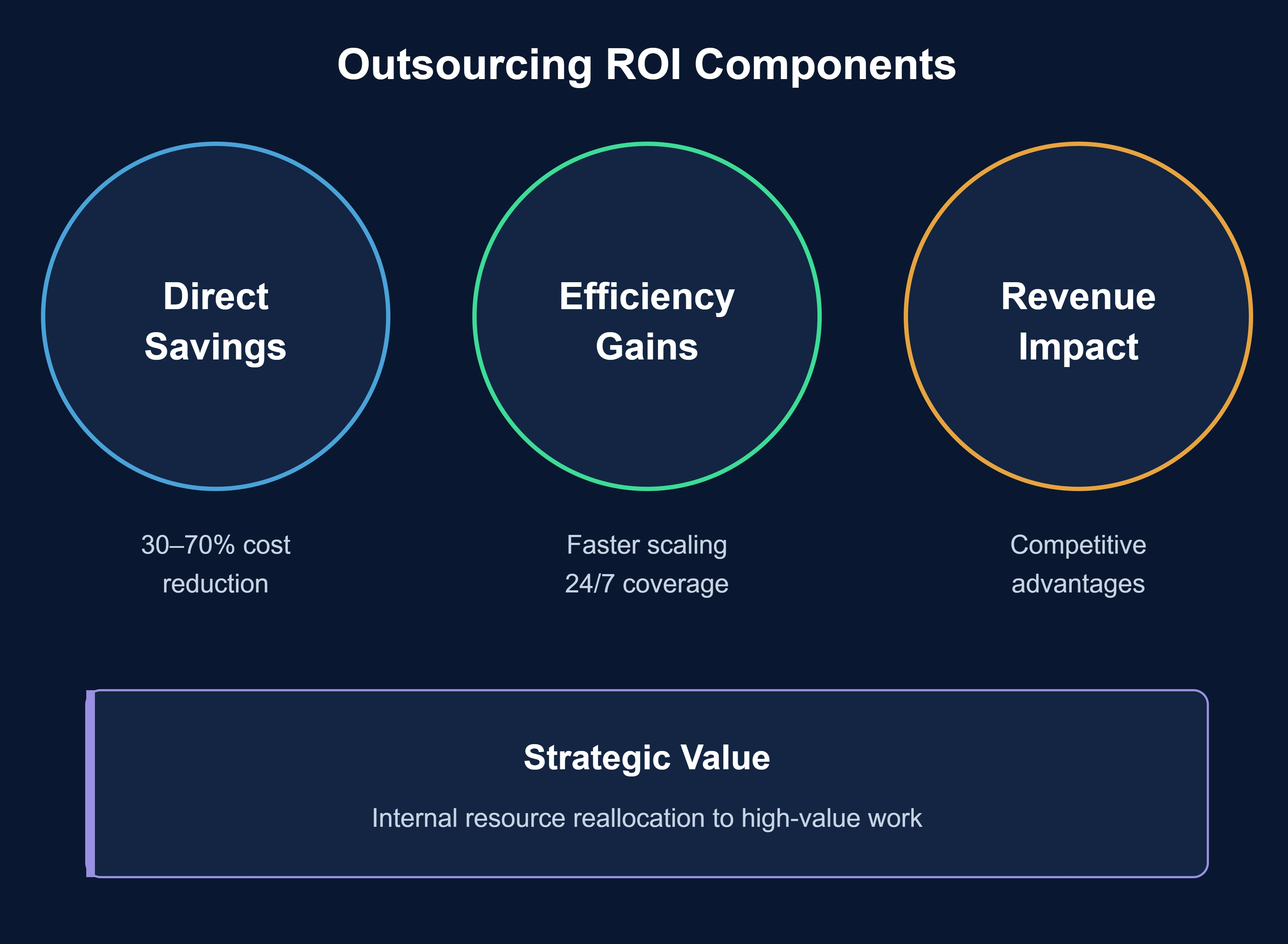
Quantifying outsourcing returns requires looking beyond simple cost comparison. The full picture includes direct savings, efficiency gains, revenue impact, and strategic benefits.
Direct Cost Savings
Compare the fully loaded cost of in-house support—salaries, benefits, taxes, space, equipment, technology, management—against outsourcing fees plus retained oversight costs.
Typical savings range from 30-70% depending on location choice, service complexity, and existing cost structure. Research indicates that prioritizing customer service and experience can correlate with competitive revenue advantages, suggesting that quality support drives topline growth alongside cost reduction.
Scalability Value
The ability to flex capacity up or down has economic value that's harder to quantify but very real. Avoiding hiring costs for seasonal staff, reducing time-to-scale during growth spurts, and eliminating severance expenses during downturns all contribute to ROI.
Strategic Resource Reallocation
Outsourcing basic support frees internal teams to focus on high-value activities: complex enterprise customers, product development, strategic initiatives, or revenue-generating work.
This opportunity cost matters. If internal support staff can redeploy to activities with clearer revenue contribution, the value exceeds just cost differential.
Customer Lifetime Value Impact
Quality support drives retention and expansion.
Calculate how improved response times, 24/7 availability, or multilingual coverage affect customer retention rates. Small retention improvements generate substantial lifetime value gains.
The Future of Customer Service Outsourcing
The outsourcing landscape continues evolving, shaped by technology advances, changing customer expectations, and economic pressures.
AI and Automation Integration
Artificial intelligence is transforming outsourced support. Chatbots handle routine inquiries, AI-powered knowledge bases surface answers instantly, sentiment analysis flags unhappy customers, and automation handles repetitive tasks.
According to research from UC Berkeley, legal teams using AI accelerate contract reviews by 60%, suggesting automation can dramatically improve both speed and capacity. Similarly, organizations report handling 20% increases in complex customer service inquiries without additional staff when AI tools support human agents.
The future isn't AI replacing outsourced agents—it's AI augmenting them, handling tier-zero automation while enabling human agents to focus on complex, high-empathy interactions.
Hybrid and Flexible Models
The rigid offshore-versus-onshore choice is giving way to flexible hybrid approaches. Companies mix locations based on use case: onshore for complex B2B, nearshore for tier-one support, offshore for high-volume transactional work.
Some providers offer follow-the-sun models where support seamlessly transitions between global locations, delivering 24/7 coverage with native speakers in every time zone.
Increased Specialization
Generic call centers are losing ground to specialized providers with deep vertical expertise. Healthcare outsourcing providers understand HIPAA compliance. SaaS-focused partners know software troubleshooting. E-commerce specialists master logistics and returns.
This specialization trend should accelerate as customer expectations for knowledgeable support increase.
Outcome-Based Pricing Models
Traditional time-based billing is shifting toward outcome-focused pricing: per-resolution fees, customer satisfaction bonuses, retention-linked compensation, or revenue-share arrangements.
These models align provider incentives with business results rather than just operational efficiency.
Conclusion: Making Customer Service Outsourcing Work for Your Business
Customer service outsourcing has evolved from a pure cost-cutting tactic into a strategic capability that enables businesses to deliver better support, scale efficiently, and compete effectively in global markets.
The $525 billion industry continues growing because outsourcing, when done well, delivers real value: cost savings of 30-70%, access to specialized expertise, 24/7 multilingual coverage, and operational flexibility that in-house teams struggle to match.
But success isn't automatic. It requires choosing partners carefully based on industry experience, technology capabilities, cultural fit, and quality commitment rather than just price. It demands comprehensive setup through detailed documentation, thorough training, clear SLAs, and gradual implementation. And it needs active ongoing management with continuous monitoring, quality assurance, and relentless improvement.
The businesses that succeed with outsourcing view it as a partnership, not a vendor transaction. They invest in enablement, communicate openly, share customer feedback, and work collaboratively to solve problems.
Is customer service outsourcing right for your business? The answer depends on your specific situation—support volume, complexity, budget constraints, growth trajectory, and strategic priorities. But for companies facing any combination of cost pressure, scaling challenges, coverage gaps, or capacity constraints, outsourcing deserves serious evaluation.
Start by assessing your current support costs, identifying specific pain points, and defining clear objectives beyond just cost reduction. Then approach the market with realistic expectations, evaluate partners thoroughly, and implement deliberately with the understanding that outsourcing is a journey requiring ongoing attention, not a set-it-and-forget-it solution.
The companies thriving with customer service outsourcing in 2026 aren't necessarily the ones who outsource the most—they're the ones who outsource the right functions to the right partners with the right setup and management approach.
Frequently Asked Questions
Topics
Customer Service Outsourcing Guide 2026

Quick Summary: Customer service outsourcing involves partnering with specialized third-party providers to handle customer support operations, offering businesses access to 24/7 coverage, multilingual support, and cost savings of 30-70% compared to in-house teams. With the global outsourcing market reaching $525 billion and 90% of small businesses planning to outsource, choosing the right partner and model—whether offshore, nearshore, onshore, or hybrid—requires careful evaluation of expertise, technology integration, and cultural alignment.
The customer service landscape has shifted dramatically. Customer expectations are higher than ever, operating hours stretch across time zones, and staffing costs continue climbing.
That's pushed customer service outsourcing from a niche strategy to a $525 billion global industry. According to 2023 research, the BPO and customer service outsourcing market is anticipated to expand at a CAGR of 9.4% from 2023 to 2030.
But here's the thing—outsourcing customer support isn't just about cost reduction anymore. It's about accessing specialized expertise, scaling efficiently, and delivering the kind of always-on, multilingual support that modern customers demand.
This guide breaks down everything: what customer service outsourcing actually involves, when it makes sense for your business, how to choose the right partner, what you'll pay, and how to set up for success from day one.
What Is Customer Service Outsourcing?
Customer service outsourcing means contracting a third-party company to handle some or all of your customer support operations. Instead of hiring, training, and managing an internal team, businesses partner with specialized providers who bring the infrastructure, talent, and technology needed to deliver customer support.
These outsourcing partners—often called Business Process Outsourcing (BPO) providers or contact centers—handle customer inquiries through various channels: phone, email, live chat, social media, and increasingly, messaging apps.
The scope can range from handling overflow during peak seasons to completely owning the customer service function. Some companies outsource tier-one support while keeping complex escalations in-house. Others hand off everything.
Types of Customer Service Outsourcing Models
Not all outsourcing arrangements look the same. The right model depends on your budget, customer base, and service complexity.
- Offshore outsourcing places customer service teams in distant countries—typically India, the Philippines, or other regions with significantly lower labor costs. Outsourcing to India or the Philippines costs $8-$11 per hour, making this the most cost-effective option.
- Nearshore outsourcing uses providers in nearby countries with similar time zones. For US companies, that often means Latin America. For European businesses, Eastern Europe. Outsourcing to Eastern Europe or Latin America costs between $10-$15 per hour, offering a middle ground between cost and proximity.
- Onshore outsourcing keeps operations within your home country. Outsourcing to North America or Western Europe typically runs $20-$35 per hour. The premium buys cultural alignment, native language speakers, and easier oversight.
- Hybrid models mix these approaches—perhaps onshore for complex B2B support and offshore for high-volume transactional inquiries.
Why Businesses Outsource Customer Service
The decision to outsource customer support stems from multiple business drivers. Cost reduction remains a major factor—70% of companies who outsource do so to reduce costs—but it's rarely the only reason.
Cost Savings That Go Beyond Labor
The math on outsourcing can be compelling. Building an in-house customer service team requires significant upfront investment: recruiting costs, salaries, benefits, training programs, office space, equipment, technology platforms, and management overhead.
Outsourcing converts these fixed costs into variable expenses. Partners already have the infrastructure, technology, and trained agents. Businesses pay for the service hours they need without the capital expenditure or long-term commitments of hiring.
For small businesses especially, this matters. Basic answering services typically cost $1 to $2 per minute plus a monthly fee, while comprehensive support programs can run $8-$35 per hour depending on location and complexity—still substantially less than the fully loaded cost of an employee.
Access to Specialized Expertise
Customer service outsourcing providers focus on support 100% of the time. They've built expertise in specific industries, mastered support technologies, developed quality assurance frameworks, and refined training methodologies.
That specialization translates into better performance. Outsourcing teams who focus on customer service and customer experience 100% of the time tend to deliver more consistent results than generalist in-house teams juggling multiple priorities.
Some providers bring deep vertical expertise—healthcare compliance, SaaS technical support, e-commerce logistics, financial services regulations. That domain knowledge would take years to build internally.
24/7 Coverage and Scalability
Modern customers expect support outside traditional business hours. Delivering true 24/7 coverage with an in-house team means running three shifts, managing overnight staffing, and handling weekend schedules—operationally complex and expensive.
Outsourcing partners operate continuously, often across multiple time zones. They handle overnight and weekend coverage as standard service.
Scalability works both ways. During peak seasons—Black Friday, tax season, product launches—support volumes spike. Outsourcing partners can rapidly scale capacity up or down without the lag time and risk of hiring temporary staff.
Multilingual Support
Serving global customers often requires multilingual capabilities. Building in-house teams fluent in Spanish, French, German, Mandarin, and other languages is challenging in most markets.
Many outsourcing providers maintain multilingual teams as core competency, giving businesses instant access to native speakers across dozens of languages.
When Customer Service Outsourcing Makes Sense
Outsourcing isn't universally appropriate. Some situations create strong fit; others suggest keeping support in-house.
- High-volume, transactional support outsources well. Password resets, order status inquiries, basic troubleshooting, account updates—these repeatable interactions follow clear scripts and don't require deep product expertise.
- Seasonal fluctuations favor outsourcing. Retailers facing holiday rushes, tax software companies during filing season, or any business with predictable volume spikes can flex capacity without permanent headcount increases.
- Rapid growth phases strain in-house teams. When customer volume is growing 20-30% quarterly, outsourcing provides breathing room while the business figures out long-term support strategy.
- Cost pressure drives evaluation, especially for startups and SMBs. If support headcount is consuming disproportionate budget, outsourcing economics become attractive.
- After-hours coverage needs without after-hours budget make outsourcing practical. Small teams can maintain business-hours expertise in-house while outsourcing overnight and weekend coverage.
When to Think Twice
Highly complex, consultative support often stays in-house. Enterprise B2B customers expect deep product expertise and relationship continuity that's harder to deliver through outsourced teams.
Early-stage products still finding product-market fit benefit from in-house support. The customer insights, rapid iteration, and product feedback loops matter more than efficiency at that stage.
Situations requiring tight integration with other departments—engineering, product, sales—work better with internal teams who can walk down the hall for collaboration.
Scale Customer Support with NeoWork
Customer service outsourcing helps businesses handle growing support volumes without expanding their internal team. NeoWork provides customer support professionals who work as an extension of existing operations. The company manages recruitment, benefits, training, and ongoing teammate engagement, while clients retain day-to-day oversight. Its 91% annualized teammate retention rate and 3.2% candidate selectivity rate reflect a focus on selective hiring and longer-term team stability.
NeoWork's customer service model offers:
- dedicated customer support professionals
- integration with existing tools and workflows
- recruitment and ongoing teammate support
Contact NeoWork to build a customer support team that fits your operations.
Choosing the Right Customer Service Outsourcing Partner
Partner selection determines outsourcing success more than any other factor. The wrong choice creates customer satisfaction problems that outweigh any cost savings.
Industry Experience and Specialization
Look for providers with demonstrated experience in your industry. SaaS support differs fundamentally from healthcare, e-commerce, or financial services.
Ask for case studies, client references, and specific examples of similar engagements. A provider handling 4,000+ intricate issues in your vertical brings more value than generic call center experience.
Technology Stack and Integration Capabilities
The outsourcing partner needs to integrate seamlessly with your existing systems: CRM platforms, helpdesk software, knowledge bases, e-commerce systems, and communication tools.
Evaluate their technology stack. Do they use modern omnichannel platforms? Can they handle chat, email, phone, social media, and messaging apps? Do they have AI-powered tools for automation and agent assistance?
Integration complexity varies. Some providers plug directly into Zendesk, Salesforce, or Shopify with minimal configuration. Others require custom API work or operate on separate systems that create data silos.
Quality Assurance and Metrics
Ask detailed questions about quality programs. How do they monitor agent performance? What's their QA sampling rate? How do they handle coaching and improvement?
Request their standard reporting package. Look for comprehensive metrics: first-contact resolution, customer satisfaction scores (CSAT), average handle time, ticket backlog, SLA compliance, and Net Promoter Score.
The best providers offer real-time dashboards and regular business reviews, not just monthly spreadsheet dumps.
Cultural Alignment and Communication
Cultural fit matters enormously. Agents represent your brand to customers—misalignment in tone, values, or communication style damages customer relationships.
During the selection process, evaluate responsiveness and communication quality. Providers who are slow, unclear, or difficult during the sales process won't improve after signing.
Pricing Structure and Contract Terms
Pricing models vary. Common structures include per-minute billing, per-ticket pricing, dedicated agent fees, or hourly rates.
Understand what's included in base pricing versus add-ons. Some providers charge extra for reporting, quality assurance, training, or technology integrations.
Watch for hidden fees and long lock-in periods. The best partnerships include reasonable ramp-down provisions if the fit doesn't work.
The True Cost of Customer Service Outsourcing
Outsourcing costs extend beyond the hourly rate. Understanding the full economic picture prevents surprises and enables accurate ROI calculations.
Direct Service Costs
The core expense is the per-hour, per-minute, or per-ticket fee charged by the provider. As mentioned earlier, this ranges from $8-$11 per hour for offshore providers to $20-$35 for onshore teams.
Volume commitments often affect pricing. Providers offer better rates for guaranteed minimum hours or long-term contracts.
Setup and Onboarding Costs
Most partnerships involve initial setup fees covering technology integration, knowledge base development, training program creation, and process documentation.
These one-time costs typically range from a few thousand dollars for simple implementations to $20,000+ for complex enterprise deployments.
Technology and Integration Expenses
Some providers include technology platforms in their base pricing. Others charge separately for helpdesk licenses, telephony systems, quality monitoring tools, or reporting dashboards.
Custom integrations with proprietary systems can add development costs if APIs don't exist or require specialized configuration.
Ongoing Management Overhead
Outsourcing doesn't eliminate internal involvement. Someone on your team needs to manage the relationship, review performance, update processes, handle escalations, and ensure alignment.
For smaller engagements, this might be 5-10 hours weekly. Larger partnerships can require dedicated program managers.
Hidden Costs to Watch
Quality problems create indirect costs. Poor outsourced support drives customer churn, damages brand reputation, and generates internal escalations that consume product and engineering time.
Transition costs include knowledge transfer, process documentation, dual-running periods, and the productivity dip during migration.
Scope creep happens when initially excluded services—special projects, reporting requests, additional training—get added without clear pricing.
Setting Up Your Outsourcing Program for Success
Implementation determines whether outsourcing delivers the promised benefits or becomes a source of frustration. Successful programs share common setup characteristics.
Comprehensive Documentation
Outsourcing partners can't read minds. They need exhaustive documentation covering brand voice, product knowledge, common scenarios, escalation procedures, edge cases, and troubleshooting guides.
Create detailed playbooks for every support situation. Document not just what to do, but why—the reasoning behind policies helps agents handle variations intelligently.
Many companies underestimate documentation requirements. Plan for 40-60 hours of intensive knowledge transfer during initial setup.
Thorough Training Programs
Generic call center training isn't sufficient. The outsourcing team needs product-specific training, industry context, customer segment understanding, and brand immersion.
Effective programs combine self-paced learning, live training sessions, shadowing experienced agents, and practical exercises. Some companies bring outsourced agents onsite for initial training or conduct product immersion experiences.
Training doesn't end after launch. Continuous education on product updates, new features, policy changes, and performance feedback maintains quality over time.
Clear SLAs and Performance Metrics
Establish specific, measurable service level agreements covering response times, resolution times, customer satisfaction targets, quality scores, and escalation handling.
Define exactly how each metric is measured, what constitutes success, and how often reporting occurs. Ambiguous SLAs create friction when expectations aren't met.
Balance efficiency metrics with quality measures. Focusing solely on average handle time or ticket closure speed encourages agents to rush customers rather than solving problems thoroughly.
Escalation Paths and Edge Case Handling
Not every situation fits the playbook. Create clear escalation procedures for complex technical issues, angry customers, legal matters, security concerns, and scenarios outside normal scope.
Define who handles escalations, expected response times, and how escalated cases flow back to the outsourcing team for closure.
Regular Communication Rhythms
Establish structured communication cadences: daily status updates during launch, weekly operational reviews, monthly business reviews, and quarterly strategic planning sessions.
Create channels for real-time communication when urgent issues arise. Slack channels, shared email groups, or dedicated hotlines keep teams connected.
Gradual Ramp-Up Strategy
Don't flip a switch and transfer all support overnight. Successful implementations phase in gradually, starting with lower-complexity channels or specific ticket types.
A typical ramp might start with email support for product questions, expand to chat once quality stabilizes, add phone support next, and finally include after-hours coverage.
This staged approach lets teams build confidence, refine processes, and catch problems when impact is limited.
Monitoring and Improving Outsourced Customer Service
Launch is the beginning, not the end. Sustained success requires active management, continuous monitoring, and relentless improvement.
Key Performance Indicators to Track
Monitor both operational metrics and customer experience indicators:
- First Contact Resolution (FCR) measures how often issues are solved in the initial interaction without requiring follow-up
- Customer Satisfaction (CSAT) captures how customers rate their support experience
- Average Handle Time (AHT) tracks efficiency without sacrificing thoroughness
- Response Time measures how quickly customers receive initial replies
- Resolution Time tracks end-to-end case closure speed
- Quality Scores evaluate agent adherence to standards, accuracy, and soft skills
- Escalation Rate shows how often cases require elevation beyond the outsourced team
- Customer Retention reveals whether support quality affects long-term loyalty
The best programs establish baseline metrics before outsourcing, enabling clear before-and-after comparisons.
Quality Assurance Programs
Don't rely solely on the provider's QA process. Implement your own quality monitoring, reviewing random ticket samples, listening to call recordings, and evaluating chat transcripts.
Focus quality reviews on customer outcome, not just process compliance. An agent who bent the rules to delight a customer should be celebrated, not penalized.
Voice of Customer Feedback
Systematically collect customer feedback through post-interaction surveys, follow-up emails, or periodic customer interviews.
Monitor social media, review sites, and public forums for unsolicited feedback about support experiences.
Share this feedback—both positive and negative—with the outsourcing partner. Customer voices drive improvement more effectively than abstract metrics.
Continuous Process Refinement
Regular business reviews should identify improvement opportunities: knowledge base gaps, confusing procedures, recurring issues that need product fixes, or training deficiencies.
Update documentation continuously as products evolve, new edge cases emerge, or better solutions are discovered.
The best partnerships feel collaborative, with both sides actively contributing ideas for enhancement rather than just executing a static playbook.
Common Challenges and How to Overcome Them
Every outsourcing relationship faces obstacles. Anticipating common problems and having mitigation strategies prevents small issues from becoming program-threatening crises.
Knowledge Gaps and Training Deficiencies
Outsourced agents initially lack the product depth of long-tenured employees. This shows up as incorrect information, inefficient troubleshooting, or excessive escalations.
Combat this through comprehensive onboarding, continuous education, easy-to-search knowledge bases, and regular product update sessions. Some companies assign internal subject matter experts as ongoing resources for complex questions.
Cultural and Communication Differences
Offshore teams may struggle with idioms, cultural references, accent comprehension, or communication style expectations.
Address this through cultural training, brand voice guidelines, and careful location selection. For customer bases where cultural alignment matters enormously, nearshore or onshore options justify their premium pricing.
Quality Inconsistency
Support quality that starts strong can degrade over time as agents develop shortcuts, documentation becomes outdated, or coaching diminishes.
Prevent backsliding through sustained QA programs, regular refresher training, visible performance dashboards, and accountability for maintaining standards.
Technology Integration Problems
System incompatibilities, data sync failures, or clunky workflows create agent frustration and customer-facing errors.
Invest adequately in integration work upfront. Test thoroughly before launch. Maintain technical resources for troubleshooting and optimization.
Scope Creep and Misaligned Expectations
What seemed clearly defined during contracting becomes fuzzy in practice. Disagreements emerge about what's included versus out-of-scope.
Prevent this through detailed statements of work, written approval processes for scope changes, and regular alignment conversations about expectations.
The ROI of Customer Service Outsourcing
Quantifying outsourcing returns requires looking beyond simple cost comparison. The full picture includes direct savings, efficiency gains, revenue impact, and strategic benefits.
Direct Cost Savings
Compare the fully loaded cost of in-house support—salaries, benefits, taxes, space, equipment, technology, management—against outsourcing fees plus retained oversight costs.
Typical savings range from 30-70% depending on location choice, service complexity, and existing cost structure. Research indicates that prioritizing customer service and experience can correlate with competitive revenue advantages, suggesting that quality support drives topline growth alongside cost reduction.
Scalability Value
The ability to flex capacity up or down has economic value that's harder to quantify but very real. Avoiding hiring costs for seasonal staff, reducing time-to-scale during growth spurts, and eliminating severance expenses during downturns all contribute to ROI.
Strategic Resource Reallocation
Outsourcing basic support frees internal teams to focus on high-value activities: complex enterprise customers, product development, strategic initiatives, or revenue-generating work.
This opportunity cost matters. If internal support staff can redeploy to activities with clearer revenue contribution, the value exceeds just cost differential.
Customer Lifetime Value Impact
Quality support drives retention and expansion.
Calculate how improved response times, 24/7 availability, or multilingual coverage affect customer retention rates. Small retention improvements generate substantial lifetime value gains.
The Future of Customer Service Outsourcing
The outsourcing landscape continues evolving, shaped by technology advances, changing customer expectations, and economic pressures.
AI and Automation Integration
Artificial intelligence is transforming outsourced support. Chatbots handle routine inquiries, AI-powered knowledge bases surface answers instantly, sentiment analysis flags unhappy customers, and automation handles repetitive tasks.
According to research from UC Berkeley, legal teams using AI accelerate contract reviews by 60%, suggesting automation can dramatically improve both speed and capacity. Similarly, organizations report handling 20% increases in complex customer service inquiries without additional staff when AI tools support human agents.
The future isn't AI replacing outsourced agents—it's AI augmenting them, handling tier-zero automation while enabling human agents to focus on complex, high-empathy interactions.
Hybrid and Flexible Models
The rigid offshore-versus-onshore choice is giving way to flexible hybrid approaches. Companies mix locations based on use case: onshore for complex B2B, nearshore for tier-one support, offshore for high-volume transactional work.
Some providers offer follow-the-sun models where support seamlessly transitions between global locations, delivering 24/7 coverage with native speakers in every time zone.
Increased Specialization
Generic call centers are losing ground to specialized providers with deep vertical expertise. Healthcare outsourcing providers understand HIPAA compliance. SaaS-focused partners know software troubleshooting. E-commerce specialists master logistics and returns.
This specialization trend should accelerate as customer expectations for knowledgeable support increase.
Outcome-Based Pricing Models
Traditional time-based billing is shifting toward outcome-focused pricing: per-resolution fees, customer satisfaction bonuses, retention-linked compensation, or revenue-share arrangements.
These models align provider incentives with business results rather than just operational efficiency.
Conclusion: Making Customer Service Outsourcing Work for Your Business
Customer service outsourcing has evolved from a pure cost-cutting tactic into a strategic capability that enables businesses to deliver better support, scale efficiently, and compete effectively in global markets.
The $525 billion industry continues growing because outsourcing, when done well, delivers real value: cost savings of 30-70%, access to specialized expertise, 24/7 multilingual coverage, and operational flexibility that in-house teams struggle to match.
But success isn't automatic. It requires choosing partners carefully based on industry experience, technology capabilities, cultural fit, and quality commitment rather than just price. It demands comprehensive setup through detailed documentation, thorough training, clear SLAs, and gradual implementation. And it needs active ongoing management with continuous monitoring, quality assurance, and relentless improvement.
The businesses that succeed with outsourcing view it as a partnership, not a vendor transaction. They invest in enablement, communicate openly, share customer feedback, and work collaboratively to solve problems.
Is customer service outsourcing right for your business? The answer depends on your specific situation—support volume, complexity, budget constraints, growth trajectory, and strategic priorities. But for companies facing any combination of cost pressure, scaling challenges, coverage gaps, or capacity constraints, outsourcing deserves serious evaluation.
Start by assessing your current support costs, identifying specific pain points, and defining clear objectives beyond just cost reduction. Then approach the market with realistic expectations, evaluate partners thoroughly, and implement deliberately with the understanding that outsourcing is a journey requiring ongoing attention, not a set-it-and-forget-it solution.
The companies thriving with customer service outsourcing in 2026 aren't necessarily the ones who outsource the most—they're the ones who outsource the right functions to the right partners with the right setup and management approach.
Frequently Asked Questions
Topics
Related Blogs
Related Podcasts


.webp)

.webp)
.webp)



