

.avif)
.avif)

Data Processing Outsourcing Guide: What to Know in 2026


.svg)

Quick Summary: Data processing outsourcing means handing tasks like data entry, cleaning, validation, and analytics to an external provider so internal teams can focus on core work. The right partner combines skilled staff, secure infrastructure, and clear service-level agreements to cut costs and improve accuracy. Success depends on matching the engagement model, pricing structure, and compliance posture to the specific type of data being handled.
Every company generates more data than it can comfortably manage in-house. Spreadsheets pile up, customer records need cleaning, and someone has to keep it all consistent across systems. That's the gap data processing outsourcing fills.
Instead of hiring and training an internal team for repetitive, volume-heavy work, businesses hand it to a specialized provider. Done right, it's faster, cheaper, and more accurate than doing it alone. Done wrong, it creates security headaches and quality problems that take months to fix.
This guide walks through what data processing outsourcing actually involves, the main service types, how pricing typically works, what to check before signing a contract, and the compliance issues that can't be ignored. It also covers the questions most first-time buyers ask before committing to a provider.
What Is Data Processing Outsourcing?
Data processing outsourcing is the practice of assigning data-related tasks—entry, cleaning, validation, formatting, categorization, and reporting—to an external vendor rather than an internal department. The provider supplies the people, software, and workflow infrastructure; the client supplies the raw data and the rules for how it should end up.
It sits under the broader umbrella of business process outsourcing (BPO), but it's narrower and more technical than general back-office work. A payroll BPO firm handles HR paperwork. A data processing partner handles the actual information: cleaning a customer database, digitizing scanned forms, or running quality checks on product catalogs before they go live on an e-commerce site.
Companies turn to outsourcing for a few consistent reasons: it's expensive to build an in-house team for work that spikes seasonally, specialized data tools require training that isn't worth it for occasional use, and providers with scale can often turn around large volumes faster than a small internal team ever could.
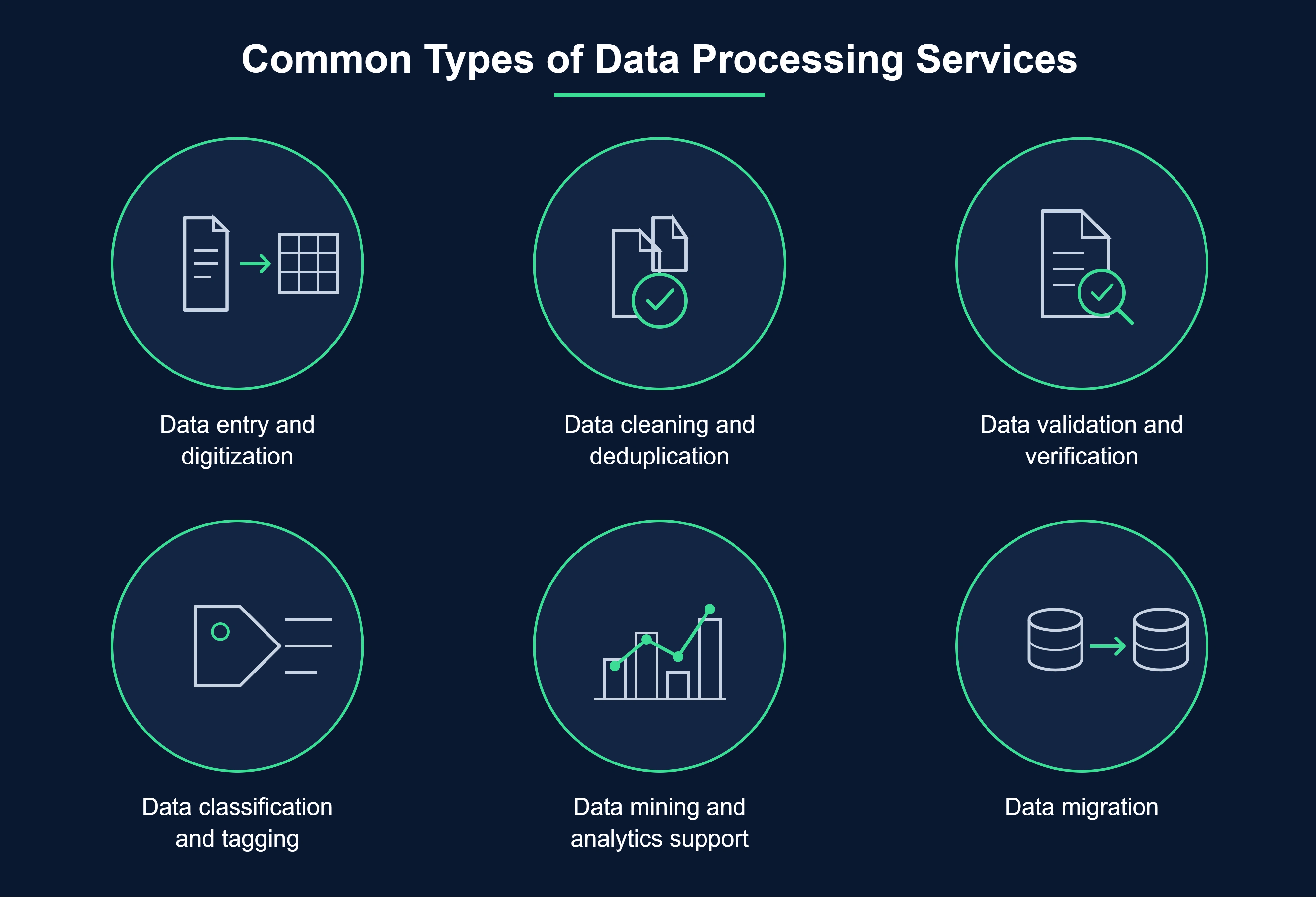
Common Types of Data Processing Services
Not all "data processing" work looks the same. Providers typically group services into a handful of categories, and most vendors specialize in a few rather than all of them.
- Data entry and digitization — converting paper forms, PDFs, or scanned images into structured digital records.
- Data cleaning and deduplication — removing duplicate, outdated, or inconsistent entries from a database.
- Data validation and verification — cross-checking entries against source documents or third-party databases for accuracy.
- Data classification and tagging — labeling data for search, analytics, or machine learning training sets.
- Data mining and analytics support — extracting patterns and insights from large datasets to support business decisions.
- Data migration — moving data between systems, such as during a CRM or ERP switch.
Why Businesses Outsource Data Processing
Cost is the obvious driver, but it's rarely the only one. Access to specialized tools and trained staff, without the overhead of hiring them permanently, matters just as much for many teams. So does scalability — a provider can add staff during a busy season and scale back down without a company going through a hiring and layoff cycle every quarter.
There's also a quality argument. A dedicated data processing team, whose entire job is entry and validation, tends to build accuracy habits that a generalist internal employee juggling five other responsibilities simply won't develop.
Cost Efficiency
Outsourcing converts fixed labor costs into variable ones. Instead of paying salaries, benefits, and software licenses year-round, a business pays for the volume of work actually processed. That's especially valuable for seasonal spikes — retail order processing around holidays, for instance, or tax-season data entry for accounting firms.
Access to Expertise and Technology
Established data processing vendors invest in tools most single companies wouldn't justify buying on their own: OCR software, automated validation engines, and increasingly AI-assisted classification systems. Clients get the benefit of that tooling without the capital expense.
Focus on Core Business
Every hour an internal team spends on manual data cleanup is an hour not spent on product, sales, or strategy. Offloading the repetitive layer lets internal staff concentrate on work that actually differentiates the business.

Organize Data Processing with NeoWork
Data processing outsourcing helps companies manage recurring data entry, records updates, document handling, and back-office workflows without expanding every role internally. NeoWork provides remote teammates who can support structured data processing tasks as part of the client’s existing operations. NeoWork handles recruitment, benefits, training, and ongoing engagement, while teammates integrate into the client’s systems and workflows. Its 91% annualized teammate retention rate and 3.2% candidate selectivity rate reflect a focus on selective hiring and longer-term team stability.
NeoWork's data processing model offers:
- data entry and records support
- integration with the client’s tools and processes
- recruitment and ongoing teammate support
Contact NeoWork to add data processing support that can handle recurring operational work.
In-House vs. Outsourced Data Processing
How Data Processing Outsourcing Pricing Works
Pricing models vary by provider and by the nature of the work, so it's worth understanding the options before comparing quotes. Exact rates depend heavily on task complexity, data volume, turnaround time, and the provider's location — always check a given provider's official site or request a quote for current rates rather than relying on a general figure, since costs shift by region and specialization.
- Per-hour billing — common for open-ended or evolving projects where scope isn't fully defined upfront.
- Per-record or per-unit pricing — typical for data entry, where cost is tied to the number of records, forms, or fields processed.
- Per-project flat fee — used for well-scoped, one-time jobs like a database migration.
- Dedicated team / retainer model — a fixed monthly cost for a set number of full-time staff dedicated to the account, common for ongoing high-volume needs.
Offshore providers in regions with lower labor costs typically undercut onshore or nearshore vendors on price, but that gap often narrows once time-zone coordination, language nuances, and quality-control overhead get factored in.
Choosing the Right Outsourcing Partner
The provider search shouldn't start with price. It should start with fit: does this vendor actually handle the type of data in question, at the volume needed, with the security posture the industry requires?
Questions to Ask Before Signing
- What industries and data types does the provider specialize in?
- What security certifications or frameworks does it follow (ISO 27001, SOC 2, or similar)?
- How does it structure service-level agreements around accuracy and turnaround time?
- What happens to data after the contract ends — is it deleted, returned, or retained?
- Can the provider scale up or down without a lengthy renegotiation?
- Who owns liability if there's a data breach or major error?
Data Security and Compliance Considerations
Handing data to a third party doesn't hand off legal responsibility for it. Under regulations like the EU's General Data Protection Regulation (GDPR), a company using an outsourced processor generally remains the "data controller," while the vendor acts as a "data processor" — and GDPR requires a written data processing agreement spelling out how that processor handles, protects, and eventually deletes personal data. Similar obligations exist under other regional privacy laws, so it's worth confirming with legal counsel which framework applies before data crosses any border.
Practical due diligence should cover where the data physically resides, how it's encrypted in transit and at rest, who on the vendor's side has access, and whether subcontractors are involved. A provider that can't answer these clearly is a red flag regardless of how attractive its pricing looks.
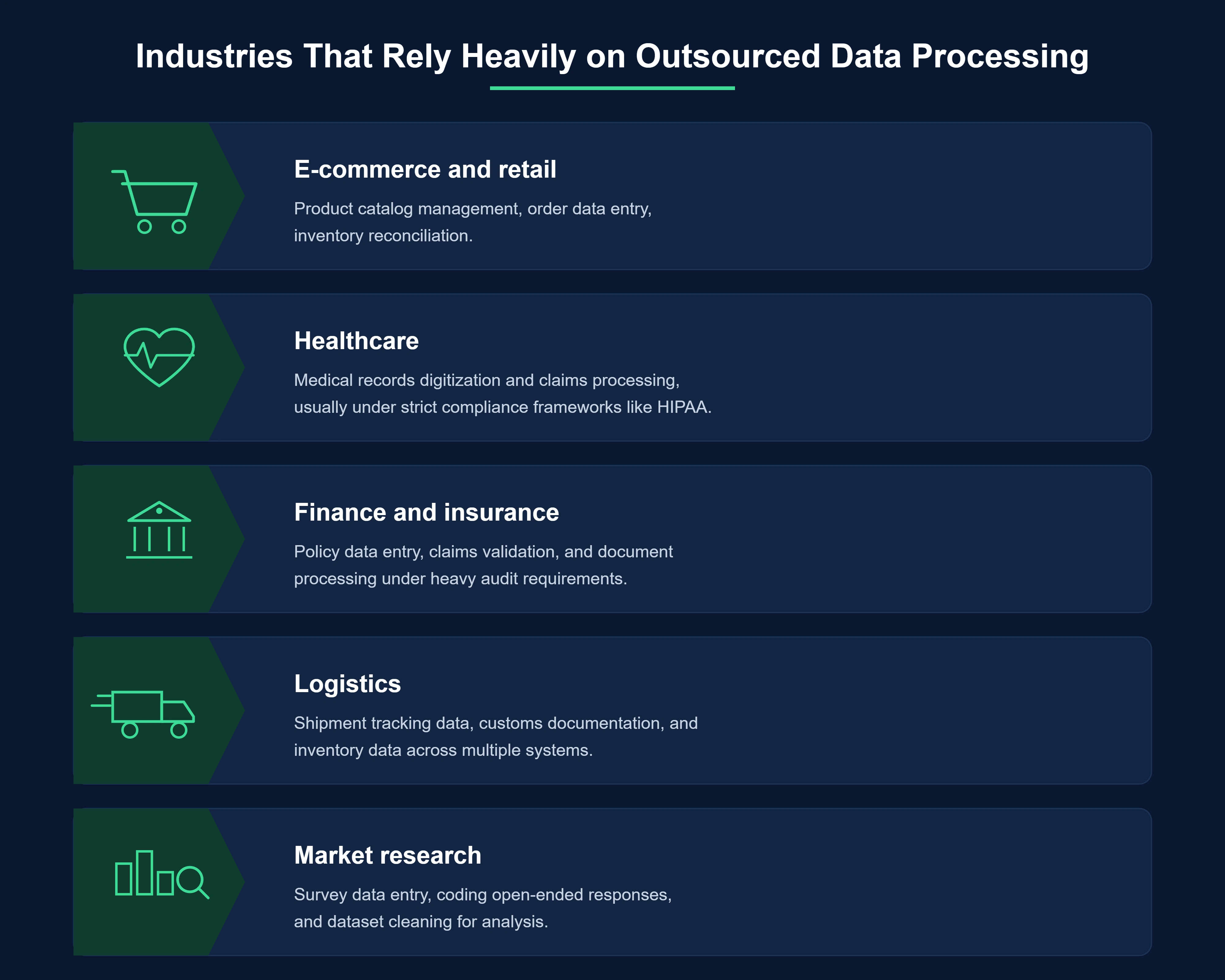
Industries That Rely Heavily on Outsourced Data Processing
Some sectors lean on outsourcing more than others because of volume, regulatory complexity, or seasonal demand.
- E-commerce and retail — product catalog management, order data entry, inventory reconciliation.
- Healthcare — medical records digitization and claims data processing, usually under strict compliance frameworks like HIPAA in the United States.
- Finance and insurance — policy data entry, claims validation, and document processing under heavy audit requirements.
- Logistics — shipment tracking data, customs documentation, and inventory data across multiple systems.
- Market research — survey data entry, coding open-ended responses, and dataset cleaning for analysis.
Trends Shaping Data Processing Outsourcing
AI-assisted tools are changing what "manual" data processing even means. Optical character recognition and machine learning classification now handle a lot of the repetitive first-pass work, with human reviewers focused on exceptions and quality checks rather than raw entry. That shift is pushing providers to market themselves less as low-cost labor pools and more as technology-enabled operations teams.
Nearshoring is also picking up as companies weigh time-zone overlap and cultural alignment against the pure labor-cost savings of far-offshore locations. And regulatory pressure — especially around cross-border data transfers — is pushing more clients to ask providers detailed questions about data residency before signing anything.
Common Mistakes to Avoid
- Rushing into a contract without a pilot project is the most common error. A small test batch reveals accuracy, communication style, and turnaround speed far better than a sales call ever will.
- Underestimating onboarding time is another one. Even simple data entry projects need clear documentation of formatting rules, edge cases, and validation logic — skipping that step guarantees rework later.
- And treating price as the only variable tends to backfire. The cheapest quote often comes with the least oversight, the thinnest quality-control layer, and the fewest security certifications.
Final Thoughts
Data processing outsourcing isn't a one-size-fits-all decision. The right setup depends on data sensitivity, volume, budget, and how much oversight a company wants to retain. What matters most is treating it like a real partnership rather than a one-time transaction — clear documentation, a pilot project, and a genuine understanding of the provider's security practices go a long way toward avoiding costly surprises.
Start small, verify the provider's compliance credentials directly, and scale the relationship once accuracy and turnaround times prove out. That approach beats jumping straight into a large contract based on price alone, every time.
FAQ: Data Processing Outsourcing
Topics
Data Processing Outsourcing Guide: What to Know in 2026

Quick Summary: Data processing outsourcing means handing tasks like data entry, cleaning, validation, and analytics to an external provider so internal teams can focus on core work. The right partner combines skilled staff, secure infrastructure, and clear service-level agreements to cut costs and improve accuracy. Success depends on matching the engagement model, pricing structure, and compliance posture to the specific type of data being handled.
Every company generates more data than it can comfortably manage in-house. Spreadsheets pile up, customer records need cleaning, and someone has to keep it all consistent across systems. That's the gap data processing outsourcing fills.
Instead of hiring and training an internal team for repetitive, volume-heavy work, businesses hand it to a specialized provider. Done right, it's faster, cheaper, and more accurate than doing it alone. Done wrong, it creates security headaches and quality problems that take months to fix.
This guide walks through what data processing outsourcing actually involves, the main service types, how pricing typically works, what to check before signing a contract, and the compliance issues that can't be ignored. It also covers the questions most first-time buyers ask before committing to a provider.
What Is Data Processing Outsourcing?
Data processing outsourcing is the practice of assigning data-related tasks—entry, cleaning, validation, formatting, categorization, and reporting—to an external vendor rather than an internal department. The provider supplies the people, software, and workflow infrastructure; the client supplies the raw data and the rules for how it should end up.
It sits under the broader umbrella of business process outsourcing (BPO), but it's narrower and more technical than general back-office work. A payroll BPO firm handles HR paperwork. A data processing partner handles the actual information: cleaning a customer database, digitizing scanned forms, or running quality checks on product catalogs before they go live on an e-commerce site.
Companies turn to outsourcing for a few consistent reasons: it's expensive to build an in-house team for work that spikes seasonally, specialized data tools require training that isn't worth it for occasional use, and providers with scale can often turn around large volumes faster than a small internal team ever could.
Common Types of Data Processing Services
Not all "data processing" work looks the same. Providers typically group services into a handful of categories, and most vendors specialize in a few rather than all of them.
- Data entry and digitization — converting paper forms, PDFs, or scanned images into structured digital records.
- Data cleaning and deduplication — removing duplicate, outdated, or inconsistent entries from a database.
- Data validation and verification — cross-checking entries against source documents or third-party databases for accuracy.
- Data classification and tagging — labeling data for search, analytics, or machine learning training sets.
- Data mining and analytics support — extracting patterns and insights from large datasets to support business decisions.
- Data migration — moving data between systems, such as during a CRM or ERP switch.
Why Businesses Outsource Data Processing
Cost is the obvious driver, but it's rarely the only one. Access to specialized tools and trained staff, without the overhead of hiring them permanently, matters just as much for many teams. So does scalability — a provider can add staff during a busy season and scale back down without a company going through a hiring and layoff cycle every quarter.
There's also a quality argument. A dedicated data processing team, whose entire job is entry and validation, tends to build accuracy habits that a generalist internal employee juggling five other responsibilities simply won't develop.
Cost Efficiency
Outsourcing converts fixed labor costs into variable ones. Instead of paying salaries, benefits, and software licenses year-round, a business pays for the volume of work actually processed. That's especially valuable for seasonal spikes — retail order processing around holidays, for instance, or tax-season data entry for accounting firms.
Access to Expertise and Technology
Established data processing vendors invest in tools most single companies wouldn't justify buying on their own: OCR software, automated validation engines, and increasingly AI-assisted classification systems. Clients get the benefit of that tooling without the capital expense.
Focus on Core Business
Every hour an internal team spends on manual data cleanup is an hour not spent on product, sales, or strategy. Offloading the repetitive layer lets internal staff concentrate on work that actually differentiates the business.
Organize Data Processing with NeoWork
Data processing outsourcing helps companies manage recurring data entry, records updates, document handling, and back-office workflows without expanding every role internally. NeoWork provides remote teammates who can support structured data processing tasks as part of the client’s existing operations. NeoWork handles recruitment, benefits, training, and ongoing engagement, while teammates integrate into the client’s systems and workflows. Its 91% annualized teammate retention rate and 3.2% candidate selectivity rate reflect a focus on selective hiring and longer-term team stability.
NeoWork's data processing model offers:
- data entry and records support
- integration with the client’s tools and processes
- recruitment and ongoing teammate support
Contact NeoWork to add data processing support that can handle recurring operational work.
In-House vs. Outsourced Data Processing
How Data Processing Outsourcing Pricing Works
Pricing models vary by provider and by the nature of the work, so it's worth understanding the options before comparing quotes. Exact rates depend heavily on task complexity, data volume, turnaround time, and the provider's location — always check a given provider's official site or request a quote for current rates rather than relying on a general figure, since costs shift by region and specialization.
- Per-hour billing — common for open-ended or evolving projects where scope isn't fully defined upfront.
- Per-record or per-unit pricing — typical for data entry, where cost is tied to the number of records, forms, or fields processed.
- Per-project flat fee — used for well-scoped, one-time jobs like a database migration.
- Dedicated team / retainer model — a fixed monthly cost for a set number of full-time staff dedicated to the account, common for ongoing high-volume needs.
Offshore providers in regions with lower labor costs typically undercut onshore or nearshore vendors on price, but that gap often narrows once time-zone coordination, language nuances, and quality-control overhead get factored in.
Choosing the Right Outsourcing Partner
The provider search shouldn't start with price. It should start with fit: does this vendor actually handle the type of data in question, at the volume needed, with the security posture the industry requires?
Questions to Ask Before Signing
- What industries and data types does the provider specialize in?
- What security certifications or frameworks does it follow (ISO 27001, SOC 2, or similar)?
- How does it structure service-level agreements around accuracy and turnaround time?
- What happens to data after the contract ends — is it deleted, returned, or retained?
- Can the provider scale up or down without a lengthy renegotiation?
- Who owns liability if there's a data breach or major error?
Data Security and Compliance Considerations
Handing data to a third party doesn't hand off legal responsibility for it. Under regulations like the EU's General Data Protection Regulation (GDPR), a company using an outsourced processor generally remains the "data controller," while the vendor acts as a "data processor" — and GDPR requires a written data processing agreement spelling out how that processor handles, protects, and eventually deletes personal data. Similar obligations exist under other regional privacy laws, so it's worth confirming with legal counsel which framework applies before data crosses any border.
Practical due diligence should cover where the data physically resides, how it's encrypted in transit and at rest, who on the vendor's side has access, and whether subcontractors are involved. A provider that can't answer these clearly is a red flag regardless of how attractive its pricing looks.
Industries That Rely Heavily on Outsourced Data Processing
Some sectors lean on outsourcing more than others because of volume, regulatory complexity, or seasonal demand.
- E-commerce and retail — product catalog management, order data entry, inventory reconciliation.
- Healthcare — medical records digitization and claims data processing, usually under strict compliance frameworks like HIPAA in the United States.
- Finance and insurance — policy data entry, claims validation, and document processing under heavy audit requirements.
- Logistics — shipment tracking data, customs documentation, and inventory data across multiple systems.
- Market research — survey data entry, coding open-ended responses, and dataset cleaning for analysis.
Trends Shaping Data Processing Outsourcing
AI-assisted tools are changing what "manual" data processing even means. Optical character recognition and machine learning classification now handle a lot of the repetitive first-pass work, with human reviewers focused on exceptions and quality checks rather than raw entry. That shift is pushing providers to market themselves less as low-cost labor pools and more as technology-enabled operations teams.
Nearshoring is also picking up as companies weigh time-zone overlap and cultural alignment against the pure labor-cost savings of far-offshore locations. And regulatory pressure — especially around cross-border data transfers — is pushing more clients to ask providers detailed questions about data residency before signing anything.
Common Mistakes to Avoid
- Rushing into a contract without a pilot project is the most common error. A small test batch reveals accuracy, communication style, and turnaround speed far better than a sales call ever will.
- Underestimating onboarding time is another one. Even simple data entry projects need clear documentation of formatting rules, edge cases, and validation logic — skipping that step guarantees rework later.
- And treating price as the only variable tends to backfire. The cheapest quote often comes with the least oversight, the thinnest quality-control layer, and the fewest security certifications.
Final Thoughts
Data processing outsourcing isn't a one-size-fits-all decision. The right setup depends on data sensitivity, volume, budget, and how much oversight a company wants to retain. What matters most is treating it like a real partnership rather than a one-time transaction — clear documentation, a pilot project, and a genuine understanding of the provider's security practices go a long way toward avoiding costly surprises.
Start small, verify the provider's compliance credentials directly, and scale the relationship once accuracy and turnaround times prove out. That approach beats jumping straight into a large contract based on price alone, every time.
FAQ: Data Processing Outsourcing
Topics
Related Blogs
Related Podcasts


.webp)

.webp)
.webp)



