

.avif)
.avif)

Finance Team Augmentation Guide: 2026 Complete Handbook


.svg)

Quick Summary: Finance team augmentation is a flexible staffing strategy that allows organizations to bring in specialized financial professionals on a temporary or project basis to supplement existing teams. This approach helps companies handle ERP implementations, seasonal workload spikes, and specialized projects without the long-term commitment and overhead costs of permanent hires, while maintaining control over processes and ensuring business continuity.
Finance departments face constant pressure. Month-end close deadlines don't move. Audits happen whether teams are ready or not. And when major projects like ERP implementations hit, finance teams get squeezed from both sides—supporting the project while keeping day-to-day operations running smoothly.
That's where finance team augmentation comes in.
Unlike traditional outsourcing where entire functions get handed off to external providers, staff augmentation brings skilled finance professionals directly into your existing workflows. They use your tools, follow your processes, and report to your managers. Think of it as adding horsepower exactly where and when it's needed.
What Is Finance Team Augmentation?
Finance team augmentation is a staffing model where external finance professionals integrate temporarily with your in-house team. These aren't consultants who show up with their own methodology and take over. Augmented staff work as extensions of your existing team.
The key difference? Control stays with you.
Your managers direct the work. Your processes remain in place. The augmented professionals simply provide the expertise and capacity your team needs to handle workload spikes, specialized projects, or knowledge gaps.
This model offers flexibility traditional hiring can't match. When a six-month ERP implementation needs extra hands for data cleanup and testing, permanent hires don't make sense. When quarterly close cycles consistently overwhelm your team for three weeks every quarter, augmentation provides targeted relief without year-round overhead.
How It Differs From Other Staffing Models
The staffing world throws around terms like consultants, freelancers, temps, and outsourcing. Here's how augmentation stands apart:
- Consultants typically bring their own processes and recommendations. They analyze, advise, and sometimes implement—but on their terms. Augmented staff follow your playbook.
- Outsourcing means handing entire functions to external providers. You might outsource payroll processing or accounts payable completely. With augmentation, functions stay internal—you're just adding people to execute them.
- Temporary staff from agencies often fill basic administrative roles. Augmented finance professionals bring specialized expertise in areas like financial planning and analysis, technical accounting, or systems implementation.
When Finance Teams Need Augmentation
Not every staffing challenge calls for augmentation. But certain scenarios make it the clear choice.
ERP Implementations and System Upgrades
ERP projects put finance teams in an impossible position. The implementation demands significant involvement—defining requirements, mapping processes, cleaning data, testing workflows, training users. Meanwhile, the regular finance engine keeps running. Month-end close still happens. Reporting deadlines don't pause.
According to research on team augmentation services, the global staffing industry supporting augmentation talent is estimated to contribute to a $490 billion annual market, with IT staff augmentation services projected to reach $81.87 billion as organizations seek flexible expertise.
Finance teams face dual pressure during these projects. Support the ERP initiative while maintaining business operations. The hidden cost of trying to do it all? Burnout, missed deadlines, and project delays that extend timelines and balloon budgets.
Staff augmentation is especially valuable at key ERP milestones:
- Planning Phase – Finance defines requirements and reporting needs while augmented staff handle documentation and process reviews
- Implementation Phase – Teams shift focus to testing and validation while augmented professionals manage data cleanup and support user testing
- Go-Live and Post-Launch – Training, error resolution, and parallel processing create massive workload spikes that augmented staff can absorb
- Stabilization – Troubleshooting and process refinement continue for months while augmented team members provide continuity
Seasonal Workload Spikes
Finance operates on predictable cycles. Quarter-end and year-end close periods compress weeks of work into days. Budget season demands intensive planning and analysis. Audit periods require detailed documentation and extensive support.
These spikes are intense but temporary. Hiring permanent staff to handle peak periods means carrying excess capacity the rest of the year. Augmentation matches resources to actual demand.
Specialized Project Work
Sometimes finance teams need expertise that doesn't exist in-house and won't be needed long-term. Technical accounting for complex transactions. Financial modeling for potential acquisitions. Regulatory compliance for new requirements.
Building permanent expertise for one-off projects doesn't make financial sense. Augmented specialists bring the knowledge, deliver results, and move on.
Unexpected Departures and Coverage Gaps
When key finance team members leave suddenly, knowledge walks out the door. Critical functions can't wait months for recruitment and onboarding. Augmented professionals provide immediate coverage while permanent hiring proceeds at a reasonable pace.

Build Finance Team Support with NeoWork
Finance team augmentation helps companies manage recurring finance, accounting, and administrative workflows without building every role in-house. NeoWork provides remote teammates who can support data entry, records organization, bookkeeping-related tasks, accounts payable support, and finance operations. NeoWork handles recruitment, benefits, training, and ongoing engagement, while teammates integrate into the client’s systems and daily workflows. Its 91% annualized teammate retention rate and 3.2% candidate selectivity rate reflect a focus on selective hiring and longer-term team stability.
NeoWork's finance team augmentation model offers:
- finance and accounting support teammates
- integration with the client’s tools and processes
- recruitment and ongoing teammate support
Contact NeoWork to add finance team support that can grow with your operations.
The Financial Case for Augmentation
The cost comparison between augmented staff and permanent hires looks straightforward on the surface—but the real analysis goes deeper than hourly rates.
Direct Cost Comparison
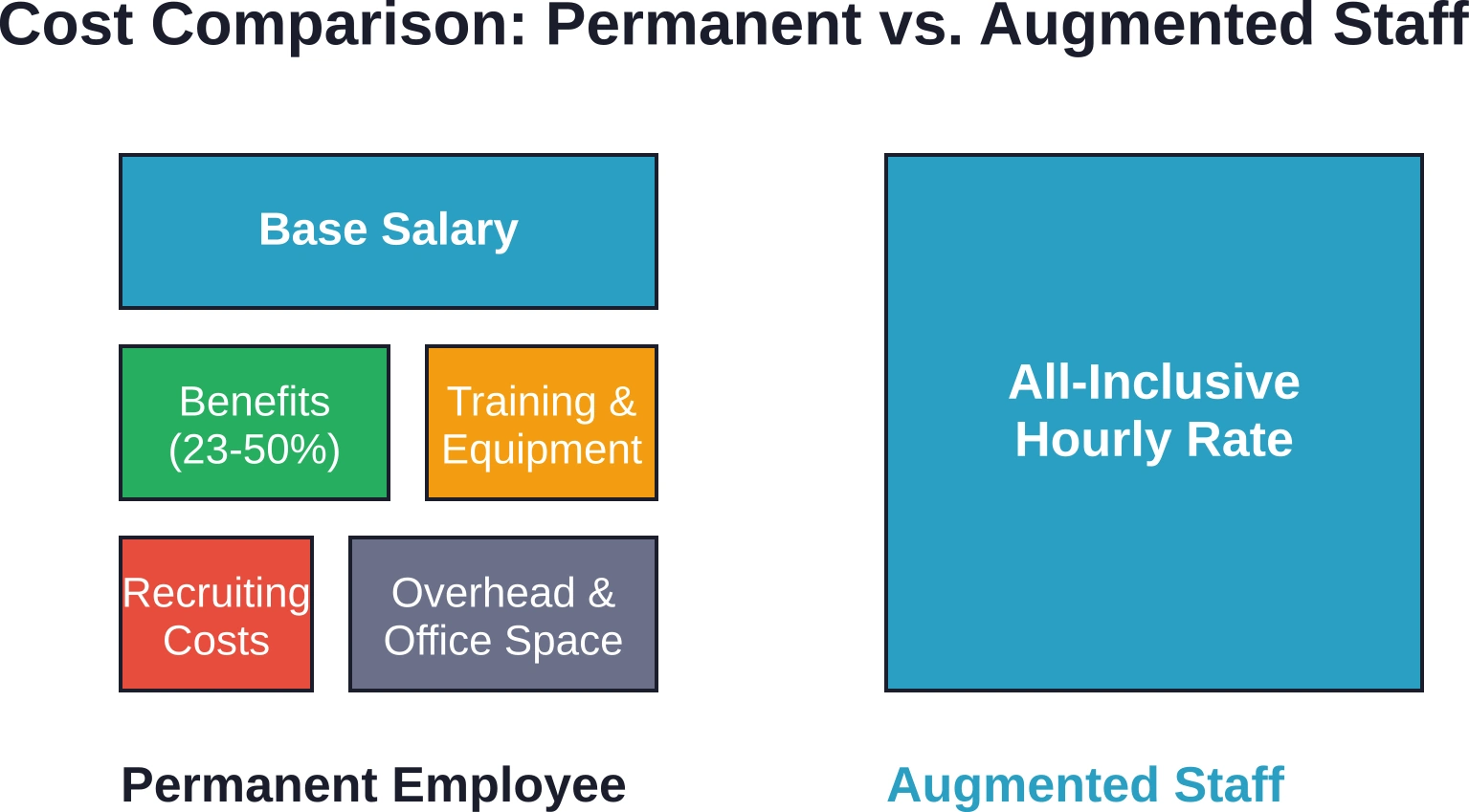
Permanent employees carry significant costs beyond base salary. Benefits, payroll taxes, training, office space, equipment, and ongoing professional development add substantial overhead. Industry analyses indicate these additional costs can reach 23-50% depending on region and organization type.
Augmented staff rates include this overhead in their billing. What looks like a premium hourly rate often breaks even or costs less than the fully loaded cost of a permanent employee—especially when the need is temporary.
Typical cost ranges for augmented finance professionals vary by geography and experience:
- Nearshore/offshore agency rates: $50-110 per hour
- Onshore agency rates for senior professionals: $150-350 per hour
- Junior to mid-level professionals: $90-150 per hour
- Senior specialists and technical experts: $150-250+ per hour
Cost advantages versus onshore permanent hires often range from 50-70% when engaging nearshore or offshore augmented staff, making it an attractive option for extended project work.
Hidden Savings and Avoided Costs
The real financial benefit extends beyond hourly rate comparisons.
- Recruitment costs disappear. No agency fees, job postings, interview time, or background checks. Augmentation providers handle sourcing and vetting.
- Onboarding accelerates. Augmented professionals come with domain expertise and hit the ground running. Training focuses on company-specific processes, not foundational skills.
- Flexibility prevents overcommitment. When project needs end, augmented staff assignments end. No severance, no reorganization, no difficult conversations.
- Risk decreases. Bad permanent hires cost months of productivity and create team disruption. Augmented staff can be replaced quickly if fit or performance issues emerge.
Types of Finance Roles Well-Suited for Augmentation
Not all finance positions work equally well with augmentation. Some roles integrate seamlessly, while others require deep institutional knowledge that makes augmentation impractical.
High-Value Augmentation Roles
- Financial Analysts bring modeling, forecasting, and analytical skills that apply across industries. They can dive into budgeting cycles, variance analysis, and performance reporting with minimal ramp-up time.
- Technical Accountants handle complex transactions, revenue recognition, lease accounting, and other specialized areas. Their expertise centers on technical standards, not company-specific knowledge.
- ERP and Systems Specialists understand financial systems architecture, data migration, and process configuration. During implementations, they're invaluable—but companies don't need this expertise year-round.
- Financial Reporting Specialists manage SEC reporting, technical disclosures, and regulatory compliance. Public companies often need surge capacity during quarterly and annual reporting cycles.
- FP&A Professionals support strategic planning, business case development, and decision support. Projects like acquisition analysis or new market evaluation benefit from fresh analytical perspectives.
Roles That Challenge Augmentation
Controller and CFO positions require deep relationships, strategic vision, and institutional knowledge. While fractional CFO services exist, these operate differently than typical augmentation.
Treasury and cash management roles involve banking relationships, authority levels, and sensitive system access that companies hesitate to extend to temporary staff.
Accounts payable and receivable processing can be augmented, but outsourcing often works better for these transaction-heavy, routine functions.
Best Practices for Successful Finance Team Augmentation
Bringing external professionals into finance operations requires thoughtful planning. The teams that get this right follow proven patterns.
Define Scope and Expectations Clearly
Before engaging augmented staff, document exactly what needs to get done. Vague mandates like "help with close" lead to confusion and wasted time.
Successful engagements specify deliverables, timelines, and success criteria. "Complete fixed asset reconciliation for 12 locations by October 15" gives clear direction. So does "support quarterly SEC filing preparation including footnote drafting and technical review."
Define reporting relationships upfront. Who directs daily work? Who reviews deliverables? Who addresses questions about company policies or processes?
Integrate Augmented Staff Properly
The "augmented" part of staff augmentation means integration, not isolation. Bring external professionals into team meetings. Include them in communication channels. Provide access to documentation and subject matter experts.
Remote work makes integration both easier and harder. Video calls allow augmented staff anywhere to participate in meetings, but building relationships requires intentional effort.
Assign an internal point person who can answer questions, provide context, and help navigate company culture and systems. This single step prevents most early friction.
Manage Security and Access Appropriately
Finance teams handle sensitive data. Augmented staff need sufficient access to do their jobs, but security protocols can't be ignored.
Work with IT to establish appropriate system permissions. Most augmentation arrangements use temporary credentials with role-based access that limits exposure.
Confidentiality agreements are standard, but enforcement matters too. Clear policies about data handling, device security, and information sharing prevent problems before they start.
Plan for Knowledge Transfer
When augmented staff complete their assignments, their knowledge shouldn't leave with them. Build documentation requirements into the engagement.
Process documentation, model explanations, and technical notes ensure institutional knowledge stays with your organization. For longer engagements, schedule knowledge transfer sessions before augmented professionals roll off.
How to Find and Vet Finance Augmentation Providers
The augmentation market offers plenty of options—but quality varies dramatically. Finding providers who understand finance requirements and deliver qualified professionals takes diligence.
Specialized Finance Staffing Firms
Providers who focus exclusively on finance and accounting understand the domain deeply. They know the difference between financial analysts and FP&A professionals. They can assess technical accounting knowledge and systems expertise.
Look for firms with finance-specific recruiting teams, not generalists who happen to place some finance roles. Ask about their vetting process for candidates. Technical assessments matter.
Evaluating Provider Credentials
How long has the provider operated? Firms with multi-year track records have refined their processes and built talent networks.
What's their replacement policy if a placement doesn't work out? Strong providers stand behind their people and will swap resources quickly when fit issues arise.
Can they provide references from similar engagements? Speaking with other finance leaders who've used the provider reveals how they handle challenges and support clients.
Geography and Delivery Models
Onshore augmentation provides same time zone collaboration and cultural alignment. It costs more but offers the simplest setup.
Nearshore options (like Latin America for U.S. companies) balance cost savings with reasonable time zone overlap and easier travel if needed.
Offshore augmentation delivers the largest cost advantages—often 50-70% below onshore rates—but requires accepting time zone gaps and potentially less cultural alignment. For technical work that doesn't need constant real-time interaction, offshore models work well.
Key Questions to Ask Providers
Before engaging any augmentation provider, get clear answers to these questions:
- How do you source and vet finance professionals? What assessments do candidates complete?
- What's your average time to present qualified candidates after receiving requirements?
- How do you handle performance issues or fit problems?
- What's included in your rates? Are there additional fees for replacement or management?
- What security and confidentiality protocols do you require of your professionals?
- Can you scale up or down if project needs change?
Common Challenges and How to Overcome Them
Even well-planned augmentation engagements hit bumps. Knowing what to expect helps teams navigate challenges smoothly.
Cultural and Communication Gaps
External professionals don't know company culture, communication norms, or unwritten rules. What seems obvious to insiders confuses newcomers.
The fix? Over-communicate early. Share organizational charts, explain decision-making processes, and clarify expectations explicitly. What feels like over-explaining isn't—it's investing in faster productivity.
For offshore or nearshore augmentation, language proficiency matters. Verify English capability (or whatever language your team uses) during provider vetting, not after professionals start.
Access and Systems Delays
Finance systems have complex security. Getting augmented staff the right access often takes longer than expected, delaying productive work.
Start the access provisioning process before professionals begin. Work with IT to pre-stage accounts and permissions. Have system documentation ready.
Consider creating standardized access packages for common augmentation roles. When the next ERP implementation needs financial analysts, IT can activate a pre-defined permission set instead of building from scratch.
Knowledge Gaps and Context
Augmented professionals bring technical skills but lack company context. They don't know why certain processes exist, what happened during last year's audit, or which executives care about specific metrics.
Assign a buddy or mentor from your internal team. This person isn't a supervisor—they're a resource for questions about context, history, and company-specific knowledge.
Create a reference document with common questions: How do we handle intercompany transactions? What's our policy on capitalizing software costs? Where's the documentation from the last system upgrade?
Managing Hybrid Teams
When some team members are internal and others augmented, dynamics get tricky. Internal staff might resist external help or dump undesirable work on augmented professionals.
Address this directly. Frame augmentation as supporting the entire team, not replacing anyone. Assign meaningful work that leverages augmented professionals' expertise.
Include augmented staff in team recognition and celebrations. They're contributing to team success—acknowledge it.
Measuring Success and ROI
How do you know if finance team augmentation is working? Clear metrics separate productive engagements from expensive disappointments.
Project-Specific Metrics
For defined projects, success metrics are straightforward. Did the work get completed on time? Did quality meet standards? Did deliverables match requirements?
ERP implementations measure success by milestone completion, testing coverage, and go-live readiness. Close cycle support measures transaction volume processed, reconciliations completed, and deadline achievement.
Efficiency and Capacity Metrics
Track how augmentation affects team capacity. If your internal team worked 60-hour weeks during quarter close before augmentation and now works standard hours, that's measurable improvement.
Monitor error rates and rework. Quality shouldn't decline with augmented staff. If it does, provider quality or integration process needs attention.
Financial Metrics
Compare the fully loaded cost of augmented staff against the alternative. What would permanent hiring have cost? How much project delay did augmentation prevent, and what's that delay worth?
Calculate cost per deliverable or cost per transaction. This normalizes comparisons across different staffing models.
Team Satisfaction and Retention
Here's a metric teams overlook: internal staff retention and satisfaction. If augmentation relieves burnout and allows your permanent team to focus on high-value work, retention improves. Replacing finance professionals typically involves significant recruitment, training, and productivity ramp-up costs.
Survey your internal team. Do they feel augmentation helps or creates more work coordinating external resources? Their feedback reveals process improvements.
Future Trends in Finance Team Augmentation
The augmentation model continues evolving as work patterns and technology shift.
Remote-First Augmentation
Geography matters less every year. Finance teams increasingly source augmented talent globally, prioritizing expertise over location. Video collaboration tools, cloud-based financial systems, and asynchronous work patterns make this seamless.
This trend expands talent pools dramatically. Instead of finding qualified professionals within commuting distance, teams can engage experts anywhere.
Specialized Skill Augmentation
As finance becomes more technical, specialized skills command premium value. Data analytics, financial systems architecture, advanced modeling, and regulatory compliance expertise are increasingly augmented rather than built permanently.
Companies realize they need these skills episodically. Augmentation provides access without the commitment.
Fractional Leadership Models
While traditional augmentation focuses on individual contributor roles, fractional CFO and controller services bring senior expertise part-time. Small and mid-sized companies get executive-level guidance without executive-level salaries.
These arrangements blend consulting with augmentation. Fractional leaders provide strategic direction but also execute hands-on work.
Technology-Enabled Matching
Augmentation providers increasingly use technology platforms to match client needs with professional capabilities. Detailed skill profiles, availability calendars, and automated matching speed the sourcing process.
Some platforms enable direct engagement, reducing provider intermediation and costs. Whether this fully disintermediates traditional staffing firms or simply augments their model remains to be seen.
Making the Decision: Is Finance Team Augmentation Right for You?
Not every finance staffing challenge calls for augmentation. Here's how to decide if this model fits your situation.
When Augmentation Makes Clear Sense
You have a defined project with specific timeline and scope. ERP implementations, system conversions, technical accounting projects, and major process improvements all fit augmentation well.
Your workload has predictable spikes that overwhelm current capacity. Quarter-end close, annual budgeting, and audit support create temporary demand peaks.
You need specialized expertise that your team lacks and won't need long-term. Technical accounting for complex transactions, financial modeling for acquisitions, or compliance for new regulations fit this pattern.
You face unexpected coverage gaps from departures or leave, and business can't wait for traditional hiring.
When Other Options Might Work Better
If you need additional permanent capacity for ongoing work, traditional hiring builds institutional knowledge and team cohesion better than extended augmentation.
When entire functions need offloading, not just capacity increases, outsourcing provides complete handoff with provider accountability.
For highly sensitive work requiring deep institutional knowledge and relationships, internal staff remain the better choice.
The Hybrid Approach
Many finance teams use augmentation strategically alongside permanent staff. Core team members provide continuity and institutional knowledge. Augmented professionals flex capacity for projects and peaks.
This hybrid model optimizes cost and capability. Permanent staff handle relationship-intensive, context-dependent work. Augmented professionals bring specialized skills and surge capacity.
Conclusion: Strategic Staffing for Modern Finance Teams
Finance departments operate under constant pressure to do more with less. Close deadlines, audit requirements, system implementations, and strategic projects compete for limited team capacity. Permanent hiring adds fixed overhead and takes months. Burnout threatens team stability.
Finance team augmentation offers a practical alternative—flexible access to specialized expertise exactly when and where it's needed.
The model works because it preserves control while adding capacity. Augmented professionals integrate with existing teams, follow established processes, and deliver results under your direction. When projects complete or workload normalizes, engagements end cleanly without the complexity of workforce reductions.
Success requires thoughtful execution. Define scope clearly. Choose providers carefully. Integrate augmented staff properly. Measure results objectively. Teams that follow these practices consistently report positive outcomes: projects delivered on time, internal teams protected from burnout, and specialized expertise accessed cost-effectively.
The question isn't whether finance team augmentation works—it demonstrably does for organizations across industries and sizes. The question is whether your current staffing challenges match the situations where augmentation excels: defined projects, temporary capacity needs, specialized expertise gaps, or unexpected coverage requirements.
If your finance team faces any of these scenarios, exploring augmentation makes strategic sense. Start with a clear assessment of your needs, research qualified providers, and consider a pilot engagement to evaluate the model firsthand.
The right staffing approach transforms finance team performance. Augmentation deserves a place in that strategic toolkit.
Frequently Asked Questions
Topics
Finance Team Augmentation Guide: 2026 Complete Handbook

Quick Summary: Finance team augmentation is a flexible staffing strategy that allows organizations to bring in specialized financial professionals on a temporary or project basis to supplement existing teams. This approach helps companies handle ERP implementations, seasonal workload spikes, and specialized projects without the long-term commitment and overhead costs of permanent hires, while maintaining control over processes and ensuring business continuity.
Finance departments face constant pressure. Month-end close deadlines don't move. Audits happen whether teams are ready or not. And when major projects like ERP implementations hit, finance teams get squeezed from both sides—supporting the project while keeping day-to-day operations running smoothly.
That's where finance team augmentation comes in.
Unlike traditional outsourcing where entire functions get handed off to external providers, staff augmentation brings skilled finance professionals directly into your existing workflows. They use your tools, follow your processes, and report to your managers. Think of it as adding horsepower exactly where and when it's needed.
What Is Finance Team Augmentation?
Finance team augmentation is a staffing model where external finance professionals integrate temporarily with your in-house team. These aren't consultants who show up with their own methodology and take over. Augmented staff work as extensions of your existing team.
The key difference? Control stays with you.
Your managers direct the work. Your processes remain in place. The augmented professionals simply provide the expertise and capacity your team needs to handle workload spikes, specialized projects, or knowledge gaps.
This model offers flexibility traditional hiring can't match. When a six-month ERP implementation needs extra hands for data cleanup and testing, permanent hires don't make sense. When quarterly close cycles consistently overwhelm your team for three weeks every quarter, augmentation provides targeted relief without year-round overhead.
How It Differs From Other Staffing Models
The staffing world throws around terms like consultants, freelancers, temps, and outsourcing. Here's how augmentation stands apart:
- Consultants typically bring their own processes and recommendations. They analyze, advise, and sometimes implement—but on their terms. Augmented staff follow your playbook.
- Outsourcing means handing entire functions to external providers. You might outsource payroll processing or accounts payable completely. With augmentation, functions stay internal—you're just adding people to execute them.
- Temporary staff from agencies often fill basic administrative roles. Augmented finance professionals bring specialized expertise in areas like financial planning and analysis, technical accounting, or systems implementation.
When Finance Teams Need Augmentation
Not every staffing challenge calls for augmentation. But certain scenarios make it the clear choice.
ERP Implementations and System Upgrades
ERP projects put finance teams in an impossible position. The implementation demands significant involvement—defining requirements, mapping processes, cleaning data, testing workflows, training users. Meanwhile, the regular finance engine keeps running. Month-end close still happens. Reporting deadlines don't pause.
According to research on team augmentation services, the global staffing industry supporting augmentation talent is estimated to contribute to a $490 billion annual market, with IT staff augmentation services projected to reach $81.87 billion as organizations seek flexible expertise.
Finance teams face dual pressure during these projects. Support the ERP initiative while maintaining business operations. The hidden cost of trying to do it all? Burnout, missed deadlines, and project delays that extend timelines and balloon budgets.
Staff augmentation is especially valuable at key ERP milestones:
- Planning Phase – Finance defines requirements and reporting needs while augmented staff handle documentation and process reviews
- Implementation Phase – Teams shift focus to testing and validation while augmented professionals manage data cleanup and support user testing
- Go-Live and Post-Launch – Training, error resolution, and parallel processing create massive workload spikes that augmented staff can absorb
- Stabilization – Troubleshooting and process refinement continue for months while augmented team members provide continuity
Seasonal Workload Spikes
Finance operates on predictable cycles. Quarter-end and year-end close periods compress weeks of work into days. Budget season demands intensive planning and analysis. Audit periods require detailed documentation and extensive support.
These spikes are intense but temporary. Hiring permanent staff to handle peak periods means carrying excess capacity the rest of the year. Augmentation matches resources to actual demand.
Specialized Project Work
Sometimes finance teams need expertise that doesn't exist in-house and won't be needed long-term. Technical accounting for complex transactions. Financial modeling for potential acquisitions. Regulatory compliance for new requirements.
Building permanent expertise for one-off projects doesn't make financial sense. Augmented specialists bring the knowledge, deliver results, and move on.
Unexpected Departures and Coverage Gaps
When key finance team members leave suddenly, knowledge walks out the door. Critical functions can't wait months for recruitment and onboarding. Augmented professionals provide immediate coverage while permanent hiring proceeds at a reasonable pace.
Build Finance Team Support with NeoWork
Finance team augmentation helps companies manage recurring finance, accounting, and administrative workflows without building every role in-house. NeoWork provides remote teammates who can support data entry, records organization, bookkeeping-related tasks, accounts payable support, and finance operations. NeoWork handles recruitment, benefits, training, and ongoing engagement, while teammates integrate into the client’s systems and daily workflows. Its 91% annualized teammate retention rate and 3.2% candidate selectivity rate reflect a focus on selective hiring and longer-term team stability.
NeoWork's finance team augmentation model offers:
- finance and accounting support teammates
- integration with the client’s tools and processes
- recruitment and ongoing teammate support
Contact NeoWork to add finance team support that can grow with your operations.
The Financial Case for Augmentation
The cost comparison between augmented staff and permanent hires looks straightforward on the surface—but the real analysis goes deeper than hourly rates.
Direct Cost Comparison
Permanent employees carry significant costs beyond base salary. Benefits, payroll taxes, training, office space, equipment, and ongoing professional development add substantial overhead. Industry analyses indicate these additional costs can reach 23-50% depending on region and organization type.
Augmented staff rates include this overhead in their billing. What looks like a premium hourly rate often breaks even or costs less than the fully loaded cost of a permanent employee—especially when the need is temporary.
Typical cost ranges for augmented finance professionals vary by geography and experience:
- Nearshore/offshore agency rates: $50-110 per hour
- Onshore agency rates for senior professionals: $150-350 per hour
- Junior to mid-level professionals: $90-150 per hour
- Senior specialists and technical experts: $150-250+ per hour
Cost advantages versus onshore permanent hires often range from 50-70% when engaging nearshore or offshore augmented staff, making it an attractive option for extended project work.
Hidden Savings and Avoided Costs
The real financial benefit extends beyond hourly rate comparisons.
- Recruitment costs disappear. No agency fees, job postings, interview time, or background checks. Augmentation providers handle sourcing and vetting.
- Onboarding accelerates. Augmented professionals come with domain expertise and hit the ground running. Training focuses on company-specific processes, not foundational skills.
- Flexibility prevents overcommitment. When project needs end, augmented staff assignments end. No severance, no reorganization, no difficult conversations.
- Risk decreases. Bad permanent hires cost months of productivity and create team disruption. Augmented staff can be replaced quickly if fit or performance issues emerge.
Types of Finance Roles Well-Suited for Augmentation
Not all finance positions work equally well with augmentation. Some roles integrate seamlessly, while others require deep institutional knowledge that makes augmentation impractical.
High-Value Augmentation Roles
- Financial Analysts bring modeling, forecasting, and analytical skills that apply across industries. They can dive into budgeting cycles, variance analysis, and performance reporting with minimal ramp-up time.
- Technical Accountants handle complex transactions, revenue recognition, lease accounting, and other specialized areas. Their expertise centers on technical standards, not company-specific knowledge.
- ERP and Systems Specialists understand financial systems architecture, data migration, and process configuration. During implementations, they're invaluable—but companies don't need this expertise year-round.
- Financial Reporting Specialists manage SEC reporting, technical disclosures, and regulatory compliance. Public companies often need surge capacity during quarterly and annual reporting cycles.
- FP&A Professionals support strategic planning, business case development, and decision support. Projects like acquisition analysis or new market evaluation benefit from fresh analytical perspectives.
Roles That Challenge Augmentation
Controller and CFO positions require deep relationships, strategic vision, and institutional knowledge. While fractional CFO services exist, these operate differently than typical augmentation.
Treasury and cash management roles involve banking relationships, authority levels, and sensitive system access that companies hesitate to extend to temporary staff.
Accounts payable and receivable processing can be augmented, but outsourcing often works better for these transaction-heavy, routine functions.
Best Practices for Successful Finance Team Augmentation
Bringing external professionals into finance operations requires thoughtful planning. The teams that get this right follow proven patterns.
Define Scope and Expectations Clearly
Before engaging augmented staff, document exactly what needs to get done. Vague mandates like "help with close" lead to confusion and wasted time.
Successful engagements specify deliverables, timelines, and success criteria. "Complete fixed asset reconciliation for 12 locations by October 15" gives clear direction. So does "support quarterly SEC filing preparation including footnote drafting and technical review."
Define reporting relationships upfront. Who directs daily work? Who reviews deliverables? Who addresses questions about company policies or processes?
Integrate Augmented Staff Properly
The "augmented" part of staff augmentation means integration, not isolation. Bring external professionals into team meetings. Include them in communication channels. Provide access to documentation and subject matter experts.
Remote work makes integration both easier and harder. Video calls allow augmented staff anywhere to participate in meetings, but building relationships requires intentional effort.
Assign an internal point person who can answer questions, provide context, and help navigate company culture and systems. This single step prevents most early friction.
Manage Security and Access Appropriately
Finance teams handle sensitive data. Augmented staff need sufficient access to do their jobs, but security protocols can't be ignored.
Work with IT to establish appropriate system permissions. Most augmentation arrangements use temporary credentials with role-based access that limits exposure.
Confidentiality agreements are standard, but enforcement matters too. Clear policies about data handling, device security, and information sharing prevent problems before they start.
Plan for Knowledge Transfer
When augmented staff complete their assignments, their knowledge shouldn't leave with them. Build documentation requirements into the engagement.
Process documentation, model explanations, and technical notes ensure institutional knowledge stays with your organization. For longer engagements, schedule knowledge transfer sessions before augmented professionals roll off.
How to Find and Vet Finance Augmentation Providers
The augmentation market offers plenty of options—but quality varies dramatically. Finding providers who understand finance requirements and deliver qualified professionals takes diligence.
Specialized Finance Staffing Firms
Providers who focus exclusively on finance and accounting understand the domain deeply. They know the difference between financial analysts and FP&A professionals. They can assess technical accounting knowledge and systems expertise.
Look for firms with finance-specific recruiting teams, not generalists who happen to place some finance roles. Ask about their vetting process for candidates. Technical assessments matter.
Evaluating Provider Credentials
How long has the provider operated? Firms with multi-year track records have refined their processes and built talent networks.
What's their replacement policy if a placement doesn't work out? Strong providers stand behind their people and will swap resources quickly when fit issues arise.
Can they provide references from similar engagements? Speaking with other finance leaders who've used the provider reveals how they handle challenges and support clients.
Geography and Delivery Models
Onshore augmentation provides same time zone collaboration and cultural alignment. It costs more but offers the simplest setup.
Nearshore options (like Latin America for U.S. companies) balance cost savings with reasonable time zone overlap and easier travel if needed.
Offshore augmentation delivers the largest cost advantages—often 50-70% below onshore rates—but requires accepting time zone gaps and potentially less cultural alignment. For technical work that doesn't need constant real-time interaction, offshore models work well.
Key Questions to Ask Providers
Before engaging any augmentation provider, get clear answers to these questions:
- How do you source and vet finance professionals? What assessments do candidates complete?
- What's your average time to present qualified candidates after receiving requirements?
- How do you handle performance issues or fit problems?
- What's included in your rates? Are there additional fees for replacement or management?
- What security and confidentiality protocols do you require of your professionals?
- Can you scale up or down if project needs change?
Common Challenges and How to Overcome Them
Even well-planned augmentation engagements hit bumps. Knowing what to expect helps teams navigate challenges smoothly.
Cultural and Communication Gaps
External professionals don't know company culture, communication norms, or unwritten rules. What seems obvious to insiders confuses newcomers.
The fix? Over-communicate early. Share organizational charts, explain decision-making processes, and clarify expectations explicitly. What feels like over-explaining isn't—it's investing in faster productivity.
For offshore or nearshore augmentation, language proficiency matters. Verify English capability (or whatever language your team uses) during provider vetting, not after professionals start.
Access and Systems Delays
Finance systems have complex security. Getting augmented staff the right access often takes longer than expected, delaying productive work.
Start the access provisioning process before professionals begin. Work with IT to pre-stage accounts and permissions. Have system documentation ready.
Consider creating standardized access packages for common augmentation roles. When the next ERP implementation needs financial analysts, IT can activate a pre-defined permission set instead of building from scratch.
Knowledge Gaps and Context
Augmented professionals bring technical skills but lack company context. They don't know why certain processes exist, what happened during last year's audit, or which executives care about specific metrics.
Assign a buddy or mentor from your internal team. This person isn't a supervisor—they're a resource for questions about context, history, and company-specific knowledge.
Create a reference document with common questions: How do we handle intercompany transactions? What's our policy on capitalizing software costs? Where's the documentation from the last system upgrade?
Managing Hybrid Teams
When some team members are internal and others augmented, dynamics get tricky. Internal staff might resist external help or dump undesirable work on augmented professionals.
Address this directly. Frame augmentation as supporting the entire team, not replacing anyone. Assign meaningful work that leverages augmented professionals' expertise.
Include augmented staff in team recognition and celebrations. They're contributing to team success—acknowledge it.
Measuring Success and ROI
How do you know if finance team augmentation is working? Clear metrics separate productive engagements from expensive disappointments.
Project-Specific Metrics
For defined projects, success metrics are straightforward. Did the work get completed on time? Did quality meet standards? Did deliverables match requirements?
ERP implementations measure success by milestone completion, testing coverage, and go-live readiness. Close cycle support measures transaction volume processed, reconciliations completed, and deadline achievement.
Efficiency and Capacity Metrics
Track how augmentation affects team capacity. If your internal team worked 60-hour weeks during quarter close before augmentation and now works standard hours, that's measurable improvement.
Monitor error rates and rework. Quality shouldn't decline with augmented staff. If it does, provider quality or integration process needs attention.
Financial Metrics
Compare the fully loaded cost of augmented staff against the alternative. What would permanent hiring have cost? How much project delay did augmentation prevent, and what's that delay worth?
Calculate cost per deliverable or cost per transaction. This normalizes comparisons across different staffing models.
Team Satisfaction and Retention
Here's a metric teams overlook: internal staff retention and satisfaction. If augmentation relieves burnout and allows your permanent team to focus on high-value work, retention improves. Replacing finance professionals typically involves significant recruitment, training, and productivity ramp-up costs.
Survey your internal team. Do they feel augmentation helps or creates more work coordinating external resources? Their feedback reveals process improvements.
Future Trends in Finance Team Augmentation
The augmentation model continues evolving as work patterns and technology shift.
Remote-First Augmentation
Geography matters less every year. Finance teams increasingly source augmented talent globally, prioritizing expertise over location. Video collaboration tools, cloud-based financial systems, and asynchronous work patterns make this seamless.
This trend expands talent pools dramatically. Instead of finding qualified professionals within commuting distance, teams can engage experts anywhere.
Specialized Skill Augmentation
As finance becomes more technical, specialized skills command premium value. Data analytics, financial systems architecture, advanced modeling, and regulatory compliance expertise are increasingly augmented rather than built permanently.
Companies realize they need these skills episodically. Augmentation provides access without the commitment.
Fractional Leadership Models
While traditional augmentation focuses on individual contributor roles, fractional CFO and controller services bring senior expertise part-time. Small and mid-sized companies get executive-level guidance without executive-level salaries.
These arrangements blend consulting with augmentation. Fractional leaders provide strategic direction but also execute hands-on work.
Technology-Enabled Matching
Augmentation providers increasingly use technology platforms to match client needs with professional capabilities. Detailed skill profiles, availability calendars, and automated matching speed the sourcing process.
Some platforms enable direct engagement, reducing provider intermediation and costs. Whether this fully disintermediates traditional staffing firms or simply augments their model remains to be seen.
Making the Decision: Is Finance Team Augmentation Right for You?
Not every finance staffing challenge calls for augmentation. Here's how to decide if this model fits your situation.
When Augmentation Makes Clear Sense
You have a defined project with specific timeline and scope. ERP implementations, system conversions, technical accounting projects, and major process improvements all fit augmentation well.
Your workload has predictable spikes that overwhelm current capacity. Quarter-end close, annual budgeting, and audit support create temporary demand peaks.
You need specialized expertise that your team lacks and won't need long-term. Technical accounting for complex transactions, financial modeling for acquisitions, or compliance for new regulations fit this pattern.
You face unexpected coverage gaps from departures or leave, and business can't wait for traditional hiring.
When Other Options Might Work Better
If you need additional permanent capacity for ongoing work, traditional hiring builds institutional knowledge and team cohesion better than extended augmentation.
When entire functions need offloading, not just capacity increases, outsourcing provides complete handoff with provider accountability.
For highly sensitive work requiring deep institutional knowledge and relationships, internal staff remain the better choice.
The Hybrid Approach
Many finance teams use augmentation strategically alongside permanent staff. Core team members provide continuity and institutional knowledge. Augmented professionals flex capacity for projects and peaks.
This hybrid model optimizes cost and capability. Permanent staff handle relationship-intensive, context-dependent work. Augmented professionals bring specialized skills and surge capacity.
Conclusion: Strategic Staffing for Modern Finance Teams
Finance departments operate under constant pressure to do more with less. Close deadlines, audit requirements, system implementations, and strategic projects compete for limited team capacity. Permanent hiring adds fixed overhead and takes months. Burnout threatens team stability.
Finance team augmentation offers a practical alternative—flexible access to specialized expertise exactly when and where it's needed.
The model works because it preserves control while adding capacity. Augmented professionals integrate with existing teams, follow established processes, and deliver results under your direction. When projects complete or workload normalizes, engagements end cleanly without the complexity of workforce reductions.
Success requires thoughtful execution. Define scope clearly. Choose providers carefully. Integrate augmented staff properly. Measure results objectively. Teams that follow these practices consistently report positive outcomes: projects delivered on time, internal teams protected from burnout, and specialized expertise accessed cost-effectively.
The question isn't whether finance team augmentation works—it demonstrably does for organizations across industries and sizes. The question is whether your current staffing challenges match the situations where augmentation excels: defined projects, temporary capacity needs, specialized expertise gaps, or unexpected coverage requirements.
If your finance team faces any of these scenarios, exploring augmentation makes strategic sense. Start with a clear assessment of your needs, research qualified providers, and consider a pilot engagement to evaluate the model firsthand.
The right staffing approach transforms finance team performance. Augmentation deserves a place in that strategic toolkit.
Frequently Asked Questions
Topics
Related Blogs
Related Podcasts


.webp)

.webp)
.webp)



