
.avif)
.avif)

Frontend Developer Outsourcing Guide for 2026


.svg)

Quick Summary: Frontend developer outsourcing means hiring external specialists or agencies to build and maintain the client-side layer of a web or mobile product, typically to cut costs, access scarce skills, or speed up delivery. The right approach depends on matching an engagement model (staff augmentation, dedicated team, or project-based) to project scope, then vetting partners on technical depth, communication, and portfolio fit rather than price alone. In 2026, rates range from roughly $15/hr in South Asia to $150/hr for senior North American talent, with most mid-market teams landing in the 30-70/hr range.
Hiring a full in-house frontend team sounds great until payroll, benefits, and recruiting timelines start eating into the runway. That's usually the moment founders and engineering leads start typing "frontend developer outsourcing" into Google at 11pm.
Here's the thing though — outsourcing frontend work isn't just a budget hack anymore. Frameworks like React, Vue, and Svelte evolve fast, accessibility and performance standards keep tightening, and finding developers who are genuinely strong across UI engineering, state management, and design-system thinking is harder than most job postings admit. Outsourcing, done well, is often the fastest way to get that expertise without a six-month hiring cycle.
This guide walks through what frontend outsourcing actually involves, the engagement models worth knowing, realistic 2026 pricing, how to vet a partner, and the mistakes that sink most outsourced projects before they ship.
What Is Frontend Developer Outsourcing?
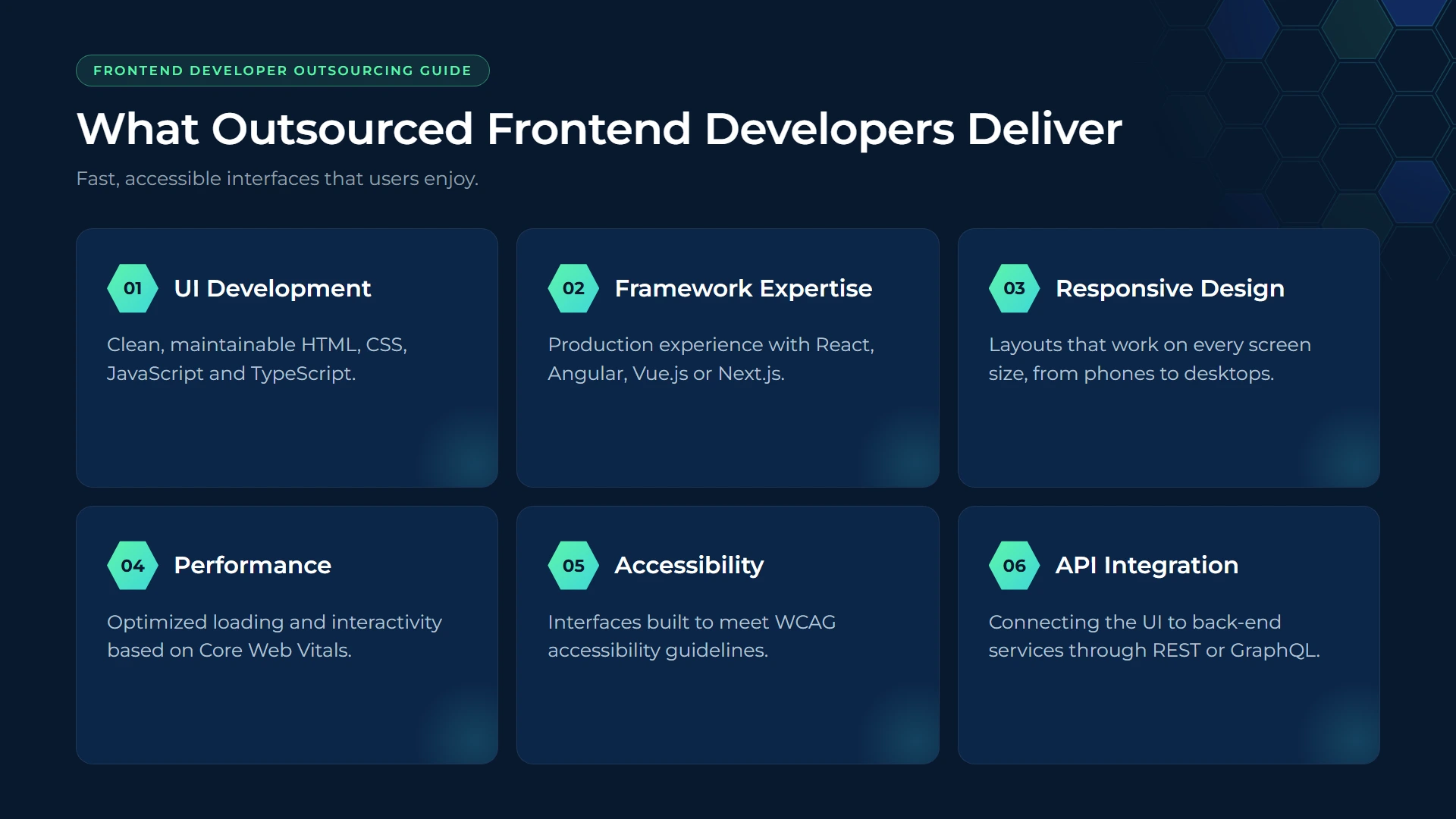
Frontend developer outsourcing is the practice of handing off the client-side layer of an application — everything a user sees, clicks, and scrolls through — to an external developer, freelancer, or agency rather than building that capability in-house. That covers UI implementation, responsive layouts, state management, accessibility, performance tuning, and often integration with backend APIs.
It's distinct from full-stack outsourcing, where a vendor owns both the client and server sides. Many teams outsource just the frontend because they already have backend engineers in-house, or because the frontend is the bottleneck — a common scenario when a product's API is stable but its interface needs a redesign, a framework migration, or multi-platform support.
Why Companies Outsource Frontend Work
- Cost efficiency — offshore and nearshore rates can be a fraction of local senior salaries.
- Speed — an established team can start contributing in days, not months.
- Specialized skills — niche needs like WebGL, design systems, or accessibility audits often don't justify a full-time hire.
- Flexibility — teams can scale frontend capacity up or down with product demand.
- Focus — internal teams stay concentrated on core product and backend logic.
Engagement Models: Which One Fits?
Not every project needs the same relationship. Picking the wrong model is one of the most common reasons outsourced frontend work disappoints — a one-off landing page doesn't need a dedicated team, and a multi-year product roadmap rarely works well as a fixed-price project.
Staff augmentation tends to work best when there's already a product manager and tech lead in-house who can direct the work. Dedicated teams suit companies that need frontend capacity for the long haul but don't want the overhead of direct employment. Managed outsourcing is the right call for non-technical founders who need someone else to own the "how," not just the "who."

Add Frontend Development Support with NeoWork
Frontend developer outsourcing helps companies add development capacity for user interfaces, web applications, and recurring product work without expanding every technical role internally. At NeoWork, we provide remote teammates who can support frontend development within your existing product and engineering workflows. We handle recruitment, benefits, training, and ongoing engagement, while our teammates work inside your tools, codebase, and delivery processes. Our 91% annualized teammate retention rate and 3.2% candidate selectivity rate reflect our focus on selective hiring and longer-term team stability.
Our frontend development support model offers:
- frontend development support
- integration with your tools and processes
- recruitment and ongoing teammate support
Contact NeoWork to add frontend development capacity that fits your existing engineering team.
2026 Frontend Outsourcing Rates by Region
Pricing varies enormously depending on where talent is sourced and how senior the developer is. As of 2026, industry rate surveys put typical hourly ranges roughly as follows — treat these as directional, since actual quotes depend heavily on seniority, specialization, and vendor overhead.
Always confirm current numbers directly with a shortlisted vendor or a rate calculator before budgeting — these figures shift year to year and swing based on specialization (a React Native specialist costs more than a general HTML/CSS developer, for instance).
How to Choose the Right Outsourcing Partner
Price is the easiest thing to compare and often the worst thing to optimize for. A cheap frontend team that ships brittle code ends up costing more in rework than a pricier team that gets it right the first time.
Technical Vetting
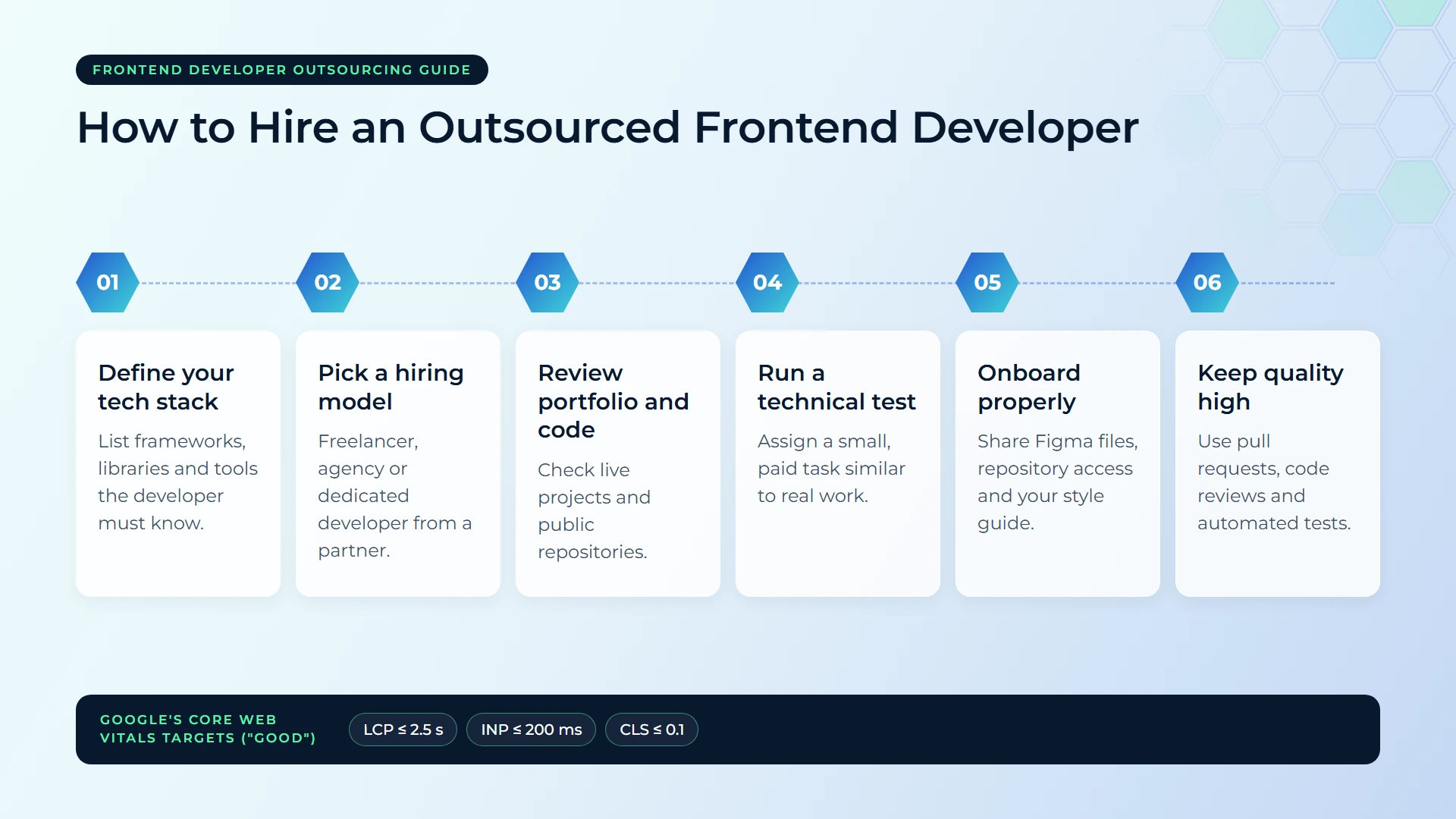
Look past the portfolio screenshots. Ask for a code sample, run a live technical interview, or commission a small paid trial task. Pay attention to how candidates handle component architecture, state management choices, and accessibility — these are the areas where junior-level outsourcing shops tend to cut corners.
Communication and Process
Daily standups, shared project boards, and clear async documentation matter more than raw talent when a team is distributed across time zones. A vendor that can't articulate its sprint process or testing approach in the sales call probably doesn't have one.
Portfolio Relevance
A team that's built dozens of marketing sites isn't automatically ready to build a complex dashboard with real-time data. Match the vendor's past work to the actual complexity of the project at hand — not just the industry.
Red Flags Worth Walking Away From
- Vague answers about who will actually be on the team day-to-day.
- No written process for code review or QA.
- Reluctance to sign an NDA or provide references.
- Pricing that's dramatically below the regional average with no clear explanation.
Managing an Outsourced Frontend Team
Signing the contract is the easy part. The real work starts once the sprints begin — and this is where most of the value (or most of the damage) actually happens.
Set up shared tools early: a project board (Jira, Linear, or similar), a design handoff tool (Figma is the default now), and a single source of truth for component libraries. Define a definition of "done" that includes code review, cross-browser testing, and accessibility checks — not just "it looks right on my screen."
Weekly syncs work better than daily ones for dedicated teams once trust is established, but daily async check-ins are worth keeping even then. And don't skip the kickoff documentation — a clear style guide, naming conventions, and Git workflow saves weeks of back-and-forth later.
Tools That Make Outsourcing Work
Cost vs. Quality: Finding the Balance
It's tempting to chase the lowest hourly rate on paper. But does that actually save money? Rarely, once rework, delays, and miscommunication get factored in.
A more reliable way to think about it: budget for the engagement model that fits the project's complexity, then pick the most technically credible vendor inside that budget band. A $25/hr developer who needs three revision rounds per feature isn't cheaper than a $45/hr developer who nails it on the first pass.
Final Thoughts
Frontend developer outsourcing works best when it's treated as a partnership, not a transaction. The companies that get the most value out of it define scope clearly, pick an engagement model that matches the actual work, and vet partners on substance rather than the lowest quoted rate.
So before sending out that first RFP, get specific: what does the project actually need, what's the realistic budget band for that scope, and what does "done well" look like in six months? Nail those three questions first, and the vendor search gets a lot easier. Start by shortlisting two or three partners, run a small paid trial task with each, and let the results — not the pitch deck — make the final call.
Topics
Frontend Developer Outsourcing Guide for 2026

Quick Summary: Frontend developer outsourcing means hiring external specialists or agencies to build and maintain the client-side layer of a web or mobile product, typically to cut costs, access scarce skills, or speed up delivery. The right approach depends on matching an engagement model (staff augmentation, dedicated team, or project-based) to project scope, then vetting partners on technical depth, communication, and portfolio fit rather than price alone. In 2026, rates range from roughly $15/hr in South Asia to $150/hr for senior North American talent, with most mid-market teams landing in the 30-70/hr range.
Hiring a full in-house frontend team sounds great until payroll, benefits, and recruiting timelines start eating into the runway. That's usually the moment founders and engineering leads start typing "frontend developer outsourcing" into Google at 11pm.
Here's the thing though — outsourcing frontend work isn't just a budget hack anymore. Frameworks like React, Vue, and Svelte evolve fast, accessibility and performance standards keep tightening, and finding developers who are genuinely strong across UI engineering, state management, and design-system thinking is harder than most job postings admit. Outsourcing, done well, is often the fastest way to get that expertise without a six-month hiring cycle.
This guide walks through what frontend outsourcing actually involves, the engagement models worth knowing, realistic 2026 pricing, how to vet a partner, and the mistakes that sink most outsourced projects before they ship.
What Is Frontend Developer Outsourcing?
Frontend developer outsourcing is the practice of handing off the client-side layer of an application — everything a user sees, clicks, and scrolls through — to an external developer, freelancer, or agency rather than building that capability in-house. That covers UI implementation, responsive layouts, state management, accessibility, performance tuning, and often integration with backend APIs.
It's distinct from full-stack outsourcing, where a vendor owns both the client and server sides. Many teams outsource just the frontend because they already have backend engineers in-house, or because the frontend is the bottleneck — a common scenario when a product's API is stable but its interface needs a redesign, a framework migration, or multi-platform support.
Why Companies Outsource Frontend Work
- Cost efficiency — offshore and nearshore rates can be a fraction of local senior salaries.
- Speed — an established team can start contributing in days, not months.
- Specialized skills — niche needs like WebGL, design systems, or accessibility audits often don't justify a full-time hire.
- Flexibility — teams can scale frontend capacity up or down with product demand.
- Focus — internal teams stay concentrated on core product and backend logic.
Engagement Models: Which One Fits?
Not every project needs the same relationship. Picking the wrong model is one of the most common reasons outsourced frontend work disappoints — a one-off landing page doesn't need a dedicated team, and a multi-year product roadmap rarely works well as a fixed-price project.
Staff augmentation tends to work best when there's already a product manager and tech lead in-house who can direct the work. Dedicated teams suit companies that need frontend capacity for the long haul but don't want the overhead of direct employment. Managed outsourcing is the right call for non-technical founders who need someone else to own the "how," not just the "who."
Add Frontend Development Support with NeoWork
Frontend developer outsourcing helps companies add development capacity for user interfaces, web applications, and recurring product work without expanding every technical role internally. At NeoWork, we provide remote teammates who can support frontend development within your existing product and engineering workflows. We handle recruitment, benefits, training, and ongoing engagement, while our teammates work inside your tools, codebase, and delivery processes. Our 91% annualized teammate retention rate and 3.2% candidate selectivity rate reflect our focus on selective hiring and longer-term team stability.
Our frontend development support model offers:
- frontend development support
- integration with your tools and processes
- recruitment and ongoing teammate support
Contact NeoWork to add frontend development capacity that fits your existing engineering team.
2026 Frontend Outsourcing Rates by Region
Pricing varies enormously depending on where talent is sourced and how senior the developer is. As of 2026, industry rate surveys put typical hourly ranges roughly as follows — treat these as directional, since actual quotes depend heavily on seniority, specialization, and vendor overhead.
Always confirm current numbers directly with a shortlisted vendor or a rate calculator before budgeting — these figures shift year to year and swing based on specialization (a React Native specialist costs more than a general HTML/CSS developer, for instance).
How to Choose the Right Outsourcing Partner
Price is the easiest thing to compare and often the worst thing to optimize for. A cheap frontend team that ships brittle code ends up costing more in rework than a pricier team that gets it right the first time.
Technical Vetting
Look past the portfolio screenshots. Ask for a code sample, run a live technical interview, or commission a small paid trial task. Pay attention to how candidates handle component architecture, state management choices, and accessibility — these are the areas where junior-level outsourcing shops tend to cut corners.
Communication and Process
Daily standups, shared project boards, and clear async documentation matter more than raw talent when a team is distributed across time zones. A vendor that can't articulate its sprint process or testing approach in the sales call probably doesn't have one.
Portfolio Relevance
A team that's built dozens of marketing sites isn't automatically ready to build a complex dashboard with real-time data. Match the vendor's past work to the actual complexity of the project at hand — not just the industry.
Red Flags Worth Walking Away From
- Vague answers about who will actually be on the team day-to-day.
- No written process for code review or QA.
- Reluctance to sign an NDA or provide references.
- Pricing that's dramatically below the regional average with no clear explanation.
Managing an Outsourced Frontend Team
Signing the contract is the easy part. The real work starts once the sprints begin — and this is where most of the value (or most of the damage) actually happens.
Set up shared tools early: a project board (Jira, Linear, or similar), a design handoff tool (Figma is the default now), and a single source of truth for component libraries. Define a definition of "done" that includes code review, cross-browser testing, and accessibility checks — not just "it looks right on my screen."
Weekly syncs work better than daily ones for dedicated teams once trust is established, but daily async check-ins are worth keeping even then. And don't skip the kickoff documentation — a clear style guide, naming conventions, and Git workflow saves weeks of back-and-forth later.
Tools That Make Outsourcing Work
Cost vs. Quality: Finding the Balance
It's tempting to chase the lowest hourly rate on paper. But does that actually save money? Rarely, once rework, delays, and miscommunication get factored in.
A more reliable way to think about it: budget for the engagement model that fits the project's complexity, then pick the most technically credible vendor inside that budget band. A $25/hr developer who needs three revision rounds per feature isn't cheaper than a $45/hr developer who nails it on the first pass.
Final Thoughts
Frontend developer outsourcing works best when it's treated as a partnership, not a transaction. The companies that get the most value out of it define scope clearly, pick an engagement model that matches the actual work, and vet partners on substance rather than the lowest quoted rate.
So before sending out that first RFP, get specific: what does the project actually need, what's the realistic budget band for that scope, and what does "done well" look like in six months? Nail those three questions first, and the vendor search gets a lot easier. Start by shortlisting two or three partners, run a small paid trial task with each, and let the results — not the pitch deck — make the final call.
Topics
Related Blogs
Related Podcasts