



Frontend Team Augmentation Guide for 2026




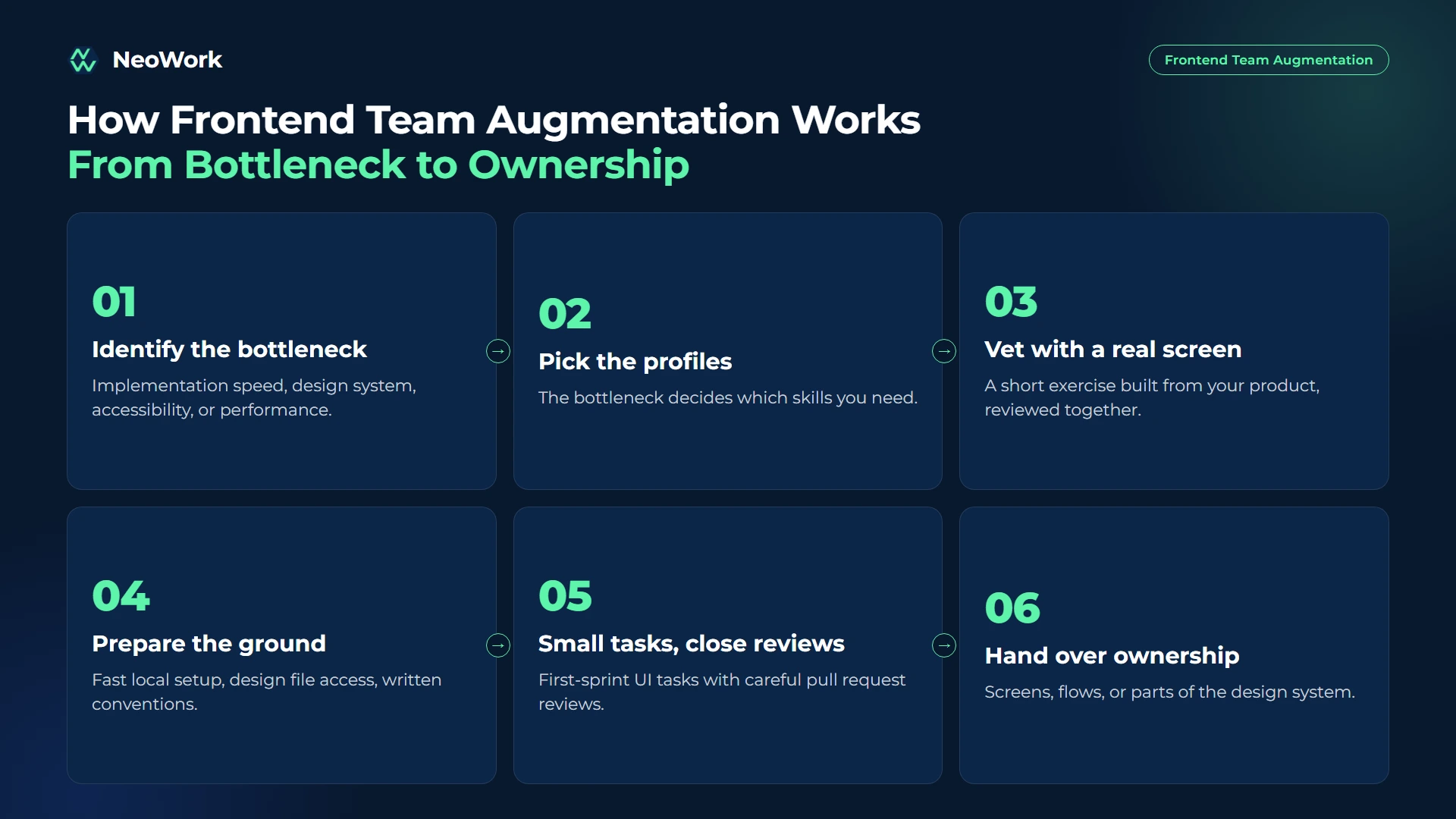
Quick Summary: Frontend team augmentation means adding external frontend engineers, or a small frontend pod, to your product team so they build user interfaces inside your codebase, design system, and sprint process. It helps companies ship designs faster, keep UI consistent, and bring in skills like accessibility and performance optimization without long hiring cycles. JavaScript has been the most used language in Stack Overflow's developer survey for more than a decade, so finding frontend developers isn't the hard part; finding senior ones who can work across design, accessibility, and performance is. This guide covers why teams augment frontend capacity, which skills are in demand, how augmentation compares with agencies and freelancers, how the process works, and the pitfalls to avoid.
Most product teams know the feeling. Designers finish screens faster than engineers can build them, the backlog of "ready for development" designs keeps growing, and every launch slips by a sprint or two because the UI isn't done.
Frontend team augmentation is often the quickest way to close that gap. But adding engineers to a frontend codebase without shared conventions can make things worse before they get better. This guide covers how to do it properly.
What Is Frontend Team Augmentation?
Frontend team augmentation is an engagement model where a provider supplies dedicated frontend engineers who join your product team. They work from your designs and backlog, use your component library, take part in design and code reviews, and ship through your pipelines. The provider handles recruitment, employment, and continuity.
It's different from hiring a design and development agency. An agency usually owns a defined project, such as a marketing site, and hands it over at the end. Augmented engineers stay with your product and build knowledge of it over time.
Why Companies Augment Their Frontend Teams
- Design is ahead of development: Finished designs wait weeks for implementation.
- UI is inconsistent: Several squads build their own versions of the same components.
- Accessibility needs attention: Audits, legal requirements, or user complaints demand focused work.
- Pages are slow: Core Web Vitals and bundle size affect SEO and conversion.
- Framework migrations stall: Moving to a newer framework version competes with feature work.
Frontend Skills in Highest Demand

Add Frontend Engineers with NeoWork
Frontend team augmentation helps companies add UI development capacity without building every role in-house. At NeoWork, we provide dedicated frontend engineers through individual contributor and team structures. We handle recruitment, benefits, training, and ongoing engagement, while our teammates integrate into your codebase, design tools, and sprint process. Our industry-leading 91% annualized teammate retention rate and 3.2% candidate selectivity rate reflect our focus on selective hiring and long-term team stability.
Our frontend team augmentation model offers:
- dedicated frontend development support
- integration with your tools and processes
- recruitment and ongoing teammate support
Contact NeoWork to add frontend capacity that fits your existing product team.
Augmentation vs. Agency vs. Freelancers
Cost vs. Quality: Finding the Balance
It's tempting to chase the lowest monthly rate. But does a cheaper engineer actually cost less if every component needs rework, or if accessibility issues show up after launch? In frontend work, quality problems are visible to every user, which makes them expensive in ways that don't appear on an invoice.
A better approach is to budget for the skills your bottleneck requires. Design system and accessibility specialists cost more than feature developers, and senior leads cost more again, but one strong senior engineer can raise the quality of everyone around them. See how dedicated roles are structured on our pricing page.
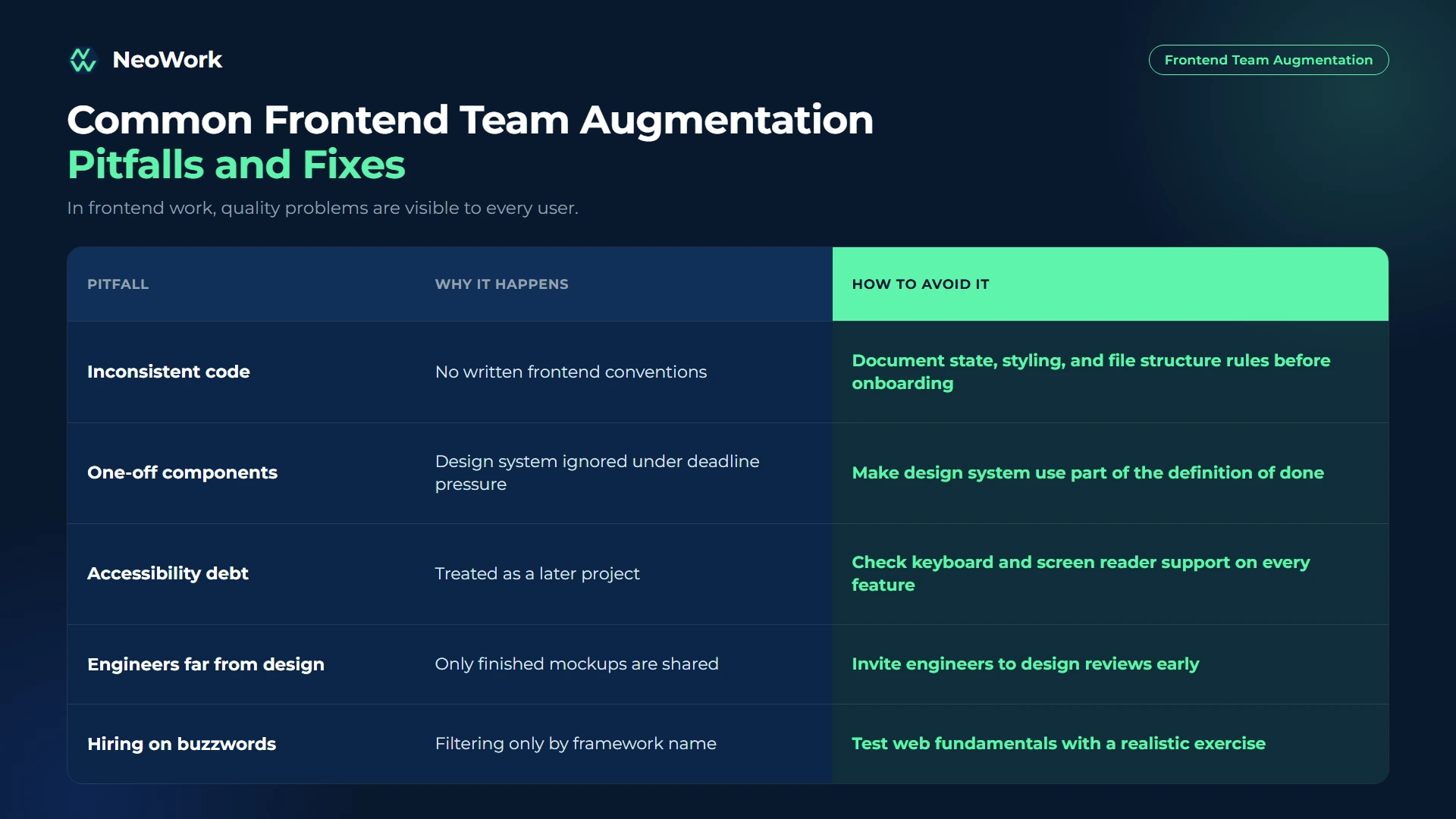
Common Pitfalls
Signs Your Frontend Team Needs Reinforcement
- Designs wait more than a sprint for implementation: the gap between design and development keeps growing.
- The same component exists in several versions: buttons, modals, and forms differ across screens.
- Lighthouse and Core Web Vitals scores are slipping: pages get slower with every release.
- Accessibility issues are reported by users or auditors: fixes compete with feature work.
- A framework upgrade has been postponed for months: the old version is becoming a risk.
Building a Frontend Definition of Done
A shared definition of done keeps quality consistent when new engineers join. It should be short enough that people actually use it. A practical version looks like this:
- Design match: the feature matches the approved design on agreed breakpoints.
- Design system use: existing components are used wherever they exist.
- Accessibility: new interactions work with a keyboard and a screen reader.
- Performance: the change stays within the agreed performance budget.
- Tests: critical behavior is covered by component or end-to-end tests.
- Review: another engineer has reviewed the code, and design has reviewed visible changes.
Working Effectively With Designers
Augmented frontend engineers do their best work when they're close to design, not downstream of it. Invite them to design reviews before designs are final, so they can flag technical constraints early and suggest simpler interactions. Give them access to design files and design system documentation from day one.
Edge cases deserve special attention. Designs rarely show empty states, error messages, loading states, or very long text, and those details often decide whether a feature feels polished. Agree on how engineers should handle them, and run a short visual QA session with design before major screens go live. When engineers build new patterns, feed them back into the design system instead of leaving them as one-offs.
Frontend Trends to Plan For in 2026
Frameworks keep moving toward server-side rendering and server components, which blurs the line between frontend and backend work. TypeScript has become the default in most professional codebases, and accessibility requirements are tightening in several markets. When choosing augmented engineers, look for people who are comfortable with these shifts rather than only with one framework version.
Real-World Scenario: Rescuing an Inconsistent UI
Picture a SaaS company with three product squads, each building its own version of buttons, tables, and forms. Customers notice small inconsistencies, accessibility issues pile up, and every visual change has to be made in several places.
The company adds a small augmented frontend pod: a senior frontend lead, a design system engineer, and an accessibility specialist. Over two quarters, the pod builds a shared component library with documented tokens, migrates the most used screens, and adds accessibility checks to the definition of done. The squads keep shipping features throughout, and new screens get faster to build because the components already exist.
FAQ
Final Thoughts
Frontend team augmentation works best when it targets a clear bottleneck: implementation speed, consistency, accessibility, or performance. Add the right profile, vet for fundamentals, write down your conventions, and keep engineers close to your designers.
So before contacting providers, look at your backlog and ask what's really slowing the UI down. The answer tells you exactly who to add.
Topics
Frontend Team Augmentation Guide for 2026

Quick Summary: Frontend team augmentation means adding external frontend engineers, or a small frontend pod, to your product team so they build user interfaces inside your codebase, design system, and sprint process. It helps companies ship designs faster, keep UI consistent, and bring in skills like accessibility and performance optimization without long hiring cycles. JavaScript has been the most used language in Stack Overflow's developer survey for more than a decade, so finding frontend developers isn't the hard part; finding senior ones who can work across design, accessibility, and performance is. This guide covers why teams augment frontend capacity, which skills are in demand, how augmentation compares with agencies and freelancers, how the process works, and the pitfalls to avoid.
Most product teams know the feeling. Designers finish screens faster than engineers can build them, the backlog of "ready for development" designs keeps growing, and every launch slips by a sprint or two because the UI isn't done.
Frontend team augmentation is often the quickest way to close that gap. But adding engineers to a frontend codebase without shared conventions can make things worse before they get better. This guide covers how to do it properly.
What Is Frontend Team Augmentation?
Frontend team augmentation is an engagement model where a provider supplies dedicated frontend engineers who join your product team. They work from your designs and backlog, use your component library, take part in design and code reviews, and ship through your pipelines. The provider handles recruitment, employment, and continuity.
It's different from hiring a design and development agency. An agency usually owns a defined project, such as a marketing site, and hands it over at the end. Augmented engineers stay with your product and build knowledge of it over time.
Why Companies Augment Their Frontend Teams
- Design is ahead of development: Finished designs wait weeks for implementation.
- UI is inconsistent: Several squads build their own versions of the same components.
- Accessibility needs attention: Audits, legal requirements, or user complaints demand focused work.
- Pages are slow: Core Web Vitals and bundle size affect SEO and conversion.
- Framework migrations stall: Moving to a newer framework version competes with feature work.
Frontend Skills in Highest Demand
Add Frontend Engineers with NeoWork
Frontend team augmentation helps companies add UI development capacity without building every role in-house. At NeoWork, we provide dedicated frontend engineers through individual contributor and team structures. We handle recruitment, benefits, training, and ongoing engagement, while our teammates integrate into your codebase, design tools, and sprint process. Our industry-leading 91% annualized teammate retention rate and 3.2% candidate selectivity rate reflect our focus on selective hiring and long-term team stability.
Our frontend team augmentation model offers:
- dedicated frontend development support
- integration with your tools and processes
- recruitment and ongoing teammate support
Contact NeoWork to add frontend capacity that fits your existing product team.
Augmentation vs. Agency vs. Freelancers
Cost vs. Quality: Finding the Balance
It's tempting to chase the lowest monthly rate. But does a cheaper engineer actually cost less if every component needs rework, or if accessibility issues show up after launch? In frontend work, quality problems are visible to every user, which makes them expensive in ways that don't appear on an invoice.
A better approach is to budget for the skills your bottleneck requires. Design system and accessibility specialists cost more than feature developers, and senior leads cost more again, but one strong senior engineer can raise the quality of everyone around them. See how dedicated roles are structured on our pricing page.
Common Pitfalls
Signs Your Frontend Team Needs Reinforcement
- Designs wait more than a sprint for implementation: the gap between design and development keeps growing.
- The same component exists in several versions: buttons, modals, and forms differ across screens.
- Lighthouse and Core Web Vitals scores are slipping: pages get slower with every release.
- Accessibility issues are reported by users or auditors: fixes compete with feature work.
- A framework upgrade has been postponed for months: the old version is becoming a risk.
Building a Frontend Definition of Done
A shared definition of done keeps quality consistent when new engineers join. It should be short enough that people actually use it. A practical version looks like this:
- Design match: the feature matches the approved design on agreed breakpoints.
- Design system use: existing components are used wherever they exist.
- Accessibility: new interactions work with a keyboard and a screen reader.
- Performance: the change stays within the agreed performance budget.
- Tests: critical behavior is covered by component or end-to-end tests.
- Review: another engineer has reviewed the code, and design has reviewed visible changes.
Working Effectively With Designers
Augmented frontend engineers do their best work when they're close to design, not downstream of it. Invite them to design reviews before designs are final, so they can flag technical constraints early and suggest simpler interactions. Give them access to design files and design system documentation from day one.
Edge cases deserve special attention. Designs rarely show empty states, error messages, loading states, or very long text, and those details often decide whether a feature feels polished. Agree on how engineers should handle them, and run a short visual QA session with design before major screens go live. When engineers build new patterns, feed them back into the design system instead of leaving them as one-offs.
Frontend Trends to Plan For in 2026
Frameworks keep moving toward server-side rendering and server components, which blurs the line between frontend and backend work. TypeScript has become the default in most professional codebases, and accessibility requirements are tightening in several markets. When choosing augmented engineers, look for people who are comfortable with these shifts rather than only with one framework version.
Real-World Scenario: Rescuing an Inconsistent UI
Picture a SaaS company with three product squads, each building its own version of buttons, tables, and forms. Customers notice small inconsistencies, accessibility issues pile up, and every visual change has to be made in several places.
The company adds a small augmented frontend pod: a senior frontend lead, a design system engineer, and an accessibility specialist. Over two quarters, the pod builds a shared component library with documented tokens, migrates the most used screens, and adds accessibility checks to the definition of done. The squads keep shipping features throughout, and new screens get faster to build because the components already exist.
FAQ
Final Thoughts
Frontend team augmentation works best when it targets a clear bottleneck: implementation speed, consistency, accessibility, or performance. Add the right profile, vet for fundamentals, write down your conventions, and keep engineers close to your designers.
So before contacting providers, look at your backlog and ask what's really slowing the UI down. The answer tells you exactly who to add.
Topics
Related Blogs
Related Podcasts





