

Updated:
Oct 6
2026
.avif)
.avif)

.svg)

Quick Summary: Game environment outsourcing means hiring an external studio or freelance team to build levels, modular kits, props, and background art instead of growing an in-house environment team. Done well, it speeds up production, fills skill gaps, and frees internal artists to focus on hero assets and art direction. The key to success is picking the right engagement model, writing clear briefs, and setting up a review pipeline before a single asset gets made.
Every studio hits the same wall eventually. The game's scope keeps growing, the internal team is stretched across characters, UI, and gameplay systems, and someone still needs to build forty variations of a ruined city block. That's usually the moment environment outsourcing gets a serious look.
It's not a new idea. Big studios have leaned on external environment art teams for years to hit milestones without permanently expanding headcount. What's changed is how accessible this has become for small and mid-size teams too. There are now hundreds of specialist studios and freelance collectives built specifically around environment art, modular kit production, and world-building pipelines.
This guide walks through what game environment outsourcing actually involves, when it makes sense, how pricing tends to work, and how to avoid the mistakes that turn a cost-saving decision into a production headache.
Environment art is a broad category, and outsourcing partners often specialize in particular parts of the production pipeline rather than handling everything at once.
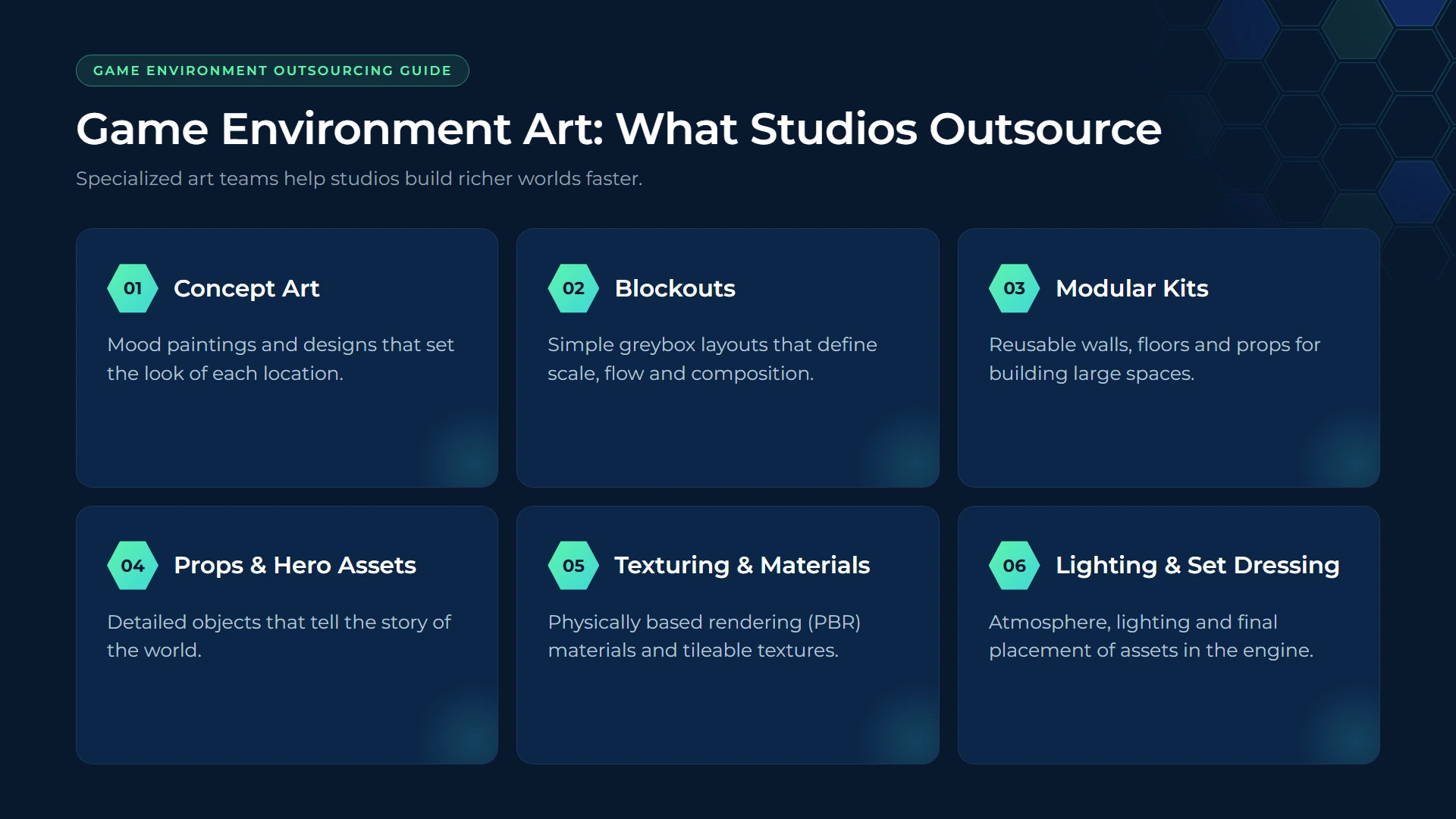
These include walls, floors, props, trims, and reusable architectural pieces designed to fit together efficiently. They are especially useful for building larger levels while keeping production time and asset consistency under control.
Hero assets are unique, high-detail elements that draw attention within a level. Examples include boss arenas, major landmarks, signature buildings, or important story locations that need more custom work than standard environment assets.
Studios may also produce distant scenery, skyboxes, painted backgrounds, and other visual elements that help establish scale and atmosphere without requiring fully modeled 3D environments.
This can cover trees, rocks, terrain textures, vegetation sets, and other natural assets. Outsourcing teams may also prepare reusable systems for scattering foliage across larger environments.
Some partners go beyond asset creation and help assemble the scene itself. That can include placing props, refining composition, adjusting lighting, and improving mood and readability.
The scope can be narrow or extensive. One studio might outsource only modular kits for a new biome, while another hands over an entire level from blockout through final polish. The right setup depends on budget, deadlines, and how much creative control the internal team wants to keep.
The reasons tend to repeat across projects, regardless of studio size.
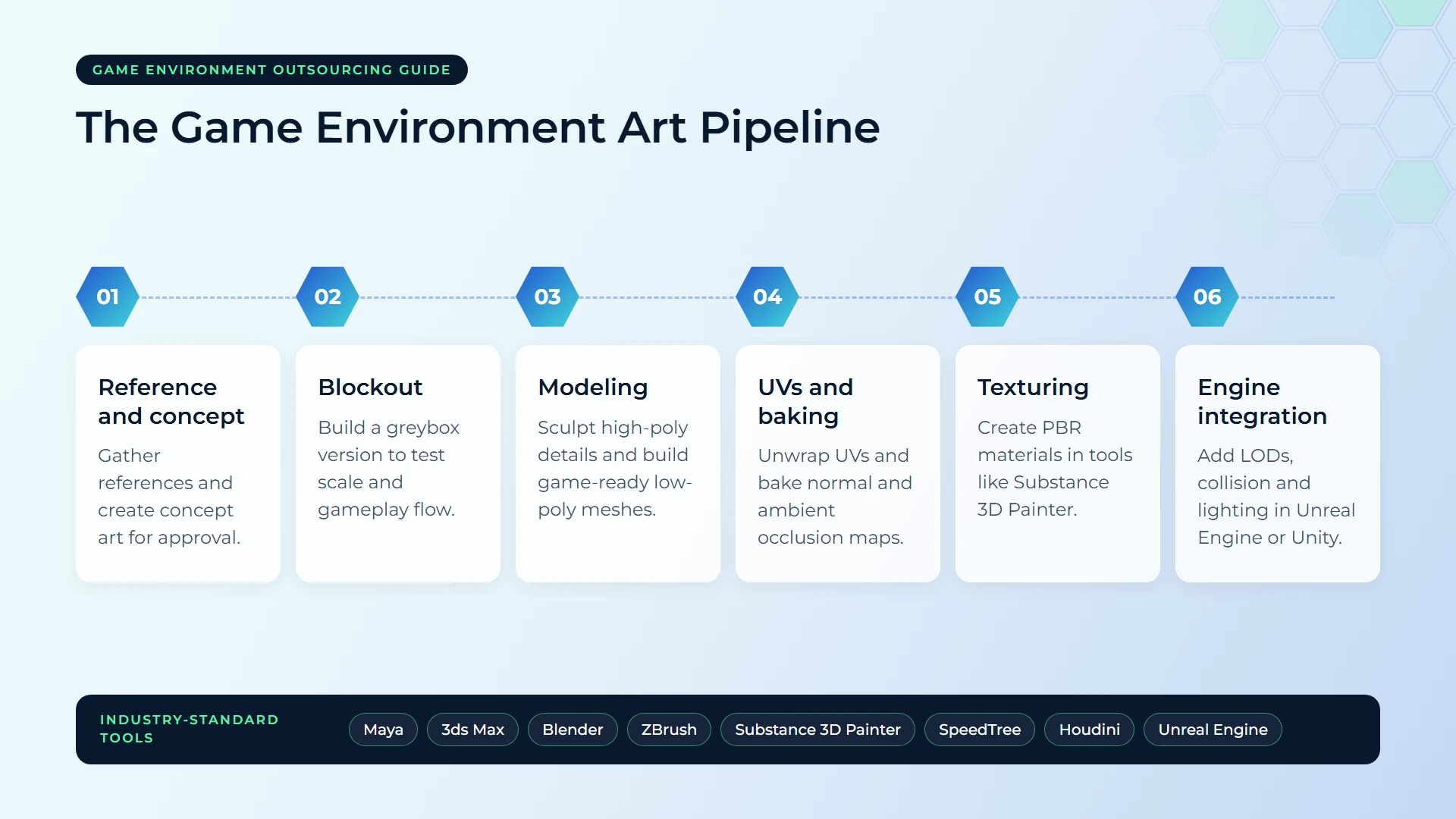
Not every outsourcing deal looks the same. The model picked affects pricing, communication frequency, and how much control the internal team keeps.
Project-based contracts work well for a clearly scoped deliverable, like a single biome's modular kit. Dedicated teams make more sense when environment needs will keep shifting as the game evolves, since the partner studio stays embedded and learns the project's style over time.

Game environment outsourcing helps studios add capacity for recurring design, production, and creative workflows without expanding every role in-house. At NeoWork, we provide remote teammates who can support creative and technical production within your existing game development process. We handle recruitment, benefits, training, and ongoing engagement, while our teammates work inside your tools, pipelines, and project workflows. Our 91% annualized teammate retention rate and 3.2% candidate selectivity rate reflect our focus on selective hiring and longer-term team stability.
Our game environment support model offers:
Contact NeoWork to add game environment support that works alongside your existing team.
Pricing varies enormously by region, asset complexity, and studio reputation, so treat any number here as a rough planning range rather than a quote. Generally, costs scale with polish level — a stylized low-poly prop costs a fraction of a photoreal hero asset with custom sculpted detail and multiple texture passes.
Studios usually see lower rates from teams based in regions with lower cost of living, though quality variance there can be wider too. It's worth asking any potential partner for a representative cost breakdown tied to specific asset types rather than a single flat day rate — that makes budgeting against a milestone far more accurate. Current market rates shift year to year, so check directly with shortlisted studios for up-to-date quotes rather than relying on older published figures.
In-house teams offer tighter creative alignment and faster day-to-day iteration since everyone sits inside the same studio culture. Outsourced teams trade a bit of that immediacy for flexibility, specialist skill access, and lower fixed overhead. Most mid-size and large studios end up running a hybrid — a core internal art team handling direction and hero pieces, with external partners covering volume production.
This is where a lot of outsourcing relationships go wrong — not because the external team lacks skill, but because the vetting process skipped steps that would've surfaced a mismatch early.
Start with portfolio review, but go past the highlight reel. Ask for examples of work in the specific style the project needs — a studio great at gritty realism might struggle with a bright stylized look, and vice versa. Request a small paid test task before committing to a larger contract; it reveals communication speed, how closely a brief gets followed, and whether revision requests get handled gracefully.
Check references from past clients if possible, and pay attention to how the studio handles pipeline integration. Can they work in the engine already in use? Do they understand the naming conventions and folder structure the internal team needs? These details matter more than they sound.
Before any asset gets made, the contract should spell out who owns the final files, what happens to reference material and intermediate work, confidentiality terms around unannounced projects, and payment milestones tied to deliverables rather than just time elapsed. Studios handling unannounced titles often require an NDA before even sharing concept art, which is reasonable and worth building into the timeline.
It also helps to agree on a defined number of revision rounds per asset in the contract itself. Open-ended "revise until happy" clauses sound generous but tend to blow out timelines on both sides.
Game environment outsourcing isn't a shortcut — it's a production tool. Used with a clear brief, a sensible engagement model, and a contract that protects both sides, it lets studios scale output without permanently expanding the team. Used carelessly, with vague direction and no review checkpoints, it creates rework that costs more than it saves.
The studios that get the most out of outsourcing tend to treat the partner like an extension of the internal art department rather than a vendor placing an order. Start small with a test task, build the relationship over a defined project, and expand from there once the pipeline proves itself. That's generally a safer path than committing to a full level on a first engagement.

Quick Summary: Game environment outsourcing means hiring an external studio or freelance team to build levels, modular kits, props, and background art instead of growing an in-house environment team. Done well, it speeds up production, fills skill gaps, and frees internal artists to focus on hero assets and art direction. The key to success is picking the right engagement model, writing clear briefs, and setting up a review pipeline before a single asset gets made.
Every studio hits the same wall eventually. The game's scope keeps growing, the internal team is stretched across characters, UI, and gameplay systems, and someone still needs to build forty variations of a ruined city block. That's usually the moment environment outsourcing gets a serious look.
It's not a new idea. Big studios have leaned on external environment art teams for years to hit milestones without permanently expanding headcount. What's changed is how accessible this has become for small and mid-size teams too. There are now hundreds of specialist studios and freelance collectives built specifically around environment art, modular kit production, and world-building pipelines.
This guide walks through what game environment outsourcing actually involves, when it makes sense, how pricing tends to work, and how to avoid the mistakes that turn a cost-saving decision into a production headache.
Environment art is a broad category, and outsourcing partners often specialize in particular parts of the production pipeline rather than handling everything at once.
These include walls, floors, props, trims, and reusable architectural pieces designed to fit together efficiently. They are especially useful for building larger levels while keeping production time and asset consistency under control.
Hero assets are unique, high-detail elements that draw attention within a level. Examples include boss arenas, major landmarks, signature buildings, or important story locations that need more custom work than standard environment assets.
Studios may also produce distant scenery, skyboxes, painted backgrounds, and other visual elements that help establish scale and atmosphere without requiring fully modeled 3D environments.
This can cover trees, rocks, terrain textures, vegetation sets, and other natural assets. Outsourcing teams may also prepare reusable systems for scattering foliage across larger environments.
Some partners go beyond asset creation and help assemble the scene itself. That can include placing props, refining composition, adjusting lighting, and improving mood and readability.
The scope can be narrow or extensive. One studio might outsource only modular kits for a new biome, while another hands over an entire level from blockout through final polish. The right setup depends on budget, deadlines, and how much creative control the internal team wants to keep.
The reasons tend to repeat across projects, regardless of studio size.
Not every outsourcing deal looks the same. The model picked affects pricing, communication frequency, and how much control the internal team keeps.
Project-based contracts work well for a clearly scoped deliverable, like a single biome's modular kit. Dedicated teams make more sense when environment needs will keep shifting as the game evolves, since the partner studio stays embedded and learns the project's style over time.
Game environment outsourcing helps studios add capacity for recurring design, production, and creative workflows without expanding every role in-house. At NeoWork, we provide remote teammates who can support creative and technical production within your existing game development process. We handle recruitment, benefits, training, and ongoing engagement, while our teammates work inside your tools, pipelines, and project workflows. Our 91% annualized teammate retention rate and 3.2% candidate selectivity rate reflect our focus on selective hiring and longer-term team stability.
Our game environment support model offers:
Contact NeoWork to add game environment support that works alongside your existing team.
Pricing varies enormously by region, asset complexity, and studio reputation, so treat any number here as a rough planning range rather than a quote. Generally, costs scale with polish level — a stylized low-poly prop costs a fraction of a photoreal hero asset with custom sculpted detail and multiple texture passes.
Studios usually see lower rates from teams based in regions with lower cost of living, though quality variance there can be wider too. It's worth asking any potential partner for a representative cost breakdown tied to specific asset types rather than a single flat day rate — that makes budgeting against a milestone far more accurate. Current market rates shift year to year, so check directly with shortlisted studios for up-to-date quotes rather than relying on older published figures.
In-house teams offer tighter creative alignment and faster day-to-day iteration since everyone sits inside the same studio culture. Outsourced teams trade a bit of that immediacy for flexibility, specialist skill access, and lower fixed overhead. Most mid-size and large studios end up running a hybrid — a core internal art team handling direction and hero pieces, with external partners covering volume production.
This is where a lot of outsourcing relationships go wrong — not because the external team lacks skill, but because the vetting process skipped steps that would've surfaced a mismatch early.
Start with portfolio review, but go past the highlight reel. Ask for examples of work in the specific style the project needs — a studio great at gritty realism might struggle with a bright stylized look, and vice versa. Request a small paid test task before committing to a larger contract; it reveals communication speed, how closely a brief gets followed, and whether revision requests get handled gracefully.
Check references from past clients if possible, and pay attention to how the studio handles pipeline integration. Can they work in the engine already in use? Do they understand the naming conventions and folder structure the internal team needs? These details matter more than they sound.
Before any asset gets made, the contract should spell out who owns the final files, what happens to reference material and intermediate work, confidentiality terms around unannounced projects, and payment milestones tied to deliverables rather than just time elapsed. Studios handling unannounced titles often require an NDA before even sharing concept art, which is reasonable and worth building into the timeline.
It also helps to agree on a defined number of revision rounds per asset in the contract itself. Open-ended "revise until happy" clauses sound generous but tend to blow out timelines on both sides.
Game environment outsourcing isn't a shortcut — it's a production tool. Used with a clear brief, a sensible engagement model, and a contract that protects both sides, it lets studios scale output without permanently expanding the team. Used carelessly, with vague direction and no review checkpoints, it creates rework that costs more than it saves.
The studios that get the most out of outsourcing tend to treat the partner like an extension of the internal art department rather than a vendor placing an order. Start small with a test task, build the relationship over a defined project, and expand from there once the pipeline proves itself. That's generally a safer path than committing to a full level on a first engagement.



.webp)

.webp)