
Updated:
Oct 4
2026
.avif)
.avif)

.svg)

Quick Summary: Medical transcription outsourcing means handing dictated clinical notes to an external vendor that returns formatted, proofread documentation for the medical record. The right choice depends on turnaround requirements, HIPAA-grade security controls, pricing model, and how much human review backs up the speech-to-text engine. Clinics that vet vendors on these four factors tend to avoid the rework and compliance headaches that sink the rest.
Dictation piles up fast. A single physician can generate dozens of notes a day, and somebody has to turn that audio into a clean, billable chart entry. Outsourcing that work isn't a new idea, but the way it's done has changed a lot over the past few years, and the vendor landscape in 2026 looks very different from what it did even three years ago.
This guide walks through what medical transcription outsourcing actually involves, how to judge a vendor's quality and compliance posture, what it tends to cost, and how to avoid the mistakes that turn a cost-saving decision into a documentation mess.
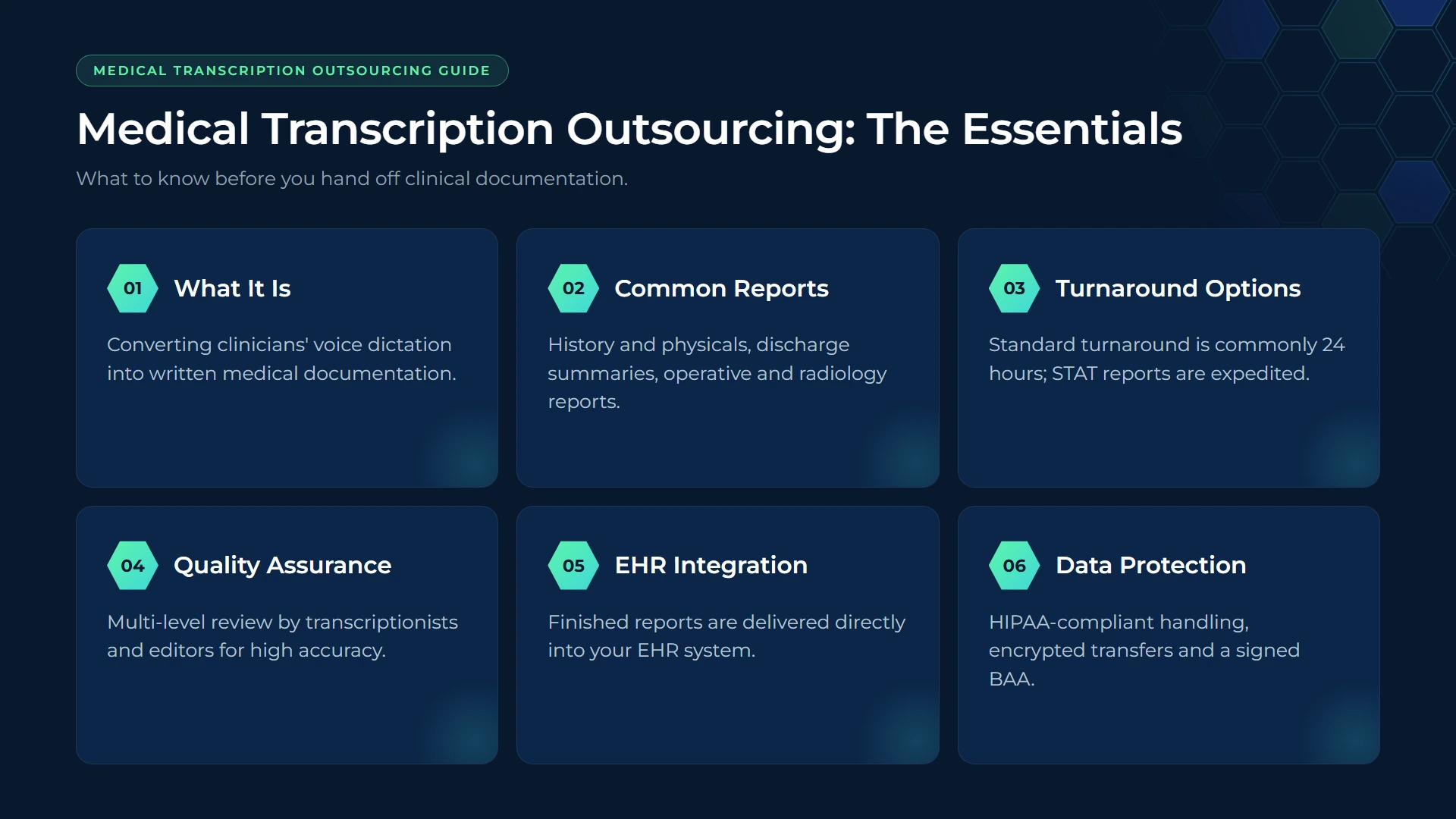
At its core, outsourcing transfers one task: converting spoken clinical notes into written documentation that can live in a patient's chart. A provider dictates observations, a diagnosis, a treatment plan, or discharge instructions using a phone line, a handheld recorder, or a digital dictation app tied to the EHR. That audio file then leaves the building.
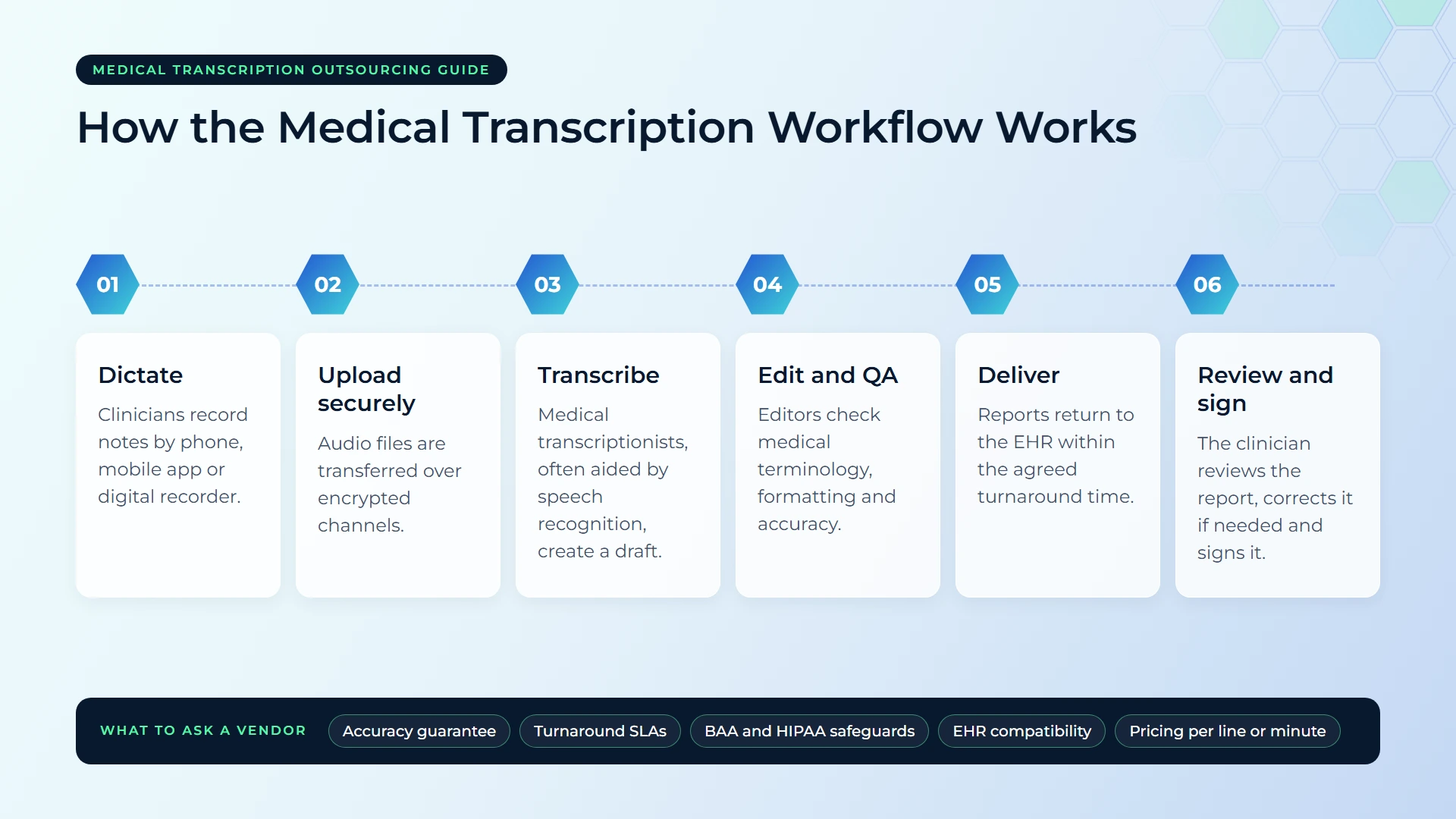
From there, most vendors run the file through an automated speech recognition engine first. A human editor then reviews the draft, checks it against clinical terminology, fixes misheard drug names or dosages, and formats the note to match the practice's template. The finished document gets delivered back — usually straight into the EHR — within a contracted turnaround window.
That's the simple version. In practice, vendors differ wildly in how much human oversight actually happens, where that work gets done, and how tightly the whole pipeline is locked down.
This is usually the first fork in the road, and it shapes almost everything else — price, turnaround, and risk exposure.
Transcriptionists work within the same country as the practice. Costs run higher, but data stays under local jurisdiction and time-zone alignment is simpler for urgent documentation. This model can be a better fit for organizations that prioritize fast turnaround, tighter oversight, or locally managed compliance.
Work is handled in lower-cost labor markets, often India or the Philippines. Pricing can drop significantly, sometimes by half, but practices need to look closely at data-handling agreements, security controls, and any rules covering cross-border data transfers.
A hybrid setup combines both approaches — offshore teams for routine notes and domestic staff for specialty, high-priority, or urgent dictation. More vendors are offering this model because it can balance lower costs with more dependable turnaround for time-sensitive work.
Neither model is inherently better. A small dermatology practice with predictable, low-urgency notes might do perfectly well with offshore support, while a trauma center that needs same-hour discharge summaries may be better suited to a domestic or hybrid model.

Medical transcription outsourcing helps healthcare organizations manage recurring documentation and transcription workflows without adding more work to internal administrative teams. At NeoWork, we provide remote teammates who can support structured healthcare documentation and related back-office tasks within your existing systems and processes. We handle recruitment, benefits, training, and ongoing engagement, while our teammates follow your procedures, tools, and quality requirements. Our 91% annualized teammate retention rate and 3.2% candidate selectivity rate reflect our focus on selective hiring and longer-term team stability.
Our medical transcription support model offers:
Contact NeoWork to add medical transcription support for recurring documentation workflows.
Handing patient audio to a third party is, legally speaking, no different from handing them a paper chart. HIPAA still applies, and the practice remains accountable even when a vendor drops the ball.
Before signing anything, confirm the vendor can produce:
Offshore vendors aren't automatically less secure, but the compliance paperwork takes more digging. Ask specifically where servers are physically located and which jurisdiction's privacy law applies to any subcontracted staff.
Medical transcription pricing isn't one-size-fits-all, and comparing quotes across vendors without normalizing the unit of billing is how practices end up overpaying.
Published per-line or per-minute rates vary by vendor, specialty complexity, and turnaround tier, so it's worth requesting a written quote based on an actual sample of the practice's dictation rather than relying on a generic rate card. Check a vendor's official pricing page for current numbers before comparing bids.
"Accuracy" gets thrown around a lot in vendor marketing, but the number means little without context. A vendor claiming 99% accuracy on a clean, slow-paced dictation sample tells you almost nothing about how it handles a mumbled overnight ER note full of drug names.
Better questions to ask during vendor selection:
A good vendor will happily run a paid or free pilot batch before any long-term contract. If a vendor resists a trial run, that's worth noting.
Outsourcing isn't the only path, and plenty of practices run a mix. Here's how the three common approaches stack up.
Most mature vendors today actually combine the second and third rows — automated drafting backed by human editors — rather than offering pure AI with zero human review. Worth asking directly where a vendor sits on that spectrum, since "AI-powered" marketing language can mean very different levels of human oversight.
A few warning signs show up again and again in practices that end up switching vendors within the first year:
None of these are automatic deal-breakers on their own, but two or more together is usually a sign to keep looking.
Switching vendors — or moving off in-house transcription entirely — goes more smoothly with a short overlap period. Run the new vendor alongside the existing process for two to four weeks, comparing a sample of finished notes side by side before fully cutting over. That catches template mismatches and terminology gaps before they hit the live chart.
It also helps to give the vendor a style guide early: preferred abbreviations, how the practice wants headers formatted, and any provider-specific quirks in dictation style. Vendors that ask for this upfront tend to produce cleaner first drafts.
Medical transcription outsourcing isn't a single decision — it's a stack of smaller ones: which delivery model, which pricing structure, how much human review, and what compliance paperwork backs it all up. Get those four right, and the rest tends to fall into place.
Before signing with any vendor, run a pilot batch, check the BAA, and compare turnaround guarantees against what the practice actually needs on its busiest day. That's the difference between outsourcing that quietly removes documentation burden and outsourcing that creates a new one.

Quick Summary: Medical transcription outsourcing means handing dictated clinical notes to an external vendor that returns formatted, proofread documentation for the medical record. The right choice depends on turnaround requirements, HIPAA-grade security controls, pricing model, and how much human review backs up the speech-to-text engine. Clinics that vet vendors on these four factors tend to avoid the rework and compliance headaches that sink the rest.
Dictation piles up fast. A single physician can generate dozens of notes a day, and somebody has to turn that audio into a clean, billable chart entry. Outsourcing that work isn't a new idea, but the way it's done has changed a lot over the past few years, and the vendor landscape in 2026 looks very different from what it did even three years ago.
This guide walks through what medical transcription outsourcing actually involves, how to judge a vendor's quality and compliance posture, what it tends to cost, and how to avoid the mistakes that turn a cost-saving decision into a documentation mess.
At its core, outsourcing transfers one task: converting spoken clinical notes into written documentation that can live in a patient's chart. A provider dictates observations, a diagnosis, a treatment plan, or discharge instructions using a phone line, a handheld recorder, or a digital dictation app tied to the EHR. That audio file then leaves the building.
From there, most vendors run the file through an automated speech recognition engine first. A human editor then reviews the draft, checks it against clinical terminology, fixes misheard drug names or dosages, and formats the note to match the practice's template. The finished document gets delivered back — usually straight into the EHR — within a contracted turnaround window.
That's the simple version. In practice, vendors differ wildly in how much human oversight actually happens, where that work gets done, and how tightly the whole pipeline is locked down.
This is usually the first fork in the road, and it shapes almost everything else — price, turnaround, and risk exposure.
Transcriptionists work within the same country as the practice. Costs run higher, but data stays under local jurisdiction and time-zone alignment is simpler for urgent documentation. This model can be a better fit for organizations that prioritize fast turnaround, tighter oversight, or locally managed compliance.
Work is handled in lower-cost labor markets, often India or the Philippines. Pricing can drop significantly, sometimes by half, but practices need to look closely at data-handling agreements, security controls, and any rules covering cross-border data transfers.
A hybrid setup combines both approaches — offshore teams for routine notes and domestic staff for specialty, high-priority, or urgent dictation. More vendors are offering this model because it can balance lower costs with more dependable turnaround for time-sensitive work.
Neither model is inherently better. A small dermatology practice with predictable, low-urgency notes might do perfectly well with offshore support, while a trauma center that needs same-hour discharge summaries may be better suited to a domestic or hybrid model.
Medical transcription outsourcing helps healthcare organizations manage recurring documentation and transcription workflows without adding more work to internal administrative teams. At NeoWork, we provide remote teammates who can support structured healthcare documentation and related back-office tasks within your existing systems and processes. We handle recruitment, benefits, training, and ongoing engagement, while our teammates follow your procedures, tools, and quality requirements. Our 91% annualized teammate retention rate and 3.2% candidate selectivity rate reflect our focus on selective hiring and longer-term team stability.
Our medical transcription support model offers:
Contact NeoWork to add medical transcription support for recurring documentation workflows.
Handing patient audio to a third party is, legally speaking, no different from handing them a paper chart. HIPAA still applies, and the practice remains accountable even when a vendor drops the ball.
Before signing anything, confirm the vendor can produce:
Offshore vendors aren't automatically less secure, but the compliance paperwork takes more digging. Ask specifically where servers are physically located and which jurisdiction's privacy law applies to any subcontracted staff.
Medical transcription pricing isn't one-size-fits-all, and comparing quotes across vendors without normalizing the unit of billing is how practices end up overpaying.
Published per-line or per-minute rates vary by vendor, specialty complexity, and turnaround tier, so it's worth requesting a written quote based on an actual sample of the practice's dictation rather than relying on a generic rate card. Check a vendor's official pricing page for current numbers before comparing bids.
"Accuracy" gets thrown around a lot in vendor marketing, but the number means little without context. A vendor claiming 99% accuracy on a clean, slow-paced dictation sample tells you almost nothing about how it handles a mumbled overnight ER note full of drug names.
Better questions to ask during vendor selection:
A good vendor will happily run a paid or free pilot batch before any long-term contract. If a vendor resists a trial run, that's worth noting.
Outsourcing isn't the only path, and plenty of practices run a mix. Here's how the three common approaches stack up.
Most mature vendors today actually combine the second and third rows — automated drafting backed by human editors — rather than offering pure AI with zero human review. Worth asking directly where a vendor sits on that spectrum, since "AI-powered" marketing language can mean very different levels of human oversight.
A few warning signs show up again and again in practices that end up switching vendors within the first year:
None of these are automatic deal-breakers on their own, but two or more together is usually a sign to keep looking.
Switching vendors — or moving off in-house transcription entirely — goes more smoothly with a short overlap period. Run the new vendor alongside the existing process for two to four weeks, comparing a sample of finished notes side by side before fully cutting over. That catches template mismatches and terminology gaps before they hit the live chart.
It also helps to give the vendor a style guide early: preferred abbreviations, how the practice wants headers formatted, and any provider-specific quirks in dictation style. Vendors that ask for this upfront tend to produce cleaner first drafts.
Medical transcription outsourcing isn't a single decision — it's a stack of smaller ones: which delivery model, which pricing structure, how much human review, and what compliance paperwork backs it all up. Get those four right, and the rest tends to fall into place.
Before signing with any vendor, run a pilot batch, check the BAA, and compare turnaround guarantees against what the practice actually needs on its busiest day. That's the difference between outsourcing that quietly removes documentation burden and outsourcing that creates a new one.