

Updated:
Oct 6
2026
.avif)
.avif)


.svg)

Quick Summary: Health care helpline outsourcing means handing patient-facing phone, chat, and messaging support to a specialized vendor instead of staffing it internally. Done well, it cuts wait times, extends coverage to nights and weekends, and keeps costs predictable, provided the partner meets HIPAA requirements and clinical escalation protocols. The right fit depends on call volume, the mix of clinical versus administrative questions, and how tightly the helpline needs to connect with the EHR.
A ringing phone at 2 a.m. from a worried parent, a Medicare member confused about a claim, a patient trying to reschedule an infusion appointment — healthcare helplines absorb all of it, around the clock, with zero tolerance for mistakes. Staffing that internally, every hour of every day, is expensive and genuinely hard to scale. That's exactly why so many hospitals, clinics, payers, and telehealth companies have turned to outsourcing partners who already run this kind of operation at volume.
This guide walks through what health care helpline outsourcing actually covers, how the process works step by step, what it costs, and how to pick a partner that won't put compliance or patient trust at risk.
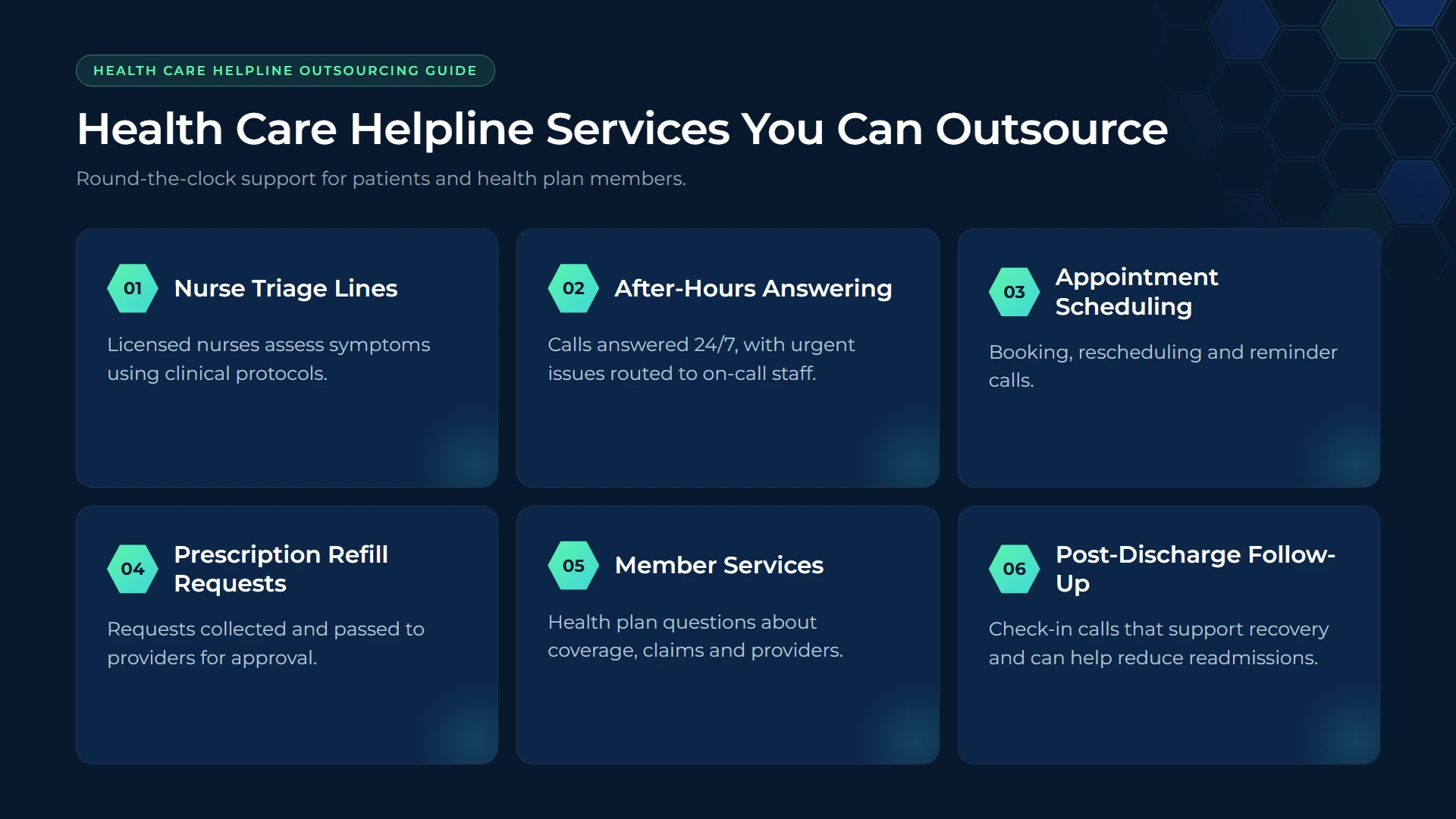
Health care helpline outsourcing is the practice of contracting a third-party contact center to handle patient and member calls, chats, or messages on behalf of a provider, payer, or health tech company. It's not just answering phones. Modern vendors manage appointment scheduling, insurance verification, prescription refill requests, nurse triage lines, billing questions, and even post-discharge follow-up calls.
Two broad categories matter here, and mixing them up is where a lot of organizations get tripped up when evaluating vendors.
Most organizations don't outsource everything at once. A common starting point is after-hours call overflow — the calls that come in when internal staff have gone home but patients still need answers.
Telehealth adoption didn't slow down after the pandemic-era surge, it just normalized. That means more virtual visits to schedule, more remote patients needing tech support, and more insurance verification happening outside a traditional office visit window. Internal teams built for in-person volume often can't absorb that without hiring, and hiring licensed clinical staff for a 24/7 line is neither quick nor cheap.
Patient experience has also become a financial metric, not just a satisfaction score. Long hold times and dropped calls show up in retention numbers, in online reviews, and in some reimbursement models tied to patient satisfaction. So the helpline isn't a back-office cost center anymore — it's a frontline touchpoint that shapes whether a patient stays with a practice or switches to a competitor.
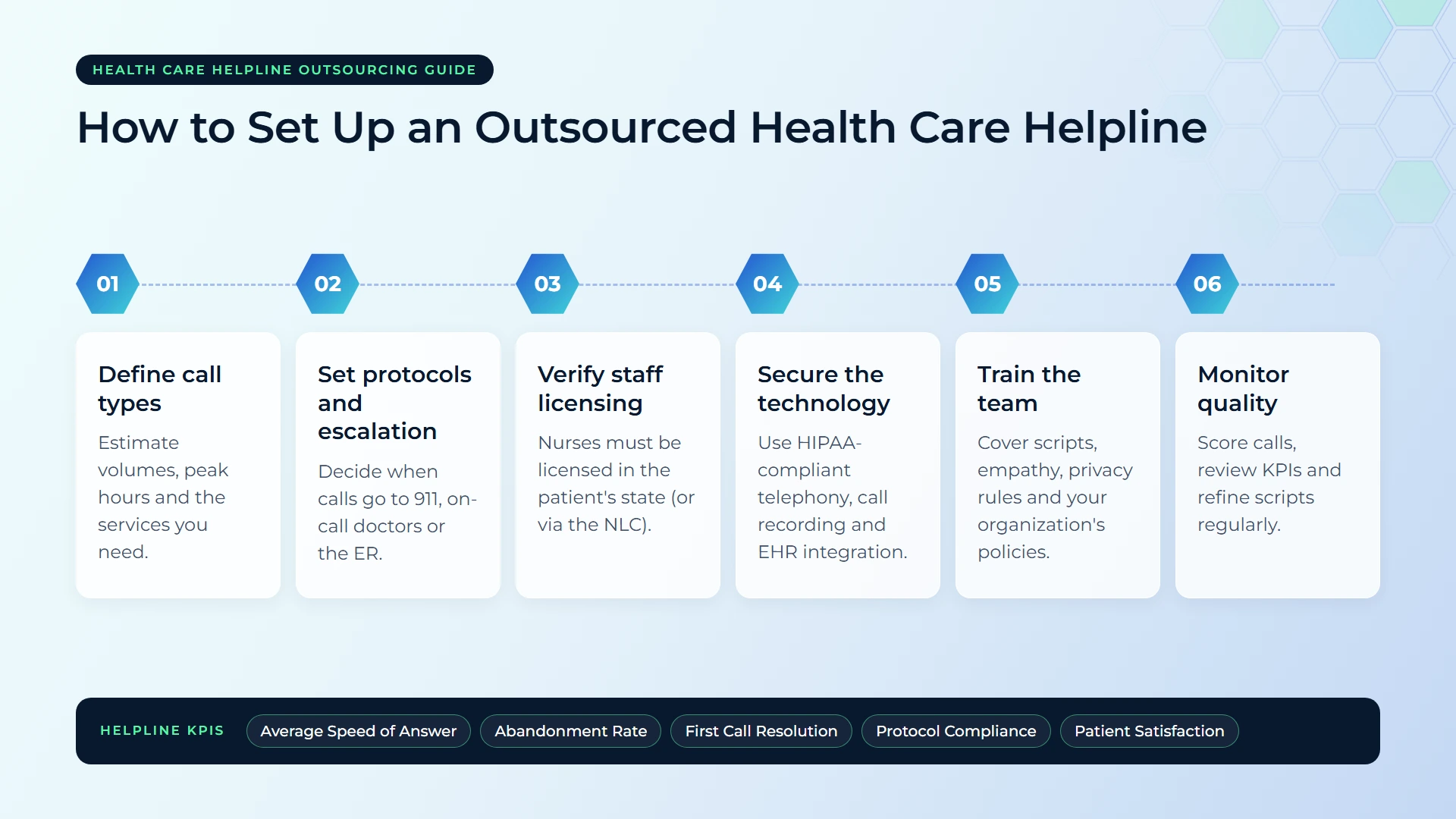
Switching from in-house to outsourced support isn't a single handoff — it's a sequence of decisions, each one affecting the next. Rushing this step-by-step flow is probably the single biggest reason outsourcing projects stall or underperform in year one.
Before talking to a single vendor, it helps to know the baseline: average hold time, call abandonment rate, what percentage of calls are clinical versus administrative, and when peak volume hits. Without this, it's nearly impossible to judge whether a vendor's proposal is realistic.
Few organizations outsource everything on day one. After-hours coverage, overflow during peak hours, or a single function like appointment scheduling are common starting points. Clinical triage usually comes later, once trust in the partner is established.
A call center that handles retail returns is not automatically equipped to handle a patient describing chest pain. Look for vendors with documented healthcare clients, licensed nursing staff if clinical triage is in scope, and existing integrations with common EHR platforms.
This is non-negotiable. The vendor needs a signed Business Associate Agreement, documented HIPAA training, secure call recording and storage, and ideally SOC 2 or HITRUST certification. State-specific telehealth and triage regulations matter too, especially for organizations operating across multiple states.
Start with one call type or one shift. Measure first-call resolution, patient satisfaction, and escalation accuracy over 60 to 90 days before expanding scope.
The helpline needs real-time access to scheduling calendars and, where appropriate, limited EHR visibility. Clunky integrations are where good vendors end up looking bad — agents can only be as effective as the systems feeding them information.
Ongoing quality audits, call recordings review, and patient feedback loops keep the partnership honest long after the contract is signed.

Healthcare helpline outsourcing helps organizations manage patient inquiries, appointment-related questions, follow-ups, and recurring support workflows without expanding every internal role. At NeoWork, we provide remote teammates who can support healthcare helpline operations within your existing systems and processes. We handle recruitment, benefits, training, and ongoing engagement, while our teammates follow your tools, procedures, and daily priorities. Our 91% annualized teammate retention rate and 3.2% candidate selectivity rate reflect our focus on selective hiring and longer-term team stability.
Our healthcare helpline support model offers:
Contact NeoWork to add healthcare helpline support that fits your existing operations
There's no universally correct model — it depends on volume, budget, and how specialized the calls tend to be. Here's a rough comparison most organizations end up weighing.
Pricing varies widely based on scope, licensing requirements, and coverage hours, so treat any flat number with suspicion. Vendors typically price using one of a few models:
Clinical triage lines staffed by licensed nurses generally cost more than administrative scheduling lines, simply because of licensing and liability. Always ask vendors for current rate cards directly rather than relying on published averages, since pricing shifts with labor markets and demand.
Look, most outsourcing failures don't come from bad vendors — they come from poor planning on the client side. A few recurring mistakes:
Outsourcing a health care helpline isn't about cutting corners on patient care — done right, it's often the opposite. A well-vetted partner can extend coverage hours, reduce hold times, and bring in licensed clinical staff that would be costly to hire directly. The organizations that get the most out of it start small, verify compliance obsessively, and treat the vendor relationship as an ongoing partnership rather than a one-time handoff. Before signing with anyone, run the pilot, check the certifications, and read the SLA twice.

Quick Summary: Health care helpline outsourcing means handing patient-facing phone, chat, and messaging support to a specialized vendor instead of staffing it internally. Done well, it cuts wait times, extends coverage to nights and weekends, and keeps costs predictable, provided the partner meets HIPAA requirements and clinical escalation protocols. The right fit depends on call volume, the mix of clinical versus administrative questions, and how tightly the helpline needs to connect with the EHR.
A ringing phone at 2 a.m. from a worried parent, a Medicare member confused about a claim, a patient trying to reschedule an infusion appointment — healthcare helplines absorb all of it, around the clock, with zero tolerance for mistakes. Staffing that internally, every hour of every day, is expensive and genuinely hard to scale. That's exactly why so many hospitals, clinics, payers, and telehealth companies have turned to outsourcing partners who already run this kind of operation at volume.
This guide walks through what health care helpline outsourcing actually covers, how the process works step by step, what it costs, and how to pick a partner that won't put compliance or patient trust at risk.
Health care helpline outsourcing is the practice of contracting a third-party contact center to handle patient and member calls, chats, or messages on behalf of a provider, payer, or health tech company. It's not just answering phones. Modern vendors manage appointment scheduling, insurance verification, prescription refill requests, nurse triage lines, billing questions, and even post-discharge follow-up calls.
Two broad categories matter here, and mixing them up is where a lot of organizations get tripped up when evaluating vendors.
Most organizations don't outsource everything at once. A common starting point is after-hours call overflow — the calls that come in when internal staff have gone home but patients still need answers.
Telehealth adoption didn't slow down after the pandemic-era surge, it just normalized. That means more virtual visits to schedule, more remote patients needing tech support, and more insurance verification happening outside a traditional office visit window. Internal teams built for in-person volume often can't absorb that without hiring, and hiring licensed clinical staff for a 24/7 line is neither quick nor cheap.
Patient experience has also become a financial metric, not just a satisfaction score. Long hold times and dropped calls show up in retention numbers, in online reviews, and in some reimbursement models tied to patient satisfaction. So the helpline isn't a back-office cost center anymore — it's a frontline touchpoint that shapes whether a patient stays with a practice or switches to a competitor.
Switching from in-house to outsourced support isn't a single handoff — it's a sequence of decisions, each one affecting the next. Rushing this step-by-step flow is probably the single biggest reason outsourcing projects stall or underperform in year one.
Before talking to a single vendor, it helps to know the baseline: average hold time, call abandonment rate, what percentage of calls are clinical versus administrative, and when peak volume hits. Without this, it's nearly impossible to judge whether a vendor's proposal is realistic.
Few organizations outsource everything on day one. After-hours coverage, overflow during peak hours, or a single function like appointment scheduling are common starting points. Clinical triage usually comes later, once trust in the partner is established.
A call center that handles retail returns is not automatically equipped to handle a patient describing chest pain. Look for vendors with documented healthcare clients, licensed nursing staff if clinical triage is in scope, and existing integrations with common EHR platforms.
This is non-negotiable. The vendor needs a signed Business Associate Agreement, documented HIPAA training, secure call recording and storage, and ideally SOC 2 or HITRUST certification. State-specific telehealth and triage regulations matter too, especially for organizations operating across multiple states.
Start with one call type or one shift. Measure first-call resolution, patient satisfaction, and escalation accuracy over 60 to 90 days before expanding scope.
The helpline needs real-time access to scheduling calendars and, where appropriate, limited EHR visibility. Clunky integrations are where good vendors end up looking bad — agents can only be as effective as the systems feeding them information.
Ongoing quality audits, call recordings review, and patient feedback loops keep the partnership honest long after the contract is signed.
Healthcare helpline outsourcing helps organizations manage patient inquiries, appointment-related questions, follow-ups, and recurring support workflows without expanding every internal role. At NeoWork, we provide remote teammates who can support healthcare helpline operations within your existing systems and processes. We handle recruitment, benefits, training, and ongoing engagement, while our teammates follow your tools, procedures, and daily priorities. Our 91% annualized teammate retention rate and 3.2% candidate selectivity rate reflect our focus on selective hiring and longer-term team stability.
Our healthcare helpline support model offers:
Contact NeoWork to add healthcare helpline support that fits your existing operations
There's no universally correct model — it depends on volume, budget, and how specialized the calls tend to be. Here's a rough comparison most organizations end up weighing.
Pricing varies widely based on scope, licensing requirements, and coverage hours, so treat any flat number with suspicion. Vendors typically price using one of a few models:
Clinical triage lines staffed by licensed nurses generally cost more than administrative scheduling lines, simply because of licensing and liability. Always ask vendors for current rate cards directly rather than relying on published averages, since pricing shifts with labor markets and demand.
Look, most outsourcing failures don't come from bad vendors — they come from poor planning on the client side. A few recurring mistakes:
Outsourcing a health care helpline isn't about cutting corners on patient care — done right, it's often the opposite. A well-vetted partner can extend coverage hours, reduce hold times, and bring in licensed clinical staff that would be costly to hire directly. The organizations that get the most out of it start small, verify compliance obsessively, and treat the vendor relationship as an ongoing partnership rather than a one-time handoff. Before signing with anyone, run the pilot, check the certifications, and read the SLA twice.