

.avif)
.avif)

IT Staff Augmentation Guide: How to Scale Your Team in 2026


.svg)

Quick Summary: IT staff augmentation lets companies add external developers or specialists to an in-house team on a temporary basis, filling skill gaps without the overhead of full-time hiring. It works best for short-to-mid-term projects, spikes in workload, or niche technical needs, and typically costs less than building an entirely new internal team. The model differs from managed services or full outsourcing because the client retains control over daily work and project direction.
Every engineering leader eventually hits the same wall: there's more work than people to do it, and hiring takes months you don't have. That's the moment staff augmentation starts looking less like a buzzword and more like a survival tactic.
This guide breaks down what IT staff augmentation actually means, how it compares to other outsourcing models, what it costs, and how to bring in external talent without creating a mess for your existing team. No fluff, no vendor pitch — just the practical stuff.
What Is IT Staff Augmentation?
IT staff augmentation is a staffing model where a company hires external developers, testers, DevOps engineers, or other tech specialists to work directly alongside its in-house team. The augmented staff typically reports to the client's project managers, uses the client's tools and processes, and gets treated more or less like an extension of the existing team — just without the payroll commitment.
Unlike a traditional outsourcing contract, where an agency owns the deliverable and manages the work itself, staff augmentation keeps project ownership and day-to-day direction with the hiring company. Think of it as renting expertise rather than buying a finished product.
This matters because it changes how much oversight is needed. With staff augmentation, someone on the internal team still needs to manage the augmented staff. With full outsourcing or a managed team, that burden shifts to the vendor.
How It Differs From Similar Models
Why Companies Turn to Staff Augmentation
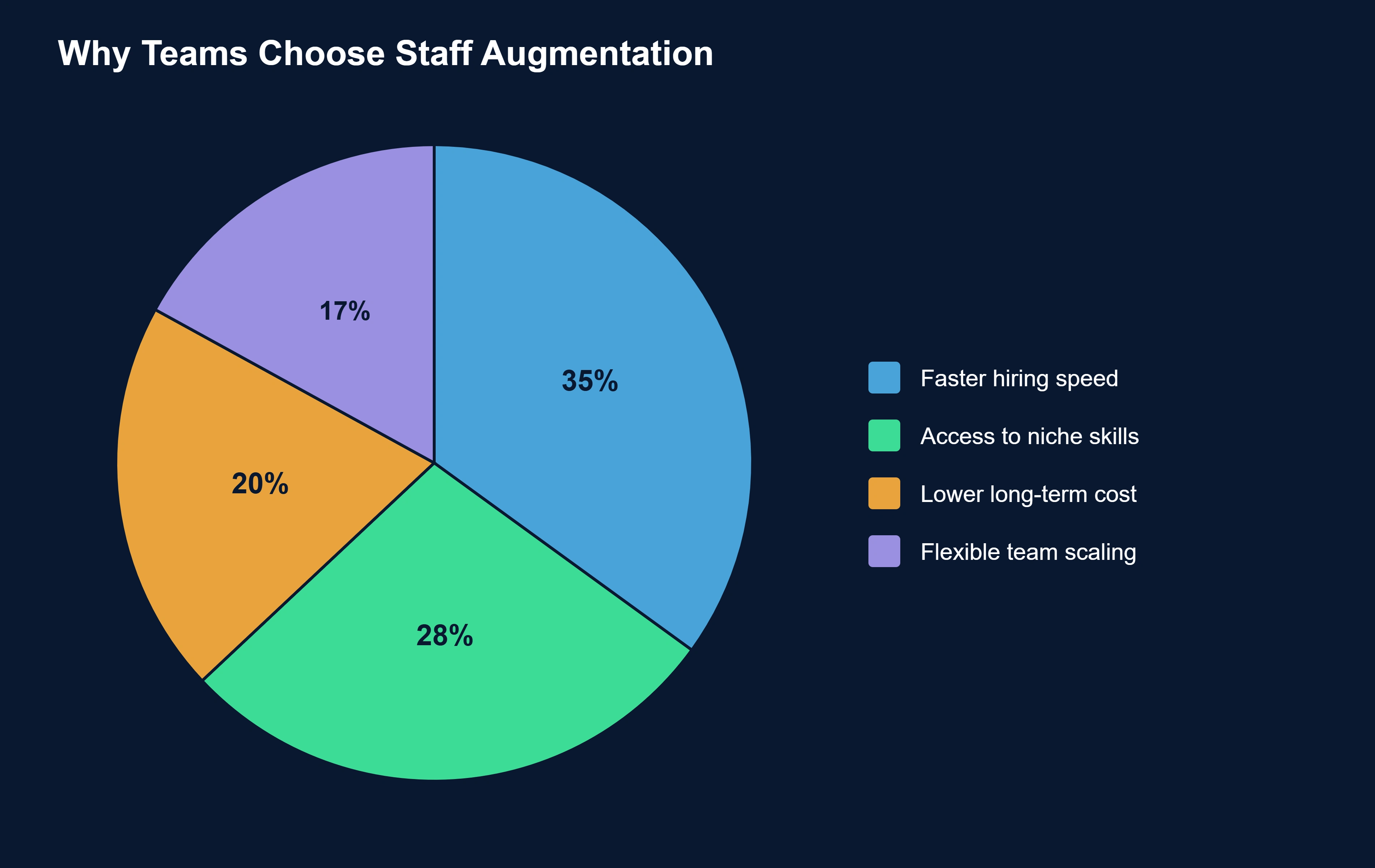
The appeal isn't complicated. Hiring a full-time senior engineer can take two to four months from job posting to signed offer, and that's before onboarding. Staff augmentation compresses that timeline to days or a couple of weeks in many cases, because the vendor already has vetted candidates on the bench.
There's also the skills-gap problem. A team that's strong in backend architecture might have zero experience with a specific cloud migration tool or a niche framework needed for one project. Rather than training someone from scratch or hiring permanently for a temporary need, augmentation fills that exact gap.
- Faster ramp-up than traditional recruiting
- No long-term payroll, benefits, or severance obligations
- Access to specialized skills that don't justify a full-time hire
- Flexibility to scale the team up or down as project phases shift
- Lower overhead compared to standing up an internal hiring pipeline
None of this means augmentation is free of tradeoffs. It works best when the internal team already has strong processes, clear documentation, and someone available to manage new hires — augmented or not.
Expand IT Capacity with NeoWork

IT staff augmentation helps companies add technical professionals without hiring every role internally. NeoWork provides remote teammates across software engineering, data science, cloud architecture, and related IT functions, with structures ranging from individual contributors to dedicated teams. NeoWork handles recruitment, benefits, training, and ongoing engagement, while teammates integrate into the client’s systems and development workflows. Its 91% annualized teammate retention rate and 3.2% candidate selectivity rate reflect a focus on selective hiring and longer-term team stability.
NeoWork's IT staff augmentation model offers:
- IT and development professionals
- integration with the client’s tools and processes
- recruitment and ongoing teammate support
Contact NeoWork to add IT professionals who can support ongoing technical work and scale with your team.
Common Staff Augmentation Models
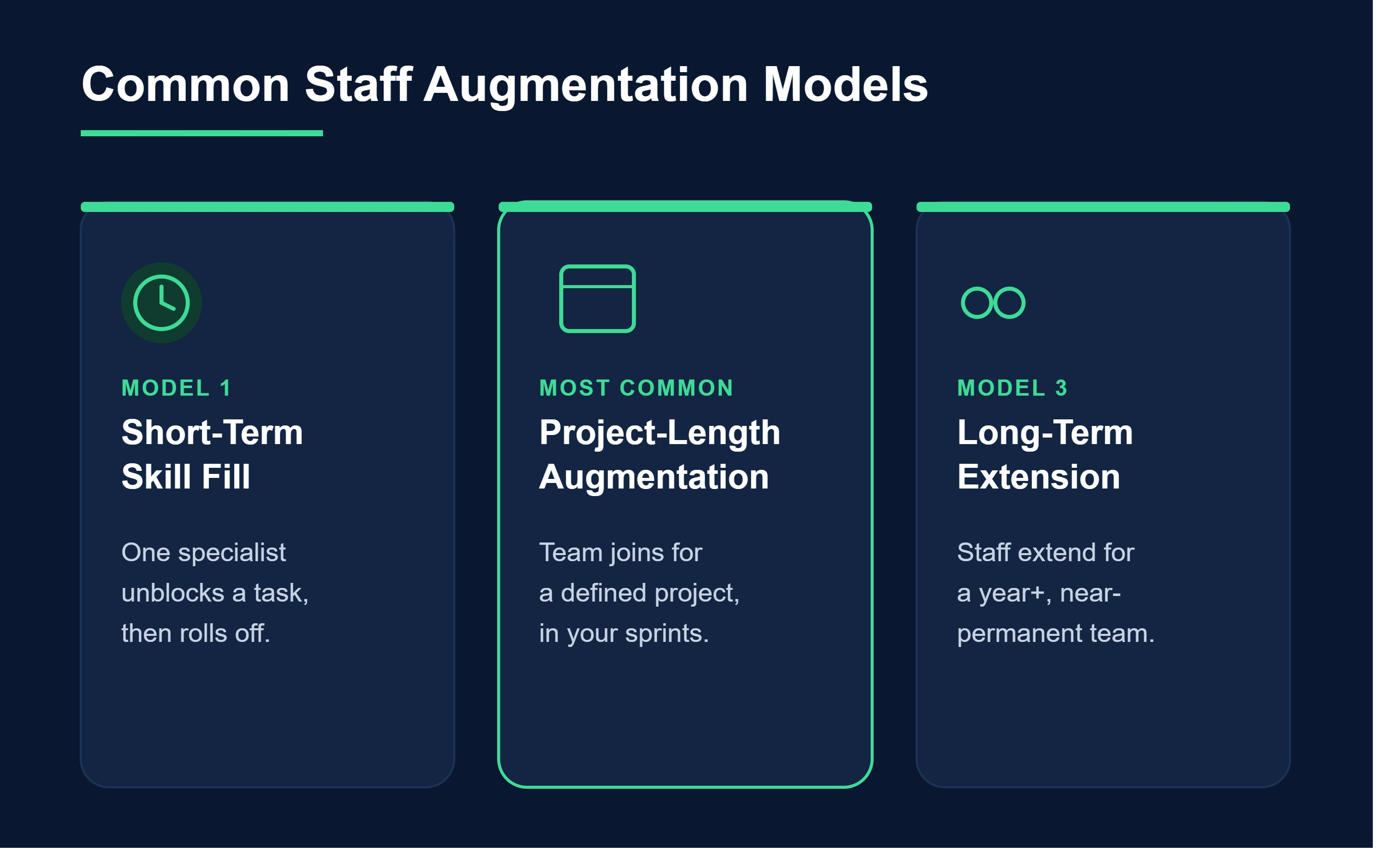
Not all engagements look the same. Vendors typically offer a few variations, and picking the right one depends on how much control the internal team wants to keep.
Short-Term Skill Fill
A single specialist — say, a Kubernetes expert — joins for a few weeks to unblock a specific technical challenge, then rolls off once the work is done.
Project-Length Augmentation
Several engineers join for the duration of a defined project, integrating into existing sprints and ceremonies. This is the most common setup for product launches or major feature builds.
Long-Term Extension
Some companies use augmented staff for a year or more, essentially treating the arrangement as a semi-permanent extension of the team. This blurs into managed-team territory but still keeps management control in-house.
How Much Does IT Staff Augmentation Cost?
Pricing varies widely by role, seniority, and geography, so any specific number quoted here would go stale fast. Rates for augmented developers generally run lower than hiring a full-time employee in a high-cost market, especially when sourcing talent from regions with lower labor costs, but higher than a basic freelance gig given the added vetting and reliability.
Most vendors charge either a flat hourly/monthly rate per resource or a markup on top of the resource's base pay. It's worth asking vendors directly for current rate cards, since these shift with market demand and currency fluctuations — check the vendor's official pricing page or request a quote rather than relying on outdated blog estimates.
How to Get Started: A Step-by-Step Process
Bringing in augmented staff without a plan is how projects go sideways. Here's the sequence that tends to work.
- Define the gap precisely. Is it a skill shortage, a capacity shortage, or both? Vague requests lead to mismatched hires.
- Set the engagement length and scope. Decide upfront whether this is a two-month sprint or an open-ended extension.
- Choose a sourcing model. Vendor-managed staffing firm, freelance marketplace, or direct contractor network — each has different vetting rigor.
- Screen for technical fit and communication. Technical tests matter, but so does how well a candidate communicates async with a distributed team.
- Onboard with real documentation. Augmented staff move faster when they have access to architecture docs, coding standards, and a clear point of contact.
- Set KPIs and check-in cadence. Weekly syncs and clear deliverables keep the arrangement accountable on both sides.
Risks and How to Manage Them
Staff augmentation isn't risk-free. Knowledge tends to walk out the door when a contractor rolls off, especially if documentation was skipped. Time zone gaps can slow down real-time collaboration. And integrating a new person into an existing team culture takes more effort than it looks like on paper.
The fix is mostly procedural rather than technical. Insist on documentation as a deliverable, not an afterthought. Pair augmented staff with an internal buddy for the first few weeks. And build in a short overlap period before a contractor's contract ends, so knowledge transfer happens while they're still around — not after.
There's also a vendor-quality risk. Not every staffing firm vets candidates the same way, so it pays to ask about their screening process, past client retention rates, and how they handle underperformance or a bad culture fit.
When Staff Augmentation Isn't the Right Fit
It's not always the answer. If a company needs an entire product built from zero with no internal technical oversight, full-service outsourcing or a managed team probably makes more sense — augmentation still requires someone in-house to direct the work.
Similarly, if the need is truly permanent — a core role that will exist for years — augmentation ends up costing more over time than just hiring full-time. It shines brightest for temporary, well-scoped, or specialized needs, not as a permanent staffing substitute.
Wrapping Up
IT staff augmentation works best as a targeted fix, not a blanket strategy. Used well — with clear scope, solid documentation, and real oversight — it lets teams move faster without the long hiring cycles or the overhead of a permanent headcount increase.
The next step is straightforward: map out exactly where the current team is stretched thin, decide how long the gap will realistically last, and start vetting vendors or contractors against that specific need rather than a generic job description.
FAQ
Topics
IT Staff Augmentation Guide: How to Scale Your Team in 2026

Quick Summary: IT staff augmentation lets companies add external developers or specialists to an in-house team on a temporary basis, filling skill gaps without the overhead of full-time hiring. It works best for short-to-mid-term projects, spikes in workload, or niche technical needs, and typically costs less than building an entirely new internal team. The model differs from managed services or full outsourcing because the client retains control over daily work and project direction.
Every engineering leader eventually hits the same wall: there's more work than people to do it, and hiring takes months you don't have. That's the moment staff augmentation starts looking less like a buzzword and more like a survival tactic.
This guide breaks down what IT staff augmentation actually means, how it compares to other outsourcing models, what it costs, and how to bring in external talent without creating a mess for your existing team. No fluff, no vendor pitch — just the practical stuff.
What Is IT Staff Augmentation?
IT staff augmentation is a staffing model where a company hires external developers, testers, DevOps engineers, or other tech specialists to work directly alongside its in-house team. The augmented staff typically reports to the client's project managers, uses the client's tools and processes, and gets treated more or less like an extension of the existing team — just without the payroll commitment.
Unlike a traditional outsourcing contract, where an agency owns the deliverable and manages the work itself, staff augmentation keeps project ownership and day-to-day direction with the hiring company. Think of it as renting expertise rather than buying a finished product.
This matters because it changes how much oversight is needed. With staff augmentation, someone on the internal team still needs to manage the augmented staff. With full outsourcing or a managed team, that burden shifts to the vendor.
How It Differs From Similar Models
Why Companies Turn to Staff Augmentation
The appeal isn't complicated. Hiring a full-time senior engineer can take two to four months from job posting to signed offer, and that's before onboarding. Staff augmentation compresses that timeline to days or a couple of weeks in many cases, because the vendor already has vetted candidates on the bench.
There's also the skills-gap problem. A team that's strong in backend architecture might have zero experience with a specific cloud migration tool or a niche framework needed for one project. Rather than training someone from scratch or hiring permanently for a temporary need, augmentation fills that exact gap.
- Faster ramp-up than traditional recruiting
- No long-term payroll, benefits, or severance obligations
- Access to specialized skills that don't justify a full-time hire
- Flexibility to scale the team up or down as project phases shift
- Lower overhead compared to standing up an internal hiring pipeline
None of this means augmentation is free of tradeoffs. It works best when the internal team already has strong processes, clear documentation, and someone available to manage new hires — augmented or not.
Expand IT Capacity with NeoWork
IT staff augmentation helps companies add technical professionals without hiring every role internally. NeoWork provides remote teammates across software engineering, data science, cloud architecture, and related IT functions, with structures ranging from individual contributors to dedicated teams. NeoWork handles recruitment, benefits, training, and ongoing engagement, while teammates integrate into the client’s systems and development workflows. Its 91% annualized teammate retention rate and 3.2% candidate selectivity rate reflect a focus on selective hiring and longer-term team stability.
NeoWork's IT staff augmentation model offers:
- IT and development professionals
- integration with the client’s tools and processes
- recruitment and ongoing teammate support
Contact NeoWork to add IT professionals who can support ongoing technical work and scale with your team.
Common Staff Augmentation Models
Not all engagements look the same. Vendors typically offer a few variations, and picking the right one depends on how much control the internal team wants to keep.
Short-Term Skill Fill
A single specialist — say, a Kubernetes expert — joins for a few weeks to unblock a specific technical challenge, then rolls off once the work is done.
Project-Length Augmentation
Several engineers join for the duration of a defined project, integrating into existing sprints and ceremonies. This is the most common setup for product launches or major feature builds.
Long-Term Extension
Some companies use augmented staff for a year or more, essentially treating the arrangement as a semi-permanent extension of the team. This blurs into managed-team territory but still keeps management control in-house.
How Much Does IT Staff Augmentation Cost?
Pricing varies widely by role, seniority, and geography, so any specific number quoted here would go stale fast. Rates for augmented developers generally run lower than hiring a full-time employee in a high-cost market, especially when sourcing talent from regions with lower labor costs, but higher than a basic freelance gig given the added vetting and reliability.
Most vendors charge either a flat hourly/monthly rate per resource or a markup on top of the resource's base pay. It's worth asking vendors directly for current rate cards, since these shift with market demand and currency fluctuations — check the vendor's official pricing page or request a quote rather than relying on outdated blog estimates.
How to Get Started: A Step-by-Step Process
Bringing in augmented staff without a plan is how projects go sideways. Here's the sequence that tends to work.
- Define the gap precisely. Is it a skill shortage, a capacity shortage, or both? Vague requests lead to mismatched hires.
- Set the engagement length and scope. Decide upfront whether this is a two-month sprint or an open-ended extension.
- Choose a sourcing model. Vendor-managed staffing firm, freelance marketplace, or direct contractor network — each has different vetting rigor.
- Screen for technical fit and communication. Technical tests matter, but so does how well a candidate communicates async with a distributed team.
- Onboard with real documentation. Augmented staff move faster when they have access to architecture docs, coding standards, and a clear point of contact.
- Set KPIs and check-in cadence. Weekly syncs and clear deliverables keep the arrangement accountable on both sides.
Risks and How to Manage Them
Staff augmentation isn't risk-free. Knowledge tends to walk out the door when a contractor rolls off, especially if documentation was skipped. Time zone gaps can slow down real-time collaboration. And integrating a new person into an existing team culture takes more effort than it looks like on paper.
The fix is mostly procedural rather than technical. Insist on documentation as a deliverable, not an afterthought. Pair augmented staff with an internal buddy for the first few weeks. And build in a short overlap period before a contractor's contract ends, so knowledge transfer happens while they're still around — not after.
There's also a vendor-quality risk. Not every staffing firm vets candidates the same way, so it pays to ask about their screening process, past client retention rates, and how they handle underperformance or a bad culture fit.
When Staff Augmentation Isn't the Right Fit
It's not always the answer. If a company needs an entire product built from zero with no internal technical oversight, full-service outsourcing or a managed team probably makes more sense — augmentation still requires someone in-house to direct the work.
Similarly, if the need is truly permanent — a core role that will exist for years — augmentation ends up costing more over time than just hiring full-time. It shines brightest for temporary, well-scoped, or specialized needs, not as a permanent staffing substitute.
Wrapping Up
IT staff augmentation works best as a targeted fix, not a blanket strategy. Used well — with clear scope, solid documentation, and real oversight — it lets teams move faster without the long hiring cycles or the overhead of a permanent headcount increase.
The next step is straightforward: map out exactly where the current team is stretched thin, decide how long the gap will realistically last, and start vetting vendors or contractors against that specific need rather than a generic job description.
FAQ
Topics
Related Blogs
Related Podcasts


.webp)

.webp)
.webp)



