

.avif)
.avif)

Legal Document Preparation Outsourcing Guide (2026)


.svg)

Quick Summary: Legal document preparation outsourcing means handing off drafting, formatting, and review tasks to external specialists so in-house attorneys can focus on higher-value work. Done well, it cuts turnaround time and overhead without sacrificing accuracy. The key is picking the right tasks to delegate, vetting vendors on security and expertise, and keeping quality control in-house through a clear review step.
Every law firm eventually hits the same wall: too many documents, not enough hours. Contracts need drafting, discovery needs reviewing, filings need formatting—and none of it stops just because the calendar fills up. That's the pressure pushing more firms toward legal document preparation outsourcing.
This isn't a new idea. Legal process outsourcing has existed for over two decades. But the tools, vendors, and expectations around it have changed a lot, especially with AI-assisted drafting now sitting alongside traditional offshore paralegal teams. So what actually makes sense to outsource in 2026, and how does a firm do it without creating new headaches? That's what this guide covers.
What Legal Document Preparation Outsourcing Actually Means
At its core, legal document preparation outsourcing is the practice of delegating drafting, formatting, proofreading, and sometimes basic review of legal documents to a third-party provider. That provider might be an offshore legal process outsourcing (LPO) firm, a domestic contract paralegal service, or a specialized vendor that blends software with human reviewers.
It's a subset of the broader legal process outsourcing category, which also covers research, e-discovery, billing support, and more. Document preparation specifically tends to include things like pleadings, contracts, NDAs, closing binders, discovery responses, and court filing packages.
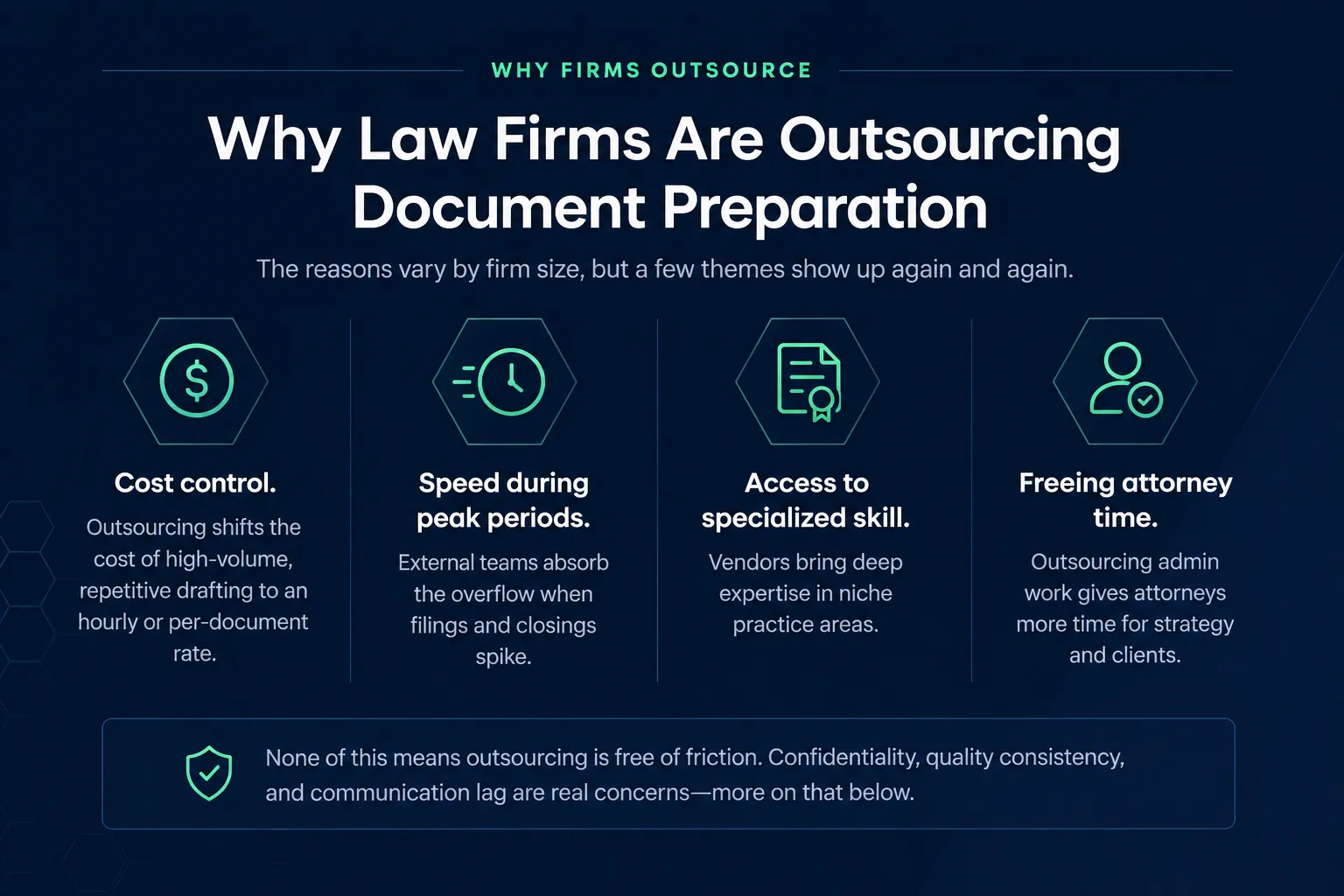
Why Law Firms Are Outsourcing Document Preparation
The reasons vary by firm size, but a few themes show up again and again.
- Cost control. Hiring full-time paralegals or associates for high-volume, repetitive drafting is expensive. Outsourcing shifts that cost to an hourly or per-document rate.
- Speed during peak periods. Litigation surges, deal closings, and seasonal filing crunches don't align neatly with staffing levels. External teams absorb the overflow.
- Access to specialized skill. Some vendors focus narrowly on immigration filings, real estate closings, or IP prosecution documents—areas where in-house generalists may be slower.
- Freeing attorney time. Every hour a partner spends formatting a exhibit list is an hour not spent on strategy or client relationships. Outsourcing reclaims that time.
None of this means outsourcing is free of friction. Confidentiality, quality consistency, and communication lag are real concerns—more on that below.
Tasks Commonly Outsourced

Streamline Legal Document Preparation with NeoWork
Legal document preparation outsourcing helps firms manage recurring drafting support, document organization, data entry, and file maintenance tasks. NeoWork provides remote teammates who can work within established templates, systems, and review processes. NeoWork handles recruitment, benefits, training, and ongoing engagement, while teammates follow the client’s documentation standards and daily priorities. Its 91% annualized teammate retention rate and 3.2% candidate selectivity rate reflect a focus on selective hiring and longer-term team stability.
NeoWork's legal document support model offers:
- document preparation and records support
- integration with the client’s tools and processes
- recruitment and ongoing teammate support
Contact NeoWork to add document preparation support to your legal operations.
How the Outsourcing Process Typically Works
Most engagements follow a similar arc, whether the vendor is offshore or domestic. Understanding the flow helps firms set realistic expectations before signing anything.
Define the Work and Expectations
Start by identifying the tasks to outsource, expected volume, turnaround times, formatting requirements, and any specialist knowledge the provider will need. Clear instructions make it easier to compare vendors and avoid confusion later.
Review the Provider
The next step is checking the vendor's experience, security practices, communication process, references, and team structure. Firms should also confirm who will handle the work and how quality will be reviewed.
Begin with a Pilot Project
The pilot phase matters more than firms often realize. Sending a batch of low-stakes documents first, such as internal memos or routine contract templates, gives a clear read on a vendor's turnaround, formatting habits, and communication style before anything client-facing is on the line.
Evaluate the Results
Review the pilot for accuracy, consistency, response time, and adherence to instructions. Any recurring issues should be addressed before the volume increases or more sensitive work is assigned.
Formalize and Scale the Engagement
Once the provider meets the required standards, the parties can formalize deadlines, quality benchmarks, security requirements, reporting, and escalation procedures. The engagement can then expand gradually as the workflow becomes more reliable.
Choosing Between Offshore, Domestic, and Hybrid Vendors
Vendors generally fall into three camps, and the right fit depends on budget, sensitivity of the work, and how much oversight the firm wants to maintain.
Offshore providers often win on price and can genuinely turn work around overnight thanks to time zone differences. Domestic vendors cost more but tend to know local court rules and filing quirks better. Hybrid vendors—the newer category—pair AI-assisted first drafts with human legal reviewers, which works particularly well for high-volume contract review.
Questions to Ask Before Signing
- What credentials do the staff handling the work actually hold?
- How is client data stored, encrypted, and eventually destroyed?
- What happens if a document contains an error—who's liable, and how is it fixed?
- Can the firm request a specific reviewer or team for continuity?
- What's the escalation path if turnaround slips?
A paralegal certification or documented legal training on the vendor's side is a reasonable baseline to expect, not a bonus.
Confidentiality and Ethical Considerations
This is where outsourcing decisions get serious. Bar associations in most jurisdictions permit legal process outsourcing, but attorneys remain responsible for supervising the work and protecting client confidentiality regardless of who touches the document. That means the firm—not the vendor—still carries the ethical exposure if something goes wrong.
Practical safeguards worth building into any outsourcing arrangement:
- Signed NDAs and data processing agreements before any document changes hands
- Redacting or anonymizing client-identifying details where the task allows it
- Restricting vendor access to only the documents relevant to the assigned task
- Maintaining an audit trail of who touched a document and when
- Running a final in-house review before anything goes to a client or court
Skipping that last step is the most common mistake firms make. Outsourcing reduces workload—it shouldn't eliminate oversight.
Cost Breakdown: What Outsourcing Actually Saves
Savings vary widely by firm size and task type, but the general pattern holds: routine, high-volume work sees the biggest cost reduction, while specialized or high-risk drafting sees more modest gains once quality-control overhead is factored in.
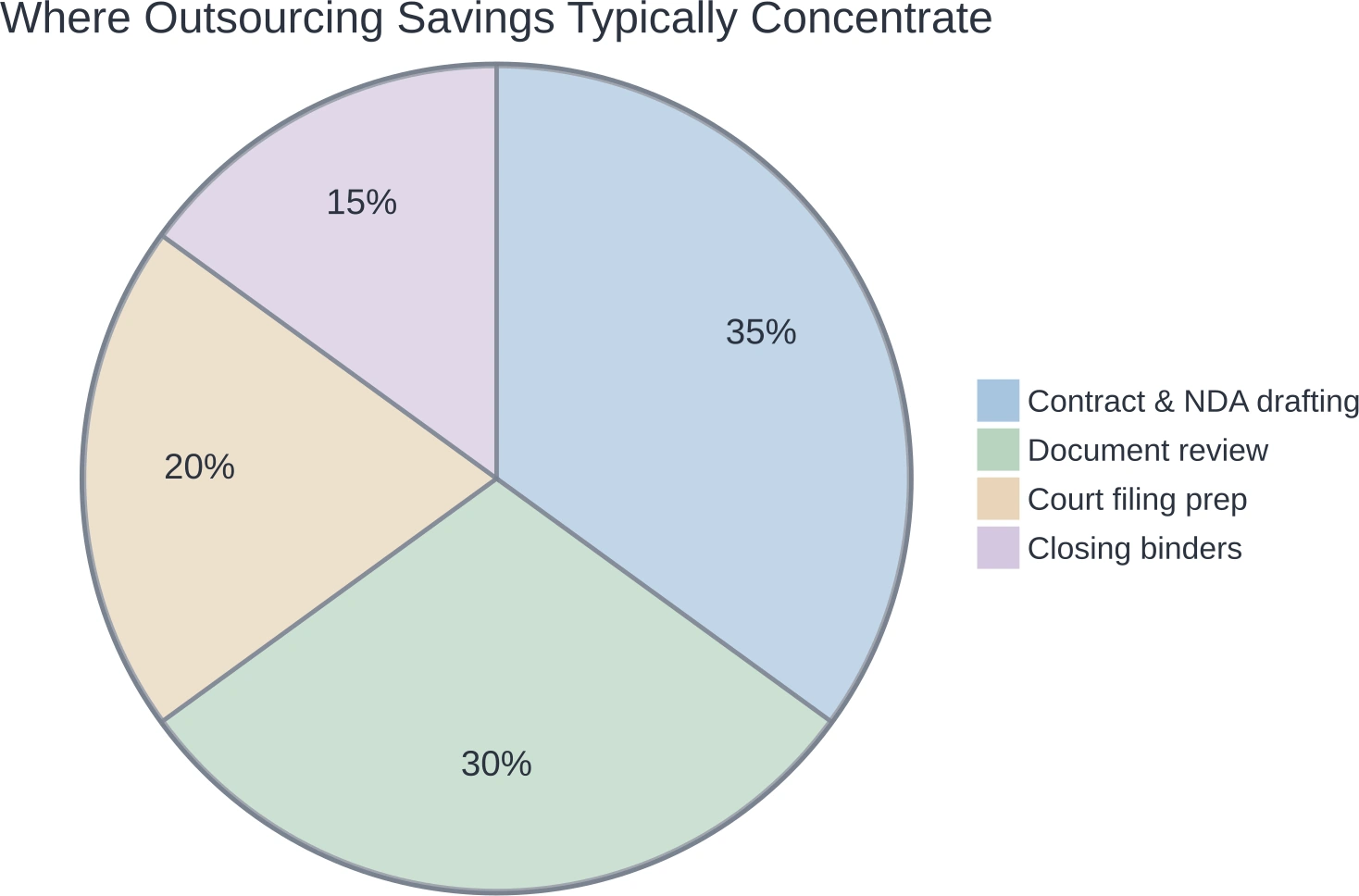
For exact current pricing, check individual vendor rate sheets directly—rates shift with demand, currency exchange, and the level of legal expertise required, so any specific dollar figure quoted here would go stale fast.
Signs Outsourcing Might Not Be the Right Fit Yet
Outsourcing isn't automatically the right move for every firm. It tends to struggle when:
- The firm's document volume is too low to justify vendor onboarding time
- Matters are highly bespoke with little repeatable structure
- Internal systems can't securely share documents with an outside party
- There's no bandwidth internally to review vendor output before it goes out
In those cases, it's often better to start small—one task, one vendor, one trial period—rather than restructuring an entire workflow around outsourcing from day one.
Building a Sustainable Outsourcing Workflow
Firms that get the most out of outsourcing tend to treat it as an extension of their team rather than a one-off vendor transaction. That means regular check-ins, consistent feedback on document quality, and a clear internal owner responsible for the relationship. Rotating vendors constantly to chase the lowest price usually backfires—continuity with a known provider tends to produce better, faster work over time.
It also helps to standardize templates and style guides before handing work off. A vendor working from a clear template library will produce far more consistent output than one guessing at formatting preferences on every document.
Final Thoughts
Legal document preparation outsourcing isn't about handing off responsibility—it's about redistributing the workload so attorneys spend less time formatting exhibits and more time practicing law. The firms that succeed with it treat vendor selection carefully, keep a human review step in place, and start small before scaling. Get those fundamentals right, and outsourcing becomes less of a risk and more of a genuine efficiency tool. Start by identifying one repetitive, low-risk document type this quarter, run a small pilot with a vetted vendor, and measure the results before expanding further.
FAQ: Legal Document Preparation Outsourcing
Topics
Legal Document Preparation Outsourcing Guide (2026)

Quick Summary: Legal document preparation outsourcing means handing off drafting, formatting, and review tasks to external specialists so in-house attorneys can focus on higher-value work. Done well, it cuts turnaround time and overhead without sacrificing accuracy. The key is picking the right tasks to delegate, vetting vendors on security and expertise, and keeping quality control in-house through a clear review step.
Every law firm eventually hits the same wall: too many documents, not enough hours. Contracts need drafting, discovery needs reviewing, filings need formatting—and none of it stops just because the calendar fills up. That's the pressure pushing more firms toward legal document preparation outsourcing.
This isn't a new idea. Legal process outsourcing has existed for over two decades. But the tools, vendors, and expectations around it have changed a lot, especially with AI-assisted drafting now sitting alongside traditional offshore paralegal teams. So what actually makes sense to outsource in 2026, and how does a firm do it without creating new headaches? That's what this guide covers.
What Legal Document Preparation Outsourcing Actually Means
At its core, legal document preparation outsourcing is the practice of delegating drafting, formatting, proofreading, and sometimes basic review of legal documents to a third-party provider. That provider might be an offshore legal process outsourcing (LPO) firm, a domestic contract paralegal service, or a specialized vendor that blends software with human reviewers.
It's a subset of the broader legal process outsourcing category, which also covers research, e-discovery, billing support, and more. Document preparation specifically tends to include things like pleadings, contracts, NDAs, closing binders, discovery responses, and court filing packages.
Why Law Firms Are Outsourcing Document Preparation
The reasons vary by firm size, but a few themes show up again and again.
- Cost control. Hiring full-time paralegals or associates for high-volume, repetitive drafting is expensive. Outsourcing shifts that cost to an hourly or per-document rate.
- Speed during peak periods. Litigation surges, deal closings, and seasonal filing crunches don't align neatly with staffing levels. External teams absorb the overflow.
- Access to specialized skill. Some vendors focus narrowly on immigration filings, real estate closings, or IP prosecution documents—areas where in-house generalists may be slower.
- Freeing attorney time. Every hour a partner spends formatting a exhibit list is an hour not spent on strategy or client relationships. Outsourcing reclaims that time.
None of this means outsourcing is free of friction. Confidentiality, quality consistency, and communication lag are real concerns—more on that below.
Tasks Commonly Outsourced
Streamline Legal Document Preparation with NeoWork
Legal document preparation outsourcing helps firms manage recurring drafting support, document organization, data entry, and file maintenance tasks. NeoWork provides remote teammates who can work within established templates, systems, and review processes. NeoWork handles recruitment, benefits, training, and ongoing engagement, while teammates follow the client’s documentation standards and daily priorities. Its 91% annualized teammate retention rate and 3.2% candidate selectivity rate reflect a focus on selective hiring and longer-term team stability.
NeoWork's legal document support model offers:
- document preparation and records support
- integration with the client’s tools and processes
- recruitment and ongoing teammate support
Contact NeoWork to add document preparation support to your legal operations.
How the Outsourcing Process Typically Works
Most engagements follow a similar arc, whether the vendor is offshore or domestic. Understanding the flow helps firms set realistic expectations before signing anything.
Define the Work and Expectations
Start by identifying the tasks to outsource, expected volume, turnaround times, formatting requirements, and any specialist knowledge the provider will need. Clear instructions make it easier to compare vendors and avoid confusion later.
Review the Provider
The next step is checking the vendor's experience, security practices, communication process, references, and team structure. Firms should also confirm who will handle the work and how quality will be reviewed.
Begin with a Pilot Project
The pilot phase matters more than firms often realize. Sending a batch of low-stakes documents first, such as internal memos or routine contract templates, gives a clear read on a vendor's turnaround, formatting habits, and communication style before anything client-facing is on the line.
Evaluate the Results
Review the pilot for accuracy, consistency, response time, and adherence to instructions. Any recurring issues should be addressed before the volume increases or more sensitive work is assigned.
Formalize and Scale the Engagement
Once the provider meets the required standards, the parties can formalize deadlines, quality benchmarks, security requirements, reporting, and escalation procedures. The engagement can then expand gradually as the workflow becomes more reliable.
Choosing Between Offshore, Domestic, and Hybrid Vendors
Vendors generally fall into three camps, and the right fit depends on budget, sensitivity of the work, and how much oversight the firm wants to maintain.
Offshore providers often win on price and can genuinely turn work around overnight thanks to time zone differences. Domestic vendors cost more but tend to know local court rules and filing quirks better. Hybrid vendors—the newer category—pair AI-assisted first drafts with human legal reviewers, which works particularly well for high-volume contract review.
Questions to Ask Before Signing
- What credentials do the staff handling the work actually hold?
- How is client data stored, encrypted, and eventually destroyed?
- What happens if a document contains an error—who's liable, and how is it fixed?
- Can the firm request a specific reviewer or team for continuity?
- What's the escalation path if turnaround slips?
A paralegal certification or documented legal training on the vendor's side is a reasonable baseline to expect, not a bonus.
Confidentiality and Ethical Considerations
This is where outsourcing decisions get serious. Bar associations in most jurisdictions permit legal process outsourcing, but attorneys remain responsible for supervising the work and protecting client confidentiality regardless of who touches the document. That means the firm—not the vendor—still carries the ethical exposure if something goes wrong.
Practical safeguards worth building into any outsourcing arrangement:
- Signed NDAs and data processing agreements before any document changes hands
- Redacting or anonymizing client-identifying details where the task allows it
- Restricting vendor access to only the documents relevant to the assigned task
- Maintaining an audit trail of who touched a document and when
- Running a final in-house review before anything goes to a client or court
Skipping that last step is the most common mistake firms make. Outsourcing reduces workload—it shouldn't eliminate oversight.
Cost Breakdown: What Outsourcing Actually Saves
Savings vary widely by firm size and task type, but the general pattern holds: routine, high-volume work sees the biggest cost reduction, while specialized or high-risk drafting sees more modest gains once quality-control overhead is factored in.
For exact current pricing, check individual vendor rate sheets directly—rates shift with demand, currency exchange, and the level of legal expertise required, so any specific dollar figure quoted here would go stale fast.
Signs Outsourcing Might Not Be the Right Fit Yet
Outsourcing isn't automatically the right move for every firm. It tends to struggle when:
- The firm's document volume is too low to justify vendor onboarding time
- Matters are highly bespoke with little repeatable structure
- Internal systems can't securely share documents with an outside party
- There's no bandwidth internally to review vendor output before it goes out
In those cases, it's often better to start small—one task, one vendor, one trial period—rather than restructuring an entire workflow around outsourcing from day one.
Building a Sustainable Outsourcing Workflow
Firms that get the most out of outsourcing tend to treat it as an extension of their team rather than a one-off vendor transaction. That means regular check-ins, consistent feedback on document quality, and a clear internal owner responsible for the relationship. Rotating vendors constantly to chase the lowest price usually backfires—continuity with a known provider tends to produce better, faster work over time.
It also helps to standardize templates and style guides before handing work off. A vendor working from a clear template library will produce far more consistent output than one guessing at formatting preferences on every document.
Final Thoughts
Legal document preparation outsourcing isn't about handing off responsibility—it's about redistributing the workload so attorneys spend less time formatting exhibits and more time practicing law. The firms that succeed with it treat vendor selection carefully, keep a human review step in place, and start small before scaling. Get those fundamentals right, and outsourcing becomes less of a risk and more of a genuine efficiency tool. Start by identifying one repetitive, low-risk document type this quarter, run a small pilot with a vetted vendor, and measure the results before expanding further.
FAQ: Legal Document Preparation Outsourcing
Topics
Related Blogs
Related Podcasts


.webp)
.webp)



