

.avif)
.avif)

Legal Outsourcing Guide: What to Outsource, How, and Why


.svg)

Quick Summary: Legal outsourcing means handing off specific legal tasks — like contract review, legal research, or e-discovery — to an external provider, freelance lawyer, or specialized firm instead of hiring in-house staff. Done well, it cuts overhead, adds flexible capacity during busy periods, and lets in-house teams and small firms focus on higher-value work. The keys to doing it right are picking the correct tasks to delegate, vetting providers for security and expertise, and keeping oversight tight enough to protect client confidentiality and quality.
Every law firm eventually hits the same wall: too much work, not enough hands, and a budget that won't stretch to another full-time hire. Legal outsourcing has become the workaround. It's no longer a niche cost-cutting trick reserved for offshore document review — it's a mainstream strategy used by solo practitioners, mid-size firms, and Fortune 500 legal departments alike.
This guide walks through what legal outsourcing actually involves, which tasks make sense to hand off, how the process typically works, and what to watch out for before signing a contract with a provider. No fluff, no vague promises — just a practical breakdown.
What Is Legal Outsourcing (and Legal Process Outsourcing)?
Legal outsourcing is the practice of delegating specific legal tasks, functions, or responsibilities to an external party instead of handling them entirely with in-house staff. That external party might be a dedicated Legal Process Outsourcing (LPO) company, a freelance attorney, a legal staffing agency, or a software platform that automates part of the work.
Legal Process Outsourcing specifically refers to structured, often high-volume work — document review, legal research, contract drafting, due diligence — routed to a specialized vendor, frequently one with lower labor costs or deep subject-matter expertise. It grew out of the same logic that drove business process outsourcing in finance and IT: some tasks are important but not strategic, and they're often done better and cheaper by a specialist team than by generalist staff stretched across too many priorities.
The distinction matters less than people think, though. Whether it's called "legal outsourcing" or "LPO," the underlying decision is the same: which parts of the legal workload belong inside the firm, and which parts are safe — and smart — to send elsewhere?
Why Firms and In-House Teams Outsource Legal Work
Cost is the obvious driver, but it's rarely the only one. Firms that outsource well tend to be solving one of a few recurring problems.
- Capacity spikes. Litigation, M&A due diligence, and regulatory deadlines create short bursts of intense workload that don't justify a permanent hire.
- Specialized expertise. Niche areas — IP filings in a foreign jurisdiction, e-discovery technology, compliance in a new market — often require skills the in-house team simply doesn't have.
- Cost control. Routine, repeatable tasks cost less per hour when handled by a vendor built around efficiency rather than billable-hour economics.
- Focus. Freeing senior lawyers from document review and administrative drafting lets them spend more time on strategy, client relationships, and complex advocacy.

Support Legal Operations with NeoWork
Legal outsourcing helps firms manage recurring administrative, document, and case support work without adding more pressure to internal teams. NeoWork provides remote teammates who can assist with structured legal workflows, records management, data entry, and day-to-day operational tasks. NeoWork handles recruitment, benefits, training, and ongoing engagement, while teammates integrate into the client’s systems and processes. Its 91% annualized teammate retention rate and 3.2% candidate selectivity rate reflect a focus on selective hiring and longer-term team stability.
NeoWork's legal outsourcing model offers:
- legal administrative and document support
- integration with the client’s tools and processes
- recruitment and ongoing teammate support
Contact NeoWork to build legal support that fits your existing workflows.
What Legal Tasks Can (and Can't) Be Outsourced
Not everything belongs on the outsourcing table. The tasks that travel well tend to be structured, document-heavy, and governed by clear rules or checklists. The ones that don't usually involve direct client judgment calls, courtroom advocacy, or decisions that carry firm-level liability.
Notice the pattern: the outsourced column skews toward volume and process, the retained column skews toward judgment and accountability. That's the filter worth applying to almost any task under consideration.
How the Legal Outsourcing Process Works
The mechanics vary by provider, but most engagements follow a similar arc from the first conversation to ongoing delivery.
Define the Scope of Work
Start with scope. Vague requests such as "help with contracts" lead to vague results. A tighter brief covering volume, turnaround time, format, and required expertise makes it much easier to evaluate whether a vendor can actually deliver.
Vet the Provider
Then comes vetting. Review data security certifications, references from similar-sized clients, malpractice or errors-and-omissions coverage, and confirmation of who on the provider's team will actually handle the work.
Run a Pilot Project
A pilot project, even a small one, reveals more than any sales pitch. It gives the firm a chance to assess work quality, communication, turnaround time, and the provider's ability to follow instructions before making a larger commitment.
Formalize Service Expectations
Once quality and turnaround hold up, service-level agreements can formalize expectations. These agreements should cover deadlines, quality standards, communication, confidentiality, reporting, and escalation procedures.
Scale the Engagement
After the workflow is proven, the relationship can scale. Firms may increase task volume, expand the range of outsourced work, or move from project-based support to an ongoing delivery model.
Choosing a Legal Outsourcing Provider
Providers fall into a few broad categories, and each suits different needs.
Price shouldn't be the only lens. A vendor that's 30% cheaper but misses deadlines or mishandles confidential data ends up costing more once the cleanup starts. Ask specifically how data is stored, who has access, and what happens to files after a project closes.
What Does Legal Outsourcing Cost?
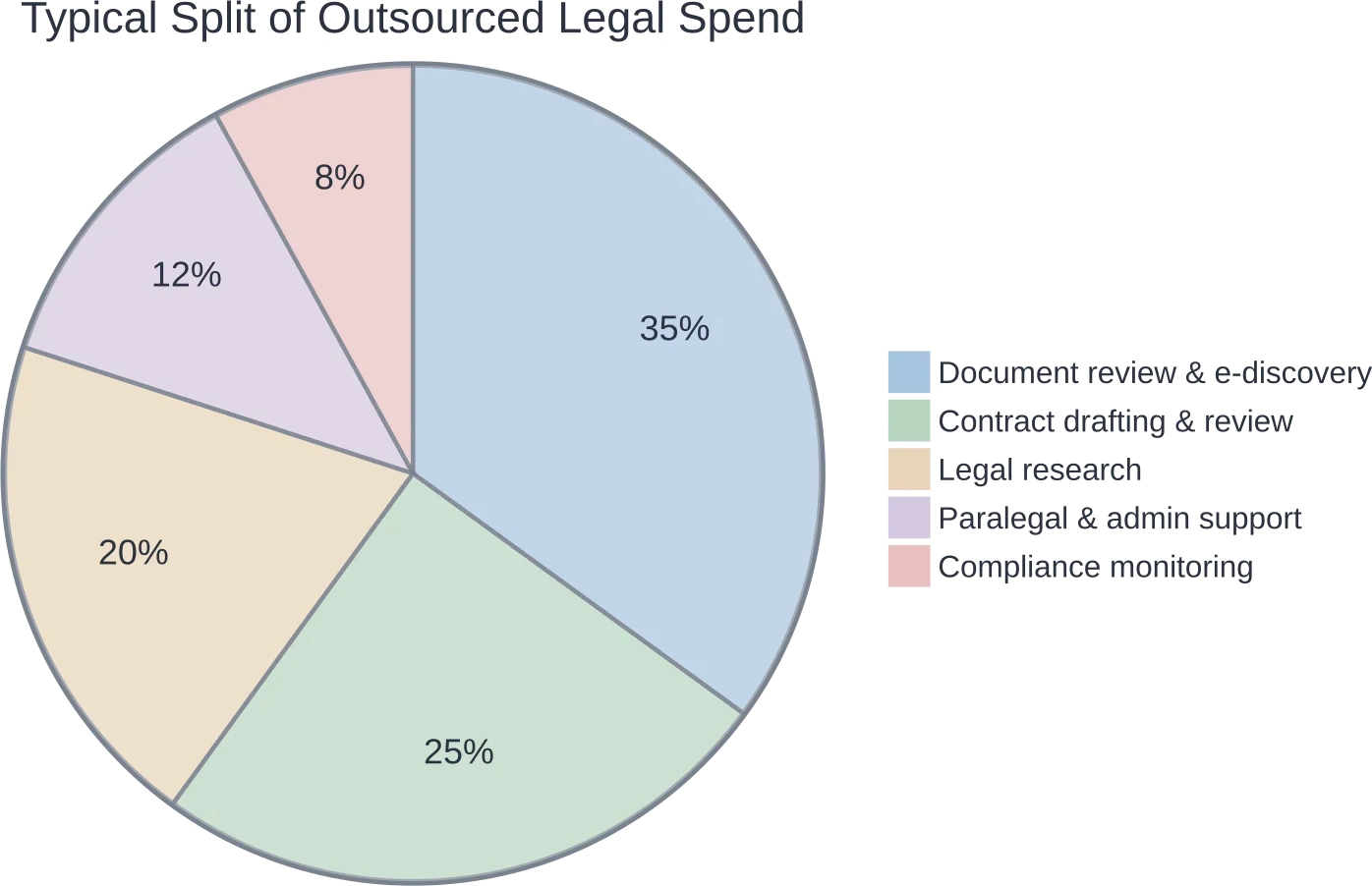
Pricing models differ across providers — some bill hourly, others by document volume, others on a flat monthly retainer. As a rough industry pattern, outsourced legal work tends to run meaningfully below equivalent in-house or big-firm billable rates, particularly for offshore document review and research. Exact figures shift by region, task complexity, and provider reputation, so it's worth requesting a detailed quote and comparing it against the fully-loaded cost of doing the same work internally — salary, benefits, software, and management overhead included, not just the base wage.
Risks — and How to Manage Them
Outsourcing legal work introduces real exposure if it's not managed carefully. The biggest risks tend to cluster around three areas: confidentiality, quality control, and regulatory compliance.
- Confidentiality. Client data crossing organizational (and sometimes national) borders raises privilege and data-protection questions. Contracts should spell out encryption standards, access controls, and breach notification timelines.
- Quality drift. Without spot-checks, outsourced work can slip in accuracy over time. Regular sampling and clear feedback loops keep standards from eroding.
- Jurisdictional rules. Bar association rules on unauthorized practice of law and supervision requirements vary. It's worth confirming that outsourcing arrangements comply with the rules governing the firm's home jurisdiction — not just the vendor's.
None of these risks is a reason to avoid outsourcing altogether. They're reasons to build contracts and oversight processes that actually address them, rather than assuming a vendor's marketing page covers it.
Legal Outsourcing Trends Worth Watching in 2026
AI-assisted contract review and research tools have shifted a lot of the routine grunt work that used to go entirely to offshore teams. That hasn't eliminated LPO — it's changed the mix. Vendors increasingly pair AI-driven first-pass analysis with human review, which tends to speed up turnaround while keeping accuracy in check. Smaller firms and solo practitioners have also become bigger adopters of outsourcing than they were a decade ago, largely because pay-as-you-go pricing models make it viable even without high case volume. Expect more hybrid arrangements — part automated, part human — rather than either extreme.
Final Thoughts
Legal outsourcing isn't a shortcut around doing good legal work — it's a way of making sure the right people, inside or outside the firm, are doing the right tasks. Get the scoping right, vet providers thoroughly, and keep oversight tight, and outsourcing becomes one of the more reliable levers for controlling cost and adding capacity without sacrificing quality.
Start small if this is new territory. Pick one repeatable task — contract review, legal research, whatever creates the most bottleneck right now — and run a trial with a vetted provider before expanding further. The firms that get the most out of outsourcing rarely start by outsourcing everything at once.
FAQ: Legal Outsourcing Guide
Topics
Legal Outsourcing Guide: What to Outsource, How, and Why

Quick Summary: Legal outsourcing means handing off specific legal tasks — like contract review, legal research, or e-discovery — to an external provider, freelance lawyer, or specialized firm instead of hiring in-house staff. Done well, it cuts overhead, adds flexible capacity during busy periods, and lets in-house teams and small firms focus on higher-value work. The keys to doing it right are picking the correct tasks to delegate, vetting providers for security and expertise, and keeping oversight tight enough to protect client confidentiality and quality.
Every law firm eventually hits the same wall: too much work, not enough hands, and a budget that won't stretch to another full-time hire. Legal outsourcing has become the workaround. It's no longer a niche cost-cutting trick reserved for offshore document review — it's a mainstream strategy used by solo practitioners, mid-size firms, and Fortune 500 legal departments alike.
This guide walks through what legal outsourcing actually involves, which tasks make sense to hand off, how the process typically works, and what to watch out for before signing a contract with a provider. No fluff, no vague promises — just a practical breakdown.
What Is Legal Outsourcing (and Legal Process Outsourcing)?
Legal outsourcing is the practice of delegating specific legal tasks, functions, or responsibilities to an external party instead of handling them entirely with in-house staff. That external party might be a dedicated Legal Process Outsourcing (LPO) company, a freelance attorney, a legal staffing agency, or a software platform that automates part of the work.
Legal Process Outsourcing specifically refers to structured, often high-volume work — document review, legal research, contract drafting, due diligence — routed to a specialized vendor, frequently one with lower labor costs or deep subject-matter expertise. It grew out of the same logic that drove business process outsourcing in finance and IT: some tasks are important but not strategic, and they're often done better and cheaper by a specialist team than by generalist staff stretched across too many priorities.
The distinction matters less than people think, though. Whether it's called "legal outsourcing" or "LPO," the underlying decision is the same: which parts of the legal workload belong inside the firm, and which parts are safe — and smart — to send elsewhere?
Why Firms and In-House Teams Outsource Legal Work
Cost is the obvious driver, but it's rarely the only one. Firms that outsource well tend to be solving one of a few recurring problems.
- Capacity spikes. Litigation, M&A due diligence, and regulatory deadlines create short bursts of intense workload that don't justify a permanent hire.
- Specialized expertise. Niche areas — IP filings in a foreign jurisdiction, e-discovery technology, compliance in a new market — often require skills the in-house team simply doesn't have.
- Cost control. Routine, repeatable tasks cost less per hour when handled by a vendor built around efficiency rather than billable-hour economics.
- Focus. Freeing senior lawyers from document review and administrative drafting lets them spend more time on strategy, client relationships, and complex advocacy.
Support Legal Operations with NeoWork
Legal outsourcing helps firms manage recurring administrative, document, and case support work without adding more pressure to internal teams. NeoWork provides remote teammates who can assist with structured legal workflows, records management, data entry, and day-to-day operational tasks. NeoWork handles recruitment, benefits, training, and ongoing engagement, while teammates integrate into the client’s systems and processes. Its 91% annualized teammate retention rate and 3.2% candidate selectivity rate reflect a focus on selective hiring and longer-term team stability.
NeoWork's legal outsourcing model offers:
- legal administrative and document support
- integration with the client’s tools and processes
- recruitment and ongoing teammate support
Contact NeoWork to build legal support that fits your existing workflows.
What Legal Tasks Can (and Can't) Be Outsourced
Not everything belongs on the outsourcing table. The tasks that travel well tend to be structured, document-heavy, and governed by clear rules or checklists. The ones that don't usually involve direct client judgment calls, courtroom advocacy, or decisions that carry firm-level liability.
Notice the pattern: the outsourced column skews toward volume and process, the retained column skews toward judgment and accountability. That's the filter worth applying to almost any task under consideration.
How the Legal Outsourcing Process Works
The mechanics vary by provider, but most engagements follow a similar arc from the first conversation to ongoing delivery.
Define the Scope of Work
Start with scope. Vague requests such as "help with contracts" lead to vague results. A tighter brief covering volume, turnaround time, format, and required expertise makes it much easier to evaluate whether a vendor can actually deliver.
Vet the Provider
Then comes vetting. Review data security certifications, references from similar-sized clients, malpractice or errors-and-omissions coverage, and confirmation of who on the provider's team will actually handle the work.
Run a Pilot Project
A pilot project, even a small one, reveals more than any sales pitch. It gives the firm a chance to assess work quality, communication, turnaround time, and the provider's ability to follow instructions before making a larger commitment.
Formalize Service Expectations
Once quality and turnaround hold up, service-level agreements can formalize expectations. These agreements should cover deadlines, quality standards, communication, confidentiality, reporting, and escalation procedures.
Scale the Engagement
After the workflow is proven, the relationship can scale. Firms may increase task volume, expand the range of outsourced work, or move from project-based support to an ongoing delivery model.
Choosing a Legal Outsourcing Provider
Providers fall into a few broad categories, and each suits different needs.
Price shouldn't be the only lens. A vendor that's 30% cheaper but misses deadlines or mishandles confidential data ends up costing more once the cleanup starts. Ask specifically how data is stored, who has access, and what happens to files after a project closes.
What Does Legal Outsourcing Cost?
Pricing models differ across providers — some bill hourly, others by document volume, others on a flat monthly retainer. As a rough industry pattern, outsourced legal work tends to run meaningfully below equivalent in-house or big-firm billable rates, particularly for offshore document review and research. Exact figures shift by region, task complexity, and provider reputation, so it's worth requesting a detailed quote and comparing it against the fully-loaded cost of doing the same work internally — salary, benefits, software, and management overhead included, not just the base wage.
Risks — and How to Manage Them
Outsourcing legal work introduces real exposure if it's not managed carefully. The biggest risks tend to cluster around three areas: confidentiality, quality control, and regulatory compliance.
- Confidentiality. Client data crossing organizational (and sometimes national) borders raises privilege and data-protection questions. Contracts should spell out encryption standards, access controls, and breach notification timelines.
- Quality drift. Without spot-checks, outsourced work can slip in accuracy over time. Regular sampling and clear feedback loops keep standards from eroding.
- Jurisdictional rules. Bar association rules on unauthorized practice of law and supervision requirements vary. It's worth confirming that outsourcing arrangements comply with the rules governing the firm's home jurisdiction — not just the vendor's.
None of these risks is a reason to avoid outsourcing altogether. They're reasons to build contracts and oversight processes that actually address them, rather than assuming a vendor's marketing page covers it.
Legal Outsourcing Trends Worth Watching in 2026
AI-assisted contract review and research tools have shifted a lot of the routine grunt work that used to go entirely to offshore teams. That hasn't eliminated LPO — it's changed the mix. Vendors increasingly pair AI-driven first-pass analysis with human review, which tends to speed up turnaround while keeping accuracy in check. Smaller firms and solo practitioners have also become bigger adopters of outsourcing than they were a decade ago, largely because pay-as-you-go pricing models make it viable even without high case volume. Expect more hybrid arrangements — part automated, part human — rather than either extreme.
Final Thoughts
Legal outsourcing isn't a shortcut around doing good legal work — it's a way of making sure the right people, inside or outside the firm, are doing the right tasks. Get the scoping right, vet providers thoroughly, and keep oversight tight, and outsourcing becomes one of the more reliable levers for controlling cost and adding capacity without sacrificing quality.
Start small if this is new territory. Pick one repeatable task — contract review, legal research, whatever creates the most bottleneck right now — and run a trial with a vetted provider before expanding further. The firms that get the most out of outsourcing rarely start by outsourcing everything at once.
FAQ: Legal Outsourcing Guide
Topics
Related Blogs
Related Podcasts


.webp)
.webp)



