



Medical Software Outsourcing Guide 2026: Compliance, Costs & Partners




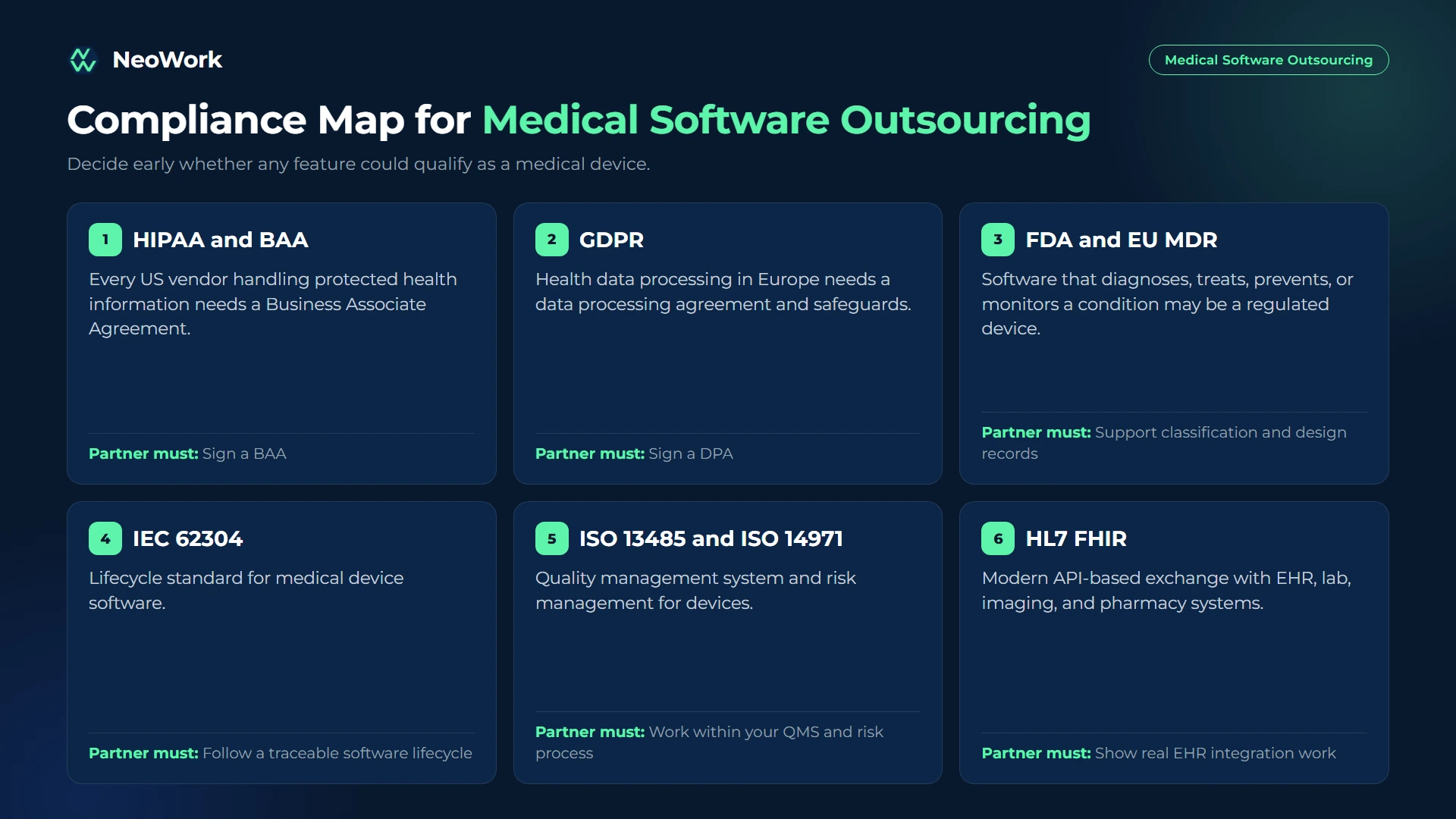
Quick Summary: Medical software outsourcing means working with an external partner or dedicated external engineers to build, test, or maintain healthcare software, from patient portals and telehealth apps to EHR integrations, clinical tools, and software that qualifies as a medical device. Regulation is what sets it apart. In the US, any vendor handling protected health information must sign a Business Associate Agreement under HIPAA; Europe treats health data as a special category under GDPR; and medical device software falls under FDA or EU MDR requirements, typically supported by IEC 62304, ISO 13485, and ISO 14971. This guide covers the types of medical software that get outsourced, why healthcare companies outsource, the compliance side, cost structures, how in-house and outsourced development compare, and how to choose a partner.
Healthcare organizations need more software than ever: virtual care, remote monitoring, patient self-service, data platforms, and AI-assisted documentation. Digital health startups face the same pressure from the other side, racing to build products that clinicians will trust and regulators will accept.
Outsourcing can supply the engineering capacity many healthcare teams lack. But in this space, picking the wrong partner can mean a privacy breach or a regulatory setback, not just a missed deadline.
What Is Medical Software Outsourcing?
Medical software outsourcing is the delegation of healthcare software development or support to a third party or to dedicated external engineers. The partner might build a complete product, develop specific components, handle integrations, or support testing and validation.
Why Healthcare Companies Outsource Software Development
The most common reason is capacity. Hospital innovation teams often know exactly what clinicians need but have few developers to build it. Digital health startups may have strong product teams but need specialists who have connected to major EHRs before.
Timelines are the second reason. Pilots with health systems, payer contracts, funding milestones, and regulatory submissions all come with dates attached, and building an internal team from scratch rarely fits them. Partners who already understand healthcare security and interoperability can start contributing within weeks.

Strengthen Healthcare Software Teams with NeoWork
Medical software outsourcing helps healthcare companies add engineering capacity without building every role in-house. At NeoWork, we provide dedicated developers, QA engineers, and technical support engineers who work inside your repositories, tools, and quality processes, under your product and compliance leadership. We handle recruitment, benefits, training, and ongoing engagement. Our industry-leading 91% annualized teammate retention rate and 3.2% candidate selectivity rate reflect our focus on selective hiring and long-term team stability.
Our healthcare software support model offers:
- software development and technical support
- integration with your tools and processes
- recruitment and ongoing teammate support
Contact NeoWork to add engineering capacity that fits your healthcare product.
Compliance: Why This Is the Real Risk
The most important early decision is whether your software, or any feature in it, could qualify as a medical device. Software that only handles scheduling or billing is usually healthcare IT. Software intended to diagnose, treat, prevent, or monitor a condition may be regulated as a device, even if it runs on a phone or in the cloud. Teams that discover this late often face months of rework to create design records, risk analysis, and traceability.
Privacy rules apply either way. In the US, every vendor that handles protected health information on your behalf needs a Business Associate Agreement. In Europe, health data processing requires a data processing agreement and appropriate safeguards. Development should use synthetic or de-identified data wherever possible, with real patient data restricted to named people with a documented need.
Outsourcing Models and Cost Structures
Medical software usually costs more than comparable non-healthcare software because of security requirements, integration complexity, documentation, and validation. Regulated device software costs more again, because every requirement, risk, and test must be traceable.
- Full product development: A partner builds the product end to end, usually priced as fixed scope or time and materials.
- Regulated development partner: A partner with its own quality system develops device software, with higher documentation effort.
- Dedicated engineering team: Engineers work inside your team and quality system for a monthly rate.
- Specialist services: Integration, security testing, or verification work priced per project.
See how dedicated roles are structured on our pricing page.
In-House vs. Outsourced: Pros and Cons
How to Choose a Medical Software Partner
Making the Transition Smooth
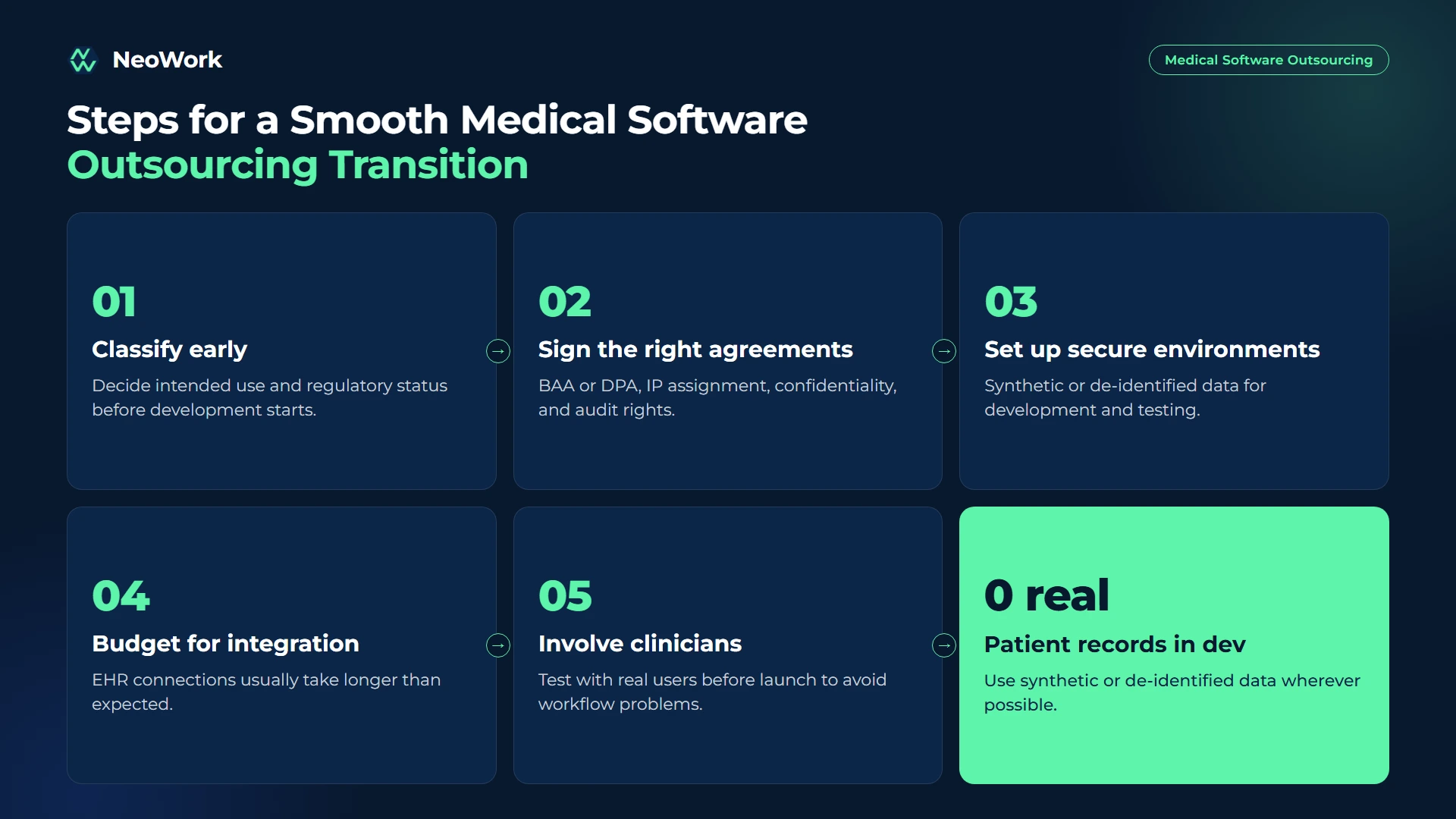
- Classify early: Decide intended use and regulatory status before development starts.
- Sign the right agreements: BAA or DPA, IP assignment, confidentiality, and audit rights.
- Set up secure environments: Synthetic or de-identified data for development and testing.
- Budget for integration: EHR connections usually take longer than expected.
- Involve clinicians: Test with real users before launch to avoid workflow problems.
Is Your Software a Medical Device?
This question shapes the whole project, so it's worth answering before development starts. The answer depends on intended use, not on technology. Questions to discuss with regulatory experts include:
- Intended use: what is the software for, and who will use it?
- Clinical decisions: does it make or support decisions about individual patients?
- Medical data analysis: does it analyze images, signals, or lab results?
- Potential harm: what could happen if the software gives a wrong result?
- Markets: in which countries will it be used or sold?
If the answer points toward a medical device, choose partners with regulated development experience and plan for the documentation, risk management, and validation that regulators expect.
Protecting Patient Data During Development
- Synthetic or de-identified data: use it in development and testing environments by default.
- Restricted access: limit real patient data to named people with a documented need.
- Logging: record access to systems that contain protected information.
- No local copies: keep production data off laptops and personal tools.
- Vetted services: review every third-party tool, including AI APIs, before it touches patient data.
- Agreements everywhere: sign BAAs or data processing agreements with every vendor in the data chain.
Why Healthcare Software Projects Slip
Late classification is the most common cause. Teams that discover halfway through that a feature makes the product a medical device have to recreate design records and risk analysis that should have existed from the start.
Integration is the second cause. Connecting to EHRs and clinical systems involves access approvals, testing environments, data mapping, and coordination with hospital IT teams, and those steps rarely move at development speed. Clinical adoption is the third: software that adds clicks or interrupts workflows won't be used, no matter how well it's built. Involving clinicians early and testing with real users prevents expensive rework after launch.
Working With Clinicians
Clinicians are the users who decide whether healthcare software succeeds. Involve them early, not just at final testing. Short workflow observations and interviews reveal how work actually happens, which is often different from how it's documented.
During development, run regular usability sessions with a small group of clinical users, and treat their feedback as seriously as bug reports. Pay particular attention to clicks, alert fatigue, and how information is displayed under time pressure. A partner with healthcare experience will expect this involvement and plan for it, rather than treating clinical feedback as a late-stage obstacle.
FAQ
Final Thoughts
Medical software outsourcing works best when regulation shapes the plan from the start. Classify your software early, choose partners who meet the requirements that actually apply, keep patient data out of development, and plan realistic time for integration and clinical validation.
Before talking to partners, write down your intended use and target markets. Those two answers determine almost everything about who you should work with.
Topics
Medical Software Outsourcing Guide 2026: Compliance, Costs & Partners

Quick Summary: Medical software outsourcing means working with an external partner or dedicated external engineers to build, test, or maintain healthcare software, from patient portals and telehealth apps to EHR integrations, clinical tools, and software that qualifies as a medical device. Regulation is what sets it apart. In the US, any vendor handling protected health information must sign a Business Associate Agreement under HIPAA; Europe treats health data as a special category under GDPR; and medical device software falls under FDA or EU MDR requirements, typically supported by IEC 62304, ISO 13485, and ISO 14971. This guide covers the types of medical software that get outsourced, why healthcare companies outsource, the compliance side, cost structures, how in-house and outsourced development compare, and how to choose a partner.
Healthcare organizations need more software than ever: virtual care, remote monitoring, patient self-service, data platforms, and AI-assisted documentation. Digital health startups face the same pressure from the other side, racing to build products that clinicians will trust and regulators will accept.
Outsourcing can supply the engineering capacity many healthcare teams lack. But in this space, picking the wrong partner can mean a privacy breach or a regulatory setback, not just a missed deadline.
What Is Medical Software Outsourcing?
Medical software outsourcing is the delegation of healthcare software development or support to a third party or to dedicated external engineers. The partner might build a complete product, develop specific components, handle integrations, or support testing and validation.
Why Healthcare Companies Outsource Software Development
The most common reason is capacity. Hospital innovation teams often know exactly what clinicians need but have few developers to build it. Digital health startups may have strong product teams but need specialists who have connected to major EHRs before.
Timelines are the second reason. Pilots with health systems, payer contracts, funding milestones, and regulatory submissions all come with dates attached, and building an internal team from scratch rarely fits them. Partners who already understand healthcare security and interoperability can start contributing within weeks.
Strengthen Healthcare Software Teams with NeoWork
Medical software outsourcing helps healthcare companies add engineering capacity without building every role in-house. At NeoWork, we provide dedicated developers, QA engineers, and technical support engineers who work inside your repositories, tools, and quality processes, under your product and compliance leadership. We handle recruitment, benefits, training, and ongoing engagement. Our industry-leading 91% annualized teammate retention rate and 3.2% candidate selectivity rate reflect our focus on selective hiring and long-term team stability.
Our healthcare software support model offers:
- software development and technical support
- integration with your tools and processes
- recruitment and ongoing teammate support
Contact NeoWork to add engineering capacity that fits your healthcare product.
Compliance: Why This Is the Real Risk
The most important early decision is whether your software, or any feature in it, could qualify as a medical device. Software that only handles scheduling or billing is usually healthcare IT. Software intended to diagnose, treat, prevent, or monitor a condition may be regulated as a device, even if it runs on a phone or in the cloud. Teams that discover this late often face months of rework to create design records, risk analysis, and traceability.
Privacy rules apply either way. In the US, every vendor that handles protected health information on your behalf needs a Business Associate Agreement. In Europe, health data processing requires a data processing agreement and appropriate safeguards. Development should use synthetic or de-identified data wherever possible, with real patient data restricted to named people with a documented need.
Outsourcing Models and Cost Structures
Medical software usually costs more than comparable non-healthcare software because of security requirements, integration complexity, documentation, and validation. Regulated device software costs more again, because every requirement, risk, and test must be traceable.
- Full product development: A partner builds the product end to end, usually priced as fixed scope or time and materials.
- Regulated development partner: A partner with its own quality system develops device software, with higher documentation effort.
- Dedicated engineering team: Engineers work inside your team and quality system for a monthly rate.
- Specialist services: Integration, security testing, or verification work priced per project.
See how dedicated roles are structured on our pricing page.
In-House vs. Outsourced: Pros and Cons
How to Choose a Medical Software Partner
Making the Transition Smooth
- Classify early: Decide intended use and regulatory status before development starts.
- Sign the right agreements: BAA or DPA, IP assignment, confidentiality, and audit rights.
- Set up secure environments: Synthetic or de-identified data for development and testing.
- Budget for integration: EHR connections usually take longer than expected.
- Involve clinicians: Test with real users before launch to avoid workflow problems.
Is Your Software a Medical Device?
This question shapes the whole project, so it's worth answering before development starts. The answer depends on intended use, not on technology. Questions to discuss with regulatory experts include:
- Intended use: what is the software for, and who will use it?
- Clinical decisions: does it make or support decisions about individual patients?
- Medical data analysis: does it analyze images, signals, or lab results?
- Potential harm: what could happen if the software gives a wrong result?
- Markets: in which countries will it be used or sold?
If the answer points toward a medical device, choose partners with regulated development experience and plan for the documentation, risk management, and validation that regulators expect.
Protecting Patient Data During Development
- Synthetic or de-identified data: use it in development and testing environments by default.
- Restricted access: limit real patient data to named people with a documented need.
- Logging: record access to systems that contain protected information.
- No local copies: keep production data off laptops and personal tools.
- Vetted services: review every third-party tool, including AI APIs, before it touches patient data.
- Agreements everywhere: sign BAAs or data processing agreements with every vendor in the data chain.
Why Healthcare Software Projects Slip
Late classification is the most common cause. Teams that discover halfway through that a feature makes the product a medical device have to recreate design records and risk analysis that should have existed from the start.
Integration is the second cause. Connecting to EHRs and clinical systems involves access approvals, testing environments, data mapping, and coordination with hospital IT teams, and those steps rarely move at development speed. Clinical adoption is the third: software that adds clicks or interrupts workflows won't be used, no matter how well it's built. Involving clinicians early and testing with real users prevents expensive rework after launch.
Working With Clinicians
Clinicians are the users who decide whether healthcare software succeeds. Involve them early, not just at final testing. Short workflow observations and interviews reveal how work actually happens, which is often different from how it's documented.
During development, run regular usability sessions with a small group of clinical users, and treat their feedback as seriously as bug reports. Pay particular attention to clicks, alert fatigue, and how information is displayed under time pressure. A partner with healthcare experience will expect this involvement and plan for it, rather than treating clinical feedback as a late-stage obstacle.
FAQ
Final Thoughts
Medical software outsourcing works best when regulation shapes the plan from the start. Classify your software early, choose partners who meet the requirements that actually apply, keep patient data out of development, and plan realistic time for integration and clinical validation.
Before talking to partners, write down your intended use and target markets. Those two answers determine almost everything about who you should work with.
Topics
Related Blogs
Related Podcasts





