

.avif)
.avif)

Nearshore vs Offshore Staffing: 2026 Decision Guide


.svg)

Quick Summary: Nearshore staffing places teams in neighboring countries with shared time zones and cultural alignment, while offshore staffing leverages distant regions for maximum cost savings. Nearshore models cost $53-$66/hour and offer real-time collaboration, whereas offshore teams run $27-$65/hour but face communication challenges. The right choice depends on project complexity, budget constraints, and how much synchronous interaction your business requires.
The global IT staffing market hit $80.34 billion in 2024 and is barreling toward $135.7 billion by 2033. That explosive growth isn't happening because companies suddenly got generous with budgets.
It's happening because traditional hiring models are breaking down.
According to SHRM research, 61% of recruiting professionals have a lack of qualified candidates for open roles. More than a quarter of unemployed people could not be matched to a job opening in their occupational group. The mismatch is real, and it's forcing businesses to look beyond their borders.
Enter nearshore and offshore staffing — two models that sound similar but deliver completely different experiences. One prioritizes proximity and collaboration. The other maximizes cost savings and talent pool depth.
Here's what actually separates them, and how to pick the right model for your business in 2026.
Understanding the Three Staffing Models
Before diving into nearshore versus offshore, let's map out the full landscape. Most discussions include a third option: onshore staffing.
Onshore Staffing
Onshore means hiring within your own country. A company in New York staffing developers in California? That's onshore.
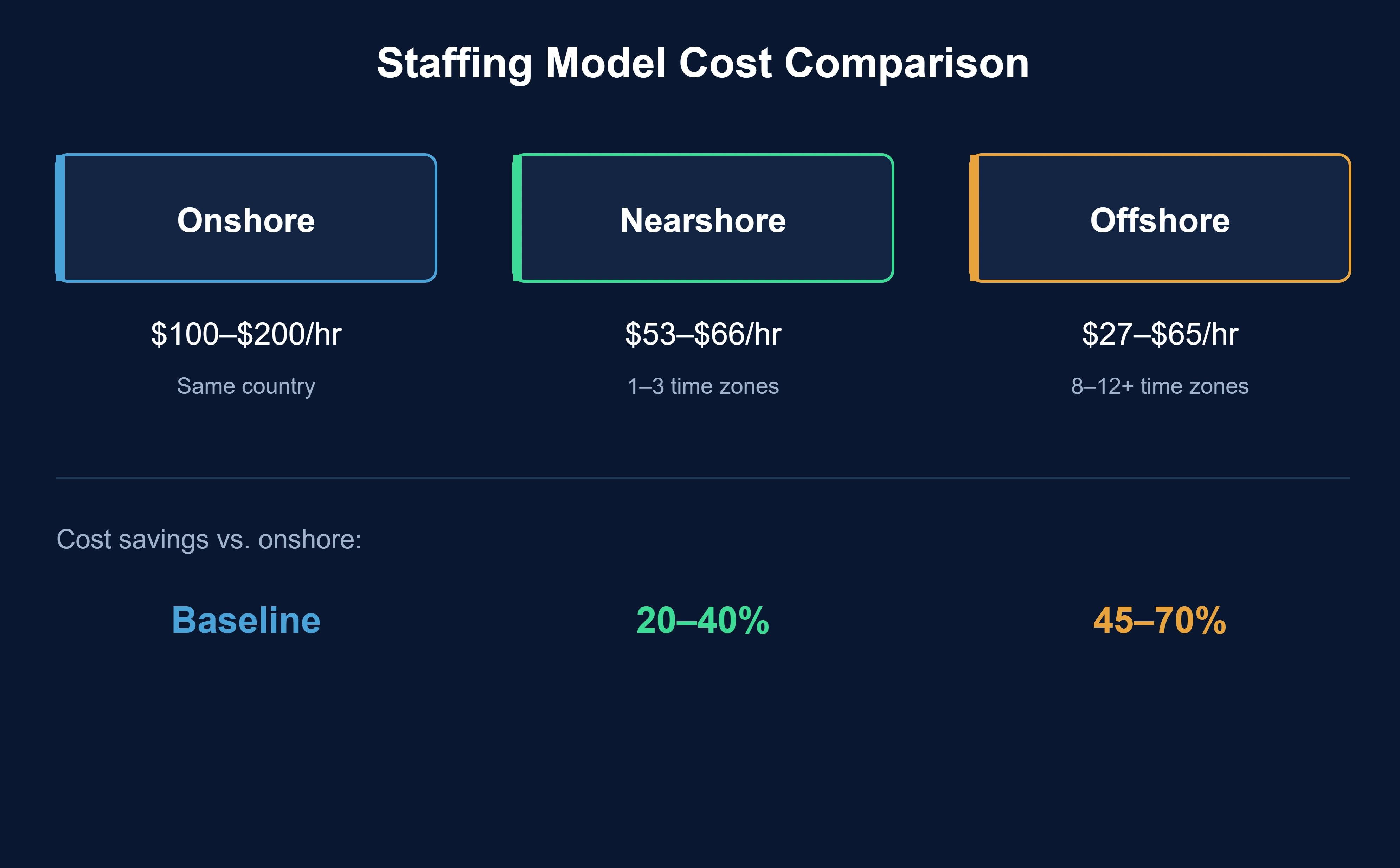
The upside: zero cultural friction, identical time zones, simplified compliance. The downside: premium pricing. U.S.-based software developers typically cost $100-$150+ per hour, with senior specialists and architects reaching $150-$200+ per hour.
When does onshore make sense? Customer-facing roles that need local market knowledge, regulatory-heavy positions where compliance complexity outweighs cost concerns, and leadership roles requiring constant presence.
Nearshore Staffing
Nearshore staffing places teams in neighboring or nearby countries — typically within 1-3 time zones of your headquarters.
For U.S. companies, that usually means Latin America: Mexico, Colombia, Argentina, Costa Rica. For Canadian businesses, similar destinations apply. European companies often nearshore to Eastern Europe or the Balkans.
Research shows that nearshore mid-level developers cost approximately $53-$66 per hour — a premium of 10-30% over the cheapest offshore locations, but still substantially below onshore rates.
The tradeoff: you pay more than offshore, but gain time zone alignment, cultural overlap, and easier real-time collaboration.
Offshore Staffing
Offshore staffing taps talent in distant regions, typically 8-12+ time zones away. For North American companies, that means Asia (India, Philippines, Vietnam), Eastern Europe, or parts of Africa.
Market data shows offshore mid-level developers might cost $27-$65 per hour. Eastern Europe rates span $37-$101 per hour. These figures represent approximately 50% of equivalent onshore costs — sometimes less.
The catch: significant time zone gaps, potential cultural differences, and communication overhead that can slow iteration cycles.
Cost Reality Beyond Hourly Rates
Staring at hourly rates tells you almost nothing about total cost of ownership. The real expense calculation includes recruitment fees, infrastructure overhead, management burden, and productivity loss from misalignment.
Industry analyses indicate 45-70% cost savings on labor compared to onshore rates when moving to offshore models. But that's gross savings — before accounting for hidden costs.
The Hidden Expenses Nobody Mentions
Offshore teams often require overlapping shifts to bridge time zones. That means paying for hours when your remote team stays late (or comes in early) just to catch your afternoon standup.
Communication lag adds iteration cycles. A question that takes 10 minutes to resolve in a Slack thread with a nearshore team might take 18 hours offshore — asked at 4 PM your time, answered at 9 AM theirs, clarification at 4 PM again, resolution the next morning.
Recruitment and turnover costs vary wildly by region. Some offshore markets have 25-30% annual attrition in tech roles. Nearshore markets typically run 15-20%. Onshore U.S. tech attrition averages 13-15%.
Then there's management overhead. Leading a distributed team across 10 time zones demands different processes, better documentation, and more structured async communication. That infrastructure costs time and money to build.
Scale Nearshore and Offshore Staffing with NeoWork

Nearshore and offshore staffing both help companies add remote professionals, but the right model depends on workload, time zone needs, and team structure. NeoWork provides remote teammates who can support operations, customer experience, technical work, AI tasks, and administrative workflows. NeoWork handles recruitment, benefits, training, and ongoing engagement, while teammates work inside the client’s systems and processes. Its 91% annualized teammate retention rate and 3.2% candidate selectivity rate reflect a focus on selective hiring and longer-term team stability.
NeoWork's remote staffing model offers:
- nearshore or offshore teammates based on business needs
- integration with the client’s tools and processes
- recruitment and ongoing teammate support
Contact NeoWork to discuss the right staffing model for your team and daily operations.
Time Zone Alignment and Collaboration Dynamics
Here's where nearshore and offshore models diverge most sharply.
Nearshore teams in Latin America share 0-3 hours of offset from U.S. East Coast businesses. A developer in Colombia works the same 9-to-5 as your team in Atlanta. Need to jump on a call at 2 PM? No problem.
Offshore teams in Asia are 10-13 hours ahead. Your 2 PM is their 3 AM. Real-time collaboration doesn't exist — everything runs asynchronously.
When Async Works (and When It Doesn't)
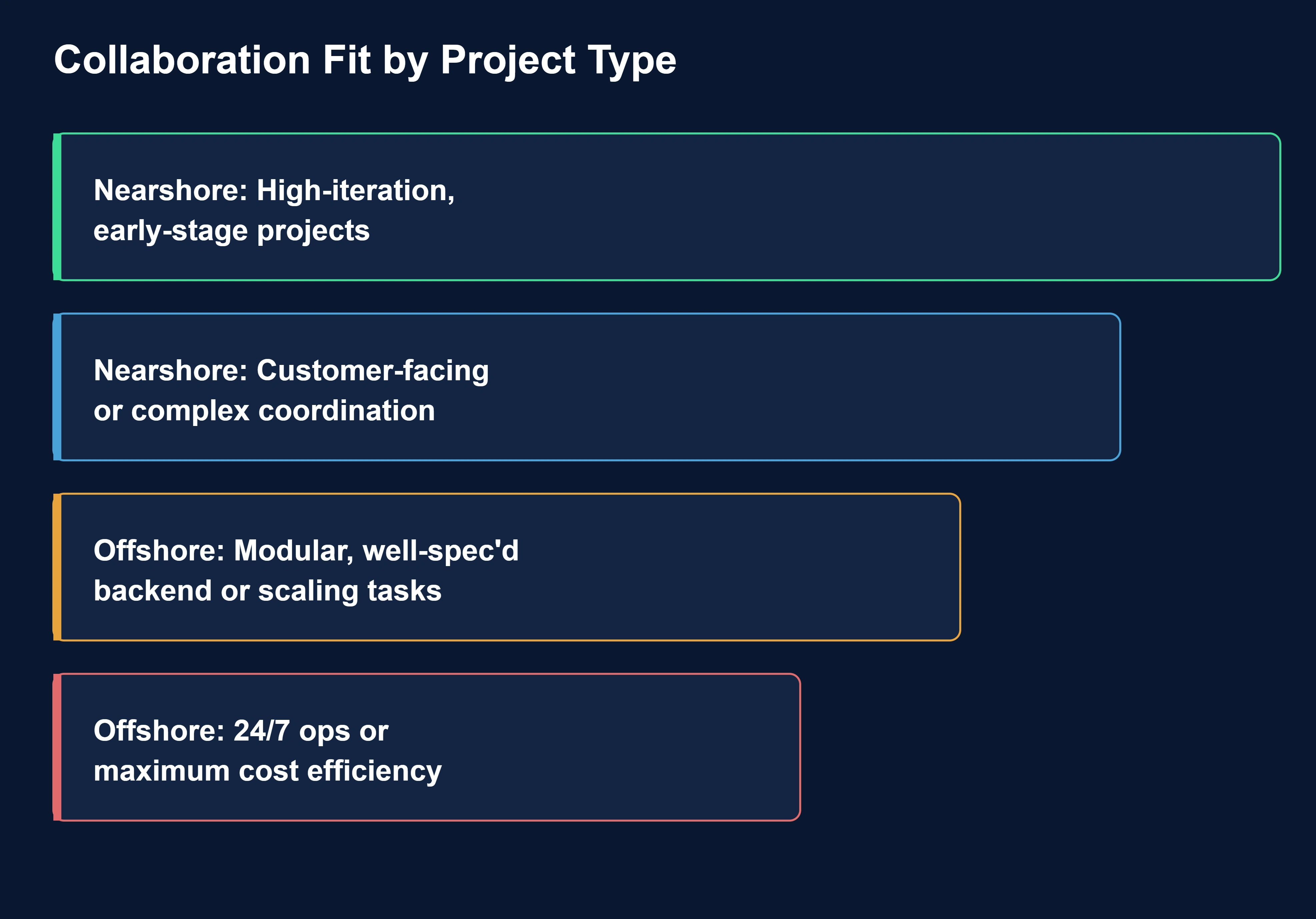
Asynchronous workflows excel for well-defined, modular projects. Backend API development with clear specs? Offshore teams crush it. The handoff happens overnight, and you review progress each morning.
But async breaks down for ambiguous, rapidly changing work. Early-stage product development, customer discovery, iterative design — these need synchronous communication. Waiting 12 hours for answers kills momentum.
Community discussions consistently highlight this dynamic. Teams report that offshore models work beautifully for scaling established products but struggle during the messy zero-to-one phase.
Nearshore splits the difference. You get 6-8 hours of overlap daily, enabling real-time collaboration when needed and async handoffs when convenient.
Cultural Alignment and Communication Nuance
Cultural fit isn't about stereotypes. It's about communication norms, business expectations, and how conflict gets resolved.
Nearshore teams in Latin America often share cultural touchpoints with North American companies: similar business etiquette, overlapping media consumption, familiar corporate structures. Language proficiency tends to be high, especially in tech hubs like Buenos Aires, Medellín, and Mexico City.
Offshore teams in Asia bring different workplace norms. Hierarchical decision-making is more common. Direct disagreement may be avoided to preserve harmony. These aren't negatives — just differences that require intentional management.
Eastern European offshore teams often align more closely with Western business culture, but language barriers can still emerge outside major tech hubs.
The Accent Question
Real talk: accent and fluency matter for customer-facing roles. A support team handling U.S. customers needs not just grammatical English but cultural fluency — idioms, regional references, conversational rhythm.
For internal engineering roles? Accent is almost irrelevant. Technical English is its own dialect. Code comments and Slack messages don't have accents.
Nearshore teams typically offer native or near-native Spanish/Portuguese speakers with strong English proficiency. Offshore teams vary more widely depending on region and educational background.
Talent Quality and Market Depth
Both nearshore and offshore markets have leveled up dramatically over the past decade. The question isn't whether you can find talented developers — you can. The question is market depth and specialization.
Nearshore Talent Pools
Latin American tech hubs have exploded. Mexico City, Guadalajara, Medellín, Buenos Aires, São Paulo — these cities now produce thousands of CS graduates annually and host thriving startup ecosystems.
Nearshore markets excel in full-stack development, mobile engineering, and modern JavaScript frameworks. Specialization in emerging tech (AI/ML, blockchain, advanced data engineering) is growing but still concentrates in a few top-tier cities.
Offshore Talent Pools
India alone graduates 1.5 million engineers yearly. The sheer scale means you can find specialists in almost any tech stack or niche domain.
Offshore markets dominate in enterprise Java, legacy system maintenance, large-scale QA operations, and data processing pipelines. Emerging tech expertise (particularly AI/ML) is strong in Bangalore, Hyderabad, and parts of Eastern Europe.
The depth of offshore markets means faster hiring for rare skill sets. Need a developer with five years of experience in a specific version of SAP? Offshore recruiters will find three candidates in a week. Nearshore might take a month.
Legal, Compliance, and IP Considerations
Intellectual property protection varies by jurisdiction. Both nearshore and offshore models require airtight contracts, but enforcement difficulty differs.
Latin American countries generally have strong IP frameworks aligned with international standards. Mexico, Colombia, Argentina, and Chile are all signatories to major IP treaties. Legal recourse is realistic if disputes arise.
Offshore jurisdictions vary more widely. India has robust IP law and English-language courts. Vietnam and the Philippines have improving frameworks but less precedent. Some offshore destinations have IP enforcement challenges that require additional contractual safeguards.
Data Residency and Regulatory Compliance
Data governance is tightening across employment practices and regulatory requirements. If your industry faces strict data residency requirements (healthcare, finance, government contracting), nearshore models often simplify compliance. Many Latin American countries have bilateral data-sharing agreements with the U.S.
Offshore models can still work but require careful architectural planning — edge processing, data anonymization, or hybrid models where sensitive data never leaves approved jurisdictions.
Building Hybrid Staffing Strategies
Here's the thing: you don't have to pick one model exclusively.
The most sophisticated global teams blend onshore, nearshore, and offshore resources based on project requirements. Product leadership and customer-facing roles stay onshore. Core product development shifts nearshore for collaboration. Offshore teams handle scaling, QA, and infrastructure maintenance.
One financial services company (documented in industry case studies) structured their team this way: Onshore product owner and tech lead in New York. Nearshore core engineering team (five developers plus Scrum Master) in Colombia. Offshore QA and DevOps team in India.
Total cost: roughly 40% below a fully onshore equivalent, but with much higher collaboration quality than a fully offshore approach.
Vendor Selection and Partnership Models
Whether nearshore or offshore, vendor selection determines success or failure.
Key evaluation criteria include: technical vetting rigor (not just resume screening — live coding tests, architecture discussions), team stability and retention rates, communication infrastructure (tooling, processes, project management maturity), and cultural fit with your organization.
Red flags: vendors who can't provide references from similar-scale clients, unusually low pricing (often signals junior talent or high churn), resistance to transparency around team composition or performance metrics, and over-reliance on account managers instead of direct engineer access.
Green flags: willingness to do paid trial projects before long-term commitment, clear escalation paths and SLA documentation, proactive communication (they surface problems before you discover them), and engineering leadership who ask smart questions about your architecture and business goals.
Staff Augmentation vs. Dedicated Teams vs. Project-Based
Staff augmentation embeds individual contractors into your existing teams. You manage them directly. Best for filling specific skill gaps short-term.
Dedicated teams provide a complete unit (developers, QA, Scrum Master) managed by the vendor but working exclusively on your product. Best for sustained product development.
Project-based outsourcing hands off a defined scope to the vendor, who delivers the finished product. Best for well-specified, standalone initiatives where you don't need ongoing control.
Nearshore models work well for all three. Offshore models shine brightest in dedicated teams and project-based work, where async handoffs are structured into the engagement model.
The 2026 Landscape and Emerging Trends
The staffing market is shifting underneath everyone's feet.
AI tooling is changing productivity equations. A nearshore developer using GitHub Copilot, Cursor, and modern AI assistants can outproduce a three-person offshore team using traditional workflows. The cost-per-feature calculation is flipping.
Remote work normalization killed the stigma around distributed teams. In 2019, suggesting offshore development to a Series A startup got you laughed out of the room. In 2026, it's standard practice.
But the pendulum is swinging back slightly. After years of pure cost optimization, companies are rediscovering that collaboration quality matters. Nearshore models are gaining market share from pure offshore approaches, especially for product development.
Talent mobility is increasing. Top developers in offshore markets are getting remote offers from U.S. companies at nearshore-equivalent rates, creating wage pressure in traditional offshore destinations.
Making the Decision: A Practical Framework
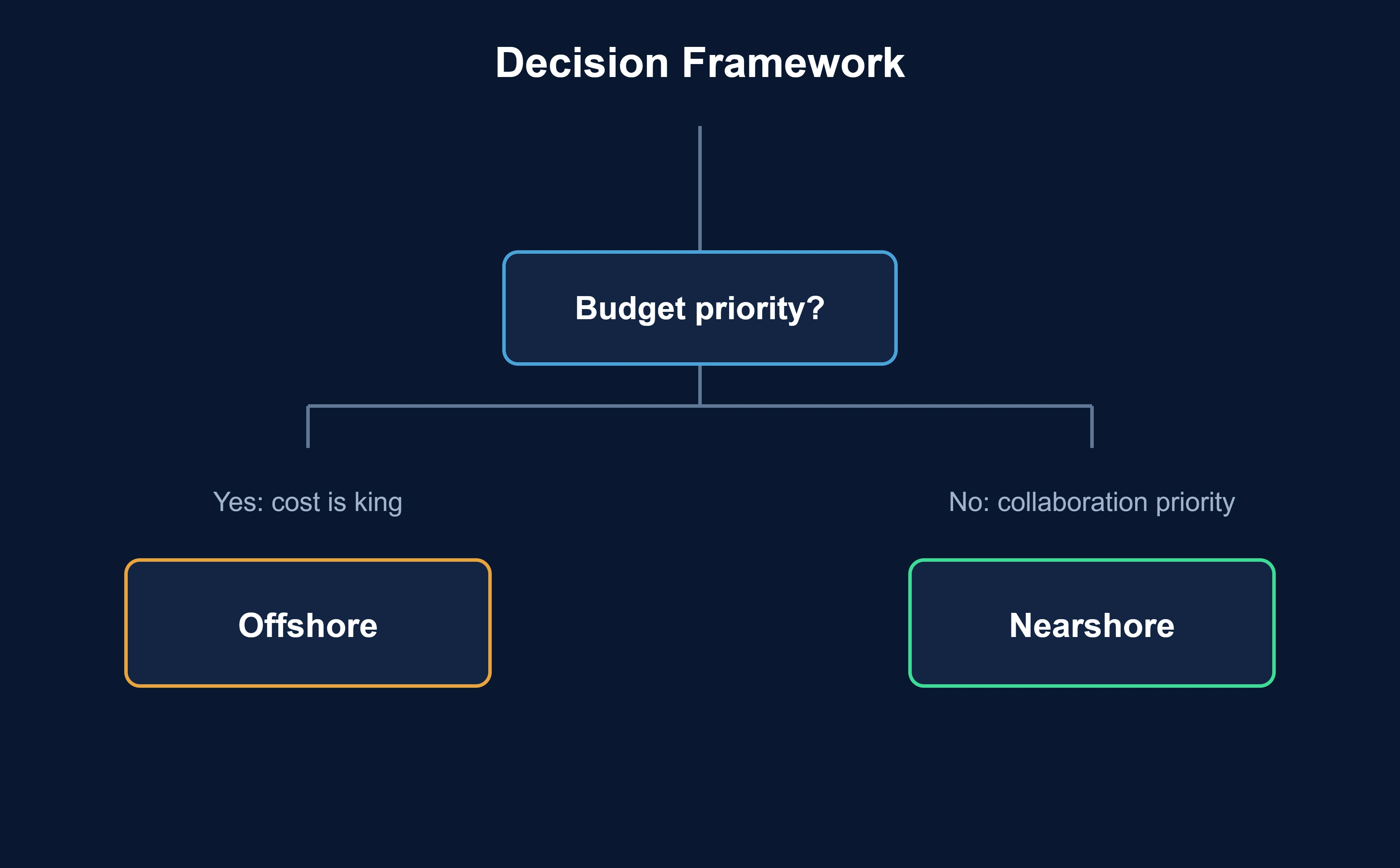
So which model should you choose?
Start by answering these questions:
- What's the project's ambiguity level? High ambiguity (early-stage product, shifting requirements, customer discovery) → nearshore. Low ambiguity (scaling proven features, clear specs, established patterns) → offshore works well.
- How much synchronous collaboration does the work require? Daily pairing, frequent architecture discussions, rapid iteration → nearshore. Modular work with clear interfaces and weekly check-ins → offshore is fine.
- What's your cost sensitivity? Need maximum savings and have processes to manage async teams → offshore. Willing to pay 10-30% more for easier collaboration → nearshore.
- What's your management capacity? Limited bandwidth for process design and async communication structure → nearshore (lower overhead). Strong project management infrastructure and documentation culture → offshore is manageable.
- Are there regulatory or compliance constraints? Strict data residency, IP sensitivity, or regulatory requirements → nearshore often simplifies compliance. Standard commercial software with normal IP agreements → either model works.
Common Pitfalls and How to Avoid Them
- The most common mistake: treating offshore or nearshore teams as expendable resources rather than core team members. When remote developers are excluded from planning discussions, kept out of Slack channels, or treated as order-takers instead of collaborators, productivity craters. Turnover spikes. Quality suffers.
- Second mistake: underestimating onboarding time. Remote teams need 2-3x longer to ramp up than co-located hires. They can't tap a colleague on the shoulder for context. Everything must be documented.
- Third mistake: choosing on price alone. The cheapest vendor is almost never the best value. A mid-tier nearshore team that delivers clean code and communicates proactively will outperform a cut-rate offshore team that generates technical debt.
- Fourth mistake: skipping the trial period. Always run a 4-8 week paid pilot before committing to a long-term contract. You'll learn more in one month of real collaboration than in ten vendor calls.
The Bottom Line
Nearshore and offshore staffing aren't competing solutions — they're tools for different jobs.
Offshore delivers maximum cost efficiency and access to the deepest talent pools. It works brilliantly for well-defined projects, scaling operations, and companies with strong async management practices.
Nearshore trades some cost savings for collaboration quality, time zone alignment, and cultural proximity. It excels for iterative product work, customer-facing roles, and teams that value real-time communication.
The smartest global staffing strategies don't pick one model. They blend onshore, nearshore, and offshore resources based on project characteristics, budget constraints, and organizational maturity.
What matters more than the model is vendor selection, team integration, and management discipline. A mediocre onshore team will underperform a well-managed offshore team every time.
Start small. Run a pilot. Measure outcomes, not activity. And remember: the goal isn't to find the cheapest developers. It's to build the most effective team your budget allows.
Ready to build your global team? Start by defining your project's ambiguity level and collaboration needs, then map those requirements to the model that fits. The right staffing strategy isn't the one that saves the most money — it's the one that delivers the best results.
FAQ
Topics
Nearshore vs Offshore Staffing: 2026 Decision Guide

Quick Summary: Nearshore staffing places teams in neighboring countries with shared time zones and cultural alignment, while offshore staffing leverages distant regions for maximum cost savings. Nearshore models cost $53-$66/hour and offer real-time collaboration, whereas offshore teams run $27-$65/hour but face communication challenges. The right choice depends on project complexity, budget constraints, and how much synchronous interaction your business requires.
The global IT staffing market hit $80.34 billion in 2024 and is barreling toward $135.7 billion by 2033. That explosive growth isn't happening because companies suddenly got generous with budgets.
It's happening because traditional hiring models are breaking down.
According to SHRM research, 61% of recruiting professionals have a lack of qualified candidates for open roles. More than a quarter of unemployed people could not be matched to a job opening in their occupational group. The mismatch is real, and it's forcing businesses to look beyond their borders.
Enter nearshore and offshore staffing — two models that sound similar but deliver completely different experiences. One prioritizes proximity and collaboration. The other maximizes cost savings and talent pool depth.
Here's what actually separates them, and how to pick the right model for your business in 2026.
Understanding the Three Staffing Models
Before diving into nearshore versus offshore, let's map out the full landscape. Most discussions include a third option: onshore staffing.
Onshore Staffing
Onshore means hiring within your own country. A company in New York staffing developers in California? That's onshore.
The upside: zero cultural friction, identical time zones, simplified compliance. The downside: premium pricing. U.S.-based software developers typically cost $100-$150+ per hour, with senior specialists and architects reaching $150-$200+ per hour.
When does onshore make sense? Customer-facing roles that need local market knowledge, regulatory-heavy positions where compliance complexity outweighs cost concerns, and leadership roles requiring constant presence.
Nearshore Staffing
Nearshore staffing places teams in neighboring or nearby countries — typically within 1-3 time zones of your headquarters.
For U.S. companies, that usually means Latin America: Mexico, Colombia, Argentina, Costa Rica. For Canadian businesses, similar destinations apply. European companies often nearshore to Eastern Europe or the Balkans.
Research shows that nearshore mid-level developers cost approximately $53-$66 per hour — a premium of 10-30% over the cheapest offshore locations, but still substantially below onshore rates.
The tradeoff: you pay more than offshore, but gain time zone alignment, cultural overlap, and easier real-time collaboration.
Offshore Staffing
Offshore staffing taps talent in distant regions, typically 8-12+ time zones away. For North American companies, that means Asia (India, Philippines, Vietnam), Eastern Europe, or parts of Africa.
Market data shows offshore mid-level developers might cost $27-$65 per hour. Eastern Europe rates span $37-$101 per hour. These figures represent approximately 50% of equivalent onshore costs — sometimes less.
The catch: significant time zone gaps, potential cultural differences, and communication overhead that can slow iteration cycles.
Cost Reality Beyond Hourly Rates
Staring at hourly rates tells you almost nothing about total cost of ownership. The real expense calculation includes recruitment fees, infrastructure overhead, management burden, and productivity loss from misalignment.
Industry analyses indicate 45-70% cost savings on labor compared to onshore rates when moving to offshore models. But that's gross savings — before accounting for hidden costs.
The Hidden Expenses Nobody Mentions
Offshore teams often require overlapping shifts to bridge time zones. That means paying for hours when your remote team stays late (or comes in early) just to catch your afternoon standup.
Communication lag adds iteration cycles. A question that takes 10 minutes to resolve in a Slack thread with a nearshore team might take 18 hours offshore — asked at 4 PM your time, answered at 9 AM theirs, clarification at 4 PM again, resolution the next morning.
Recruitment and turnover costs vary wildly by region. Some offshore markets have 25-30% annual attrition in tech roles. Nearshore markets typically run 15-20%. Onshore U.S. tech attrition averages 13-15%.
Then there's management overhead. Leading a distributed team across 10 time zones demands different processes, better documentation, and more structured async communication. That infrastructure costs time and money to build.
Scale Nearshore and Offshore Staffing with NeoWork
Nearshore and offshore staffing both help companies add remote professionals, but the right model depends on workload, time zone needs, and team structure. NeoWork provides remote teammates who can support operations, customer experience, technical work, AI tasks, and administrative workflows. NeoWork handles recruitment, benefits, training, and ongoing engagement, while teammates work inside the client’s systems and processes. Its 91% annualized teammate retention rate and 3.2% candidate selectivity rate reflect a focus on selective hiring and longer-term team stability.
NeoWork's remote staffing model offers:
- nearshore or offshore teammates based on business needs
- integration with the client’s tools and processes
- recruitment and ongoing teammate support
Contact NeoWork to discuss the right staffing model for your team and daily operations.
Time Zone Alignment and Collaboration Dynamics
Here's where nearshore and offshore models diverge most sharply.
Nearshore teams in Latin America share 0-3 hours of offset from U.S. East Coast businesses. A developer in Colombia works the same 9-to-5 as your team in Atlanta. Need to jump on a call at 2 PM? No problem.
Offshore teams in Asia are 10-13 hours ahead. Your 2 PM is their 3 AM. Real-time collaboration doesn't exist — everything runs asynchronously.
When Async Works (and When It Doesn't)
Asynchronous workflows excel for well-defined, modular projects. Backend API development with clear specs? Offshore teams crush it. The handoff happens overnight, and you review progress each morning.
But async breaks down for ambiguous, rapidly changing work. Early-stage product development, customer discovery, iterative design — these need synchronous communication. Waiting 12 hours for answers kills momentum.
Community discussions consistently highlight this dynamic. Teams report that offshore models work beautifully for scaling established products but struggle during the messy zero-to-one phase.
Nearshore splits the difference. You get 6-8 hours of overlap daily, enabling real-time collaboration when needed and async handoffs when convenient.
Cultural Alignment and Communication Nuance
Cultural fit isn't about stereotypes. It's about communication norms, business expectations, and how conflict gets resolved.
Nearshore teams in Latin America often share cultural touchpoints with North American companies: similar business etiquette, overlapping media consumption, familiar corporate structures. Language proficiency tends to be high, especially in tech hubs like Buenos Aires, Medellín, and Mexico City.
Offshore teams in Asia bring different workplace norms. Hierarchical decision-making is more common. Direct disagreement may be avoided to preserve harmony. These aren't negatives — just differences that require intentional management.
Eastern European offshore teams often align more closely with Western business culture, but language barriers can still emerge outside major tech hubs.
The Accent Question
Real talk: accent and fluency matter for customer-facing roles. A support team handling U.S. customers needs not just grammatical English but cultural fluency — idioms, regional references, conversational rhythm.
For internal engineering roles? Accent is almost irrelevant. Technical English is its own dialect. Code comments and Slack messages don't have accents.
Nearshore teams typically offer native or near-native Spanish/Portuguese speakers with strong English proficiency. Offshore teams vary more widely depending on region and educational background.
Talent Quality and Market Depth
Both nearshore and offshore markets have leveled up dramatically over the past decade. The question isn't whether you can find talented developers — you can. The question is market depth and specialization.
Nearshore Talent Pools
Latin American tech hubs have exploded. Mexico City, Guadalajara, Medellín, Buenos Aires, São Paulo — these cities now produce thousands of CS graduates annually and host thriving startup ecosystems.
Nearshore markets excel in full-stack development, mobile engineering, and modern JavaScript frameworks. Specialization in emerging tech (AI/ML, blockchain, advanced data engineering) is growing but still concentrates in a few top-tier cities.
Offshore Talent Pools
India alone graduates 1.5 million engineers yearly. The sheer scale means you can find specialists in almost any tech stack or niche domain.
Offshore markets dominate in enterprise Java, legacy system maintenance, large-scale QA operations, and data processing pipelines. Emerging tech expertise (particularly AI/ML) is strong in Bangalore, Hyderabad, and parts of Eastern Europe.
The depth of offshore markets means faster hiring for rare skill sets. Need a developer with five years of experience in a specific version of SAP? Offshore recruiters will find three candidates in a week. Nearshore might take a month.
Legal, Compliance, and IP Considerations
Intellectual property protection varies by jurisdiction. Both nearshore and offshore models require airtight contracts, but enforcement difficulty differs.
Latin American countries generally have strong IP frameworks aligned with international standards. Mexico, Colombia, Argentina, and Chile are all signatories to major IP treaties. Legal recourse is realistic if disputes arise.
Offshore jurisdictions vary more widely. India has robust IP law and English-language courts. Vietnam and the Philippines have improving frameworks but less precedent. Some offshore destinations have IP enforcement challenges that require additional contractual safeguards.
Data Residency and Regulatory Compliance
Data governance is tightening across employment practices and regulatory requirements. If your industry faces strict data residency requirements (healthcare, finance, government contracting), nearshore models often simplify compliance. Many Latin American countries have bilateral data-sharing agreements with the U.S.
Offshore models can still work but require careful architectural planning — edge processing, data anonymization, or hybrid models where sensitive data never leaves approved jurisdictions.
Building Hybrid Staffing Strategies
Here's the thing: you don't have to pick one model exclusively.
The most sophisticated global teams blend onshore, nearshore, and offshore resources based on project requirements. Product leadership and customer-facing roles stay onshore. Core product development shifts nearshore for collaboration. Offshore teams handle scaling, QA, and infrastructure maintenance.
One financial services company (documented in industry case studies) structured their team this way: Onshore product owner and tech lead in New York. Nearshore core engineering team (five developers plus Scrum Master) in Colombia. Offshore QA and DevOps team in India.
Total cost: roughly 40% below a fully onshore equivalent, but with much higher collaboration quality than a fully offshore approach.
Vendor Selection and Partnership Models
Whether nearshore or offshore, vendor selection determines success or failure.
Key evaluation criteria include: technical vetting rigor (not just resume screening — live coding tests, architecture discussions), team stability and retention rates, communication infrastructure (tooling, processes, project management maturity), and cultural fit with your organization.
Red flags: vendors who can't provide references from similar-scale clients, unusually low pricing (often signals junior talent or high churn), resistance to transparency around team composition or performance metrics, and over-reliance on account managers instead of direct engineer access.
Green flags: willingness to do paid trial projects before long-term commitment, clear escalation paths and SLA documentation, proactive communication (they surface problems before you discover them), and engineering leadership who ask smart questions about your architecture and business goals.
Staff Augmentation vs. Dedicated Teams vs. Project-Based
Staff augmentation embeds individual contractors into your existing teams. You manage them directly. Best for filling specific skill gaps short-term.
Dedicated teams provide a complete unit (developers, QA, Scrum Master) managed by the vendor but working exclusively on your product. Best for sustained product development.
Project-based outsourcing hands off a defined scope to the vendor, who delivers the finished product. Best for well-specified, standalone initiatives where you don't need ongoing control.
Nearshore models work well for all three. Offshore models shine brightest in dedicated teams and project-based work, where async handoffs are structured into the engagement model.
The 2026 Landscape and Emerging Trends
The staffing market is shifting underneath everyone's feet.
AI tooling is changing productivity equations. A nearshore developer using GitHub Copilot, Cursor, and modern AI assistants can outproduce a three-person offshore team using traditional workflows. The cost-per-feature calculation is flipping.
Remote work normalization killed the stigma around distributed teams. In 2019, suggesting offshore development to a Series A startup got you laughed out of the room. In 2026, it's standard practice.
But the pendulum is swinging back slightly. After years of pure cost optimization, companies are rediscovering that collaboration quality matters. Nearshore models are gaining market share from pure offshore approaches, especially for product development.
Talent mobility is increasing. Top developers in offshore markets are getting remote offers from U.S. companies at nearshore-equivalent rates, creating wage pressure in traditional offshore destinations.
Making the Decision: A Practical Framework
So which model should you choose?
Start by answering these questions:
- What's the project's ambiguity level? High ambiguity (early-stage product, shifting requirements, customer discovery) → nearshore. Low ambiguity (scaling proven features, clear specs, established patterns) → offshore works well.
- How much synchronous collaboration does the work require? Daily pairing, frequent architecture discussions, rapid iteration → nearshore. Modular work with clear interfaces and weekly check-ins → offshore is fine.
- What's your cost sensitivity? Need maximum savings and have processes to manage async teams → offshore. Willing to pay 10-30% more for easier collaboration → nearshore.
- What's your management capacity? Limited bandwidth for process design and async communication structure → nearshore (lower overhead). Strong project management infrastructure and documentation culture → offshore is manageable.
- Are there regulatory or compliance constraints? Strict data residency, IP sensitivity, or regulatory requirements → nearshore often simplifies compliance. Standard commercial software with normal IP agreements → either model works.
Common Pitfalls and How to Avoid Them
- The most common mistake: treating offshore or nearshore teams as expendable resources rather than core team members. When remote developers are excluded from planning discussions, kept out of Slack channels, or treated as order-takers instead of collaborators, productivity craters. Turnover spikes. Quality suffers.
- Second mistake: underestimating onboarding time. Remote teams need 2-3x longer to ramp up than co-located hires. They can't tap a colleague on the shoulder for context. Everything must be documented.
- Third mistake: choosing on price alone. The cheapest vendor is almost never the best value. A mid-tier nearshore team that delivers clean code and communicates proactively will outperform a cut-rate offshore team that generates technical debt.
- Fourth mistake: skipping the trial period. Always run a 4-8 week paid pilot before committing to a long-term contract. You'll learn more in one month of real collaboration than in ten vendor calls.
The Bottom Line
Nearshore and offshore staffing aren't competing solutions — they're tools for different jobs.
Offshore delivers maximum cost efficiency and access to the deepest talent pools. It works brilliantly for well-defined projects, scaling operations, and companies with strong async management practices.
Nearshore trades some cost savings for collaboration quality, time zone alignment, and cultural proximity. It excels for iterative product work, customer-facing roles, and teams that value real-time communication.
The smartest global staffing strategies don't pick one model. They blend onshore, nearshore, and offshore resources based on project characteristics, budget constraints, and organizational maturity.
What matters more than the model is vendor selection, team integration, and management discipline. A mediocre onshore team will underperform a well-managed offshore team every time.
Start small. Run a pilot. Measure outcomes, not activity. And remember: the goal isn't to find the cheapest developers. It's to build the most effective team your budget allows.
Ready to build your global team? Start by defining your project's ambiguity level and collaboration needs, then map those requirements to the model that fits. The right staffing strategy isn't the one that saves the most money — it's the one that delivers the best results.
FAQ
Topics
Related Blogs
Related Podcasts


.webp)

.webp)
.webp)



