

.avif)
.avif)

Offshore Admin Staffing Guide: 2026 Playbook


.svg)

Quick Summary: Offshore admin staffing involves hiring dedicated remote administrative professionals based in other countries—typically the Philippines, Eastern Europe, or Latin America—to handle core operational tasks. Companies can reduce overhead by 50–70% while maintaining full control over hiring, training, and day-to-day management, unlike traditional outsourcing. It works best for roles like data entry, customer support, virtual assistance, and back-office operations that don't require physical presence.
Administrative work hasn't shrunk. If anything, it's ballooned.
Every CRM entry, every support ticket, every invoice, every scheduling conflict—all of it demands time that could go toward revenue-generating work. Local hiring costs keep climbing, and small teams feel the squeeze hardest.
That's where offshore admin staffing comes in. It's not outsourcing in the old sense—you're not handing tasks to a faceless agency. You're building a dedicated remote team member who works for you, reports to you, and integrates into your operations, just from a different time zone.
By the end of this guide, you'll understand exactly how offshore admin staffing works, what it costs, which roles fit, and how to hire and manage remote admin staff without the usual headaches.
What Offshore Admin Staffing Actually Means
Offshore admin staffing is the practice of hiring full-time or part-time administrative employees based in another country to handle core operational tasks. These aren't freelancers hopping between projects. They're dedicated team members—often exclusive to your business—who clock regular hours and integrate into your workflows.
The distinction matters. Outsourcing typically means you hire a third-party company to deliver a service. You pay for outputs, not hours, and you have limited control over who does the work or how they do it.
Offshore staffing flips that model. You recruit, interview, and onboard the person yourself. You set their schedule, assign their tasks, track their performance, and build a long-term working relationship. The only difference? They work remotely from a lower-cost region.
Why Admin Roles Work Especially Well Offshore
Admin functions are process-driven, digitally native, and don't require physical presence. That makes them ideal candidates for remote work, and offshore placement amplifies the financial benefit.
Roles like data entry, customer support, scheduling, bookkeeping, and virtual assistance involve repetitive, high-volume tasks that scale poorly when you're paying $25–$40 per hour locally. Offshore, the same work gets done at $8–$15 per hour, often with better focus because the role isn't a stepping stone—it's a career.
Here's the cost reality. A U.S.-based admin assistant earning $40,000 per year actually costs closer to $55,000–$65,000 when you factor in payroll taxes, health insurance, paid time off, office space, equipment, and recruitment expenses. An offshore equivalent delivering identical output runs $15,000–$25,000 annually, all-in.
That's not a marginal difference. It's transformational for cash flow, especially in the $500K–$5M revenue range where every hire decision still moves the needle.
The Three Offshore Staffing Models
Not all offshore arrangements look the same. Understanding the three core models helps you pick the structure that fits your risk tolerance, control needs, and operational maturity.
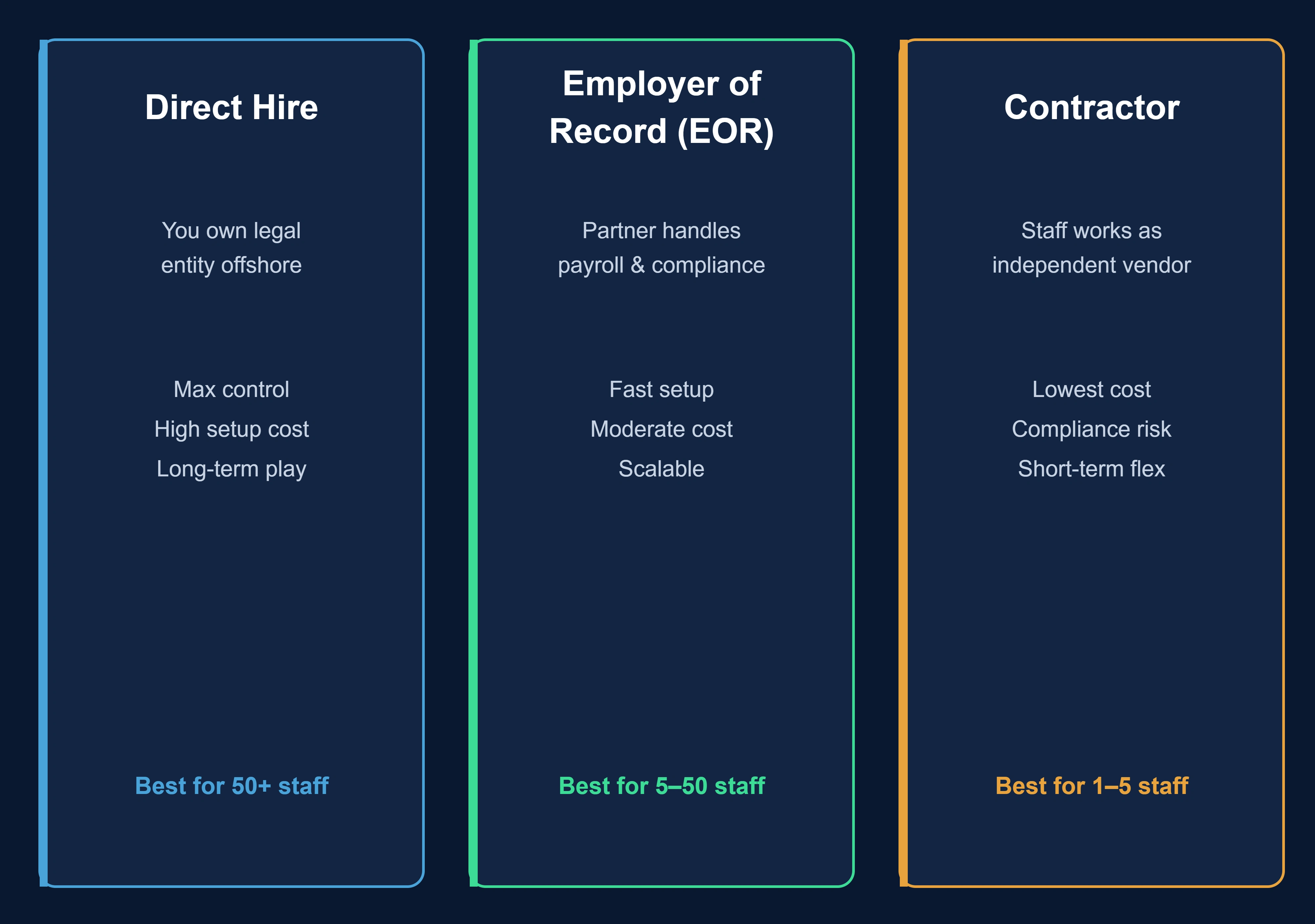
Model 1: Direct Hire (Own Entity Offshore)
This is the most hands-on approach. Your company establishes a legal entity in the target country—say, a Philippine corporation or a Polish subsidiary—and hires staff directly onto that payroll.
You handle everything: employment contracts, local tax compliance, benefits administration, office leases if needed. Full control, full responsibility.
The upside? Maximum flexibility and lowest per-employee cost at scale. Once the entity is running, adding your tenth or fiftieth hire is cheap.
The downside? Significant upfront investment—legal setup, accounting infrastructure, local HR expertise—and ongoing compliance overhead. This model makes sense when you're planning to hire 20+ people and commit for years. For a three-person admin team, it's overkill.
Model 2: Employer of Record (EOR)
An EOR provider becomes the legal employer on paper. They handle payroll, tax withholding, benefits, and local labor law compliance. You manage the day-to-day work, performance, and task assignment.
Think of it as staffing-as-a-service. You get dedicated employees without needing to set up a foreign subsidiary. The EOR invoices you monthly for salary plus a service fee—typically 15–30% of gross wages, depending on the country and contract length.
This is the sweet spot for most small and mid-sized businesses. Fast setup, low risk, predictable costs, and you can scale from one employee to twenty without restructuring.
Model 3: Independent Contractor
The simplest and cheapest route: hire offshore workers as contractors, not employees. You pay them directly (or via a payment platform), and they handle their own taxes and benefits.
It's fast, flexible, and avoids entity setup entirely. But it comes with real compliance risk. Many countries—including the Philippines and most of Europe—have strict rules about worker classification. If the relationship looks like employment (fixed hours, exclusive work, direct supervision), tax authorities can reclassify the contractor as an employee, triggering back taxes, penalties, and fines.
Contractor arrangements work for short-term projects or genuinely independent specialists. For full-time, long-term admin staff, the legal exposure usually isn't worth the savings.

Build Offshore Admin Support with NeoWork
Offshore admin staffing helps companies manage recurring administrative work without adding every support role internally. NeoWork provides offshore teammates who can support documentation, scheduling, data entry, records organization, and daily operational tasks. NeoWork handles recruitment, benefits, training, and ongoing engagement, while teammates integrate into the client’s systems and workflows. Its 91% annualized teammate retention rate and 3.2% candidate selectivity rate reflect a focus on selective hiring and longer-term team stability.
NeoWork's offshore admin staffing model offers:
- offshore admin teammates for recurring workflows
- integration with the client’s tools and processes
- recruitment and ongoing teammate support
Contact NeoWork to build offshore admin support that can keep daily operations organized.
Admin Roles That Work Offshore
Not every admin function translates well to remote offshore work. The ones that do share a few traits: they're process-driven, don't require real-time collaboration across time zones, and involve clear, measurable outputs.
Data entry and virtual assistance top the list for offshore placement. The work is high-volume, straightforward, and easy to standardize. Customer support follows closely, especially for written channels like email and chat where accent concerns disappear.
Bookkeeping roles work well offshore if the person has familiarity with your accounting software—QuickBooks, Xero, NetSuite—and you've got a domestic accountant for final review. Tax preparation and strategic finance stay onshore; data prep and reconciliation move offshore.
Operations coordination is trickier. It works when the role focuses on executing defined processes—tracking shipments, updating status dashboards, following up with vendors—but struggles when it requires real-time decision-making or frequent synchronous meetings.
The Real Cost Breakdown
Let's get specific. Organizations commonly report saving 50–70% on wage-related expenses by offshoring administrative roles by offshoring administrative roles. That range holds across industries, though the absolute numbers vary.
A local U.S. admin assistant at $18/hour costs roughly $37,440 in base salary. Add 7.65% for FICA, health insurance ($6,000–$15,000 per year for employer contribution), paid time off (averaging 20 days, costing $3,200–$4,200 in productive time), office space and equipment ($5,000–$12,000 per year), HR and management overhead, and recruitment costs ($4,000–$8,000 per hire). The fully loaded annual cost lands between $55,000 and $70,000.
An offshore equivalent—say, a Filipino virtual assistant at $10/hour—runs $20,800 annually at full-time hours. Through an EOR, add 20% for the service fee and benefits: total $24,960. Equipment (laptop, headset, software licenses) adds another $800–$1,200 upfront, amortized over two years.
All-in first-year cost: roughly $26,000. Second year and beyond: $25,000. That's a 60–64% reduction compared to the low end of the U.S. cost range, and 75% savings against the high end.
Now scale that. Five offshore admin staff cost $125,000 per year. Five local equivalents cost $280,000–$350,000. The delta funds another product launch, a senior hire, or six months of runway.
Where to Hire: The Top Offshore Admin Hubs
Geography matters. Wage rates, English proficiency, cultural fit, time zone overlap, legal frameworks, and talent pool depth all vary by region.
The Philippines
The Philippines dominates offshore admin staffing, especially for U.S. and Australian companies. English is an official language, the accent is neutral and widely understood, and there's a deep talent pool of college-educated professionals targeting admin, customer support, and data roles.
Time zone overlap with the U.S. West Coast is decent (Manila is 15–16 hours ahead, so 6 PM Pacific = 9–10 AM Manila). East Coast overlap is tougher but manageable with flexible shifts.
Monthly wages for mid-level admin roles run $800–$1,500, depending on experience and skill complexity. Regulatory environment is business-friendly, and the EOR market is mature.
Eastern Europe (Poland, Romania, Ukraine)
Eastern Europe appeals to companies that prioritize European time zones and need workers who can interface with EU clients or navigate European regulatory frameworks.
English proficiency is strong, especially among younger professionals. Tech and process skills tend to be high. Costs run higher than the Philippines—$1,500–$3,000 per month for admin roles—but still 50–60% below Western Europe or the U.S.
Legal compliance is straightforward within the EU, but non-EU hires (Ukraine, for example) require careful contractor vs. employee structuring.
Latin America (Colombia, Argentina, Mexico)
Latin America offers better time zone alignment for U.S. companies—often just one to three hours off Eastern or Central time—and growing English proficiency, particularly in major cities.
Admin wages range from $1,000–$2,200 per month. Cultural affinity with U.S. business norms is high, and travel for in-person onboarding or team events is cheaper and faster than Asia.
The downside? Talent pools are shallower outside major metros, and political or economic instability in some countries adds risk.
The Offshore Admin Hiring Process
Hiring offshore admin staff isn't radically different from hiring locally—you still need to define the role, source candidates, assess skills, and onboard effectively. But the mechanics shift, and small mistakes compound quickly across borders.
Step 1: Define the Role With Precision
Vague job descriptions fail anywhere. Offshore, they're fatal. Time zone differences and async communication mean you can't course-correct in real time, so the initial brief has to be airtight.
Document the exact tasks, tools, systems, and success metrics. Not "manage customer inquiries" but "respond to customer emails in Zendesk within four hours, achieve 95% CSAT, escalate unresolved issues to Sarah by end of shift."
List required software proficiency—specific CRMs, project management tools, spreadsheet functions. "Familiar with Excel" isn't enough; specify pivot tables, VLOOKUP, conditional formatting, whatever the role demands.
Clarify working hours. Full overlap? Partial? Fully async? If you need someone online 9 AM–5 PM U.S. Eastern, say that up front. If you're flexible, say that too.
Step 2: Source Candidates
Three main channels: offshore staffing agencies, direct recruiting on local job boards, or hybrid platforms that pre-vet talent.
Agencies handle sourcing, initial screening, and sometimes payroll. You pay a premium—15–40% markup—but save time and reduce risk. Look for agencies with replacement guarantees (30–90 days) and transparent pricing.
Direct recruiting via Bossjob (Philippines), or LinkedIn gives you more control and lower cost, but you own the entire funnel: posting, filtering, interviewing, reference checks. Expect to review 50+ applications for every hire.
Hybrid platforms like Remotee or Scale Army offer pre-vetted pools. Candidates have passed skills tests and background checks; you interview finalists and make the call. Faster than DIY, cheaper than full-service agencies.
Step 3: Skills Testing and Interviewing
Don't skip the skills test. Resumes inflate everywhere, but offshore candidates often list tools they've seen once in a webinar. A 30-minute practical assessment—"Here's a messy spreadsheet; clean it and build a summary pivot table"—filters out 60% of applicants immediately.
For customer support or VA roles, test written communication. Give them a sample angry customer email and ask for a response. Typos, tone-deafness, and unclear phrasing surface fast.
Interviews should be video, always. You're assessing English fluency, professionalism, and cultural fit. Record the call (with permission) so you can review answers and share with stakeholders.
Ask situational questions: "You've got five tasks due today and your manager is offline. How do you prioritize?" Look for ownership, problem-solving, and comfort with autonomy.
Step 4: Reference Checks and Background Screening
Verify employment history and ask for references from previous remote roles if possible. Offshore candidates sometimes pad dates or titles; a quick reference call catches discrepancies.
Background checks vary by country. The Philippines and Mexico have established third-party screening services. In some regions, formal criminal checks aren't accessible to foreign employers, so you rely more on references and probationary performance.
Step 5: Contract and Onboarding
If you're using an EOR, they'll generate the employment agreement under local law. Review it—make sure IP assignment, confidentiality, and termination clauses align with your needs.
If hiring as a contractor, use a clear independent contractor agreement that specifies deliverables, payment terms, confidentiality, and IP ownership. Avoid language that implies employment (set schedules, exclusive work, direct supervision) to reduce misclassification risk.
Onboarding sets the tone. Ship equipment early—laptop, headset, second monitor if budget allows. Provide written SOPs for every recurring task. Record walkthrough videos for complex workflows.
Assign a buddy or primary point of contact for the first two weeks. Daily check-ins, even if brief, prevent small confusion from snowballing.
Managing Offshore Admin Staff Day-to-Day
Management challenges compound with distance. You can't pop by someone's desk, read body language in the hallway, or pull them into an impromptu sync. Everything has to be more deliberate.
Communication Cadence
Daily async updates work better than weekly video calls for admin roles. A short end-of-day summary—what got done, what's in progress, what's blocked—keeps everyone aligned without burning meeting time.
Use a structured format: Slack message, email template, or a shared doc. Consistency matters more than the tool.
Weekly 1-on-1 video calls cover bigger-picture feedback, roadblocks, and morale. Keep them short—20 minutes—and use a running agenda doc so nothing falls through the cracks.
Tools and Systems
Centralize communication in one tool: Slack, Microsoft Teams, or similar. Email for external contacts, Slack for internal. Don't split conversations across five platforms.
Use project management software—Asana, Trello, ClickUp—to assign tasks, set deadlines, and track status. Transparency reduces micromanagement and gives the admin clear priorities.
Time tracking is optional but often useful. Tools like Hubstaff or Time Doctor log hours and take periodic screenshots (if agreed upon). It's not about surveillance—it's about identifying bottlenecks and justifying costs to finance teams.
Building Trust and Accountability
Remote work runs on trust. If you're second-guessing every task, the relationship is doomed.
Set clear expectations, measure outputs, and give feedback fast. Praise what's working; correct what's not within 24 hours. Silence breeds anxiety and guesswork.
Avoid the temptation to over-monitor. If the work is getting done to standard, let them own the process. Autonomy drives engagement, especially in cultures where admin roles are respected careers, not stepping stones.
Legal and Compliance Essentials
Cross-border employment introduces regulatory complexity. Miss a compliance requirement, and you're looking at fines, back taxes, or legal disputes.
Worker Classification
The contractor vs. employee question is the most common trap. Tax authorities worldwide are cracking down on misclassification—hiring someone as a contractor when the relationship looks like employment.
Key tests vary by country, but common factors include: fixed working hours, exclusive work for one client, direct supervision, use of employer-provided tools, and long-term engagement. If most of those apply, you're probably employing them, not contracting.
The U.S. IRS uses a multi-factor test under IRC Section 7701. The Philippines applies the "control test" under the Labor Code. The EU uses national tests that tend to favor employee status.
For full-time, long-term admin staff, employee classification—via EOR or direct entity—is the safer route. Save contractor status for genuinely independent, project-based work.
Tax Withholding and Reporting
If you hire through an EOR, they handle payroll tax withholding in the local country. You don't withhold U.S. taxes on foreign employees working abroad (unless they're U.S. citizens or residents). According to IRS guidance on persons employed abroad, wages paid to a U.S. citizen or resident alien by a U.S. person for services performed outside the United States are subject to U.S. federal income tax withholding. For non-U.S. workers abroad, no U.S. withholding applies—but you still file information returns if paying contractors over certain thresholds.
Per IRS rules, certain compensation may be exempt from U.S. withholding for nonresidents present in the U.S. for limited periods, though specific thresholds and conditions apply and should be verified with tax counsel. For offshore staff working entirely abroad, this is generally moot—but document residency to avoid confusion.
Data Privacy and IP Protection
Offshore admin staff often access customer data, financial records, or proprietary systems. That triggers GDPR (if you serve EU customers), CCPA (California), or other regional privacy laws.
Use data processing agreements (DPAs) that specify how data is handled, stored, and protected. Many EORs provide template DPAs compliant with major frameworks.
Require confidentiality and IP assignment clauses in every employment or contractor agreement. Make sure the language is enforceable under local law—some jurisdictions limit IP assignment or require additional consideration.
Use role-based access controls in your systems. Don't give a data entry clerk admin access to your entire CRM. Principle of least privilege reduces risk.
Common Risks and How to Avoid Them
Offshore admin staffing isn't risk-free. But most pitfalls are predictable and preventable.
Poor Cultural Fit
Not every candidate thrives in remote, async, offshore setups. Look for self-starters who've worked remotely before, communicate proactively, and don't need hand-holding.
Cultural nuances matter too. Some offshore professionals come from hierarchical work cultures and hesitate to push back or ask clarifying questions. Encourage open dialogue from day one and model the behavior you want.
Communication Breakdowns
Time zones, language barriers, and async work create fertile ground for misunderstandings. The fix? Overcommunicate. Repeat priorities. Confirm understanding. Use video and screenshots, not just text.
Establish a single source of truth for tasks and deadlines. If something's critical, don't bury it in a Slack thread—put it in the project tracker and tag them.
High Turnover
Offshore staff churn when they feel disposable, underpaid, or disconnected. Competitive wages help, but so do recognition, career development, and inclusion in team culture.
Celebrate wins. Share company updates. Invite them to team meetings, even if they're observers. Small gestures compound.
Security and Data Leaks
Remote work expands your attack surface. Enforce strong passwords, two-factor authentication, VPN use, and device encryption. Conduct periodic security training, even if it's a short video.
Revoke access immediately upon termination. Audit permissions quarterly to catch orphaned accounts.
Measuring ROI and Success
How do you know offshore admin staffing is working? Track both financial and operational metrics.
Cost Per Output
Calculate the cost per completed task—per invoice processed, per ticket resolved, per data row entered. Compare offshore cost per output to your previous local baseline.
If local cost per invoice was $8 and offshore is $3, that's a 62.5% improvement. Multiply by annual volume to see total savings.
Quality and Error Rates
Cost means nothing if quality tanks. Track error rates, rework frequency, and customer satisfaction (for support roles).
Set acceptable thresholds—say, 98% data accuracy or 90% first-contact resolution. Review weekly. If metrics slip, diagnose fast: training gap, unclear SOPs, or wrong hire?
Time to Productivity
How long does it take a new offshore hire to reach full productivity? Strong onboarding and clear processes should get someone to 80% output within two weeks, 100% by week four.
If ramp time stretches beyond six weeks, your SOPs or training need work.
Manager Time Savings
One of the hidden ROI drivers: freeing up your time or your manager's time. Track hours per week spent on admin tasks before and after offshore hiring. Reallocate that time to revenue work and measure the impact.
Real-World Use Case
Take a small property management company in Texas managing 150 rental units. The owner spent 15 hours per week fielding tenant calls, scheduling maintenance, tracking rent payments, and chasing late payers.
They hired a Filipino virtual assistant for $1,200/month. The VA handled all tenant communication via email and text, scheduled maintenance through their software, tracked payments in a shared spreadsheet, and followed up on overdue rent with templated reminders.
The owner's admin time dropped from 60 hours/month to under 10. That freed up time to scout new properties, close two acquisitions in the next quarter, and add 22 units to the portfolio. The offshore hire didn't just save $30K/year in avoided local wages—it unlocked $180K in new revenue.
That's the compounding effect. Offshore admin staffing isn't just cost arbitrage. It's capacity unlocking.
Wrapping It Up
Offshore admin staffing solves a problem that's only gotten worse: the rising cost of operational work that doesn't directly generate revenue but can't be ignored. Data entry, scheduling, customer support, bookkeeping—all essential, all expensive when done locally, all prime candidates for offshore placement.
The model works when you approach it deliberately. Define roles with precision. Hire for skills and cultural fit, not just low cost. Use EORs or agencies to manage compliance risk. Onboard thoroughly. Communicate clearly and consistently. Measure performance, not hours. Treat offshore staff as team members, not vendors.
Done right, offshore admin staffing delivers 50–70% cost savings, frees up leadership time, and scales smoothly as you grow. It's not a magic bullet—bad hires, unclear processes, and weak management kill offshore setups just as fast as local ones. But the economics and talent pools are real, and the operational upside compounds over time.
If administrative overhead is eating into your margins or blocking your ability to scale, offshore staffing is worth serious consideration. Start small—one role, clear scope, structured trial period—and expand once the model proves out.
The world's talent pool is bigger than your zip code. Might be time to tap into it.
Frequently Asked Questions
Topics
Offshore Admin Staffing Guide: 2026 Playbook

Quick Summary: Offshore admin staffing involves hiring dedicated remote administrative professionals based in other countries—typically the Philippines, Eastern Europe, or Latin America—to handle core operational tasks. Companies can reduce overhead by 50–70% while maintaining full control over hiring, training, and day-to-day management, unlike traditional outsourcing. It works best for roles like data entry, customer support, virtual assistance, and back-office operations that don't require physical presence.
Administrative work hasn't shrunk. If anything, it's ballooned.
Every CRM entry, every support ticket, every invoice, every scheduling conflict—all of it demands time that could go toward revenue-generating work. Local hiring costs keep climbing, and small teams feel the squeeze hardest.
That's where offshore admin staffing comes in. It's not outsourcing in the old sense—you're not handing tasks to a faceless agency. You're building a dedicated remote team member who works for you, reports to you, and integrates into your operations, just from a different time zone.
By the end of this guide, you'll understand exactly how offshore admin staffing works, what it costs, which roles fit, and how to hire and manage remote admin staff without the usual headaches.
What Offshore Admin Staffing Actually Means
Offshore admin staffing is the practice of hiring full-time or part-time administrative employees based in another country to handle core operational tasks. These aren't freelancers hopping between projects. They're dedicated team members—often exclusive to your business—who clock regular hours and integrate into your workflows.
The distinction matters. Outsourcing typically means you hire a third-party company to deliver a service. You pay for outputs, not hours, and you have limited control over who does the work or how they do it.
Offshore staffing flips that model. You recruit, interview, and onboard the person yourself. You set their schedule, assign their tasks, track their performance, and build a long-term working relationship. The only difference? They work remotely from a lower-cost region.
Why Admin Roles Work Especially Well Offshore
Admin functions are process-driven, digitally native, and don't require physical presence. That makes them ideal candidates for remote work, and offshore placement amplifies the financial benefit.
Roles like data entry, customer support, scheduling, bookkeeping, and virtual assistance involve repetitive, high-volume tasks that scale poorly when you're paying $25–$40 per hour locally. Offshore, the same work gets done at $8–$15 per hour, often with better focus because the role isn't a stepping stone—it's a career.
Here's the cost reality. A U.S.-based admin assistant earning $40,000 per year actually costs closer to $55,000–$65,000 when you factor in payroll taxes, health insurance, paid time off, office space, equipment, and recruitment expenses. An offshore equivalent delivering identical output runs $15,000–$25,000 annually, all-in.
That's not a marginal difference. It's transformational for cash flow, especially in the $500K–$5M revenue range where every hire decision still moves the needle.
The Three Offshore Staffing Models
Not all offshore arrangements look the same. Understanding the three core models helps you pick the structure that fits your risk tolerance, control needs, and operational maturity.
Model 1: Direct Hire (Own Entity Offshore)
This is the most hands-on approach. Your company establishes a legal entity in the target country—say, a Philippine corporation or a Polish subsidiary—and hires staff directly onto that payroll.
You handle everything: employment contracts, local tax compliance, benefits administration, office leases if needed. Full control, full responsibility.
The upside? Maximum flexibility and lowest per-employee cost at scale. Once the entity is running, adding your tenth or fiftieth hire is cheap.
The downside? Significant upfront investment—legal setup, accounting infrastructure, local HR expertise—and ongoing compliance overhead. This model makes sense when you're planning to hire 20+ people and commit for years. For a three-person admin team, it's overkill.
Model 2: Employer of Record (EOR)
An EOR provider becomes the legal employer on paper. They handle payroll, tax withholding, benefits, and local labor law compliance. You manage the day-to-day work, performance, and task assignment.
Think of it as staffing-as-a-service. You get dedicated employees without needing to set up a foreign subsidiary. The EOR invoices you monthly for salary plus a service fee—typically 15–30% of gross wages, depending on the country and contract length.
This is the sweet spot for most small and mid-sized businesses. Fast setup, low risk, predictable costs, and you can scale from one employee to twenty without restructuring.
Model 3: Independent Contractor
The simplest and cheapest route: hire offshore workers as contractors, not employees. You pay them directly (or via a payment platform), and they handle their own taxes and benefits.
It's fast, flexible, and avoids entity setup entirely. But it comes with real compliance risk. Many countries—including the Philippines and most of Europe—have strict rules about worker classification. If the relationship looks like employment (fixed hours, exclusive work, direct supervision), tax authorities can reclassify the contractor as an employee, triggering back taxes, penalties, and fines.
Contractor arrangements work for short-term projects or genuinely independent specialists. For full-time, long-term admin staff, the legal exposure usually isn't worth the savings.
Build Offshore Admin Support with NeoWork
Offshore admin staffing helps companies manage recurring administrative work without adding every support role internally. NeoWork provides offshore teammates who can support documentation, scheduling, data entry, records organization, and daily operational tasks. NeoWork handles recruitment, benefits, training, and ongoing engagement, while teammates integrate into the client’s systems and workflows. Its 91% annualized teammate retention rate and 3.2% candidate selectivity rate reflect a focus on selective hiring and longer-term team stability.
NeoWork's offshore admin staffing model offers:
- offshore admin teammates for recurring workflows
- integration with the client’s tools and processes
- recruitment and ongoing teammate support
Contact NeoWork to build offshore admin support that can keep daily operations organized.
Admin Roles That Work Offshore
Not every admin function translates well to remote offshore work. The ones that do share a few traits: they're process-driven, don't require real-time collaboration across time zones, and involve clear, measurable outputs.
Data entry and virtual assistance top the list for offshore placement. The work is high-volume, straightforward, and easy to standardize. Customer support follows closely, especially for written channels like email and chat where accent concerns disappear.
Bookkeeping roles work well offshore if the person has familiarity with your accounting software—QuickBooks, Xero, NetSuite—and you've got a domestic accountant for final review. Tax preparation and strategic finance stay onshore; data prep and reconciliation move offshore.
Operations coordination is trickier. It works when the role focuses on executing defined processes—tracking shipments, updating status dashboards, following up with vendors—but struggles when it requires real-time decision-making or frequent synchronous meetings.
The Real Cost Breakdown
Let's get specific. Organizations commonly report saving 50–70% on wage-related expenses by offshoring administrative roles by offshoring administrative roles. That range holds across industries, though the absolute numbers vary.
A local U.S. admin assistant at $18/hour costs roughly $37,440 in base salary. Add 7.65% for FICA, health insurance ($6,000–$15,000 per year for employer contribution), paid time off (averaging 20 days, costing $3,200–$4,200 in productive time), office space and equipment ($5,000–$12,000 per year), HR and management overhead, and recruitment costs ($4,000–$8,000 per hire). The fully loaded annual cost lands between $55,000 and $70,000.
An offshore equivalent—say, a Filipino virtual assistant at $10/hour—runs $20,800 annually at full-time hours. Through an EOR, add 20% for the service fee and benefits: total $24,960. Equipment (laptop, headset, software licenses) adds another $800–$1,200 upfront, amortized over two years.
All-in first-year cost: roughly $26,000. Second year and beyond: $25,000. That's a 60–64% reduction compared to the low end of the U.S. cost range, and 75% savings against the high end.
Now scale that. Five offshore admin staff cost $125,000 per year. Five local equivalents cost $280,000–$350,000. The delta funds another product launch, a senior hire, or six months of runway.
Where to Hire: The Top Offshore Admin Hubs
Geography matters. Wage rates, English proficiency, cultural fit, time zone overlap, legal frameworks, and talent pool depth all vary by region.
The Philippines
The Philippines dominates offshore admin staffing, especially for U.S. and Australian companies. English is an official language, the accent is neutral and widely understood, and there's a deep talent pool of college-educated professionals targeting admin, customer support, and data roles.
Time zone overlap with the U.S. West Coast is decent (Manila is 15–16 hours ahead, so 6 PM Pacific = 9–10 AM Manila). East Coast overlap is tougher but manageable with flexible shifts.
Monthly wages for mid-level admin roles run $800–$1,500, depending on experience and skill complexity. Regulatory environment is business-friendly, and the EOR market is mature.
Eastern Europe (Poland, Romania, Ukraine)
Eastern Europe appeals to companies that prioritize European time zones and need workers who can interface with EU clients or navigate European regulatory frameworks.
English proficiency is strong, especially among younger professionals. Tech and process skills tend to be high. Costs run higher than the Philippines—$1,500–$3,000 per month for admin roles—but still 50–60% below Western Europe or the U.S.
Legal compliance is straightforward within the EU, but non-EU hires (Ukraine, for example) require careful contractor vs. employee structuring.
Latin America (Colombia, Argentina, Mexico)
Latin America offers better time zone alignment for U.S. companies—often just one to three hours off Eastern or Central time—and growing English proficiency, particularly in major cities.
Admin wages range from $1,000–$2,200 per month. Cultural affinity with U.S. business norms is high, and travel for in-person onboarding or team events is cheaper and faster than Asia.
The downside? Talent pools are shallower outside major metros, and political or economic instability in some countries adds risk.
The Offshore Admin Hiring Process
Hiring offshore admin staff isn't radically different from hiring locally—you still need to define the role, source candidates, assess skills, and onboard effectively. But the mechanics shift, and small mistakes compound quickly across borders.
Step 1: Define the Role With Precision
Vague job descriptions fail anywhere. Offshore, they're fatal. Time zone differences and async communication mean you can't course-correct in real time, so the initial brief has to be airtight.
Document the exact tasks, tools, systems, and success metrics. Not "manage customer inquiries" but "respond to customer emails in Zendesk within four hours, achieve 95% CSAT, escalate unresolved issues to Sarah by end of shift."
List required software proficiency—specific CRMs, project management tools, spreadsheet functions. "Familiar with Excel" isn't enough; specify pivot tables, VLOOKUP, conditional formatting, whatever the role demands.
Clarify working hours. Full overlap? Partial? Fully async? If you need someone online 9 AM–5 PM U.S. Eastern, say that up front. If you're flexible, say that too.
Step 2: Source Candidates
Three main channels: offshore staffing agencies, direct recruiting on local job boards, or hybrid platforms that pre-vet talent.
Agencies handle sourcing, initial screening, and sometimes payroll. You pay a premium—15–40% markup—but save time and reduce risk. Look for agencies with replacement guarantees (30–90 days) and transparent pricing.
Direct recruiting via Bossjob (Philippines), or LinkedIn gives you more control and lower cost, but you own the entire funnel: posting, filtering, interviewing, reference checks. Expect to review 50+ applications for every hire.
Hybrid platforms like Remotee or Scale Army offer pre-vetted pools. Candidates have passed skills tests and background checks; you interview finalists and make the call. Faster than DIY, cheaper than full-service agencies.
Step 3: Skills Testing and Interviewing
Don't skip the skills test. Resumes inflate everywhere, but offshore candidates often list tools they've seen once in a webinar. A 30-minute practical assessment—"Here's a messy spreadsheet; clean it and build a summary pivot table"—filters out 60% of applicants immediately.
For customer support or VA roles, test written communication. Give them a sample angry customer email and ask for a response. Typos, tone-deafness, and unclear phrasing surface fast.
Interviews should be video, always. You're assessing English fluency, professionalism, and cultural fit. Record the call (with permission) so you can review answers and share with stakeholders.
Ask situational questions: "You've got five tasks due today and your manager is offline. How do you prioritize?" Look for ownership, problem-solving, and comfort with autonomy.
Step 4: Reference Checks and Background Screening
Verify employment history and ask for references from previous remote roles if possible. Offshore candidates sometimes pad dates or titles; a quick reference call catches discrepancies.
Background checks vary by country. The Philippines and Mexico have established third-party screening services. In some regions, formal criminal checks aren't accessible to foreign employers, so you rely more on references and probationary performance.
Step 5: Contract and Onboarding
If you're using an EOR, they'll generate the employment agreement under local law. Review it—make sure IP assignment, confidentiality, and termination clauses align with your needs.
If hiring as a contractor, use a clear independent contractor agreement that specifies deliverables, payment terms, confidentiality, and IP ownership. Avoid language that implies employment (set schedules, exclusive work, direct supervision) to reduce misclassification risk.
Onboarding sets the tone. Ship equipment early—laptop, headset, second monitor if budget allows. Provide written SOPs for every recurring task. Record walkthrough videos for complex workflows.
Assign a buddy or primary point of contact for the first two weeks. Daily check-ins, even if brief, prevent small confusion from snowballing.
Managing Offshore Admin Staff Day-to-Day
Management challenges compound with distance. You can't pop by someone's desk, read body language in the hallway, or pull them into an impromptu sync. Everything has to be more deliberate.
Communication Cadence
Daily async updates work better than weekly video calls for admin roles. A short end-of-day summary—what got done, what's in progress, what's blocked—keeps everyone aligned without burning meeting time.
Use a structured format: Slack message, email template, or a shared doc. Consistency matters more than the tool.
Weekly 1-on-1 video calls cover bigger-picture feedback, roadblocks, and morale. Keep them short—20 minutes—and use a running agenda doc so nothing falls through the cracks.
Tools and Systems
Centralize communication in one tool: Slack, Microsoft Teams, or similar. Email for external contacts, Slack for internal. Don't split conversations across five platforms.
Use project management software—Asana, Trello, ClickUp—to assign tasks, set deadlines, and track status. Transparency reduces micromanagement and gives the admin clear priorities.
Time tracking is optional but often useful. Tools like Hubstaff or Time Doctor log hours and take periodic screenshots (if agreed upon). It's not about surveillance—it's about identifying bottlenecks and justifying costs to finance teams.
Building Trust and Accountability
Remote work runs on trust. If you're second-guessing every task, the relationship is doomed.
Set clear expectations, measure outputs, and give feedback fast. Praise what's working; correct what's not within 24 hours. Silence breeds anxiety and guesswork.
Avoid the temptation to over-monitor. If the work is getting done to standard, let them own the process. Autonomy drives engagement, especially in cultures where admin roles are respected careers, not stepping stones.
Legal and Compliance Essentials
Cross-border employment introduces regulatory complexity. Miss a compliance requirement, and you're looking at fines, back taxes, or legal disputes.
Worker Classification
The contractor vs. employee question is the most common trap. Tax authorities worldwide are cracking down on misclassification—hiring someone as a contractor when the relationship looks like employment.
Key tests vary by country, but common factors include: fixed working hours, exclusive work for one client, direct supervision, use of employer-provided tools, and long-term engagement. If most of those apply, you're probably employing them, not contracting.
The U.S. IRS uses a multi-factor test under IRC Section 7701. The Philippines applies the "control test" under the Labor Code. The EU uses national tests that tend to favor employee status.
For full-time, long-term admin staff, employee classification—via EOR or direct entity—is the safer route. Save contractor status for genuinely independent, project-based work.
Tax Withholding and Reporting
If you hire through an EOR, they handle payroll tax withholding in the local country. You don't withhold U.S. taxes on foreign employees working abroad (unless they're U.S. citizens or residents). According to IRS guidance on persons employed abroad, wages paid to a U.S. citizen or resident alien by a U.S. person for services performed outside the United States are subject to U.S. federal income tax withholding. For non-U.S. workers abroad, no U.S. withholding applies—but you still file information returns if paying contractors over certain thresholds.
Per IRS rules, certain compensation may be exempt from U.S. withholding for nonresidents present in the U.S. for limited periods, though specific thresholds and conditions apply and should be verified with tax counsel. For offshore staff working entirely abroad, this is generally moot—but document residency to avoid confusion.
Data Privacy and IP Protection
Offshore admin staff often access customer data, financial records, or proprietary systems. That triggers GDPR (if you serve EU customers), CCPA (California), or other regional privacy laws.
Use data processing agreements (DPAs) that specify how data is handled, stored, and protected. Many EORs provide template DPAs compliant with major frameworks.
Require confidentiality and IP assignment clauses in every employment or contractor agreement. Make sure the language is enforceable under local law—some jurisdictions limit IP assignment or require additional consideration.
Use role-based access controls in your systems. Don't give a data entry clerk admin access to your entire CRM. Principle of least privilege reduces risk.
Common Risks and How to Avoid Them
Offshore admin staffing isn't risk-free. But most pitfalls are predictable and preventable.
Poor Cultural Fit
Not every candidate thrives in remote, async, offshore setups. Look for self-starters who've worked remotely before, communicate proactively, and don't need hand-holding.
Cultural nuances matter too. Some offshore professionals come from hierarchical work cultures and hesitate to push back or ask clarifying questions. Encourage open dialogue from day one and model the behavior you want.
Communication Breakdowns
Time zones, language barriers, and async work create fertile ground for misunderstandings. The fix? Overcommunicate. Repeat priorities. Confirm understanding. Use video and screenshots, not just text.
Establish a single source of truth for tasks and deadlines. If something's critical, don't bury it in a Slack thread—put it in the project tracker and tag them.
High Turnover
Offshore staff churn when they feel disposable, underpaid, or disconnected. Competitive wages help, but so do recognition, career development, and inclusion in team culture.
Celebrate wins. Share company updates. Invite them to team meetings, even if they're observers. Small gestures compound.
Security and Data Leaks
Remote work expands your attack surface. Enforce strong passwords, two-factor authentication, VPN use, and device encryption. Conduct periodic security training, even if it's a short video.
Revoke access immediately upon termination. Audit permissions quarterly to catch orphaned accounts.
Measuring ROI and Success
How do you know offshore admin staffing is working? Track both financial and operational metrics.
Cost Per Output
Calculate the cost per completed task—per invoice processed, per ticket resolved, per data row entered. Compare offshore cost per output to your previous local baseline.
If local cost per invoice was $8 and offshore is $3, that's a 62.5% improvement. Multiply by annual volume to see total savings.
Quality and Error Rates
Cost means nothing if quality tanks. Track error rates, rework frequency, and customer satisfaction (for support roles).
Set acceptable thresholds—say, 98% data accuracy or 90% first-contact resolution. Review weekly. If metrics slip, diagnose fast: training gap, unclear SOPs, or wrong hire?
Time to Productivity
How long does it take a new offshore hire to reach full productivity? Strong onboarding and clear processes should get someone to 80% output within two weeks, 100% by week four.
If ramp time stretches beyond six weeks, your SOPs or training need work.
Manager Time Savings
One of the hidden ROI drivers: freeing up your time or your manager's time. Track hours per week spent on admin tasks before and after offshore hiring. Reallocate that time to revenue work and measure the impact.
Real-World Use Case
Take a small property management company in Texas managing 150 rental units. The owner spent 15 hours per week fielding tenant calls, scheduling maintenance, tracking rent payments, and chasing late payers.
They hired a Filipino virtual assistant for $1,200/month. The VA handled all tenant communication via email and text, scheduled maintenance through their software, tracked payments in a shared spreadsheet, and followed up on overdue rent with templated reminders.
The owner's admin time dropped from 60 hours/month to under 10. That freed up time to scout new properties, close two acquisitions in the next quarter, and add 22 units to the portfolio. The offshore hire didn't just save $30K/year in avoided local wages—it unlocked $180K in new revenue.
That's the compounding effect. Offshore admin staffing isn't just cost arbitrage. It's capacity unlocking.
Wrapping It Up
Offshore admin staffing solves a problem that's only gotten worse: the rising cost of operational work that doesn't directly generate revenue but can't be ignored. Data entry, scheduling, customer support, bookkeeping—all essential, all expensive when done locally, all prime candidates for offshore placement.
The model works when you approach it deliberately. Define roles with precision. Hire for skills and cultural fit, not just low cost. Use EORs or agencies to manage compliance risk. Onboard thoroughly. Communicate clearly and consistently. Measure performance, not hours. Treat offshore staff as team members, not vendors.
Done right, offshore admin staffing delivers 50–70% cost savings, frees up leadership time, and scales smoothly as you grow. It's not a magic bullet—bad hires, unclear processes, and weak management kill offshore setups just as fast as local ones. But the economics and talent pools are real, and the operational upside compounds over time.
If administrative overhead is eating into your margins or blocking your ability to scale, offshore staffing is worth serious consideration. Start small—one role, clear scope, structured trial period—and expand once the model proves out.
The world's talent pool is bigger than your zip code. Might be time to tap into it.
Frequently Asked Questions
Topics
Related Blogs
Related Podcasts


.webp)

.webp)
.webp)



