

.avif)
.avif)

Offshore Engineering Staffing Agency: 2026 Guide


.svg)

Quick Summary: An offshore engineering staffing agency connects companies with skilled engineers in international markets, handling recruitment, compliance, and payroll. These agencies help firms reduce hiring costs by 30-60%, access global talent pools, and scale technical teams faster than traditional hiring. The best agencies pre-vet candidates for technical depth and cultural fit, manage legal complexities across jurisdictions, and offer flexible engagement models from contract-to-hire to dedicated offshore teams.
Finding qualified engineers in today's market feels like searching for unicorns. Talent pipelines dry up. Projects slip. Budgets get tighter.
That's why more companies turn to offshore engineering staffing agencies—not just to save money, but to actually find the specialized skills that local markets can't provide fast enough.
This guide breaks down how offshore engineering staffing works, which agencies deliver real results, and how to structure engagements that scale without losing control.
What Is Offshore Engineering Staffing?
Offshore engineering staffing means hiring technical professionals located in other countries to work for your company—either as contractors or full-time employees managed through a third-party agency.
Unlike traditional recruitment firms that just match resumes, offshore staffing agencies handle the entire employment lifecycle. They recruit, vet, onboard, manage payroll, ensure compliance with local labor laws, and often provide ongoing HR support.
The model works particularly well for engineering roles that require deep technical expertise but don't need physical presence in your office.
Why Companies Choose Offshore Engineering Agencies
Three main drivers push companies toward offshore staffing partners:
- Cost reduction. Hiring engineers in markets like Eastern Europe, Latin America, or Southeast Asia typically costs 40-60% less than equivalent US hires—without sacrificing quality when agencies pre-vet properly.
- Access to specialized talent. Need petroleum engineers with subsea expertise? Aerospace engineers familiar with composite materials? Marine engineers with naval architecture backgrounds? These niche specializations often concentrate in specific global regions where industries developed differently.
- Speed to hire. Local pipelines stall for months. Offshore agencies maintain pre-vetted talent pools and can present qualified candidates within days, not quarters.
According to Bureau of Labor Statistics data from May 2024, the median annual wage for petroleum engineers was $141,280 in May 2024. For companies needing multiple petroleum engineers or other specialized roles, offshore options make scaling financially viable.
How Offshore Engineering Staffing Agencies Work
The process varies by agency, but the core workflow follows similar patterns across reputable providers.
The Standard Engagement Process
First, the agency conducts intake calls to understand technical requirements, team culture, communication expectations, and project timelines. Good agencies ask detailed questions about tech stacks, methodologies, and integration with existing teams.
Next comes candidate sourcing and vetting. Agencies tap their existing talent networks, post targeted job descriptions, and screen applicants through technical assessments. The best agencies conduct multiple rounds—initial screening, technical interviews with senior engineers, English proficiency tests, and cultural fit evaluations.
Shortlisted candidates get presented to the client company. Typically three to five profiles per role, complete with detailed technical assessments and interview recordings. The client conducts final interviews and makes selections.
Once hired, the agency handles contracts, payroll, benefits, equipment provisioning, and legal compliance in the worker's home country. The engineer works as part of the client's team—attending standups, accessing company systems, delivering on project milestones—but employment administration stays with the agency.
What Agencies Actually Manage
Reputable offshore engineering staffing agencies take on responsibilities that extend well beyond simple recruiting:
- Legal entity and compliance: They maintain legal entities in the countries where workers reside, ensuring all employment contracts comply with local labor laws, tax regulations, and statutory benefits requirements.
- Payroll and benefits administration: Monthly salary payments, tax withholdings, mandatory benefits, health insurance, and retirement contributions all flow through the agency's systems.
- Equipment and infrastructure: Some agencies provide laptops, monitors, and other hardware. Others reimburse engineers or provide stipends.
- Performance management: While day-to-day task direction comes from the client, agencies often handle formal performance reviews, professional development planning, and conflict resolution.
- Risk mitigation: Insurance coverage, intellectual property protection, data security protocols, and liability management.
This comprehensive service model explains why agencies charge more than simple contingency recruiters—they're managing ongoing employment relationships, not just filling seats.

Strengthen Engineering Support with NeoWork
Offshore engineering staffing helps companies add technical capacity for software, cloud, data, and related development work. NeoWork provides offshore teammates who can support IT and development functions as part of an existing engineering or operations team. NeoWork handles recruitment, benefits, training, and ongoing engagement, while teammates work inside the client’s systems and delivery workflows. Its 91% annualized teammate retention rate and 3.2% candidate selectivity rate reflect a focus on selective hiring and longer-term team stability.
NeoWork's offshore engineering staffing model offers:
- offshore technical and development support
- integration with the client’s tools and processes
- recruitment and ongoing teammate support
Contact NeoWork to add offshore engineering support that fits your delivery workflow.
Top Engineering Roles Filled Through Offshore Agencies
Offshore staffing works across engineering disciplines, but certain specializations see particularly high demand.
Software and Data Engineers
Backend developers, frontend specialists, full-stack engineers, DevOps engineers, data engineers, and machine learning engineers represent the highest volume of offshore placements. The work translates seamlessly to remote contexts, and talent pools in Eastern Europe, Latin America, and South Asia run deep.
Petroleum and Energy Engineers
Oil and gas recruitment firms increasingly source petroleum engineers, drilling engineers, reservoir engineers, and production engineers from international markets. Industry reports suggest that with capital expenditure increases in the 8 to 25% range across major oil companies, demand for specialized petroleum engineers has tightened. Major oil companies including Chevron announced significant capital expenditure increases, driving demand for engineers who understand both traditional extraction and emerging sustainability technologies.
Marine and Naval Engineers
Marine engineers and naval architects design, develop, and evaluate marine vessels, ship machinery, and related equipment. The Bureau of Labor Statistics notes that these professionals typically need bachelor's degrees in marine engineering, naval architecture, or related fields.
Offshore agencies specializing in marine recruitment connect companies with engineers experienced in shipbuilding, offshore platform design, subsea systems, and maritime propulsion systems.
Aerospace Engineers
Aerospace engineering roles—whether focused on aircraft, spacecraft, satellites, or missiles—increasingly get filled through offshore channels. The median annual pay for aerospace engineers was $134,830 in 2024, making offshore options attractive for companies scaling aerospace R&D teams.
Civil and Structural Engineers
Infrastructure projects, construction firms, and real estate developers use offshore staffing for civil engineers, structural engineers, and CAD specialists who can work on design, analysis, and project planning remotely.
Choosing the Right Offshore Engineering Staffing Agency
Not all agencies deliver equal value. Some maintain rigorous vetting standards and long-term client relationships. Others churn through candidates, prioritize speed over quality, and disappear when problems emerge.
Core Evaluation Criteria
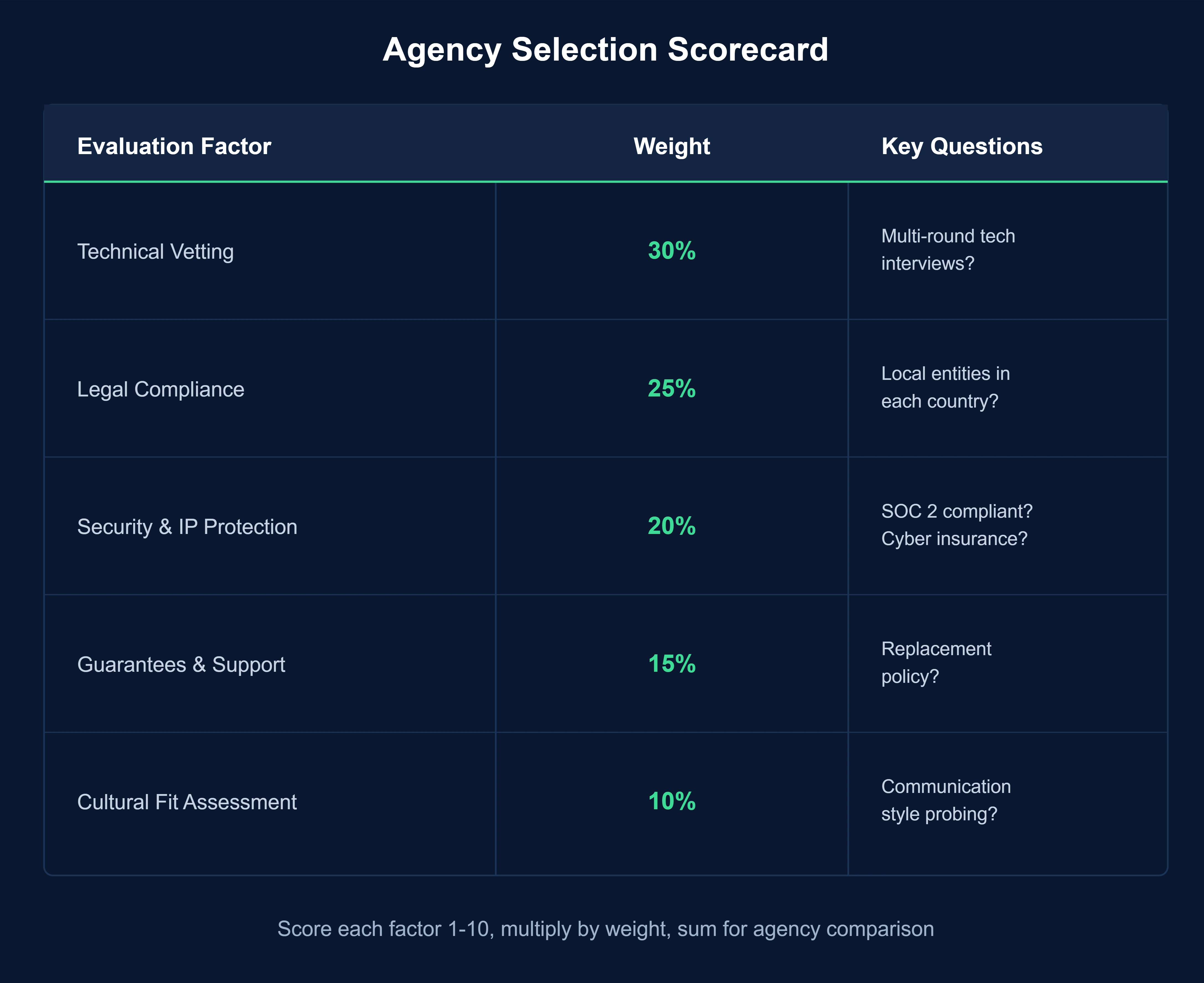
When comparing offshore engineering staffing agencies, assess these dimensions:
- Technical vetting depth. Ask exactly how they assess engineering skills. Do they use standardized coding challenges? Do senior engineers conduct technical interviews? Can they evaluate niche specializations like subsea engineering or avionics?
- Agencies that simply review resumes and conduct HR screens won't catch technical gaps that cause problems months into engagements.
- Geographic presence and legal compliance. Verify the agency maintains legal entities in the countries where they place workers. Ask about their tax compliance processes, labor law expertise, and how they handle regulatory changes.
- Operating without proper legal infrastructure exposes clients to employment misclassification risks, tax penalties, and intellectual property vulnerabilities.
- Replacement and satisfaction guarantees. What happens if a placement doesn't work out? Do they offer free replacements within 30, 60, or 90 days? Some agencies provide satisfaction guarantees where clients only pay for productive work.
- Security and data protection. For engineering roles involving proprietary designs, code, or sensitive data, security protocols matter. Look for agencies with SOC 2 compliance, robust data protection agreements, and clear intellectual property assignment terms.
- Some agencies carry cyber-liability coverage in the millions—a signal they take security seriously and have resources to address breaches.
- Communication and cultural alignment. Time zone overlap matters for real-time collaboration. English proficiency assessments should go beyond basic conversation—engineers need to articulate complex technical concepts, participate in design discussions, and document decisions clearly.
Cultural fit assessment often separates successful placements from frustrating ones. Agencies that probe working style preferences, communication norms, and team dynamics tend to produce better matches.
Offshore Staffing Engagement Models and Pricing
Agencies offer different commercial structures depending on commitment level, control preferences, and company size.
Staff Augmentation (Contractor Model)
The most flexible option. The agency sources and manages individual engineers who integrate into your existing teams. Contracts typically run month-to-month or with quarterly commitments.
Pricing usually comes as a multiplier on the engineer's gross salary. For example, if a developer earns $80,000 annually and the agency charges a markup, the total cost factors in recruitment, payroll taxes, benefits, agency overhead, and profit margin.
Staff augmentation works well when gaps are temporary, requirements keep evolving, or companies want to test offshore hiring before deeper commitments.
Dedicated Team Model
The agency builds a complete team—often including engineers at multiple levels, a team lead, and sometimes QA or DevOps specialists—that works exclusively for one client.
Pricing tends to be per-seat monthly rates with volume discounts. Setup fees sometimes apply to cover initial recruiting and team assembly costs.
Dedicated teams make sense for ongoing product development, large-scale system implementations, or companies ready to treat offshore capacity as core infrastructure rather than temporary help.
Project-Based or Outcome-Based Pricing
Less common but growing in specialized engineering domains. The agency commits to delivering specific outcomes—a completed design, a functional prototype, a production system—for a fixed price.
Risk shifts more heavily to the agency, which must accurately scope work and manage its own resources. Clients gain cost predictability but sacrifice flexibility to change requirements mid-stream.
This model appears most often in civil engineering projects, mechanical design work, or well-defined software development initiatives.
What Offshore Engineering Actually Costs
Actual costs vary significantly by region, seniority, and specialization.
Eastern European engineers—particularly in Poland, Romania, Ukraine—typically cost 50-70% of US equivalents for similar experience levels. Latin American engineers—especially in Argentina, Brazil, Colombia—often fall in a similar range with better time zone overlap for US clients.
Southeast Asian markets like Vietnam or the Philippines can go lower, sometimes 60-75% less than US rates, though specialized engineering talent concentrations vary by discipline.
When evaluating pricing, compare total cost of engagement—not just hourly rates. An agency charging slightly higher rates but providing better vetting, stronger legal protection, and superior retention may deliver better total value than the cheapest option.
Best Practices for Working With Offshore Engineering Teams
Successful offshore engineering arrangements require intentional management approaches that differ from co-located team practices.
Set Clear Communication Norms Early
Define expectations around response times, meeting attendance, availability windows, and preferred communication channels during onboarding—not after misunderstandings accumulate.
Asynchronous communication becomes more important. Encourage thorough documentation, detailed pull request descriptions, and comprehensive status updates that reduce back-and-forth needed for clarity.
Invest in Relationship Building
Remote engineers integrated poorly into company culture often feel like disposable contractors rather than team members. That perception drives turnover.
Include offshore engineers in all-hands meetings, team social events, and decision-making discussions. Use video calls by default. Recognize contributions publicly.
Some companies fly offshore team members to headquarters once or twice a year for in-person collaboration sprints. The relationship depth gained often justifies the travel expense.
Structure Work for Distributed Execution
Not all engineering work translates well to offshore models. Highly ambiguous exploration work where requirements emerge through rapid iteration can frustrate distributed teams.
Offshore teams typically excel at execution when requirements are clear, when interfaces between components get well-defined, or when specialized expertise matters more than real-time collaboration.
Breaking large initiatives into well-scoped work packages with clear acceptance criteria helps offshore engineers deliver value independently without constant synchronous oversight.
Monitor Security and Intellectual Property Protection
Establish data handling protocols, access control policies, and intellectual property assignment agreements before work begins.
Use VPNs, secure code repositories with proper access controls, and regular security audits. Verify the agency maintains cyber-liability insurance and has incident response procedures.
For particularly sensitive engineering work—defense contractors, financial systems, healthcare applications—consider additional background checks or restricting access to specific system components.
Common Pitfalls and How to Avoid Them
Even well-intentioned offshore hiring initiatives hit predictable obstacles.
Underestimating Cultural and Communication Differences
Engineers in different cultural contexts approach feedback, conflict, hierarchy, and problem-solving differently. Direct American communication styles can feel harsh. Indirect feedback common in some Asian cultures can feel evasive.
Mitigate this through explicit discussion of working styles during hiring, cultural training for both sides, and building trust through consistent interaction over time.
Treating Offshore Engineers as Second-Class Team Members
When offshore staff get excluded from important decisions, receive less context, or work on only the least interesting tasks, engagement craters and turnover spikes.
Give offshore engineers ownership over meaningful features. Involve them in architecture decisions. Rotate interesting and mundane work fairly across the entire team.
Choosing Agencies Based Purely on Cost
The lowest-cost agency often delivers the lowest quality. Poor vetting means bad hires. Weak legal infrastructure means compliance risk. Minimal support means problems fall back on your team.
Research suggests that significant portions of technology projects face challenges due to poor planning or inadequate skills. Investing in agency quality pays back quickly through reduced turnover, fewer quality issues, and less management overhead.
Skipping Trial Periods
Jumping straight into large offshore team commitments without testing the model invites expensive mistakes.
Start with one or two engineers. Run a defined pilot project. Evaluate communication patterns, work quality, and cultural fit before scaling. Most agencies accommodate trial engagements specifically for this purpose.
Offshore Staffing for Specific Engineering Disciplines
Different engineering specializations present unique offshore hiring considerations.
Software Engineering
The most mature offshore market. Agencies maintain deep talent pools across virtually all technology stacks, frameworks, and methodologies.
Look for agencies that specialize in your specific domain—fintech, healthcare, e-commerce—rather than general software shops. Domain expertise reduces onboarding time and improves solution quality.
Petroleum and Energy Engineering
Oil and gas recruitment firms maintain networks of petroleum engineers, drilling engineers, and reservoir engineers globally. Many specialize in placing professionals with experience in specific plays—deepwater, shale, offshore platforms—or particular technologies.
Given recent capital expenditure trends in the energy sector, demand for petroleum engineers with expertise in both traditional extraction and emissions reduction technologies has intensified. Agencies that understand this dual focus deliver better matches.
Civil and Structural Engineering
Offshore civil engineers typically support design, modeling, analysis, and documentation work rather than on-site construction management.
Strong CAD skills, familiarity with regional building codes, and experience with specific engineering software packages become critical selection factors. Agencies specializing in civil engineering should assess these technical capabilities explicitly.
Marine Engineering
Marine engineers and naval architects with backgrounds in shipbuilding, offshore structures, or subsea systems concentrate in countries with significant maritime industries—Norway, South Korea, Singapore, the Netherlands.
Agencies serving the marine sector often maintain partnerships with technical universities and maritime training centers in these regions, providing access to newly graduating talent and experienced professionals.
Aerospace Engineering
Aerospace engineering talent offshore tends to concentrate in countries with active aerospace industries or strong engineering education systems—India, Eastern Europe, and increasingly Mexico.
Export control regulations and ITAR restrictions complicate offshore aerospace hiring for US defense contractors. Agencies working in this space must understand these constraints and help structure compliant engagement models.
Legal and Compliance Considerations
Employment law, tax obligations, and intellectual property protections vary dramatically across jurisdictions. Reputable agencies manage these complexities, but companies should understand the fundamentals.
Employment Classification
Misclassifying employees as independent contractors creates significant legal and tax liability. The U.S. Department of Labor requires proper classification, and foreign governments enforce their own labor standards.
When agencies serve as the employer of record, they assume classification responsibility—but only if they genuinely control the employment relationship. If the client company directs every aspect of work, sets hours, and provides equipment, classification risk may still land on the client.
Intellectual Property Assignment
Ensure contracts explicitly assign all intellectual property created by offshore engineers to your company. Default copyright laws in some jurisdictions don't automatically grant employers ownership of employee-created work.
Agencies should provide standard IP assignment agreements that comply with both the worker's home country and the client's jurisdiction.
Data Protection and Privacy
If offshore engineers handle personal data of EU citizens, GDPR compliance becomes mandatory. Similar regulations apply in California (CCPA), Brazil (LGPD), and other jurisdictions.
Agencies operating in regulated industries or handling sensitive data should demonstrate data protection certifications, conduct regular audits, and maintain data processing agreements that meet regulatory requirements.
Tax Obligations
Foreign workers don't pay US payroll taxes, but the agency must withhold and remit taxes in the worker's home country. The client company typically has no direct tax obligation unless it establishes a permanent establishment in that country.
Verify the agency maintains tax compliance and provides documentation proving proper withholding and remittance. Tax authorities in multiple countries increasingly scrutinize cross-border employment arrangements.
Measuring Success and Optimizing Offshore Partnerships
Once offshore engineering teams start delivering, establish metrics and feedback loops to optimize the relationship over time.
Key Performance Indicators
Track both outcomes and leading indicators of partnership health:
- Time to productivity: How long until new offshore engineers contribute meaningfully? Strong agencies and effective onboarding should get engineers productive within two to four weeks.
- Retention rate: Annual turnover below 15% suggests good matching and engagement. Rates above 25% signal problems with hiring quality, management practices, or compensation.
- Code quality and defect rates: For software engineers, measure pull request acceptance rates, bug density, and technical debt contribution compared to onshore team members.
- Communication effectiveness: Survey onshore team members about offshore engineer responsiveness, clarity, and collaboration quality.
- Cost per outcome: Rather than just hourly rates, measure cost per feature, per sprint point, or per project milestone to assess true value delivery.
Regular Partnership Reviews
Schedule quarterly business reviews with the agency. Discuss what's working, where friction emerges, and how to optimize the engagement.
Good agencies proactively suggest improvements—process changes, additional training, team structure adjustments—rather than waiting for client complaints.
Continuous Process Refinement
As the relationship matures, refine how work gets assigned, how communication flows, and how teams integrate.
Successful offshore partnerships evolve from "offshore team gets discrete tasks" toward "unified global team collaborates seamlessly across locations." That evolution requires intentional investment in relationships, processes, and tools.
Making Offshore Engineering Staffing Work for Your Organization
Offshore engineering staffing isn't a magic solution that fixes all hiring challenges. It requires intentional effort, clear processes, and realistic expectations.
But for companies willing to invest in finding the right agency partner, structuring engagements thoughtfully, and managing distributed teams effectively, offshore staffing unlocks access to specialized engineering talent that local markets simply can't provide at scale.
The best results come from treating offshore engineers as full team members—not cheap contractors. Give them context. Involve them in decisions. Recognize their contributions. Build relationships.
When companies approach offshore staffing with this mindset, backed by strong agency partnerships and clear operational frameworks, they build engineering capacity that scales efficiently without sacrificing quality or control.
Start small. Test the model. Learn what works for your organization. Then scale deliberately as confidence and capabilities grow.
Ready to explore offshore engineering staffing for your company? Evaluate agencies using the criteria outlined above, run a focused pilot project, and measure results rigorously before committing to large-scale offshore team expansion.
Frequently Asked Questions
Topics
Offshore Engineering Staffing Agency: 2026 Guide

Quick Summary: An offshore engineering staffing agency connects companies with skilled engineers in international markets, handling recruitment, compliance, and payroll. These agencies help firms reduce hiring costs by 30-60%, access global talent pools, and scale technical teams faster than traditional hiring. The best agencies pre-vet candidates for technical depth and cultural fit, manage legal complexities across jurisdictions, and offer flexible engagement models from contract-to-hire to dedicated offshore teams.
Finding qualified engineers in today's market feels like searching for unicorns. Talent pipelines dry up. Projects slip. Budgets get tighter.
That's why more companies turn to offshore engineering staffing agencies—not just to save money, but to actually find the specialized skills that local markets can't provide fast enough.
This guide breaks down how offshore engineering staffing works, which agencies deliver real results, and how to structure engagements that scale without losing control.
What Is Offshore Engineering Staffing?
Offshore engineering staffing means hiring technical professionals located in other countries to work for your company—either as contractors or full-time employees managed through a third-party agency.
Unlike traditional recruitment firms that just match resumes, offshore staffing agencies handle the entire employment lifecycle. They recruit, vet, onboard, manage payroll, ensure compliance with local labor laws, and often provide ongoing HR support.
The model works particularly well for engineering roles that require deep technical expertise but don't need physical presence in your office.
Why Companies Choose Offshore Engineering Agencies
Three main drivers push companies toward offshore staffing partners:
- Cost reduction. Hiring engineers in markets like Eastern Europe, Latin America, or Southeast Asia typically costs 40-60% less than equivalent US hires—without sacrificing quality when agencies pre-vet properly.
- Access to specialized talent. Need petroleum engineers with subsea expertise? Aerospace engineers familiar with composite materials? Marine engineers with naval architecture backgrounds? These niche specializations often concentrate in specific global regions where industries developed differently.
- Speed to hire. Local pipelines stall for months. Offshore agencies maintain pre-vetted talent pools and can present qualified candidates within days, not quarters.
According to Bureau of Labor Statistics data from May 2024, the median annual wage for petroleum engineers was $141,280 in May 2024. For companies needing multiple petroleum engineers or other specialized roles, offshore options make scaling financially viable.
How Offshore Engineering Staffing Agencies Work
The process varies by agency, but the core workflow follows similar patterns across reputable providers.
The Standard Engagement Process
First, the agency conducts intake calls to understand technical requirements, team culture, communication expectations, and project timelines. Good agencies ask detailed questions about tech stacks, methodologies, and integration with existing teams.
Next comes candidate sourcing and vetting. Agencies tap their existing talent networks, post targeted job descriptions, and screen applicants through technical assessments. The best agencies conduct multiple rounds—initial screening, technical interviews with senior engineers, English proficiency tests, and cultural fit evaluations.
Shortlisted candidates get presented to the client company. Typically three to five profiles per role, complete with detailed technical assessments and interview recordings. The client conducts final interviews and makes selections.
Once hired, the agency handles contracts, payroll, benefits, equipment provisioning, and legal compliance in the worker's home country. The engineer works as part of the client's team—attending standups, accessing company systems, delivering on project milestones—but employment administration stays with the agency.
What Agencies Actually Manage
Reputable offshore engineering staffing agencies take on responsibilities that extend well beyond simple recruiting:
- Legal entity and compliance: They maintain legal entities in the countries where workers reside, ensuring all employment contracts comply with local labor laws, tax regulations, and statutory benefits requirements.
- Payroll and benefits administration: Monthly salary payments, tax withholdings, mandatory benefits, health insurance, and retirement contributions all flow through the agency's systems.
- Equipment and infrastructure: Some agencies provide laptops, monitors, and other hardware. Others reimburse engineers or provide stipends.
- Performance management: While day-to-day task direction comes from the client, agencies often handle formal performance reviews, professional development planning, and conflict resolution.
- Risk mitigation: Insurance coverage, intellectual property protection, data security protocols, and liability management.
This comprehensive service model explains why agencies charge more than simple contingency recruiters—they're managing ongoing employment relationships, not just filling seats.
Strengthen Engineering Support with NeoWork
Offshore engineering staffing helps companies add technical capacity for software, cloud, data, and related development work. NeoWork provides offshore teammates who can support IT and development functions as part of an existing engineering or operations team. NeoWork handles recruitment, benefits, training, and ongoing engagement, while teammates work inside the client’s systems and delivery workflows. Its 91% annualized teammate retention rate and 3.2% candidate selectivity rate reflect a focus on selective hiring and longer-term team stability.
NeoWork's offshore engineering staffing model offers:
- offshore technical and development support
- integration with the client’s tools and processes
- recruitment and ongoing teammate support
Contact NeoWork to add offshore engineering support that fits your delivery workflow.
Top Engineering Roles Filled Through Offshore Agencies
Offshore staffing works across engineering disciplines, but certain specializations see particularly high demand.
Software and Data Engineers
Backend developers, frontend specialists, full-stack engineers, DevOps engineers, data engineers, and machine learning engineers represent the highest volume of offshore placements. The work translates seamlessly to remote contexts, and talent pools in Eastern Europe, Latin America, and South Asia run deep.
Petroleum and Energy Engineers
Oil and gas recruitment firms increasingly source petroleum engineers, drilling engineers, reservoir engineers, and production engineers from international markets. Industry reports suggest that with capital expenditure increases in the 8 to 25% range across major oil companies, demand for specialized petroleum engineers has tightened. Major oil companies including Chevron announced significant capital expenditure increases, driving demand for engineers who understand both traditional extraction and emerging sustainability technologies.
Marine and Naval Engineers
Marine engineers and naval architects design, develop, and evaluate marine vessels, ship machinery, and related equipment. The Bureau of Labor Statistics notes that these professionals typically need bachelor's degrees in marine engineering, naval architecture, or related fields.
Offshore agencies specializing in marine recruitment connect companies with engineers experienced in shipbuilding, offshore platform design, subsea systems, and maritime propulsion systems.
Aerospace Engineers
Aerospace engineering roles—whether focused on aircraft, spacecraft, satellites, or missiles—increasingly get filled through offshore channels. The median annual pay for aerospace engineers was $134,830 in 2024, making offshore options attractive for companies scaling aerospace R&D teams.
Civil and Structural Engineers
Infrastructure projects, construction firms, and real estate developers use offshore staffing for civil engineers, structural engineers, and CAD specialists who can work on design, analysis, and project planning remotely.
Choosing the Right Offshore Engineering Staffing Agency
Not all agencies deliver equal value. Some maintain rigorous vetting standards and long-term client relationships. Others churn through candidates, prioritize speed over quality, and disappear when problems emerge.
Core Evaluation Criteria
When comparing offshore engineering staffing agencies, assess these dimensions:
- Technical vetting depth. Ask exactly how they assess engineering skills. Do they use standardized coding challenges? Do senior engineers conduct technical interviews? Can they evaluate niche specializations like subsea engineering or avionics?
- Agencies that simply review resumes and conduct HR screens won't catch technical gaps that cause problems months into engagements.
- Geographic presence and legal compliance. Verify the agency maintains legal entities in the countries where they place workers. Ask about their tax compliance processes, labor law expertise, and how they handle regulatory changes.
- Operating without proper legal infrastructure exposes clients to employment misclassification risks, tax penalties, and intellectual property vulnerabilities.
- Replacement and satisfaction guarantees. What happens if a placement doesn't work out? Do they offer free replacements within 30, 60, or 90 days? Some agencies provide satisfaction guarantees where clients only pay for productive work.
- Security and data protection. For engineering roles involving proprietary designs, code, or sensitive data, security protocols matter. Look for agencies with SOC 2 compliance, robust data protection agreements, and clear intellectual property assignment terms.
- Some agencies carry cyber-liability coverage in the millions—a signal they take security seriously and have resources to address breaches.
- Communication and cultural alignment. Time zone overlap matters for real-time collaboration. English proficiency assessments should go beyond basic conversation—engineers need to articulate complex technical concepts, participate in design discussions, and document decisions clearly.
Cultural fit assessment often separates successful placements from frustrating ones. Agencies that probe working style preferences, communication norms, and team dynamics tend to produce better matches.
Offshore Staffing Engagement Models and Pricing
Agencies offer different commercial structures depending on commitment level, control preferences, and company size.
Staff Augmentation (Contractor Model)
The most flexible option. The agency sources and manages individual engineers who integrate into your existing teams. Contracts typically run month-to-month or with quarterly commitments.
Pricing usually comes as a multiplier on the engineer's gross salary. For example, if a developer earns $80,000 annually and the agency charges a markup, the total cost factors in recruitment, payroll taxes, benefits, agency overhead, and profit margin.
Staff augmentation works well when gaps are temporary, requirements keep evolving, or companies want to test offshore hiring before deeper commitments.
Dedicated Team Model
The agency builds a complete team—often including engineers at multiple levels, a team lead, and sometimes QA or DevOps specialists—that works exclusively for one client.
Pricing tends to be per-seat monthly rates with volume discounts. Setup fees sometimes apply to cover initial recruiting and team assembly costs.
Dedicated teams make sense for ongoing product development, large-scale system implementations, or companies ready to treat offshore capacity as core infrastructure rather than temporary help.
Project-Based or Outcome-Based Pricing
Less common but growing in specialized engineering domains. The agency commits to delivering specific outcomes—a completed design, a functional prototype, a production system—for a fixed price.
Risk shifts more heavily to the agency, which must accurately scope work and manage its own resources. Clients gain cost predictability but sacrifice flexibility to change requirements mid-stream.
This model appears most often in civil engineering projects, mechanical design work, or well-defined software development initiatives.
What Offshore Engineering Actually Costs
Actual costs vary significantly by region, seniority, and specialization.
Eastern European engineers—particularly in Poland, Romania, Ukraine—typically cost 50-70% of US equivalents for similar experience levels. Latin American engineers—especially in Argentina, Brazil, Colombia—often fall in a similar range with better time zone overlap for US clients.
Southeast Asian markets like Vietnam or the Philippines can go lower, sometimes 60-75% less than US rates, though specialized engineering talent concentrations vary by discipline.
When evaluating pricing, compare total cost of engagement—not just hourly rates. An agency charging slightly higher rates but providing better vetting, stronger legal protection, and superior retention may deliver better total value than the cheapest option.
Best Practices for Working With Offshore Engineering Teams
Successful offshore engineering arrangements require intentional management approaches that differ from co-located team practices.
Set Clear Communication Norms Early
Define expectations around response times, meeting attendance, availability windows, and preferred communication channels during onboarding—not after misunderstandings accumulate.
Asynchronous communication becomes more important. Encourage thorough documentation, detailed pull request descriptions, and comprehensive status updates that reduce back-and-forth needed for clarity.
Invest in Relationship Building
Remote engineers integrated poorly into company culture often feel like disposable contractors rather than team members. That perception drives turnover.
Include offshore engineers in all-hands meetings, team social events, and decision-making discussions. Use video calls by default. Recognize contributions publicly.
Some companies fly offshore team members to headquarters once or twice a year for in-person collaboration sprints. The relationship depth gained often justifies the travel expense.
Structure Work for Distributed Execution
Not all engineering work translates well to offshore models. Highly ambiguous exploration work where requirements emerge through rapid iteration can frustrate distributed teams.
Offshore teams typically excel at execution when requirements are clear, when interfaces between components get well-defined, or when specialized expertise matters more than real-time collaboration.
Breaking large initiatives into well-scoped work packages with clear acceptance criteria helps offshore engineers deliver value independently without constant synchronous oversight.
Monitor Security and Intellectual Property Protection
Establish data handling protocols, access control policies, and intellectual property assignment agreements before work begins.
Use VPNs, secure code repositories with proper access controls, and regular security audits. Verify the agency maintains cyber-liability insurance and has incident response procedures.
For particularly sensitive engineering work—defense contractors, financial systems, healthcare applications—consider additional background checks or restricting access to specific system components.
Common Pitfalls and How to Avoid Them
Even well-intentioned offshore hiring initiatives hit predictable obstacles.
Underestimating Cultural and Communication Differences
Engineers in different cultural contexts approach feedback, conflict, hierarchy, and problem-solving differently. Direct American communication styles can feel harsh. Indirect feedback common in some Asian cultures can feel evasive.
Mitigate this through explicit discussion of working styles during hiring, cultural training for both sides, and building trust through consistent interaction over time.
Treating Offshore Engineers as Second-Class Team Members
When offshore staff get excluded from important decisions, receive less context, or work on only the least interesting tasks, engagement craters and turnover spikes.
Give offshore engineers ownership over meaningful features. Involve them in architecture decisions. Rotate interesting and mundane work fairly across the entire team.
Choosing Agencies Based Purely on Cost
The lowest-cost agency often delivers the lowest quality. Poor vetting means bad hires. Weak legal infrastructure means compliance risk. Minimal support means problems fall back on your team.
Research suggests that significant portions of technology projects face challenges due to poor planning or inadequate skills. Investing in agency quality pays back quickly through reduced turnover, fewer quality issues, and less management overhead.
Skipping Trial Periods
Jumping straight into large offshore team commitments without testing the model invites expensive mistakes.
Start with one or two engineers. Run a defined pilot project. Evaluate communication patterns, work quality, and cultural fit before scaling. Most agencies accommodate trial engagements specifically for this purpose.
Offshore Staffing for Specific Engineering Disciplines
Different engineering specializations present unique offshore hiring considerations.
Software Engineering
The most mature offshore market. Agencies maintain deep talent pools across virtually all technology stacks, frameworks, and methodologies.
Look for agencies that specialize in your specific domain—fintech, healthcare, e-commerce—rather than general software shops. Domain expertise reduces onboarding time and improves solution quality.
Petroleum and Energy Engineering
Oil and gas recruitment firms maintain networks of petroleum engineers, drilling engineers, and reservoir engineers globally. Many specialize in placing professionals with experience in specific plays—deepwater, shale, offshore platforms—or particular technologies.
Given recent capital expenditure trends in the energy sector, demand for petroleum engineers with expertise in both traditional extraction and emissions reduction technologies has intensified. Agencies that understand this dual focus deliver better matches.
Civil and Structural Engineering
Offshore civil engineers typically support design, modeling, analysis, and documentation work rather than on-site construction management.
Strong CAD skills, familiarity with regional building codes, and experience with specific engineering software packages become critical selection factors. Agencies specializing in civil engineering should assess these technical capabilities explicitly.
Marine Engineering
Marine engineers and naval architects with backgrounds in shipbuilding, offshore structures, or subsea systems concentrate in countries with significant maritime industries—Norway, South Korea, Singapore, the Netherlands.
Agencies serving the marine sector often maintain partnerships with technical universities and maritime training centers in these regions, providing access to newly graduating talent and experienced professionals.
Aerospace Engineering
Aerospace engineering talent offshore tends to concentrate in countries with active aerospace industries or strong engineering education systems—India, Eastern Europe, and increasingly Mexico.
Export control regulations and ITAR restrictions complicate offshore aerospace hiring for US defense contractors. Agencies working in this space must understand these constraints and help structure compliant engagement models.
Legal and Compliance Considerations
Employment law, tax obligations, and intellectual property protections vary dramatically across jurisdictions. Reputable agencies manage these complexities, but companies should understand the fundamentals.
Employment Classification
Misclassifying employees as independent contractors creates significant legal and tax liability. The U.S. Department of Labor requires proper classification, and foreign governments enforce their own labor standards.
When agencies serve as the employer of record, they assume classification responsibility—but only if they genuinely control the employment relationship. If the client company directs every aspect of work, sets hours, and provides equipment, classification risk may still land on the client.
Intellectual Property Assignment
Ensure contracts explicitly assign all intellectual property created by offshore engineers to your company. Default copyright laws in some jurisdictions don't automatically grant employers ownership of employee-created work.
Agencies should provide standard IP assignment agreements that comply with both the worker's home country and the client's jurisdiction.
Data Protection and Privacy
If offshore engineers handle personal data of EU citizens, GDPR compliance becomes mandatory. Similar regulations apply in California (CCPA), Brazil (LGPD), and other jurisdictions.
Agencies operating in regulated industries or handling sensitive data should demonstrate data protection certifications, conduct regular audits, and maintain data processing agreements that meet regulatory requirements.
Tax Obligations
Foreign workers don't pay US payroll taxes, but the agency must withhold and remit taxes in the worker's home country. The client company typically has no direct tax obligation unless it establishes a permanent establishment in that country.
Verify the agency maintains tax compliance and provides documentation proving proper withholding and remittance. Tax authorities in multiple countries increasingly scrutinize cross-border employment arrangements.
Measuring Success and Optimizing Offshore Partnerships
Once offshore engineering teams start delivering, establish metrics and feedback loops to optimize the relationship over time.
Key Performance Indicators
Track both outcomes and leading indicators of partnership health:
- Time to productivity: How long until new offshore engineers contribute meaningfully? Strong agencies and effective onboarding should get engineers productive within two to four weeks.
- Retention rate: Annual turnover below 15% suggests good matching and engagement. Rates above 25% signal problems with hiring quality, management practices, or compensation.
- Code quality and defect rates: For software engineers, measure pull request acceptance rates, bug density, and technical debt contribution compared to onshore team members.
- Communication effectiveness: Survey onshore team members about offshore engineer responsiveness, clarity, and collaboration quality.
- Cost per outcome: Rather than just hourly rates, measure cost per feature, per sprint point, or per project milestone to assess true value delivery.
Regular Partnership Reviews
Schedule quarterly business reviews with the agency. Discuss what's working, where friction emerges, and how to optimize the engagement.
Good agencies proactively suggest improvements—process changes, additional training, team structure adjustments—rather than waiting for client complaints.
Continuous Process Refinement
As the relationship matures, refine how work gets assigned, how communication flows, and how teams integrate.
Successful offshore partnerships evolve from "offshore team gets discrete tasks" toward "unified global team collaborates seamlessly across locations." That evolution requires intentional investment in relationships, processes, and tools.
Making Offshore Engineering Staffing Work for Your Organization
Offshore engineering staffing isn't a magic solution that fixes all hiring challenges. It requires intentional effort, clear processes, and realistic expectations.
But for companies willing to invest in finding the right agency partner, structuring engagements thoughtfully, and managing distributed teams effectively, offshore staffing unlocks access to specialized engineering talent that local markets simply can't provide at scale.
The best results come from treating offshore engineers as full team members—not cheap contractors. Give them context. Involve them in decisions. Recognize their contributions. Build relationships.
When companies approach offshore staffing with this mindset, backed by strong agency partnerships and clear operational frameworks, they build engineering capacity that scales efficiently without sacrificing quality or control.
Start small. Test the model. Learn what works for your organization. Then scale deliberately as confidence and capabilities grow.
Ready to explore offshore engineering staffing for your company? Evaluate agencies using the criteria outlined above, run a focused pilot project, and measure results rigorously before committing to large-scale offshore team expansion.
Frequently Asked Questions
Topics
Related Blogs
Related Podcasts


.webp)

.webp)
.webp)



