

.avif)
.avif)

Offshore Staffing for Accounting Firms: 2026 Guide


.svg)

Quick Summary: Offshore staffing for accounting firms involves hiring remote professionals from cost-effective regions to handle bookkeeping, tax preparation, and financial analysis. This guide covers cost savings of 30–70%, implementation best practices, provider selection criteria, and strategies to overcome data security and time zone challenges while scaling your firm's capacity.
The accounting profession is in crisis mode.
The accounting sector is facing significant challenges due to a dwindling workforce, with projections indicating a need for new accountants and auditors annually over the next decade. The accounting profession has experienced significant staff departures in recent years, creating a supply-demand mismatch that's strangling firm growth.
Traditional hiring doesn't cut it anymore. College accounting program enrollments keep dropping as students chase careers perceived as more lucrative or exciting. The talent pool has dried up domestically, and the firms that survive the next five years won't be the ones waiting for that pool to refill.
They'll be the ones who figured out offshore staffing.
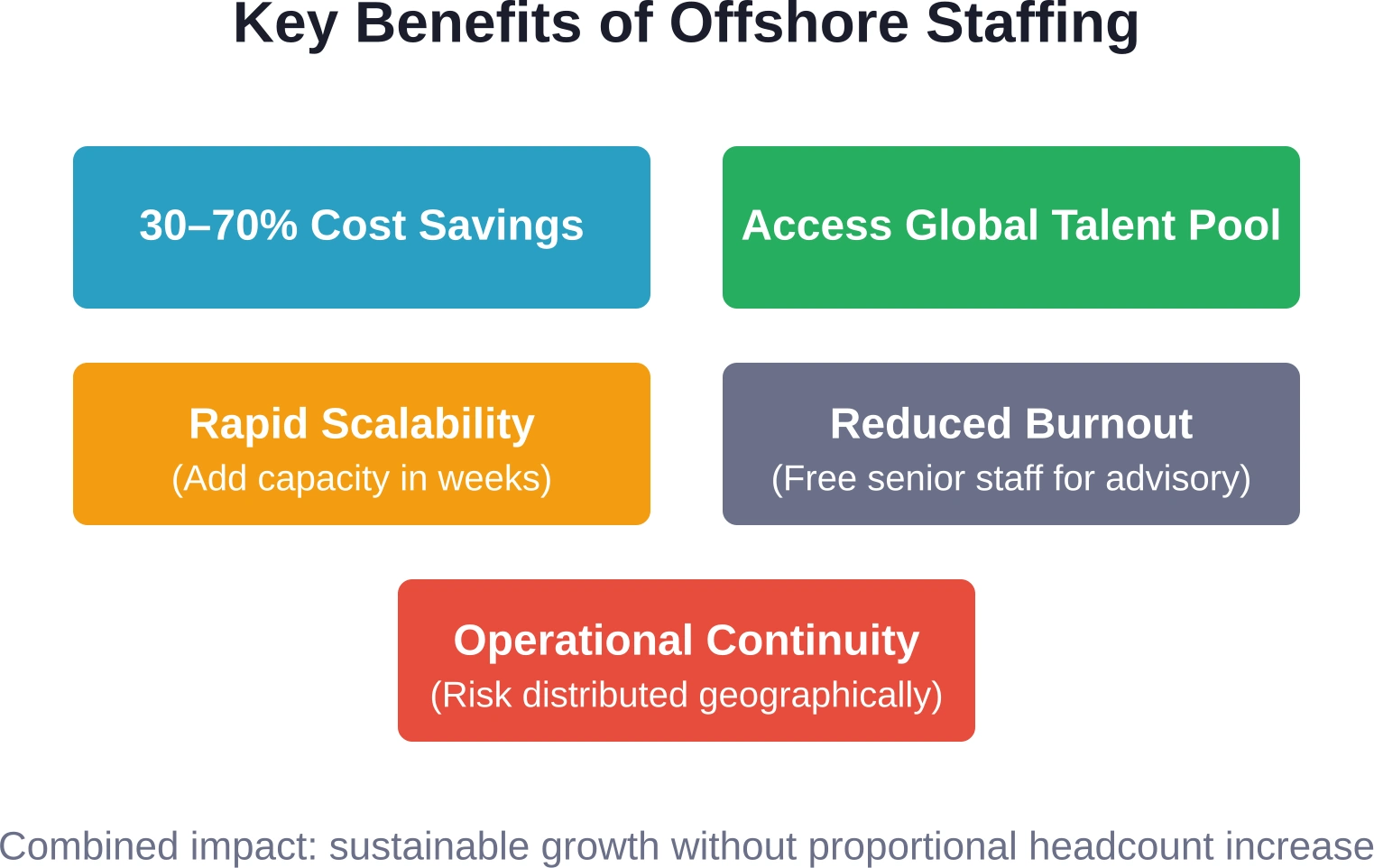
Offshore accounting staffing isn't just about saving money—though cost reductions of 30–70% compared to US salaries don't hurt. It's about accessing a global talent market, building scalable capacity, and keeping client work moving without burning out the team members sitting in your office right now.
Here's the thing though—offshore staffing done wrong creates more problems than it solves. Data security nightmares, communication breakdowns, quality control issues, and compliance headaches have all torpedoed firms that rushed into offshoring without a plan.
This guide walks through everything: what offshore staffing actually means for accounting practices, why firms are making the shift, how to choose providers that won't leave you hanging, which services make sense to offshore first, and the implementation steps that separate successful transitions from expensive disasters.
What Is Offshore Staffing for Accounting Firms?
Offshore staffing means hiring accounting professionals who work remotely from countries with lower labor costs than the United States. These aren't freelancers picking up one-off projects—they're dedicated team members integrated into firm workflows, using firm software, following firm procedures, and handling client work under firm supervision.
The model works through three main approaches:
- Direct hiring: Firms recruit, hire, and manage offshore staff themselves. This approach offers maximum control but requires infrastructure for international payroll, HR compliance, and local legal requirements. Smaller firms rarely have bandwidth for this overhead.
- Staffing agencies: Third-party providers recruit pre-vetted candidates, handle employment logistics, and place workers with accounting firms. The firm directs the work; the agency handles HR, payroll, and compliance. This is the most common model for firms getting started with offshore teams.
- Outsourcing firms: The firm sends work to a service provider that completes it using their own staff and processes. This differs from staffing because the firm has less control over who does the work and how. It's more transactional—less like adding team members, more like subcontracting projects.
Most accounting firms lean toward the staffing agency model. It splits the difference between control and convenience—firms get named, dedicated team members without building international HR departments.
Geography matters. The two dominant offshore regions are Asia (primarily India and the Philippines) and Latin America. Asia offers the deepest talent pools and lowest costs. Latin America offers time zone alignment with US business hours and cultural familiarity.
That time zone difference is bigger than most firms realize initially. A bookkeeper in the Philippines works while US partners sleep. Questions sit unanswered for 12 hours. Client calls happen asynchronously. Tax season coordination becomes a logistical puzzle.
Latin America's 0–3 hour offset from US Eastern Time means live review of reconciliations, same-day sign-offs during tax season, and no overnight delays on client work. Latin America's time zone alignment with US business hours provides structural advantages for firms requiring real-time collaboration.
Why US Accounting Firms Are Turning to Offshore Staffing
The accounting talent crisis isn't theoretical—it's hitting firm capacity right now. But the staffing shortage is only one pressure point pushing firms toward offshore solutions.
The Talent Shortage Isn't Getting Better
Accounting program enrollments in colleges continue declining. Students are drawn to tech, finance, consulting—fields positioned as dynamic and innovative. Accounting hasn't successfully rebranded itself for younger generations.
Professional Accounting Organizations and industry media have been sounding alarms about staffing concerns for years. The warnings were accurate. Firms now compete viciously for entry-level candidates, offering signing bonuses and flexible arrangements that would have seemed absurd five years ago.
And still, firms can't fill seats.
Total employment is projected to grow by 4.0 percent and add 6.7 million jobs (2023-2033 projection period). But that doesn't help accounting firms when the talent entering the profession can't replace those leaving it.
Offshore staffing taps talent pools that aren't constrained by US enrollment trends. Countries like India, the Philippines, and Mexico graduate thousands of accounting professionals annually, many with US GAAP training, English fluency, and familiarity with QuickBooks, Xero, and other platforms US firms use daily.
Cost Pressure From Every Direction
Client fee pressure isn't new, but it's intensified. Small businesses shop around. They compare proposals. They push back on rate increases. The IFAC Global SMP Survey identified fee pressure as a key challenge many small and medium-sized practices face.
Meanwhile, salaries for US-based accounting staff keep climbing. Firms trapped between margin compression and wage inflation have limited options: raise prices (and lose clients), reduce services (and shrink revenue), or find ways to deliver the same quality at lower internal cost.
Offshore staffing addresses the cost structure directly. Salary comparisons tell the story:
For Asian markets, the numbers shift even lower:
These aren't sweatshop wages—they reflect competitive professional salaries in local markets. A $1,200 monthly salary in Manila or Bangalore provides a comfortable middle-class lifestyle, while the same work costs a US firm $4,500–$6,000 monthly in Cleveland or Phoenix.
Scalability Without the Hiring Treadmill
Tax season demand spikes 300 percent. Firms scramble to hire seasonal staff, train them in three weeks, and then lay them off in May. It's inefficient, expensive, and demoralizing.
Offshore teams scale differently. Staffing providers maintain bench strength—pre-trained accountants ready to deploy when workload surges. Firms can add two preparers in January, scale back to one in June, then ramp up again the following year without posting job ads or conducting interviews.
This elasticity matters for growth too. Landing a new client with 50 locations doesn't require posting requisitions and waiting 90 days to fill them. Firms can onboard offshore capacity in weeks, not quarters.
Burnout Is Killing Firms From the Inside
Your existing team is exhausted. They're covering for unfilled positions, working weekends during tax season, and picking up slack from constant turnover. That's not sustainable.
Offshore staffing doesn't fix toxic culture or unreasonable workloads on its own. But it does relieve pressure. When routine reconciliations, data entry, and first-draft tax prep move offshore, senior staff can focus on client advisory, complex problem-solving, and relationship management—the work that actually requires their expertise.
Firms report that offshore teams handle repetitive, high-volume tasks more consistently than burned-out local staff juggling too many responsibilities. Fresh eyes on month-end close procedures often catch errors that exhausted seniors miss at 9 PM on a Thursday.

Support Accounting Firm with Offshore Staff from NeoWork
Offshore staffing for accounting firms helps teams manage recurring finance, admin, and back-office work without overloading internal staff. NeoWork provides offshore teammates who can support accounting data entry, document management, records organization, accounts payable workflows, and bookkeeping-related tasks. NeoWork handles recruitment, benefits, training, and ongoing engagement, while teammates integrate into the firm’s systems and workflows. Its 91% annualized teammate retention rate and 3.2% candidate selectivity rate reflect a focus on selective hiring and longer-term team stability.
NeoWork's offshore staffing model for accounting firms offers:
- offshore teammates for accounting support workflows
- integration with the firm’s tools and processes
- recruitment and ongoing teammate support
Contact NeoWork to add offshore staffing support that can help your accounting team manage recurring work.
Core Benefits of Offshore Staffing for Accounting Firms
Cost savings grab headlines, but they're not the only reason firms stick with offshore teams long-term. The real benefits stack up across multiple dimensions.
Direct Cost Reduction
Offshore accounting staffing reduces hiring costs by 30–70 percent compared to US salaries. That's not promotional fluff—it's math.
A mid-level accountant in the US costs $70,000–$114,000 annually before benefits, payroll taxes, office space, equipment, and training. The same skill set offshore runs $30,000–$42,000 in Latin America or $14,400–$19,200 annually ($1,200–$1,600 monthly) in Asia.
Add benefits and overhead, and total US employment cost hits $95,000–$150,000. Offshore all-in cost through a staffing agency: $35,000–$50,000. The difference funds marketing, technology upgrades, or falls straight to partner distributions.
One case study highlighted a seasonal pool business that reduced accounting costs by 45 percent after transitioning bookkeeping and reconciliation work to an offshore team. Quality stayed consistent; client satisfaction didn't budge. The savings became profit.
Access to Specialized Talent
Small firms in secondary markets struggle to hire candidates with niche expertise. Finding a US-based accountant who knows nonprofit fund accounting, works in Sage Intacct, and lives within commuting distance of a 12-person firm in Tulsa? Good luck.
Offshore providers recruit from national and international talent pools. They can source specialists in industry-specific accounting, particular software platforms, or technical areas like R&D tax credits or international tax compliance.
That specialization used to be the exclusive domain of Big Four firms with deep recruiting budgets. Offshore staffing democratizes access—boutique firms can hire the same caliber of technical talent, just remotely.
24-Hour Productivity Cycles (Maybe)
Here's where the Asia versus Latin America trade-off gets real.
Asian offshore teams work opposite US hours. Some firms love this—they send work at end-of-day US time, and it's completed overnight, ready for review the next morning. Tax season work queues churn 24 hours continuously.
But that model assumes work doesn't need real-time collaboration. When questions arise, they sit for 12 hours. Client calls require scheduling gymnastics. Training happens asynchronously through recorded videos.
Latin American teams overlap US business hours. Real-time Slack conversations happen. Zoom calls with clients don't require 3 AM alarms. The trade-off: less "overnight magic," more actual teamwork.
Neither approach is universally better. Firms doing high-volume, template-driven work (individual tax prep, basic bookkeeping) benefit from Asia's overnight model. Firms doing complex advisory work that requires frequent communication lean toward Latin America's time zone alignment.
Operational Continuity and Risk Distribution
When your only senior accountant quits two weeks before a compliance deadline, the firm is in crisis. Cross-training helps, but small firms often can't afford the redundancy.
Offshore teams distribute knowledge and capacity geographically. Turnover in one location doesn't cripple operations. Providers typically maintain backup staff who can step into roles quickly.
This isn't bulletproof—offshore staff leave jobs too—but staffing agencies absorb replacement risk contractually. If an offshore team member departs, the agency fills the role, not the firm.
Challenges and Risks to Plan For
Offshore staffing isn't autopilot. Firms that succeed acknowledge the challenges upfront and build mitigation strategies before problems surface.
Data Security and Compliance
Client financial data crosses international borders. That creates regulatory, ethical, and technical risk.
IRS Circular 230 doesn't prohibit offshore tax preparation, but it does require firms to supervise and review all work, regardless of where it's performed. The CPA signs the return. The CPA owns the liability. Offshore preparers don't change that.
Professional liability insurance often includes geographic restrictions. Policies may not cover work performed outside the US unless specifically endorsed. Firms should review coverage with their broker before offshore staff touch client data.
Data security standards must be non-negotiable. Look for providers with SOC 2 Type II certification, ISO 27001 compliance, and infrastructure hardening (VPNs, endpoint security, access logging, encryption at rest and in transit).
Client consent matters too. Some clients won't authorize offshore access to their data, period. Firms need clear disclosure policies and client agreements that specify where and by whom work will be performed.
Communication and Cultural Differences
English fluency varies. Accents exist. Time zones complicate real-time discussion. Cultural norms around hierarchy, feedback, and conflict differ.
These aren't insurmountable, but they're also not trivial. Firms that assume "everyone speaks English" will hit frustration fast when nuanced technical discussions become game of telephone.
Successful firms invest in communication infrastructure: daily standups via Zoom, written documentation of procedures, screen-share training sessions, and explicit feedback loops. They also accept that building rapport with offshore teams takes time—relationships don't form instantly across 8,000 miles.
Latin American teams typically have fewer cultural friction points with US firms than Asian teams—shared Western business norms, similar meeting etiquette, overlapping work hours. That's not a knock on Asian talent; it's acknowledgment that cultural proximity reduces onboarding friction.
Quality Control and Training
Offshore staff don't magically know firm procedures. They need training, templates, checklists, and quality review just like local hires.
Firms that offshore successfully treat remote team members like remote team members, not like outsourced vendors. That means documented processes, structured onboarding, regular check-ins, and performance management.
CPA-led offshore providers build quality control into service delivery: two-layer internal review before work reaches the firm, supervision by licensed CPAs familiar with US standards, and error-tracking systems that flag recurring issues for remedial training.
Still, ultimate responsibility stays with the firm. Partners review offshore work the same way they review local staff work—carefully, critically, and with client outcome in mind.
Turnover and Knowledge Retention
Offshore employees leave jobs. Career advancement opportunities, competing offers, visa opportunities, life changes—all the same reasons US staff leave apply offshore too.
The mitigation strategy is contractual: staffing agreements should specify replacement timelines, knowledge transfer procedures, and overlap periods when transitions occur. Firms should also document processes thoroughly enough that no single person (onshore or offshore) holds irreplaceable institutional knowledge.
How to Choose an Offshore Accounting Staffing Provider
Not all offshore staffing companies are created equal. Some deliver consistent quality and partnership-level service. Others churn through low-cost labor and leave firms cleaning up errors.
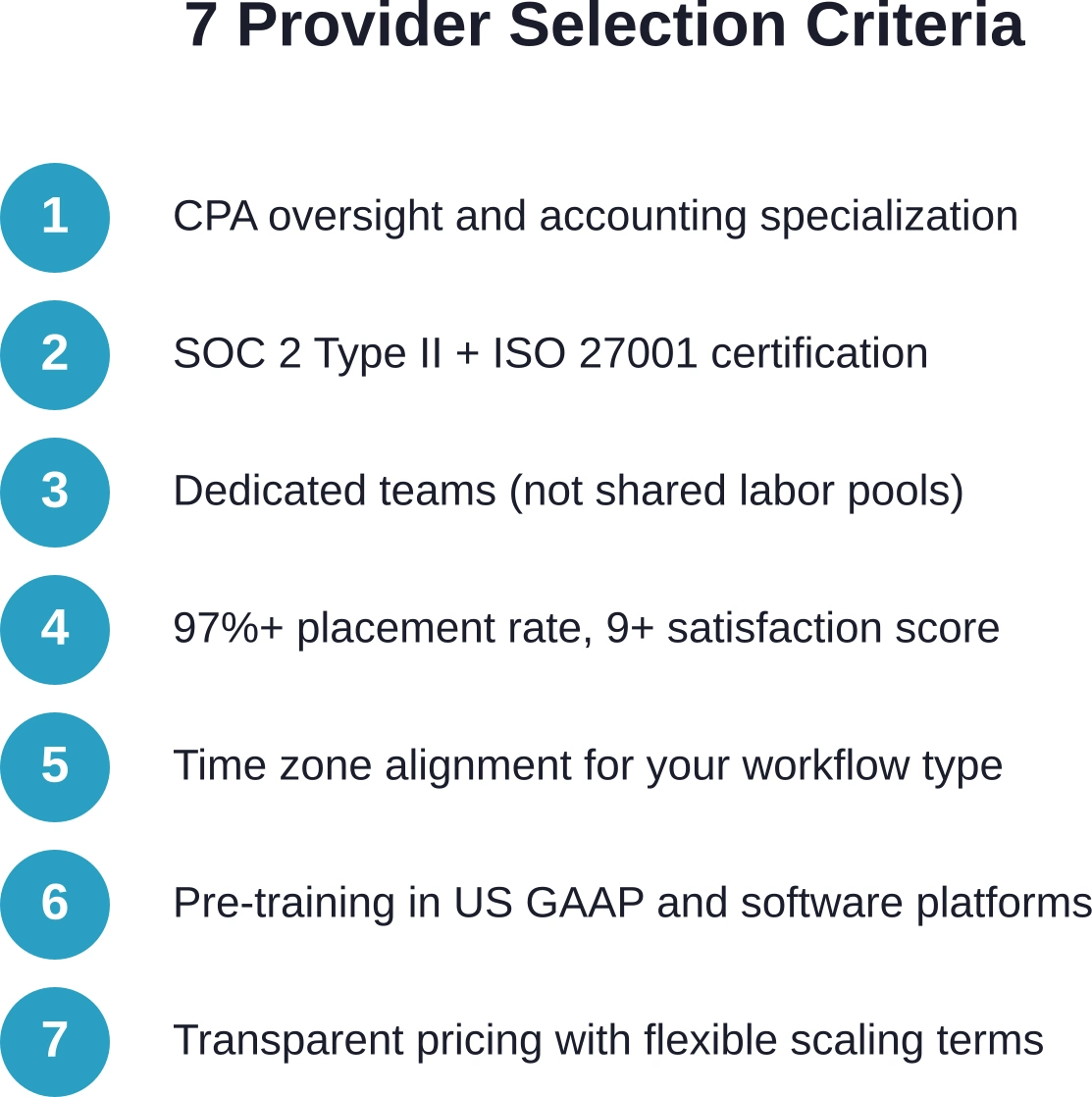
Here are seven criteria that separate providers worth considering from those that'll waste time and money.
1. CPA Oversight and Industry Specialization
Generalist staffing firms recruit accountants the way they recruit call center reps—bodies in seats, hit the rate card, move on. That doesn't work for technical accounting.
Look for providers led by CPAs who understand accounting firm operations. They should speak the language—know the difference between compilations and reviews, understand tax workflow, recognize busy season constraints.
CPA-supervised offshore teams build quality control into delivery. Every return, reconciliation, or financial statement gets reviewed by a licensed accountant before it reaches the US firm. That's the difference between offshore staffing and offshore outsourcing: staffing gives the firm a team member; CPA oversight ensures that team member meets professional standards.
2. Compliance Certifications
Data security isn't optional. Require SOC 2 Type II certification at minimum—this verifies annual third-party audits of security controls. ISO 27001 adds another layer of assurance around information security management systems.
If the provider can't produce current certification reports, walk away. Client data is too sensitive to trust to providers who won't submit to external audits.
Also ask about GDPR compliance (if any clients have EU operations), HIPAA controls (for healthcare clients), and infrastructure specifics: encryption protocols, access management, endpoint protection, network segmentation, incident response procedures.
3. Dedicated Teams vs. Shared Pools
Some providers use shared labor pools—firms submit work to a queue, and whoever's available picks it up. This model offers flexibility but sacrifices continuity. Different people handle work each cycle; nobody learns firm preferences or client quirks.
Dedicated team models assign named individuals to a firm permanently. Same team, same clients, same procedures, every month. This builds institutional knowledge, improves quality over time, and creates actual team cohesion.
Dedicated costs more than pooled, but the quality and efficiency gains justify the premium for most firms. One CPA-led provider noted: "There's no anonymous pool of workers here. We assign one dedicated team to your firm and keep it there."
4. Placement Success Metrics
Ask about placement rates and client satisfaction scores. Quality providers track these metrics and share them.
A 97 percent placement rate and 9.1+ client satisfaction rating (on a 10-point scale) indicates a provider that pre-screens candidates rigorously and matches skills to firm needs accurately. Low placement rates or poor satisfaction scores suggest the provider prioritizes speed over fit.
Also ask about turnover: what percentage of placed staff stay 12+ months? High turnover signals compensation issues, poor working conditions, or mismatched expectations—problems that become the firm's problems when knowledge walks out the door mid-engagement.
5. Geographic Footprint and Time Zone Coverage
Decide whether time zone overlap matters for the work being offshored.
High-volume, low-interaction tasks (individual 1040 prep, transaction coding) work fine with Asian teams operating overnight. Complex engagements requiring frequent collaboration (consolidated financial statements, technical research, client-facing advisory) benefit from Latin American teams working US business hours.
Some providers offer both. Firms can place routine work in the Philippines for overnight processing and advisory work in Colombia or Mexico for real-time collaboration. Geography becomes a strategic tool, not a binary choice.
6. Training and Onboarding Support
How much onboarding does the provider handle versus dumping it on the firm?
Strong providers pre-train offshore staff in common US accounting software (QuickBooks, Xero, Drake, Lacerte, ProSeries), US GAAP fundamentals, and tax code basics before placement. Firms still need to train on internal procedures, but baseline technical knowledge is already in place.
Onboarding support should include dedicated implementation managers, training templates, process documentation assistance, and scheduled check-ins during the first 90 days. Firms shouldn't navigate offshore integration alone—providers who've done this hundreds of times should guide the transition.
7. Transparent Pricing and Contract Terms
Pricing models vary: hourly rates, monthly retainers, per-deliverable pricing, or hybrid approaches. None are inherently better, but all should be transparent.
Watch for hidden fees: setup charges, platform fees, overtime rates, replacement fees when staff leave, early termination penalties. Read contracts carefully.
Also clarify intellectual property and work product ownership. Some providers claim rights to processes developed during engagement. That's unacceptable—firms should own documentation, templates, and procedures created for their clients.
Contract terms should allow scaling up or down with reasonable notice (30–60 days). Firms locked into rigid headcount commitments lose the scalability that makes offshore staffing attractive in the first place.
Which Accounting Services to Offshore First
Not every accounting function is equally suitable for offshore staffing. Start with high-volume, process-driven work that has clear inputs, outputs, and quality criteria.
Bookkeeping and Transaction Processing
This is offshore staffing's sweet spot. Data entry, bank reconciliations, accounts payable and receivable, payroll processing—all repetitive, rules-based tasks that scale predictably.
Offshore bookkeepers typically handle multiple clients simultaneously, following documented procedures for each. Firms provide chart of accounts, coding guidelines, and reconciliation templates; offshore staff execute consistently.
Month-end close procedures offshore particularly well when properly documented. The same checklist works every month: reconcile accounts, post adjusting entries, generate reports, flag variances for manager review.
Tax Preparation
Individual returns (1040), business returns (1120, 1065, 1120-S), and estate/trust returns (1041) all move offshore successfully. The structure is standardized; software guides the process; review happens at multiple layers before filing.
Offshore tax preparers work from client source documents: W-2s, 1099s, K-1s, receipts, statements. They input data, apply rules, generate drafts. Senior reviewers onshore check accuracy, optimize positions, and handle client communications.
Per-return pricing for offshore tax prep runs $59 and up depending on complexity. A Florida boutique firm cut prep costs 60 percent by moving 1040 and 1065 prep to a dedicated, CPA-led offshore crew. Five-stage internal review kept rework under 2 percent.
Tax research is trickier to offshore. It requires judgment, technical expertise, and familiarity with firm client base. Some firms offshore initial research (gathering code sections, regulations, cases) and keep final analysis onshore.
Financial Statement Preparation
Compilations and basic financial statements offshore well once chart of account mapping and formatting templates are established. Offshore staff prepare statements from trial balance; CPAs review before delivery to clients.
Reviews and audits require more caution. Fieldwork components (confirmations, testing, documentation) can move offshore, but planning, risk assessment, and conclusion formation should stay with licensed CPAs who understand firm liability exposure.
Advisory and Client-Facing Work
Strategic advisory, complex problem-solving, client relationship management, and business development stay onshore. These require judgment, relationship capital, and deep understanding of client context—things that don't offshore easily.
That said, offshore staff can support advisory work: building financial models, preparing board presentation decks, analyzing scenarios, assembling data for strategic discussions. The analysis stays onshore; the data preparation moves offshore.
Start Small, Scale Gradually
Pilot offshore staffing with one function and a small team before committing broadly. Test bookkeeping for five clients, or 50 individual tax returns, or AP processing for a single division.
Measure quality, communication effectiveness, time-to-productivity, and actual cost savings. Adjust processes based on what breaks. Then scale—add more clients to offshore bookkeeping, expand into tax prep, layer in financial statement work.
Firms that try to offshore everything simultaneously overwhelm both onshore and offshore teams, creating chaos that tanks productivity and quality.
Implementation Roadmap: 6 Steps to Offshore Success
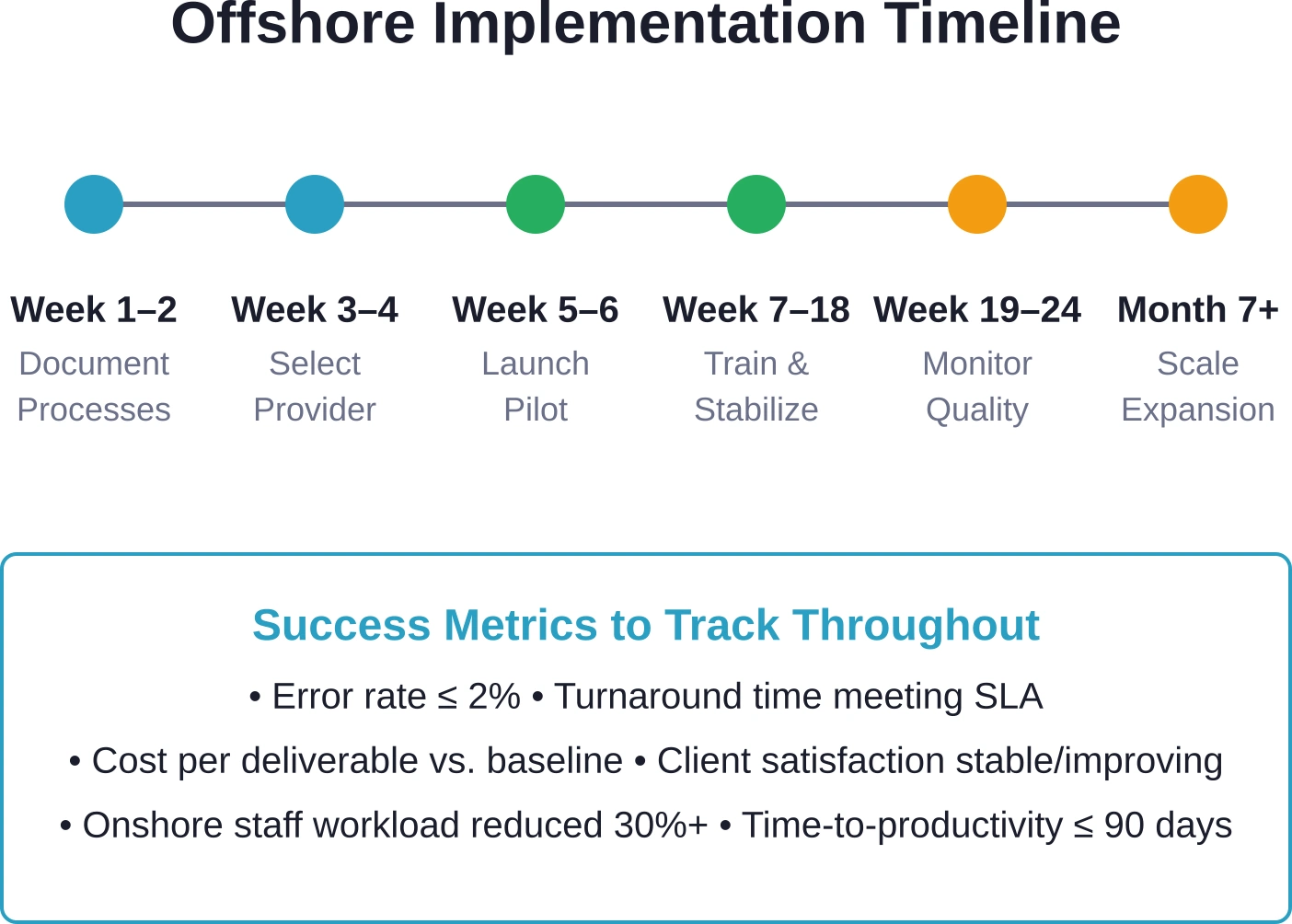
Moving from decision to execution requires structured planning. Here's a six-phase roadmap firms use to implement offshore staffing without disrupting client service.
Step 1: Process Documentation and Standardization
Offshore teams can't read minds. Before hiring anyone, document every process slated for offshore transition: step-by-step procedures, decision trees, quality criteria, software screenshots, common errors and corrections.
This documentation benefits onshore staff too—it surfaces inconsistencies, identifies bottlenecks, and forces clarity around "how we actually do this" versus "how we think we do this."
Create templates for recurring deliverables: standard financial statement formats, reconciliation checklists, tax organizer layouts. Templates reduce variability and make quality review faster.
Step 2: Provider Selection and Contracting
Use the seven criteria above to evaluate 3–5 providers. Request proposals, check references, ask for sample contracts, and interview account management teams.
Negotiate clearly: pricing structure, service level agreements, replacement policies, termination terms, data security requirements, intellectual property ownership, scalability provisions.
Don't skip the reference check phase. Talk to firms similar in size and service mix. Ask what went wrong during implementation, how the provider responded to problems, and whether they'd choose the same provider again.
Step 3: Pilot Program Launch
Start with one service line and a small team—typically one to three offshore staff. Choose work that's high-volume, well-documented, and representative of broader firm workload.
Set clear success metrics before launch: error rates, turnaround time, cost per deliverable, client satisfaction (if applicable), onshore staff feedback. Establish baseline measurements using current onshore performance.
Expect productivity dips initially. Offshore staff need time to learn systems, understand firm expectations, and build speed. Budget 60–90 days to reach full productivity.
Step 4: Training and Integration
Treat offshore team members like team members. Schedule video introductions, explain firm culture and values, walk through client histories and sensitivities.
Provide structured training: screen-share sessions on software, recorded walkthroughs of procedures, access to templates and documentation, scheduled Q&A time.
Assign onshore mentors—specific people offshore staff can ask questions without feeling like they're bothering the whole firm. Clear escalation paths prevent small issues from becoming big mistakes.
Step 5: Quality Monitoring and Iteration
Review 100 percent of offshore work initially. Check accuracy, formatting, completeness, and adherence to procedures. Track errors by type and frequency.
Provide feedback quickly—same day when possible. Offshore staff can't improve if they don't know what needs correction. Be specific: "This reconciliation is missing the outstanding check detail" beats "Quality needs improvement."
Adjust processes as patterns emerge. If offshore staff consistently misinterpret a procedure, the procedure documentation is probably unclear. Fix the documentation, not the staff.
As quality stabilizes, shift to sample-based review: 25 percent of work initially, then 10 percent, eventually matching whatever review percentage applies to onshore staff doing similar work.
Step 6: Scaling and Expansion
Once the pilot demonstrates success—quality at target, costs below projection, onshore staff seeing relief—expand gradually. Add more clients to existing offshore staff, then add staff as volume justifies.
Consider expanding into adjacent services. If bookkeeping works well, add tax prep. If tax prep succeeds, layer in simple compilations. Each expansion follows the same cycle: document, pilot, train, monitor, scale.
Build offshore staffing into firm capacity planning. When evaluating new client opportunities, factor offshore capacity availability into feasibility assessments. Offshore teams become strategic assets, not just cost savers.
Managing Data Security and Client Confidentiality
Client data security isn't a feature—it's the foundation. One breach destroys firm reputation permanently. Offshore staffing requires multiple overlapping security layers.
Infrastructure Security
Offshore staff should access firm systems through secure, monitored connections only. VPNs encrypt data in transit. Multi-factor authentication prevents unauthorized access. Endpoint protection (antivirus, anti-malware, device encryption) secures laptops and workstations.
Providers should enforce network segmentation—offshore staff can't access systems beyond what their role requires. A bookkeeper doesn't need payroll system access; a tax preparer doesn't need HR files.
Access logging tracks who viewed what data when. Audit trails create accountability and enable investigation if anomalies surface.
Physical Security
Where do offshore staff physically work? Home offices create risk—family members see screens, devices get shared, network security depends on consumer-grade routers.
Secure offshore centers provide controlled environments: badge access, security cameras, clean desk policies, restricted personal device usage, monitored internet connections. Firms should visit facilities (or review third-party audit reports) to verify physical controls.
Contractual Protections
Offshore staff should sign confidentiality agreements and non-disclosure agreements covering client data, firm processes, and proprietary information. Agreements should specify data handling requirements, breach notification obligations, and termination procedures.
Contracts with providers should include data protection clauses: security standards the provider must maintain, breach notification timelines (immediate disclosure, not after investigation concludes), liability for data compromises, and rights to audit security controls.
Client Disclosure
Professional ethics require informed consent. Clients should know if offshore staff will access their data, where those staff are located, what protections apply, and how to opt out.
Engagement letters should include offshore work disclosure. Some firms address it in firm-wide privacy policies; others include it in annual engagement confirmations.
A handful of clients will refuse offshore access. Respect that. Build capacity to serve those clients entirely onshore, or decline engagements where offshore access is prohibited but economics don't work without it.
Cost Analysis: Offshore vs. Local Hiring
Offshore staffing costs more than just salary. Total cost includes provider fees, training time, quality review overhead, communication infrastructure, and management attention.
Still, the all-in economics favor offshore substantially for most firms.
Local Hiring Full Cost
Hiring a mid-level accountant in the US involves:
- Base salary: $70,000–$114,000 depending on market and experience
- Payroll taxes: 7.65 percent FICA plus state unemployment
- Benefits: health insurance ($8,000–$12,000/year), 401(k) match (3–6 percent of salary), PTO (2–3 weeks paid), other benefits
- Recruiting costs: job ads, agency fees (15–25 percent of first-year salary if used), interview time
- Workspace: desk, computer, software licenses, office space allocation
- Training: onboarding time, CPE, mentoring
Total first-year cost: $95,000–$150,000. Ongoing annual cost: $85,000–$140,000.
Offshore Staffing Full Cost
Hiring equivalent offshore capacity through a staffing agency:
- Base fee to provider: $30,000–$42,000/year for Latin America (senior accountant equivalent), $14,400–$19,200/year for Asia
- Setup and onboarding: $1,000–$3,000 one-time (some providers waive this)
- Software licenses: same as local staff
- Training time: higher initially (time zone coordination, cultural acclimation), lower long-term
- Quality review overhead: 10–20 percent more review time initially, normalizing to local levels within six months
- Management time: slightly higher for remote coordination
Total first-year cost: $35,000–$55,000 (LatAm), $18,000–$28,000 (Asia). Ongoing annual cost: $32,000–$48,000 (LatAm), $16,000–$24,000 (Asia).
Break-Even and Payback
A firm replacing one $90,000 local accountant with a $38,000 offshore equivalent (LatAm, all-in cost) saves roughly $52,000 annually. Setup and onboarding costs ($2,000) and first-quarter productivity drag (estimate $5,000 in extra review time) get recovered in the first year.
By year two, the full $52,000 saving flows through. Over five years, one offshore position saves $260,000 compared to local hiring—funding technology upgrades, marketing expansion, or partner compensation.
The economics scale: three offshore accountants save $156,000 annually; five save $260,000. These aren't rounding errors—they're material impacts to firm profitability.
Real-World Outcomes: What Firms Report
Cost models are theoretical until tested against operational reality. What do firms actually experience after implementing offshore staffing?
A seasonal pool business reduced accounting costs by 45 percent after transitioning bookkeeping work offshore. Quality remained consistent, and client satisfaction didn't budge. The savings became profit.
A Florida boutique CPA firm cut per-return tax prep costs by 60 percent by moving 1040 and 1065 preparation to a dedicated, CPA-led offshore team. A five-stage internal review process kept rework below 2 percent. Partners redirected hours toward advisory services, generating new revenue streams.
Firms also report qualitative benefits: reduced burnout among senior staff, improved work-life balance, ability to accept growth opportunities previously declined due to capacity constraints, and faster response to seasonal demand fluctuations.
Not every implementation succeeds smoothly. Firms cite challenges including initial communication friction, longer-than-expected training periods, client pushback on offshore disclosure, and occasional quality inconsistencies during staff transitions.
The pattern: firms that invest upfront in documentation, provider selection, and structured onboarding see positive ROI within 12 months. Firms that rush implementation, skip training, or choose providers based solely on lowest cost struggle with quality issues and end up bringing work back onshore.
The Path Forward for Accounting Firms
The accounting talent crisis isn't temporary. Demographic trends, enrollment declines, and profession perception issues aren't reversing in the next five years. Firms waiting for the domestic talent market to recover will wait a long time.
Offshore staffing offers a proven alternative. The model works—thousands of accounting firms globally now operate with offshore teams handling bookkeeping, tax preparation, financial statements, and back-office functions. Cost savings are real, typically 30–70 percent below US hiring costs. Capacity scales faster than traditional recruiting allows.
But offshore staffing isn't autopilot. Success requires thoughtful provider selection, structured implementation, process documentation, quality monitoring, and ongoing management attention. Firms that rush in without planning create expensive messes. Firms that treat offshore staffing as a strategic capability build sustainable competitive advantages.
Start small. Document one process thoroughly. Choose a provider using the seven criteria outlined above. Launch a pilot with clear success metrics. Train deliberately. Monitor quality rigorously. Scale gradually as results justify expansion.
The technology exists. The talent pools are proven. The providers have track records. The regulatory path is clear. The economics are compelling.
What's missing is the decision to start.
Frequently Asked Questions
Topics
Offshore Staffing for Accounting Firms: 2026 Guide

Quick Summary: Offshore staffing for accounting firms involves hiring remote professionals from cost-effective regions to handle bookkeeping, tax preparation, and financial analysis. This guide covers cost savings of 30–70%, implementation best practices, provider selection criteria, and strategies to overcome data security and time zone challenges while scaling your firm's capacity.
The accounting profession is in crisis mode.
The accounting sector is facing significant challenges due to a dwindling workforce, with projections indicating a need for new accountants and auditors annually over the next decade. The accounting profession has experienced significant staff departures in recent years, creating a supply-demand mismatch that's strangling firm growth.
Traditional hiring doesn't cut it anymore. College accounting program enrollments keep dropping as students chase careers perceived as more lucrative or exciting. The talent pool has dried up domestically, and the firms that survive the next five years won't be the ones waiting for that pool to refill.
They'll be the ones who figured out offshore staffing.
Offshore accounting staffing isn't just about saving money—though cost reductions of 30–70% compared to US salaries don't hurt. It's about accessing a global talent market, building scalable capacity, and keeping client work moving without burning out the team members sitting in your office right now.
Here's the thing though—offshore staffing done wrong creates more problems than it solves. Data security nightmares, communication breakdowns, quality control issues, and compliance headaches have all torpedoed firms that rushed into offshoring without a plan.
This guide walks through everything: what offshore staffing actually means for accounting practices, why firms are making the shift, how to choose providers that won't leave you hanging, which services make sense to offshore first, and the implementation steps that separate successful transitions from expensive disasters.
What Is Offshore Staffing for Accounting Firms?
Offshore staffing means hiring accounting professionals who work remotely from countries with lower labor costs than the United States. These aren't freelancers picking up one-off projects—they're dedicated team members integrated into firm workflows, using firm software, following firm procedures, and handling client work under firm supervision.
The model works through three main approaches:
- Direct hiring: Firms recruit, hire, and manage offshore staff themselves. This approach offers maximum control but requires infrastructure for international payroll, HR compliance, and local legal requirements. Smaller firms rarely have bandwidth for this overhead.
- Staffing agencies: Third-party providers recruit pre-vetted candidates, handle employment logistics, and place workers with accounting firms. The firm directs the work; the agency handles HR, payroll, and compliance. This is the most common model for firms getting started with offshore teams.
- Outsourcing firms: The firm sends work to a service provider that completes it using their own staff and processes. This differs from staffing because the firm has less control over who does the work and how. It's more transactional—less like adding team members, more like subcontracting projects.
Most accounting firms lean toward the staffing agency model. It splits the difference between control and convenience—firms get named, dedicated team members without building international HR departments.
Geography matters. The two dominant offshore regions are Asia (primarily India and the Philippines) and Latin America. Asia offers the deepest talent pools and lowest costs. Latin America offers time zone alignment with US business hours and cultural familiarity.
That time zone difference is bigger than most firms realize initially. A bookkeeper in the Philippines works while US partners sleep. Questions sit unanswered for 12 hours. Client calls happen asynchronously. Tax season coordination becomes a logistical puzzle.
Latin America's 0–3 hour offset from US Eastern Time means live review of reconciliations, same-day sign-offs during tax season, and no overnight delays on client work. Latin America's time zone alignment with US business hours provides structural advantages for firms requiring real-time collaboration.
Why US Accounting Firms Are Turning to Offshore Staffing
The accounting talent crisis isn't theoretical—it's hitting firm capacity right now. But the staffing shortage is only one pressure point pushing firms toward offshore solutions.
The Talent Shortage Isn't Getting Better
Accounting program enrollments in colleges continue declining. Students are drawn to tech, finance, consulting—fields positioned as dynamic and innovative. Accounting hasn't successfully rebranded itself for younger generations.
Professional Accounting Organizations and industry media have been sounding alarms about staffing concerns for years. The warnings were accurate. Firms now compete viciously for entry-level candidates, offering signing bonuses and flexible arrangements that would have seemed absurd five years ago.
And still, firms can't fill seats.
Total employment is projected to grow by 4.0 percent and add 6.7 million jobs (2023-2033 projection period). But that doesn't help accounting firms when the talent entering the profession can't replace those leaving it.
Offshore staffing taps talent pools that aren't constrained by US enrollment trends. Countries like India, the Philippines, and Mexico graduate thousands of accounting professionals annually, many with US GAAP training, English fluency, and familiarity with QuickBooks, Xero, and other platforms US firms use daily.
Cost Pressure From Every Direction
Client fee pressure isn't new, but it's intensified. Small businesses shop around. They compare proposals. They push back on rate increases. The IFAC Global SMP Survey identified fee pressure as a key challenge many small and medium-sized practices face.
Meanwhile, salaries for US-based accounting staff keep climbing. Firms trapped between margin compression and wage inflation have limited options: raise prices (and lose clients), reduce services (and shrink revenue), or find ways to deliver the same quality at lower internal cost.
Offshore staffing addresses the cost structure directly. Salary comparisons tell the story:
For Asian markets, the numbers shift even lower:
These aren't sweatshop wages—they reflect competitive professional salaries in local markets. A $1,200 monthly salary in Manila or Bangalore provides a comfortable middle-class lifestyle, while the same work costs a US firm $4,500–$6,000 monthly in Cleveland or Phoenix.
Scalability Without the Hiring Treadmill
Tax season demand spikes 300 percent. Firms scramble to hire seasonal staff, train them in three weeks, and then lay them off in May. It's inefficient, expensive, and demoralizing.
Offshore teams scale differently. Staffing providers maintain bench strength—pre-trained accountants ready to deploy when workload surges. Firms can add two preparers in January, scale back to one in June, then ramp up again the following year without posting job ads or conducting interviews.
This elasticity matters for growth too. Landing a new client with 50 locations doesn't require posting requisitions and waiting 90 days to fill them. Firms can onboard offshore capacity in weeks, not quarters.
Burnout Is Killing Firms From the Inside
Your existing team is exhausted. They're covering for unfilled positions, working weekends during tax season, and picking up slack from constant turnover. That's not sustainable.
Offshore staffing doesn't fix toxic culture or unreasonable workloads on its own. But it does relieve pressure. When routine reconciliations, data entry, and first-draft tax prep move offshore, senior staff can focus on client advisory, complex problem-solving, and relationship management—the work that actually requires their expertise.
Firms report that offshore teams handle repetitive, high-volume tasks more consistently than burned-out local staff juggling too many responsibilities. Fresh eyes on month-end close procedures often catch errors that exhausted seniors miss at 9 PM on a Thursday.
Support Accounting Firm with Offshore Staff from NeoWork
Offshore staffing for accounting firms helps teams manage recurring finance, admin, and back-office work without overloading internal staff. NeoWork provides offshore teammates who can support accounting data entry, document management, records organization, accounts payable workflows, and bookkeeping-related tasks. NeoWork handles recruitment, benefits, training, and ongoing engagement, while teammates integrate into the firm’s systems and workflows. Its 91% annualized teammate retention rate and 3.2% candidate selectivity rate reflect a focus on selective hiring and longer-term team stability.
NeoWork's offshore staffing model for accounting firms offers:
- offshore teammates for accounting support workflows
- integration with the firm’s tools and processes
- recruitment and ongoing teammate support
Contact NeoWork to add offshore staffing support that can help your accounting team manage recurring work.
Core Benefits of Offshore Staffing for Accounting Firms
Cost savings grab headlines, but they're not the only reason firms stick with offshore teams long-term. The real benefits stack up across multiple dimensions.
Direct Cost Reduction
Offshore accounting staffing reduces hiring costs by 30–70 percent compared to US salaries. That's not promotional fluff—it's math.
A mid-level accountant in the US costs $70,000–$114,000 annually before benefits, payroll taxes, office space, equipment, and training. The same skill set offshore runs $30,000–$42,000 in Latin America or $14,400–$19,200 annually ($1,200–$1,600 monthly) in Asia.
Add benefits and overhead, and total US employment cost hits $95,000–$150,000. Offshore all-in cost through a staffing agency: $35,000–$50,000. The difference funds marketing, technology upgrades, or falls straight to partner distributions.
One case study highlighted a seasonal pool business that reduced accounting costs by 45 percent after transitioning bookkeeping and reconciliation work to an offshore team. Quality stayed consistent; client satisfaction didn't budge. The savings became profit.
Access to Specialized Talent
Small firms in secondary markets struggle to hire candidates with niche expertise. Finding a US-based accountant who knows nonprofit fund accounting, works in Sage Intacct, and lives within commuting distance of a 12-person firm in Tulsa? Good luck.
Offshore providers recruit from national and international talent pools. They can source specialists in industry-specific accounting, particular software platforms, or technical areas like R&D tax credits or international tax compliance.
That specialization used to be the exclusive domain of Big Four firms with deep recruiting budgets. Offshore staffing democratizes access—boutique firms can hire the same caliber of technical talent, just remotely.
24-Hour Productivity Cycles (Maybe)
Here's where the Asia versus Latin America trade-off gets real.
Asian offshore teams work opposite US hours. Some firms love this—they send work at end-of-day US time, and it's completed overnight, ready for review the next morning. Tax season work queues churn 24 hours continuously.
But that model assumes work doesn't need real-time collaboration. When questions arise, they sit for 12 hours. Client calls require scheduling gymnastics. Training happens asynchronously through recorded videos.
Latin American teams overlap US business hours. Real-time Slack conversations happen. Zoom calls with clients don't require 3 AM alarms. The trade-off: less "overnight magic," more actual teamwork.
Neither approach is universally better. Firms doing high-volume, template-driven work (individual tax prep, basic bookkeeping) benefit from Asia's overnight model. Firms doing complex advisory work that requires frequent communication lean toward Latin America's time zone alignment.
Operational Continuity and Risk Distribution
When your only senior accountant quits two weeks before a compliance deadline, the firm is in crisis. Cross-training helps, but small firms often can't afford the redundancy.
Offshore teams distribute knowledge and capacity geographically. Turnover in one location doesn't cripple operations. Providers typically maintain backup staff who can step into roles quickly.
This isn't bulletproof—offshore staff leave jobs too—but staffing agencies absorb replacement risk contractually. If an offshore team member departs, the agency fills the role, not the firm.
Challenges and Risks to Plan For
Offshore staffing isn't autopilot. Firms that succeed acknowledge the challenges upfront and build mitigation strategies before problems surface.
Data Security and Compliance
Client financial data crosses international borders. That creates regulatory, ethical, and technical risk.
IRS Circular 230 doesn't prohibit offshore tax preparation, but it does require firms to supervise and review all work, regardless of where it's performed. The CPA signs the return. The CPA owns the liability. Offshore preparers don't change that.
Professional liability insurance often includes geographic restrictions. Policies may not cover work performed outside the US unless specifically endorsed. Firms should review coverage with their broker before offshore staff touch client data.
Data security standards must be non-negotiable. Look for providers with SOC 2 Type II certification, ISO 27001 compliance, and infrastructure hardening (VPNs, endpoint security, access logging, encryption at rest and in transit).
Client consent matters too. Some clients won't authorize offshore access to their data, period. Firms need clear disclosure policies and client agreements that specify where and by whom work will be performed.
Communication and Cultural Differences
English fluency varies. Accents exist. Time zones complicate real-time discussion. Cultural norms around hierarchy, feedback, and conflict differ.
These aren't insurmountable, but they're also not trivial. Firms that assume "everyone speaks English" will hit frustration fast when nuanced technical discussions become game of telephone.
Successful firms invest in communication infrastructure: daily standups via Zoom, written documentation of procedures, screen-share training sessions, and explicit feedback loops. They also accept that building rapport with offshore teams takes time—relationships don't form instantly across 8,000 miles.
Latin American teams typically have fewer cultural friction points with US firms than Asian teams—shared Western business norms, similar meeting etiquette, overlapping work hours. That's not a knock on Asian talent; it's acknowledgment that cultural proximity reduces onboarding friction.
Quality Control and Training
Offshore staff don't magically know firm procedures. They need training, templates, checklists, and quality review just like local hires.
Firms that offshore successfully treat remote team members like remote team members, not like outsourced vendors. That means documented processes, structured onboarding, regular check-ins, and performance management.
CPA-led offshore providers build quality control into service delivery: two-layer internal review before work reaches the firm, supervision by licensed CPAs familiar with US standards, and error-tracking systems that flag recurring issues for remedial training.
Still, ultimate responsibility stays with the firm. Partners review offshore work the same way they review local staff work—carefully, critically, and with client outcome in mind.
Turnover and Knowledge Retention
Offshore employees leave jobs. Career advancement opportunities, competing offers, visa opportunities, life changes—all the same reasons US staff leave apply offshore too.
The mitigation strategy is contractual: staffing agreements should specify replacement timelines, knowledge transfer procedures, and overlap periods when transitions occur. Firms should also document processes thoroughly enough that no single person (onshore or offshore) holds irreplaceable institutional knowledge.
How to Choose an Offshore Accounting Staffing Provider
Not all offshore staffing companies are created equal. Some deliver consistent quality and partnership-level service. Others churn through low-cost labor and leave firms cleaning up errors.
Here are seven criteria that separate providers worth considering from those that'll waste time and money.
1. CPA Oversight and Industry Specialization
Generalist staffing firms recruit accountants the way they recruit call center reps—bodies in seats, hit the rate card, move on. That doesn't work for technical accounting.
Look for providers led by CPAs who understand accounting firm operations. They should speak the language—know the difference between compilations and reviews, understand tax workflow, recognize busy season constraints.
CPA-supervised offshore teams build quality control into delivery. Every return, reconciliation, or financial statement gets reviewed by a licensed accountant before it reaches the US firm. That's the difference between offshore staffing and offshore outsourcing: staffing gives the firm a team member; CPA oversight ensures that team member meets professional standards.
2. Compliance Certifications
Data security isn't optional. Require SOC 2 Type II certification at minimum—this verifies annual third-party audits of security controls. ISO 27001 adds another layer of assurance around information security management systems.
If the provider can't produce current certification reports, walk away. Client data is too sensitive to trust to providers who won't submit to external audits.
Also ask about GDPR compliance (if any clients have EU operations), HIPAA controls (for healthcare clients), and infrastructure specifics: encryption protocols, access management, endpoint protection, network segmentation, incident response procedures.
3. Dedicated Teams vs. Shared Pools
Some providers use shared labor pools—firms submit work to a queue, and whoever's available picks it up. This model offers flexibility but sacrifices continuity. Different people handle work each cycle; nobody learns firm preferences or client quirks.
Dedicated team models assign named individuals to a firm permanently. Same team, same clients, same procedures, every month. This builds institutional knowledge, improves quality over time, and creates actual team cohesion.
Dedicated costs more than pooled, but the quality and efficiency gains justify the premium for most firms. One CPA-led provider noted: "There's no anonymous pool of workers here. We assign one dedicated team to your firm and keep it there."
4. Placement Success Metrics
Ask about placement rates and client satisfaction scores. Quality providers track these metrics and share them.
A 97 percent placement rate and 9.1+ client satisfaction rating (on a 10-point scale) indicates a provider that pre-screens candidates rigorously and matches skills to firm needs accurately. Low placement rates or poor satisfaction scores suggest the provider prioritizes speed over fit.
Also ask about turnover: what percentage of placed staff stay 12+ months? High turnover signals compensation issues, poor working conditions, or mismatched expectations—problems that become the firm's problems when knowledge walks out the door mid-engagement.
5. Geographic Footprint and Time Zone Coverage
Decide whether time zone overlap matters for the work being offshored.
High-volume, low-interaction tasks (individual 1040 prep, transaction coding) work fine with Asian teams operating overnight. Complex engagements requiring frequent collaboration (consolidated financial statements, technical research, client-facing advisory) benefit from Latin American teams working US business hours.
Some providers offer both. Firms can place routine work in the Philippines for overnight processing and advisory work in Colombia or Mexico for real-time collaboration. Geography becomes a strategic tool, not a binary choice.
6. Training and Onboarding Support
How much onboarding does the provider handle versus dumping it on the firm?
Strong providers pre-train offshore staff in common US accounting software (QuickBooks, Xero, Drake, Lacerte, ProSeries), US GAAP fundamentals, and tax code basics before placement. Firms still need to train on internal procedures, but baseline technical knowledge is already in place.
Onboarding support should include dedicated implementation managers, training templates, process documentation assistance, and scheduled check-ins during the first 90 days. Firms shouldn't navigate offshore integration alone—providers who've done this hundreds of times should guide the transition.
7. Transparent Pricing and Contract Terms
Pricing models vary: hourly rates, monthly retainers, per-deliverable pricing, or hybrid approaches. None are inherently better, but all should be transparent.
Watch for hidden fees: setup charges, platform fees, overtime rates, replacement fees when staff leave, early termination penalties. Read contracts carefully.
Also clarify intellectual property and work product ownership. Some providers claim rights to processes developed during engagement. That's unacceptable—firms should own documentation, templates, and procedures created for their clients.
Contract terms should allow scaling up or down with reasonable notice (30–60 days). Firms locked into rigid headcount commitments lose the scalability that makes offshore staffing attractive in the first place.
Which Accounting Services to Offshore First
Not every accounting function is equally suitable for offshore staffing. Start with high-volume, process-driven work that has clear inputs, outputs, and quality criteria.
Bookkeeping and Transaction Processing
This is offshore staffing's sweet spot. Data entry, bank reconciliations, accounts payable and receivable, payroll processing—all repetitive, rules-based tasks that scale predictably.
Offshore bookkeepers typically handle multiple clients simultaneously, following documented procedures for each. Firms provide chart of accounts, coding guidelines, and reconciliation templates; offshore staff execute consistently.
Month-end close procedures offshore particularly well when properly documented. The same checklist works every month: reconcile accounts, post adjusting entries, generate reports, flag variances for manager review.
Tax Preparation
Individual returns (1040), business returns (1120, 1065, 1120-S), and estate/trust returns (1041) all move offshore successfully. The structure is standardized; software guides the process; review happens at multiple layers before filing.
Offshore tax preparers work from client source documents: W-2s, 1099s, K-1s, receipts, statements. They input data, apply rules, generate drafts. Senior reviewers onshore check accuracy, optimize positions, and handle client communications.
Per-return pricing for offshore tax prep runs $59 and up depending on complexity. A Florida boutique firm cut prep costs 60 percent by moving 1040 and 1065 prep to a dedicated, CPA-led offshore crew. Five-stage internal review kept rework under 2 percent.
Tax research is trickier to offshore. It requires judgment, technical expertise, and familiarity with firm client base. Some firms offshore initial research (gathering code sections, regulations, cases) and keep final analysis onshore.
Financial Statement Preparation
Compilations and basic financial statements offshore well once chart of account mapping and formatting templates are established. Offshore staff prepare statements from trial balance; CPAs review before delivery to clients.
Reviews and audits require more caution. Fieldwork components (confirmations, testing, documentation) can move offshore, but planning, risk assessment, and conclusion formation should stay with licensed CPAs who understand firm liability exposure.
Advisory and Client-Facing Work
Strategic advisory, complex problem-solving, client relationship management, and business development stay onshore. These require judgment, relationship capital, and deep understanding of client context—things that don't offshore easily.
That said, offshore staff can support advisory work: building financial models, preparing board presentation decks, analyzing scenarios, assembling data for strategic discussions. The analysis stays onshore; the data preparation moves offshore.
Start Small, Scale Gradually
Pilot offshore staffing with one function and a small team before committing broadly. Test bookkeeping for five clients, or 50 individual tax returns, or AP processing for a single division.
Measure quality, communication effectiveness, time-to-productivity, and actual cost savings. Adjust processes based on what breaks. Then scale—add more clients to offshore bookkeeping, expand into tax prep, layer in financial statement work.
Firms that try to offshore everything simultaneously overwhelm both onshore and offshore teams, creating chaos that tanks productivity and quality.
Implementation Roadmap: 6 Steps to Offshore Success
Moving from decision to execution requires structured planning. Here's a six-phase roadmap firms use to implement offshore staffing without disrupting client service.
Step 1: Process Documentation and Standardization
Offshore teams can't read minds. Before hiring anyone, document every process slated for offshore transition: step-by-step procedures, decision trees, quality criteria, software screenshots, common errors and corrections.
This documentation benefits onshore staff too—it surfaces inconsistencies, identifies bottlenecks, and forces clarity around "how we actually do this" versus "how we think we do this."
Create templates for recurring deliverables: standard financial statement formats, reconciliation checklists, tax organizer layouts. Templates reduce variability and make quality review faster.
Step 2: Provider Selection and Contracting
Use the seven criteria above to evaluate 3–5 providers. Request proposals, check references, ask for sample contracts, and interview account management teams.
Negotiate clearly: pricing structure, service level agreements, replacement policies, termination terms, data security requirements, intellectual property ownership, scalability provisions.
Don't skip the reference check phase. Talk to firms similar in size and service mix. Ask what went wrong during implementation, how the provider responded to problems, and whether they'd choose the same provider again.
Step 3: Pilot Program Launch
Start with one service line and a small team—typically one to three offshore staff. Choose work that's high-volume, well-documented, and representative of broader firm workload.
Set clear success metrics before launch: error rates, turnaround time, cost per deliverable, client satisfaction (if applicable), onshore staff feedback. Establish baseline measurements using current onshore performance.
Expect productivity dips initially. Offshore staff need time to learn systems, understand firm expectations, and build speed. Budget 60–90 days to reach full productivity.
Step 4: Training and Integration
Treat offshore team members like team members. Schedule video introductions, explain firm culture and values, walk through client histories and sensitivities.
Provide structured training: screen-share sessions on software, recorded walkthroughs of procedures, access to templates and documentation, scheduled Q&A time.
Assign onshore mentors—specific people offshore staff can ask questions without feeling like they're bothering the whole firm. Clear escalation paths prevent small issues from becoming big mistakes.
Step 5: Quality Monitoring and Iteration
Review 100 percent of offshore work initially. Check accuracy, formatting, completeness, and adherence to procedures. Track errors by type and frequency.
Provide feedback quickly—same day when possible. Offshore staff can't improve if they don't know what needs correction. Be specific: "This reconciliation is missing the outstanding check detail" beats "Quality needs improvement."
Adjust processes as patterns emerge. If offshore staff consistently misinterpret a procedure, the procedure documentation is probably unclear. Fix the documentation, not the staff.
As quality stabilizes, shift to sample-based review: 25 percent of work initially, then 10 percent, eventually matching whatever review percentage applies to onshore staff doing similar work.
Step 6: Scaling and Expansion
Once the pilot demonstrates success—quality at target, costs below projection, onshore staff seeing relief—expand gradually. Add more clients to existing offshore staff, then add staff as volume justifies.
Consider expanding into adjacent services. If bookkeeping works well, add tax prep. If tax prep succeeds, layer in simple compilations. Each expansion follows the same cycle: document, pilot, train, monitor, scale.
Build offshore staffing into firm capacity planning. When evaluating new client opportunities, factor offshore capacity availability into feasibility assessments. Offshore teams become strategic assets, not just cost savers.
Managing Data Security and Client Confidentiality
Client data security isn't a feature—it's the foundation. One breach destroys firm reputation permanently. Offshore staffing requires multiple overlapping security layers.
Infrastructure Security
Offshore staff should access firm systems through secure, monitored connections only. VPNs encrypt data in transit. Multi-factor authentication prevents unauthorized access. Endpoint protection (antivirus, anti-malware, device encryption) secures laptops and workstations.
Providers should enforce network segmentation—offshore staff can't access systems beyond what their role requires. A bookkeeper doesn't need payroll system access; a tax preparer doesn't need HR files.
Access logging tracks who viewed what data when. Audit trails create accountability and enable investigation if anomalies surface.
Physical Security
Where do offshore staff physically work? Home offices create risk—family members see screens, devices get shared, network security depends on consumer-grade routers.
Secure offshore centers provide controlled environments: badge access, security cameras, clean desk policies, restricted personal device usage, monitored internet connections. Firms should visit facilities (or review third-party audit reports) to verify physical controls.
Contractual Protections
Offshore staff should sign confidentiality agreements and non-disclosure agreements covering client data, firm processes, and proprietary information. Agreements should specify data handling requirements, breach notification obligations, and termination procedures.
Contracts with providers should include data protection clauses: security standards the provider must maintain, breach notification timelines (immediate disclosure, not after investigation concludes), liability for data compromises, and rights to audit security controls.
Client Disclosure
Professional ethics require informed consent. Clients should know if offshore staff will access their data, where those staff are located, what protections apply, and how to opt out.
Engagement letters should include offshore work disclosure. Some firms address it in firm-wide privacy policies; others include it in annual engagement confirmations.
A handful of clients will refuse offshore access. Respect that. Build capacity to serve those clients entirely onshore, or decline engagements where offshore access is prohibited but economics don't work without it.
Cost Analysis: Offshore vs. Local Hiring
Offshore staffing costs more than just salary. Total cost includes provider fees, training time, quality review overhead, communication infrastructure, and management attention.
Still, the all-in economics favor offshore substantially for most firms.
Local Hiring Full Cost
Hiring a mid-level accountant in the US involves:
- Base salary: $70,000–$114,000 depending on market and experience
- Payroll taxes: 7.65 percent FICA plus state unemployment
- Benefits: health insurance ($8,000–$12,000/year), 401(k) match (3–6 percent of salary), PTO (2–3 weeks paid), other benefits
- Recruiting costs: job ads, agency fees (15–25 percent of first-year salary if used), interview time
- Workspace: desk, computer, software licenses, office space allocation
- Training: onboarding time, CPE, mentoring
Total first-year cost: $95,000–$150,000. Ongoing annual cost: $85,000–$140,000.
Offshore Staffing Full Cost
Hiring equivalent offshore capacity through a staffing agency:
- Base fee to provider: $30,000–$42,000/year for Latin America (senior accountant equivalent), $14,400–$19,200/year for Asia
- Setup and onboarding: $1,000–$3,000 one-time (some providers waive this)
- Software licenses: same as local staff
- Training time: higher initially (time zone coordination, cultural acclimation), lower long-term
- Quality review overhead: 10–20 percent more review time initially, normalizing to local levels within six months
- Management time: slightly higher for remote coordination
Total first-year cost: $35,000–$55,000 (LatAm), $18,000–$28,000 (Asia). Ongoing annual cost: $32,000–$48,000 (LatAm), $16,000–$24,000 (Asia).
Break-Even and Payback
A firm replacing one $90,000 local accountant with a $38,000 offshore equivalent (LatAm, all-in cost) saves roughly $52,000 annually. Setup and onboarding costs ($2,000) and first-quarter productivity drag (estimate $5,000 in extra review time) get recovered in the first year.
By year two, the full $52,000 saving flows through. Over five years, one offshore position saves $260,000 compared to local hiring—funding technology upgrades, marketing expansion, or partner compensation.
The economics scale: three offshore accountants save $156,000 annually; five save $260,000. These aren't rounding errors—they're material impacts to firm profitability.
Real-World Outcomes: What Firms Report
Cost models are theoretical until tested against operational reality. What do firms actually experience after implementing offshore staffing?
A seasonal pool business reduced accounting costs by 45 percent after transitioning bookkeeping work offshore. Quality remained consistent, and client satisfaction didn't budge. The savings became profit.
A Florida boutique CPA firm cut per-return tax prep costs by 60 percent by moving 1040 and 1065 preparation to a dedicated, CPA-led offshore team. A five-stage internal review process kept rework below 2 percent. Partners redirected hours toward advisory services, generating new revenue streams.
Firms also report qualitative benefits: reduced burnout among senior staff, improved work-life balance, ability to accept growth opportunities previously declined due to capacity constraints, and faster response to seasonal demand fluctuations.
Not every implementation succeeds smoothly. Firms cite challenges including initial communication friction, longer-than-expected training periods, client pushback on offshore disclosure, and occasional quality inconsistencies during staff transitions.
The pattern: firms that invest upfront in documentation, provider selection, and structured onboarding see positive ROI within 12 months. Firms that rush implementation, skip training, or choose providers based solely on lowest cost struggle with quality issues and end up bringing work back onshore.
The Path Forward for Accounting Firms
The accounting talent crisis isn't temporary. Demographic trends, enrollment declines, and profession perception issues aren't reversing in the next five years. Firms waiting for the domestic talent market to recover will wait a long time.
Offshore staffing offers a proven alternative. The model works—thousands of accounting firms globally now operate with offshore teams handling bookkeeping, tax preparation, financial statements, and back-office functions. Cost savings are real, typically 30–70 percent below US hiring costs. Capacity scales faster than traditional recruiting allows.
But offshore staffing isn't autopilot. Success requires thoughtful provider selection, structured implementation, process documentation, quality monitoring, and ongoing management attention. Firms that rush in without planning create expensive messes. Firms that treat offshore staffing as a strategic capability build sustainable competitive advantages.
Start small. Document one process thoroughly. Choose a provider using the seven criteria outlined above. Launch a pilot with clear success metrics. Train deliberately. Monitor quality rigorously. Scale gradually as results justify expansion.
The technology exists. The talent pools are proven. The providers have track records. The regulatory path is clear. The economics are compelling.
What's missing is the decision to start.
Frequently Asked Questions
Topics
Related Blogs
Related Podcasts


.webp)

.webp)
.webp)



