

.avif)
.avif)

Offshore Staffing Guide: Build Global Teams in 2026


.svg)

Quick Summary: Offshore staffing involves hiring dedicated, full-time employees in other countries to work as part of your core team, rather than outsourcing tasks or projects. Companies use this model to access global talent, reduce labor costs by 50-70%, and scale operations without the overhead of local hiring. Offshore staff work directly for the business, typically through an EOR or staffing agency that handles payroll, compliance, and local HR requirements.
Building a team used to mean hiring locally or dealing with expensive contractors. Now? The game has changed completely.
Offshore staffing has become a legitimate growth strategy for small businesses, mid-sized companies, and venture-backed startups. Not because it's trendy. Because labor markets are tight, costs keep climbing, and remote work proved that location doesn't matter as much as everyone thought.
But here's the thing—offshore staffing isn't outsourcing. It's not farming out projects to a faceless agency. Done right, offshore staffing means hiring real, dedicated team members who work for the business, not for someone else.
This guide breaks down what offshore staffing actually is, how it works in practice, which roles make sense to hire first, and how to avoid the common mistakes that sink offshore hiring efforts before they start.
What Offshore Staffing Actually Means
Offshore staffing is the practice of hiring full-time employees in other countries to perform ongoing work for the business. These aren't freelancers. They're not contractors managing multiple clients.
They're dedicated staff members who work exclusively for one company, usually during overlapping business hours, integrated into the core team.
The distinction matters. When a business outsources, it hands off a project or function to a third party. That third party manages the work, the people, and the delivery. The business gets results but loses visibility and control.
Offshore staffing flips that. The business hires the person. The business manages the work. The offshore employee reports directly to internal managers, joins team meetings, uses company tools, and functions like any other remote team member—except they're based in Manila, Bogotá, or Kyiv instead of Kansas City.
The Models Behind Offshore Staffing
Most companies use one of three models when they build offshore teams:
- Direct hire: The company establishes a legal entity in the target country, handles payroll, taxes, benefits, and compliance directly. This gives maximum control but requires serious upfront investment and ongoing admin overhead. Most small businesses skip this route unless they're hiring dozens of people.
- Employer of Record (EOR): A third-party service becomes the legal employer in the foreign country. The EOR handles all compliance, payroll, taxes, and HR admin. The business directs the work and manages the employee day-to-day. This model offers flexibility without the legal burden.
- Offshore staffing agency: An agency recruits, vets, hires, and employs the staff on behalf of the client. The agency handles everything an EOR does, but often adds recruiting, onboarding, workspace, equipment, and sometimes training. The business pays the agency a monthly fee per employee.
Each model has trade-offs. Direct hire offers control but demands infrastructure. EORs provide compliance with flexibility. Agencies bundle services but add margin to the cost.
Why Businesses Turn to Offshore Staffing Now
Offshore staffing isn't new. What's new is how mainstream it's become. A few forces converged over the past few years that pushed offshore hiring from niche tactic to standard playbook.
Labor Costs Keep Climbing
Salaries in major U.S. markets rose sharply. A mid-level software engineer in San Francisco costs $140K–$180K base, plus benefits, taxes, and equity. That same role in Poland or Argentina? $40K–$70K for comparable skill.
The math is hard to ignore. Companies can hire two or three offshore developers for the cost of one onshore hire. Or they can reinvest the savings into marketing, product, or growth.
Talent Shortages Hit Hard
Hiring freezes and layoffs in some sectors haven't solved the talent problem in others. Skilled roles—developers, designers, accountants, data analysts—remain scarce in many U.S. regions.
Offshore staffing opens access to global talent pools. The Philippines produces thousands of English-speaking customer support specialists every year. Eastern Europe has deep benches of engineers. Latin America's time zones overlap with U.S. business hours.
Remote Work Normalized Distributed Teams
COVID-19 forced companies to figure out remote work whether they wanted to or not. Once teams proved they could collaborate across cities, the jump to collaborating across countries felt smaller.
Tools improved. Video calls became default. Async communication matured. The operational barriers that once made offshore hiring feel risky mostly disappeared.
Flexibility Became Non-Negotiable
Small businesses don't always need full-time roles. Sometimes the workload justifies 25 hours a week, not 40. Sometimes a specialized skill is needed for six months, not indefinitely.
Offshore staffing offers flexibility. Businesses can hire part-time, scale up or down faster, and test roles before committing to expensive local hires.
.webp)
Build Offshore Staffing Support with NeoWork

Offshore staffing helps companies add remote talent for daily operations, support, and back-office work without hiring every role internally. NeoWork provides offshore professionals who can work as part of the client’s existing team or within a managed operations structure. NeoWork handles recruitment, benefits, training, and ongoing engagement, while teammates follow the client’s tools, workflows, and priorities. Its 91% annualized teammate retention rate and 3.2% candidate selectivity rate reflect a focus on selective hiring and longer-term team stability.
NeoWork's offshore staffing model offers:
- offshore professionals for recurring business functions
- integration with the client’s tools and processes
- recruitment and ongoing teammate support
Contact NeoWork to build offshore staffing support around your daily business needs.
Which Roles Work Best for Offshore Staffing
Not every role translates well to offshore hiring. Some functions demand deep local context, in-person collaboration, or regulatory constraints that make remote work impractical.
But many roles—especially knowledge work—transfer seamlessly. Here's where offshore staffing tends to deliver the strongest results.
Software Development and Engineering
This is the most common offshore category. Developers write code that works anywhere. Version control, CI/CD pipelines, and collaboration tools make distributed engineering teams standard practice.
Companies hire offshore developers for backend work, frontend development, mobile apps, QA testing, and DevOps. Eastern Europe, Latin America, and Southeast Asia all have strong developer talent.
Customer Support and Success
Support roles scale easily offshore. The Philippines has built an entire industry around English-language customer service. Agents handle chat, email, phone support, and basic account management.
The time zone difference can actually help. U.S.-based companies can offer extended or 24/7 support by layering offshore teams into their coverage model.
Design and Creative Work
Graphic designers, UX/UI specialists, video editors, and content creators work well remotely. Design tools are cloud-based. Feedback happens asynchronously. Quality depends on the individual, not the location.
Some companies hire entire design teams offshore. Others bring on one or two specialists to support local creative leads.
Finance and Accounting
Bookkeeping, accounts payable, accounts receivable, payroll processing, and financial reporting are highly standardized. Accounting firms and finance teams have been offshoring these functions for years.
Countries like India and the Philippines produce large numbers of trained accountants familiar with U.S. accounting standards and software like QuickBooks and Xero.
Marketing and Content
Content writers, SEO specialists, social media managers, and paid ads coordinators often work remotely already. Offshore hires in these roles manage blogs, run campaigns, conduct keyword research, and optimize landing pages.
The key is clear communication about brand voice, audience, and goals. With solid onboarding, offshore marketers perform just as well as local hires.
Administrative and Operations
Virtual assistants, executive assistants, data entry specialists, and operations coordinators handle repetitive or administrative tasks that don't require physical presence.
These roles free up expensive local staff to focus on higher-value work. Offshore admin staff costs a fraction of a U.S.-based equivalent.
What Offshore Staffing Actually Costs
Cost savings drive a lot of offshore hiring decisions. But the numbers vary widely depending on location, role, experience level, and engagement model.
Here's a rough breakdown of what businesses typically pay for offshore staff in common regions:
These figures include salary, but when using an agency or EOR, expect to pay 20-40% on top of base salary to cover their margin, benefits administration, and compliance overhead.
Still, even with markup, offshore hires cost 50-70% less than comparable U.S. roles in most cases.
How Offshore Staffing Actually Works in Practice
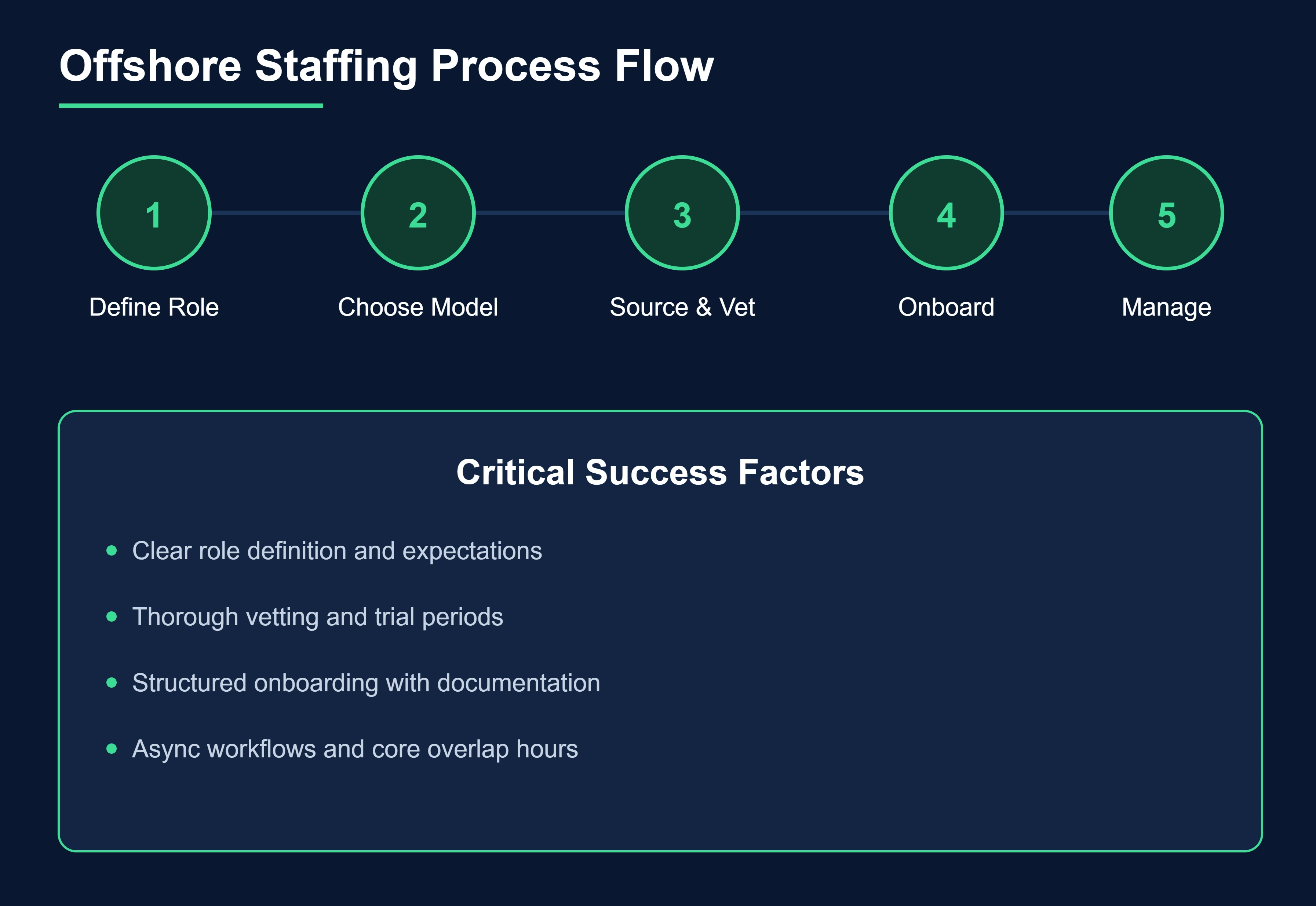
Understanding the concept is one thing. Implementing offshore staffing is another. Here's how the process typically unfolds when a business decides to hire offshore.
Step 1: Define the Role Clearly
Vague job descriptions kill offshore hiring efforts. The more specific the role, the better the outcome. Define responsibilities, required skills, tools the person will use, who they'll report to, and how success will be measured.
If the internal team doesn't know exactly what the role entails, the offshore hire won't either. Clarity upfront saves months of frustration.
Step 2: Choose the Engagement Model
Decide whether to go direct, use an EOR, or work with a staffing agency. For first-time offshore hires, agencies reduce risk. They handle recruiting, vetting, onboarding, and ongoing HR support.
EORs work well when the business already knows who to hire (maybe through referrals or direct sourcing) but needs someone to handle the legal and payroll side.
Direct hiring makes sense at scale—usually after 10+ offshore employees—when the cost of setting up a foreign entity pays off.
Step 3: Source and Vet Candidates
If using an agency, they'll present pre-vetted candidates. If going direct or using an EOR, the business needs to source candidates through job boards, LinkedIn, or local recruiting partners.
Vetting matters. Test technical skills. Run structured interviews. Check references. Offshore hiring has a higher risk of misrepresentation because in-person verification isn't possible.
Many companies run paid trial projects before committing to full-time hires. A one or two-week trial reveals work quality, communication style, and cultural fit.
Step 4: Onboard Thoroughly
Offshore employees need more onboarding than local hires. They don't absorb company culture by osmosis. They won't overhear conversations or pick up on unwritten norms.
Document everything. Record training videos. Create written guides for tools, processes, and expectations. Schedule regular check-ins during the first month.
Assign a direct manager or buddy. Offshore hires who feel connected to the team perform better and stay longer.
Step 5: Manage Communication and Collaboration
Time zones complicate synchronous work. A team in New York and a developer in Ukraine have a six or seven-hour difference. Meetings require compromise.
Successful offshore teams rely on asynchronous communication. Use Slack, Notion, or project management tools to document decisions, share updates, and track work. Record meetings for people who can't attend live.
Set core overlap hours—two to four hours when everyone is online—for real-time collaboration. Outside those hours, async workflows keep things moving.
Step 6: Measure Performance and Iterate
Track outcomes, not hours. Offshore employees can't be monitored the same way as someone in the office. Instead, focus on deliverables, deadlines, and quality.
Weekly or biweekly one-on-ones help identify blockers early. Regular feedback loops prevent small issues from becoming big problems.
If something isn't working, address it fast. The biggest mistake is letting underperformance drift for months because the person is remote.
Where Offshore Staffing Can Go Wrong
Offshore hiring isn't risk-free. Plenty of companies try it, hit roadblocks, and abandon the model. Understanding common failure modes helps avoid them.
Underinvesting in Onboarding
The biggest mistake is treating offshore hires like plug-and-play resources. Without proper onboarding, they lack context. They don't know how decisions get made, who owns what, or what good work looks like.
Result? They spin their wheels, produce mediocre output, and eventually quit or get fired. The company blames offshore hiring. The real problem was onboarding.
Poor Communication Infrastructure
When internal teams rely on hallway conversations, impromptu desk chats, and unwritten norms, offshore employees get left out. They miss context. They don't know what's happening. They make mistakes because they're working with incomplete information.
Fixing this requires intentionality. Document decisions. Use shared tools. Over-communicate. If the internal team isn't ready to work asynchronously, offshore hiring will struggle.
Hiring for the Wrong Roles
Some roles just don't offshore well. Jobs that require deep local market knowledge—like U.S.-focused sales or PR—are hard to do remotely from another country. Roles that depend on frequent in-person collaboration also struggle.
The mistake is trying to force-fit offshore hiring where it doesn't belong, then blaming the model when it fails.
Ignoring Time Zone Realities
A 12-hour time zone difference kills collaboration. If the business needs real-time input and the offshore team is asleep during work hours, frustration builds fast.
Choosing regions with reasonable overlap matters. Latin America aligns with U.S. time zones. Eastern Europe overlaps partially with U.S. East Coast hours. Asia works for companies that can handle async workflows or need 24/7 coverage.
Skipping Legal and Compliance Steps
Employing people internationally involves tax, labor law, and compliance obligations. Businesses that try to cut corners—paying offshore workers as contractors when they're really employees, ignoring local labor laws—risk fines, lawsuits, and back taxes.
Using an EOR or agency mitigates this. Going direct requires proper legal setup. Ignoring compliance entirely is a bad bet.
Getting Offshore Staffing Right Long-Term
Offshore staffing works best as a long-term strategy, not a short-term cost hack. Companies that succeed treat offshore employees like core team members, invest in their growth, and build durable systems around distributed work.
Retention Matters
Turnover kills the cost advantage. Training replacement after replacement eats into savings and tanks productivity. Building a culture where offshore employees feel valued, see career growth, and stay for years is what makes the model work.
That means competitive pay (within local markets), recognition, development opportunities, and inclusion in company events and communication.
Documentation Becomes a Competitive Advantage
Teams that document processes, decisions, and knowledge scale faster. Offshore employees ramp up quicker. New hires onboard smoother. Everyone spends less time answering the same questions.
Distributed teams force documentation. That discipline benefits the entire organization.
Hybrid Models Scale Better
Most successful companies don't go all-offshore. They blend onshore leadership and client-facing roles with offshore execution and support roles.
A product team might have a U.S.-based product manager and designer with offshore developers. A finance team might have a local controller with offshore bookkeepers and AP clerks.
This hybrid model balances cost, communication, and expertise.
Compliance and Regulatory Considerations
Hiring internationally introduces legal complexity. Labor laws vary by country, and tax treaties, visa requirements, and worker classification rules differ widely.
The U.S. Department of Labor enforces strict standards domestically, but its reach does not extend to foreign workers employed abroad. That said, misclassifying workers - treating employees as independent contractors - remains a serious problem and can apply even in cross-border arrangements.
Worker Classification and Misclassification Risks
According to DOL guidance, misclassification occurs when an employer treats a worker who should be classified as an employee under the Fair Labor Standards Act as an independent contractor. This affects wage protections, overtime eligibility, and benefits.
For companies using offshore staffing agencies, worker classification should be reviewed carefully. A reliable provider should be clear about whether workers are employed directly, contracted, or managed through another legal structure.
Labor Enforcement and Due Diligence
In fiscal year 2023, the DOL investigated 955 cases with child labor violations involving 5,792 children nationwide - an 88% increase since 2019 - including 502 children employed in violation of hazardous occupation standards. While these cases primarily involved domestic staffing agencies, the numbers underscore the importance of compliance and due diligence when working with any staffing provider, including offshore agencies.
The department addressed those violations by assessing employers more than $8 million in civil money penalties in fiscal year 2023. One case involved a Kingsport staffing agency that employed children illegally at a Morristown manufacturing facility.
These enforcement actions highlight why vetting offshore staffing agencies matters. Reputable agencies maintain compliance with local labor laws, verify worker eligibility, and ensure legal employment practices.
What to Verify Before Choosing an Offshore Staffing Partner
When evaluating offshore staffing partners, verify:
- Legal registration and business licenses in the operating country
- Compliance with local labor codes and wage laws
- Proper worker classification, including employee vs. contractor status
- Benefits administration and payroll transparency
- Insurance coverage, including liability and workers' compensation where applicable
Businesses with compliance questions can contact the DOL's toll-free helpline at 866-4US-WAGE (487-9243) for guidance on wage and hour regulations, though international employment typically falls outside direct DOL jurisdiction.
Building Global Teams That Scale
Offshore staffing has moved from experimental to essential for many growing companies. Cost savings matter, but access to talent, operational flexibility, and scalability drive long-term adoption.
The model works when approached deliberately. Clear role definitions, thorough vetting, structured onboarding, strong communication infrastructure, and outcome-based management separate successful offshore teams from failed experiments.
Compliance and legal considerations require attention. Using reputable agencies or EORs mitigates risk. Documentation and async workflows benefit the entire organization, not just offshore employees.
For businesses ready to scale beyond local hiring constraints, offshore staffing offers a proven path. Start small—one or two roles—learn the operational cadence, then expand as confidence and systems improve.
The companies that master distributed global teams will have a significant advantage in the years ahead. Lower costs. Broader talent access. Faster scaling. That's the promise of offshore staffing done right.
Ready to build your first offshore team? Start by defining one high-impact role, choosing an engagement model that fits your risk tolerance, and committing to thorough onboarding. The investment in systems and communication will pay dividends as the team grows.
Frequently Asked Questions
Topics
Offshore Staffing Guide: Build Global Teams in 2026

Quick Summary: Offshore staffing involves hiring dedicated, full-time employees in other countries to work as part of your core team, rather than outsourcing tasks or projects. Companies use this model to access global talent, reduce labor costs by 50-70%, and scale operations without the overhead of local hiring. Offshore staff work directly for the business, typically through an EOR or staffing agency that handles payroll, compliance, and local HR requirements.
Building a team used to mean hiring locally or dealing with expensive contractors. Now? The game has changed completely.
Offshore staffing has become a legitimate growth strategy for small businesses, mid-sized companies, and venture-backed startups. Not because it's trendy. Because labor markets are tight, costs keep climbing, and remote work proved that location doesn't matter as much as everyone thought.
But here's the thing—offshore staffing isn't outsourcing. It's not farming out projects to a faceless agency. Done right, offshore staffing means hiring real, dedicated team members who work for the business, not for someone else.
This guide breaks down what offshore staffing actually is, how it works in practice, which roles make sense to hire first, and how to avoid the common mistakes that sink offshore hiring efforts before they start.
What Offshore Staffing Actually Means
Offshore staffing is the practice of hiring full-time employees in other countries to perform ongoing work for the business. These aren't freelancers. They're not contractors managing multiple clients.
They're dedicated staff members who work exclusively for one company, usually during overlapping business hours, integrated into the core team.
The distinction matters. When a business outsources, it hands off a project or function to a third party. That third party manages the work, the people, and the delivery. The business gets results but loses visibility and control.
Offshore staffing flips that. The business hires the person. The business manages the work. The offshore employee reports directly to internal managers, joins team meetings, uses company tools, and functions like any other remote team member—except they're based in Manila, Bogotá, or Kyiv instead of Kansas City.
The Models Behind Offshore Staffing
Most companies use one of three models when they build offshore teams:
- Direct hire: The company establishes a legal entity in the target country, handles payroll, taxes, benefits, and compliance directly. This gives maximum control but requires serious upfront investment and ongoing admin overhead. Most small businesses skip this route unless they're hiring dozens of people.
- Employer of Record (EOR): A third-party service becomes the legal employer in the foreign country. The EOR handles all compliance, payroll, taxes, and HR admin. The business directs the work and manages the employee day-to-day. This model offers flexibility without the legal burden.
- Offshore staffing agency: An agency recruits, vets, hires, and employs the staff on behalf of the client. The agency handles everything an EOR does, but often adds recruiting, onboarding, workspace, equipment, and sometimes training. The business pays the agency a monthly fee per employee.
Each model has trade-offs. Direct hire offers control but demands infrastructure. EORs provide compliance with flexibility. Agencies bundle services but add margin to the cost.
Why Businesses Turn to Offshore Staffing Now
Offshore staffing isn't new. What's new is how mainstream it's become. A few forces converged over the past few years that pushed offshore hiring from niche tactic to standard playbook.
Labor Costs Keep Climbing
Salaries in major U.S. markets rose sharply. A mid-level software engineer in San Francisco costs $140K–$180K base, plus benefits, taxes, and equity. That same role in Poland or Argentina? $40K–$70K for comparable skill.
The math is hard to ignore. Companies can hire two or three offshore developers for the cost of one onshore hire. Or they can reinvest the savings into marketing, product, or growth.
Talent Shortages Hit Hard
Hiring freezes and layoffs in some sectors haven't solved the talent problem in others. Skilled roles—developers, designers, accountants, data analysts—remain scarce in many U.S. regions.
Offshore staffing opens access to global talent pools. The Philippines produces thousands of English-speaking customer support specialists every year. Eastern Europe has deep benches of engineers. Latin America's time zones overlap with U.S. business hours.
Remote Work Normalized Distributed Teams
COVID-19 forced companies to figure out remote work whether they wanted to or not. Once teams proved they could collaborate across cities, the jump to collaborating across countries felt smaller.
Tools improved. Video calls became default. Async communication matured. The operational barriers that once made offshore hiring feel risky mostly disappeared.
Flexibility Became Non-Negotiable
Small businesses don't always need full-time roles. Sometimes the workload justifies 25 hours a week, not 40. Sometimes a specialized skill is needed for six months, not indefinitely.
Offshore staffing offers flexibility. Businesses can hire part-time, scale up or down faster, and test roles before committing to expensive local hires.
Build Offshore Staffing Support with NeoWork
Offshore staffing helps companies add remote talent for daily operations, support, and back-office work without hiring every role internally. NeoWork provides offshore professionals who can work as part of the client’s existing team or within a managed operations structure. NeoWork handles recruitment, benefits, training, and ongoing engagement, while teammates follow the client’s tools, workflows, and priorities. Its 91% annualized teammate retention rate and 3.2% candidate selectivity rate reflect a focus on selective hiring and longer-term team stability.
NeoWork's offshore staffing model offers:
- offshore professionals for recurring business functions
- integration with the client’s tools and processes
- recruitment and ongoing teammate support
Contact NeoWork to build offshore staffing support around your daily business needs.
Which Roles Work Best for Offshore Staffing
Not every role translates well to offshore hiring. Some functions demand deep local context, in-person collaboration, or regulatory constraints that make remote work impractical.
But many roles—especially knowledge work—transfer seamlessly. Here's where offshore staffing tends to deliver the strongest results.
Software Development and Engineering
This is the most common offshore category. Developers write code that works anywhere. Version control, CI/CD pipelines, and collaboration tools make distributed engineering teams standard practice.
Companies hire offshore developers for backend work, frontend development, mobile apps, QA testing, and DevOps. Eastern Europe, Latin America, and Southeast Asia all have strong developer talent.
Customer Support and Success
Support roles scale easily offshore. The Philippines has built an entire industry around English-language customer service. Agents handle chat, email, phone support, and basic account management.
The time zone difference can actually help. U.S.-based companies can offer extended or 24/7 support by layering offshore teams into their coverage model.
Design and Creative Work
Graphic designers, UX/UI specialists, video editors, and content creators work well remotely. Design tools are cloud-based. Feedback happens asynchronously. Quality depends on the individual, not the location.
Some companies hire entire design teams offshore. Others bring on one or two specialists to support local creative leads.
Finance and Accounting
Bookkeeping, accounts payable, accounts receivable, payroll processing, and financial reporting are highly standardized. Accounting firms and finance teams have been offshoring these functions for years.
Countries like India and the Philippines produce large numbers of trained accountants familiar with U.S. accounting standards and software like QuickBooks and Xero.
Marketing and Content
Content writers, SEO specialists, social media managers, and paid ads coordinators often work remotely already. Offshore hires in these roles manage blogs, run campaigns, conduct keyword research, and optimize landing pages.
The key is clear communication about brand voice, audience, and goals. With solid onboarding, offshore marketers perform just as well as local hires.
Administrative and Operations
Virtual assistants, executive assistants, data entry specialists, and operations coordinators handle repetitive or administrative tasks that don't require physical presence.
These roles free up expensive local staff to focus on higher-value work. Offshore admin staff costs a fraction of a U.S.-based equivalent.
What Offshore Staffing Actually Costs
Cost savings drive a lot of offshore hiring decisions. But the numbers vary widely depending on location, role, experience level, and engagement model.
Here's a rough breakdown of what businesses typically pay for offshore staff in common regions:
These figures include salary, but when using an agency or EOR, expect to pay 20-40% on top of base salary to cover their margin, benefits administration, and compliance overhead.
Still, even with markup, offshore hires cost 50-70% less than comparable U.S. roles in most cases.
How Offshore Staffing Actually Works in Practice
Understanding the concept is one thing. Implementing offshore staffing is another. Here's how the process typically unfolds when a business decides to hire offshore.
Step 1: Define the Role Clearly
Vague job descriptions kill offshore hiring efforts. The more specific the role, the better the outcome. Define responsibilities, required skills, tools the person will use, who they'll report to, and how success will be measured.
If the internal team doesn't know exactly what the role entails, the offshore hire won't either. Clarity upfront saves months of frustration.
Step 2: Choose the Engagement Model
Decide whether to go direct, use an EOR, or work with a staffing agency. For first-time offshore hires, agencies reduce risk. They handle recruiting, vetting, onboarding, and ongoing HR support.
EORs work well when the business already knows who to hire (maybe through referrals or direct sourcing) but needs someone to handle the legal and payroll side.
Direct hiring makes sense at scale—usually after 10+ offshore employees—when the cost of setting up a foreign entity pays off.
Step 3: Source and Vet Candidates
If using an agency, they'll present pre-vetted candidates. If going direct or using an EOR, the business needs to source candidates through job boards, LinkedIn, or local recruiting partners.
Vetting matters. Test technical skills. Run structured interviews. Check references. Offshore hiring has a higher risk of misrepresentation because in-person verification isn't possible.
Many companies run paid trial projects before committing to full-time hires. A one or two-week trial reveals work quality, communication style, and cultural fit.
Step 4: Onboard Thoroughly
Offshore employees need more onboarding than local hires. They don't absorb company culture by osmosis. They won't overhear conversations or pick up on unwritten norms.
Document everything. Record training videos. Create written guides for tools, processes, and expectations. Schedule regular check-ins during the first month.
Assign a direct manager or buddy. Offshore hires who feel connected to the team perform better and stay longer.
Step 5: Manage Communication and Collaboration
Time zones complicate synchronous work. A team in New York and a developer in Ukraine have a six or seven-hour difference. Meetings require compromise.
Successful offshore teams rely on asynchronous communication. Use Slack, Notion, or project management tools to document decisions, share updates, and track work. Record meetings for people who can't attend live.
Set core overlap hours—two to four hours when everyone is online—for real-time collaboration. Outside those hours, async workflows keep things moving.
Step 6: Measure Performance and Iterate
Track outcomes, not hours. Offshore employees can't be monitored the same way as someone in the office. Instead, focus on deliverables, deadlines, and quality.
Weekly or biweekly one-on-ones help identify blockers early. Regular feedback loops prevent small issues from becoming big problems.
If something isn't working, address it fast. The biggest mistake is letting underperformance drift for months because the person is remote.
Where Offshore Staffing Can Go Wrong
Offshore hiring isn't risk-free. Plenty of companies try it, hit roadblocks, and abandon the model. Understanding common failure modes helps avoid them.
Underinvesting in Onboarding
The biggest mistake is treating offshore hires like plug-and-play resources. Without proper onboarding, they lack context. They don't know how decisions get made, who owns what, or what good work looks like.
Result? They spin their wheels, produce mediocre output, and eventually quit or get fired. The company blames offshore hiring. The real problem was onboarding.
Poor Communication Infrastructure
When internal teams rely on hallway conversations, impromptu desk chats, and unwritten norms, offshore employees get left out. They miss context. They don't know what's happening. They make mistakes because they're working with incomplete information.
Fixing this requires intentionality. Document decisions. Use shared tools. Over-communicate. If the internal team isn't ready to work asynchronously, offshore hiring will struggle.
Hiring for the Wrong Roles
Some roles just don't offshore well. Jobs that require deep local market knowledge—like U.S.-focused sales or PR—are hard to do remotely from another country. Roles that depend on frequent in-person collaboration also struggle.
The mistake is trying to force-fit offshore hiring where it doesn't belong, then blaming the model when it fails.
Ignoring Time Zone Realities
A 12-hour time zone difference kills collaboration. If the business needs real-time input and the offshore team is asleep during work hours, frustration builds fast.
Choosing regions with reasonable overlap matters. Latin America aligns with U.S. time zones. Eastern Europe overlaps partially with U.S. East Coast hours. Asia works for companies that can handle async workflows or need 24/7 coverage.
Skipping Legal and Compliance Steps
Employing people internationally involves tax, labor law, and compliance obligations. Businesses that try to cut corners—paying offshore workers as contractors when they're really employees, ignoring local labor laws—risk fines, lawsuits, and back taxes.
Using an EOR or agency mitigates this. Going direct requires proper legal setup. Ignoring compliance entirely is a bad bet.
Getting Offshore Staffing Right Long-Term
Offshore staffing works best as a long-term strategy, not a short-term cost hack. Companies that succeed treat offshore employees like core team members, invest in their growth, and build durable systems around distributed work.
Retention Matters
Turnover kills the cost advantage. Training replacement after replacement eats into savings and tanks productivity. Building a culture where offshore employees feel valued, see career growth, and stay for years is what makes the model work.
That means competitive pay (within local markets), recognition, development opportunities, and inclusion in company events and communication.
Documentation Becomes a Competitive Advantage
Teams that document processes, decisions, and knowledge scale faster. Offshore employees ramp up quicker. New hires onboard smoother. Everyone spends less time answering the same questions.
Distributed teams force documentation. That discipline benefits the entire organization.
Hybrid Models Scale Better
Most successful companies don't go all-offshore. They blend onshore leadership and client-facing roles with offshore execution and support roles.
A product team might have a U.S.-based product manager and designer with offshore developers. A finance team might have a local controller with offshore bookkeepers and AP clerks.
This hybrid model balances cost, communication, and expertise.
Compliance and Regulatory Considerations
Hiring internationally introduces legal complexity. Labor laws vary by country, and tax treaties, visa requirements, and worker classification rules differ widely.
The U.S. Department of Labor enforces strict standards domestically, but its reach does not extend to foreign workers employed abroad. That said, misclassifying workers - treating employees as independent contractors - remains a serious problem and can apply even in cross-border arrangements.
Worker Classification and Misclassification Risks
According to DOL guidance, misclassification occurs when an employer treats a worker who should be classified as an employee under the Fair Labor Standards Act as an independent contractor. This affects wage protections, overtime eligibility, and benefits.
For companies using offshore staffing agencies, worker classification should be reviewed carefully. A reliable provider should be clear about whether workers are employed directly, contracted, or managed through another legal structure.
Labor Enforcement and Due Diligence
In fiscal year 2023, the DOL investigated 955 cases with child labor violations involving 5,792 children nationwide - an 88% increase since 2019 - including 502 children employed in violation of hazardous occupation standards. While these cases primarily involved domestic staffing agencies, the numbers underscore the importance of compliance and due diligence when working with any staffing provider, including offshore agencies.
The department addressed those violations by assessing employers more than $8 million in civil money penalties in fiscal year 2023. One case involved a Kingsport staffing agency that employed children illegally at a Morristown manufacturing facility.
These enforcement actions highlight why vetting offshore staffing agencies matters. Reputable agencies maintain compliance with local labor laws, verify worker eligibility, and ensure legal employment practices.
What to Verify Before Choosing an Offshore Staffing Partner
When evaluating offshore staffing partners, verify:
- Legal registration and business licenses in the operating country
- Compliance with local labor codes and wage laws
- Proper worker classification, including employee vs. contractor status
- Benefits administration and payroll transparency
- Insurance coverage, including liability and workers' compensation where applicable
Businesses with compliance questions can contact the DOL's toll-free helpline at 866-4US-WAGE (487-9243) for guidance on wage and hour regulations, though international employment typically falls outside direct DOL jurisdiction.
Building Global Teams That Scale
Offshore staffing has moved from experimental to essential for many growing companies. Cost savings matter, but access to talent, operational flexibility, and scalability drive long-term adoption.
The model works when approached deliberately. Clear role definitions, thorough vetting, structured onboarding, strong communication infrastructure, and outcome-based management separate successful offshore teams from failed experiments.
Compliance and legal considerations require attention. Using reputable agencies or EORs mitigates risk. Documentation and async workflows benefit the entire organization, not just offshore employees.
For businesses ready to scale beyond local hiring constraints, offshore staffing offers a proven path. Start small—one or two roles—learn the operational cadence, then expand as confidence and systems improve.
The companies that master distributed global teams will have a significant advantage in the years ahead. Lower costs. Broader talent access. Faster scaling. That's the promise of offshore staffing done right.
Ready to build your first offshore team? Start by defining one high-impact role, choosing an engagement model that fits your risk tolerance, and committing to thorough onboarding. The investment in systems and communication will pay dividends as the team grows.
Frequently Asked Questions
Topics
Related Blogs
Related Podcasts


.webp)

.webp)
.webp)



