

.avif)
.avif)

Medical Billing Outsourcing Guide 2026: Complete Roadmap


.svg)

Quick Summary: Medical billing outsourcing involves partnering with a specialized third-party company to handle claim submission, payment posting, denial management, and patient billing. The medical billing outsourcing market was valued at nearly $12 billion in 2021 and is projected to grow by over 11% annually through 2030, driven by rising denial rates, staffing shortages, and complex payer requirements. Successful outsourcing can increase net collection rates to 92-98% while reducing billing costs to 4-10% of collections, compared to 8-12% for in-house operations.
Healthcare providers face mounting pressure from every direction. Denial rates climb steadily. Staffing turnover never seems to stop. Payer rules change faster than practices can adapt.
Medical billing outsourcing has shifted from a cost-cutting tactic to a strategic necessity for many organizations. The numbers tell the story—the global market for outsourced medical billing was valued at nearly $12 billion in 2021 and is projected to grow by over 11% annually through 2030.
But here's the thing though: not every outsourcing partnership delivers results. Some practices see their collections soar above 95%. Others struggle with unresponsive vendors and declining revenue.
This guide breaks down what actually matters when evaluating, selecting, and working with a medical billing partner in 2026.
What Is Medical Billing Outsourcing?
Medical billing outsourcing means contracting with a specialized company to handle the revenue cycle functions that transform clinical services into cash. These functions extend beyond simple claim submission.
A comprehensive outsourced billing partner manages:
- Insurance eligibility verification before appointments
- Charge entry and coding review for accuracy
- Electronic claim submission to payers
- Payment posting and reconciliation
- Denial management and appeals
- Patient billing and collections
- Accounts receivable follow-up
- Financial reporting and analytics
The arrangement typically operates on a percentage of collections—most commonly ranging from 4% to 10%—though some vendors offer flat-fee models for specific services.
These companies employ certified coders, billing specialists, and revenue cycle analysts who focus exclusively on maximizing reimbursement. They invest in specialized software, maintain HIPAA compliance infrastructure, and stay current on payer policy changes.
Why Healthcare Providers Are Choosing Outsourced Medical Billing
The shift toward outsourcing accelerated sharply in recent years. Several converging factors explain this trend.
Persistent Staffing Challenges
Recruiting and retaining qualified billing staff has become increasingly difficult. When a billing specialist performs accounts receivable work every day, this adds up to 2,000 hours annually—equating to five months of full-time effort just to keep collections moving.
Turnover forces practices to restart the training cycle repeatedly. Knowledge gaps during transitions lead directly to revenue leakage.
Rising Administrative Burden
Billing complexity continues to escalate. The Consolidated Appropriations Act of 2021 established new requirements for providers through "No Surprises" rules, including balance billing prohibitions and cost transparency mandates.
Medicare payments for remote patient monitoring exceeded $500 million in 2024, creating new coding opportunities—but only for practices that can navigate the documentation requirements correctly.
Keeping pace demands constant policy monitoring and workflow adjustments that stretch internal teams thin.
Financial Performance Gaps
The American Medical Association reports that roughly 65% of denied claims are never corrected and resubmitted. That revenue gets written off by default rather than by decision.
Industry estimates put the cost of reworking a single denied claim between $25 and $181, depending on complexity. Most analyses suggest 60-70% of these denials were preventable with proper upfront scrubbing.
Practices often see their net collection rates climb from a typical 75-85% range to an impressive 92-98% after transitioning to specialized billing partners.

Strengthen Medical Billing Support with NeoWork
Medical billing outsourcing helps healthcare companies manage recurring billing, records, and back-office workflows without adding pressure to internal teams. NeoWork provides remote teammates who can support administrative healthcare operations, billing-related data entry, documentation, and workflow coordination. NeoWork handles recruitment, benefits, training, and ongoing engagement, while teammates integrate into the client’s systems and daily processes. Its 91% annualized teammate retention rate and 3.2% candidate selectivity rate reflect a focus on selective hiring and longer-term team stability.
NeoWork's medical billing outsourcing model offers:
- billing admin and records support
- integration with the client’s tools and processes
- recruitment and ongoing teammate support
Contact NeoWork to add medical billing support that can work alongside your existing healthcare operations.
Core Benefits of Medical Billing Outsourcing
When executed properly, outsourcing delivers measurable advantages across financial, operational, and clinical dimensions.
Cost Conversion and Reduction
Outsourcing converts fixed costs into variable ones, cutting billing-related expenses by up to 40%. When outsourcing typically costs 4% to 10% of collections versus 8-12% for in-house operations, the savings compound quickly.
Consider the full cost of maintaining internal billing staff:
Total annual in-house billing costs frequently exceed $120,000 to $290,000 for a mid-sized practice. Outsourcing at 6% of $1.5 million in collections equals $90,000—a meaningful reduction.
Revenue Optimization
Specialized billing companies achieve claim acceptance rates over 95%, compared to the industry average of 85-90%. They maintain denial rates below 5% through proactive denial management.
Their revenue cycle platforms flag coding errors before submission, verify coverage eligibility in real-time, and automatically scrub claims against payer-specific requirements.
Clinical Focus Protection
According to industry polling, a significant percentage of physicians indicated time saving as a key advantage of outsourcing medical billing. When administrative burden lifts, clinical staff redirect attention to patient care rather than claim status inquiries.
This matters more than many realize. Provider burnout correlates strongly with administrative load. Reducing that friction improves job satisfaction and retention.
Scalability and Flexibility
Practice volume fluctuates. Seasonal patterns, new provider additions, and payer contract changes create workload variability that's difficult to staff appropriately.
Outsourced partners absorb these fluctuations without requiring hiring decisions or overtime expenses. They scale resources up during busy periods and down during slower months automatically.
Compliance and Risk Mitigation
HIPAA covered entities and business associates must comply with regulations protecting the privacy and security of electronic protected health information. HIPAA Rules allow covered entities to use cloud service providers that store ePHI on servers outside the United States, provided they enter into proper business associate agreements.
Reputable billing companies maintain comprehensive compliance programs including:
- Annual HIPAA security risk assessments
- Encrypted data transmission and storage
- Role-based access controls
- Regular staff compliance training
- Incident response procedures
- Business associate agreements with all vendors
This infrastructure would cost individual practices tens of thousands annually to replicate internally.
Understanding Outsourcing Costs and Pricing Models
Pricing structures vary significantly across vendors. Understanding the models helps practices evaluate true cost-effectiveness.
Percentage of Collections
The most common arrangement charges 4-10% of actual collections. The vendor earns more only when the practice collects more, aligning incentives naturally.
Higher percentages often indicate smaller practice focus or additional services included. Lower percentages may reflect limited scope or require separate fees for certain functions.
Per-Claim or Per-Transaction Fees
Some companies charge flat fees per claim submitted—typically $2 to $8 depending on complexity. This model provides cost predictability but doesn't necessarily incentivize revenue maximization.
Hybrid Models
Combining a small percentage (2-3%) with per-claim fees creates middle-ground pricing. The percentage component maintains revenue alignment while per-claim fees cover baseline processing costs.
Hidden Costs to Watch
Read contracts carefully for additional charges:
- Setup or onboarding fees ($500-$5,000)
- Monthly platform or technology fees
- Termination fees or minimum contract periods
- Charges for patient statements or collections calls
- Fees for custom reporting or analytics
Request all-inclusive pricing in writing before signing agreements.
Evaluating Medical Billing Partners: What Actually Matters
Some physicians have indicated lack of control as a concern with medical billing outsourcing. Choosing the right partner mitigates this risk substantially.
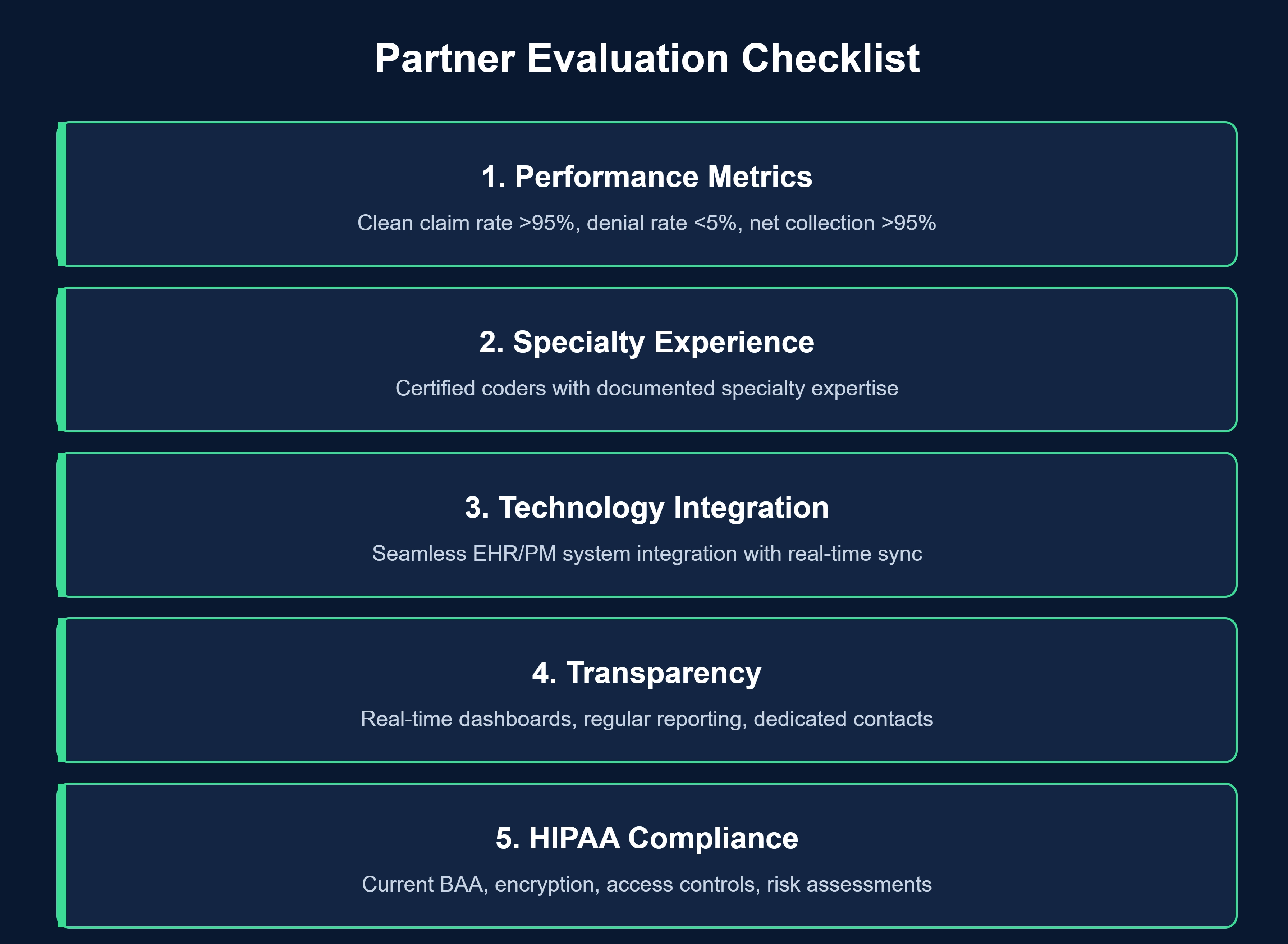
Focus evaluation on measurable performance indicators rather than marketing promises.
Performance Metrics and Benchmarks
Request specific historical performance data:
Ask for references from practices similar in size, specialty, and payer mix. Contact them directly to verify claimed results.
Specialty Expertise
Generic billing companies struggle with specialty-specific coding nuances and payer requirements. Orthopedics billing differs dramatically from behavioral health or cardiology.
Verify the vendor employs certified coders with specific experience in the specialty. Ask how many similar practices they currently serve and for how long.
Technology and Integration
The billing partner should integrate seamlessly with the existing practice management and electronic health record systems. Clunky interfaces create workflow friction and data synchronization problems.
Confirm the vendor supports the specific EHR platform version currently in use. Ask about data migration processes and dual-system operation during transitions.
Transparency and Communication
Real-time access to billing data and financial reports isn't optional. Practices need visibility into claim status, collection trends, and denial patterns.
Determine:
- What reporting dashboards are provided?
- How frequently are they updated?
- Who is the primary point of contact?
- What are guaranteed response times for inquiries?
- How are strategy meetings scheduled and conducted?
Vendors who resist providing transparent reporting often have performance they'd prefer to hide.
Compliance and Security Standards
Verify HIPAA compliance infrastructure through specific questions:
- When was the last security risk assessment completed?
- What encryption standards protect data in transit and at rest?
- How is employee access monitored and controlled?
- What incident response procedures are documented?
- Can they provide evidence of cyber liability insurance?
Request to review their standard business associate agreement before signing master service agreements.
Implementation and Transition Strategy
The transition period determines whether outsourcing succeeds or creates cash flow disasters. Poor implementations cause revenue disruption lasting months.
Timeline Planning
Realistic transitions require 60-90 days minimum from contract signing to full operational handoff. Rushing this timeline invites errors.
Break the implementation into phases:
- Weeks 1-2: Data migration and system integration testing
- Weeks 3-4: Staff training on new workflows and communication protocols
- Weeks 5-6: Parallel processing (both teams working simultaneously)
- Weeks 7-8: Gradual handoff with daily reconciliation
- Weeks 9-12: Full transition with intensive monitoring
Data Migration and Historical Claims
Determine responsibility for outstanding accounts receivable clearly. Some vendors accept historical A/R management; others start fresh with new services only.
Older claims often require different handling than new submissions. Clarify who manages claims submitted before the transition date and how long they'll pursue those balances.
Staff Communication and Role Changes
Internal billing staff face understandable anxiety during outsourcing transitions. Handle these conversations with transparency and advance notice.
Some practices retain front-desk staff for scheduling and registration while outsourcing back-end billing. Others transition billing employees into patient care coordination or practice management roles.
Revenue Protection During Transition
Cash flow dips during handoffs are common but manageable. Protect revenue by:
- Maintaining parallel claim submission during the first 30 days
- Accelerating collections on current A/R before transition
- Monitoring daily deposit amounts closely
- Scheduling weekly check-ins with the new vendor
- Keeping a financial reserve to cover temporary gaps
Set explicit performance guarantees in the contract for the first 90 days.
Common Outsourcing Myths and Misconceptions
Several persistent myths prevent practices from considering outsourcing despite clear financial benefits.
Myth: Outsourcing Means Losing Control
Control concerns have been raised as barriers to outsourcing adoption. But control doesn't require direct employment of billing staff.
Effective vendor relationships include regular performance reviews, real-time data access, and collaborative decision-making on billing policies and appeals strategy. The practice retains final authority on all financial decisions.
Myth: In-House Is Always Cheaper
Some practitioners note that outsourcing billing at 6-8% of collections represents a significant expense.
This perspective ignores the full cost of internal operations. When salary, benefits, software, training, and overhead combine, in-house billing frequently costs 8-12% of collections or more—with worse performance than specialized vendors.
Myth: Quality Suffers with Outsourcing
The opposite typically proves true. Dedicated billing companies invest heavily in coder certification, ongoing training, and quality assurance programs that individual practices cannot afford.
Their staff handle higher claim volumes, encounter more payer scenarios, and develop deeper expertise than generalist practice employees managing multiple administrative roles.
Myth: Outsourcing Only Works for Large Practices
Small practices actually benefit disproportionately from outsourcing. Fixed costs hit harder when spread across fewer providers and lower revenue.
Many vendors specialize in small practice segments and offer pricing scaled appropriately for 1-3 provider groups.
The Role of Technology and Automation in 2026
Artificial intelligence and automation continue reshaping medical billing operations. The best outsourcing partners leverage these technologies rather than resist them.
AI-Powered Coding Assistance
Natural language processing tools now read clinical documentation and suggest appropriate CPT and ICD-10 codes with increasing accuracy. Human coders verify and refine AI suggestions, dramatically accelerating the coding process.
This hybrid approach combines machine speed with human judgment, reducing coding backlogs while maintaining accuracy.
Predictive Denial Analytics
Machine learning models analyze historical claim data to identify denial patterns before submission. They flag claims likely to face rejection based on hundreds of variables—payer, diagnosis combination, modifier usage, documentation gaps.
Real talk: this prevents denials rather than just appealing them after the fact, protecting cash flow proactively.
Robotic Process Automation for Repetitive Tasks
Software bots now handle eligibility verification, claim status checks, and payment posting automatically. They work 24/7 without errors or fatigue.
This frees human staff to focus on complex problem-solving—appealing denials, negotiating payment plans, resolving billing disputes—where judgment and communication skills matter most.
Patient Payment Platforms
Modern billing vendors integrate digital payment portals that accept credit cards, ACH transfers, and payment plans. These systems send automated payment reminders via text and email.
Patient collections improve significantly when multiple payment options and convenient channels replace mailed paper statements exclusively.
Specialty-Specific Considerations
Different specialties face unique billing challenges that generic vendors struggle to address effectively.
Behavioral Health and Substance Use Disorder Treatment
Confidentiality of substance use disorder patient records imposes strict requirements beyond standard HIPAA protections. Billing partners must understand 42 CFR Part 2 regulations governing disclosure.
Many payers require prior authorization for therapy sessions beyond initial evaluations. Managing these authorization cycles demands specialty expertise.
Federally Qualified Health Centers
FQHCs receive prospective payment system reimbursement rather than fee-for-service, creating different billing workflows and reconciliation requirements.
Sliding fee scale programs and wrap payments add complexity that general billing companies often mishandle, leaving significant revenue on the table.
Surgical Specialties
Orthopedics, ophthalmology, and other surgical practices deal with bundled payments, global periods, and modifier requirements that dramatically impact reimbursement.
Incorrectly applying modifiers like -25, -59, or -78 triggers automatic denials or underpayments worth thousands per case.
Remote Patient Monitoring and Telehealth
Medicare payments for remote patient monitoring exceeded $500 million in 2024. Capturing this revenue requires understanding specific time thresholds, documentation requirements, and billing limitations.
The Office of Inspector General recently scrutinized RPM billing for compliance issues. Experienced billing partners stay current on these enforcement priorities and structure documentation defensibly.
Key Questions to Ask Before Signing a Contract
These questions reveal vendor capabilities and commitment before legal obligations begin:
- What percentage of your current clients match our specialty and size?
- Can you provide three references from practices we can contact directly?
- What is your average net collection rate for practices like ours?
- How quickly do you submit clean claims after service dates?
- What is your staff turnover rate, and how do you maintain continuity?
- Who will be our dedicated account manager, and what is their background?
- How do you handle credentialing and payer enrollment for new providers?
- What reporting do we receive, and how often?
- What are your contract length requirements and termination terms?
- How do you charge for setup, and what does onboarding include?
- What happens to our data if we terminate the relationship?
- Do you guarantee any performance metrics contractually?
Vendors who provide vague answers or deflect these questions warrant skepticism.
When Outsourcing Might Not Be the Right Choice
Outsourcing isn't universally optimal. Some situations favor keeping billing in-house.
Very Small Practices with Simple Billing
Solo practitioners with limited payer mix and straightforward coding may find outsourcing costs exceed benefits. If one part-time employee handles billing comfortably with minimal denials, change introduces unnecessary risk.
Practices with Excellent Current Performance
If the current in-house team achieves 95%+ net collection rates with denial rates below 5%, and turnover isn't a concern, maintaining the status quo makes sense.
Measure actual performance honestly though. Many practices overestimate internal capabilities.
Organizations Requiring Unique Workflow Control
Certain academic medical centers, hospital systems, or integrated delivery networks have proprietary billing workflows tied to research protocols, teaching programs, or complex cost accounting.
These requirements may exceed what outside vendors can accommodate within standard contracts.
Moving Forward with Medical Billing Outsourcing
Medical billing outsourcing represents a strategic shift rather than a simple vendor relationship. The decision impacts revenue, operational efficiency, compliance risk, and staff morale simultaneously.
The data supports outsourcing for most practices. Net collection rates climbing from 75-85% to 92-98% while costs drop from 8-12% to 4-10% of collections creates compelling financial logic.
But success depends entirely on partner selection and implementation quality. Vendors that guarantee performance metrics contractually, demonstrate specialty expertise through references, integrate seamlessly with existing systems, and maintain transparent communication deliver results. Those that don't create expensive headaches.
Start the evaluation process by documenting current performance honestly. Calculate actual in-house costs including all overhead. Measure baseline metrics like net collection rates, days in A/R, and denial rates.
Then interview at least three potential partners using the questions and evaluation criteria outlined above. Check references thoroughly. Review sample reports and dashboard access. Read contracts carefully, especially termination clauses and performance guarantees.
The medical billing outsourcing market will continue growing by over 11% annually through 2030 because the fundamental drivers—staffing challenges, regulatory complexity, financial pressure—aren't disappearing. Practices that adapt strategically will outperform those that resist change reflexively.
The right outsourcing partner functions as a revenue cycle extension of the practice, not a replacement for internal oversight. Maintain active involvement, demand accountability, and adjust the relationship as needs evolve.
When approached methodically, medical billing outsourcing transforms administrative burden into competitive advantage—freeing clinical staff to focus on patient care while specialized experts maximize every dollar owed.
Frequently Asked Questions
Topics
Medical Billing Outsourcing Guide 2026: Complete Roadmap

Quick Summary: Medical billing outsourcing involves partnering with a specialized third-party company to handle claim submission, payment posting, denial management, and patient billing. The medical billing outsourcing market was valued at nearly $12 billion in 2021 and is projected to grow by over 11% annually through 2030, driven by rising denial rates, staffing shortages, and complex payer requirements. Successful outsourcing can increase net collection rates to 92-98% while reducing billing costs to 4-10% of collections, compared to 8-12% for in-house operations.
Healthcare providers face mounting pressure from every direction. Denial rates climb steadily. Staffing turnover never seems to stop. Payer rules change faster than practices can adapt.
Medical billing outsourcing has shifted from a cost-cutting tactic to a strategic necessity for many organizations. The numbers tell the story—the global market for outsourced medical billing was valued at nearly $12 billion in 2021 and is projected to grow by over 11% annually through 2030.
But here's the thing though: not every outsourcing partnership delivers results. Some practices see their collections soar above 95%. Others struggle with unresponsive vendors and declining revenue.
This guide breaks down what actually matters when evaluating, selecting, and working with a medical billing partner in 2026.
What Is Medical Billing Outsourcing?
Medical billing outsourcing means contracting with a specialized company to handle the revenue cycle functions that transform clinical services into cash. These functions extend beyond simple claim submission.
A comprehensive outsourced billing partner manages:
- Insurance eligibility verification before appointments
- Charge entry and coding review for accuracy
- Electronic claim submission to payers
- Payment posting and reconciliation
- Denial management and appeals
- Patient billing and collections
- Accounts receivable follow-up
- Financial reporting and analytics
The arrangement typically operates on a percentage of collections—most commonly ranging from 4% to 10%—though some vendors offer flat-fee models for specific services.
These companies employ certified coders, billing specialists, and revenue cycle analysts who focus exclusively on maximizing reimbursement. They invest in specialized software, maintain HIPAA compliance infrastructure, and stay current on payer policy changes.
Why Healthcare Providers Are Choosing Outsourced Medical Billing
The shift toward outsourcing accelerated sharply in recent years. Several converging factors explain this trend.
Persistent Staffing Challenges
Recruiting and retaining qualified billing staff has become increasingly difficult. When a billing specialist performs accounts receivable work every day, this adds up to 2,000 hours annually—equating to five months of full-time effort just to keep collections moving.
Turnover forces practices to restart the training cycle repeatedly. Knowledge gaps during transitions lead directly to revenue leakage.
Rising Administrative Burden
Billing complexity continues to escalate. The Consolidated Appropriations Act of 2021 established new requirements for providers through "No Surprises" rules, including balance billing prohibitions and cost transparency mandates.
Medicare payments for remote patient monitoring exceeded $500 million in 2024, creating new coding opportunities—but only for practices that can navigate the documentation requirements correctly.
Keeping pace demands constant policy monitoring and workflow adjustments that stretch internal teams thin.
Financial Performance Gaps
The American Medical Association reports that roughly 65% of denied claims are never corrected and resubmitted. That revenue gets written off by default rather than by decision.
Industry estimates put the cost of reworking a single denied claim between $25 and $181, depending on complexity. Most analyses suggest 60-70% of these denials were preventable with proper upfront scrubbing.
Practices often see their net collection rates climb from a typical 75-85% range to an impressive 92-98% after transitioning to specialized billing partners.
Strengthen Medical Billing Support with NeoWork
Medical billing outsourcing helps healthcare companies manage recurring billing, records, and back-office workflows without adding pressure to internal teams. NeoWork provides remote teammates who can support administrative healthcare operations, billing-related data entry, documentation, and workflow coordination. NeoWork handles recruitment, benefits, training, and ongoing engagement, while teammates integrate into the client’s systems and daily processes. Its 91% annualized teammate retention rate and 3.2% candidate selectivity rate reflect a focus on selective hiring and longer-term team stability.
NeoWork's medical billing outsourcing model offers:
- billing admin and records support
- integration with the client’s tools and processes
- recruitment and ongoing teammate support
Contact NeoWork to add medical billing support that can work alongside your existing healthcare operations.
Core Benefits of Medical Billing Outsourcing
When executed properly, outsourcing delivers measurable advantages across financial, operational, and clinical dimensions.
Cost Conversion and Reduction
Outsourcing converts fixed costs into variable ones, cutting billing-related expenses by up to 40%. When outsourcing typically costs 4% to 10% of collections versus 8-12% for in-house operations, the savings compound quickly.
Consider the full cost of maintaining internal billing staff:
Total annual in-house billing costs frequently exceed $120,000 to $290,000 for a mid-sized practice. Outsourcing at 6% of $1.5 million in collections equals $90,000—a meaningful reduction.
Revenue Optimization
Specialized billing companies achieve claim acceptance rates over 95%, compared to the industry average of 85-90%. They maintain denial rates below 5% through proactive denial management.
Their revenue cycle platforms flag coding errors before submission, verify coverage eligibility in real-time, and automatically scrub claims against payer-specific requirements.
Clinical Focus Protection
According to industry polling, a significant percentage of physicians indicated time saving as a key advantage of outsourcing medical billing. When administrative burden lifts, clinical staff redirect attention to patient care rather than claim status inquiries.
This matters more than many realize. Provider burnout correlates strongly with administrative load. Reducing that friction improves job satisfaction and retention.
Scalability and Flexibility
Practice volume fluctuates. Seasonal patterns, new provider additions, and payer contract changes create workload variability that's difficult to staff appropriately.
Outsourced partners absorb these fluctuations without requiring hiring decisions or overtime expenses. They scale resources up during busy periods and down during slower months automatically.
Compliance and Risk Mitigation
HIPAA covered entities and business associates must comply with regulations protecting the privacy and security of electronic protected health information. HIPAA Rules allow covered entities to use cloud service providers that store ePHI on servers outside the United States, provided they enter into proper business associate agreements.
Reputable billing companies maintain comprehensive compliance programs including:
- Annual HIPAA security risk assessments
- Encrypted data transmission and storage
- Role-based access controls
- Regular staff compliance training
- Incident response procedures
- Business associate agreements with all vendors
This infrastructure would cost individual practices tens of thousands annually to replicate internally.
Understanding Outsourcing Costs and Pricing Models
Pricing structures vary significantly across vendors. Understanding the models helps practices evaluate true cost-effectiveness.
Percentage of Collections
The most common arrangement charges 4-10% of actual collections. The vendor earns more only when the practice collects more, aligning incentives naturally.
Higher percentages often indicate smaller practice focus or additional services included. Lower percentages may reflect limited scope or require separate fees for certain functions.
Per-Claim or Per-Transaction Fees
Some companies charge flat fees per claim submitted—typically $2 to $8 depending on complexity. This model provides cost predictability but doesn't necessarily incentivize revenue maximization.
Hybrid Models
Combining a small percentage (2-3%) with per-claim fees creates middle-ground pricing. The percentage component maintains revenue alignment while per-claim fees cover baseline processing costs.
Hidden Costs to Watch
Read contracts carefully for additional charges:
- Setup or onboarding fees ($500-$5,000)
- Monthly platform or technology fees
- Termination fees or minimum contract periods
- Charges for patient statements or collections calls
- Fees for custom reporting or analytics
Request all-inclusive pricing in writing before signing agreements.
Evaluating Medical Billing Partners: What Actually Matters
Some physicians have indicated lack of control as a concern with medical billing outsourcing. Choosing the right partner mitigates this risk substantially.
Focus evaluation on measurable performance indicators rather than marketing promises.
Performance Metrics and Benchmarks
Request specific historical performance data:
Ask for references from practices similar in size, specialty, and payer mix. Contact them directly to verify claimed results.
Specialty Expertise
Generic billing companies struggle with specialty-specific coding nuances and payer requirements. Orthopedics billing differs dramatically from behavioral health or cardiology.
Verify the vendor employs certified coders with specific experience in the specialty. Ask how many similar practices they currently serve and for how long.
Technology and Integration
The billing partner should integrate seamlessly with the existing practice management and electronic health record systems. Clunky interfaces create workflow friction and data synchronization problems.
Confirm the vendor supports the specific EHR platform version currently in use. Ask about data migration processes and dual-system operation during transitions.
Transparency and Communication
Real-time access to billing data and financial reports isn't optional. Practices need visibility into claim status, collection trends, and denial patterns.
Determine:
- What reporting dashboards are provided?
- How frequently are they updated?
- Who is the primary point of contact?
- What are guaranteed response times for inquiries?
- How are strategy meetings scheduled and conducted?
Vendors who resist providing transparent reporting often have performance they'd prefer to hide.
Compliance and Security Standards
Verify HIPAA compliance infrastructure through specific questions:
- When was the last security risk assessment completed?
- What encryption standards protect data in transit and at rest?
- How is employee access monitored and controlled?
- What incident response procedures are documented?
- Can they provide evidence of cyber liability insurance?
Request to review their standard business associate agreement before signing master service agreements.
Implementation and Transition Strategy
The transition period determines whether outsourcing succeeds or creates cash flow disasters. Poor implementations cause revenue disruption lasting months.
Timeline Planning
Realistic transitions require 60-90 days minimum from contract signing to full operational handoff. Rushing this timeline invites errors.
Break the implementation into phases:
- Weeks 1-2: Data migration and system integration testing
- Weeks 3-4: Staff training on new workflows and communication protocols
- Weeks 5-6: Parallel processing (both teams working simultaneously)
- Weeks 7-8: Gradual handoff with daily reconciliation
- Weeks 9-12: Full transition with intensive monitoring
Data Migration and Historical Claims
Determine responsibility for outstanding accounts receivable clearly. Some vendors accept historical A/R management; others start fresh with new services only.
Older claims often require different handling than new submissions. Clarify who manages claims submitted before the transition date and how long they'll pursue those balances.
Staff Communication and Role Changes
Internal billing staff face understandable anxiety during outsourcing transitions. Handle these conversations with transparency and advance notice.
Some practices retain front-desk staff for scheduling and registration while outsourcing back-end billing. Others transition billing employees into patient care coordination or practice management roles.
Revenue Protection During Transition
Cash flow dips during handoffs are common but manageable. Protect revenue by:
- Maintaining parallel claim submission during the first 30 days
- Accelerating collections on current A/R before transition
- Monitoring daily deposit amounts closely
- Scheduling weekly check-ins with the new vendor
- Keeping a financial reserve to cover temporary gaps
Set explicit performance guarantees in the contract for the first 90 days.
Common Outsourcing Myths and Misconceptions
Several persistent myths prevent practices from considering outsourcing despite clear financial benefits.
Myth: Outsourcing Means Losing Control
Control concerns have been raised as barriers to outsourcing adoption. But control doesn't require direct employment of billing staff.
Effective vendor relationships include regular performance reviews, real-time data access, and collaborative decision-making on billing policies and appeals strategy. The practice retains final authority on all financial decisions.
Myth: In-House Is Always Cheaper
Some practitioners note that outsourcing billing at 6-8% of collections represents a significant expense.
This perspective ignores the full cost of internal operations. When salary, benefits, software, training, and overhead combine, in-house billing frequently costs 8-12% of collections or more—with worse performance than specialized vendors.
Myth: Quality Suffers with Outsourcing
The opposite typically proves true. Dedicated billing companies invest heavily in coder certification, ongoing training, and quality assurance programs that individual practices cannot afford.
Their staff handle higher claim volumes, encounter more payer scenarios, and develop deeper expertise than generalist practice employees managing multiple administrative roles.
Myth: Outsourcing Only Works for Large Practices
Small practices actually benefit disproportionately from outsourcing. Fixed costs hit harder when spread across fewer providers and lower revenue.
Many vendors specialize in small practice segments and offer pricing scaled appropriately for 1-3 provider groups.
The Role of Technology and Automation in 2026
Artificial intelligence and automation continue reshaping medical billing operations. The best outsourcing partners leverage these technologies rather than resist them.
AI-Powered Coding Assistance
Natural language processing tools now read clinical documentation and suggest appropriate CPT and ICD-10 codes with increasing accuracy. Human coders verify and refine AI suggestions, dramatically accelerating the coding process.
This hybrid approach combines machine speed with human judgment, reducing coding backlogs while maintaining accuracy.
Predictive Denial Analytics
Machine learning models analyze historical claim data to identify denial patterns before submission. They flag claims likely to face rejection based on hundreds of variables—payer, diagnosis combination, modifier usage, documentation gaps.
Real talk: this prevents denials rather than just appealing them after the fact, protecting cash flow proactively.
Robotic Process Automation for Repetitive Tasks
Software bots now handle eligibility verification, claim status checks, and payment posting automatically. They work 24/7 without errors or fatigue.
This frees human staff to focus on complex problem-solving—appealing denials, negotiating payment plans, resolving billing disputes—where judgment and communication skills matter most.
Patient Payment Platforms
Modern billing vendors integrate digital payment portals that accept credit cards, ACH transfers, and payment plans. These systems send automated payment reminders via text and email.
Patient collections improve significantly when multiple payment options and convenient channels replace mailed paper statements exclusively.
Specialty-Specific Considerations
Different specialties face unique billing challenges that generic vendors struggle to address effectively.
Behavioral Health and Substance Use Disorder Treatment
Confidentiality of substance use disorder patient records imposes strict requirements beyond standard HIPAA protections. Billing partners must understand 42 CFR Part 2 regulations governing disclosure.
Many payers require prior authorization for therapy sessions beyond initial evaluations. Managing these authorization cycles demands specialty expertise.
Federally Qualified Health Centers
FQHCs receive prospective payment system reimbursement rather than fee-for-service, creating different billing workflows and reconciliation requirements.
Sliding fee scale programs and wrap payments add complexity that general billing companies often mishandle, leaving significant revenue on the table.
Surgical Specialties
Orthopedics, ophthalmology, and other surgical practices deal with bundled payments, global periods, and modifier requirements that dramatically impact reimbursement.
Incorrectly applying modifiers like -25, -59, or -78 triggers automatic denials or underpayments worth thousands per case.
Remote Patient Monitoring and Telehealth
Medicare payments for remote patient monitoring exceeded $500 million in 2024. Capturing this revenue requires understanding specific time thresholds, documentation requirements, and billing limitations.
The Office of Inspector General recently scrutinized RPM billing for compliance issues. Experienced billing partners stay current on these enforcement priorities and structure documentation defensibly.
Key Questions to Ask Before Signing a Contract
These questions reveal vendor capabilities and commitment before legal obligations begin:
- What percentage of your current clients match our specialty and size?
- Can you provide three references from practices we can contact directly?
- What is your average net collection rate for practices like ours?
- How quickly do you submit clean claims after service dates?
- What is your staff turnover rate, and how do you maintain continuity?
- Who will be our dedicated account manager, and what is their background?
- How do you handle credentialing and payer enrollment for new providers?
- What reporting do we receive, and how often?
- What are your contract length requirements and termination terms?
- How do you charge for setup, and what does onboarding include?
- What happens to our data if we terminate the relationship?
- Do you guarantee any performance metrics contractually?
Vendors who provide vague answers or deflect these questions warrant skepticism.
When Outsourcing Might Not Be the Right Choice
Outsourcing isn't universally optimal. Some situations favor keeping billing in-house.
Very Small Practices with Simple Billing
Solo practitioners with limited payer mix and straightforward coding may find outsourcing costs exceed benefits. If one part-time employee handles billing comfortably with minimal denials, change introduces unnecessary risk.
Practices with Excellent Current Performance
If the current in-house team achieves 95%+ net collection rates with denial rates below 5%, and turnover isn't a concern, maintaining the status quo makes sense.
Measure actual performance honestly though. Many practices overestimate internal capabilities.
Organizations Requiring Unique Workflow Control
Certain academic medical centers, hospital systems, or integrated delivery networks have proprietary billing workflows tied to research protocols, teaching programs, or complex cost accounting.
These requirements may exceed what outside vendors can accommodate within standard contracts.
Moving Forward with Medical Billing Outsourcing
Medical billing outsourcing represents a strategic shift rather than a simple vendor relationship. The decision impacts revenue, operational efficiency, compliance risk, and staff morale simultaneously.
The data supports outsourcing for most practices. Net collection rates climbing from 75-85% to 92-98% while costs drop from 8-12% to 4-10% of collections creates compelling financial logic.
But success depends entirely on partner selection and implementation quality. Vendors that guarantee performance metrics contractually, demonstrate specialty expertise through references, integrate seamlessly with existing systems, and maintain transparent communication deliver results. Those that don't create expensive headaches.
Start the evaluation process by documenting current performance honestly. Calculate actual in-house costs including all overhead. Measure baseline metrics like net collection rates, days in A/R, and denial rates.
Then interview at least three potential partners using the questions and evaluation criteria outlined above. Check references thoroughly. Review sample reports and dashboard access. Read contracts carefully, especially termination clauses and performance guarantees.
The medical billing outsourcing market will continue growing by over 11% annually through 2030 because the fundamental drivers—staffing challenges, regulatory complexity, financial pressure—aren't disappearing. Practices that adapt strategically will outperform those that resist change reflexively.
The right outsourcing partner functions as a revenue cycle extension of the practice, not a replacement for internal oversight. Maintain active involvement, demand accountability, and adjust the relationship as needs evolve.
When approached methodically, medical billing outsourcing transforms administrative burden into competitive advantage—freeing clinical staff to focus on patient care while specialized experts maximize every dollar owed.
Frequently Asked Questions
Topics
Related Blogs
Related Podcasts


.webp)

.webp)
.webp)



