

.avif)
.avif)

Procurement Outsourcing Guide 2026: Models, Costs & How to Choose a Partner


.svg)

Quick Summary: Procurement outsourcing means handing off some or all sourcing, purchasing, and supplier management work to a third-party specialist, either to cut costs, free up internal staff, or bring in category expertise the business lacks internally. The right approach depends on scale: small teams often benefit from full outsourcing or a group purchasing organization, while larger enterprises tend to outsource selectively — tail spend, one category, or a single project like an RFP. Success hinges less on the provider's size and more on clear governance, defined KPIs, and a realistic transition plan.
Most procurement teams don't outsource because they want to give up control. They do it because the internal team is stretched thin, the category expertise doesn't exist in-house, or leadership wants sourcing costs off the balance sheet as a fixed line item instead of a growing headcount problem. That's the real driver behind procurement outsourcing, and it's why the market for it keeps expanding even as more companies invest in procurement software at the same time.
This guide breaks down what procurement outsourcing actually covers, the models available, what it tends to cost, the risks nobody mentions in the sales deck, and a practical way to evaluate a partner before signing anything.
What Is Procurement Outsourcing?
Procurement outsourcing is the practice of contracting an external provider to handle part or all of the procure-to-pay cycle — supplier sourcing, negotiation, purchase order management, contract administration, spend analysis, or payment processing. It ranges from a single outsourced task, like running an RFP, to a full business process outsourcing (BPO) arrangement where an external team effectively becomes the procurement department.
The scope typically falls into a few buckets:
- Strategic sourcing — market research, supplier identification, negotiation strategy
- Tactical/transactional procurement — purchase orders, invoice matching, catalog management
- Category management — ongoing ownership of a spend category like IT, marketing, or facilities
- Contract and supplier management — lifecycle tracking, compliance, performance reviews
Why Companies Outsource Procurement
The reasons stack up fast once a company starts comparing the fully-loaded cost of an internal procurement hire against a flexible outsourced arrangement.
- Cost control: Outsourcing converts fixed headcount costs into variable, often performance-linked fees, and specialist buyers frequently negotiate better rates than an internal generalist could.
- Speed: An established provider can run a sourcing event or RFP in weeks rather than months because the process, templates, and supplier relationships already exist.
- Access to expertise: Category specialists — say, someone who's negotiated hundreds of SaaS or logistics contracts — bring pattern recognition an in-house generalist team rarely has.
- Scalability: Outsourcing flexes up during a merger, expansion, or seasonal spike without a permanent hiring commitment.
- Focus: Freeing internal staff from transactional purchasing lets them concentrate on supplier strategy and higher-value category work.
None of that means outsourcing is automatically cheaper or better. It's a trade-off, and the next section digs into where that trade-off tends to break down.

Support Procurement Operations with NeoWork
Procurement outsourcing helps companies manage vendor coordination, documentation, data entry, purchase support, and recurring administrative workflows. NeoWork provides remote teammates who can support procurement operations as part of the client’s existing team structure. NeoWork handles recruitment, benefits, training, and ongoing engagement, while teammates integrate into the client’s systems and workflow requirements. Its 91% annualized teammate retention rate and 3.2% candidate selectivity rate reflect a focus on selective hiring and longer-term team stability.
NeoWork's procurement support model offers:
- procurement admin and vendor support
- integration with the client’s tools and processes
- recruitment and ongoing teammate support
Contact NeoWork to add procurement support that keeps daily purchasing workflows moving.
Procurement Outsourcing Models
Not every company needs the same depth of outsourcing. The models generally fall into four tiers, and picking the wrong one is one of the most common reasons these engagements underperform.
Tail spend outsourcing deserves a specific mention here. It's become one of the more common entry points into procurement outsourcing because it targets the long list of small, low-value purchase orders that eat up disproportionate administrative time relative to the dollars involved. Handing that segment to a provider frees internal buyers to focus on the strategic categories that actually move the spend needle.
What Procurement Outsourcing Actually Costs
Pricing varies widely because it depends on scope, category complexity, and region, so treat any number here as directional rather than a quote. Providers generally use one of these structures:
- Percentage of managed spend — common for category or full outsourcing, often tied to savings delivered
- Fixed monthly retainer — predictable cost for ongoing transactional or category support
- Per-project fee — flat rate for a defined deliverable like an RFP or supplier audit
- Gain-share / performance fee — the provider takes a cut of documented savings, aligning incentives but requiring careful savings validation
Rather than fixating on the headline rate, it's worth asking what's included in that fee — implementation, reporting cadence, category coverage — and what triggers an additional charge. Check the specific provider's official pricing page for current numbers before comparing options, since these figures shift with market conditions and aren't standardized across the industry.
Benefits and Risks, Side by Side
Every procurement outsourcing pitch leads with the upside. Fewer mention the friction that shows up six months into the contract.
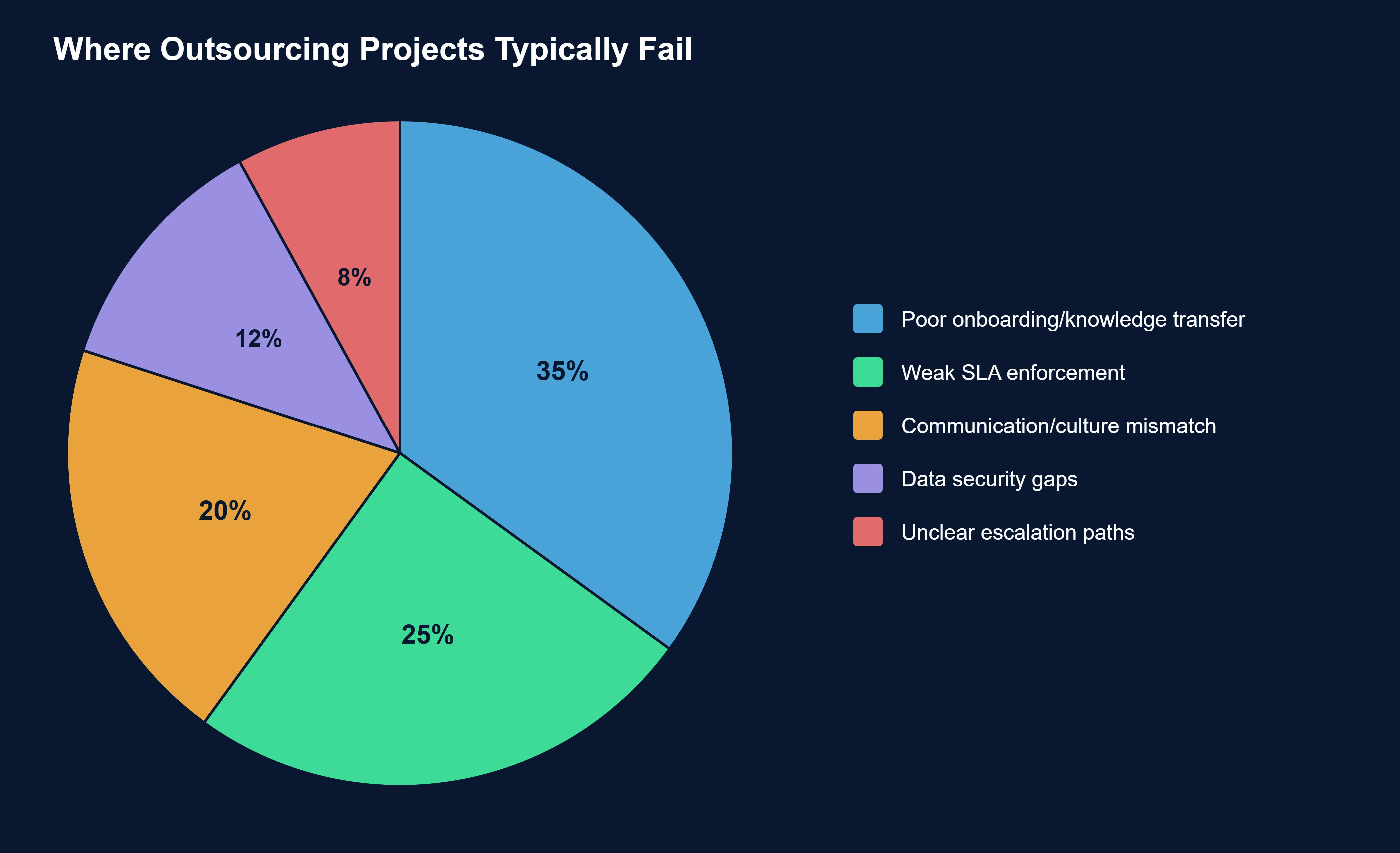
Here's the thing though — most of the risk column isn't inherent to outsourcing itself. It's what happens when governance is weak. A provider with vague reporting, no defined escalation path, and no service-level agreement will underperform regardless of how good its sales deck looked.
How to Choose the Right Procurement Outsourcing Partner
Selecting a partner shouldn't come down to who has the flashiest case studies. A structured evaluation catches problems before they become contract disputes.
1. Map the scope precisely
Decide exactly which categories, processes, and decision rights are moving externally versus staying in-house. Ambiguity here causes most of the disputes that surface later.
2. Check category-specific experience
A provider strong in logistics procurement isn't automatically strong in software or professional services sourcing. Ask for references in the exact category being outsourced, not just general procurement credentials.
3. Demand transparent reporting
Savings claims mean nothing without a clear, agreed methodology for measuring them. Insist on a baseline before the engagement starts, not after.
4. Evaluate technology fit
Does the provider work inside the existing procurement or ERP stack, or does it require a separate system that creates reconciliation headaches?
5. Set governance from day one
Define escalation paths, review cadence, and exit terms in the contract itself — not as an afterthought once something goes wrong.
Procurement Outsourcing Trends Shaping 2026
A few shifts are changing how outsourcing arrangements get structured this year:
- AI-assisted sourcing: Providers increasingly layer AI-driven spend analysis and supplier risk scoring on top of traditional outsourced services, speeding up sourcing cycles.
- Hybrid delivery: Rather than all-or-nothing, more companies split work between an internal core team and an outsourced layer for tail spend or overflow categories.
- Sustainability and compliance scrutiny: Buyers are asking providers to document supplier ESG performance and regulatory compliance as part of the sourcing process, not as a separate audit.
- Risk-adjusted contracts: Supply chain disruptions in recent years have pushed more contracts toward shared-risk and dual-sourcing clauses rather than single-supplier dependency.
None of these trends replace the fundamentals. They just raise the bar for what a competent provider is expected to deliver.
Full Outsourcing vs. Hybrid vs. Keeping It In-House
So which approach actually fits? It depends on team size, category complexity, and how much control leadership is willing to hand over.
Companies without any procurement function tend to get the most value from full outsourcing or a GPO — there's simply no internal capability to protect. Businesses with a lean team but a gap in one category, like SaaS or logistics, usually do better with selective outsourcing rather than handing over everything. And organizations that already run a mature, well-staffed procurement function often find outsourcing makes sense only for discrete projects, like a large RFP or a supplier market analysis, where extra bandwidth is needed temporarily.
Common Mistakes to Avoid
A handful of missteps show up again and again in outsourcing engagements that underdeliver:
- Outsourcing without first cleaning up spend data, so the provider inherits the same visibility gaps the internal team had
- Signing a long-term contract before running a smaller pilot project
- Ignoring cultural fit and communication cadence in favor of the lowest bid
- Failing to define what happens to knowledge and supplier relationships if the contract ends
- Treating the provider as a vendor to manage rather than a partner to collaborate with
Avoiding these isn't complicated, but it does require slowing down during the selection phase instead of rushing to sign the first proposal that looks reasonable.
The Bottom Line
Procurement outsourcing isn't a single decision — it's a spectrum, from handing off one RFP to letting a provider run the entire function. The companies that get the most out of it start with a clear-eyed audit of what's actually broken internally, whether that's cost, capacity, or missing expertise, and then match the model to that specific gap rather than defaulting to the most comprehensive (and expensive) option available.
Before signing anything, run a small pilot, insist on transparent reporting from day one, and check any provider's current pricing and service scope directly on its official site rather than relying on a sales deck. Done right, procurement outsourcing frees internal teams to focus on strategy instead of transactional busywork. Done carelessly, it just relocates the same problems to a third party.
FAQ: Procurement Outsourcing
Topics
Procurement Outsourcing Guide 2026: Models, Costs & How to Choose a Partner

Quick Summary: Procurement outsourcing means handing off some or all sourcing, purchasing, and supplier management work to a third-party specialist, either to cut costs, free up internal staff, or bring in category expertise the business lacks internally. The right approach depends on scale: small teams often benefit from full outsourcing or a group purchasing organization, while larger enterprises tend to outsource selectively — tail spend, one category, or a single project like an RFP. Success hinges less on the provider's size and more on clear governance, defined KPIs, and a realistic transition plan.
Most procurement teams don't outsource because they want to give up control. They do it because the internal team is stretched thin, the category expertise doesn't exist in-house, or leadership wants sourcing costs off the balance sheet as a fixed line item instead of a growing headcount problem. That's the real driver behind procurement outsourcing, and it's why the market for it keeps expanding even as more companies invest in procurement software at the same time.
This guide breaks down what procurement outsourcing actually covers, the models available, what it tends to cost, the risks nobody mentions in the sales deck, and a practical way to evaluate a partner before signing anything.
What Is Procurement Outsourcing?
Procurement outsourcing is the practice of contracting an external provider to handle part or all of the procure-to-pay cycle — supplier sourcing, negotiation, purchase order management, contract administration, spend analysis, or payment processing. It ranges from a single outsourced task, like running an RFP, to a full business process outsourcing (BPO) arrangement where an external team effectively becomes the procurement department.
The scope typically falls into a few buckets:
- Strategic sourcing — market research, supplier identification, negotiation strategy
- Tactical/transactional procurement — purchase orders, invoice matching, catalog management
- Category management — ongoing ownership of a spend category like IT, marketing, or facilities
- Contract and supplier management — lifecycle tracking, compliance, performance reviews
Why Companies Outsource Procurement
The reasons stack up fast once a company starts comparing the fully-loaded cost of an internal procurement hire against a flexible outsourced arrangement.
- Cost control: Outsourcing converts fixed headcount costs into variable, often performance-linked fees, and specialist buyers frequently negotiate better rates than an internal generalist could.
- Speed: An established provider can run a sourcing event or RFP in weeks rather than months because the process, templates, and supplier relationships already exist.
- Access to expertise: Category specialists — say, someone who's negotiated hundreds of SaaS or logistics contracts — bring pattern recognition an in-house generalist team rarely has.
- Scalability: Outsourcing flexes up during a merger, expansion, or seasonal spike without a permanent hiring commitment.
- Focus: Freeing internal staff from transactional purchasing lets them concentrate on supplier strategy and higher-value category work.
None of that means outsourcing is automatically cheaper or better. It's a trade-off, and the next section digs into where that trade-off tends to break down.
Support Procurement Operations with NeoWork
Procurement outsourcing helps companies manage vendor coordination, documentation, data entry, purchase support, and recurring administrative workflows. NeoWork provides remote teammates who can support procurement operations as part of the client’s existing team structure. NeoWork handles recruitment, benefits, training, and ongoing engagement, while teammates integrate into the client’s systems and workflow requirements. Its 91% annualized teammate retention rate and 3.2% candidate selectivity rate reflect a focus on selective hiring and longer-term team stability.
NeoWork's procurement support model offers:
- procurement admin and vendor support
- integration with the client’s tools and processes
- recruitment and ongoing teammate support
Contact NeoWork to add procurement support that keeps daily purchasing workflows moving.
Procurement Outsourcing Models
Not every company needs the same depth of outsourcing. The models generally fall into four tiers, and picking the wrong one is one of the most common reasons these engagements underperform.
Tail spend outsourcing deserves a specific mention here. It's become one of the more common entry points into procurement outsourcing because it targets the long list of small, low-value purchase orders that eat up disproportionate administrative time relative to the dollars involved. Handing that segment to a provider frees internal buyers to focus on the strategic categories that actually move the spend needle.
What Procurement Outsourcing Actually Costs
Pricing varies widely because it depends on scope, category complexity, and region, so treat any number here as directional rather than a quote. Providers generally use one of these structures:
- Percentage of managed spend — common for category or full outsourcing, often tied to savings delivered
- Fixed monthly retainer — predictable cost for ongoing transactional or category support
- Per-project fee — flat rate for a defined deliverable like an RFP or supplier audit
- Gain-share / performance fee — the provider takes a cut of documented savings, aligning incentives but requiring careful savings validation
Rather than fixating on the headline rate, it's worth asking what's included in that fee — implementation, reporting cadence, category coverage — and what triggers an additional charge. Check the specific provider's official pricing page for current numbers before comparing options, since these figures shift with market conditions and aren't standardized across the industry.
Benefits and Risks, Side by Side
Every procurement outsourcing pitch leads with the upside. Fewer mention the friction that shows up six months into the contract.
Here's the thing though — most of the risk column isn't inherent to outsourcing itself. It's what happens when governance is weak. A provider with vague reporting, no defined escalation path, and no service-level agreement will underperform regardless of how good its sales deck looked.
How to Choose the Right Procurement Outsourcing Partner
Selecting a partner shouldn't come down to who has the flashiest case studies. A structured evaluation catches problems before they become contract disputes.
1. Map the scope precisely
Decide exactly which categories, processes, and decision rights are moving externally versus staying in-house. Ambiguity here causes most of the disputes that surface later.
2. Check category-specific experience
A provider strong in logistics procurement isn't automatically strong in software or professional services sourcing. Ask for references in the exact category being outsourced, not just general procurement credentials.
3. Demand transparent reporting
Savings claims mean nothing without a clear, agreed methodology for measuring them. Insist on a baseline before the engagement starts, not after.
4. Evaluate technology fit
Does the provider work inside the existing procurement or ERP stack, or does it require a separate system that creates reconciliation headaches?
5. Set governance from day one
Define escalation paths, review cadence, and exit terms in the contract itself — not as an afterthought once something goes wrong.
Procurement Outsourcing Trends Shaping 2026
A few shifts are changing how outsourcing arrangements get structured this year:
- AI-assisted sourcing: Providers increasingly layer AI-driven spend analysis and supplier risk scoring on top of traditional outsourced services, speeding up sourcing cycles.
- Hybrid delivery: Rather than all-or-nothing, more companies split work between an internal core team and an outsourced layer for tail spend or overflow categories.
- Sustainability and compliance scrutiny: Buyers are asking providers to document supplier ESG performance and regulatory compliance as part of the sourcing process, not as a separate audit.
- Risk-adjusted contracts: Supply chain disruptions in recent years have pushed more contracts toward shared-risk and dual-sourcing clauses rather than single-supplier dependency.
None of these trends replace the fundamentals. They just raise the bar for what a competent provider is expected to deliver.
Full Outsourcing vs. Hybrid vs. Keeping It In-House
So which approach actually fits? It depends on team size, category complexity, and how much control leadership is willing to hand over.
Companies without any procurement function tend to get the most value from full outsourcing or a GPO — there's simply no internal capability to protect. Businesses with a lean team but a gap in one category, like SaaS or logistics, usually do better with selective outsourcing rather than handing over everything. And organizations that already run a mature, well-staffed procurement function often find outsourcing makes sense only for discrete projects, like a large RFP or a supplier market analysis, where extra bandwidth is needed temporarily.
Common Mistakes to Avoid
A handful of missteps show up again and again in outsourcing engagements that underdeliver:
- Outsourcing without first cleaning up spend data, so the provider inherits the same visibility gaps the internal team had
- Signing a long-term contract before running a smaller pilot project
- Ignoring cultural fit and communication cadence in favor of the lowest bid
- Failing to define what happens to knowledge and supplier relationships if the contract ends
- Treating the provider as a vendor to manage rather than a partner to collaborate with
Avoiding these isn't complicated, but it does require slowing down during the selection phase instead of rushing to sign the first proposal that looks reasonable.
The Bottom Line
Procurement outsourcing isn't a single decision — it's a spectrum, from handing off one RFP to letting a provider run the entire function. The companies that get the most out of it start with a clear-eyed audit of what's actually broken internally, whether that's cost, capacity, or missing expertise, and then match the model to that specific gap rather than defaulting to the most comprehensive (and expensive) option available.
Before signing anything, run a small pilot, insist on transparent reporting from day one, and check any provider's current pricing and service scope directly on its official site rather than relying on a sales deck. Done right, procurement outsourcing frees internal teams to focus on strategy instead of transactional busywork. Done carelessly, it just relocates the same problems to a third party.
FAQ: Procurement Outsourcing
Topics
Related Blogs
Related Podcasts


.webp)

.webp)
.webp)



