

.avif)
.avif)

Procurement Specialist Outsourcing Guide (2026)


.svg)

Quick Summary: Procurement specialist outsourcing means hiring an external partner or individual to handle sourcing, supplier management, and purchasing activities instead of building that capability in-house. Pricing typically runs on FTE-based, transaction-based, or fixed-fee models, and research from McKinsey and Aberdeen shows outsourced procurement programs can cut costs anywhere from 4% to 20% depending on category and maturity. The right approach depends on spend volume, category complexity, and how much control a company wants to retain over supplier relationships.
Hiring a full internal procurement team sounds great until the recruiting bill, the training curve, and the software licenses start piling up. That's usually the moment finance and operations leaders start asking whether an outsourced procurement specialist could do the job faster, cheaper, and with less headache.
The honest answer? It depends on what's being outsourced, who's doing it, and how the contract is structured. This guide walks through the models, the real costs, the risks nobody mentions in the sales pitch, and a framework for picking a partner that won't blow up six months in.
What Is Procurement Specialist Outsourcing?
Procurement specialist outsourcing is the practice of appointing a third-party provider — an individual specialist, a boutique consultancy, or a large business process outsourcing (BPO) firm — to manage some or all of an organization's sourcing, purchasing, and supplier management activities. That can mean anything from a single category specialist negotiating raw material contracts to a fully outsourced procurement department running requisition-to-pay for an entire company.
Unlike traditional staffing, this isn't just filling a headcount gap. A good outsourced specialist brings category expertise, supplier networks, and negotiation leverage that most internal teams take years to build. Some companies route this through a group purchasing organization (GPO), pooling spend with other buyers to get volume pricing; others hire dedicated procurement BPO providers for end-to-end management.
What Typically Gets Outsourced
- Strategic sourcing and supplier negotiation for specific categories
- Purchase order processing and requisition-to-pay administration
- Supplier onboarding, vetting, and risk screening
- Contract management and renewal tracking
- Spend analysis and category management reporting
- Indirect procurement (office supplies, travel, IT hardware, facilities)
Why Companies Outsource Procurement
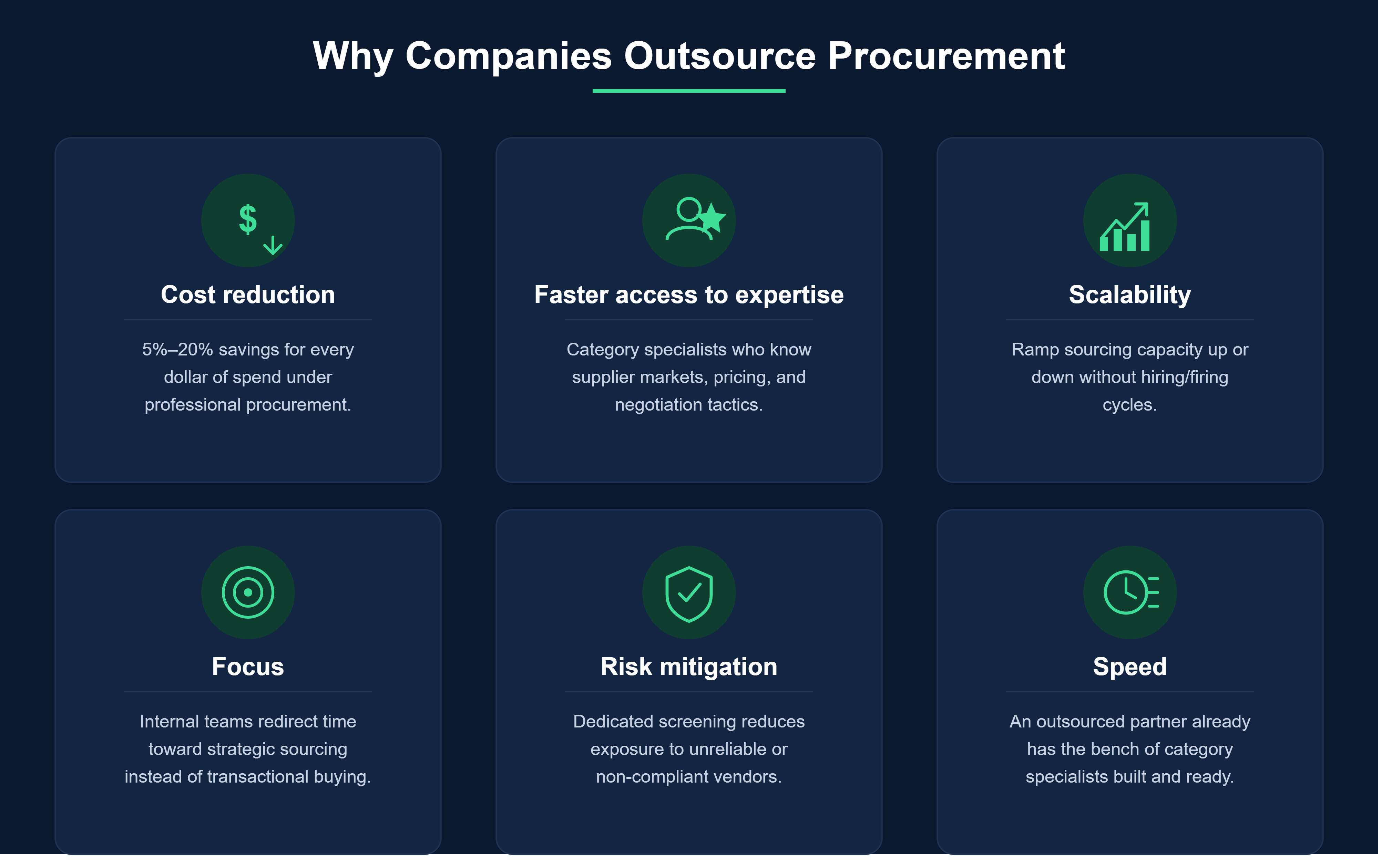
Cost is the headline reason, but it's rarely the only one. Talent scarcity plays a bigger role than most leaders admit — a Gartner-cited figure from Auxis notes that only 14% of procurement leaders felt they had adequate talent to meet future needs as of 2023, and that gap hasn't closed on its own.
Then there's speed. Standing up an internal procurement function with category specialists across dozens of spend areas can take years. An outsourced partner already has that bench built.
- Cost reduction: Research cited by Aberdeen found that for every dollar of spend brought under professional procurement management, companies realized savings between 5% and 20%, with variance driven by company size and category maturity.
- Faster access to expertise: Category specialists who already know supplier markets, pricing benchmarks, and negotiation tactics.
- Scalability: Ramp sourcing capacity up or down without hiring/firing cycles.
- Focus: Internal teams redirect time toward strategic sourcing decisions instead of transactional purchasing.
- Risk mitigation: Dedicated screening reduces exposure to unreliable or non-compliant vendors.
McKinsey's research on indirect procurement outsourcing found that companies typically see total cost reductions of four to six percent in the first couple of years, followed by incremental annual reductions of one to two percent after that. That's a more conservative — and arguably more realistic — number than some vendor marketing suggests, and it's worth anchoring expectations there rather than the higher-end figures GPOs sometimes advertise.

Add Procurement Specialist Support with NeoWork
Procurement specialist outsourcing helps companies add remote support for sourcing workflows, vendor follow-up, purchase documentation, and recurring procurement tasks. NeoWork provides teammates who can support procurement-related operations while working within the client’s existing tools and approval processes. NeoWork handles recruitment, benefits, training, and ongoing engagement, while teammates follow the client’s daily priorities and process requirements. Its 91% annualized teammate retention rate and 3.2% candidate selectivity rate reflect a focus on selective hiring and longer-term team stability.
NeoWork's procurement specialist support model offers:
- procurement specialist support
- integration with the client’s tools and processes
- recruitment and ongoing teammate support
Contact NeoWork to add procurement specialist support that fits your existing operations.
Procurement Outsourcing Models
Not all outsourcing arrangements look the same. Picking the wrong model is one of the most common reasons these engagements underdeliver.
Pricing Models Explained
Outsourced procurement pricing generally follows one of a handful of structures borrowed from the broader BPO industry. Knowing which one fits a given engagement matters as much as picking the provider itself.
- FTE-based pricing: A fixed fee per dedicated outsourced resource, regardless of workload swings. Predictable, but can mean overpaying during slow periods.
- Transaction-based pricing: Cost scales with volume — per purchase order, per contract negotiated, per supplier onboarded. Good fit for variable workloads.
- Fixed-fee / project-based: A set price for a defined scope, common for one-off sourcing projects or category reviews.
- Percentage-of-savings: Provider fee is tied to a share of the cost savings actually delivered — aligns incentives but requires clear savings measurement upfront.
- Managed service / retainer: A recurring fee covering an agreed scope of ongoing procurement activities, often used for full outsourcing arrangements.
Here's the thing though — none of these models is inherently better. A transaction-based model looks cheap on paper for low-volume categories, then turns expensive fast once volume spikes. Fixed retainers work well for predictable, steady-state functions but can mean paying for idle capacity in a slow quarter. It's worth matching the pricing model to the actual demand pattern of the category being outsourced, not just picking whatever the provider defaults to in the proposal.
Risks and What to Manage
Procurement outsourcing isn't risk-free, and most of the horror stories trace back to a handful of predictable failure points.
TUPE-style employment transfer obligations can also come into play in certain jurisdictions when an internal procurement team's functions move to a third party — that's a legal detail worth checking with counsel before signing anything, since rules vary significantly by country and by how the transfer is structured.
How to Choose the Right Procurement Outsourcing Partner
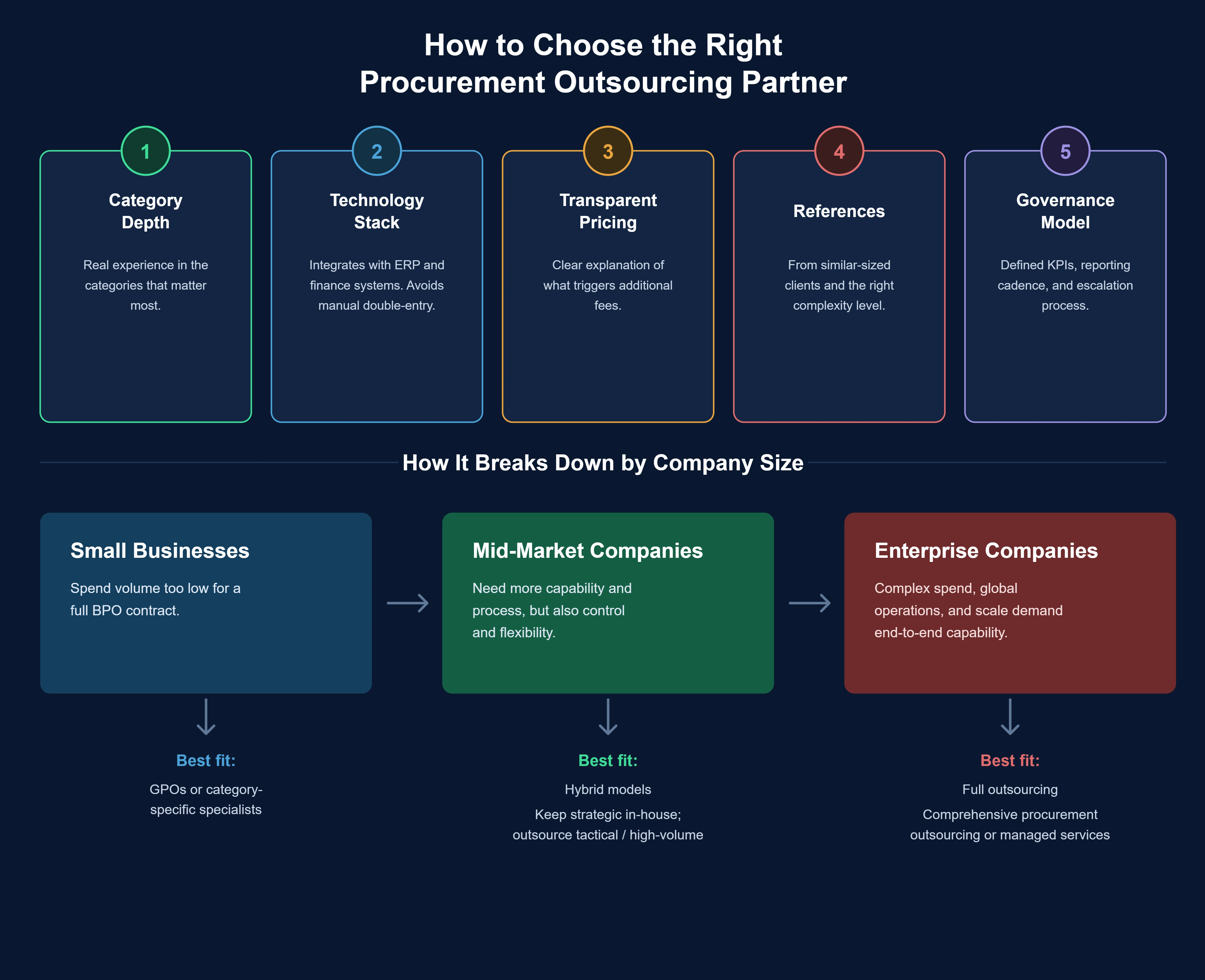
Look past the glossy case studies. A few things actually predict whether an engagement will work.
- Category depth: Does the provider have real, demonstrable experience in the specific spend categories that matter most?
- Technology stack: Do they use procurement software that integrates with existing ERP or finance systems, or will there be manual double-entry everywhere?
- Transparent pricing: Can they explain, in plain terms, exactly what triggers additional fees?
- References from similar-sized clients: A provider built for enterprise accounts may over-engineer a small business engagement, and vice versa.
- Governance model: Regular reporting cadence, defined KPIs, and an escalation path when something goes wrong.
So how does this actually break down by company size? Smaller businesses tend to lean toward GPOs or category-specific specialists because the spend volume doesn't justify a full BPO contract. Mid-market and enterprise companies more often go for full outsourcing or hybrid models, keeping strategic categories in-house while handing off tactical, high-volume purchasing.
Full Outsourcing vs. Category-Specific vs. GPO
It's tempting to default to whichever model a sales rep pitches first. But the right fit really comes down to spend concentration and internal capability.
Final Thoughts
Procurement outsourcing works best when a company is clear about what it wants to hand off, what it still wants to control, and how success will be measured. It is not a shortcut for unclear purchasing processes, but it can help reduce friction in sourcing, supplier follow-up, purchase documentation, and recurring procurement tasks.
The right model depends on spend volume, category complexity, and internal capacity. Some teams need one outsourced specialist, while others may need category-specific support, a GPO, or a broader BPO setup. A good partner should make procurement easier to manage, with clear pricing, steady communication, and processes that fit the company’s existing workflow.
FAQ
Topics
Procurement Specialist Outsourcing Guide (2026)

Quick Summary: Procurement specialist outsourcing means hiring an external partner or individual to handle sourcing, supplier management, and purchasing activities instead of building that capability in-house. Pricing typically runs on FTE-based, transaction-based, or fixed-fee models, and research from McKinsey and Aberdeen shows outsourced procurement programs can cut costs anywhere from 4% to 20% depending on category and maturity. The right approach depends on spend volume, category complexity, and how much control a company wants to retain over supplier relationships.
Hiring a full internal procurement team sounds great until the recruiting bill, the training curve, and the software licenses start piling up. That's usually the moment finance and operations leaders start asking whether an outsourced procurement specialist could do the job faster, cheaper, and with less headache.
The honest answer? It depends on what's being outsourced, who's doing it, and how the contract is structured. This guide walks through the models, the real costs, the risks nobody mentions in the sales pitch, and a framework for picking a partner that won't blow up six months in.
What Is Procurement Specialist Outsourcing?
Procurement specialist outsourcing is the practice of appointing a third-party provider — an individual specialist, a boutique consultancy, or a large business process outsourcing (BPO) firm — to manage some or all of an organization's sourcing, purchasing, and supplier management activities. That can mean anything from a single category specialist negotiating raw material contracts to a fully outsourced procurement department running requisition-to-pay for an entire company.
Unlike traditional staffing, this isn't just filling a headcount gap. A good outsourced specialist brings category expertise, supplier networks, and negotiation leverage that most internal teams take years to build. Some companies route this through a group purchasing organization (GPO), pooling spend with other buyers to get volume pricing; others hire dedicated procurement BPO providers for end-to-end management.
What Typically Gets Outsourced
- Strategic sourcing and supplier negotiation for specific categories
- Purchase order processing and requisition-to-pay administration
- Supplier onboarding, vetting, and risk screening
- Contract management and renewal tracking
- Spend analysis and category management reporting
- Indirect procurement (office supplies, travel, IT hardware, facilities)
Why Companies Outsource Procurement
Cost is the headline reason, but it's rarely the only one. Talent scarcity plays a bigger role than most leaders admit — a Gartner-cited figure from Auxis notes that only 14% of procurement leaders felt they had adequate talent to meet future needs as of 2023, and that gap hasn't closed on its own.
Then there's speed. Standing up an internal procurement function with category specialists across dozens of spend areas can take years. An outsourced partner already has that bench built.
- Cost reduction: Research cited by Aberdeen found that for every dollar of spend brought under professional procurement management, companies realized savings between 5% and 20%, with variance driven by company size and category maturity.
- Faster access to expertise: Category specialists who already know supplier markets, pricing benchmarks, and negotiation tactics.
- Scalability: Ramp sourcing capacity up or down without hiring/firing cycles.
- Focus: Internal teams redirect time toward strategic sourcing decisions instead of transactional purchasing.
- Risk mitigation: Dedicated screening reduces exposure to unreliable or non-compliant vendors.
McKinsey's research on indirect procurement outsourcing found that companies typically see total cost reductions of four to six percent in the first couple of years, followed by incremental annual reductions of one to two percent after that. That's a more conservative — and arguably more realistic — number than some vendor marketing suggests, and it's worth anchoring expectations there rather than the higher-end figures GPOs sometimes advertise.
Add Procurement Specialist Support with NeoWork
Procurement specialist outsourcing helps companies add remote support for sourcing workflows, vendor follow-up, purchase documentation, and recurring procurement tasks. NeoWork provides teammates who can support procurement-related operations while working within the client’s existing tools and approval processes. NeoWork handles recruitment, benefits, training, and ongoing engagement, while teammates follow the client’s daily priorities and process requirements. Its 91% annualized teammate retention rate and 3.2% candidate selectivity rate reflect a focus on selective hiring and longer-term team stability.
NeoWork's procurement specialist support model offers:
- procurement specialist support
- integration with the client’s tools and processes
- recruitment and ongoing teammate support
Contact NeoWork to add procurement specialist support that fits your existing operations.
Procurement Outsourcing Models
Not all outsourcing arrangements look the same. Picking the wrong model is one of the most common reasons these engagements underdeliver.
Pricing Models Explained
Outsourced procurement pricing generally follows one of a handful of structures borrowed from the broader BPO industry. Knowing which one fits a given engagement matters as much as picking the provider itself.
- FTE-based pricing: A fixed fee per dedicated outsourced resource, regardless of workload swings. Predictable, but can mean overpaying during slow periods.
- Transaction-based pricing: Cost scales with volume — per purchase order, per contract negotiated, per supplier onboarded. Good fit for variable workloads.
- Fixed-fee / project-based: A set price for a defined scope, common for one-off sourcing projects or category reviews.
- Percentage-of-savings: Provider fee is tied to a share of the cost savings actually delivered — aligns incentives but requires clear savings measurement upfront.
- Managed service / retainer: A recurring fee covering an agreed scope of ongoing procurement activities, often used for full outsourcing arrangements.
Here's the thing though — none of these models is inherently better. A transaction-based model looks cheap on paper for low-volume categories, then turns expensive fast once volume spikes. Fixed retainers work well for predictable, steady-state functions but can mean paying for idle capacity in a slow quarter. It's worth matching the pricing model to the actual demand pattern of the category being outsourced, not just picking whatever the provider defaults to in the proposal.
Risks and What to Manage
Procurement outsourcing isn't risk-free, and most of the horror stories trace back to a handful of predictable failure points.
TUPE-style employment transfer obligations can also come into play in certain jurisdictions when an internal procurement team's functions move to a third party — that's a legal detail worth checking with counsel before signing anything, since rules vary significantly by country and by how the transfer is structured.
How to Choose the Right Procurement Outsourcing Partner
Look past the glossy case studies. A few things actually predict whether an engagement will work.
- Category depth: Does the provider have real, demonstrable experience in the specific spend categories that matter most?
- Technology stack: Do they use procurement software that integrates with existing ERP or finance systems, or will there be manual double-entry everywhere?
- Transparent pricing: Can they explain, in plain terms, exactly what triggers additional fees?
- References from similar-sized clients: A provider built for enterprise accounts may over-engineer a small business engagement, and vice versa.
- Governance model: Regular reporting cadence, defined KPIs, and an escalation path when something goes wrong.
So how does this actually break down by company size? Smaller businesses tend to lean toward GPOs or category-specific specialists because the spend volume doesn't justify a full BPO contract. Mid-market and enterprise companies more often go for full outsourcing or hybrid models, keeping strategic categories in-house while handing off tactical, high-volume purchasing.
Full Outsourcing vs. Category-Specific vs. GPO
It's tempting to default to whichever model a sales rep pitches first. But the right fit really comes down to spend concentration and internal capability.
Final Thoughts
Procurement outsourcing works best when a company is clear about what it wants to hand off, what it still wants to control, and how success will be measured. It is not a shortcut for unclear purchasing processes, but it can help reduce friction in sourcing, supplier follow-up, purchase documentation, and recurring procurement tasks.
The right model depends on spend volume, category complexity, and internal capacity. Some teams need one outsourced specialist, while others may need category-specific support, a GPO, or a broader BPO setup. A good partner should make procurement easier to manage, with clear pricing, steady communication, and processes that fit the company’s existing workflow.
FAQ
Topics
Related Blogs
Related Podcasts


.webp)

.webp)
.webp)



