

.avif)
.avif)

Remote Team Augmentation Guide 2026: Scale Fast & Smart


.svg)

Quick Summary: Remote team augmentation lets companies extend their in-house teams with external professionals who integrate directly into existing workflows. This flexible staffing model helps organizations access specialized skills, scale capacity quickly, and reduce hiring costs without the long-term commitment ofa full-time employees. The guide covers models, hiring processes, compliance, and best practices for 2026.
Building software in 2026 means racing against tight deadlines, evolving requirements, and talent shortages that can paralyze even well-funded teams. Traditional hiring takes months. Full project outsourcing means losing control. Remote team augmentation sits right in the middle—giving you the speed of external talent with the control of an in-house team.
But here's the thing: not all augmentation models work the same way, and choosing the wrong approach can cost you more than just money. It can derail sprints, frustrate your core team, and create communication black holes.
This guide walks through everything from picking the right augmentation model to managing compliance across borders, with real cost comparisons and practical implementation steps that work in 2026.
What is Remote Team Augmentation?
Remote team augmentation is a staffing strategy where external professionals work alongside your existing team on a temporary or project basis. Unlike traditional outsourcing—where you hand off entire projects to a third party—augmented staff integrate into your workflows, use your tools, and report directly to your managers.
Think of it as renting expertise rather than buying headcount.
The augmented developers, designers, or specialists become functional members of your team. They attend your standups. They use your Slack channels. They push code to your repositories. The only difference? They're employed by a staffing partner, not by you.
This model gained serious traction as remote work normalized. According to SHRM data from over 20,000 U.S. workers, 15.1% of U.S. jobs are at least 50% automated, while 7.8% rely heavily on generative AI. Teams need flexibility to adapt quickly—augmentation delivers that without long hiring cycles.
Remote Team Augmentation vs. Traditional Outsourcing
The key difference lies in control and integration.
Traditional outsourcing means you define requirements, hand them to a vendor, and wait for deliverables. You don't manage the day-to-day work. The vendor controls processes, timelines, and team composition.
With augmentation, you stay in the driver's seat. Your project manager assigns tasks. Your tech lead reviews code. Your design director approves mockups. Augmented staff extend your capacity without changing your management structure.
Why Remote Team Augmentation Matters in 2026
The talent market hasn't gotten easier. Specialized skills—cloud architects, machine learning engineers, DevOps experts—remain scarce and expensive in major tech hubs. At the same time, project timelines keep compressing.
Remote augmentation solves three critical problems at once.
Access to Global Talent Pools
Geographic boundaries used to limit hiring. Not anymore. Remote augmentation opens access to developers in Eastern Europe, Latin America, Southeast Asia, and other regions with strong technical education and lower living costs.
Companies can now hire a senior React developer from Poland or a data engineer from Argentina without opening a legal entity or navigating complex employment laws. The staffing partner handles compliance while you get the skills you need.
Cost Efficiency Without Sacrificing Quality
Salary expectations vary dramatically by region. A senior software developer in San Francisco commands $180,000+ annually. The same skill level in Colombia or Ukraine? Often $50,000-$70,000.
Typical hourly rates through augmentation agencies break down like this:
These numbers represent agency rates, which include overhead, benefits, and margin. Even so, nearshore and offshore options often deliver 50-70% cost savings compared to hiring onshore, which aligns with patterns observed across multiple service providers.
Speed and Flexibility
Traditional hiring drags on for weeks or months: write job descriptions, post openings, screen hundreds of resumes, conduct multiple interview rounds, negotiate offers, wait through notice periods.
Augmentation condenses that timeline. Many staffing partners maintain pre-vetted talent pools and can place developers within 1-2 weeks. Need to scale up for a sprint? Add two developers. Project wrapping up? Scale back down without layoffs or severance.
This flexibility matters more as AI and automation reshape workflows. Teams need to adapt fast—adding specialists for short bursts rather than committing to permanent headcount.

Expand Remote Teams with NeoWork
Remote team augmentation helps companies add capacity across departments without hiring every role internally. NeoWork provides remote teammates for support, operations, technical, AI, and creative functions, depending on business needs. NeoWork handles recruitment, benefits, training, and ongoing engagement, while teammates work within the client’s systems, tools, and daily workflows. Its 91% annualized teammate retention rate and 3.2% candidate selectivity rate reflect a focus on selective hiring and longer-term team stability.
NeoWork's remote team augmentation model offers:
- remote teammates for recurring business functions
- integration with the client’s tools and processes
- recruitment and ongoing teammate support
Contact NeoWork to add remote team capacity that fits your existing operations.
Types of Remote Team Augmentation Models
Not all augmentation arrangements look the same. The model you choose affects cost structure, control level, and how smoothly external talent integrates.
Dedicated Remote Talent (Retainer Model)
You hire one or more remote professionals who work exclusively for you, typically on a monthly retainer. These aren't shared resources juggling multiple clients—they're dedicated to your projects.
This model works best for ongoing roles where you need consistent availability: a backend developer maintaining your API, a DevOps engineer managing infrastructure, a UI designer iterating on your product.
Pros:
- High integration—dedicated team members learn your codebase and culture deeply
- Predictable monthly cost
- Strong sense of ownership and accountability
Cons:
- Less flexibility—you pay the retainer whether you have 40 hours of work or 10
- Medium ramp-down friction—typically requires 30-day notice
Time & Material (T&M) Model
You pay for actual hours worked, usually billed weekly or monthly. This model offers maximum flexibility—scale hours up and down as workload fluctuates.
T&M makes sense for variable workloads or exploratory projects where scope isn't fully defined. It's also common during the early stages of augmentation, before committing to dedicated retainers.
Pros:
- High flexibility—adjust hours week to week
- Only pay for time actually used
- Easy to test a developer before committing long-term
Cons:
- Variable monthly costs—harder to budget
- Medium control—tracking hours adds administrative overhead
- Shared resources may split attention across clients
Fixed-Price or Scope-Bound Augmentation
Less common for pure augmentation, but some providers offer hybrid models where you agree on a specific deliverable or project phase with a fixed price and timeline.
This works when requirements are well-defined and stable—building a defined feature, migrating a legacy system, or delivering a prototype.
Pros:
- Predictable total cost
- Clear deliverables and deadlines
- Lower day-to-day management burden
Cons:
- Low flexibility—scope changes trigger renegotiation or change orders
- Medium control—vendor often manages task prioritization
- Risk of misaligned expectations if requirements weren't clear upfront

Onshore, Nearshore, and Offshore: Geography Matters
Where your augmented team sits affects more than just cost. Time zones, cultural alignment, and communication styles all shift based on geography.
Onshore Augmentation
Hiring remote professionals within your own country—U.S. companies hiring U.S.-based developers, for example.
Advantages:
- Same language, culture, and business norms
- Full time-zone overlap for real-time collaboration
- Simplest legal and compliance setup
- Ability to meet in person if needed
Disadvantages:
- Highest cost—often comparable to full-time salaries
- Same talent shortage issues your internal hiring faces
Onshore augmentation makes sense when budget isn't the primary constraint and seamless communication matters more than cost savings.
Nearshore Augmentation
Hiring from neighboring countries or regions in similar time zones. For U.S. companies, that typically means Latin America—Mexico, Colombia, Argentina, Brazil.
Advantages:
- Moderate cost savings (30-50% lower than onshore)
- Significant time-zone overlap (0-3 hours difference)
- Growing English proficiency in major tech hubs
- Cultural similarities make collaboration smoother
Disadvantages:
- Language barriers can still occur, though less common
- Mid-range rates—cheaper than onshore but pricier than offshore
Nearshore hits a sweet spot for many U.S. teams: enough cost savings to matter, enough overlap to collaborate in real time.
Offshore Augmentation
Hiring from distant regions—Eastern Europe (Poland, Ukraine, Romania), Asia (India, Philippines, Vietnam), or Africa (Egypt, South Africa).
Advantages:
- Maximum cost savings (50-70% lower than onshore)
- Access to large, mature talent pools with strong technical education
- Established outsourcing ecosystems with experienced agencies
Disadvantages:
- Significant time-zone differences (6-12 hours)
- Cultural and communication style differences require adaptation
- Potential language barriers depending on region
Offshore works well for roles that don't require constant synchronous communication—backend development, QA automation, infrastructure work. Teams often adopt async-first workflows to accommodate the time gap.
The Remote Team Augmentation Process: Step-by-Step
How do you actually go from "we need help" to having productive augmented developers pushing code? Here's the practical workflow.
Step 1: Define Your Needs Clearly
Vague requests lead to bad matches. Before reaching out to staffing partners, document:
- Required skills: specific languages, frameworks, tools (not just "JavaScript developer" but "React + TypeScript + Node.js + AWS experience")
- Experience level: junior, mid, senior, or specialized roles like architect or tech lead
- Duration and hours: full-time equivalent for 6 months, part-time for 3 months, etc.
- Integration requirements: will they attend daily standups? what tools must they use? who will they report to?
The more specific you are, the faster providers can surface relevant candidates.
Step 2: Choose a Staffing Partner
Research augmentation agencies or platforms. Look for:
- Proven track record in your tech stack
- Transparent vetting process (how do they assess candidates?)
- Clear contract terms—billing cycles, notice periods, replacement policies
- Geographic focus that matches your needs (nearshore, offshore, etc.)
Ask for references and check community discussions to gauge reputation. A good partner acts as a true extension of your HR and recruiting function.
Step 3: Screen and Interview Candidates
Most staffing partners pre-vet candidates, but you should still interview finalists. Treat this like hiring an employee:
- Technical screen (coding challenge, system design, or code review depending on level)
- Behavioral interview (communication style, problem-solving approach, team fit)
- Reference check if possible
The staffing partner handles logistics, but you make the final hire decision.
Step 4: Onboard Like a Real Team Member
This step separates successful augmentation from failed experiments. Treat augmented staff like new hires:
- Grant access to repositories, project management tools, Slack/Teams, documentation
- Assign a buddy or mentor from your core team
- Schedule a kickoff meeting to explain context, goals, and expectations
- Share coding standards, PR review processes, and deployment workflows
Remote workers—especially augmented staff—need extra clarity because they can't tap a colleague on the shoulder when confused. Over-communicate early.
Step 5: Manage Actively, Communicate Proactively
Don't assume augmented developers will figure things out on their own. Active management means:
- Daily standups or async check-ins (depending on time zones)
- Clear task assignments with acceptance criteria
- Regular 1-on-1s to address blockers and gather feedback
- Public recognition and inclusion in team celebrations
Community discussions frequently highlight that augmented teams perform best when they feel like genuine members, not contractors kept at arm's length.
Step 6: Measure Performance and Iterate
Track the same metrics you'd track for internal developers: velocity, code quality, adherence to deadlines, collaboration effectiveness. If performance lags, diagnose quickly—is it a skill mismatch? unclear requirements? communication breakdown?
Good staffing partners offer replacement guarantees. If a developer isn't working out after a reasonable trial, swap them rather than limping along.
Legal and Compliance Considerations
Hiring across borders introduces legal complexity. Getting this wrong risks penalties, tax liabilities, or employment misclassification.
Employment Classification: Contractor vs. Employee
Augmented staff are typically contractors or employees of the staffing agency, not your company. That distinction matters legally.
If you exert too much control—setting work hours, providing equipment, dictating where they work—tax authorities may reclassify them as employees. The U.S. Department of Labor issued guidance clarifying that employers must track compensable hours for remote workers, underscoring the importance of clear contractor relationships.
Work with your staffing partner to ensure contracts clearly define the relationship and avoid crossing into employer territory.
Wage and Hour Compliance
For U.S.-based augmented staff, the Fair Labor Standards Act applies. Nonexempt workers must receive overtime pay at not less than 1.5 times their regular rate after 40 hours of work in a workweek, per Department of Labor regulations.
International contractors fall under their local labor laws. Reputable staffing partners handle compliance in their jurisdiction, but confirm this during vetting.
Intellectual Property Ownership
Contracts must clearly assign IP ownership to your company. Standard language should specify that all work product, code, designs, and inventions created during the engagement belong to you.
Without explicit assignment clauses, IP ownership can become murky—especially across international borders with varying default rules.
Data Security and Privacy
Remote developers will access your systems, code repositories, and potentially customer data. That creates risk.
Mitigate with:
- Non-disclosure agreements (NDAs) signed before onboarding
- Role-based access control—grant only the permissions needed
- Data processing agreements if handling EU customer data (GDPR) or California residents (CCPA)
- Security training and clear policies around data handling
If you operate in a regulated industry—healthcare, finance, government—ensure your staffing partner can meet compliance requirements (HIPAA, SOC 2, etc.).
Best Practices for Managing Remote Augmented Teams
Process and tools make or break remote augmentation. These practices consistently emerge as difference-makers.
Treat Augmented Staff Like Core Team Members
The fastest way to tank an augmentation engagement? Make external developers feel like second-class citizens. Exclude them from meetings. Leave them out of Slack channels. Assign only grunt work.
Top-performing teams do the opposite. They include augmented developers in planning sessions, celebrate their wins publicly, and assign meaningful work that leverages their expertise.
Optimize for Async Communication Across Time Zones
When your offshore team is 8-10 hours ahead or behind, synchronous meetings become painful. Instead, build async-first workflows:
- Detailed task descriptions with context, acceptance criteria, and examples
- Recorded video updates instead of live status meetings
- Written decision logs so everyone sees the rationale behind choices
- Overlap windows for critical synchronous touchpoints (1-2 hours daily)
Community discussions highlight that 70% of employees say they focus better when working remotely, and 50% find it easier to avoid distractions—async communication amplifies those benefits.
Use the Right Tools
Collaboration tools bridge the distance gap. Essential stack:
- Project management: Jira, Linear, Asana for task tracking and visibility
- Communication: Slack or Microsoft Teams for chat, Zoom for video
- Code collaboration: GitHub or GitLab with clear PR templates and review processes
- Documentation: Notion, Confluence, or a wiki to centralize knowledge
- Time tracking (if T&M): Toggl, Harvest, or Clockify for transparent billing
Pick tools your core team already uses so augmented staff aren't learning new platforms on top of your codebase.
Establish Clear Performance Metrics
How do you know if augmentation is working? Define success metrics upfront:
- Sprint velocity (story points completed per sprint)
- Code quality (test coverage, bug rates, PR approval times)
- Collaboration quality (responsiveness, communication clarity)
- Delivery consistency (meeting deadlines and commitments)
Review these regularly with both the augmented developer and your staffing partner. Address gaps early before they compound.
Invest in Onboarding and Documentation
Remote developers can't shadow a teammate or overhear conversations. That makes documentation critical.
Maintain updated guides for:
- Local development environment setup
- Architecture overview and key design decisions
- Coding standards and style guides
- Deployment and release processes
- Common troubleshooting scenarios
The upfront investment pays off when new augmented developers become productive in days instead of weeks.
Common Challenges and How to Solve Them
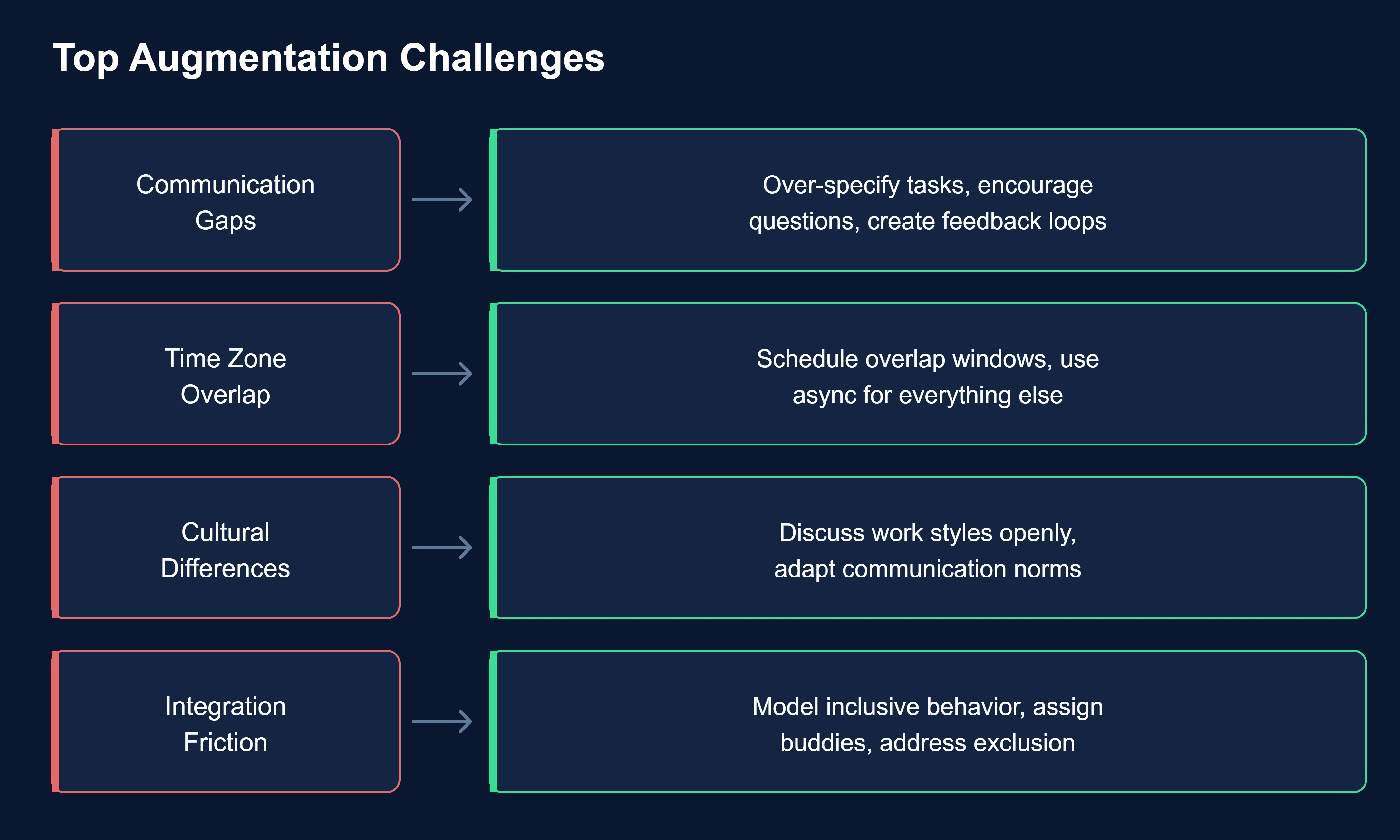
Remote augmentation isn't automatic. Expect these challenges and prepare solutions in advance.
Challenge: Communication Gaps and Misunderstandings
Remote work amplifies miscommunication. A vague requirement becomes a week of wasted work when there's no quick hallway conversation to clarify.
- Solution: Over-specify tasks, encourage questions, and create feedback loops. Use examples and mockups liberally. Schedule short sync calls when text isn't cutting it.
Challenge: Time Zone Overlap Limitations
Offshore teams may have zero overlap with your core hours, making real-time collaboration tough.
- Solution: Designate overlap windows (even if just 1-2 hours) for critical discussions. Use async updates for everything else. Rotate meeting times occasionally so one side isn't always compromising.
Challenge: Cultural and Work Style Differences
Work norms vary. Some cultures prefer explicit instructions; others expect autonomy. Some avoid saying "no" directly; others are blunt.
- Solution: Discuss work styles openly during onboarding. Ask how the developer prefers feedback. Explain your team's norms around meetings, deadlines, and communication. Adapt where reasonable.
Challenge: Integration With Existing Team Dynamics
Core team members may resist outsiders or hoard information, consciously or not.
- Solution: Leadership must model inclusive behavior. Publicly credit augmented developers' work. Assign a core team "buddy" to each augmented developer. Address exclusionary behavior quickly.
Challenge: Quality Control and Consistency
Augmented developers may not know your quality standards or shortcuts your team takes for granted.
- Solution: Codify standards in documentation and enforce them in code review. Use linters, formatters, and automated tests to catch issues early. Provide constructive feedback on PRs with examples of preferred approaches.
Evaluating Staffing Partners and Platforms
Your staffing partner makes or breaks the experience. Choose poorly and you'll waste time on mismatched candidates. Choose well and they become a trusted talent pipeline.
What to Look for in a Staffing Partner
- Specialized expertise: Does the partner focus on your tech stack and industry? A generalist agency may struggle to vet niche skills.
- Transparent vetting process: How do they assess candidates? Look for technical screenings, coding tests, reference checks, and English proficiency evaluations (if relevant).
- Talent pool size and quality: Do they maintain a bench of pre-vetted developers, or do they start recruiting from scratch when you request someone?
- Replacement guarantees: What happens if a developer doesn't work out? Most reputable partners offer a trial period and free replacement if performance doesn't meet expectations.
- Contract flexibility: Are you locked into long terms, or can you scale up and down with reasonable notice?
- Client references: Ask for 2-3 references from companies similar to yours. Ask specific questions: How quickly were roles filled? What was the quality of candidates? How did the partner handle issues?
Red Flags to Avoid
- Vague or non-existent vetting processes
- Unwillingness to let you interview candidates before hiring
- No replacement policy or unreasonable trial periods
- Opaque pricing or hidden fees
- Pushy sales tactics or pressure to commit long-term immediately
The Future of Remote Team Augmentation
Remote augmentation isn't a pandemic trend—it's a permanent shift in how companies staff projects. Several forces will accelerate adoption through 2026 and beyond.
AI and Automation Reshape Talent Needs
According to SHRM data, 15.1% of U.S. jobs are at least 50% automated, while 7.8% rely heavily on generative AI. That trend creates two opposing pressures: demand for specialized AI/ML talent spikes, while demand for routine coding tasks shrinks.
Augmentation lets companies access AI specialists for short engagements without committing to permanent hires in a rapidly evolving field.
Distributed-First Becomes the Default
More companies are abandoning the "remote-friendly" label for "remote-first" or "fully distributed" models. When your core team is already distributed, adding augmented developers becomes seamless—they're just more teammates on Slack.
Compliance and Platforms Mature
Cross-border employment complexity used to be a blocker. Now platforms handle payroll, benefits, tax withholding, and compliance automatically across 100+ countries. That removes friction and makes international augmentation accessible even to small teams.
Specialized Talent Marketplaces Emerge
Beyond traditional staffing agencies, new platforms match companies with developers based on deep skill assessments, work style compatibility, and past project performance. AI-driven matching will improve quality and reduce time-to-hire further.
Conclusion
Remote team augmentation has become one of the most effective strategies for scaling technical capacity in 2026. It delivers the flexibility to ramp up and down as projects evolve, access to global talent pools that exceed local hiring options, and cost efficiencies that traditional hiring can't match.
But success requires more than just signing a contract with a staffing partner. The companies that get real value from augmentation treat external developers like core team members, invest in onboarding and documentation, establish clear communication rhythms, and actively manage performance.
Start by defining your needs clearly—specific skills, experience level, duration. Choose a staffing partner with proven expertise in your domain and transparent vetting processes. Interview candidates as rigorously as you would internal hires. Then onboard augmented developers with the same care you'd give any new teammate.
The result? Teams that scale faster, ship products sooner, and adapt to changing requirements without the overhead and risk of permanent headcount.
Ready to scale your team with remote augmentation? Start by auditing your current skill gaps and upcoming project needs, then research 3-5 staffing partners that specialize in your tech stack. Request case studies and client references. The right partner is out there—find them, and you'll unlock a talent pipeline that grows with your ambitions.
Frequently Asked Questions
Topics
Remote Team Augmentation Guide 2026: Scale Fast & Smart

Quick Summary: Remote team augmentation lets companies extend their in-house teams with external professionals who integrate directly into existing workflows. This flexible staffing model helps organizations access specialized skills, scale capacity quickly, and reduce hiring costs without the long-term commitment ofa full-time employees. The guide covers models, hiring processes, compliance, and best practices for 2026.
Building software in 2026 means racing against tight deadlines, evolving requirements, and talent shortages that can paralyze even well-funded teams. Traditional hiring takes months. Full project outsourcing means losing control. Remote team augmentation sits right in the middle—giving you the speed of external talent with the control of an in-house team.
But here's the thing: not all augmentation models work the same way, and choosing the wrong approach can cost you more than just money. It can derail sprints, frustrate your core team, and create communication black holes.
This guide walks through everything from picking the right augmentation model to managing compliance across borders, with real cost comparisons and practical implementation steps that work in 2026.
What is Remote Team Augmentation?
Remote team augmentation is a staffing strategy where external professionals work alongside your existing team on a temporary or project basis. Unlike traditional outsourcing—where you hand off entire projects to a third party—augmented staff integrate into your workflows, use your tools, and report directly to your managers.
Think of it as renting expertise rather than buying headcount.
The augmented developers, designers, or specialists become functional members of your team. They attend your standups. They use your Slack channels. They push code to your repositories. The only difference? They're employed by a staffing partner, not by you.
This model gained serious traction as remote work normalized. According to SHRM data from over 20,000 U.S. workers, 15.1% of U.S. jobs are at least 50% automated, while 7.8% rely heavily on generative AI. Teams need flexibility to adapt quickly—augmentation delivers that without long hiring cycles.
Remote Team Augmentation vs. Traditional Outsourcing
The key difference lies in control and integration.
Traditional outsourcing means you define requirements, hand them to a vendor, and wait for deliverables. You don't manage the day-to-day work. The vendor controls processes, timelines, and team composition.
With augmentation, you stay in the driver's seat. Your project manager assigns tasks. Your tech lead reviews code. Your design director approves mockups. Augmented staff extend your capacity without changing your management structure.
Why Remote Team Augmentation Matters in 2026
The talent market hasn't gotten easier. Specialized skills—cloud architects, machine learning engineers, DevOps experts—remain scarce and expensive in major tech hubs. At the same time, project timelines keep compressing.
Remote augmentation solves three critical problems at once.
Access to Global Talent Pools
Geographic boundaries used to limit hiring. Not anymore. Remote augmentation opens access to developers in Eastern Europe, Latin America, Southeast Asia, and other regions with strong technical education and lower living costs.
Companies can now hire a senior React developer from Poland or a data engineer from Argentina without opening a legal entity or navigating complex employment laws. The staffing partner handles compliance while you get the skills you need.
Cost Efficiency Without Sacrificing Quality
Salary expectations vary dramatically by region. A senior software developer in San Francisco commands $180,000+ annually. The same skill level in Colombia or Ukraine? Often $50,000-$70,000.
Typical hourly rates through augmentation agencies break down like this:
These numbers represent agency rates, which include overhead, benefits, and margin. Even so, nearshore and offshore options often deliver 50-70% cost savings compared to hiring onshore, which aligns with patterns observed across multiple service providers.
Speed and Flexibility
Traditional hiring drags on for weeks or months: write job descriptions, post openings, screen hundreds of resumes, conduct multiple interview rounds, negotiate offers, wait through notice periods.
Augmentation condenses that timeline. Many staffing partners maintain pre-vetted talent pools and can place developers within 1-2 weeks. Need to scale up for a sprint? Add two developers. Project wrapping up? Scale back down without layoffs or severance.
This flexibility matters more as AI and automation reshape workflows. Teams need to adapt fast—adding specialists for short bursts rather than committing to permanent headcount.
Expand Remote Teams with NeoWork
Remote team augmentation helps companies add capacity across departments without hiring every role internally. NeoWork provides remote teammates for support, operations, technical, AI, and creative functions, depending on business needs. NeoWork handles recruitment, benefits, training, and ongoing engagement, while teammates work within the client’s systems, tools, and daily workflows. Its 91% annualized teammate retention rate and 3.2% candidate selectivity rate reflect a focus on selective hiring and longer-term team stability.
NeoWork's remote team augmentation model offers:
- remote teammates for recurring business functions
- integration with the client’s tools and processes
- recruitment and ongoing teammate support
Contact NeoWork to add remote team capacity that fits your existing operations.
Types of Remote Team Augmentation Models
Not all augmentation arrangements look the same. The model you choose affects cost structure, control level, and how smoothly external talent integrates.
Dedicated Remote Talent (Retainer Model)
You hire one or more remote professionals who work exclusively for you, typically on a monthly retainer. These aren't shared resources juggling multiple clients—they're dedicated to your projects.
This model works best for ongoing roles where you need consistent availability: a backend developer maintaining your API, a DevOps engineer managing infrastructure, a UI designer iterating on your product.
Pros:
- High integration—dedicated team members learn your codebase and culture deeply
- Predictable monthly cost
- Strong sense of ownership and accountability
Cons:
- Less flexibility—you pay the retainer whether you have 40 hours of work or 10
- Medium ramp-down friction—typically requires 30-day notice
Time & Material (T&M) Model
You pay for actual hours worked, usually billed weekly or monthly. This model offers maximum flexibility—scale hours up and down as workload fluctuates.
T&M makes sense for variable workloads or exploratory projects where scope isn't fully defined. It's also common during the early stages of augmentation, before committing to dedicated retainers.
Pros:
- High flexibility—adjust hours week to week
- Only pay for time actually used
- Easy to test a developer before committing long-term
Cons:
- Variable monthly costs—harder to budget
- Medium control—tracking hours adds administrative overhead
- Shared resources may split attention across clients
Fixed-Price or Scope-Bound Augmentation
Less common for pure augmentation, but some providers offer hybrid models where you agree on a specific deliverable or project phase with a fixed price and timeline.
This works when requirements are well-defined and stable—building a defined feature, migrating a legacy system, or delivering a prototype.
Pros:
- Predictable total cost
- Clear deliverables and deadlines
- Lower day-to-day management burden
Cons:
- Low flexibility—scope changes trigger renegotiation or change orders
- Medium control—vendor often manages task prioritization
- Risk of misaligned expectations if requirements weren't clear upfront
Onshore, Nearshore, and Offshore: Geography Matters
Where your augmented team sits affects more than just cost. Time zones, cultural alignment, and communication styles all shift based on geography.
Onshore Augmentation
Hiring remote professionals within your own country—U.S. companies hiring U.S.-based developers, for example.
Advantages:
- Same language, culture, and business norms
- Full time-zone overlap for real-time collaboration
- Simplest legal and compliance setup
- Ability to meet in person if needed
Disadvantages:
- Highest cost—often comparable to full-time salaries
- Same talent shortage issues your internal hiring faces
Onshore augmentation makes sense when budget isn't the primary constraint and seamless communication matters more than cost savings.
Nearshore Augmentation
Hiring from neighboring countries or regions in similar time zones. For U.S. companies, that typically means Latin America—Mexico, Colombia, Argentina, Brazil.
Advantages:
- Moderate cost savings (30-50% lower than onshore)
- Significant time-zone overlap (0-3 hours difference)
- Growing English proficiency in major tech hubs
- Cultural similarities make collaboration smoother
Disadvantages:
- Language barriers can still occur, though less common
- Mid-range rates—cheaper than onshore but pricier than offshore
Nearshore hits a sweet spot for many U.S. teams: enough cost savings to matter, enough overlap to collaborate in real time.
Offshore Augmentation
Hiring from distant regions—Eastern Europe (Poland, Ukraine, Romania), Asia (India, Philippines, Vietnam), or Africa (Egypt, South Africa).
Advantages:
- Maximum cost savings (50-70% lower than onshore)
- Access to large, mature talent pools with strong technical education
- Established outsourcing ecosystems with experienced agencies
Disadvantages:
- Significant time-zone differences (6-12 hours)
- Cultural and communication style differences require adaptation
- Potential language barriers depending on region
Offshore works well for roles that don't require constant synchronous communication—backend development, QA automation, infrastructure work. Teams often adopt async-first workflows to accommodate the time gap.
The Remote Team Augmentation Process: Step-by-Step
How do you actually go from "we need help" to having productive augmented developers pushing code? Here's the practical workflow.
Step 1: Define Your Needs Clearly
Vague requests lead to bad matches. Before reaching out to staffing partners, document:
- Required skills: specific languages, frameworks, tools (not just "JavaScript developer" but "React + TypeScript + Node.js + AWS experience")
- Experience level: junior, mid, senior, or specialized roles like architect or tech lead
- Duration and hours: full-time equivalent for 6 months, part-time for 3 months, etc.
- Integration requirements: will they attend daily standups? what tools must they use? who will they report to?
The more specific you are, the faster providers can surface relevant candidates.
Step 2: Choose a Staffing Partner
Research augmentation agencies or platforms. Look for:
- Proven track record in your tech stack
- Transparent vetting process (how do they assess candidates?)
- Clear contract terms—billing cycles, notice periods, replacement policies
- Geographic focus that matches your needs (nearshore, offshore, etc.)
Ask for references and check community discussions to gauge reputation. A good partner acts as a true extension of your HR and recruiting function.
Step 3: Screen and Interview Candidates
Most staffing partners pre-vet candidates, but you should still interview finalists. Treat this like hiring an employee:
- Technical screen (coding challenge, system design, or code review depending on level)
- Behavioral interview (communication style, problem-solving approach, team fit)
- Reference check if possible
The staffing partner handles logistics, but you make the final hire decision.
Step 4: Onboard Like a Real Team Member
This step separates successful augmentation from failed experiments. Treat augmented staff like new hires:
- Grant access to repositories, project management tools, Slack/Teams, documentation
- Assign a buddy or mentor from your core team
- Schedule a kickoff meeting to explain context, goals, and expectations
- Share coding standards, PR review processes, and deployment workflows
Remote workers—especially augmented staff—need extra clarity because they can't tap a colleague on the shoulder when confused. Over-communicate early.
Step 5: Manage Actively, Communicate Proactively
Don't assume augmented developers will figure things out on their own. Active management means:
- Daily standups or async check-ins (depending on time zones)
- Clear task assignments with acceptance criteria
- Regular 1-on-1s to address blockers and gather feedback
- Public recognition and inclusion in team celebrations
Community discussions frequently highlight that augmented teams perform best when they feel like genuine members, not contractors kept at arm's length.
Step 6: Measure Performance and Iterate
Track the same metrics you'd track for internal developers: velocity, code quality, adherence to deadlines, collaboration effectiveness. If performance lags, diagnose quickly—is it a skill mismatch? unclear requirements? communication breakdown?
Good staffing partners offer replacement guarantees. If a developer isn't working out after a reasonable trial, swap them rather than limping along.
Legal and Compliance Considerations
Hiring across borders introduces legal complexity. Getting this wrong risks penalties, tax liabilities, or employment misclassification.
Employment Classification: Contractor vs. Employee
Augmented staff are typically contractors or employees of the staffing agency, not your company. That distinction matters legally.
If you exert too much control—setting work hours, providing equipment, dictating where they work—tax authorities may reclassify them as employees. The U.S. Department of Labor issued guidance clarifying that employers must track compensable hours for remote workers, underscoring the importance of clear contractor relationships.
Work with your staffing partner to ensure contracts clearly define the relationship and avoid crossing into employer territory.
Wage and Hour Compliance
For U.S.-based augmented staff, the Fair Labor Standards Act applies. Nonexempt workers must receive overtime pay at not less than 1.5 times their regular rate after 40 hours of work in a workweek, per Department of Labor regulations.
International contractors fall under their local labor laws. Reputable staffing partners handle compliance in their jurisdiction, but confirm this during vetting.
Intellectual Property Ownership
Contracts must clearly assign IP ownership to your company. Standard language should specify that all work product, code, designs, and inventions created during the engagement belong to you.
Without explicit assignment clauses, IP ownership can become murky—especially across international borders with varying default rules.
Data Security and Privacy
Remote developers will access your systems, code repositories, and potentially customer data. That creates risk.
Mitigate with:
- Non-disclosure agreements (NDAs) signed before onboarding
- Role-based access control—grant only the permissions needed
- Data processing agreements if handling EU customer data (GDPR) or California residents (CCPA)
- Security training and clear policies around data handling
If you operate in a regulated industry—healthcare, finance, government—ensure your staffing partner can meet compliance requirements (HIPAA, SOC 2, etc.).
Best Practices for Managing Remote Augmented Teams
Process and tools make or break remote augmentation. These practices consistently emerge as difference-makers.
Treat Augmented Staff Like Core Team Members
The fastest way to tank an augmentation engagement? Make external developers feel like second-class citizens. Exclude them from meetings. Leave them out of Slack channels. Assign only grunt work.
Top-performing teams do the opposite. They include augmented developers in planning sessions, celebrate their wins publicly, and assign meaningful work that leverages their expertise.
Optimize for Async Communication Across Time Zones
When your offshore team is 8-10 hours ahead or behind, synchronous meetings become painful. Instead, build async-first workflows:
- Detailed task descriptions with context, acceptance criteria, and examples
- Recorded video updates instead of live status meetings
- Written decision logs so everyone sees the rationale behind choices
- Overlap windows for critical synchronous touchpoints (1-2 hours daily)
Community discussions highlight that 70% of employees say they focus better when working remotely, and 50% find it easier to avoid distractions—async communication amplifies those benefits.
Use the Right Tools
Collaboration tools bridge the distance gap. Essential stack:
- Project management: Jira, Linear, Asana for task tracking and visibility
- Communication: Slack or Microsoft Teams for chat, Zoom for video
- Code collaboration: GitHub or GitLab with clear PR templates and review processes
- Documentation: Notion, Confluence, or a wiki to centralize knowledge
- Time tracking (if T&M): Toggl, Harvest, or Clockify for transparent billing
Pick tools your core team already uses so augmented staff aren't learning new platforms on top of your codebase.
Establish Clear Performance Metrics
How do you know if augmentation is working? Define success metrics upfront:
- Sprint velocity (story points completed per sprint)
- Code quality (test coverage, bug rates, PR approval times)
- Collaboration quality (responsiveness, communication clarity)
- Delivery consistency (meeting deadlines and commitments)
Review these regularly with both the augmented developer and your staffing partner. Address gaps early before they compound.
Invest in Onboarding and Documentation
Remote developers can't shadow a teammate or overhear conversations. That makes documentation critical.
Maintain updated guides for:
- Local development environment setup
- Architecture overview and key design decisions
- Coding standards and style guides
- Deployment and release processes
- Common troubleshooting scenarios
The upfront investment pays off when new augmented developers become productive in days instead of weeks.
Common Challenges and How to Solve Them
Remote augmentation isn't automatic. Expect these challenges and prepare solutions in advance.
Challenge: Communication Gaps and Misunderstandings
Remote work amplifies miscommunication. A vague requirement becomes a week of wasted work when there's no quick hallway conversation to clarify.
- Solution: Over-specify tasks, encourage questions, and create feedback loops. Use examples and mockups liberally. Schedule short sync calls when text isn't cutting it.
Challenge: Time Zone Overlap Limitations
Offshore teams may have zero overlap with your core hours, making real-time collaboration tough.
- Solution: Designate overlap windows (even if just 1-2 hours) for critical discussions. Use async updates for everything else. Rotate meeting times occasionally so one side isn't always compromising.
Challenge: Cultural and Work Style Differences
Work norms vary. Some cultures prefer explicit instructions; others expect autonomy. Some avoid saying "no" directly; others are blunt.
- Solution: Discuss work styles openly during onboarding. Ask how the developer prefers feedback. Explain your team's norms around meetings, deadlines, and communication. Adapt where reasonable.
Challenge: Integration With Existing Team Dynamics
Core team members may resist outsiders or hoard information, consciously or not.
- Solution: Leadership must model inclusive behavior. Publicly credit augmented developers' work. Assign a core team "buddy" to each augmented developer. Address exclusionary behavior quickly.
Challenge: Quality Control and Consistency
Augmented developers may not know your quality standards or shortcuts your team takes for granted.
- Solution: Codify standards in documentation and enforce them in code review. Use linters, formatters, and automated tests to catch issues early. Provide constructive feedback on PRs with examples of preferred approaches.
Evaluating Staffing Partners and Platforms
Your staffing partner makes or breaks the experience. Choose poorly and you'll waste time on mismatched candidates. Choose well and they become a trusted talent pipeline.
What to Look for in a Staffing Partner
- Specialized expertise: Does the partner focus on your tech stack and industry? A generalist agency may struggle to vet niche skills.
- Transparent vetting process: How do they assess candidates? Look for technical screenings, coding tests, reference checks, and English proficiency evaluations (if relevant).
- Talent pool size and quality: Do they maintain a bench of pre-vetted developers, or do they start recruiting from scratch when you request someone?
- Replacement guarantees: What happens if a developer doesn't work out? Most reputable partners offer a trial period and free replacement if performance doesn't meet expectations.
- Contract flexibility: Are you locked into long terms, or can you scale up and down with reasonable notice?
- Client references: Ask for 2-3 references from companies similar to yours. Ask specific questions: How quickly were roles filled? What was the quality of candidates? How did the partner handle issues?
Red Flags to Avoid
- Vague or non-existent vetting processes
- Unwillingness to let you interview candidates before hiring
- No replacement policy or unreasonable trial periods
- Opaque pricing or hidden fees
- Pushy sales tactics or pressure to commit long-term immediately
The Future of Remote Team Augmentation
Remote augmentation isn't a pandemic trend—it's a permanent shift in how companies staff projects. Several forces will accelerate adoption through 2026 and beyond.
AI and Automation Reshape Talent Needs
According to SHRM data, 15.1% of U.S. jobs are at least 50% automated, while 7.8% rely heavily on generative AI. That trend creates two opposing pressures: demand for specialized AI/ML talent spikes, while demand for routine coding tasks shrinks.
Augmentation lets companies access AI specialists for short engagements without committing to permanent hires in a rapidly evolving field.
Distributed-First Becomes the Default
More companies are abandoning the "remote-friendly" label for "remote-first" or "fully distributed" models. When your core team is already distributed, adding augmented developers becomes seamless—they're just more teammates on Slack.
Compliance and Platforms Mature
Cross-border employment complexity used to be a blocker. Now platforms handle payroll, benefits, tax withholding, and compliance automatically across 100+ countries. That removes friction and makes international augmentation accessible even to small teams.
Specialized Talent Marketplaces Emerge
Beyond traditional staffing agencies, new platforms match companies with developers based on deep skill assessments, work style compatibility, and past project performance. AI-driven matching will improve quality and reduce time-to-hire further.
Conclusion
Remote team augmentation has become one of the most effective strategies for scaling technical capacity in 2026. It delivers the flexibility to ramp up and down as projects evolve, access to global talent pools that exceed local hiring options, and cost efficiencies that traditional hiring can't match.
But success requires more than just signing a contract with a staffing partner. The companies that get real value from augmentation treat external developers like core team members, invest in onboarding and documentation, establish clear communication rhythms, and actively manage performance.
Start by defining your needs clearly—specific skills, experience level, duration. Choose a staffing partner with proven expertise in your domain and transparent vetting processes. Interview candidates as rigorously as you would internal hires. Then onboard augmented developers with the same care you'd give any new teammate.
The result? Teams that scale faster, ship products sooner, and adapt to changing requirements without the overhead and risk of permanent headcount.
Ready to scale your team with remote augmentation? Start by auditing your current skill gaps and upcoming project needs, then research 3-5 staffing partners that specialize in your tech stack. Request case studies and client references. The right partner is out there—find them, and you'll unlock a talent pipeline that grows with your ambitions.
Frequently Asked Questions
Topics
Related Blogs
Related Podcasts


.webp)

.webp)
.webp)



