



Ruby Developers Outsourcing Guide for 2026




Quick Summary: Ruby developers outsourcing means working with an external provider to get Ruby development done, either by handing a project to a vendor or by hiring dedicated Ruby developers who work for your team through a provider. Most Ruby work today centers on Ruby on Rails, which powers products such as Shopify, GitHub, and Basecamp, but Ruby also appears in Sinatra and Hanami services, background job systems, and internal tools. Experienced Ruby developers form a smaller talent pool than JavaScript or Python developers, which is why outsourcing is often the most practical way to reach them. This guide covers what Ruby outsourcing includes, why companies use it, engagement models, regional options, how to vet developers, and how to protect code quality and IP.
Plenty of successful companies were built on Rails during the startup boom of the 2010s. Many of them are now mature businesses with large Rails codebases, aging dependencies, and roadmaps that keep growing. Meanwhile, fewer new developers pick Ruby as their first language.
The result is a market where senior Ruby developers are valuable and hard to hire locally. Outsourcing widens the search, as long as you know how to separate real production experience from a résumé that simply lists Ruby.
What Ruby Outsourcing Actually Covers
Ruby outsourcing can mean three different arrangements. Project outsourcing hands a defined piece of work, such as a new Rails application or a migration, to a vendor that manages its own team. Dedicated Ruby developers work only for you, inside your team and under your direction, while the provider handles employment. Team augmentation adds Ruby developers or a small pod to an existing engineering team for capacity or specific skills.
Typical work includes new Rails applications and MVPs, feature development on existing apps, Rails and Ruby upgrades, performance optimization, API and integration work, codebase takeovers, and ongoing maintenance.
Why Companies Outsource Ruby Development
- Scarcity: Senior Ruby developers are hard to find locally, and searches can take months.
- Upgrades: Old Rails and Ruby versions block security patches and gem updates.
- Performance: Slow pages and timeouts need someone who knows Active Record and caching deeply.
- Codebase takeovers: Companies bringing development in-house need someone to own an unfamiliar app.
- Lean maintenance: Mature products may need just one or two developers for upkeep.
Engagement Models Compared
How the Process Works
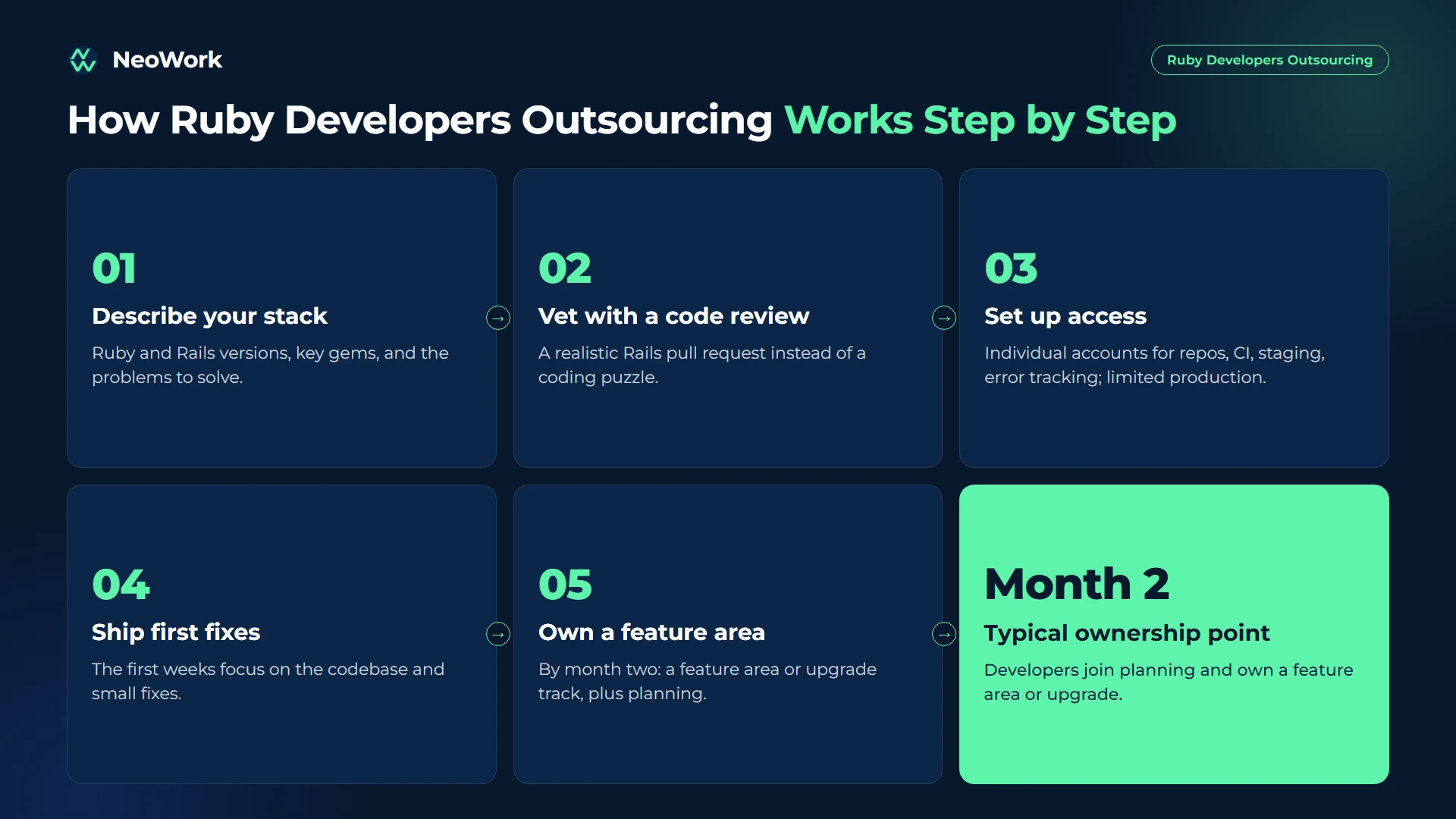
Most Ruby outsourcing engagements follow a similar path. It starts with describing your stack, Ruby and Rails versions, key gems, and the problems you want solved. Candidates are then vetted, ideally with a code review of a realistic Rails pull request rather than a coding puzzle. Once developers are selected, access to repositories, CI, staging, and error tracking is set up through individual accounts, with production access kept limited.
The first weeks focus on understanding the codebase and shipping small fixes. By the second month, developers usually own a feature area or an upgrade track and join planning discussions.

Expand Ruby Development Capacity with NeoWork
Ruby developers outsourcing helps companies add Rails expertise without long local hiring cycles. At NeoWork, we provide dedicated Ruby and Rails developers who work inside your codebase, tools, and engineering process. We handle recruitment, benefits, training, and ongoing engagement. Our industry-leading 91% annualized teammate retention rate and 3.2% candidate selectivity rate reflect our focus on selective hiring and long-term team stability.
Our Ruby development model offers:
- dedicated Ruby and Rails developers
- integration with your tools and processes
- recruitment and ongoing teammate support
Contact NeoWork to add Ruby capacity that works alongside your team.
Regional Comparison
Individual skill matters more than geography, so use region mainly to decide how much real-time collaboration you need. Our pricing page shows how dedicated roles are structured.
Choosing the Right Ruby Partner
A good Ruby partner can show real Rails work, not just a list of technologies. Ask to see examples of upgrades, performance projects, or codebase takeovers, and talk to the developers who would actually join your team.
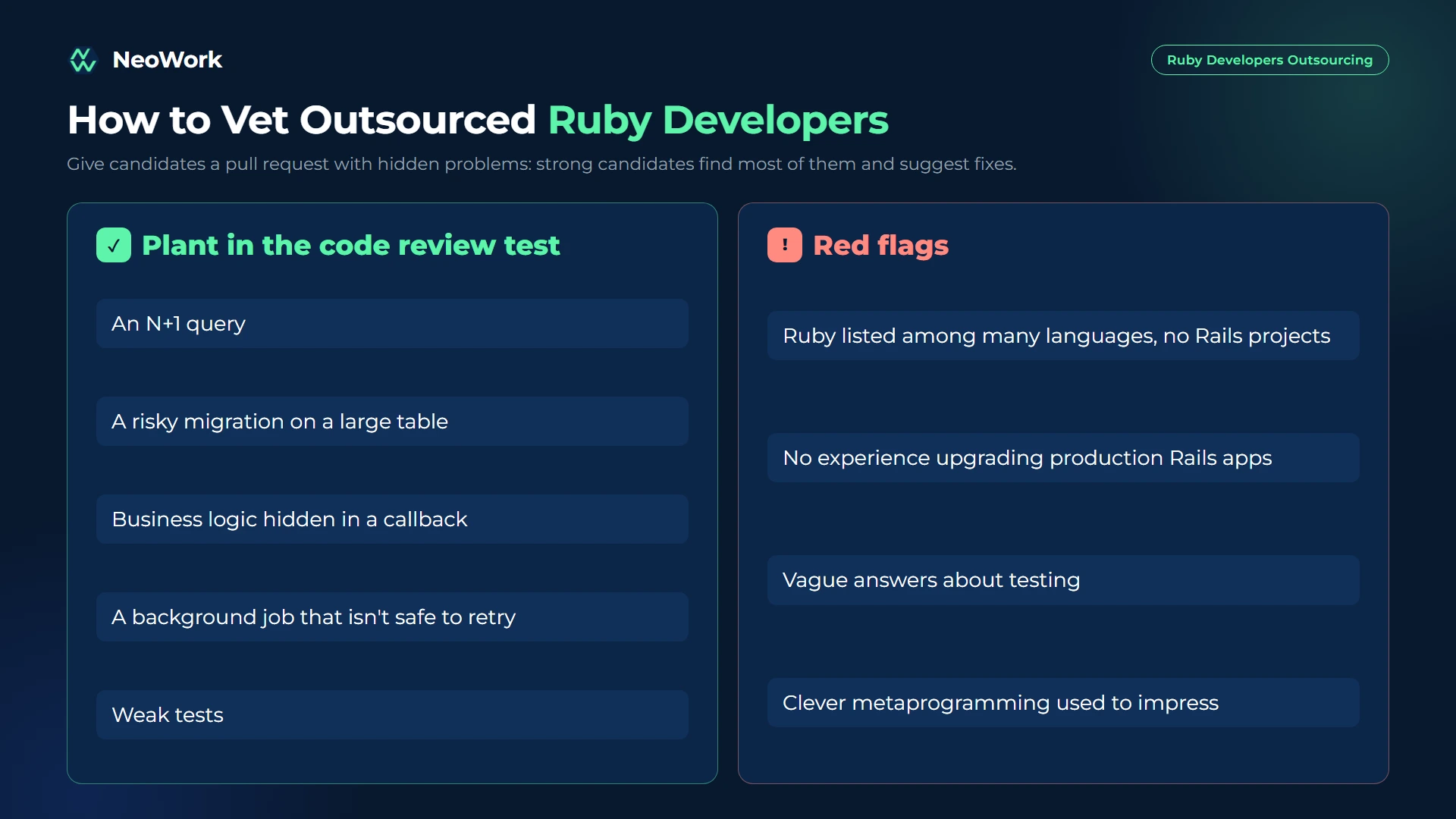
The best single vetting tool is a code review exercise. Give candidates a pull request that contains an N+1 query, a risky migration on a large table, business logic hidden in a callback, a background job that isn't safe to retry, and weak tests. Strong candidates find most of the problems, explain why they matter, and suggest practical fixes.
Red flags worth walking away from:
- Ruby listed among many languages with no specific Rails projects to discuss
- No experience upgrading production Rails apps
- Vague answers about testing
- Clever metaprogramming used to impress rather than to simplify
Protecting Code Quality and IP
Keep code in repositories you own, require pull request reviews for every change, and make sure the contract assigns all code and intellectual property to your company. Agree on testing expectations and Rails conventions before work starts, and document architecture decisions as you go so knowledge stays with you if developers change.
The Ruby Talent Market in 2026
Ruby's moment in the spotlight came during the startup boom of the late 2000s and 2010s. Many of the companies built then are now large, profitable businesses that still run on Rails, so demand for experienced Ruby developers has stayed strong. At the same time, fewer new developers pick Ruby as their first language, which means the senior talent pool grows slowly.
The developers who are most sought after have specific experience: major Rails upgrades, performance work on high-traffic apps, and taking over codebases nobody else understands. Active Ruby communities exist in Latin America, Eastern Europe, and parts of Asia, where many developers have worked on production Rails apps for international clients for years. Outsourcing is often the most practical way to reach them.
Onboarding Into a Mature Rails Codebase
Week 1: Setup and Orientation
Make sure the app runs locally with seed data, walk the developer through the domain model, key gems, background jobs, and integrations, and grant individual access to repositories, CI, staging, and error tracking. Keep production access limited at this stage.
Weeks 2 to 4: First Contributions
Start with bug fixes and small features in well-understood areas, review pull requests closely, and ask the developer to note anything confusing or risky they find. Those notes often reveal technical debt that long-time team members no longer notice.
Month 2 and Beyond: Ownership
Once the developer ships confidently, hand over a feature area or an upgrade track, invite them to planning and architecture discussions, and review delivery and quality monthly.
Budget Considerations
Because the senior Ruby talent pool is small, experienced developers command solid rates even in lower-cost regions. The best value usually comes from developers with proven production Rails experience rather than the lowest available rate. An inexperienced developer can easily create technical debt that costs more to fix than the savings.
- Project pricing: fixed price or time and materials for defined work such as an upgrade.
- Monthly dedicated rate: predictable cost for ongoing development and maintenance.
- Hourly rates: useful for small, part-time, or short-term tasks.
Rails Upgrade Projects: What to Expect
Upgrades are one of the most common reasons companies outsource Ruby work, and they follow a fairly predictable pattern. The first step is an audit: current Rails and Ruby versions, gem compatibility, deprecation warnings, and test coverage. Low coverage usually means writing tests around critical flows before any version changes.
The upgrade itself is done one major version at a time, with each step deployed and stabilized before the next. Unmaintained gems are replaced along the way. A good outsourced developer or team keeps feature work and upgrade work clearly separated, so the business can keep shipping while the platform moves forward.
FAQ
Final Thoughts
Outsourcing is often the fastest way to reach experienced Ruby developers in a tight market. Choose the model that fits your product, vet candidates with a realistic code review, and give new developers a structured path into your codebase.
Before reaching out to providers, write down your Rails version, the work that's waiting, and what "senior" means for your app. That clarity makes the whole search faster.
Topics
Ruby Developers Outsourcing Guide for 2026

Quick Summary: Ruby developers outsourcing means working with an external provider to get Ruby development done, either by handing a project to a vendor or by hiring dedicated Ruby developers who work for your team through a provider. Most Ruby work today centers on Ruby on Rails, which powers products such as Shopify, GitHub, and Basecamp, but Ruby also appears in Sinatra and Hanami services, background job systems, and internal tools. Experienced Ruby developers form a smaller talent pool than JavaScript or Python developers, which is why outsourcing is often the most practical way to reach them. This guide covers what Ruby outsourcing includes, why companies use it, engagement models, regional options, how to vet developers, and how to protect code quality and IP.
Plenty of successful companies were built on Rails during the startup boom of the 2010s. Many of them are now mature businesses with large Rails codebases, aging dependencies, and roadmaps that keep growing. Meanwhile, fewer new developers pick Ruby as their first language.
The result is a market where senior Ruby developers are valuable and hard to hire locally. Outsourcing widens the search, as long as you know how to separate real production experience from a résumé that simply lists Ruby.
What Ruby Outsourcing Actually Covers
Ruby outsourcing can mean three different arrangements. Project outsourcing hands a defined piece of work, such as a new Rails application or a migration, to a vendor that manages its own team. Dedicated Ruby developers work only for you, inside your team and under your direction, while the provider handles employment. Team augmentation adds Ruby developers or a small pod to an existing engineering team for capacity or specific skills.
Typical work includes new Rails applications and MVPs, feature development on existing apps, Rails and Ruby upgrades, performance optimization, API and integration work, codebase takeovers, and ongoing maintenance.
Why Companies Outsource Ruby Development
- Scarcity: Senior Ruby developers are hard to find locally, and searches can take months.
- Upgrades: Old Rails and Ruby versions block security patches and gem updates.
- Performance: Slow pages and timeouts need someone who knows Active Record and caching deeply.
- Codebase takeovers: Companies bringing development in-house need someone to own an unfamiliar app.
- Lean maintenance: Mature products may need just one or two developers for upkeep.
Engagement Models Compared
How the Process Works
Most Ruby outsourcing engagements follow a similar path. It starts with describing your stack, Ruby and Rails versions, key gems, and the problems you want solved. Candidates are then vetted, ideally with a code review of a realistic Rails pull request rather than a coding puzzle. Once developers are selected, access to repositories, CI, staging, and error tracking is set up through individual accounts, with production access kept limited.
The first weeks focus on understanding the codebase and shipping small fixes. By the second month, developers usually own a feature area or an upgrade track and join planning discussions.
Expand Ruby Development Capacity with NeoWork
Ruby developers outsourcing helps companies add Rails expertise without long local hiring cycles. At NeoWork, we provide dedicated Ruby and Rails developers who work inside your codebase, tools, and engineering process. We handle recruitment, benefits, training, and ongoing engagement. Our industry-leading 91% annualized teammate retention rate and 3.2% candidate selectivity rate reflect our focus on selective hiring and long-term team stability.
Our Ruby development model offers:
- dedicated Ruby and Rails developers
- integration with your tools and processes
- recruitment and ongoing teammate support
Contact NeoWork to add Ruby capacity that works alongside your team.
Regional Comparison
Individual skill matters more than geography, so use region mainly to decide how much real-time collaboration you need. Our pricing page shows how dedicated roles are structured.
Choosing the Right Ruby Partner
A good Ruby partner can show real Rails work, not just a list of technologies. Ask to see examples of upgrades, performance projects, or codebase takeovers, and talk to the developers who would actually join your team.
The best single vetting tool is a code review exercise. Give candidates a pull request that contains an N+1 query, a risky migration on a large table, business logic hidden in a callback, a background job that isn't safe to retry, and weak tests. Strong candidates find most of the problems, explain why they matter, and suggest practical fixes.
Red flags worth walking away from:
- Ruby listed among many languages with no specific Rails projects to discuss
- No experience upgrading production Rails apps
- Vague answers about testing
- Clever metaprogramming used to impress rather than to simplify
Protecting Code Quality and IP
Keep code in repositories you own, require pull request reviews for every change, and make sure the contract assigns all code and intellectual property to your company. Agree on testing expectations and Rails conventions before work starts, and document architecture decisions as you go so knowledge stays with you if developers change.
The Ruby Talent Market in 2026
Ruby's moment in the spotlight came during the startup boom of the late 2000s and 2010s. Many of the companies built then are now large, profitable businesses that still run on Rails, so demand for experienced Ruby developers has stayed strong. At the same time, fewer new developers pick Ruby as their first language, which means the senior talent pool grows slowly.
The developers who are most sought after have specific experience: major Rails upgrades, performance work on high-traffic apps, and taking over codebases nobody else understands. Active Ruby communities exist in Latin America, Eastern Europe, and parts of Asia, where many developers have worked on production Rails apps for international clients for years. Outsourcing is often the most practical way to reach them.
Onboarding Into a Mature Rails Codebase
Week 1: Setup and Orientation
Make sure the app runs locally with seed data, walk the developer through the domain model, key gems, background jobs, and integrations, and grant individual access to repositories, CI, staging, and error tracking. Keep production access limited at this stage.
Weeks 2 to 4: First Contributions
Start with bug fixes and small features in well-understood areas, review pull requests closely, and ask the developer to note anything confusing or risky they find. Those notes often reveal technical debt that long-time team members no longer notice.
Month 2 and Beyond: Ownership
Once the developer ships confidently, hand over a feature area or an upgrade track, invite them to planning and architecture discussions, and review delivery and quality monthly.
Budget Considerations
Because the senior Ruby talent pool is small, experienced developers command solid rates even in lower-cost regions. The best value usually comes from developers with proven production Rails experience rather than the lowest available rate. An inexperienced developer can easily create technical debt that costs more to fix than the savings.
- Project pricing: fixed price or time and materials for defined work such as an upgrade.
- Monthly dedicated rate: predictable cost for ongoing development and maintenance.
- Hourly rates: useful for small, part-time, or short-term tasks.
Rails Upgrade Projects: What to Expect
Upgrades are one of the most common reasons companies outsource Ruby work, and they follow a fairly predictable pattern. The first step is an audit: current Rails and Ruby versions, gem compatibility, deprecation warnings, and test coverage. Low coverage usually means writing tests around critical flows before any version changes.
The upgrade itself is done one major version at a time, with each step deployed and stabilized before the next. Unmaintained gems are replaced along the way. A good outsourced developer or team keeps feature work and upgrade work clearly separated, so the business can keep shipping while the platform moves forward.
FAQ
Final Thoughts
Outsourcing is often the fastest way to reach experienced Ruby developers in a tight market. Choose the model that fits your product, vet candidates with a realistic code review, and give new developers a structured path into your codebase.
Before reaching out to providers, write down your Rails version, the work that's waiting, and what "senior" means for your app. That clarity makes the whole search faster.
Topics
Related Blogs
Related Podcasts





