
.avif)
.avif)

Small Business HR Outsourcing Guide: Costs, Providers & Benefits


.svg)

Quick Summary: Small business HR outsourcing means hiring an external provider to handle tasks like payroll, compliance, recruitment and employee relations instead of building an in-house team. Costs typically range from a few hundred dollars per employee per year for basic advisory support up to $2,500-$6,000 a month for a fuller fractional HR service, depending on scope and headcount. Most small businesses start outsourcing once they hit 10-20 staff or face their first serious compliance headache, and the right provider should save more in reduced risk and admin time than it costs in fees.
Most small business owners didn't start their company because they love reading the Fair Work Act. Yet somewhere between hiring the fifth employee and fielding a workplace complaint nobody trained for, HR stops being optional. That's usually the moment "HR outsourcing" starts showing up in search bars at midnight.
Here's the thing though—outsourcing HR isn't just about offloading paperwork. Done well, it's a way to get senior-level HR expertise on tap without the senior-level salary. Done badly, it's an expensive subscription nobody uses. This guide walks through what small business HR outsourcing actually covers, what it costs, how to tell if it's worth it, and how to pick a partner that won't leave you exposed.
What Is HR Outsourcing, Exactly?
HR outsourcing means contracting an external provider to perform some or all human resources functions that would otherwise sit with an internal HR manager or, more commonly in small businesses, with the owner. It ranges from a bare-bones advice line to a near-complete HR department delivered remotely.
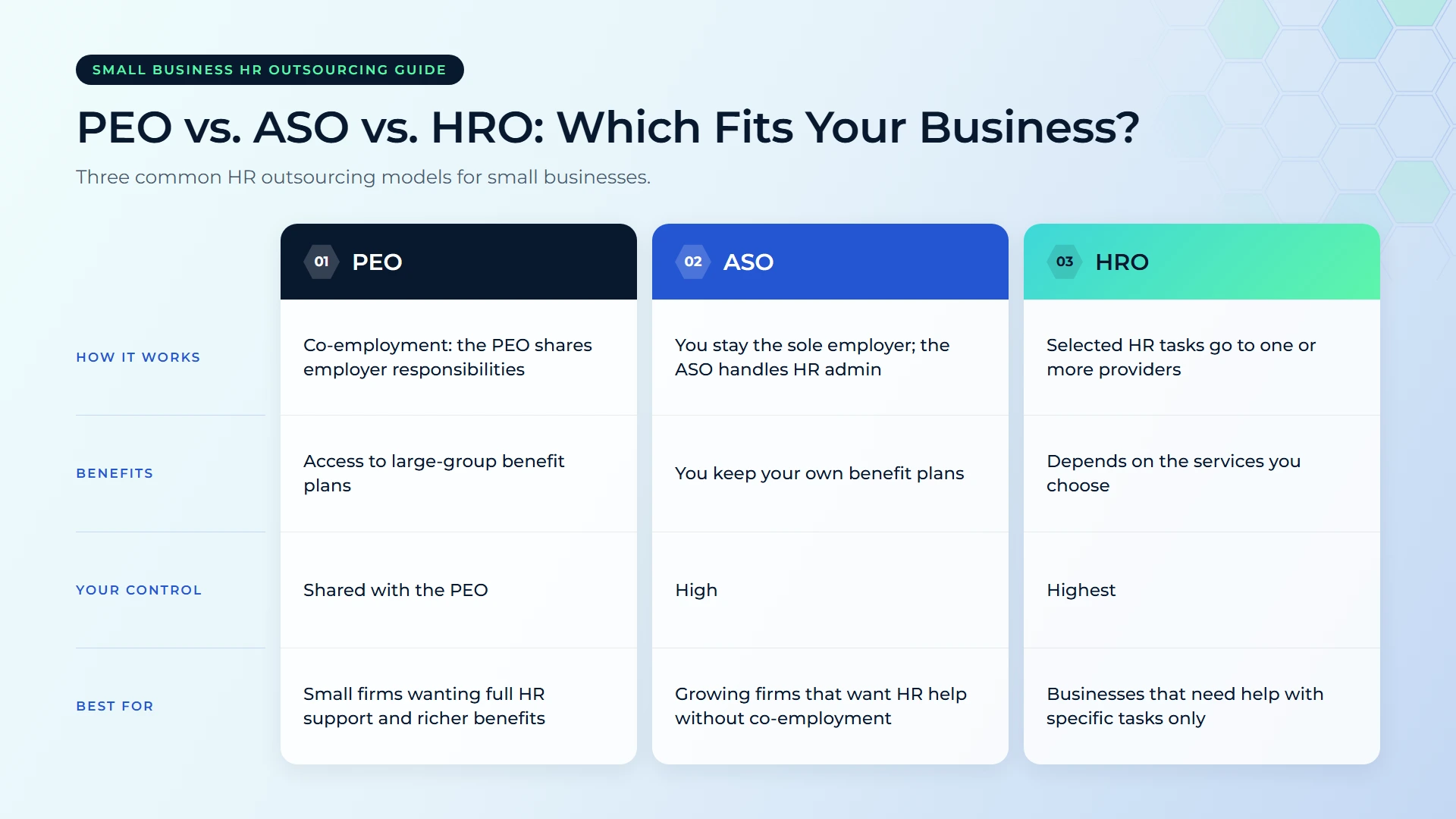
Providers typically fall into a few categories:
- HR advisory services: Phone or online support for compliance questions, award interpretation and day-to-day employee issues.
- Fractional or outsourced HR managers: A dedicated consultant who acts like a part-time in-house HR lead.
- Full-service HR outsourcing: Payroll, recruitment, onboarding, policy development and performance management bundled together.
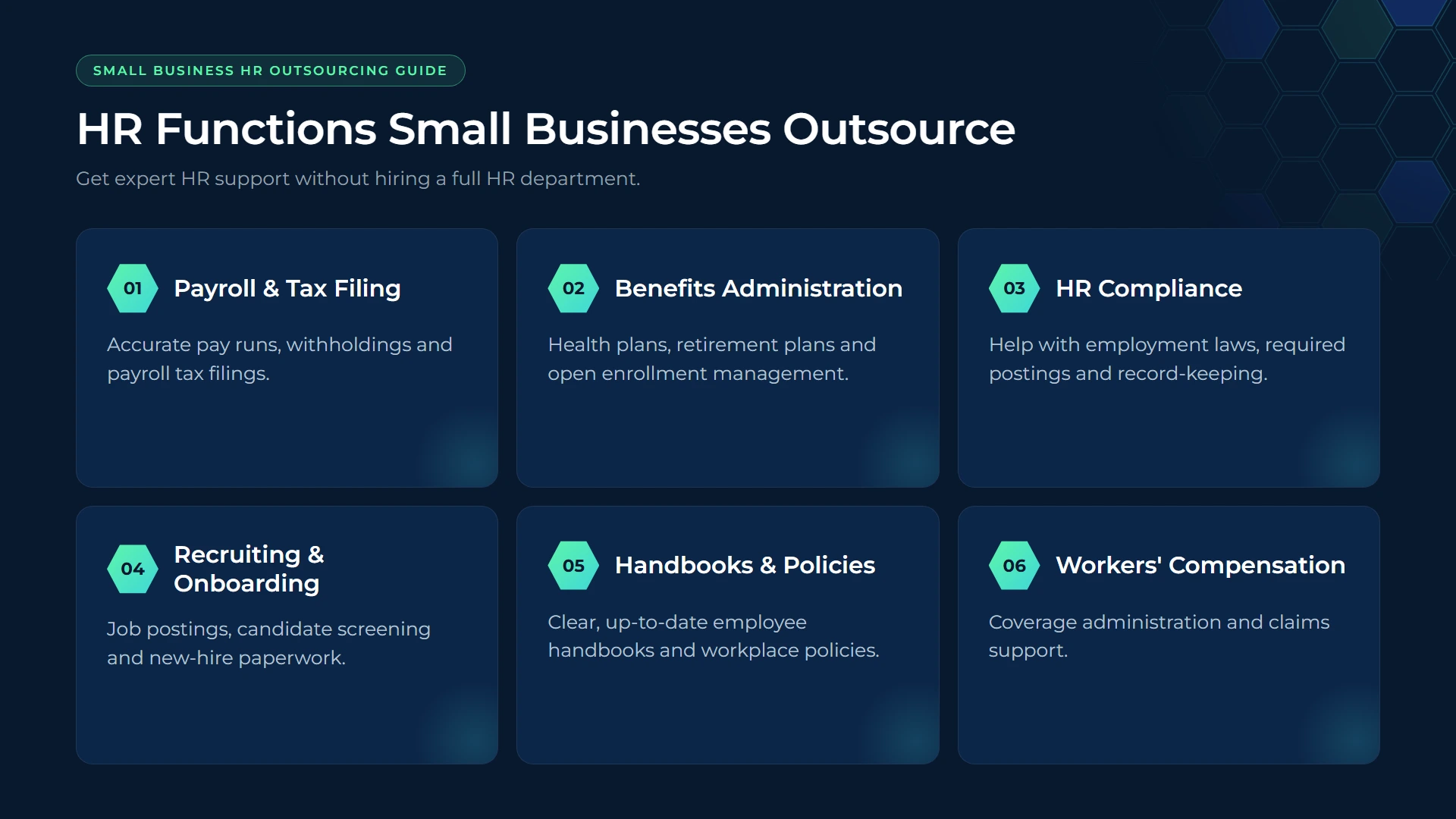
What's Usually Included
Scope varies a lot by provider and price tier, but most small business HR outsourcing packages cover some combination of the following.
Why Small Businesses Outsource HR
The appeal isn't complicated. Small teams rarely have the headcount to justify a full-time HR manager, but the legal exposure that comes with employing people doesn't scale down just because the business is small. One unfair dismissal claim or underpayment dispute can cost more than years of outsourced HR fees combined.
So the main drivers tend to be:
- Compliance risk reduction: Employment law changes often; getting it wrong is expensive.
- Cost efficiency: Access to senior expertise without a six-figure salary.
- Time back: Owners stop drafting contracts at 9pm and get back to running the business.
- Scalability: Support flexes up during hiring sprints and down during quiet periods.
- Access to tools: Many providers bundle HR software, templates and training that would otherwise cost extra.

Outsource HR and Keep Your Team Focused
At NeoWork, we help growing businesses handle the operations that start taking up more time as the team expands. We recruit and onboard dedicated teammates and provide the ongoing employment support needed to keep distributed teams running smoothly. We select just 3.2% of candidates, helping us maintain a high bar throughout the hiring process.
With us, you can:
- Spend less internal time on recruiting and onboarding
- Add dedicated support without building a larger HR department
- Keep benefits and ongoing teammate support covered
- Build a stable team backed by 91% annualized teammate retention
Contact us to discuss where HR work is taking up your time and what kind of support your business needs.
How Much Does HR Outsourcing Cost?
Pricing isn't standardised, which makes comparing providers trickier than it should be. That said, three broad models dominate the market.
For context, a full-time in-house HR manager commonly costs well over $100,000 a year once salary, super and on-costs are included — far more than most small businesses need for a team of 10 or 20. That gap is exactly why outsourcing exists as a middle ground. Always confirm current pricing directly with providers, since rates shift and packages differ in what they bundle.
In-House vs Outsourced HR: A Side-by-Side Look
Neither option is universally better. A business with 50-plus employees and complex, fast-changing people needs might genuinely benefit from an in-house hire — possibly supported by outsourced specialists for payroll or investigations. A business with 5-20 staff, on the other hand, rarely has enough HR volume to justify a full-time salary.
Is HR Outsourcing Worth It for Small Businesses?
Short answer: for most small and medium businesses without internal HR expertise, yes. But "worth it" depends on what's being compared. Outsourcing rarely beats doing nothing on a pure cost basis in the short term — it only pays off when it prevents the kind of mistake that costs far more down the line.
It tends to make the most sense when a business:
- Has grown past the point where the owner can manage HR issues confidently alone.
- Has faced (or narrowly avoided) a compliance breach, underpayment, or dispute.
- Is hiring quickly and needs onboarding and contracts handled consistently.
- Operates across multiple awards or employment types and finds classification confusing.
- Wants HR policies and documentation that would stand up if challenged.
It makes less sense for a two-person business with simple, stable employment arrangements — a basic template library and occasional advice line might cover that need without a retainer.
How to Choose the Right HR Outsourcing Partner
Not all providers are built the same, and the cheapest option isn't automatically the safest. A few things worth checking before signing anything:
- Industry experience: HR needs differ wildly between retail, hospitality, construction and professional services — ask for examples relevant to the specific sector.
- Response times: Find out how quickly urgent issues (like a termination gone wrong) actually get answered, not just what the marketing page promises.
- Scope clarity: Get a written list of exactly what's included versus billed as an extra.
- Technology: Check whether the provider includes an HR platform for contracts, leave tracking and policy storage, or whether that's a separate cost.
- References: Ask for a current client in a similar-sized business, not just a polished case study.
- Exit terms: Understand the notice period and what happens to documentation if the relationship ends.
Common Risks and How to Avoid Them
Outsourcing HR reduces risk overall, but it doesn't eliminate it entirely. A few pitfalls come up often enough to flag:
- Vague scope: "Unlimited advice" sometimes means unlimited email replies and nothing more. Get specifics in writing.
- Slow escalation: For urgent matters like a serious misconduct allegation, delays can make things worse. Confirm turnaround commitments upfront.
- Generic advice: Templates that ignore the specific award or enterprise agreement a business operates under can create more exposure, not less.
- Data handling: Employee records contain sensitive information — check how the provider stores and protects it.
Getting Started: A Simple Rollout Plan
Switching from solo HR management to an outsourced model doesn't need to happen overnight. A staged approach tends to work better than flipping everything at once:
- Audit current HR gaps — contracts, policies, outstanding compliance issues.
- Decide which functions genuinely need external support versus what's manageable internally.
- Shortlist providers and request a scope-of-work proposal, not just a price quote.
- Start with a defined trial period before committing to a multi-year contract.
- Review after three to six months against agreed outcomes, not just invoices.
Final Thoughts
HR outsourcing isn't a magic fix, and it's not free. But for small businesses stretched thin on time and short on specialist knowledge, it tends to be cheaper insurance than learning employment law the hard way. The real question isn't whether outsourcing works in general — it's whether a specific provider's scope, cost and responsiveness match what the business actually needs right now.
Start with an honest audit of where HR gaps currently sit, compare a shortlist of providers on scope rather than price alone, and trial before committing long-term. Get that process right, and HR outsourcing stops being an expense and starts acting like the risk management tool it's meant to be.
Topics
Small Business HR Outsourcing Guide: Costs, Providers & Benefits

Quick Summary: Small business HR outsourcing means hiring an external provider to handle tasks like payroll, compliance, recruitment and employee relations instead of building an in-house team. Costs typically range from a few hundred dollars per employee per year for basic advisory support up to $2,500-$6,000 a month for a fuller fractional HR service, depending on scope and headcount. Most small businesses start outsourcing once they hit 10-20 staff or face their first serious compliance headache, and the right provider should save more in reduced risk and admin time than it costs in fees.
Most small business owners didn't start their company because they love reading the Fair Work Act. Yet somewhere between hiring the fifth employee and fielding a workplace complaint nobody trained for, HR stops being optional. That's usually the moment "HR outsourcing" starts showing up in search bars at midnight.
Here's the thing though—outsourcing HR isn't just about offloading paperwork. Done well, it's a way to get senior-level HR expertise on tap without the senior-level salary. Done badly, it's an expensive subscription nobody uses. This guide walks through what small business HR outsourcing actually covers, what it costs, how to tell if it's worth it, and how to pick a partner that won't leave you exposed.
What Is HR Outsourcing, Exactly?
HR outsourcing means contracting an external provider to perform some or all human resources functions that would otherwise sit with an internal HR manager or, more commonly in small businesses, with the owner. It ranges from a bare-bones advice line to a near-complete HR department delivered remotely.
Providers typically fall into a few categories:
- HR advisory services: Phone or online support for compliance questions, award interpretation and day-to-day employee issues.
- Fractional or outsourced HR managers: A dedicated consultant who acts like a part-time in-house HR lead.
- Full-service HR outsourcing: Payroll, recruitment, onboarding, policy development and performance management bundled together.
What's Usually Included
Scope varies a lot by provider and price tier, but most small business HR outsourcing packages cover some combination of the following.
Why Small Businesses Outsource HR
The appeal isn't complicated. Small teams rarely have the headcount to justify a full-time HR manager, but the legal exposure that comes with employing people doesn't scale down just because the business is small. One unfair dismissal claim or underpayment dispute can cost more than years of outsourced HR fees combined.
So the main drivers tend to be:
- Compliance risk reduction: Employment law changes often; getting it wrong is expensive.
- Cost efficiency: Access to senior expertise without a six-figure salary.
- Time back: Owners stop drafting contracts at 9pm and get back to running the business.
- Scalability: Support flexes up during hiring sprints and down during quiet periods.
- Access to tools: Many providers bundle HR software, templates and training that would otherwise cost extra.
Outsource HR and Keep Your Team Focused
At NeoWork, we help growing businesses handle the operations that start taking up more time as the team expands. We recruit and onboard dedicated teammates and provide the ongoing employment support needed to keep distributed teams running smoothly. We select just 3.2% of candidates, helping us maintain a high bar throughout the hiring process.
With us, you can:
- Spend less internal time on recruiting and onboarding
- Add dedicated support without building a larger HR department
- Keep benefits and ongoing teammate support covered
- Build a stable team backed by 91% annualized teammate retention
Contact us to discuss where HR work is taking up your time and what kind of support your business needs.
How Much Does HR Outsourcing Cost?
Pricing isn't standardised, which makes comparing providers trickier than it should be. That said, three broad models dominate the market.
For context, a full-time in-house HR manager commonly costs well over $100,000 a year once salary, super and on-costs are included — far more than most small businesses need for a team of 10 or 20. That gap is exactly why outsourcing exists as a middle ground. Always confirm current pricing directly with providers, since rates shift and packages differ in what they bundle.
In-House vs Outsourced HR: A Side-by-Side Look
Neither option is universally better. A business with 50-plus employees and complex, fast-changing people needs might genuinely benefit from an in-house hire — possibly supported by outsourced specialists for payroll or investigations. A business with 5-20 staff, on the other hand, rarely has enough HR volume to justify a full-time salary.
Is HR Outsourcing Worth It for Small Businesses?
Short answer: for most small and medium businesses without internal HR expertise, yes. But "worth it" depends on what's being compared. Outsourcing rarely beats doing nothing on a pure cost basis in the short term — it only pays off when it prevents the kind of mistake that costs far more down the line.
It tends to make the most sense when a business:
- Has grown past the point where the owner can manage HR issues confidently alone.
- Has faced (or narrowly avoided) a compliance breach, underpayment, or dispute.
- Is hiring quickly and needs onboarding and contracts handled consistently.
- Operates across multiple awards or employment types and finds classification confusing.
- Wants HR policies and documentation that would stand up if challenged.
It makes less sense for a two-person business with simple, stable employment arrangements — a basic template library and occasional advice line might cover that need without a retainer.
How to Choose the Right HR Outsourcing Partner
Not all providers are built the same, and the cheapest option isn't automatically the safest. A few things worth checking before signing anything:
- Industry experience: HR needs differ wildly between retail, hospitality, construction and professional services — ask for examples relevant to the specific sector.
- Response times: Find out how quickly urgent issues (like a termination gone wrong) actually get answered, not just what the marketing page promises.
- Scope clarity: Get a written list of exactly what's included versus billed as an extra.
- Technology: Check whether the provider includes an HR platform for contracts, leave tracking and policy storage, or whether that's a separate cost.
- References: Ask for a current client in a similar-sized business, not just a polished case study.
- Exit terms: Understand the notice period and what happens to documentation if the relationship ends.
Common Risks and How to Avoid Them
Outsourcing HR reduces risk overall, but it doesn't eliminate it entirely. A few pitfalls come up often enough to flag:
- Vague scope: "Unlimited advice" sometimes means unlimited email replies and nothing more. Get specifics in writing.
- Slow escalation: For urgent matters like a serious misconduct allegation, delays can make things worse. Confirm turnaround commitments upfront.
- Generic advice: Templates that ignore the specific award or enterprise agreement a business operates under can create more exposure, not less.
- Data handling: Employee records contain sensitive information — check how the provider stores and protects it.
Getting Started: A Simple Rollout Plan
Switching from solo HR management to an outsourced model doesn't need to happen overnight. A staged approach tends to work better than flipping everything at once:
- Audit current HR gaps — contracts, policies, outstanding compliance issues.
- Decide which functions genuinely need external support versus what's manageable internally.
- Shortlist providers and request a scope-of-work proposal, not just a price quote.
- Start with a defined trial period before committing to a multi-year contract.
- Review after three to six months against agreed outcomes, not just invoices.
Final Thoughts
HR outsourcing isn't a magic fix, and it's not free. But for small businesses stretched thin on time and short on specialist knowledge, it tends to be cheaper insurance than learning employment law the hard way. The real question isn't whether outsourcing works in general — it's whether a specific provider's scope, cost and responsiveness match what the business actually needs right now.
Start with an honest audit of where HR gaps currently sit, compare a shortlist of providers on scope rather than price alone, and trial before committing long-term. Get that process right, and HR outsourcing stops being an expense and starts acting like the risk management tool it's meant to be.
Topics
Related Blogs
Related Podcasts