



Software Outsourcing and Outstaffing Guide 2026: Key Differences & How to Choose




Quick Summary: Software outsourcing and outstaffing are two ways to get software built with external talent. In outsourcing, a vendor takes responsibility for delivering a project and manages its own team. In outstaffing, developers employed by a provider work only for you, inside your team and under your management, while the provider handles hiring, payroll, and HR. Deloitte's 2024 Global Outsourcing Survey found that 80% of executives plan to maintain or increase investment in third-party outsourcing, with skilled talent now joining cost reduction as a key driver. This guide explains how the two models differ, when each makes sense, how costs compare, what to put in the contract, and the pitfalls that catch companies out.
The vocabulary around external software development is a mess. Vendors use outsourcing, outstaffing, staff augmentation, and dedicated teams almost interchangeably, and the same word can mean different things in different proposals.
That confusion matters, because each model puts control, risk, and knowledge in a different place. Here's how to tell them apart and pick the right one.
What Is Software Outsourcing?
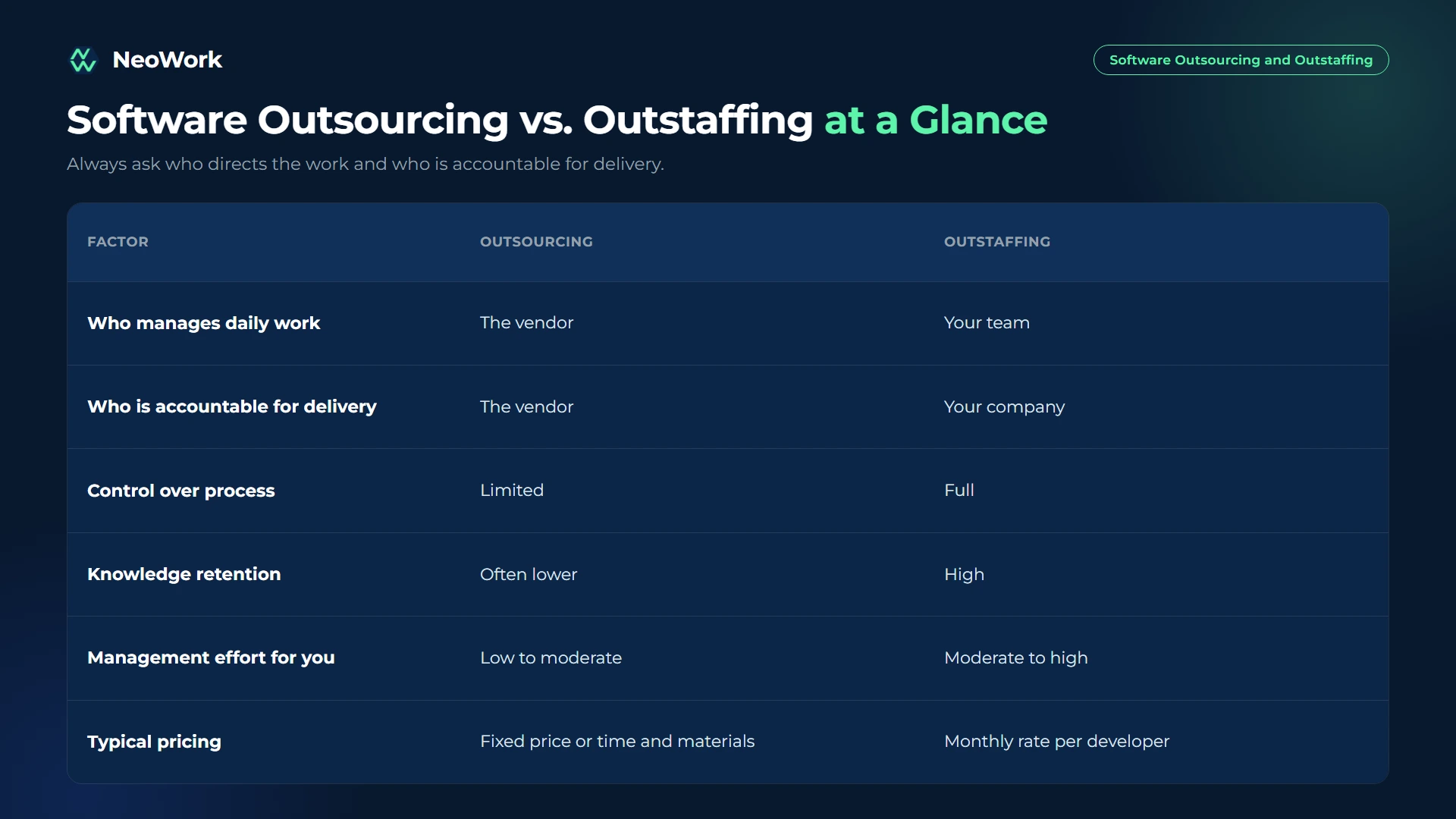
Software outsourcing means delegating the delivery of software to an external company. You describe what you need; the vendor plans the work, assembles and manages its own team, and is accountable for delivering against the agreement. Your involvement focuses on requirements, feedback, and acceptance.
What Is Software Outstaffing?
Software outstaffing means hiring developers through a provider. They stay on the provider's payroll but work exclusively for you, join your team, follow your processes, and take direction from your managers. The provider handles recruitment, contracts, payroll, benefits, and retention.
Put simply: with outsourcing, you buy an outcome. With outstaffing, you add people.
Outsourcing vs. Outstaffing: Side by Side

Build Your Development Team with NeoWork
Software outstaffing helps companies add developers and technical specialists without hiring every role locally. At NeoWork, we provide dedicated teammates who work exclusively for your company, inside your tools and processes, under your leadership. We handle recruitment, benefits, training, and ongoing engagement. Our industry-leading 91% annualized teammate retention rate and 3.2% candidate selectivity rate reflect our focus on selective hiring and long-term team stability.
Our dedicated development model offers:
- software development and technical support
- integration with your tools and processes
- recruitment and ongoing teammate support
Contact NeoWork to add developers who work as part of your team.
When Outsourcing Makes Sense (and When It Doesn't)
Outsourcing works best for defined projects with a clear end: a first product version, an integration, a migration, or a marketing site. It's also the safer choice for companies without engineering leadership, because the vendor brings project management and architecture along with the developers.
It's a weaker fit for core products that will evolve for years. Every month of development builds understanding of your users and codebase, and with outsourcing much of that understanding stays with the vendor when the contract ends.
When Outstaffing Makes Sense
Outstaffing shines when you already have someone who can lead engineers, such as a CTO, engineering manager, or strong tech lead, and you need more capacity than local hiring can deliver. Developers join your squads, follow your standards, and build knowledge that stays inside the company.
Without that leadership, outstaffing tends to struggle. Developers wait for direction or build without it, and progress slows. If leadership is missing, hire or contract it first, or start with an outsourcing model that includes it.
Cost Structures Compared
Compare total cost, including your internal time. See how dedicated roles are structured on our pricing page.
Contracts and IP Protection
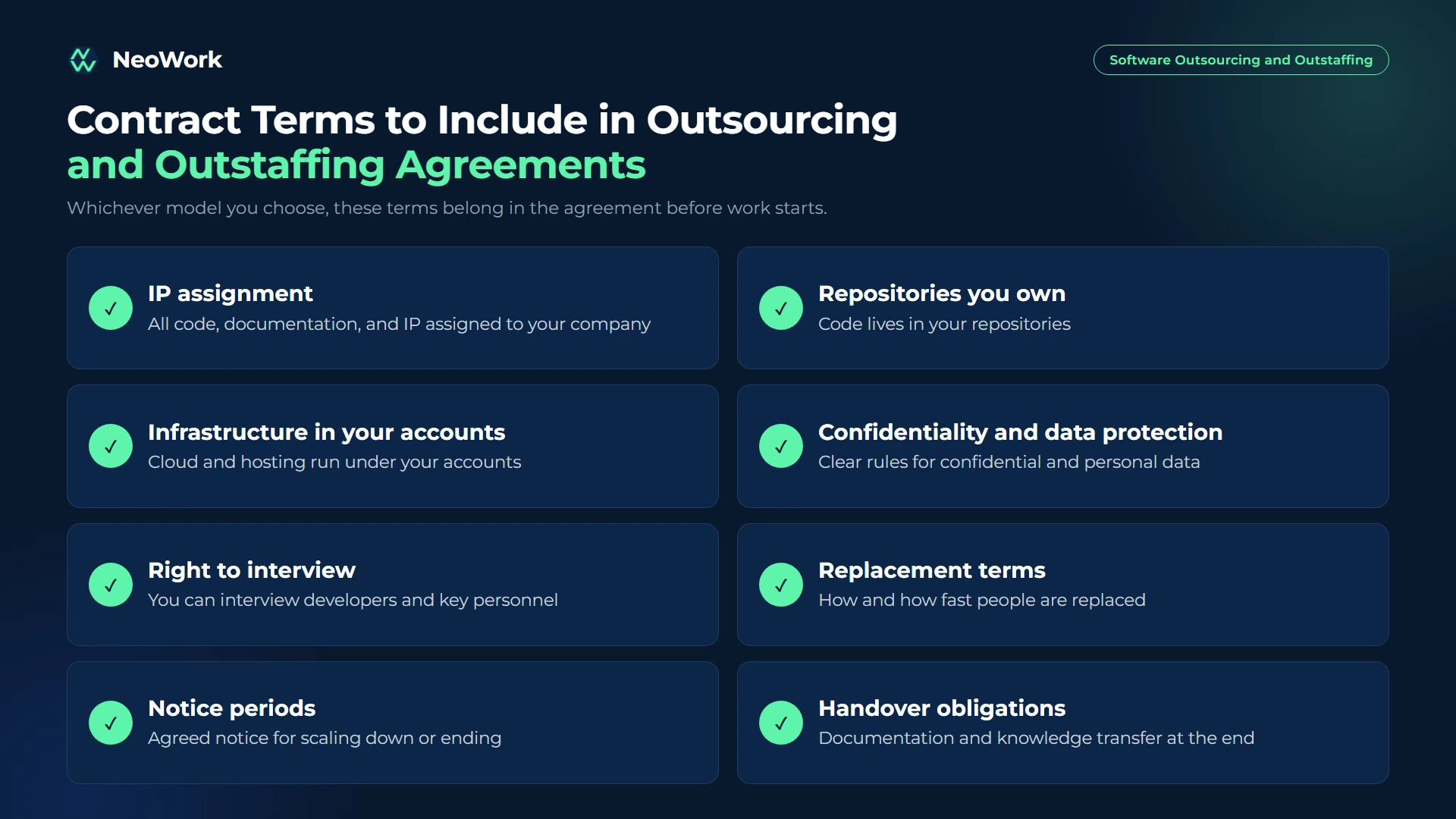
Whichever model you choose, a handful of contract terms protect you. All code, documentation, and intellectual property should be assigned to your company. Code should live in repositories you own, and infrastructure should run in your accounts. Confidentiality and data protection terms, the right to interview developers or key personnel, replacement terms, notice periods, and clear handover obligations all belong in the agreement before work starts.
Common Pitfalls and How to Avoid Them
Choosing Outstaffing Without a Leader
Lower monthly costs are tempting, but developers without direction rarely deliver. Secure engineering leadership first.
Outsourcing a Core Product Long-Term
When the contract ends, knowledge leaves with the vendor and every change becomes expensive. Keep long-lived products closer to home.
Trusting Labels Instead of Terms
"Dedicated team" can mean vendor-managed or client-managed. Always ask who directs the work and who is accountable.
Ignoring Exit Terms
Without clear handover obligations, switching providers becomes painful. Settle exit terms on day one.
Five Questions That Decide the Model
- Do you have someone who can lead engineers day to day? If not, outsourcing or hiring a lead first is safer than outstaffing.
- Does the work have a clear end? Defined projects suit outsourcing; evolving products suit outstaffing.
- How valuable is the knowledge built during development? The more it matters, the more you should keep it in your team.
- How much control do you want over process? Full control points to outstaffing.
- Who should carry delivery risk? Outsourcing moves more of it to the vendor; outstaffing keeps it with you.
Hybrid Paths That Work
- Outsource first, outstaff later: build the MVP with a vendor, then form an outstaffed team for ongoing development.
- Split by work type: keep core product work outstaffed and outsource defined side projects.
- Migration plus maintenance: an outsourced team migrates while outstaffed developers run the old system.
- Grow into ownership: start with outstaffing, then move toward your own entity when the team is large enough.
Questions to Ask Any Provider
- Management: who directs the developers day to day, your team or theirs?
- Accountability: who is responsible if deadlines or quality targets are missed?
- Selection: can you interview and approve every developer before they start?
- Retention: how long do developers typically stay, and how are replacements handled?
- Ownership: who owns the code, documentation, and intellectual property?
- Exit: what are the notice period and handover obligations?
The answers to the first two questions alone usually tell you whether a proposal is really outsourcing, outstaffing, or something in between, regardless of the label on the cover page.
Onboarding and Communication in Each Model
Outsourcing
Communication runs mainly through the vendor's project manager. Expect a kickoff, regular demos, and status reports. Your job is to give clear requirements, answer questions quickly, and accept or reject deliverables against agreed criteria. Ask for direct access to the tech lead as well, so important technical questions don't get lost in translation.
Outstaffing
Outstaffed developers should be onboarded like any new employee: access to tools, an introduction to the codebase, a buddy on the existing team, and small first tasks. They join your standups, planning, and retros, and they communicate directly with product managers and other engineers. The better the onboarding, the faster they become productive and the longer they tend to stay.
Time zones matter in both models. Agree on a few hours of daily overlap for meetings and quick questions, and keep decisions written down in tickets or shared documents so nobody depends on memory or a single conversation.
How to Measure Success
Whichever model you choose, decide upfront how you'll judge it. Useful measures include:
- Delivery: features or milestones shipped against plan.
- Quality: bugs found after release and time spent on rework.
- Predictability: how accurate estimates are over several sprints or phases.
- Team stability: how often developers change and how smoothly replacements happen.
- Knowledge retention: how much your internal team understands the code being built.
Review these measures quarterly. They make it easier to adjust scope, switch models, or expand a partnership based on evidence rather than impressions.
FAQ
Final Thoughts
Outsourcing and outstaffing solve different problems. Outsourcing buys an outcome and suits defined projects or companies without engineering leadership. Outstaffing adds people and suits ongoing development where you want control and knowledge to stay in-house.
Before choosing, answer two questions honestly: who will direct the work, and who should own what the team learns? The right model usually becomes obvious from there.
Topics
Software Outsourcing and Outstaffing Guide 2026: Key Differences & How to Choose

Quick Summary: Software outsourcing and outstaffing are two ways to get software built with external talent. In outsourcing, a vendor takes responsibility for delivering a project and manages its own team. In outstaffing, developers employed by a provider work only for you, inside your team and under your management, while the provider handles hiring, payroll, and HR. Deloitte's 2024 Global Outsourcing Survey found that 80% of executives plan to maintain or increase investment in third-party outsourcing, with skilled talent now joining cost reduction as a key driver. This guide explains how the two models differ, when each makes sense, how costs compare, what to put in the contract, and the pitfalls that catch companies out.
The vocabulary around external software development is a mess. Vendors use outsourcing, outstaffing, staff augmentation, and dedicated teams almost interchangeably, and the same word can mean different things in different proposals.
That confusion matters, because each model puts control, risk, and knowledge in a different place. Here's how to tell them apart and pick the right one.
What Is Software Outsourcing?
Software outsourcing means delegating the delivery of software to an external company. You describe what you need; the vendor plans the work, assembles and manages its own team, and is accountable for delivering against the agreement. Your involvement focuses on requirements, feedback, and acceptance.
What Is Software Outstaffing?
Software outstaffing means hiring developers through a provider. They stay on the provider's payroll but work exclusively for you, join your team, follow your processes, and take direction from your managers. The provider handles recruitment, contracts, payroll, benefits, and retention.
Put simply: with outsourcing, you buy an outcome. With outstaffing, you add people.
Outsourcing vs. Outstaffing: Side by Side
Build Your Development Team with NeoWork
Software outstaffing helps companies add developers and technical specialists without hiring every role locally. At NeoWork, we provide dedicated teammates who work exclusively for your company, inside your tools and processes, under your leadership. We handle recruitment, benefits, training, and ongoing engagement. Our industry-leading 91% annualized teammate retention rate and 3.2% candidate selectivity rate reflect our focus on selective hiring and long-term team stability.
Our dedicated development model offers:
- software development and technical support
- integration with your tools and processes
- recruitment and ongoing teammate support
Contact NeoWork to add developers who work as part of your team.
When Outsourcing Makes Sense (and When It Doesn't)
Outsourcing works best for defined projects with a clear end: a first product version, an integration, a migration, or a marketing site. It's also the safer choice for companies without engineering leadership, because the vendor brings project management and architecture along with the developers.
It's a weaker fit for core products that will evolve for years. Every month of development builds understanding of your users and codebase, and with outsourcing much of that understanding stays with the vendor when the contract ends.
When Outstaffing Makes Sense
Outstaffing shines when you already have someone who can lead engineers, such as a CTO, engineering manager, or strong tech lead, and you need more capacity than local hiring can deliver. Developers join your squads, follow your standards, and build knowledge that stays inside the company.
Without that leadership, outstaffing tends to struggle. Developers wait for direction or build without it, and progress slows. If leadership is missing, hire or contract it first, or start with an outsourcing model that includes it.
Cost Structures Compared
Compare total cost, including your internal time. See how dedicated roles are structured on our pricing page.
Contracts and IP Protection
Whichever model you choose, a handful of contract terms protect you. All code, documentation, and intellectual property should be assigned to your company. Code should live in repositories you own, and infrastructure should run in your accounts. Confidentiality and data protection terms, the right to interview developers or key personnel, replacement terms, notice periods, and clear handover obligations all belong in the agreement before work starts.
Common Pitfalls and How to Avoid Them
Choosing Outstaffing Without a Leader
Lower monthly costs are tempting, but developers without direction rarely deliver. Secure engineering leadership first.
Outsourcing a Core Product Long-Term
When the contract ends, knowledge leaves with the vendor and every change becomes expensive. Keep long-lived products closer to home.
Trusting Labels Instead of Terms
"Dedicated team" can mean vendor-managed or client-managed. Always ask who directs the work and who is accountable.
Ignoring Exit Terms
Without clear handover obligations, switching providers becomes painful. Settle exit terms on day one.
Five Questions That Decide the Model
- Do you have someone who can lead engineers day to day? If not, outsourcing or hiring a lead first is safer than outstaffing.
- Does the work have a clear end? Defined projects suit outsourcing; evolving products suit outstaffing.
- How valuable is the knowledge built during development? The more it matters, the more you should keep it in your team.
- How much control do you want over process? Full control points to outstaffing.
- Who should carry delivery risk? Outsourcing moves more of it to the vendor; outstaffing keeps it with you.
Hybrid Paths That Work
- Outsource first, outstaff later: build the MVP with a vendor, then form an outstaffed team for ongoing development.
- Split by work type: keep core product work outstaffed and outsource defined side projects.
- Migration plus maintenance: an outsourced team migrates while outstaffed developers run the old system.
- Grow into ownership: start with outstaffing, then move toward your own entity when the team is large enough.
Questions to Ask Any Provider
- Management: who directs the developers day to day, your team or theirs?
- Accountability: who is responsible if deadlines or quality targets are missed?
- Selection: can you interview and approve every developer before they start?
- Retention: how long do developers typically stay, and how are replacements handled?
- Ownership: who owns the code, documentation, and intellectual property?
- Exit: what are the notice period and handover obligations?
The answers to the first two questions alone usually tell you whether a proposal is really outsourcing, outstaffing, or something in between, regardless of the label on the cover page.
Onboarding and Communication in Each Model
Outsourcing
Communication runs mainly through the vendor's project manager. Expect a kickoff, regular demos, and status reports. Your job is to give clear requirements, answer questions quickly, and accept or reject deliverables against agreed criteria. Ask for direct access to the tech lead as well, so important technical questions don't get lost in translation.
Outstaffing
Outstaffed developers should be onboarded like any new employee: access to tools, an introduction to the codebase, a buddy on the existing team, and small first tasks. They join your standups, planning, and retros, and they communicate directly with product managers and other engineers. The better the onboarding, the faster they become productive and the longer they tend to stay.
Time zones matter in both models. Agree on a few hours of daily overlap for meetings and quick questions, and keep decisions written down in tickets or shared documents so nobody depends on memory or a single conversation.
How to Measure Success
Whichever model you choose, decide upfront how you'll judge it. Useful measures include:
- Delivery: features or milestones shipped against plan.
- Quality: bugs found after release and time spent on rework.
- Predictability: how accurate estimates are over several sprints or phases.
- Team stability: how often developers change and how smoothly replacements happen.
- Knowledge retention: how much your internal team understands the code being built.
Review these measures quarterly. They make it easier to adjust scope, switch models, or expand a partnership based on evidence rather than impressions.
FAQ
Final Thoughts
Outsourcing and outstaffing solve different problems. Outsourcing buys an outcome and suits defined projects or companies without engineering leadership. Outstaffing adds people and suits ongoing development where you want control and knowledge to stay in-house.
Before choosing, answer two questions honestly: who will direct the work, and who should own what the team learns? The right model usually becomes obvious from there.
Topics
Related Blogs
Related Podcasts





