

.avif)
.avif)

Tech Support Outsourcing Guide: What Actually Works in 2026


.svg)

Quick Summary: Tech support outsourcing means handing part or all of your technical help desk operations to a third-party provider that specializes in customer and IT support. Done well, it cuts operating costs, extends coverage to 24/7, and frees internal teams to focus on product rather than tickets. Done poorly, it damages customer trust and buries the real cost savings under hidden fees. This guide breaks down the models, costs, risks, and a practical framework for choosing a partner in 2026.
Every growing company hits the same wall eventually: ticket volume climbs faster than the internal team can hire. Support quality slips, response times creep up, and engineers who should be building product get pulled into troubleshooting instead. Tech support outsourcing exists to solve exactly that problem — but it's not a magic switch, and the companies that get burned by it usually skipped the homework.
This guide covers what tech support outsourcing actually involves, the models available, realistic cost expectations, the risks nobody puts in the sales deck, and a step-by-step way to pick a provider that won't wreck customer relationships.
What Is Tech Support Outsourcing?
Tech support outsourcing is the practice of contracting an external company — often called a business process outsourcing (BPO) firm or a specialized IT support vendor — to handle technical troubleshooting, help desk tickets, or customer-facing product support on a business's behalf. It can cover everything from Tier 1 password resets to Tier 3 engineering escalations, depending on the scope agreed upon.
The term gets used loosely alongside "customer support outsourcing," but there's a meaningful distinction. Customer support tends to be broader — billing questions, account issues, general inquiries. Tech support is narrower and skews technical: software bugs, hardware diagnostics, API integration issues, network troubleshooting. Many providers handle both under one roof, but the staffing and training requirements differ quite a bit.
Why Companies Outsource Tech Support
- Ticket volume outpaces internal hiring capacity
- Customers expect 24/7 coverage across time zones
- Seasonal or launch-driven spikes make full-time hiring inefficient
- Specialized skills (certain platforms, languages, compliance frameworks) aren't available in-house
- Fixed internal costs need to become variable, scalable ones

Expand Tech Support Capacity with NeoWork
Tech support outsourcing helps companies manage recurring support requests, troubleshooting tasks, and customer or internal service workflows. NeoWork provides remote teammates who can support tech-related operations as part of the client’s existing team or broader support function. NeoWork handles recruitment, benefits, training, and ongoing engagement, while teammates integrate into the client’s systems and daily workflows. Its 91% annualized teammate retention rate and 3.2% candidate selectivity rate reflect a focus on selective hiring and longer-term team stability.
NeoWork's tech support model offers:
- tech support for recurring service workflows
- integration with the client’s tools and processes
- recruitment and ongoing teammate support
Contact NeoWork to add tech support capacity that can grow with your operations.
Outsourcing Models: Picking the Right Structure
Not all outsourcing arrangements look the same. The model chosen affects cost, control, and how much cultural alignment is possible with the outsourced team.
What Tech Support Outsourcing Actually Costs
Pricing varies wildly depending on region, tier of support, and contract structure. That said, a few general patterns hold up across the industry.
Offshore providers in regions like the Philippines or parts of Latin America typically charge a fraction of what an in-house U.S. or Western European hire would cost — often somewhere in the range of a few thousand dollars per agent monthly versus tens of thousands in fully loaded internal salary and benefits. Nearshore options in Latin America or Eastern Europe sit in the middle. Onshore outsourcing costs the most but offers the tightest language and cultural alignment.
Common pricing structures include:
- Per-agent, per-hour: Straightforward, easy to budget, but doesn't reward efficiency.
- Per-ticket: Pay only for resolved tickets — good for predictable, high-volume queues.
- Per-minute or per-interaction: Common in voice-heavy support, ties cost directly to usage.
- Flat monthly retainer: Predictable for both sides, works well for dedicated teams.
Watch for hidden costs: onboarding fees, minimum contract volumes, overtime multipliers, and charges for reporting or QA that weren't in the initial quote. Ask providers to itemize everything before signing — check the provider's official pricing page or proposal document for current rates, since these shift with labor markets and currency fluctuations.
Benefits Worth Taking Seriously
The case for outsourcing tech support isn't just about cost. Several benefits compound over time:
- Round-the-clock coverage. Distributed teams across time zones mean support doesn't stop at 6pm.
- Faster scaling. Ramping up 20 agents for a product launch is far quicker through a vendor than through internal recruiting.
- Access to specialized skill sets. Some providers already have agents trained on specific platforms, compliance standards, or languages.
- Internal team focus. Engineers and product managers spend less time on repetitive tickets and more on building.
- Predictable, variable cost structure. Support spend can flex with demand instead of sitting as fixed payroll.
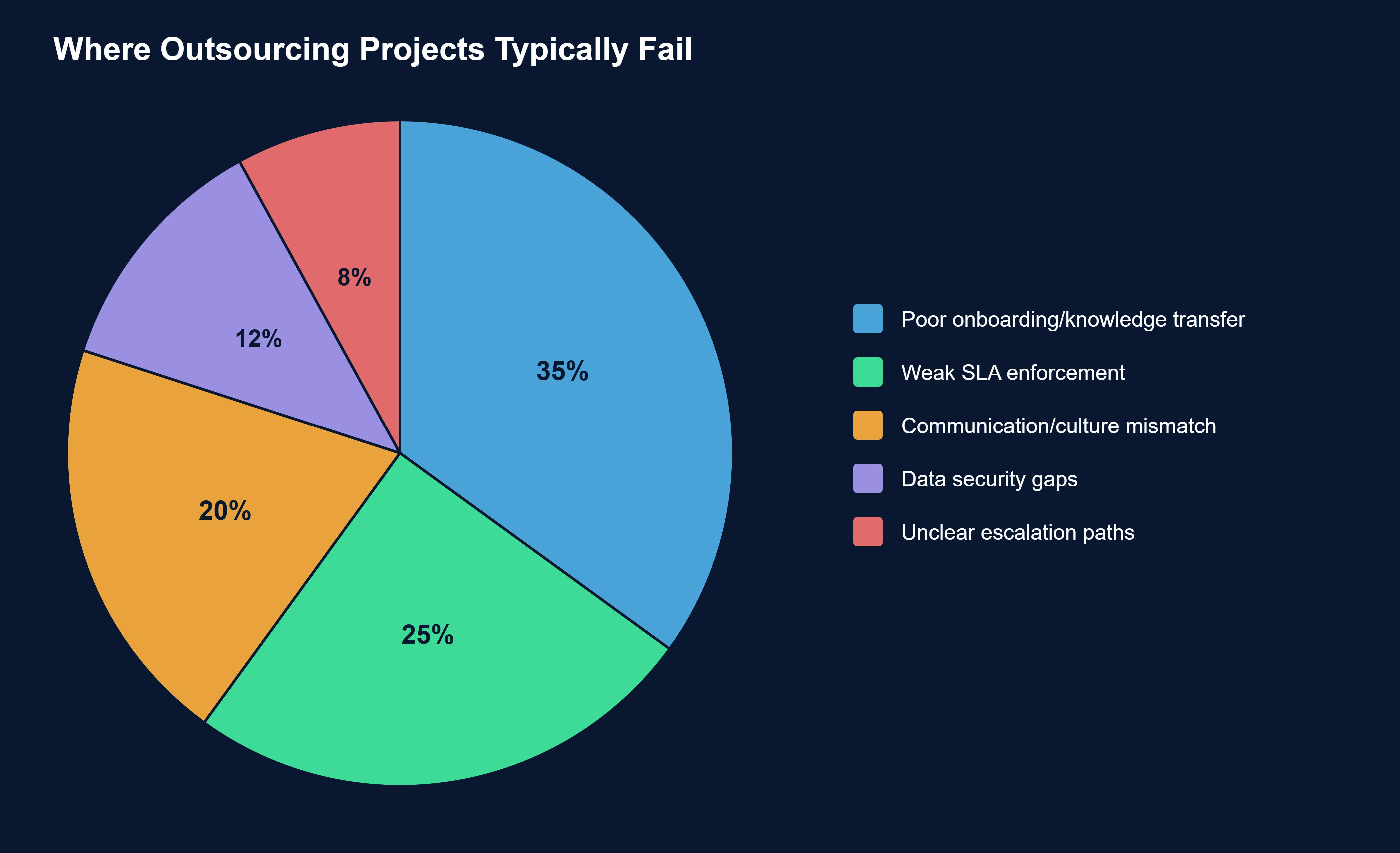
The Real Risks (And How to Mitigate Them)
Here's the thing though — none of this works automatically. Outsourcing introduces real friction points, and the guides that skip this part aren't being honest.
Quality Drift
Without strong quality assurance built into the contract, outsourced agents can default to script-reading rather than genuine problem-solving. Customers notice fast. Mitigate this with clear SLAs, regular call/ticket audits, and a shared knowledge base that's kept current.
Knowledge Gaps
External agents don't have years of tribal product knowledge. Closing that gap requires investment in onboarding, documentation, and a feedback loop where agents can escalate and learn, not just forward tickets.
Communication and Culture Friction
Language nuance, tone, and cultural context matter more in support than most companies expect. A mismatch here shows up in customer satisfaction scores before it shows up anywhere else.
Data Security and Compliance
Support agents often touch sensitive account and payment data. Any provider handling this needs clear data handling agreements, and depending on the industry, certifications like SOC 2 or compliance with regulations such as GDPR or HIPAA. Don't take a vendor's word for it — ask for documentation.
How to Choose the Right Provider
Picking a partner shouldn't come down to whoever quoted the lowest hourly rate. A structured evaluation saves headaches later.
- Define scope first. Decide which tiers, channels, and hours need coverage before talking to vendors.
- Check industry experience. A provider that's supported SaaS products understands ticket patterns differently than one focused on telecom or retail.
- Ask about agent turnover. High attrition means constant retraining and inconsistent quality — a red flag worth pressing on directly.
- Request references, not just case studies. Talk to an actual current client if possible.
- Run a pilot. A 60-90 day trial with a limited ticket volume reveals more than any sales pitch.
- Review the contract's exit terms. Know how easy — or hard — it is to leave if things don't work out.
In-House vs. Outsourced: A Quick Comparison
Making the Transition Smoothly
Switching to an outsourced model works best as a phased rollout rather than an overnight cutover. Start with a single tier or channel — Tier 1 email tickets, say — and measure results against baseline metrics like first-response time, resolution time, and customer satisfaction score. Expand scope only once those numbers hold steady or improve.
Keep a feedback channel open between internal product teams and the outsourced agents. So much of support quality comes down to how fast knowledge flows both directions — agents flagging recurring bugs, product teams updating documentation before it becomes a ticket storm.
Final Thoughts
Tech support outsourcing isn't a shortcut — it's a genuine operational shift that needs the same rigor as any major hiring decision. The companies that get it right treat it as a partnership: clear scope, honest metrics, ongoing knowledge transfer, and a willingness to course-correct early. The ones that get burned usually picked the cheapest bid and walked away from the details.
Start small, measure relentlessly, and scale only what's actually working. That approach beats chasing a perfect provider on day one every single time. Anyone evaluating vendors right now should build a shortlist, request pilot terms, and compare real SLAs side by side before committing to a long-term contract.
Frequently Asked Questions
Topics
Tech Support Outsourcing Guide: What Actually Works in 2026

Quick Summary: Tech support outsourcing means handing part or all of your technical help desk operations to a third-party provider that specializes in customer and IT support. Done well, it cuts operating costs, extends coverage to 24/7, and frees internal teams to focus on product rather than tickets. Done poorly, it damages customer trust and buries the real cost savings under hidden fees. This guide breaks down the models, costs, risks, and a practical framework for choosing a partner in 2026.
Every growing company hits the same wall eventually: ticket volume climbs faster than the internal team can hire. Support quality slips, response times creep up, and engineers who should be building product get pulled into troubleshooting instead. Tech support outsourcing exists to solve exactly that problem — but it's not a magic switch, and the companies that get burned by it usually skipped the homework.
This guide covers what tech support outsourcing actually involves, the models available, realistic cost expectations, the risks nobody puts in the sales deck, and a step-by-step way to pick a provider that won't wreck customer relationships.
What Is Tech Support Outsourcing?
Tech support outsourcing is the practice of contracting an external company — often called a business process outsourcing (BPO) firm or a specialized IT support vendor — to handle technical troubleshooting, help desk tickets, or customer-facing product support on a business's behalf. It can cover everything from Tier 1 password resets to Tier 3 engineering escalations, depending on the scope agreed upon.
The term gets used loosely alongside "customer support outsourcing," but there's a meaningful distinction. Customer support tends to be broader — billing questions, account issues, general inquiries. Tech support is narrower and skews technical: software bugs, hardware diagnostics, API integration issues, network troubleshooting. Many providers handle both under one roof, but the staffing and training requirements differ quite a bit.
Why Companies Outsource Tech Support
- Ticket volume outpaces internal hiring capacity
- Customers expect 24/7 coverage across time zones
- Seasonal or launch-driven spikes make full-time hiring inefficient
- Specialized skills (certain platforms, languages, compliance frameworks) aren't available in-house
- Fixed internal costs need to become variable, scalable ones
Expand Tech Support Capacity with NeoWork
Tech support outsourcing helps companies manage recurring support requests, troubleshooting tasks, and customer or internal service workflows. NeoWork provides remote teammates who can support tech-related operations as part of the client’s existing team or broader support function. NeoWork handles recruitment, benefits, training, and ongoing engagement, while teammates integrate into the client’s systems and daily workflows. Its 91% annualized teammate retention rate and 3.2% candidate selectivity rate reflect a focus on selective hiring and longer-term team stability.
NeoWork's tech support model offers:
- tech support for recurring service workflows
- integration with the client’s tools and processes
- recruitment and ongoing teammate support
Contact NeoWork to add tech support capacity that can grow with your operations.
Outsourcing Models: Picking the Right Structure
Not all outsourcing arrangements look the same. The model chosen affects cost, control, and how much cultural alignment is possible with the outsourced team.
What Tech Support Outsourcing Actually Costs
Pricing varies wildly depending on region, tier of support, and contract structure. That said, a few general patterns hold up across the industry.
Offshore providers in regions like the Philippines or parts of Latin America typically charge a fraction of what an in-house U.S. or Western European hire would cost — often somewhere in the range of a few thousand dollars per agent monthly versus tens of thousands in fully loaded internal salary and benefits. Nearshore options in Latin America or Eastern Europe sit in the middle. Onshore outsourcing costs the most but offers the tightest language and cultural alignment.
Common pricing structures include:
- Per-agent, per-hour: Straightforward, easy to budget, but doesn't reward efficiency.
- Per-ticket: Pay only for resolved tickets — good for predictable, high-volume queues.
- Per-minute or per-interaction: Common in voice-heavy support, ties cost directly to usage.
- Flat monthly retainer: Predictable for both sides, works well for dedicated teams.
Watch for hidden costs: onboarding fees, minimum contract volumes, overtime multipliers, and charges for reporting or QA that weren't in the initial quote. Ask providers to itemize everything before signing — check the provider's official pricing page or proposal document for current rates, since these shift with labor markets and currency fluctuations.
Benefits Worth Taking Seriously
The case for outsourcing tech support isn't just about cost. Several benefits compound over time:
- Round-the-clock coverage. Distributed teams across time zones mean support doesn't stop at 6pm.
- Faster scaling. Ramping up 20 agents for a product launch is far quicker through a vendor than through internal recruiting.
- Access to specialized skill sets. Some providers already have agents trained on specific platforms, compliance standards, or languages.
- Internal team focus. Engineers and product managers spend less time on repetitive tickets and more on building.
- Predictable, variable cost structure. Support spend can flex with demand instead of sitting as fixed payroll.
The Real Risks (And How to Mitigate Them)
Here's the thing though — none of this works automatically. Outsourcing introduces real friction points, and the guides that skip this part aren't being honest.
Quality Drift
Without strong quality assurance built into the contract, outsourced agents can default to script-reading rather than genuine problem-solving. Customers notice fast. Mitigate this with clear SLAs, regular call/ticket audits, and a shared knowledge base that's kept current.
Knowledge Gaps
External agents don't have years of tribal product knowledge. Closing that gap requires investment in onboarding, documentation, and a feedback loop where agents can escalate and learn, not just forward tickets.
Communication and Culture Friction
Language nuance, tone, and cultural context matter more in support than most companies expect. A mismatch here shows up in customer satisfaction scores before it shows up anywhere else.
Data Security and Compliance
Support agents often touch sensitive account and payment data. Any provider handling this needs clear data handling agreements, and depending on the industry, certifications like SOC 2 or compliance with regulations such as GDPR or HIPAA. Don't take a vendor's word for it — ask for documentation.
How to Choose the Right Provider
Picking a partner shouldn't come down to whoever quoted the lowest hourly rate. A structured evaluation saves headaches later.
- Define scope first. Decide which tiers, channels, and hours need coverage before talking to vendors.
- Check industry experience. A provider that's supported SaaS products understands ticket patterns differently than one focused on telecom or retail.
- Ask about agent turnover. High attrition means constant retraining and inconsistent quality — a red flag worth pressing on directly.
- Request references, not just case studies. Talk to an actual current client if possible.
- Run a pilot. A 60-90 day trial with a limited ticket volume reveals more than any sales pitch.
- Review the contract's exit terms. Know how easy — or hard — it is to leave if things don't work out.
In-House vs. Outsourced: A Quick Comparison
Making the Transition Smoothly
Switching to an outsourced model works best as a phased rollout rather than an overnight cutover. Start with a single tier or channel — Tier 1 email tickets, say — and measure results against baseline metrics like first-response time, resolution time, and customer satisfaction score. Expand scope only once those numbers hold steady or improve.
Keep a feedback channel open between internal product teams and the outsourced agents. So much of support quality comes down to how fast knowledge flows both directions — agents flagging recurring bugs, product teams updating documentation before it becomes a ticket storm.
Final Thoughts
Tech support outsourcing isn't a shortcut — it's a genuine operational shift that needs the same rigor as any major hiring decision. The companies that get it right treat it as a partnership: clear scope, honest metrics, ongoing knowledge transfer, and a willingness to course-correct early. The ones that get burned usually picked the cheapest bid and walked away from the details.
Start small, measure relentlessly, and scale only what's actually working. That approach beats chasing a perfect provider on day one every single time. Anyone evaluating vendors right now should build a shortlist, request pilot terms, and compare real SLAs side by side before committing to a long-term contract.
Frequently Asked Questions
Topics
Related Blogs
Related Podcasts


.webp)

.webp)
.webp)



