



Telemarketing Outsourcing Guide 2026: Costs, Compliance & How to Choose




Quick Summary: Telemarketing outsourcing means hiring an external team to run phone-based sales and marketing work, such as outbound lead generation, appointment setting, renewals, and win-back calls, or inbound order and inquiry lines. The provider supplies trained callers, dialing tools, and reporting, while you keep control of the offer and the closing process. Compliance shapes everything: in the US, the FTC's Telemarketing Sales Rule, the Telephone Consumer Protection Act, and the National Do Not Call Registry all apply, and Europe and the UK add GDPR and PECR. This guide explains how telemarketing outsourcing works, what it costs, how to stay compliant, which metrics matter, and how to pick a partner.
Cold calling has been declared dead more times than anyone can count, and yet companies keep booking meetings by phone. The difference between programs that work and programs that annoy people usually isn't the phone itself. It's the targeting, the training, and how carefully the program is run.
Outsourcing can give you trained callers and infrastructure within weeks. It also means trusting someone else with your brand voice and your compliance obligations, so it's worth understanding the moving parts before you sign.
What Is Telemarketing Outsourcing?
Telemarketing outsourcing is the practice of contracting an external provider to make or receive sales and marketing calls on your behalf. The provider handles hiring, training, technology, quality monitoring, and reporting, and follows your scripts, target lists, and qualification rules.
Why Companies Outsource Telemarketing
The most common reason is focus. Account executives are expensive, and every hour they spend dialing cold lists is an hour not spent closing deals. Moving the top of the funnel to a dedicated team lets salespeople spend their time on qualified conversations.
Speed is the second reason. Building an in-house calling team means hiring, training, buying dialing software, and setting up compliance processes, all in a role with traditionally high turnover. An experienced partner already has those pieces in place and can launch a pilot quickly.
Finally, there's skill. Opening a call well, handling objections without pressure, and qualifying honestly are learned skills. Partners who run many campaigns also know how to test scripts, calling windows, and list segments systematically.

Expand Telemarketing Capacity with NeoWork
Telemarketing outsourcing helps companies add capacity for outreach, lead follow-up, and inbound calls without building a call floor in-house. At NeoWork, we provide dedicated teammates who handle prospect and customer conversations inside your CRM and dialer, following your talk tracks and qualification criteria. We handle recruitment, benefits, training, and ongoing engagement. Our industry-leading 91% annualized teammate retention rate and 3.2% candidate selectivity rate reflect our focus on selective hiring and long-term team stability.
Our telemarketing support model offers:
- sales and outreach support
- integration with your tools and processes
- recruitment and ongoing teammate support
Contact NeoWork to add telemarketing support that works alongside your sales team.
Telemarketing Pricing Models
Whatever the model, the number to compare is cost per qualified outcome: cost per held meeting, per sales-accepted lead, or per closed deal.
Compliance: The Part Companies Can't Skip
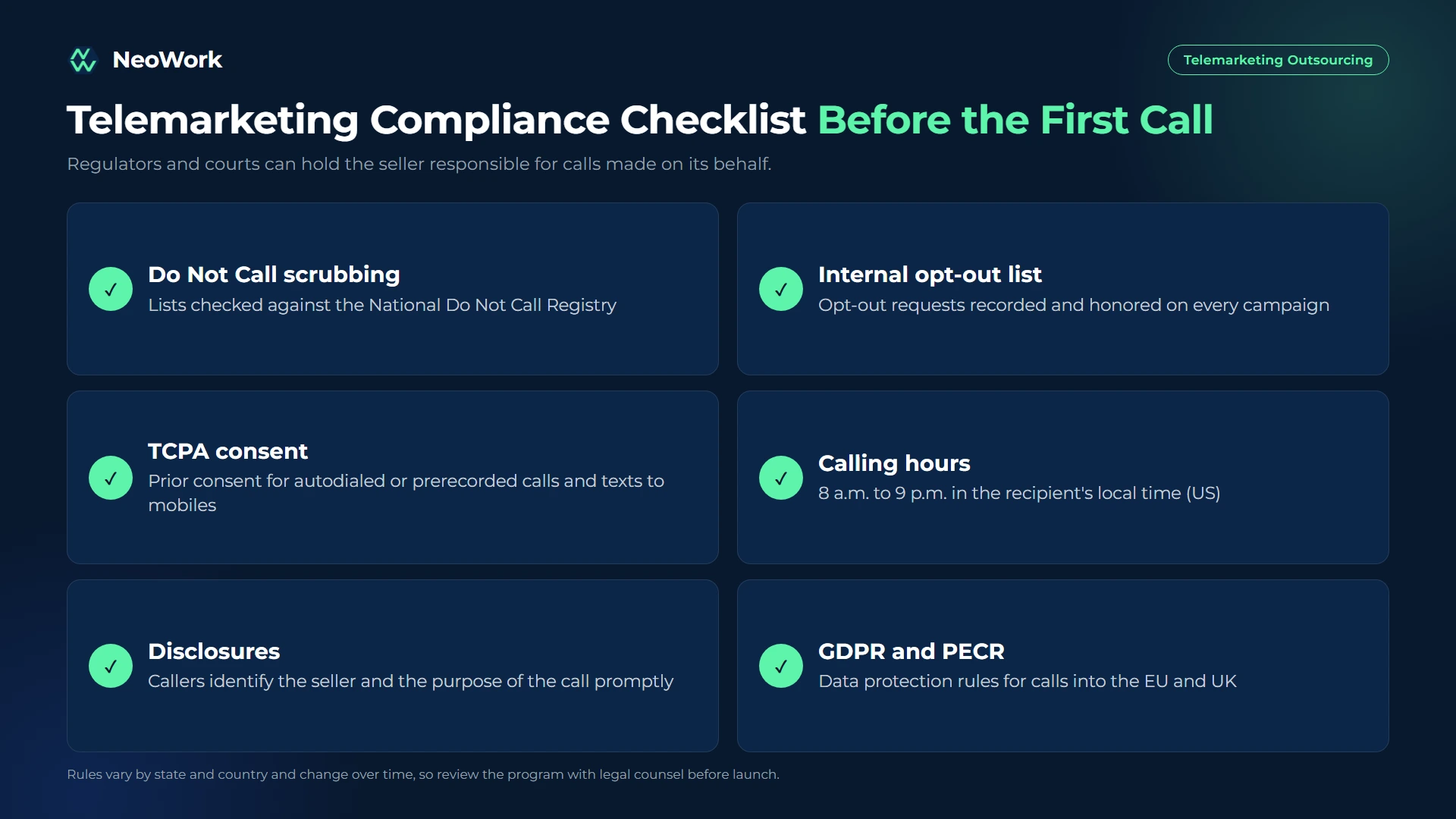
Regulators and courts can hold the seller responsible for calls made on its behalf, so compliance isn't something to leave entirely to the provider. Before the first call, make sure these basics are covered:
- Do Not Call scrubbing: Lists checked against the National Do Not Call Registry and your internal opt-out list.
- Consent for automated calls: The TCPA restricts autodialed and prerecorded calls and texts to mobile numbers without prior consent.
- Calling hours: In the US, 8 a.m. to 9 p.m. in the recipient's local time.
- Disclosures: Callers identify the seller and the purpose of the call promptly.
- Data protection abroad: GDPR and PECR rules for calls into the EU and UK.
Rules vary by state and country and change over time, so review the program with legal counsel before launch.
Metrics That Actually Matter
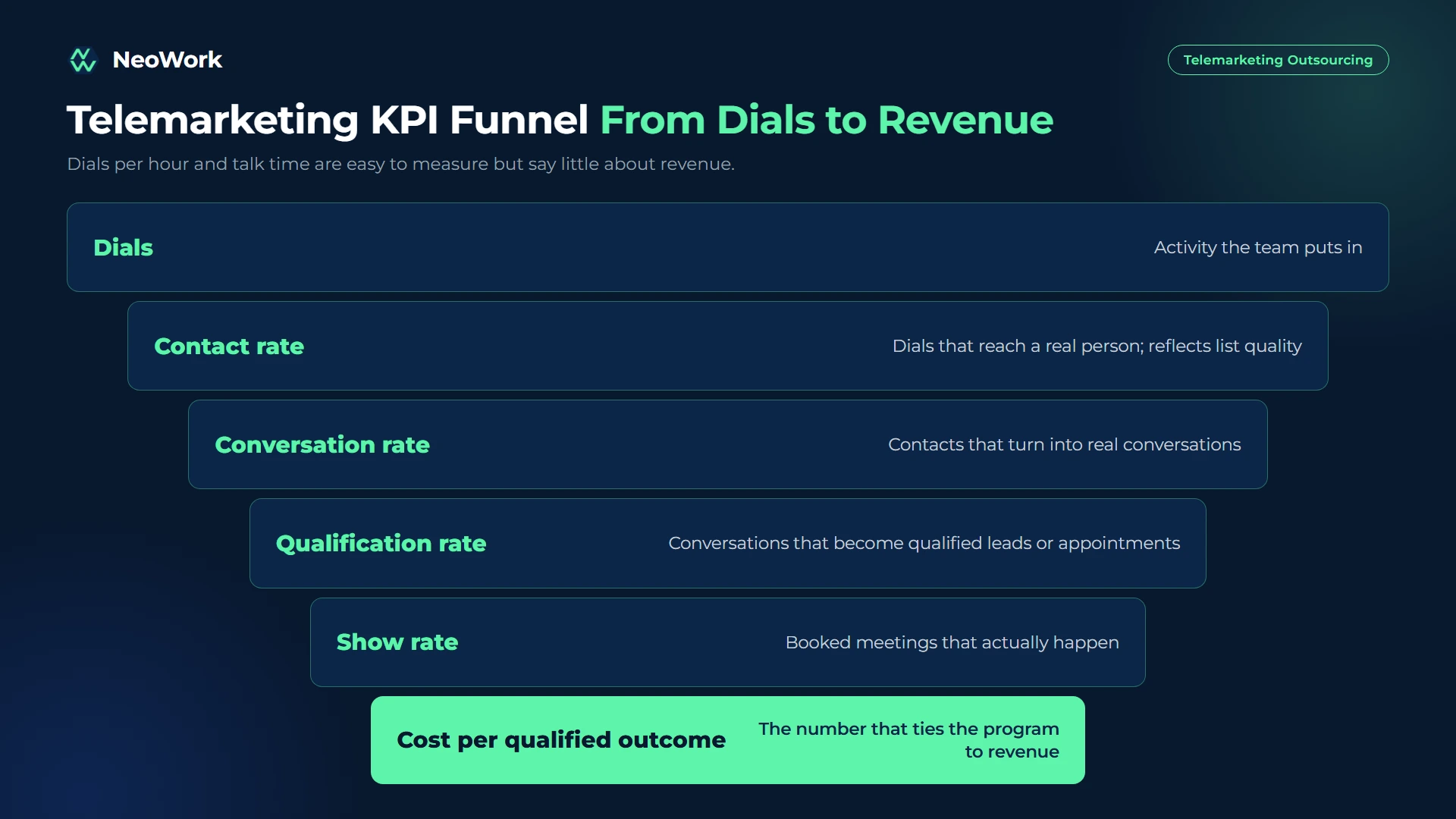
Dials per hour and talk time are easy to measure but say little about revenue. Strong programs track a funnel from activity to outcomes:
- Contact rate: How many dials reach a real person, which reflects list quality and calling windows.
- Conversation rate: How many contacts turn into real conversations.
- Qualification rate: How many conversations become qualified leads or appointments.
- Show rate: How many booked meetings actually happen.
- Cost per qualified outcome: The number that ties the program to revenue.
How to Choose a Telemarketing Partner
Getting Started: A Simple Rollout Plan
- Week 1: Define your ideal customer, qualification criteria, and talk tracks; scrub the first list; set up CRM access.
- Week 2: Start calling a small segment and review recordings daily.
- Week 3: Adjust talk tracks, calling windows, and segments based on what prospects actually say.
- Week 4: Review qualified outcomes and show rates, then decide whether to scale.
Anatomy of a Good Outbound Call
Strong telemarketing programs train callers on structure rather than word-for-word scripts. Most effective calls follow a similar flow:
- Opening: name, company, and a relevant reason for calling in the first ten seconds.
- Permission: a quick check that now is an acceptable time to talk.
- Discovery: two or three open questions that reveal whether the problem exists.
- Relevance: a short explanation of value tied to what the prospect just said.
- Qualification: honest checks against your criteria, such as role, timing, and need.
- Next step: a specific action, like a booked meeting, or a polite close if there's no fit.
- Notes: clean CRM notes so the account executive doesn't repeat questions.
Scripts vs. Talk Tracks
Rigid scripts feel safe, especially for compliance, but prospects can hear them from the first sentence. Talk tracks work better: they define the key messages, the required disclosures, and good answers to common objections, then let callers phrase things naturally.
The best approach combines both. Keep compliance language fixed and word-for-word, and keep everything else flexible. Review recordings regularly to see which openings and questions actually lead to conversations, and update talk tracks based on what prospects say rather than what you expected them to say.
Inbound Programs: What Changes
Inbound telemarketing flips the dynamic. The customer is already interested, so the job is to answer questions quickly, capture details accurately, and convert interest into an order or a qualified lead. Speed of answer matters more than in outbound, and product knowledge matters more than objection handling.
Inbound programs also need to plan for peaks. Campaign launches, TV or radio spots, and seasonal promotions can multiply call volume overnight. Agree with your partner on how quickly staffing can scale, how overflow is handled, and how missed calls are followed up, because every unanswered call is interest you already paid for.
Building and Cleaning Call Lists
List quality decides a large share of results before anyone picks up the phone. Outdated numbers, wrong contacts, and poorly targeted companies drag down contact rates and waste caller time.
- Define the ideal customer profile: industry, company size, role, and region.
- Use reliable data sources: and refresh lists regularly rather than reusing old exports.
- Scrub before every campaign: against Do Not Call registries and your internal opt-out list.
- Segment lists: so talk tracks and calling windows can be tested by segment.
- Feed results back: remove wrong numbers and update contacts after every calling round.
FAQ
Final Thoughts
Telemarketing outsourcing can fill your pipeline and free your sales team to close, as long as the program is built on clear targeting, honest qualification, and solid compliance. The partner matters, but so does how closely you stay involved in the first weeks.
Start with a focused pilot, listen to the calls, and judge results by qualified outcomes rather than activity. Then scale what works.
Topics
Telemarketing Outsourcing Guide 2026: Costs, Compliance & How to Choose

Quick Summary: Telemarketing outsourcing means hiring an external team to run phone-based sales and marketing work, such as outbound lead generation, appointment setting, renewals, and win-back calls, or inbound order and inquiry lines. The provider supplies trained callers, dialing tools, and reporting, while you keep control of the offer and the closing process. Compliance shapes everything: in the US, the FTC's Telemarketing Sales Rule, the Telephone Consumer Protection Act, and the National Do Not Call Registry all apply, and Europe and the UK add GDPR and PECR. This guide explains how telemarketing outsourcing works, what it costs, how to stay compliant, which metrics matter, and how to pick a partner.
Cold calling has been declared dead more times than anyone can count, and yet companies keep booking meetings by phone. The difference between programs that work and programs that annoy people usually isn't the phone itself. It's the targeting, the training, and how carefully the program is run.
Outsourcing can give you trained callers and infrastructure within weeks. It also means trusting someone else with your brand voice and your compliance obligations, so it's worth understanding the moving parts before you sign.
What Is Telemarketing Outsourcing?
Telemarketing outsourcing is the practice of contracting an external provider to make or receive sales and marketing calls on your behalf. The provider handles hiring, training, technology, quality monitoring, and reporting, and follows your scripts, target lists, and qualification rules.
Why Companies Outsource Telemarketing
The most common reason is focus. Account executives are expensive, and every hour they spend dialing cold lists is an hour not spent closing deals. Moving the top of the funnel to a dedicated team lets salespeople spend their time on qualified conversations.
Speed is the second reason. Building an in-house calling team means hiring, training, buying dialing software, and setting up compliance processes, all in a role with traditionally high turnover. An experienced partner already has those pieces in place and can launch a pilot quickly.
Finally, there's skill. Opening a call well, handling objections without pressure, and qualifying honestly are learned skills. Partners who run many campaigns also know how to test scripts, calling windows, and list segments systematically.
Expand Telemarketing Capacity with NeoWork
Telemarketing outsourcing helps companies add capacity for outreach, lead follow-up, and inbound calls without building a call floor in-house. At NeoWork, we provide dedicated teammates who handle prospect and customer conversations inside your CRM and dialer, following your talk tracks and qualification criteria. We handle recruitment, benefits, training, and ongoing engagement. Our industry-leading 91% annualized teammate retention rate and 3.2% candidate selectivity rate reflect our focus on selective hiring and long-term team stability.
Our telemarketing support model offers:
- sales and outreach support
- integration with your tools and processes
- recruitment and ongoing teammate support
Contact NeoWork to add telemarketing support that works alongside your sales team.
Telemarketing Pricing Models
Whatever the model, the number to compare is cost per qualified outcome: cost per held meeting, per sales-accepted lead, or per closed deal.
Compliance: The Part Companies Can't Skip
Regulators and courts can hold the seller responsible for calls made on its behalf, so compliance isn't something to leave entirely to the provider. Before the first call, make sure these basics are covered:
- Do Not Call scrubbing: Lists checked against the National Do Not Call Registry and your internal opt-out list.
- Consent for automated calls: The TCPA restricts autodialed and prerecorded calls and texts to mobile numbers without prior consent.
- Calling hours: In the US, 8 a.m. to 9 p.m. in the recipient's local time.
- Disclosures: Callers identify the seller and the purpose of the call promptly.
- Data protection abroad: GDPR and PECR rules for calls into the EU and UK.
Rules vary by state and country and change over time, so review the program with legal counsel before launch.
Metrics That Actually Matter
Dials per hour and talk time are easy to measure but say little about revenue. Strong programs track a funnel from activity to outcomes:
- Contact rate: How many dials reach a real person, which reflects list quality and calling windows.
- Conversation rate: How many contacts turn into real conversations.
- Qualification rate: How many conversations become qualified leads or appointments.
- Show rate: How many booked meetings actually happen.
- Cost per qualified outcome: The number that ties the program to revenue.
How to Choose a Telemarketing Partner
Getting Started: A Simple Rollout Plan
- Week 1: Define your ideal customer, qualification criteria, and talk tracks; scrub the first list; set up CRM access.
- Week 2: Start calling a small segment and review recordings daily.
- Week 3: Adjust talk tracks, calling windows, and segments based on what prospects actually say.
- Week 4: Review qualified outcomes and show rates, then decide whether to scale.
Anatomy of a Good Outbound Call
Strong telemarketing programs train callers on structure rather than word-for-word scripts. Most effective calls follow a similar flow:
- Opening: name, company, and a relevant reason for calling in the first ten seconds.
- Permission: a quick check that now is an acceptable time to talk.
- Discovery: two or three open questions that reveal whether the problem exists.
- Relevance: a short explanation of value tied to what the prospect just said.
- Qualification: honest checks against your criteria, such as role, timing, and need.
- Next step: a specific action, like a booked meeting, or a polite close if there's no fit.
- Notes: clean CRM notes so the account executive doesn't repeat questions.
Scripts vs. Talk Tracks
Rigid scripts feel safe, especially for compliance, but prospects can hear them from the first sentence. Talk tracks work better: they define the key messages, the required disclosures, and good answers to common objections, then let callers phrase things naturally.
The best approach combines both. Keep compliance language fixed and word-for-word, and keep everything else flexible. Review recordings regularly to see which openings and questions actually lead to conversations, and update talk tracks based on what prospects say rather than what you expected them to say.
Inbound Programs: What Changes
Inbound telemarketing flips the dynamic. The customer is already interested, so the job is to answer questions quickly, capture details accurately, and convert interest into an order or a qualified lead. Speed of answer matters more than in outbound, and product knowledge matters more than objection handling.
Inbound programs also need to plan for peaks. Campaign launches, TV or radio spots, and seasonal promotions can multiply call volume overnight. Agree with your partner on how quickly staffing can scale, how overflow is handled, and how missed calls are followed up, because every unanswered call is interest you already paid for.
Building and Cleaning Call Lists
List quality decides a large share of results before anyone picks up the phone. Outdated numbers, wrong contacts, and poorly targeted companies drag down contact rates and waste caller time.
- Define the ideal customer profile: industry, company size, role, and region.
- Use reliable data sources: and refresh lists regularly rather than reusing old exports.
- Scrub before every campaign: against Do Not Call registries and your internal opt-out list.
- Segment lists: so talk tracks and calling windows can be tested by segment.
- Feed results back: remove wrong numbers and update contacts after every calling round.
FAQ
Final Thoughts
Telemarketing outsourcing can fill your pipeline and free your sales team to close, as long as the program is built on clear targeting, honest qualification, and solid compliance. The partner matters, but so does how closely you stay involved in the first weeks.
Start with a focused pilot, listen to the calls, and judge results by qualified outcomes rather than activity. Then scale what works.
Topics
Related Blogs
Related Podcasts





