

.avif)
.avif)

UX Design Outsourcing Guide: 2026 Complete Playbook


.svg)

UX design outsourcing connects businesses with external specialists to create user-centered digital experiences without building in-house teams. Research shows 80% of users pay more for better experiences, making strategic outsourcing a competitive advantage. This guide covers when to outsource, how to choose partners, pricing models, and avoiding common pitfalls to ship better products faster.
Research from Capgemini reveals that 80% of users are willing to pay more for a better experience. That's not just a statistic—it's a business reality that's reshaping how companies approach product development.
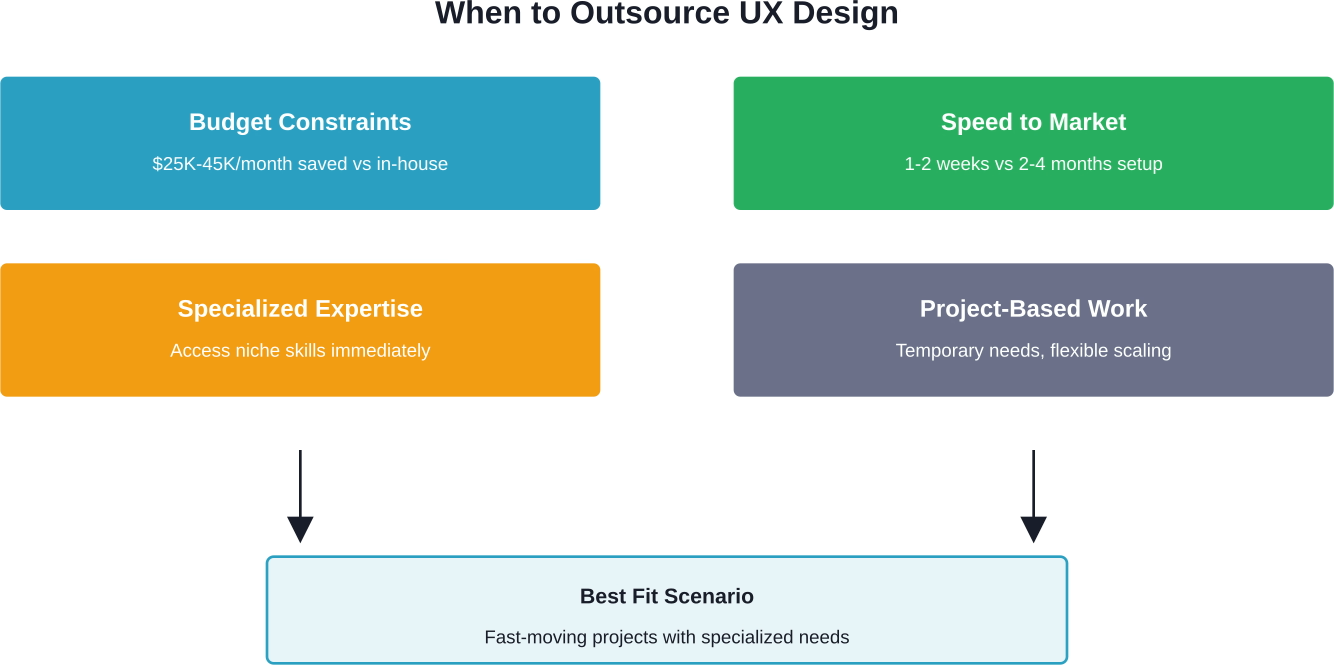
Maintaining a three-person in-house design team in the US or Western Europe typically costs between $25,000 and $45,000 monthly in salaries alone. Many businesses are discovering a different path.
UX design outsourcing has evolved from a cost-cutting tactic into a strategic advantage. Companies can access specialized expertise, accelerate time-to-market, and maintain flexibility without the overhead of permanent hires.
But here's the thing—outsourcing design isn't as simple as hiring a contractor and handing over a brief. It requires understanding what to outsource, when to do it, and how to manage external teams effectively.
This guide breaks down the entire process: from identifying when outsourcing makes sense to choosing the right partner, managing collaboration, and avoiding the pitfalls that derail projects.
What UX Design Outsourcing Actually Means
UX design outsourcing involves partnering with external specialists or agencies to handle user experience design work. Instead of hiring full-time designers, businesses contract with external teams for specific projects or ongoing design needs.
These outsourced teams handle everything from user research and information architecture to wireframing, prototyping, and visual design. UX design agencies employ skilled professionals—including UX designers, researchers, and strategists—who work exclusively on creating user-centered digital experiences.
The scope varies dramatically. Some companies outsource a single project like redesigning a checkout flow. Others build long-term partnerships where external teams function as an extension of their product organization.
What makes this different from traditional hiring? Speed and flexibility.
In-house hiring typically takes 2-4 months when factoring in recruiting, interviewing, and onboarding. Outsourced design partners can start delivering work within 1-2 weeks after contracting and briefing.
When Outsourcing Makes Strategic Sense
Not every situation calls for outsourcing. Understanding when it delivers real value helps businesses make smarter decisions.
Budget Constraints and Cost Efficiency
Maintaining a three-person design team costs $25,000-$45,000 monthly in salaries alone, according to recent industry data. That doesn't include benefits, equipment, software licenses, or management overhead.
Outsourced design partners often work on project-based or retainer models, converting fixed costs into variable expenses. For smaller companies or startups, this flexibility can mean the difference between shipping a product or running out of runway.
Access to Specialized Expertise
UX design encompasses dozens of specializations: user research, interaction design, visual design, accessibility, mobile-first design, and more. Building a team with expertise across all these areas takes years.
External design partners bring specialists who've solved similar problems dozens of times. Need someone who understands healthcare compliance and HIPAA regulations? Or fintech authentication flows? Specialized agencies already have that expertise on staff.
Speed and Time-to-Market
Product launches don't wait for hiring cycles. When time-to-market determines competitive advantage, outsourcing accelerates delivery without sacrificing quality.
External teams can ramp up immediately, working in parallel with internal development teams to compress timelines.
Project-Based or Temporary Needs
Some design work is inherently temporary. A website redesign, a new mobile app, or preparing for a funding round all have defined endpoints.
Hiring permanent staff for temporary work creates inefficiency. Outsourcing matches resource allocation to actual needs.
In-House vs Outsourced Design Teams: The Real Tradeoffs
The decision between in-house and outsourced design isn't binary. Understanding the actual tradeoffs helps companies make choices aligned with their situation.
In-house teams build institutional knowledge. They understand product history, user segments, technical constraints, and company culture deeply. That context accelerates decision-making and reduces miscommunication.
But there's a catch. Building that knowledge takes time, and in-house teams can develop blind spots from working on the same product for months or years.
Outsourced teams bring fresh perspective and cross-industry expertise. They've solved similar problems for other clients and can apply those learnings immediately. The tradeoff? They require more explicit communication and documentation of context that in-house teams absorb naturally.
The Hybrid Approach
Many successful companies don't choose one or the other exclusively. They maintain a small core design team internally while outsourcing specialized work or overflow capacity.
This hybrid model captures benefits from both approaches: institutional knowledge from internal designers, plus specialized expertise and flexibility from external partners.

Simplify UX Design with NeoWork
Outsourcing UX design can help companies scale design capabilities without building a full in-house team. NeoWork provides vetted remote UX designers who integrate into your workflows and deliver high-quality designs that align with your brand and user goals.
With access to top global talent, NeoWork supports:
- user research and persona development
- wireframing and prototyping
- visual design and interaction design
- usability testing and design iteration
Whether you need designers to augment your existing team or take ownership of specific UX projects, NeoWork ensures consistent quality and collaboration. Get started with NeoWork today to streamline your UX design outsourcing and access expert design talent.
What Design Tasks to Outsource
Not all UX design work is equally suited for outsourcing. Some tasks transfer seamlessly to external teams, while others benefit from in-house ownership.
Highly Outsourceable Work
User research and testing often outsource effectively. External researchers bring methodological expertise and unbiased perspectives. They can recruit participants, conduct interviews, run usability tests, and deliver insights without internal politics influencing findings.
Visual design and UI work translates well to outsourcing. Creating high-fidelity mockups, design systems, and production-ready assets requires specialized skills but less ongoing product context than strategic work.
Prototyping for specific features or flows works well externally. External teams can rapidly create interactive prototypes for testing and validation without needing deep knowledge of the entire product ecosystem.
Work That Benefits from Internal Ownership
Strategic product decisions and vision-setting typically stay internal. These require deep understanding of business goals, technical constraints, and long-term roadmap planning.
Design systems governance and maintenance often work better in-house. While external teams can build initial systems, maintaining consistency and making evolution decisions benefits from daily product exposure.
Real talk: the dividing line isn't absolute. What matters more than the task type is having clear communication channels, documented processes, and aligned expectations.
Choosing the Right UX Design Partner
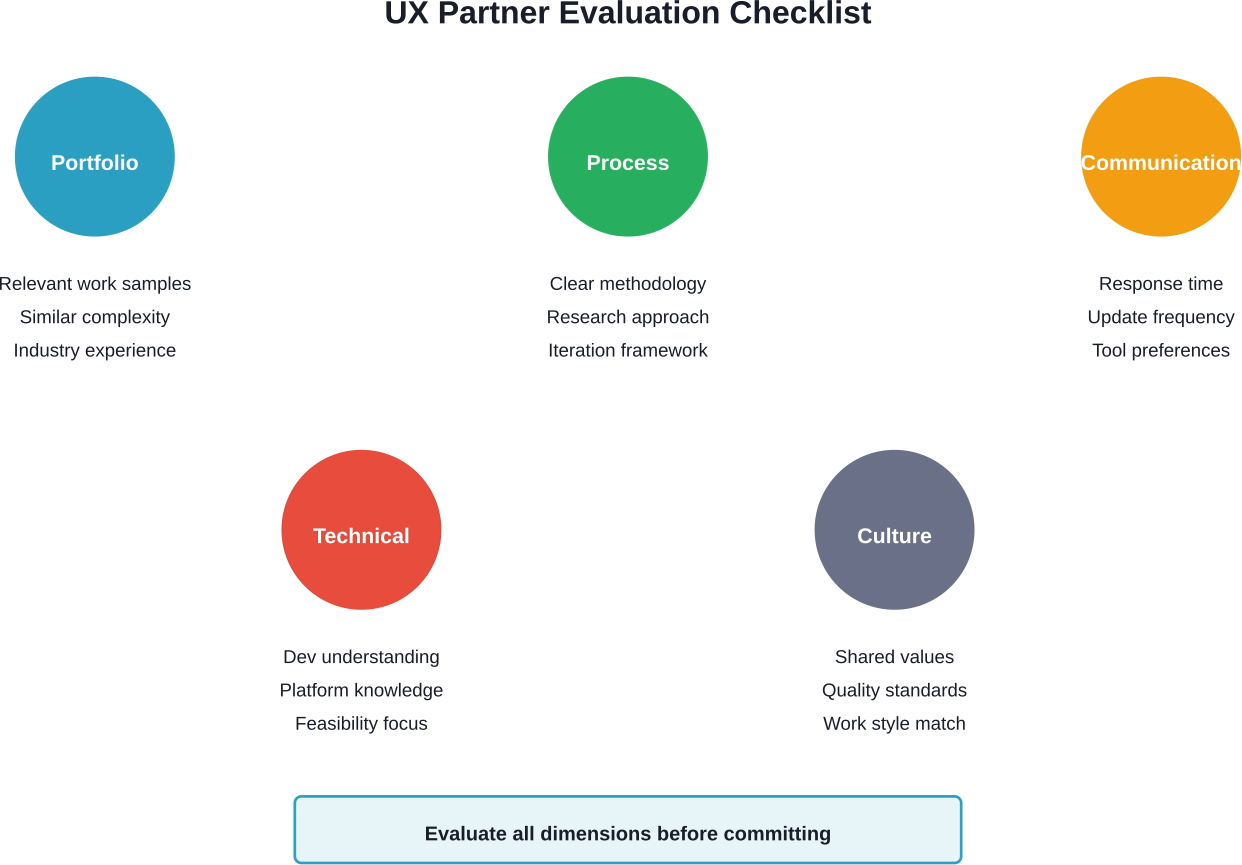
Partner selection determines whether outsourcing succeeds or becomes a expensive lesson. Several factors separate effective partnerships from problematic ones.
Portfolio and Relevant Experience
Review actual work samples, not just polished case studies. Look for projects similar to current needs in complexity, industry, or user type.
Ask specific questions: What challenges did they face? How did they measure success? What would they do differently? Generic answers signal surface-level involvement.
Process and Methodology
Understand how the partner works. Do they start with research or jump straight to design? How do they handle feedback and iteration? What does their typical timeline look like?
Partners who can't articulate their process clearly usually don't have one. That leads to miscommunication and missed expectations.
Communication and Collaboration Style
Strong outsourcing relationships require clear, frequent communication. Evaluate responsiveness during the sales process—it's a preview of how they'll operate during projects.
Clarify communication preferences: synchronous meetings versus asynchronous updates, tools they use, typical response times, and how they handle urgent questions.
Technical Capabilities
For digital products, design partners need technical fluency. They should understand development constraints, platform limitations, and implementation feasibility.
Designers who create beautiful mockups that are impossible or expensive to build create friction, not value.
Cultural Fit and Values
This sounds soft, but it matters. Partners who share similar values around user experience, quality standards, and work ethics integrate more smoothly.
Misaligned values surface as friction during tough decisions: when to ship versus iterate, how much research is enough, or whether to compromise quality for deadlines.
Understanding Outsourcing Pricing Models
UX design partners typically offer several pricing structures. Each has different implications for cost predictability, flexibility, and risk allocation.
Project-Based Fixed Price
The partner quotes a fixed price for defined deliverables. This works well for projects with clear scope: "redesign the checkout flow" or "create a design system with 50 components."
Fixed pricing offers budget predictability but requires detailed upfront scoping. Scope changes typically trigger change orders and additional costs.
Time and Materials
Billing happens based on actual hours worked at agreed rates. This provides maximum flexibility for evolving requirements but less budget certainty.
This model suits exploratory work, ongoing partnerships, or situations where requirements will emerge through the design process.
Retainer Arrangements
Monthly retainers secure a set amount of design capacity (often measured in hours or "design sprints"). This combines some predictability with flexibility for what gets worked on month-to-month.
Retainers work well for ongoing design needs across multiple projects or continuous product evolution.
Value-Based Pricing
Some partners price based on expected business impact rather than time or deliverables. This aligns incentives but requires agreement on how to measure value.
Value-based pricing typically applies to strategic work where design directly impacts revenue, conversion, or other measurable outcomes.
The UX Outsourcing Process: How It Actually Works
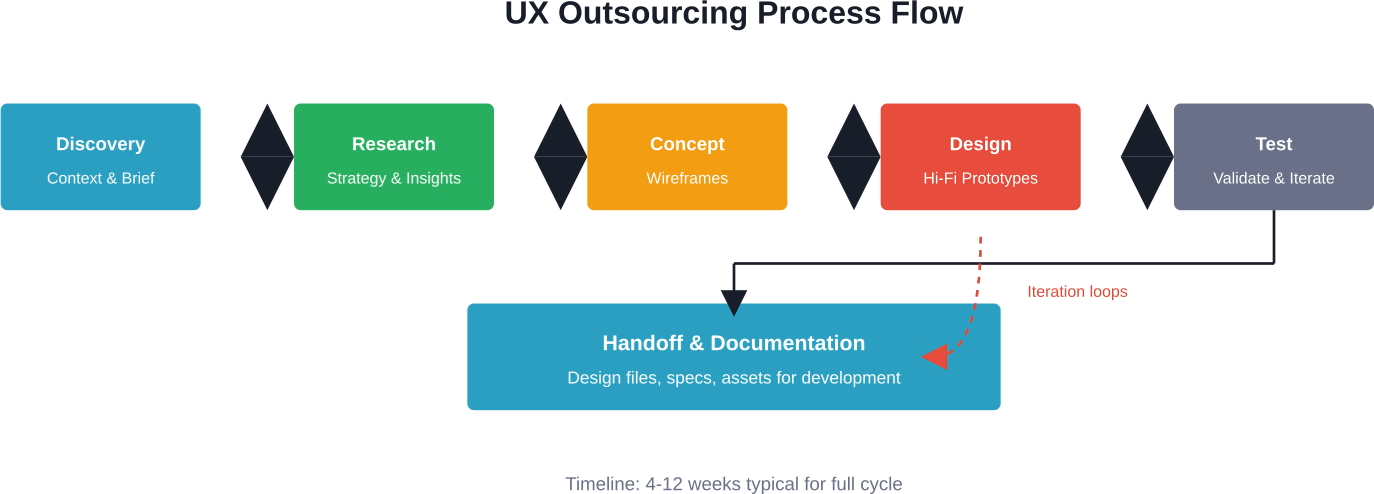
Successful outsourcing follows a structured process. While details vary, effective partnerships share common phases.
Discovery and Briefing
This phase establishes shared understanding. The internal team provides context: business goals, user insights, technical constraints, brand guidelines, and success criteria.
Strong briefs include examples of what success looks like, explicit constraints, and clear decision-making authority. Weak briefs say "make it better" and hope designers intuit the rest.
The external team asks clarifying questions, challenges assumptions, and confirms understanding before work begins.
Research and Strategy
For strategic engagements, designers start with research. This might include competitive analysis, user interviews, analytics review, or heuristic evaluation of existing experiences.
Research outputs typically include findings documents, user personas, journey maps, or opportunity frameworks that guide subsequent design decisions.
Concept and Wireframing
Designers explore multiple directions through sketches, low-fidelity wireframes, or concept mockups. The goal is exploring possibilities without investing in high-fidelity execution yet.
This phase benefits from frequent check-ins. Course-correcting early prevents wasted effort on directions that won't work.
Design and Prototyping
Selected concepts evolve into high-fidelity designs and interactive prototypes. These deliverables communicate the intended experience clearly enough for user testing and development handoff.
Prototyping tools like Figma, Adobe XD, or others allow designers to create realistic interactions without writing production code.
Testing and Iteration
Designs get validated through usability testing, stakeholder feedback, or technical feasibility review. Findings inform refinements before final delivery.
Iteration cycles vary in length and number based on project scope and budget.
Handoff and Documentation
Final deliverables include design files, specifications, asset exports, and documentation developers need for implementation.
Strong handoffs include design rationale, interaction details, responsive behavior, and accessibility requirements—not just static mockups.
Managing Outsourced UX Teams Effectively
UX outsourcing doesn't fail because of talent. It fails because of friction—slow decisions, scattered feedback, and misaligned expectations.
Establish Clear Communication Rhythms
Set up regular check-ins. One weekly sync of 30-60 minutes to review progress, unblock issues, and decide next steps prevents most communication breakdowns.
Between meetings, use asynchronous tools (Slack, project management software, shared design files) so work progresses without constant scheduling.
Centralize Feedback and Decision-Making
Feedback from multiple stakeholders delivered through different channels creates confusion. Designate a single point of contact who consolidates input and makes final decisions.
External teams can't resolve internal disagreements. When stakeholders conflict, internal teams need to align before passing feedback to designers.
Provide Context Generously
External teams lack institutional knowledge. Share context proactively: why features exist, what's been tried before, technical constraints, and strategic priorities.
The more context designers have, the better decisions they make autonomously without constant check-ins.
Set Clear Success Criteria
Define what success looks like before work starts. Measurable outcomes (improved conversion, reduced support tickets, faster task completion) provide objective evaluation criteria.
Without clear criteria, design feedback becomes subjective preference debates rather than assessment against goals.
Build Trust Through Small Projects First
Start partnerships with limited scope projects before committing to major initiatives. This allows both sides to calibrate communication, establish trust, and validate working styles with lower risk.
Common Challenges and How to Navigate Them
Even well-managed outsourcing relationships encounter predictable challenges. Anticipating them helps minimize disruption.
Knowledge Transfer and Product Context
External teams start with limited product understanding. They'll ask questions that seem obvious to internal teams.
The solution? Documentation. Create onboarding materials: product overview, user research summaries, technical architecture, design principles, and past decisions.
Yes, this takes time upfront. But it pays back quickly through fewer repeated explanations and faster designer autonomy.
Time Zone and Cultural Differences
Offshore outsourcing often involves time zone gaps. This can slow feedback cycles if not managed deliberately.
Strategies that help: overlap working hours for real-time collaboration, use asynchronous tools effectively, and establish clear expectations about response times.
Cultural differences affect communication styles. Some cultures favor direct feedback, others indirect. Some assume questions indicate disagreement, others see them as engagement. Being explicit about communication preferences prevents misunderstanding.
Quality Inconsistency
Output quality can vary between designers at the same agency or across project phases.
Mitigate this by requesting specific designers for projects, establishing quality checkpoints throughout work rather than only reviewing final deliverables, and providing clear examples of quality standards.
Scope Creep and Budget Overruns
Ill-defined requirements lead to scope expansion and budget surprises. This frustrates both sides.
Prevent it through detailed upfront scoping, documented change order processes, and regular project status reviews that catch drift early.
Integration with Development Teams
Designs created in isolation from development constraints often require expensive rework or create implementation friction.
Include developers in design reviews. Have external designers participate in technical planning. Use design systems and component libraries that align with development frameworks.
Making Outsourcing Work Long-Term
Initial projects might succeed, but sustaining effective outsourcing requires ongoing effort.
Treat Partners as Extensions of the Team
The best outsourcing relationships feel less like vendor management and more like team collaboration. Include external designers in relevant meetings, share company updates, and recognize their contributions.
Invest in Relationship Building
Business relationships are still relationships. Regular communication beyond project status, understanding partner constraints and goals, and occasional face-to-face interaction (even virtual) strengthen partnerships.
Evolve Together
As products mature, design needs change. Partners who grow capabilities alongside product evolution deliver more value than those maintained at arms length.
Share product roadmaps, involve partners in strategic planning, and be transparent about changing needs.
Measure and Optimize
Track outsourcing effectiveness: delivery timelines, quality metrics, cost per deliverable, and business impact of design work.
Use data to identify what's working and what needs adjustment. Optimization is ongoing, not one-time.
Key Takeaways for UX Design Outsourcing Success
UX design outsourcing delivers real competitive advantages when executed strategically. Research confirms that 80% of users will pay more for better experiences—investing in quality design through the right partnerships creates measurable business value.
The fundamentals that separate successful outsourcing from failed attempts:
Start with clear objectives. Understand specifically what needs outsourcing and why. Budget savings, specialized expertise, or speed to market all require different approaches.
Choose partners carefully. Portfolio quality, process clarity, communication style, technical capability, and cultural alignment all matter. Evaluate thoroughly before committing to major projects.
Manage deliberately. Regular communication rhythms, centralized feedback, generous context sharing, and clear success criteria prevent the friction that derails projects.
But here's what matters most: outsourcing isn't about handing off responsibility. It's about strategic collaboration with specialized experts who extend internal capabilities.
Organizations with higher UX maturity understand and implement user-centered design principles across the organization. Research indicates that a significant percentage of customers will abandon a brand after negative experiences.
That reality makes design quality non-negotiable. The question isn't whether to invest in UX design, but how to access the expertise needed to execute it well.
For many businesses, outsourcing provides the fastest path to shipping products that users love—without the overhead, time, and risk of building internal teams from scratch.
Frequently Asked Questions
Topics
UX Design Outsourcing Guide: 2026 Complete Playbook

UX design outsourcing connects businesses with external specialists to create user-centered digital experiences without building in-house teams. Research shows 80% of users pay more for better experiences, making strategic outsourcing a competitive advantage. This guide covers when to outsource, how to choose partners, pricing models, and avoiding common pitfalls to ship better products faster.
Research from Capgemini reveals that 80% of users are willing to pay more for a better experience. That's not just a statistic—it's a business reality that's reshaping how companies approach product development.
Maintaining a three-person in-house design team in the US or Western Europe typically costs between $25,000 and $45,000 monthly in salaries alone. Many businesses are discovering a different path.
UX design outsourcing has evolved from a cost-cutting tactic into a strategic advantage. Companies can access specialized expertise, accelerate time-to-market, and maintain flexibility without the overhead of permanent hires.
But here's the thing—outsourcing design isn't as simple as hiring a contractor and handing over a brief. It requires understanding what to outsource, when to do it, and how to manage external teams effectively.
This guide breaks down the entire process: from identifying when outsourcing makes sense to choosing the right partner, managing collaboration, and avoiding the pitfalls that derail projects.
What UX Design Outsourcing Actually Means
UX design outsourcing involves partnering with external specialists or agencies to handle user experience design work. Instead of hiring full-time designers, businesses contract with external teams for specific projects or ongoing design needs.
These outsourced teams handle everything from user research and information architecture to wireframing, prototyping, and visual design. UX design agencies employ skilled professionals—including UX designers, researchers, and strategists—who work exclusively on creating user-centered digital experiences.
The scope varies dramatically. Some companies outsource a single project like redesigning a checkout flow. Others build long-term partnerships where external teams function as an extension of their product organization.
What makes this different from traditional hiring? Speed and flexibility.
In-house hiring typically takes 2-4 months when factoring in recruiting, interviewing, and onboarding. Outsourced design partners can start delivering work within 1-2 weeks after contracting and briefing.
When Outsourcing Makes Strategic Sense
Not every situation calls for outsourcing. Understanding when it delivers real value helps businesses make smarter decisions.
Budget Constraints and Cost Efficiency
Maintaining a three-person design team costs $25,000-$45,000 monthly in salaries alone, according to recent industry data. That doesn't include benefits, equipment, software licenses, or management overhead.
Outsourced design partners often work on project-based or retainer models, converting fixed costs into variable expenses. For smaller companies or startups, this flexibility can mean the difference between shipping a product or running out of runway.
Access to Specialized Expertise
UX design encompasses dozens of specializations: user research, interaction design, visual design, accessibility, mobile-first design, and more. Building a team with expertise across all these areas takes years.
External design partners bring specialists who've solved similar problems dozens of times. Need someone who understands healthcare compliance and HIPAA regulations? Or fintech authentication flows? Specialized agencies already have that expertise on staff.
Speed and Time-to-Market
Product launches don't wait for hiring cycles. When time-to-market determines competitive advantage, outsourcing accelerates delivery without sacrificing quality.
External teams can ramp up immediately, working in parallel with internal development teams to compress timelines.
Project-Based or Temporary Needs
Some design work is inherently temporary. A website redesign, a new mobile app, or preparing for a funding round all have defined endpoints.
Hiring permanent staff for temporary work creates inefficiency. Outsourcing matches resource allocation to actual needs.
In-House vs Outsourced Design Teams: The Real Tradeoffs
The decision between in-house and outsourced design isn't binary. Understanding the actual tradeoffs helps companies make choices aligned with their situation.
In-house teams build institutional knowledge. They understand product history, user segments, technical constraints, and company culture deeply. That context accelerates decision-making and reduces miscommunication.
But there's a catch. Building that knowledge takes time, and in-house teams can develop blind spots from working on the same product for months or years.
Outsourced teams bring fresh perspective and cross-industry expertise. They've solved similar problems for other clients and can apply those learnings immediately. The tradeoff? They require more explicit communication and documentation of context that in-house teams absorb naturally.
The Hybrid Approach
Many successful companies don't choose one or the other exclusively. They maintain a small core design team internally while outsourcing specialized work or overflow capacity.
This hybrid model captures benefits from both approaches: institutional knowledge from internal designers, plus specialized expertise and flexibility from external partners.
Simplify UX Design with NeoWork
Outsourcing UX design can help companies scale design capabilities without building a full in-house team. NeoWork provides vetted remote UX designers who integrate into your workflows and deliver high-quality designs that align with your brand and user goals.
With access to top global talent, NeoWork supports:
- user research and persona development
- wireframing and prototyping
- visual design and interaction design
- usability testing and design iteration
Whether you need designers to augment your existing team or take ownership of specific UX projects, NeoWork ensures consistent quality and collaboration. Get started with NeoWork today to streamline your UX design outsourcing and access expert design talent.
What Design Tasks to Outsource
Not all UX design work is equally suited for outsourcing. Some tasks transfer seamlessly to external teams, while others benefit from in-house ownership.
Highly Outsourceable Work
User research and testing often outsource effectively. External researchers bring methodological expertise and unbiased perspectives. They can recruit participants, conduct interviews, run usability tests, and deliver insights without internal politics influencing findings.
Visual design and UI work translates well to outsourcing. Creating high-fidelity mockups, design systems, and production-ready assets requires specialized skills but less ongoing product context than strategic work.
Prototyping for specific features or flows works well externally. External teams can rapidly create interactive prototypes for testing and validation without needing deep knowledge of the entire product ecosystem.
Work That Benefits from Internal Ownership
Strategic product decisions and vision-setting typically stay internal. These require deep understanding of business goals, technical constraints, and long-term roadmap planning.
Design systems governance and maintenance often work better in-house. While external teams can build initial systems, maintaining consistency and making evolution decisions benefits from daily product exposure.
Real talk: the dividing line isn't absolute. What matters more than the task type is having clear communication channels, documented processes, and aligned expectations.
Choosing the Right UX Design Partner
Partner selection determines whether outsourcing succeeds or becomes a expensive lesson. Several factors separate effective partnerships from problematic ones.
Portfolio and Relevant Experience
Review actual work samples, not just polished case studies. Look for projects similar to current needs in complexity, industry, or user type.
Ask specific questions: What challenges did they face? How did they measure success? What would they do differently? Generic answers signal surface-level involvement.
Process and Methodology
Understand how the partner works. Do they start with research or jump straight to design? How do they handle feedback and iteration? What does their typical timeline look like?
Partners who can't articulate their process clearly usually don't have one. That leads to miscommunication and missed expectations.
Communication and Collaboration Style
Strong outsourcing relationships require clear, frequent communication. Evaluate responsiveness during the sales process—it's a preview of how they'll operate during projects.
Clarify communication preferences: synchronous meetings versus asynchronous updates, tools they use, typical response times, and how they handle urgent questions.
Technical Capabilities
For digital products, design partners need technical fluency. They should understand development constraints, platform limitations, and implementation feasibility.
Designers who create beautiful mockups that are impossible or expensive to build create friction, not value.
Cultural Fit and Values
This sounds soft, but it matters. Partners who share similar values around user experience, quality standards, and work ethics integrate more smoothly.
Misaligned values surface as friction during tough decisions: when to ship versus iterate, how much research is enough, or whether to compromise quality for deadlines.
Understanding Outsourcing Pricing Models
UX design partners typically offer several pricing structures. Each has different implications for cost predictability, flexibility, and risk allocation.
Project-Based Fixed Price
The partner quotes a fixed price for defined deliverables. This works well for projects with clear scope: "redesign the checkout flow" or "create a design system with 50 components."
Fixed pricing offers budget predictability but requires detailed upfront scoping. Scope changes typically trigger change orders and additional costs.
Time and Materials
Billing happens based on actual hours worked at agreed rates. This provides maximum flexibility for evolving requirements but less budget certainty.
This model suits exploratory work, ongoing partnerships, or situations where requirements will emerge through the design process.
Retainer Arrangements
Monthly retainers secure a set amount of design capacity (often measured in hours or "design sprints"). This combines some predictability with flexibility for what gets worked on month-to-month.
Retainers work well for ongoing design needs across multiple projects or continuous product evolution.
Value-Based Pricing
Some partners price based on expected business impact rather than time or deliverables. This aligns incentives but requires agreement on how to measure value.
Value-based pricing typically applies to strategic work where design directly impacts revenue, conversion, or other measurable outcomes.
The UX Outsourcing Process: How It Actually Works
Successful outsourcing follows a structured process. While details vary, effective partnerships share common phases.
Discovery and Briefing
This phase establishes shared understanding. The internal team provides context: business goals, user insights, technical constraints, brand guidelines, and success criteria.
Strong briefs include examples of what success looks like, explicit constraints, and clear decision-making authority. Weak briefs say "make it better" and hope designers intuit the rest.
The external team asks clarifying questions, challenges assumptions, and confirms understanding before work begins.
Research and Strategy
For strategic engagements, designers start with research. This might include competitive analysis, user interviews, analytics review, or heuristic evaluation of existing experiences.
Research outputs typically include findings documents, user personas, journey maps, or opportunity frameworks that guide subsequent design decisions.
Concept and Wireframing
Designers explore multiple directions through sketches, low-fidelity wireframes, or concept mockups. The goal is exploring possibilities without investing in high-fidelity execution yet.
This phase benefits from frequent check-ins. Course-correcting early prevents wasted effort on directions that won't work.
Design and Prototyping
Selected concepts evolve into high-fidelity designs and interactive prototypes. These deliverables communicate the intended experience clearly enough for user testing and development handoff.
Prototyping tools like Figma, Adobe XD, or others allow designers to create realistic interactions without writing production code.
Testing and Iteration
Designs get validated through usability testing, stakeholder feedback, or technical feasibility review. Findings inform refinements before final delivery.
Iteration cycles vary in length and number based on project scope and budget.
Handoff and Documentation
Final deliverables include design files, specifications, asset exports, and documentation developers need for implementation.
Strong handoffs include design rationale, interaction details, responsive behavior, and accessibility requirements—not just static mockups.
Managing Outsourced UX Teams Effectively
UX outsourcing doesn't fail because of talent. It fails because of friction—slow decisions, scattered feedback, and misaligned expectations.
Establish Clear Communication Rhythms
Set up regular check-ins. One weekly sync of 30-60 minutes to review progress, unblock issues, and decide next steps prevents most communication breakdowns.
Between meetings, use asynchronous tools (Slack, project management software, shared design files) so work progresses without constant scheduling.
Centralize Feedback and Decision-Making
Feedback from multiple stakeholders delivered through different channels creates confusion. Designate a single point of contact who consolidates input and makes final decisions.
External teams can't resolve internal disagreements. When stakeholders conflict, internal teams need to align before passing feedback to designers.
Provide Context Generously
External teams lack institutional knowledge. Share context proactively: why features exist, what's been tried before, technical constraints, and strategic priorities.
The more context designers have, the better decisions they make autonomously without constant check-ins.
Set Clear Success Criteria
Define what success looks like before work starts. Measurable outcomes (improved conversion, reduced support tickets, faster task completion) provide objective evaluation criteria.
Without clear criteria, design feedback becomes subjective preference debates rather than assessment against goals.
Build Trust Through Small Projects First
Start partnerships with limited scope projects before committing to major initiatives. This allows both sides to calibrate communication, establish trust, and validate working styles with lower risk.
Common Challenges and How to Navigate Them
Even well-managed outsourcing relationships encounter predictable challenges. Anticipating them helps minimize disruption.
Knowledge Transfer and Product Context
External teams start with limited product understanding. They'll ask questions that seem obvious to internal teams.
The solution? Documentation. Create onboarding materials: product overview, user research summaries, technical architecture, design principles, and past decisions.
Yes, this takes time upfront. But it pays back quickly through fewer repeated explanations and faster designer autonomy.
Time Zone and Cultural Differences
Offshore outsourcing often involves time zone gaps. This can slow feedback cycles if not managed deliberately.
Strategies that help: overlap working hours for real-time collaboration, use asynchronous tools effectively, and establish clear expectations about response times.
Cultural differences affect communication styles. Some cultures favor direct feedback, others indirect. Some assume questions indicate disagreement, others see them as engagement. Being explicit about communication preferences prevents misunderstanding.
Quality Inconsistency
Output quality can vary between designers at the same agency or across project phases.
Mitigate this by requesting specific designers for projects, establishing quality checkpoints throughout work rather than only reviewing final deliverables, and providing clear examples of quality standards.
Scope Creep and Budget Overruns
Ill-defined requirements lead to scope expansion and budget surprises. This frustrates both sides.
Prevent it through detailed upfront scoping, documented change order processes, and regular project status reviews that catch drift early.
Integration with Development Teams
Designs created in isolation from development constraints often require expensive rework or create implementation friction.
Include developers in design reviews. Have external designers participate in technical planning. Use design systems and component libraries that align with development frameworks.
Making Outsourcing Work Long-Term
Initial projects might succeed, but sustaining effective outsourcing requires ongoing effort.
Treat Partners as Extensions of the Team
The best outsourcing relationships feel less like vendor management and more like team collaboration. Include external designers in relevant meetings, share company updates, and recognize their contributions.
Invest in Relationship Building
Business relationships are still relationships. Regular communication beyond project status, understanding partner constraints and goals, and occasional face-to-face interaction (even virtual) strengthen partnerships.
Evolve Together
As products mature, design needs change. Partners who grow capabilities alongside product evolution deliver more value than those maintained at arms length.
Share product roadmaps, involve partners in strategic planning, and be transparent about changing needs.
Measure and Optimize
Track outsourcing effectiveness: delivery timelines, quality metrics, cost per deliverable, and business impact of design work.
Use data to identify what's working and what needs adjustment. Optimization is ongoing, not one-time.
Key Takeaways for UX Design Outsourcing Success
UX design outsourcing delivers real competitive advantages when executed strategically. Research confirms that 80% of users will pay more for better experiences—investing in quality design through the right partnerships creates measurable business value.
The fundamentals that separate successful outsourcing from failed attempts:
Start with clear objectives. Understand specifically what needs outsourcing and why. Budget savings, specialized expertise, or speed to market all require different approaches.
Choose partners carefully. Portfolio quality, process clarity, communication style, technical capability, and cultural alignment all matter. Evaluate thoroughly before committing to major projects.
Manage deliberately. Regular communication rhythms, centralized feedback, generous context sharing, and clear success criteria prevent the friction that derails projects.
But here's what matters most: outsourcing isn't about handing off responsibility. It's about strategic collaboration with specialized experts who extend internal capabilities.
Organizations with higher UX maturity understand and implement user-centered design principles across the organization. Research indicates that a significant percentage of customers will abandon a brand after negative experiences.
That reality makes design quality non-negotiable. The question isn't whether to invest in UX design, but how to access the expertise needed to execute it well.
For many businesses, outsourcing provides the fastest path to shipping products that users love—without the overhead, time, and risk of building internal teams from scratch.
Frequently Asked Questions
Topics
Related Blogs
Related Podcasts


.webp)

.webp)
.webp)



