

Updated:
Oct 6
2026
.avif)
.avif)


.svg)

Quick Summary: VR game development outsourcing means hiring an external studio or independent team to build part or all of a virtual reality project, from prototyping and 3D art to engine optimization and QA. Done right, it cuts costs by roughly 30-50% compared to building an in-house team, speeds up delivery, and gives access to specialized VR skills most studios don't keep on payroll. The tradeoffs are communication overhead, IP risk, and quality control, all of which are manageable with the right contract and engagement model.
Building a virtual reality game is a different beast than shipping a flat-screen title. Hand tracking, room-scale movement, and comfort settings all need specialized testing. And the pool of developers who actually understand VR-specific performance budgets is still small, even in 2026.
That shortage is exactly why outsourcing has become the default path for a lot of studios — big and small. Instead of spending months hiring a VR-literate team, publishers and indie developers alike are contracting specialized studios who already have the pipelines, the headset libraries, and the war stories.
This guide breaks down how VR outsourcing actually works in practice: the engagement models, realistic costs by region, the vetting process, and the contract clauses that separate a smooth partnership from a costly mess.
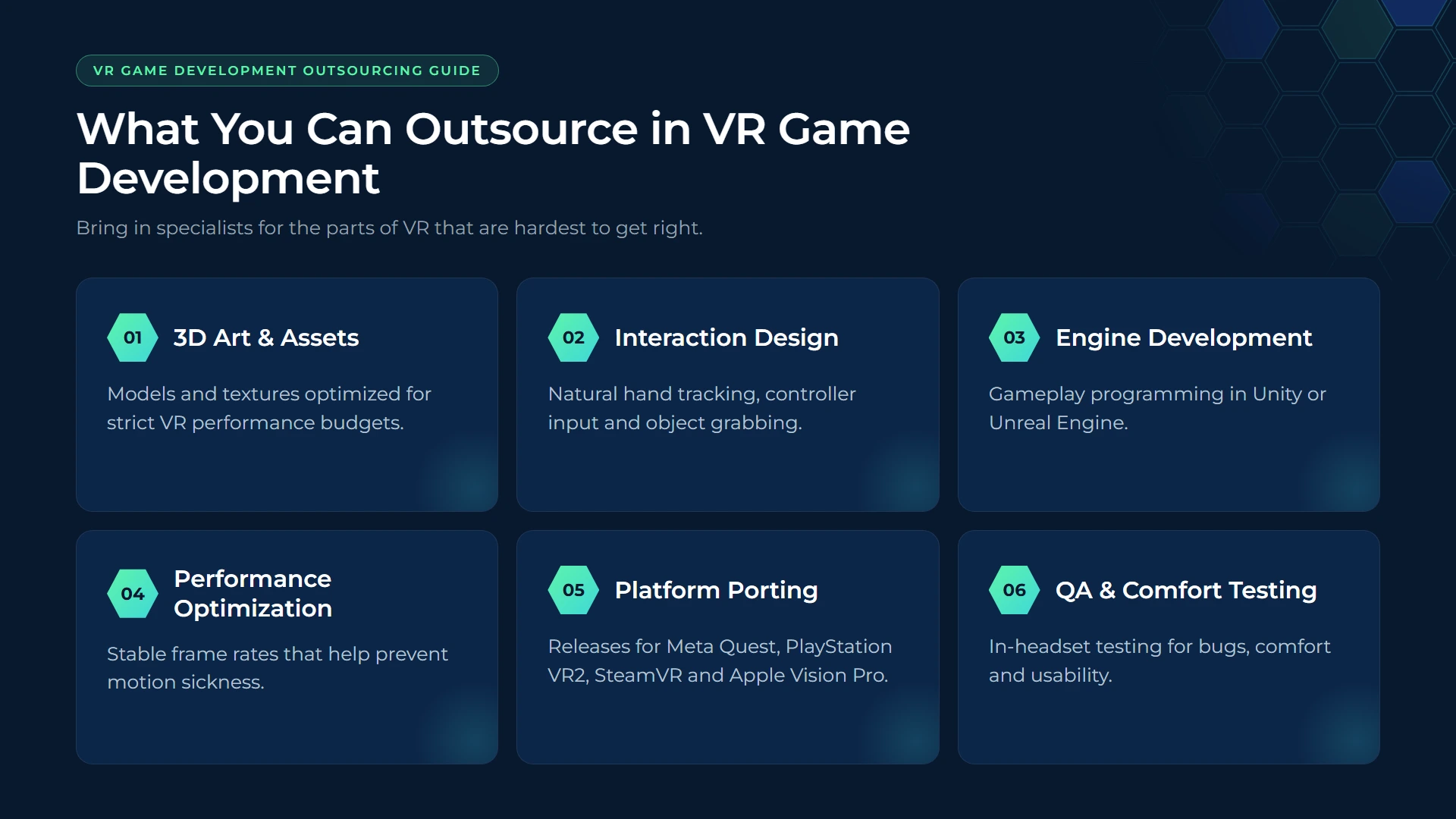
Outsourcing isn't an all-or-nothing decision. Most studios outsource specific slices of the pipeline rather than the entire project. Common scopes include:
Deciding which of these to hand off depends on what the internal team is already good at. A studio with strong gameplay programmers but no VR optimization experience, for instance, might keep design in-house and outsource only the performance tuning and headset-specific QA.
Cost is usually the headline reason, but it's rarely the only one. Specialized VR talent — people who've actually shipped on Quest 3, PSVR2, or Apple Vision Pro — is concentrated in a handful of regions, and hiring them full-time means carrying that salary even between projects.
Outsourcing solves a few problems at once: it compresses the hiring timeline from months to weeks, it brings in people who've already solved comfort and performance issues before, and it lets internal teams stay focused on game design and narrative instead of engine plumbing.
Picking the wrong engagement model is one of the most common and most expensive mistakes studios make. Here's how the main options stack up.
Dedicated teams tend to work best for VR specifically because so much of the work is iterative — comfort settings, for example, usually need several rounds of playtesting before they feel right, and fixed-price contracts punish that kind of back-and-forth.
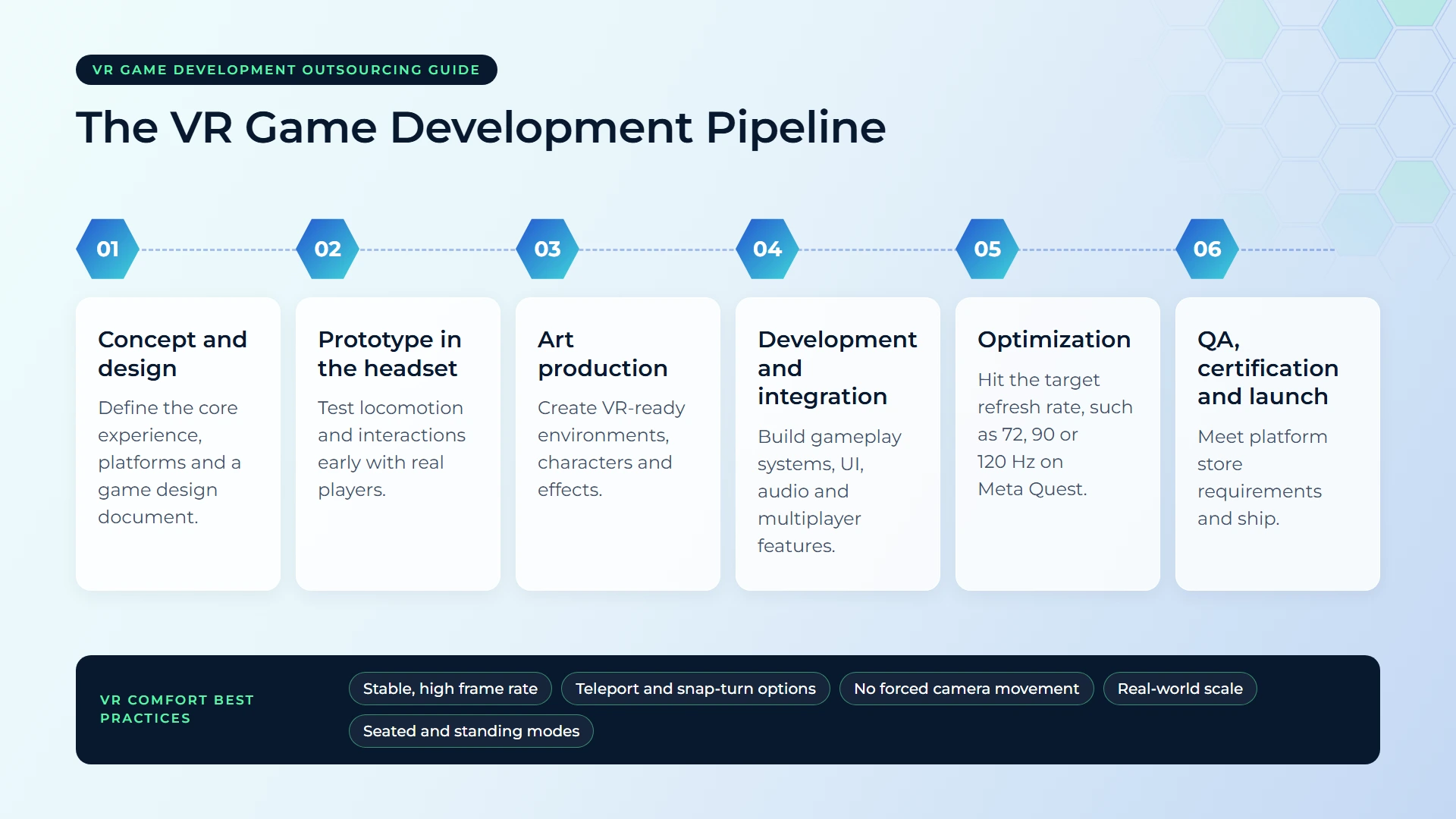
The process looks similar across most reputable studios, even if the terminology differs. Most problems start when teams rush the early stages.
Be clear about what is being outsourced — a full VR game, specific features, environments, QA, optimization, or extra development capacity. Target hardware should also be defined early because requirements differ significantly between standalone and PC-based VR.
The vetting stage deserves more attention than most teams give it. A general game-development portfolio says little about whether a studio can deliver stable performance on VR hardware.
Ask specifically for VR case studies and examples built for similar devices.
Discuss how the team handles frame-rate targets, memory limits, motion comfort, device testing, and optimization. Speaking directly with technical leads often reveals more than a polished sales presentation.
For larger projects, begin with a prototype, environment, feature, or optimization sprint. This helps test communication, delivery quality, and technical fit before committing to a longer engagement.
Agree on sprint structure, communication channels, repositories, reviews, QA responsibilities, and decision-making early. Clear ownership keeps the project moving when priorities change.
Test playable builds throughout development, ideally on the target hardware. VR performance issues are much easier to fix when caught early rather than just before launch.
The final handover should include source code, assets, documentation, build instructions, and dependencies. If the studio will provide post-launch support, define those responsibilities in advance.

VR game development outsourcing helps studios add technical and creative capacity for immersive projects without building every role internally. At NeoWork, we provide remote teammates who can support development, testing, design, and related production workflows within your existing game development environment. We handle recruitment, benefits, training, and ongoing engagement, while our teammates work inside your tools, processes, and delivery structure. Our 91% annualized teammate retention rate and 3.2% candidate selectivity rate reflect our focus on selective hiring and longer-term team stability.
Our VR game development support model offers:
Contact NeoWork to add VR game development capacity that fits your existing production workflow.
Rates vary significantly by region, and VR specialization adds a premium on top of standard game-dev rates almost everywhere. Treat the numbers below as directional — always confirm current rates directly with shortlisted studios, since pricing shifts with demand and currency fluctuations.
Cheaper isn't automatically riskier, and expensive isn't automatically better. What matters more than the hourly figure is whether the studio has shipped comfort-tested VR builds before — a mediocre rate with no VR track record usually costs more in rework than it saves upfront.
A lot of studios default to picking whoever responds fastest or quotes lowest. That's a mistake with VR specifically, since bad locomotion or a shaky frame rate can tank a game's reviews within the first week of launch.
A paid trial sprint — usually one to two weeks of real work on a small feature — reveals more about a studio's communication and code quality than any pitch deck. It's a small cost that prevents a much larger one later.
Intellectual property concerns come up constantly in outsourcing conversations, and rightly so. The fix isn't avoiding outsourcing altogether; it's writing contracts that actually address it.
Communication risk is the other big one. VR projects involve a lot of nuance — "this makes me slightly dizzy" is hard to communicate in a ticket. Daily standups or at minimum frequent async video updates tend to catch comfort issues before they compound across sprints.
VR game development outsourcing works best when it's treated as a partnership, not a transaction. The studios that get burned are usually the ones that skip the vetting, sign vague contracts, or pick a vendor based on price alone.
Start small. Scope a single feature, run a trial sprint, and see how the partner handles feedback on something as finicky as comfort settings before committing to a full build. That one decision — trial first, commit second — tends to be the difference between a VR launch that feels polished and one that gets review-bombed for motion sickness.
Ready to move forward? Define the project scope, shortlist two or three studios with real headset shipping history, and request a paid trial before signing anything long-term.

Quick Summary: VR game development outsourcing means hiring an external studio or independent team to build part or all of a virtual reality project, from prototyping and 3D art to engine optimization and QA. Done right, it cuts costs by roughly 30-50% compared to building an in-house team, speeds up delivery, and gives access to specialized VR skills most studios don't keep on payroll. The tradeoffs are communication overhead, IP risk, and quality control, all of which are manageable with the right contract and engagement model.
Building a virtual reality game is a different beast than shipping a flat-screen title. Hand tracking, room-scale movement, and comfort settings all need specialized testing. And the pool of developers who actually understand VR-specific performance budgets is still small, even in 2026.
That shortage is exactly why outsourcing has become the default path for a lot of studios — big and small. Instead of spending months hiring a VR-literate team, publishers and indie developers alike are contracting specialized studios who already have the pipelines, the headset libraries, and the war stories.
This guide breaks down how VR outsourcing actually works in practice: the engagement models, realistic costs by region, the vetting process, and the contract clauses that separate a smooth partnership from a costly mess.
Outsourcing isn't an all-or-nothing decision. Most studios outsource specific slices of the pipeline rather than the entire project. Common scopes include:
Deciding which of these to hand off depends on what the internal team is already good at. A studio with strong gameplay programmers but no VR optimization experience, for instance, might keep design in-house and outsource only the performance tuning and headset-specific QA.
Cost is usually the headline reason, but it's rarely the only one. Specialized VR talent — people who've actually shipped on Quest 3, PSVR2, or Apple Vision Pro — is concentrated in a handful of regions, and hiring them full-time means carrying that salary even between projects.
Outsourcing solves a few problems at once: it compresses the hiring timeline from months to weeks, it brings in people who've already solved comfort and performance issues before, and it lets internal teams stay focused on game design and narrative instead of engine plumbing.
Picking the wrong engagement model is one of the most common and most expensive mistakes studios make. Here's how the main options stack up.
Dedicated teams tend to work best for VR specifically because so much of the work is iterative — comfort settings, for example, usually need several rounds of playtesting before they feel right, and fixed-price contracts punish that kind of back-and-forth.
The process looks similar across most reputable studios, even if the terminology differs. Most problems start when teams rush the early stages.
Be clear about what is being outsourced — a full VR game, specific features, environments, QA, optimization, or extra development capacity. Target hardware should also be defined early because requirements differ significantly between standalone and PC-based VR.
The vetting stage deserves more attention than most teams give it. A general game-development portfolio says little about whether a studio can deliver stable performance on VR hardware.
Ask specifically for VR case studies and examples built for similar devices.
Discuss how the team handles frame-rate targets, memory limits, motion comfort, device testing, and optimization. Speaking directly with technical leads often reveals more than a polished sales presentation.
For larger projects, begin with a prototype, environment, feature, or optimization sprint. This helps test communication, delivery quality, and technical fit before committing to a longer engagement.
Agree on sprint structure, communication channels, repositories, reviews, QA responsibilities, and decision-making early. Clear ownership keeps the project moving when priorities change.
Test playable builds throughout development, ideally on the target hardware. VR performance issues are much easier to fix when caught early rather than just before launch.
The final handover should include source code, assets, documentation, build instructions, and dependencies. If the studio will provide post-launch support, define those responsibilities in advance.
VR game development outsourcing helps studios add technical and creative capacity for immersive projects without building every role internally. At NeoWork, we provide remote teammates who can support development, testing, design, and related production workflows within your existing game development environment. We handle recruitment, benefits, training, and ongoing engagement, while our teammates work inside your tools, processes, and delivery structure. Our 91% annualized teammate retention rate and 3.2% candidate selectivity rate reflect our focus on selective hiring and longer-term team stability.
Our VR game development support model offers:
Contact NeoWork to add VR game development capacity that fits your existing production workflow.
Rates vary significantly by region, and VR specialization adds a premium on top of standard game-dev rates almost everywhere. Treat the numbers below as directional — always confirm current rates directly with shortlisted studios, since pricing shifts with demand and currency fluctuations.
Cheaper isn't automatically riskier, and expensive isn't automatically better. What matters more than the hourly figure is whether the studio has shipped comfort-tested VR builds before — a mediocre rate with no VR track record usually costs more in rework than it saves upfront.
A lot of studios default to picking whoever responds fastest or quotes lowest. That's a mistake with VR specifically, since bad locomotion or a shaky frame rate can tank a game's reviews within the first week of launch.
A paid trial sprint — usually one to two weeks of real work on a small feature — reveals more about a studio's communication and code quality than any pitch deck. It's a small cost that prevents a much larger one later.
Intellectual property concerns come up constantly in outsourcing conversations, and rightly so. The fix isn't avoiding outsourcing altogether; it's writing contracts that actually address it.
Communication risk is the other big one. VR projects involve a lot of nuance — "this makes me slightly dizzy" is hard to communicate in a ticket. Daily standups or at minimum frequent async video updates tend to catch comfort issues before they compound across sprints.
VR game development outsourcing works best when it's treated as a partnership, not a transaction. The studios that get burned are usually the ones that skip the vetting, sign vague contracts, or pick a vendor based on price alone.
Start small. Scope a single feature, run a trial sprint, and see how the partner handles feedback on something as finicky as comfort settings before committing to a full build. That one decision — trial first, commit second — tends to be the difference between a VR launch that feels polished and one that gets review-bombed for motion sickness.
Ready to move forward? Define the project scope, shortlist two or three studios with real headset shipping history, and request a paid trial before signing anything long-term.



.webp)

.webp)