

.avif)
.avif)

Accounting Back Office Outsourcing Guide 2026


.svg)

Quick Summary: Accounting back office outsourcing involves delegating non-client-facing financial tasks like bookkeeping, payroll, and tax preparation to specialized third-party providers. Businesses can save up to 40% on operational expenses while accessing expert talent and maintaining compliance. This guide covers what to outsource, how to choose the right provider, and best practices for a successful transition.
Running a business means juggling countless responsibilities. For many owners, wrestling with financial records ranks somewhere between frustrating and overwhelming. Back office accounting tasks consume time, demand specialized knowledge, and pile up just when you're trying to focus on growth.
Here's the thing though—you don't have to handle every accounting function in-house. Outsourcing back office accounting has evolved from a cost-cutting tactic into a strategic advantage. The challenge isn't whether to outsource anymore. It's knowing what to outsource, when, and to whom.
This guide walks through the essential decisions, from identifying which functions to hand off to selecting a provider that actually understands your business. No fluff, just practical insights for making outsourcing work.
What Back Office Accounting Actually Means
Back office functions operate behind the scenes. Unlike customer-facing roles, these are the administrative and financial tasks that keep operations running but don't directly generate revenue.
In accounting specifically, back office work includes bookkeeping, accounts payable and receivable, payroll processing, tax preparation, financial reporting, and compliance documentation. These tasks require accuracy and consistency but don't necessarily need to happen under your roof.
The distinction matters because outsourcing back office work differs fundamentally from outsourcing client-facing roles. Service quality still counts, but the risk profile changes. A bookkeeping error affects internal operations and compliance, not customer experience.
Why Businesses Outsource Accounting Functions
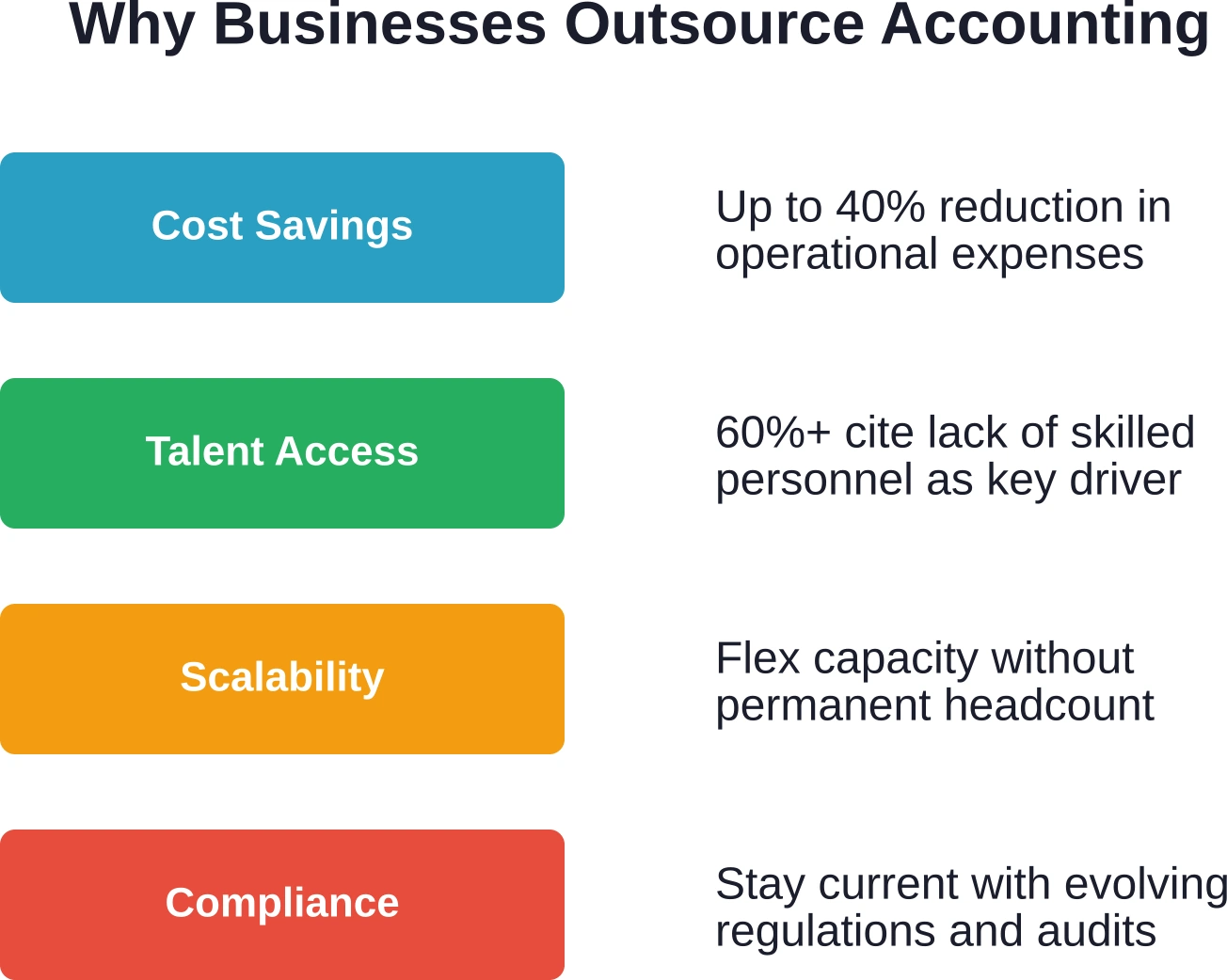
Cost savings grab headlines, and they're real. Businesses can save up to 40% on operational expenses by outsourcing bookkeeping, payroll, tax preparation, and financial reporting. But that's just the starting point.
Over 60% of businesses cite a lack of skilled personnel as a primary reason for outsourcing. The accounting talent shortage hits small and mid-sized businesses particularly hard. Hiring a full-time CPA with specialized knowledge in tax law, compliance, and financial analysis costs significantly more than many companies can justify.
Real talk: the benefits extend beyond dollars and headcount.
- Access to specialized expertise tops the list for many organizations. Outsourced providers maintain teams with diverse certifications and industry-specific knowledge. Need someone who understands construction accounting? They've got that. Looking for expertise in nonprofit financial reporting? Covered.
- Scalability matters more as businesses grow unevenly. Revenue might spike 40% one quarter, then plateau the next. Outsourced services flex with demand without the commitment of permanent headcount.
- Technology and infrastructure come bundled. Professional accounting firms invest in enterprise-grade software, security protocols, and backup systems. According to AICPA guidance, System and Organization Controls (SOC) compliance ensures service organizations maintain appropriate controls—something individual businesses rarely achieve independently.
- Risk mitigation and compliance become someone else's specialty. Tax regulations shift constantly. Audit requirements tighten. Outsourced providers stay current because they must—their business depends on it.
Support Accounting Back Office Operations With NeoWork

Accounting teams often spend considerable time on administrative processes that keep financial operations running smoothly. NeoWork provides staffing and operational support that can help organizations manage these recurring tasks.
Need Additional Accounting Back Office Support?
NeoWork can help with:
- administrative accounting tasks
- records management
- workflow coordination
- back-office support
👉 Contact NeoWork to discuss your accounting support needs.
What Functions to Outsource
Not every accounting task makes sense to hand off. Strategic decisions—like capital allocation, major investments, or financial planning—belong in-house where context and company knowledge matter most.
But repetitive, rules-based tasks? Those are prime outsourcing candidates.
Bookkeeping and Transaction Recording
Daily transaction entry, bank reconciliations, and ledger maintenance fall squarely in the outsourcing sweet spot. These tasks demand accuracy and consistency but rarely require strategic insight.
Most outsourced bookkeeping services handle accounts payable, accounts receivable, expense categorization, and monthly close processes. The work happens on your schedule, integrates with your existing software, and costs a fraction of a full-time bookkeeper's salary.
Payroll Processing
Payroll combines repetitive calculation with strict compliance requirements—exactly what specialized providers excel at. Tax withholdings, benefit deductions, direct deposits, and quarterly filings all follow clear rules.
Outsourced payroll also transfers liability. When a provider guarantees tax compliance and penalty coverage, that's meaningful risk reduction.
Tax Preparation and Compliance
Tax codes shift annually. Deductions change. State and local requirements vary wildly. Over 50% of IFAC member bodies' members are employed in business according to IFAC data, but tax expertise concentrates in specialized firms.
Outsourcing tax preparation ensures access to current knowledge without maintaining that expertise year-round. Most businesses need intensive tax work quarterly or annually, not continuously.
Financial Reporting
Monthly financial statements, cash flow reports, and management dashboards provide essential business intelligence. Outsourced accounting teams generate these reports using standardized processes and templates, often with faster turnaround than internal teams juggling multiple priorities.
Compliance and Audit Support
Regulatory compliance grows more complex as organizations scale. The SEC has established stringent auditor independence requirements, with lead and concurring audit partners subject to rotation after no more than five or seven consecutive years depending on involvement, with certain exemptions for small accounting firms.
Service organizations handling outsourced accounting functions often maintain SOC compliance, providing assurance that appropriate controls exist for financial data. According to AICPA guidance, these controls help organizations manage third-party risks effectively.
In-House vs. Outsourced: The Real Cost Comparison
Surface-level cost comparisons miss crucial factors. A full-time bookkeeper's salary represents just one component of true employment cost.
Consider the full picture: base salary, payroll taxes, benefits (health insurance, retirement contributions, paid time off), workspace and equipment, software licenses, training and professional development, and management overhead.
For specialized roles like senior accountants or CPAs, these costs multiply. A senior accountant might command $70,000-$90,000 in salary alone, but total cost of employment easily exceeds $100,000 annually.
Outsourced services typically bill hourly or monthly, with rates varying by service complexity and provider location. The key difference? Variable cost structure. No benefits, no paid time off, no hiring risk, no management burden.
That said, outsourcing isn't always cheaper for every function. High-volume transaction processing or roles requiring constant availability sometimes favor in-house staff. The calculus depends on volume, complexity, and how consistently the work flows.
How to Choose the Right Outsourcing Provider
Provider selection makes or breaks the outsourcing experience. Look, there are hundreds of accounting outsourcing firms, and quality varies dramatically.
Expertise and Certifications
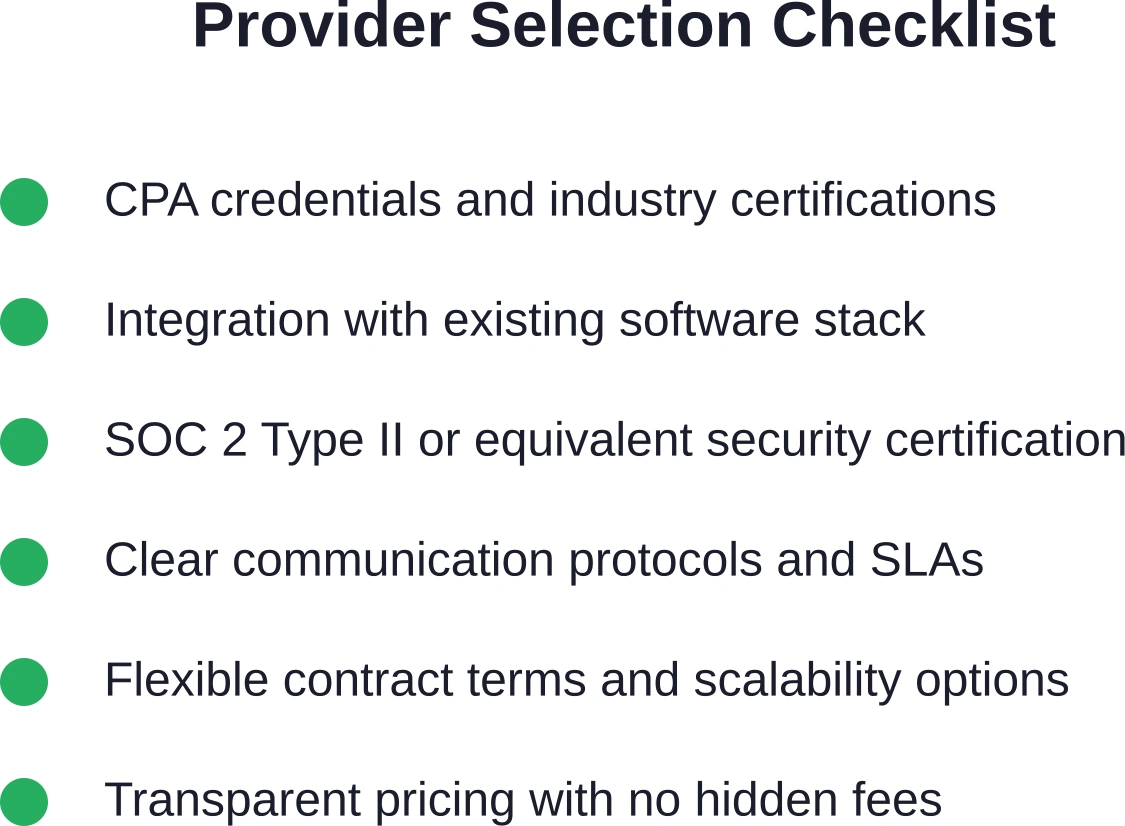
Start with credentials. Does the provider employ CPAs? Do they hold industry-specific certifications? Can they demonstrate experience with businesses like yours?
Ask about their team structure. Who actually does the work? Where are they located? What's their experience level? Some providers staff entry-level bookkeepers on complex accounting. Others maintain teams of credentialed professionals with deep expertise.
Technology and Integration
The provider should work within your existing tech stack. If you use QuickBooks, they need QuickBooks expertise. Running on NetSuite? Same deal.
Cloud-based collaboration tools matter too. Real-time access to financial data, transparent workflows, and secure document sharing should be standard, not premium features.
Security and Compliance
Financial data sensitivity demands robust security. Ask about data encryption, access controls, backup procedures, and disaster recovery plans.
SOC 2 Type II certification provides independent verification of security controls. According to AICPA guidance, SOC reports help organizations assess whether service providers maintain appropriate safeguards.
Communication and Responsiveness
Outsourcing fails when communication breaks down. Evaluate response times during the sales process—they rarely improve after contract signing.
Clarify expectations upfront: What's the guaranteed response time? Who's the main point of contact? How are urgent issues escalated? What reporting cadence makes sense?
Scalability and Flexibility
Business needs shift. The provider that fits today might not fit in two years. Can they scale services up or down? Do contract terms allow flexibility, or lock you in?
Growth-stage companies particularly need providers that can expand services as complexity increases—from basic bookkeeping to full controller functions to CFO-level advisory.
Making the Transition Smooth
Outsourcing implementation determines long-term success. A rushed transition creates data gaps, missed deadlines, and frustration on all sides.
Document Current Processes
Before handing anything off, map existing workflows. How do invoices get approved? When does payroll run? What reports go to which stakeholders?
Documentation prevents knowledge loss and gives the provider a clear starting point. It also surfaces inefficiencies worth fixing during transition.
Start with a Pilot Function
Outsource one function first. Accounts payable makes a good pilot—it's repetitive, well-defined, and non-critical if minor hiccups occur during onboarding.
Successful pilots build confidence and reveal integration issues before expanding scope.
Set Clear Expectations and Metrics
Define success upfront. What turnaround times are acceptable? What accuracy rates are required? How often should reports be delivered?
Establish key performance indicators and review them regularly. Outsourcing relationships improve through measurement and feedback.
Maintain Strategic Oversight
Outsourcing execution doesn't mean abdicating responsibility. Someone internally should own the relationship, review deliverables, and ensure alignment with business needs.
Monthly or quarterly business reviews keep both parties aligned and surface issues early.
Common Pitfalls and How to Avoid Them
Outsourcing attempts fail predictably. Here's what goes wrong and how to prevent it.
- Insufficient due diligence leads the list. Choosing based on price alone or skipping reference checks sets up disappointment. Invest time upfront in provider evaluation.
- Unclear scope and expectations create conflict. If the provider thinks they're delivering monthly reports and you expect weekly dashboards, someone ends up frustrated. Document everything.
- Poor communication channels sink relationships. Establish regular check-ins from day one, not just when problems arise.
- Inadequate data security protocols expose businesses to unnecessary risk. According to SEC guidance on auditor independence, organizations must carefully assess third-party controls and safeguards. Don't assume security—verify it.
- Resistance from internal teams derails implementation. Address concerns transparently. Outsourcing often enables existing staff to focus on higher-value work rather than replacing them.
The Bottom Line on Outsourcing Benefits
When done right, accounting back office outsourcing delivers measurable advantages: reduced costs, access to specialized expertise, improved accuracy and compliance, scalability without hiring risk, and freed-up internal resources for strategic priorities.
The approach works particularly well for small and mid-sized businesses that need professional-grade financial operations without enterprise-level overhead. It also benefits rapidly growing companies where finance complexity outpaces headcount planning.
But outsourcing isn't a magic fix. It requires careful provider selection, thoughtful transition planning, and ongoing relationship management. Organizations that treat outsourcing as a strategic partnership rather than a vendor transaction see the best results.
The key question isn't whether to outsource—it's what to outsource, when, and to whom. Answer those questions deliberately, and back office outsourcing becomes a genuine competitive advantage rather than just a cost-cutting tactic.
Frequently Asked Questions
Topics
Accounting Back Office Outsourcing Guide 2026

Quick Summary: Accounting back office outsourcing involves delegating non-client-facing financial tasks like bookkeeping, payroll, and tax preparation to specialized third-party providers. Businesses can save up to 40% on operational expenses while accessing expert talent and maintaining compliance. This guide covers what to outsource, how to choose the right provider, and best practices for a successful transition.
Running a business means juggling countless responsibilities. For many owners, wrestling with financial records ranks somewhere between frustrating and overwhelming. Back office accounting tasks consume time, demand specialized knowledge, and pile up just when you're trying to focus on growth.
Here's the thing though—you don't have to handle every accounting function in-house. Outsourcing back office accounting has evolved from a cost-cutting tactic into a strategic advantage. The challenge isn't whether to outsource anymore. It's knowing what to outsource, when, and to whom.
This guide walks through the essential decisions, from identifying which functions to hand off to selecting a provider that actually understands your business. No fluff, just practical insights for making outsourcing work.
What Back Office Accounting Actually Means
Back office functions operate behind the scenes. Unlike customer-facing roles, these are the administrative and financial tasks that keep operations running but don't directly generate revenue.
In accounting specifically, back office work includes bookkeeping, accounts payable and receivable, payroll processing, tax preparation, financial reporting, and compliance documentation. These tasks require accuracy and consistency but don't necessarily need to happen under your roof.
The distinction matters because outsourcing back office work differs fundamentally from outsourcing client-facing roles. Service quality still counts, but the risk profile changes. A bookkeeping error affects internal operations and compliance, not customer experience.
Why Businesses Outsource Accounting Functions
Cost savings grab headlines, and they're real. Businesses can save up to 40% on operational expenses by outsourcing bookkeeping, payroll, tax preparation, and financial reporting. But that's just the starting point.
Over 60% of businesses cite a lack of skilled personnel as a primary reason for outsourcing. The accounting talent shortage hits small and mid-sized businesses particularly hard. Hiring a full-time CPA with specialized knowledge in tax law, compliance, and financial analysis costs significantly more than many companies can justify.
Real talk: the benefits extend beyond dollars and headcount.
- Access to specialized expertise tops the list for many organizations. Outsourced providers maintain teams with diverse certifications and industry-specific knowledge. Need someone who understands construction accounting? They've got that. Looking for expertise in nonprofit financial reporting? Covered.
- Scalability matters more as businesses grow unevenly. Revenue might spike 40% one quarter, then plateau the next. Outsourced services flex with demand without the commitment of permanent headcount.
- Technology and infrastructure come bundled. Professional accounting firms invest in enterprise-grade software, security protocols, and backup systems. According to AICPA guidance, System and Organization Controls (SOC) compliance ensures service organizations maintain appropriate controls—something individual businesses rarely achieve independently.
- Risk mitigation and compliance become someone else's specialty. Tax regulations shift constantly. Audit requirements tighten. Outsourced providers stay current because they must—their business depends on it.
Support Accounting Back Office Operations With NeoWork
Accounting teams often spend considerable time on administrative processes that keep financial operations running smoothly. NeoWork provides staffing and operational support that can help organizations manage these recurring tasks.
Need Additional Accounting Back Office Support?
NeoWork can help with:
- administrative accounting tasks
- records management
- workflow coordination
- back-office support
👉 Contact NeoWork to discuss your accounting support needs.
What Functions to Outsource
Not every accounting task makes sense to hand off. Strategic decisions—like capital allocation, major investments, or financial planning—belong in-house where context and company knowledge matter most.
But repetitive, rules-based tasks? Those are prime outsourcing candidates.
Bookkeeping and Transaction Recording
Daily transaction entry, bank reconciliations, and ledger maintenance fall squarely in the outsourcing sweet spot. These tasks demand accuracy and consistency but rarely require strategic insight.
Most outsourced bookkeeping services handle accounts payable, accounts receivable, expense categorization, and monthly close processes. The work happens on your schedule, integrates with your existing software, and costs a fraction of a full-time bookkeeper's salary.
Payroll Processing
Payroll combines repetitive calculation with strict compliance requirements—exactly what specialized providers excel at. Tax withholdings, benefit deductions, direct deposits, and quarterly filings all follow clear rules.
Outsourced payroll also transfers liability. When a provider guarantees tax compliance and penalty coverage, that's meaningful risk reduction.
Tax Preparation and Compliance
Tax codes shift annually. Deductions change. State and local requirements vary wildly. Over 50% of IFAC member bodies' members are employed in business according to IFAC data, but tax expertise concentrates in specialized firms.
Outsourcing tax preparation ensures access to current knowledge without maintaining that expertise year-round. Most businesses need intensive tax work quarterly or annually, not continuously.
Financial Reporting
Monthly financial statements, cash flow reports, and management dashboards provide essential business intelligence. Outsourced accounting teams generate these reports using standardized processes and templates, often with faster turnaround than internal teams juggling multiple priorities.
Compliance and Audit Support
Regulatory compliance grows more complex as organizations scale. The SEC has established stringent auditor independence requirements, with lead and concurring audit partners subject to rotation after no more than five or seven consecutive years depending on involvement, with certain exemptions for small accounting firms.
Service organizations handling outsourced accounting functions often maintain SOC compliance, providing assurance that appropriate controls exist for financial data. According to AICPA guidance, these controls help organizations manage third-party risks effectively.
In-House vs. Outsourced: The Real Cost Comparison
Surface-level cost comparisons miss crucial factors. A full-time bookkeeper's salary represents just one component of true employment cost.
Consider the full picture: base salary, payroll taxes, benefits (health insurance, retirement contributions, paid time off), workspace and equipment, software licenses, training and professional development, and management overhead.
For specialized roles like senior accountants or CPAs, these costs multiply. A senior accountant might command $70,000-$90,000 in salary alone, but total cost of employment easily exceeds $100,000 annually.
Outsourced services typically bill hourly or monthly, with rates varying by service complexity and provider location. The key difference? Variable cost structure. No benefits, no paid time off, no hiring risk, no management burden.
That said, outsourcing isn't always cheaper for every function. High-volume transaction processing or roles requiring constant availability sometimes favor in-house staff. The calculus depends on volume, complexity, and how consistently the work flows.
How to Choose the Right Outsourcing Provider
Provider selection makes or breaks the outsourcing experience. Look, there are hundreds of accounting outsourcing firms, and quality varies dramatically.
Expertise and Certifications
Start with credentials. Does the provider employ CPAs? Do they hold industry-specific certifications? Can they demonstrate experience with businesses like yours?
Ask about their team structure. Who actually does the work? Where are they located? What's their experience level? Some providers staff entry-level bookkeepers on complex accounting. Others maintain teams of credentialed professionals with deep expertise.
Technology and Integration
The provider should work within your existing tech stack. If you use QuickBooks, they need QuickBooks expertise. Running on NetSuite? Same deal.
Cloud-based collaboration tools matter too. Real-time access to financial data, transparent workflows, and secure document sharing should be standard, not premium features.
Security and Compliance
Financial data sensitivity demands robust security. Ask about data encryption, access controls, backup procedures, and disaster recovery plans.
SOC 2 Type II certification provides independent verification of security controls. According to AICPA guidance, SOC reports help organizations assess whether service providers maintain appropriate safeguards.
Communication and Responsiveness
Outsourcing fails when communication breaks down. Evaluate response times during the sales process—they rarely improve after contract signing.
Clarify expectations upfront: What's the guaranteed response time? Who's the main point of contact? How are urgent issues escalated? What reporting cadence makes sense?
Scalability and Flexibility
Business needs shift. The provider that fits today might not fit in two years. Can they scale services up or down? Do contract terms allow flexibility, or lock you in?
Growth-stage companies particularly need providers that can expand services as complexity increases—from basic bookkeeping to full controller functions to CFO-level advisory.
Making the Transition Smooth
Outsourcing implementation determines long-term success. A rushed transition creates data gaps, missed deadlines, and frustration on all sides.
Document Current Processes
Before handing anything off, map existing workflows. How do invoices get approved? When does payroll run? What reports go to which stakeholders?
Documentation prevents knowledge loss and gives the provider a clear starting point. It also surfaces inefficiencies worth fixing during transition.
Start with a Pilot Function
Outsource one function first. Accounts payable makes a good pilot—it's repetitive, well-defined, and non-critical if minor hiccups occur during onboarding.
Successful pilots build confidence and reveal integration issues before expanding scope.
Set Clear Expectations and Metrics
Define success upfront. What turnaround times are acceptable? What accuracy rates are required? How often should reports be delivered?
Establish key performance indicators and review them regularly. Outsourcing relationships improve through measurement and feedback.
Maintain Strategic Oversight
Outsourcing execution doesn't mean abdicating responsibility. Someone internally should own the relationship, review deliverables, and ensure alignment with business needs.
Monthly or quarterly business reviews keep both parties aligned and surface issues early.
Common Pitfalls and How to Avoid Them
Outsourcing attempts fail predictably. Here's what goes wrong and how to prevent it.
- Insufficient due diligence leads the list. Choosing based on price alone or skipping reference checks sets up disappointment. Invest time upfront in provider evaluation.
- Unclear scope and expectations create conflict. If the provider thinks they're delivering monthly reports and you expect weekly dashboards, someone ends up frustrated. Document everything.
- Poor communication channels sink relationships. Establish regular check-ins from day one, not just when problems arise.
- Inadequate data security protocols expose businesses to unnecessary risk. According to SEC guidance on auditor independence, organizations must carefully assess third-party controls and safeguards. Don't assume security—verify it.
- Resistance from internal teams derails implementation. Address concerns transparently. Outsourcing often enables existing staff to focus on higher-value work rather than replacing them.
The Bottom Line on Outsourcing Benefits
When done right, accounting back office outsourcing delivers measurable advantages: reduced costs, access to specialized expertise, improved accuracy and compliance, scalability without hiring risk, and freed-up internal resources for strategic priorities.
The approach works particularly well for small and mid-sized businesses that need professional-grade financial operations without enterprise-level overhead. It also benefits rapidly growing companies where finance complexity outpaces headcount planning.
But outsourcing isn't a magic fix. It requires careful provider selection, thoughtful transition planning, and ongoing relationship management. Organizations that treat outsourcing as a strategic partnership rather than a vendor transaction see the best results.
The key question isn't whether to outsource—it's what to outsource, when, and to whom. Answer those questions deliberately, and back office outsourcing becomes a genuine competitive advantage rather than just a cost-cutting tactic.
Frequently Asked Questions
Topics
Related Blogs
Related Podcasts


.webp)
.webp)



