

.avif)
.avif)

Accounting BPO Services Guide: 2026 Edition


.svg)

Quick Summary: Accounting BPO services enable businesses to outsource finance and accounting functions to specialized providers, reducing costs while gaining access to expertise. This guide covers what BPO accounting includes, key benefits, how to choose the right provider, and implementation strategies for 2026.
As companies scale, accounting quickly becomes more than bookkeeping. Monthly closes, revenue recognition, audits, and investor reporting require discipline, controls, and consistency. Rather than hiring and retaining full-time finance teams, many organizations now turn to business process outsourcing—or BPO accounting—to handle these critical functions.
The shift toward outsourced accounting services reflects broader trends in how businesses operate. Instead of viewing finance as just a cost center, smart companies leverage BPO to gain strategic flexibility and access specialized expertise that would be expensive to build in-house.
What Is Accounting BPO?
Business process outsourcing (BPO) for accounting means delegating finance and accounting operations to an external provider. Unlike traditional bookkeeping services that handle basic transaction recording, accounting BPO encompasses a managed approach to entire financial processes.
Think of it as building high-performing, sophisticated finance and accounting departments—except the team works for a specialized firm rather than directly for your company. The provider manages end-to-end processes, not individual tasks.
The key distinction matters. BPO accounting goes beyond data entry and transaction posting. It involves strategic partnership where the provider takes responsibility for accuracy, timeliness, compliance, and reporting quality. This model works particularly well for startups, mid-market firms, and enterprises seeking operational flexibility.
What Processes Are Included in Accounting BPO?
The scope of accounting BPO services varies by provider and service agreement, but core functions typically include accounts payable and receivable, general ledger management, month-end close procedures, bank reconciliation, and financial reporting.
More comprehensive BPO providers also handle payroll processing, expense management, revenue recognition, tax compliance support, and audit preparation. Some firms extend into financial analysis and forecasting—essentially taking on the strategic finance role traditionally held by controllers.
Here's what matters: confirm exactly which processes your chosen provider handles. The depth and breadth of services directly impact your staffing needs and operational burden. Some startups need basic bookkeeping; others require full month-end close support with consolidated reporting across multiple entities.

Add Operational Support to Accounting Workflows
Accounting teams frequently balance transaction processing, reporting support, data management, and other recurring administrative tasks. NeoWork provides staffing and operational support that can help businesses manage these workflows more efficiently without expanding internal teams.
Need Additional Accounting Support?
NeoWork can help with:
- accounting-related administrative tasks
- data entry and records management
- workflow and process support
- back-office operational assistance
👉 Contact NeoWork to discuss your accounting operations needs.
Key Benefits of Accounting BPO Services
Cost Efficiency and Predictable Expenses
One of the strongest drivers of BPO adoption is cost reduction. Rather than paying salaries, benefits, taxes, and training costs for a full accounting team, companies pay a service fee based on transaction volume or headcount equivalent. Real-world success stories show some organizations reducing costs by 30% when switching from in-house operations to managed BPO services.
Beyond direct labor savings, BPO providers absorb infrastructure costs—software licenses, hardware, secure data centers. For growing startups, this avoids expensive upfront technology investments.
Access to Specialized Expertise
Quality BPO providers employ accounting professionals with deep expertise in compliance, tax treatment, revenue recognition standards, and industry-specific requirements. Small and mid-market companies often struggle to hire controllers or senior accountants in competitive talent markets. Outsourcing provides immediate access to this caliber of expertise without the premium cost of full-time senior roles.
Scalability Without Growing Headcount
When your business grows, accounting work grows with it—more transactions, more complexity, more reporting requirements. With in-house teams, scaling means hiring, training, and onboarding. BPO providers scale with you simply by adjusting service levels or transaction fees. This flexibility is critical for startups experiencing rapid growth.
Improved Accuracy and Compliance
Standardized processes and quality controls implemented by experienced BPO firms reduce errors. This matters for financial reporting accuracy, audit readiness, and regulatory compliance. Providers familiar with SEC rules, SOX requirements, and industry regulations help companies avoid costly missteps.
More Time to Focus on Core Business
Finance and accounting require attention but don't directly generate revenue. By outsourcing routine accounting operations, leadership teams focus on strategy, product development, and customer acquisition instead of managing back-office functions.
Types of Accounting BPO Services
Not all BPO providers offer identical services. The market includes several distinct models, each suited to different business needs.
Offshore BPO
Offshore providers operate from countries like India, Philippines, or Mexico where labor costs are lower. These firms handle high-volume transaction processing—invoice processing, data entry, bank reconciliation. The cost advantage is significant, but timezone differences and potential language considerations require clear communication protocols.
Onshore BPO
Domestic providers operate in the same country as the client. They offer closer collaboration, easier communication, and deeper familiarity with local regulations and business practices. Costs run higher than offshore but lower than building an equivalent in-house team.
Hybrid BPO
Many modern providers use a hybrid model—lower-cost offshore teams handle routine processing, while onshore senior accountants provide quality control, analysis, and strategic guidance. This balances cost efficiency with personalized service.
Specialized BPO
Some firms specialize in specific functions (payroll BPO, revenue recognition BPO) or industries (healthcare, technology, professional services). These providers develop deep expertise in their niche, often providing superior compliance and process knowledge.
Accounting BPO vs. Bookkeeping vs. In-House Accounting
Confusion between these three models leads to poor vendor selection. Understanding the differences prevents costly mistakes.
Bookkeeping services focus narrowly on transaction recording—capturing invoices, logging deposits, reconciling accounts. Bookkeepers rarely engage in analysis, provide strategic insights, or handle complex compliance matters. It's task-based work, not process management.
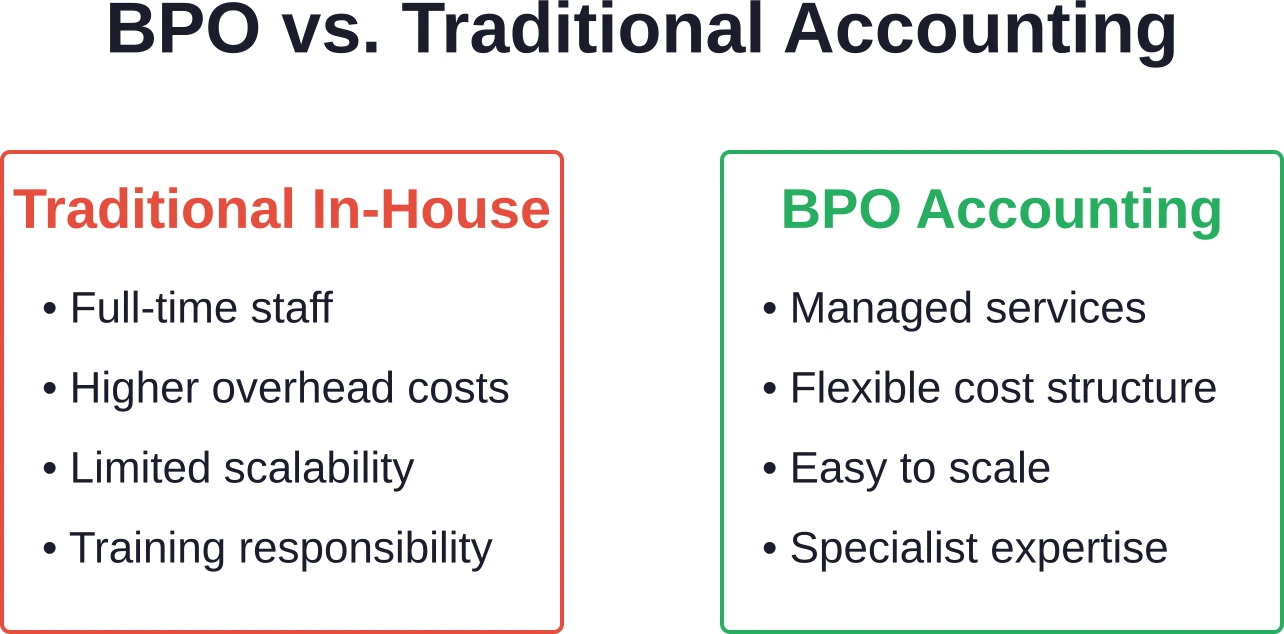
In-house accounting means employees on your payroll, working exclusively on your company's books. You control processes and timing but carry full employment, training, and infrastructure costs. This makes sense for very large companies but strains small to mid-market budgets.
BPO accounting sits between these poles—managed processes delivered by a specialized external team, with greater scope than basic bookkeeping but more cost efficiency than full in-house staffing. It's the sweet spot for many scaling companies.
How to Choose the Right Accounting BPO Provider
The market includes hundreds of BPO providers, from small boutique firms to multinational consulting companies. Making the right choice requires careful evaluation against your specific needs.
Define Your Requirements
Start by documenting exactly which accounting processes you need outsourced. Do you need end-to-end accounting including analysis and forecasting, or just transaction processing? How many entities must the provider handle? What software do you currently use, and does the provider integrate with it? What compliance requirements are critical—SEC, SOX, industry-specific regulations?
Specificity matters tremendously. A vague RFP to providers yields vague proposals. Clear requirements enable accurate pricing and realistic service level expectations.
Evaluate Experience and Credentials
Look for providers with specific experience in your industry or business model. A firm with deep expertise in SaaS accounting is better suited to revenue recognition challenges than a general BPO provider. Check certifications—CPA credentials, SOC 2 compliance, ISO certifications demonstrate professional standards.
Request case studies or references from companies similar to yours in size and complexity. Direct conversations with existing clients reveal how providers actually perform under pressure—during audits, complex consolidations, or high-growth periods.
Assess Technology and Security
The provider's tech stack matters enormously. Do they use modern cloud accounting platforms (NetSuite, Workday, SAP) or outdated on-premise systems? Can they handle integrations with your other business systems—CRM, ERP, payroll? What's their data security posture—encryption, access controls, disaster recovery plans?
Ask specifically about security certifications. ISO/IEC 27001 certification indicates a robust information security management system. SOC 2 Type II audits verify that controls operate effectively over time. These aren't marketing checkboxes—they're essential for protecting sensitive financial data.
Verify Scalability and Flexibility
Your business will change. The provider must flex with it. Can they scale capacity as you grow? What happens when transaction volumes spike? Are service levels clearly defined in writing—response times, accuracy rates, reporting schedules? Can you adjust services without excessive penalties?
Review Communication and Support
Outsourcing doesn't mean hands-off relationships. The best providers maintain regular communication—scheduled check-ins, monthly KPI reviews, accessibility when issues arise. Does the provider assign a dedicated account manager? What's their communication style—are they proactive in flagging issues or reactive only when you reach out?
Implementation Best Practices
Successful BPO transitions require more than vendor selection. The implementation process significantly impacts outcomes.
Plan the Transition Carefully
Map current processes in detail before handoff. Document all procedures, system access requirements, reporting formats, and compliance obligations. The more thoroughly you prepare transition materials, the smoother the initial months run. Most providers recommend a 4-8 week transition period depending on complexity.
Establish Clear SLAs
Service level agreements must specify response times, accuracy expectations, reporting deadlines, and escalation procedures. If the provider misses a close deadline or makes recurring errors, your SLA defines remedies. Without clear SLAs, disputes arise from unmet expectations.
Maintain Internal Controls
Outsourcing doesn't eliminate your company's responsibility for accurate financial reporting. Design review controls—someone internally spot-checks work, reviews unusual transactions, monitors reconciliations. This protective layer catches issues early and ensures management maintains healthy skepticism about outsourced results.
Conduct Regular Performance Reviews
Schedule monthly or quarterly reviews of provider performance against agreed SLAs. Are close processes meeting deadlines? Are error rates acceptable? Are financial statements accurate? Regular feedback, both positive and corrective, strengthens the partnership and identifies problems before they become serious.
When Accounting BPO Makes Sense
BPO accounting isn't universally appropriate. Smart companies match the model to their situation.
- Startups with limited cash should strongly consider BPO. Building an in-house accounting function requires significant expense before generating any revenue benefit. BPO lets startups establish financial discipline without the overhead drag. As the company scales and margins improve, they can gradually bring functions in-house if preferred.
- Growing mid-market companies often hit a scaling wall—rapid growth creates accounting complexity that existing teams can't manage. BPO fills that gap affordably while you focus resources on customer acquisition and product development.
- Highly seasonal businesses benefit from BPO's flexibility. If you need heavy accounting support only during peak seasons, outsourcing beats paying year-round salaries for people used part-time.
- Companies pursuing M&A activity or significant business transformation often use BPO temporarily during transition periods. Once integration completes, they decide whether to maintain outsourcing or transition back in-house.
- Conversely, very large enterprises with complex, company-specific accounting requirements sometimes prefer in-house expertise. Companies with proprietary systems or unique regulatory needs may find BPO less advantageous.
Common Challenges and How to Overcome Them
Every BPO relationship hits friction points. Anticipating and addressing them early prevents escalation.
- Data Security Concerns: Moving sensitive financial data to an external firm naturally raises security anxieties. Mitigation requires written security agreements, encryption standards, access controls, and regular audit confirmations. Before signing, insist on SOC 2 Type II reports or equivalent third-party security verification.
- Quality Issues: Early errors in transaction processing or reporting are common during transition. Root causes usually trace to unclear specifications rather than provider incompetence. Detailed walkthroughs of a few transactions catch issues before they scale. Invest time in the transition—it pays back rapidly.
- Communication Friction: Timezone differences with offshore providers can delay responses. Set expectations upfront about communication windows, preferred channels, and escalation paths. Hybrid models (offshore execution, onshore quality control) often work best.
- Loss of Internal Knowledge: When you outsource, risk exists that critical accounting knowledge walks out the door. Mitigate by retaining internal finance leadership and maintaining detailed process documentation. The outsourced team executes; your team owns the strategy.
Looking Ahead to 2026
The accounting BPO market continues evolving. Emerging trends include increased use of AI and automation for routine tasks, with human expertise focused on exception handling and strategic analysis. Providers offering flexible hybrid models—combining offshore cost efficiency with onshore expertise—are gaining market share.
Compliance demands continue intensifying, particularly around data privacy, cybersecurity, and regulatory reporting. Expect BPO providers to invest heavily in security capabilities and compliance expertise as differentiators.
For companies evaluating BPO in 2026, the fundamental value proposition remains unchanged: outsource non-core finance and accounting functions to specialized providers, reducing cost while maintaining quality and accessing expertise that would be expensive to build in-house.
Conclusion
Accounting BPO services offer a pragmatic solution for businesses struggling with finance and accounting complexity. Rather than building expensive in-house teams, smart companies partner with specialized providers to handle routine processes while focusing internal resources on strategic priorities.
The decision to outsource isn't binary. Many companies use a hybrid approach—outsourcing transaction processing while keeping strategic accounting and financial planning in-house. This balanced model gains cost efficiency while maintaining control where it matters most.
Whether BPO makes sense depends on your specific situation: company size, growth stage, available capital, and complexity. Startups with limited budgets and simple processes gain the most from BPO. Growing mid-market companies scaling through talent constraints benefit substantially. Large enterprises with custom systems and regulatory complexity may find in-house more appropriate.
Ready to explore accounting BPO for your business? Start by documenting your specific requirements, researching providers with relevant experience, and requesting detailed proposals. The investment in careful vendor selection now prevents costly relationship problems later. With the right partner and clear expectations, accounting BPO delivers meaningful cost savings and operational leverage—freeing your team to focus on what actually drives your business forward.
Frequently Asked Questions
Topics
Accounting BPO Services Guide: 2026 Edition

Quick Summary: Accounting BPO services enable businesses to outsource finance and accounting functions to specialized providers, reducing costs while gaining access to expertise. This guide covers what BPO accounting includes, key benefits, how to choose the right provider, and implementation strategies for 2026.
As companies scale, accounting quickly becomes more than bookkeeping. Monthly closes, revenue recognition, audits, and investor reporting require discipline, controls, and consistency. Rather than hiring and retaining full-time finance teams, many organizations now turn to business process outsourcing—or BPO accounting—to handle these critical functions.
The shift toward outsourced accounting services reflects broader trends in how businesses operate. Instead of viewing finance as just a cost center, smart companies leverage BPO to gain strategic flexibility and access specialized expertise that would be expensive to build in-house.
What Is Accounting BPO?
Business process outsourcing (BPO) for accounting means delegating finance and accounting operations to an external provider. Unlike traditional bookkeeping services that handle basic transaction recording, accounting BPO encompasses a managed approach to entire financial processes.
Think of it as building high-performing, sophisticated finance and accounting departments—except the team works for a specialized firm rather than directly for your company. The provider manages end-to-end processes, not individual tasks.
The key distinction matters. BPO accounting goes beyond data entry and transaction posting. It involves strategic partnership where the provider takes responsibility for accuracy, timeliness, compliance, and reporting quality. This model works particularly well for startups, mid-market firms, and enterprises seeking operational flexibility.
What Processes Are Included in Accounting BPO?
The scope of accounting BPO services varies by provider and service agreement, but core functions typically include accounts payable and receivable, general ledger management, month-end close procedures, bank reconciliation, and financial reporting.
More comprehensive BPO providers also handle payroll processing, expense management, revenue recognition, tax compliance support, and audit preparation. Some firms extend into financial analysis and forecasting—essentially taking on the strategic finance role traditionally held by controllers.
Here's what matters: confirm exactly which processes your chosen provider handles. The depth and breadth of services directly impact your staffing needs and operational burden. Some startups need basic bookkeeping; others require full month-end close support with consolidated reporting across multiple entities.
Add Operational Support to Accounting Workflows
Accounting teams frequently balance transaction processing, reporting support, data management, and other recurring administrative tasks. NeoWork provides staffing and operational support that can help businesses manage these workflows more efficiently without expanding internal teams.
Need Additional Accounting Support?
NeoWork can help with:
- accounting-related administrative tasks
- data entry and records management
- workflow and process support
- back-office operational assistance
👉 Contact NeoWork to discuss your accounting operations needs.
Key Benefits of Accounting BPO Services
Cost Efficiency and Predictable Expenses
One of the strongest drivers of BPO adoption is cost reduction. Rather than paying salaries, benefits, taxes, and training costs for a full accounting team, companies pay a service fee based on transaction volume or headcount equivalent. Real-world success stories show some organizations reducing costs by 30% when switching from in-house operations to managed BPO services.
Beyond direct labor savings, BPO providers absorb infrastructure costs—software licenses, hardware, secure data centers. For growing startups, this avoids expensive upfront technology investments.
Access to Specialized Expertise
Quality BPO providers employ accounting professionals with deep expertise in compliance, tax treatment, revenue recognition standards, and industry-specific requirements. Small and mid-market companies often struggle to hire controllers or senior accountants in competitive talent markets. Outsourcing provides immediate access to this caliber of expertise without the premium cost of full-time senior roles.
Scalability Without Growing Headcount
When your business grows, accounting work grows with it—more transactions, more complexity, more reporting requirements. With in-house teams, scaling means hiring, training, and onboarding. BPO providers scale with you simply by adjusting service levels or transaction fees. This flexibility is critical for startups experiencing rapid growth.
Improved Accuracy and Compliance
Standardized processes and quality controls implemented by experienced BPO firms reduce errors. This matters for financial reporting accuracy, audit readiness, and regulatory compliance. Providers familiar with SEC rules, SOX requirements, and industry regulations help companies avoid costly missteps.
More Time to Focus on Core Business
Finance and accounting require attention but don't directly generate revenue. By outsourcing routine accounting operations, leadership teams focus on strategy, product development, and customer acquisition instead of managing back-office functions.
Types of Accounting BPO Services
Not all BPO providers offer identical services. The market includes several distinct models, each suited to different business needs.
Offshore BPO
Offshore providers operate from countries like India, Philippines, or Mexico where labor costs are lower. These firms handle high-volume transaction processing—invoice processing, data entry, bank reconciliation. The cost advantage is significant, but timezone differences and potential language considerations require clear communication protocols.
Onshore BPO
Domestic providers operate in the same country as the client. They offer closer collaboration, easier communication, and deeper familiarity with local regulations and business practices. Costs run higher than offshore but lower than building an equivalent in-house team.
Hybrid BPO
Many modern providers use a hybrid model—lower-cost offshore teams handle routine processing, while onshore senior accountants provide quality control, analysis, and strategic guidance. This balances cost efficiency with personalized service.
Specialized BPO
Some firms specialize in specific functions (payroll BPO, revenue recognition BPO) or industries (healthcare, technology, professional services). These providers develop deep expertise in their niche, often providing superior compliance and process knowledge.
Accounting BPO vs. Bookkeeping vs. In-House Accounting
Confusion between these three models leads to poor vendor selection. Understanding the differences prevents costly mistakes.
Bookkeeping services focus narrowly on transaction recording—capturing invoices, logging deposits, reconciling accounts. Bookkeepers rarely engage in analysis, provide strategic insights, or handle complex compliance matters. It's task-based work, not process management.
In-house accounting means employees on your payroll, working exclusively on your company's books. You control processes and timing but carry full employment, training, and infrastructure costs. This makes sense for very large companies but strains small to mid-market budgets.
BPO accounting sits between these poles—managed processes delivered by a specialized external team, with greater scope than basic bookkeeping but more cost efficiency than full in-house staffing. It's the sweet spot for many scaling companies.
How to Choose the Right Accounting BPO Provider
The market includes hundreds of BPO providers, from small boutique firms to multinational consulting companies. Making the right choice requires careful evaluation against your specific needs.
Define Your Requirements
Start by documenting exactly which accounting processes you need outsourced. Do you need end-to-end accounting including analysis and forecasting, or just transaction processing? How many entities must the provider handle? What software do you currently use, and does the provider integrate with it? What compliance requirements are critical—SEC, SOX, industry-specific regulations?
Specificity matters tremendously. A vague RFP to providers yields vague proposals. Clear requirements enable accurate pricing and realistic service level expectations.
Evaluate Experience and Credentials
Look for providers with specific experience in your industry or business model. A firm with deep expertise in SaaS accounting is better suited to revenue recognition challenges than a general BPO provider. Check certifications—CPA credentials, SOC 2 compliance, ISO certifications demonstrate professional standards.
Request case studies or references from companies similar to yours in size and complexity. Direct conversations with existing clients reveal how providers actually perform under pressure—during audits, complex consolidations, or high-growth periods.
Assess Technology and Security
The provider's tech stack matters enormously. Do they use modern cloud accounting platforms (NetSuite, Workday, SAP) or outdated on-premise systems? Can they handle integrations with your other business systems—CRM, ERP, payroll? What's their data security posture—encryption, access controls, disaster recovery plans?
Ask specifically about security certifications. ISO/IEC 27001 certification indicates a robust information security management system. SOC 2 Type II audits verify that controls operate effectively over time. These aren't marketing checkboxes—they're essential for protecting sensitive financial data.
Verify Scalability and Flexibility
Your business will change. The provider must flex with it. Can they scale capacity as you grow? What happens when transaction volumes spike? Are service levels clearly defined in writing—response times, accuracy rates, reporting schedules? Can you adjust services without excessive penalties?
Review Communication and Support
Outsourcing doesn't mean hands-off relationships. The best providers maintain regular communication—scheduled check-ins, monthly KPI reviews, accessibility when issues arise. Does the provider assign a dedicated account manager? What's their communication style—are they proactive in flagging issues or reactive only when you reach out?
Implementation Best Practices
Successful BPO transitions require more than vendor selection. The implementation process significantly impacts outcomes.
Plan the Transition Carefully
Map current processes in detail before handoff. Document all procedures, system access requirements, reporting formats, and compliance obligations. The more thoroughly you prepare transition materials, the smoother the initial months run. Most providers recommend a 4-8 week transition period depending on complexity.
Establish Clear SLAs
Service level agreements must specify response times, accuracy expectations, reporting deadlines, and escalation procedures. If the provider misses a close deadline or makes recurring errors, your SLA defines remedies. Without clear SLAs, disputes arise from unmet expectations.
Maintain Internal Controls
Outsourcing doesn't eliminate your company's responsibility for accurate financial reporting. Design review controls—someone internally spot-checks work, reviews unusual transactions, monitors reconciliations. This protective layer catches issues early and ensures management maintains healthy skepticism about outsourced results.
Conduct Regular Performance Reviews
Schedule monthly or quarterly reviews of provider performance against agreed SLAs. Are close processes meeting deadlines? Are error rates acceptable? Are financial statements accurate? Regular feedback, both positive and corrective, strengthens the partnership and identifies problems before they become serious.
When Accounting BPO Makes Sense
BPO accounting isn't universally appropriate. Smart companies match the model to their situation.
- Startups with limited cash should strongly consider BPO. Building an in-house accounting function requires significant expense before generating any revenue benefit. BPO lets startups establish financial discipline without the overhead drag. As the company scales and margins improve, they can gradually bring functions in-house if preferred.
- Growing mid-market companies often hit a scaling wall—rapid growth creates accounting complexity that existing teams can't manage. BPO fills that gap affordably while you focus resources on customer acquisition and product development.
- Highly seasonal businesses benefit from BPO's flexibility. If you need heavy accounting support only during peak seasons, outsourcing beats paying year-round salaries for people used part-time.
- Companies pursuing M&A activity or significant business transformation often use BPO temporarily during transition periods. Once integration completes, they decide whether to maintain outsourcing or transition back in-house.
- Conversely, very large enterprises with complex, company-specific accounting requirements sometimes prefer in-house expertise. Companies with proprietary systems or unique regulatory needs may find BPO less advantageous.
Common Challenges and How to Overcome Them
Every BPO relationship hits friction points. Anticipating and addressing them early prevents escalation.
- Data Security Concerns: Moving sensitive financial data to an external firm naturally raises security anxieties. Mitigation requires written security agreements, encryption standards, access controls, and regular audit confirmations. Before signing, insist on SOC 2 Type II reports or equivalent third-party security verification.
- Quality Issues: Early errors in transaction processing or reporting are common during transition. Root causes usually trace to unclear specifications rather than provider incompetence. Detailed walkthroughs of a few transactions catch issues before they scale. Invest time in the transition—it pays back rapidly.
- Communication Friction: Timezone differences with offshore providers can delay responses. Set expectations upfront about communication windows, preferred channels, and escalation paths. Hybrid models (offshore execution, onshore quality control) often work best.
- Loss of Internal Knowledge: When you outsource, risk exists that critical accounting knowledge walks out the door. Mitigate by retaining internal finance leadership and maintaining detailed process documentation. The outsourced team executes; your team owns the strategy.
Looking Ahead to 2026
The accounting BPO market continues evolving. Emerging trends include increased use of AI and automation for routine tasks, with human expertise focused on exception handling and strategic analysis. Providers offering flexible hybrid models—combining offshore cost efficiency with onshore expertise—are gaining market share.
Compliance demands continue intensifying, particularly around data privacy, cybersecurity, and regulatory reporting. Expect BPO providers to invest heavily in security capabilities and compliance expertise as differentiators.
For companies evaluating BPO in 2026, the fundamental value proposition remains unchanged: outsource non-core finance and accounting functions to specialized providers, reducing cost while maintaining quality and accessing expertise that would be expensive to build in-house.
Conclusion
Accounting BPO services offer a pragmatic solution for businesses struggling with finance and accounting complexity. Rather than building expensive in-house teams, smart companies partner with specialized providers to handle routine processes while focusing internal resources on strategic priorities.
The decision to outsource isn't binary. Many companies use a hybrid approach—outsourcing transaction processing while keeping strategic accounting and financial planning in-house. This balanced model gains cost efficiency while maintaining control where it matters most.
Whether BPO makes sense depends on your specific situation: company size, growth stage, available capital, and complexity. Startups with limited budgets and simple processes gain the most from BPO. Growing mid-market companies scaling through talent constraints benefit substantially. Large enterprises with custom systems and regulatory complexity may find in-house more appropriate.
Ready to explore accounting BPO for your business? Start by documenting your specific requirements, researching providers with relevant experience, and requesting detailed proposals. The investment in careful vendor selection now prevents costly relationship problems later. With the right partner and clear expectations, accounting BPO delivers meaningful cost savings and operational leverage—freeing your team to focus on what actually drives your business forward.
Frequently Asked Questions
Topics
Related Blogs
Related Podcasts


.webp)
.webp)



