

.avif)
.avif)

Accounts Receivable Outsourcing Guide 2026


.svg)

Quick Summary: Accounts receivable outsourcing transfers your AR operations—invoicing, collections, dispute resolution—to a specialized third-party provider. Companies that outsource AR typically see a 20-30% reduction in days sales outstanding (DSO) within the first few months, freeing internal teams to focus on strategic priorities while cutting overhead and accelerating cash flow.
Managing accounts receivable in-house eats time. It burns payroll. And when payments lag, cash flow stalls.
For businesses processing hundreds or thousands of invoices each month, the AR cycle—from invoice generation to payment posting—can become a bottleneck that drags down operational efficiency. That's why more finance leaders are turning to accounts receivable outsourcing in 2026.
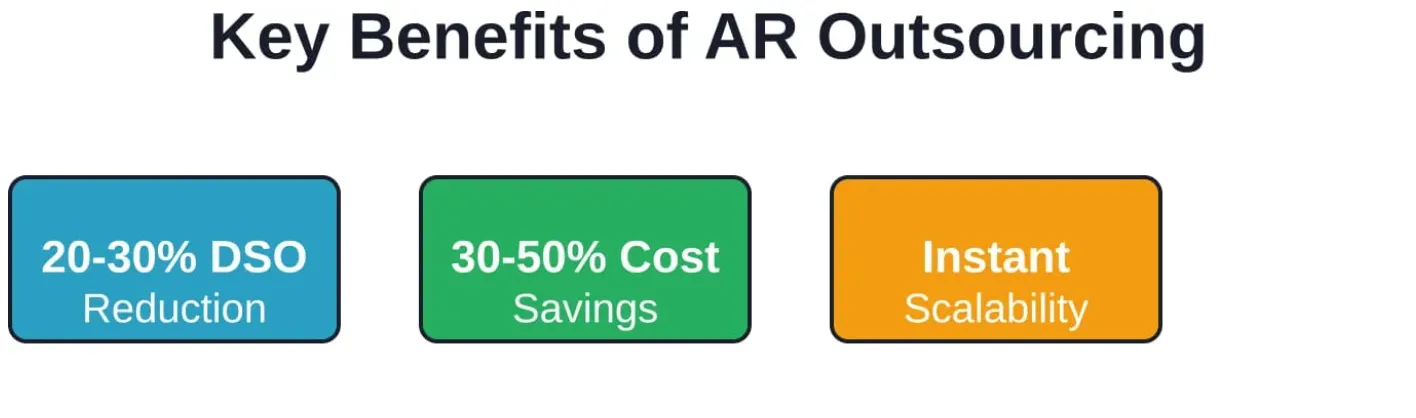
But does outsourcing actually deliver? The data says yes. Companies that use professional AR management typically see a 20-30% reduction in DSO within the first few months, according to multiple industry analyses. That's real cash returning to the business faster, without hiring another FTE or expanding your accounting department.
This guide walks through what AR outsourcing really involves, when it makes sense, what you'll pay, and how to pick a provider that fits your business model.
What Is Accounts Receivable Outsourcing?
Accounts receivable outsourcing hands off part or all of your AR function to an external service provider. Instead of hiring, training, and managing an internal AR team, you partner with specialists who handle invoicing, payment application, collections, dispute resolution, and reporting on your behalf.
The provider operates as an extension of your finance team. They use your branding, follow your credit policies, and integrate with your accounting system. You retain control over strategy and customer relationships while the provider executes the day-to-day AR workflow.
Outsourcing doesn't mean losing visibility. Modern AR providers deliver real-time dashboards, aging reports, and collection metrics that often exceed what in-house teams produce manually.
Core Services Included
Most AR outsourcing engagements cover these functions:
- Invoice generation and delivery: Preparing, formatting, and sending invoices via email, portal, or EDI
- Payment application: Matching incoming payments to open invoices and posting them to your ledger
- Collections management: Following up on overdue accounts via email, phone, and escalation protocols
- Dispute resolution: Investigating and resolving billing discrepancies, short pays, and chargebacks
- Credit memo processing: Issuing adjustments for returns, allowances, or pricing corrections
- Reporting and analytics: Delivering aging reports, DSO metrics, and cash forecasting data
Some providers also offer credit underwriting, customer onboarding, and exemption certificate management for B2B clients.
Why Businesses Outsource Accounts Receivable
The drivers vary by company size and industry, but the benefits cluster around four themes: cost, speed, expertise, and scalability.
Improved Cash Flow
This is the primary reason businesses outsource AR. Specialized providers follow up faster, escalate delinquent accounts systematically, and apply proven collection scripts that internal teams often lack the bandwidth or training to execute.
The result? Cash arrives sooner. DSO drops. Working capital improves.
Lower Operating Costs
Hiring an AR clerk costs $40,000–$55,000 annually in salary alone—before benefits, payroll taxes, software licenses, and training. An AR manager adds another $65,000–$85,000.
Outsourcing converts that fixed overhead into a variable cost tied to invoice volume or a flat monthly fee. For many businesses, the all-in cost of outsourced AR runs 30–50% below the fully loaded expense of an equivalent in-house team.
Access to Specialized Expertise
AR providers employ collections specialists, dispute analysts, and AR accountants who handle receivables full-time. They've seen thousands of customer scenarios, understand industry-specific payment terms, and know how to navigate complex deduction portals (Walmart, Amazon, major retailers).
That expertise is expensive to build internally—and hard to retain when your AR volume fluctuates seasonally.
Scalability Without Hiring
Revenue growth is great until your AR team can't keep up. Outsourcing lets you scale invoice volume and collections capacity without posting job openings, onboarding staff, or expanding office space.
Providers adjust resources dynamically. If you add a new product line or acquire a customer with high transaction volume, the provider ramps capacity to match.
How to Choose an Accounts Receivable Outsourcing Provider
Not all AR providers are equal. Here's what to evaluate.
Industry Experience
Does the provider understand your industry's payment norms? Retail has chargebacks and deduction portals. Construction deals with lien waivers and retainage. Healthcare navigates insurance reimbursement.
Ask for client references in your sector. A provider experienced in B2C e-commerce won't automatically excel at B2B manufacturing AR.
Technology Integration
The provider must integrate seamlessly with your accounting system—QuickBooks, NetSuite, Sage, Xero, or your ERP. Data should sync automatically, not via manual file uploads.
Ask about their tech stack. Do they offer a client portal for real-time visibility? Can you pull custom reports? How do they handle payment applications and bank reconciliation?
Service Level Agreements (SLAs)
SLAs define performance expectations: invoice turnaround time, dispute resolution speed, collection call frequency, reporting cadence.
Strong providers commit to measurable SLAs and track performance monthly. Weak providers offer vague promises with no accountability.
According to a 2023 survey by SSON Research & Analytics, most respondents list cost or efficiency as the top strategic priority for global business services and shared services organizations. Your SLA should balance multiple priorities including cost, efficiency, and service quality.
Data Security and Compliance
AR providers access sensitive customer data—payment terms, credit limits, transaction history. Verify that the provider maintains SOC 2 compliance, encrypts data in transit and at rest, and follows industry-standard security protocols.
To help organizations manage third-party risks, organizations and other interested parties are increasingly requesting more information about SOC for Service Organizations engagements, as noted by the AICPA.
Scalability and Flexibility
Can the provider scale with your growth? What happens if invoice volume doubles next year? Can you add or remove services mid-contract?
Look for month-to-month agreements or annual contracts with quarterly adjustment clauses. Avoid multi-year lock-ins unless pricing and terms heavily favor you.
_converted.webp)
Add Reliable Talent to Accounts Receivable Operations

Late payments and overloaded finance teams often create operational slowdowns long before companies notice the real impact on cash flow and customer communication.
NeoWork gives businesses access to dedicated global teammates who can handle recurring operational workflows and integrate directly into internal processes. The company stands out for its 91% retention rate and a hiring model that accepts only 3.2% of candidates.
Reduce AR Workload Without Overhiring
With NeoWork, companies can add:
- payment follow-up coordination
- customer communication workflows
- recurring administrative operations
- flexible back-office staffing
👉Reach out to NeoWork to build a dedicated team for accounts receivable operations.
Accounts Receivable Outsourcing Costs
Pricing models vary by provider, invoice volume, and service scope. Here's what businesses typically pay.
Common Pricing Structures
- Per-invoice fee: Providers charge $2–$8 per invoice processed. High-volume clients negotiate lower per-unit rates; low-volume accounts pay toward the top of the range.
- Percentage of collected revenue: The provider takes 3–8% of all cash collected. This aligns incentives—the provider earns more when they collect faster—but can become expensive if your customers pay reliably on their own.
- Flat monthly retainer: A fixed monthly fee covering a defined invoice volume or service level. Overages incur additional charges. Retainers range from $1,000/month for small businesses to $10,000+ for enterprise accounts.
- Hybrid models: A base retainer plus per-invoice or percentage fees above a threshold. This balances predictability with usage-based pricing.
Cost by Business Size
The table below shows typical annual costs based on revenue and invoice volume:
These figures assume full-service AR outsourcing. Partial engagements (collections only, for example) cost less.
In-House vs. Outsourced: Cost Comparison
When to Outsource Accounts Receivable
Outsourcing isn't a universal solution. It works best when specific conditions exist.
High Invoice Volume
Processing 200+ invoices per month starts to strain a single AR person. At 500+ invoices, you need dedicated staff just to keep up with data entry and payment applications.
Outsourcing becomes cost-effective when invoice volume justifies a second or third FTE but your business isn't ready to expand the team.
Rising DSO
If DSO is creeping upward despite internal efforts—customers are paying slower, aging buckets are growing, disputes are piling up—an outside provider brings fresh discipline and collections expertise.
Look at your AR aging report. If more than 15% of receivables sit beyond 60 days, collections need more attention than your current team can provide.
Limited Internal Bandwidth
Small finance teams juggle AP, payroll, month-end close, and reporting. AR often gets deprioritized until cash flow tightens.
Outsourcing lets your controller and staff focus on strategic finance—forecasting, budgeting, variance analysis—while the provider handles transactional AR work.
Seasonal Revenue Swings
Retail, manufacturing, and agriculture businesses face dramatic volume swings. Hiring for peak season means overstaffing during slow months. Outsourcing flexes capacity up and down without layoffs or idle payroll.
Rapid Growth or M&A Activity
Revenue growth is great until AR becomes the bottleneck. Acquisitions add customer bases, invoice formats, and payment portals overnight.
An outsourcing provider absorbs that complexity without forcing you to hire, train, and integrate new AR staff mid-growth.
When to Keep AR In-House
Some businesses should not outsource AR—at least not yet:
- Very low invoice volume: If you send fewer than 50 invoices per month and customers pay reliably, the cost and complexity of outsourcing outweigh the benefits. A part-time bookkeeper can handle the workload.
- Highly customized customer terms: Complex contracts with milestone billing, progress payments, or customer-specific invoicing rules require deep business knowledge. Providers can learn your processes, but the onboarding takes longer and costs more.
- Strong existing AR performance: If your DSO is below industry average, collections are timely, and your team runs efficiently, outsourcing may not yield enough improvement to justify the switch.
- Tight customer relationship management: In industries where AR staff double as account managers—maintaining customer rapport, upselling, handling service questions—separating collections from relationship management can harm customer experience.
The AR Outsourcing Implementation Process
Transitioning AR to an outside provider takes planning. Expect 4–8 weeks from contract signing to full operation.
Phase 1: Discovery and Setup (Weeks 1–2)
The provider audits your current AR process. They map your invoice formats, payment terms, customer segmentation, collection workflows, and reporting requirements.
You'll grant system access, provide customer files, and define escalation protocols (when to involve your internal team, legal, or executive leadership).
Phase 2: Integration and Testing (Weeks 3–4)
Technical teams connect the provider's platform to your accounting system. They test invoice generation, payment posting, and data sync to ensure accuracy.
Run a parallel period where both your team and the provider process a subset of transactions. Compare outputs to catch discrepancies before go-live.
Phase 3: Go-Live and Transition (Weeks 5–6)
The provider takes over daily AR operations. Your team shifts to oversight—reviewing reports, handling exceptions, and monitoring performance against SLAs.
Expect a learning curve. The provider needs time to understand customer payment behavior, dispute patterns, and your internal communication style.
Phase 4: Optimization (Weeks 7–8 and Beyond)
After the first month, analyze results. Is DSO improving? Are disputes resolving faster? Are customers satisfied with the new process?
Refine workflows based on data. Adjust collection scripts, escalation timing, or invoice delivery methods to improve outcomes.
Measuring AR Outsourcing Success
Track these metrics monthly to evaluate provider performance:
- Days Sales Outstanding (DSO): The average number of days it takes to collect payment after a sale. Target a 10–30% reduction within three months of outsourcing.
- Collection Effectiveness Index (CEI): (Beginning Receivables + Monthly Credit Sales – Ending Receivables) / (Beginning Receivables + Monthly Credit Sales – Ending Current Receivables). A CEI above 80% indicates strong collections.
- Aging bucket distribution: Track the percentage of AR in 0–30, 31–60, 61–90, and 90+ day buckets. Outsourcing should shift balances toward current (0–30 days).
- Bad debt write-offs: Dollars written off as uncollectible. Effective collections reduce write-offs over time.
- Cost per invoice processed: Total outsourcing cost divided by invoice count. Compare to your historical in-house cost per invoice to measure ROI.
Common Challenges and How to Avoid Them
Here's where AR outsourcing goes wrong—and how to prevent it.
Poor Communication Between Provider and Internal Team
If the provider operates in a silo, your finance team loses visibility. Disputes escalate, customers complain to your sales team, and nobody has current information.
Solution: Schedule weekly status calls. Require the provider to flag high-priority issues within 24 hours. Use shared dashboards so both teams see the same data in real time.
Customer Confusion or Dissatisfaction
Customers may not realize you've outsourced AR. If the provider's communication style doesn't match your brand, or if they're too aggressive in collections, customer relationships suffer.
Solution: Co-develop collection scripts and email templates with the provider. Have them use your company name and email domain. Introduce the provider to key accounts before go-live.
Data Quality Issues
If your customer master data is messy—duplicate records, incorrect contact info, outdated terms—the provider inherits the problem. Collections fail because invoices go to the wrong person or email bounces.
Solution: Clean your customer database before onboarding. Audit contact accuracy, consolidate duplicates, and verify payment terms.
Scope Creep and Hidden Fees
Providers sometimes charge extra for services you assumed were included: dispute resolution, phone collections, custom reporting.
Solution: Define scope in writing. List every included service explicitly. Negotiate a cap on overage fees or per-invoice charges above the contracted volume.
AR Outsourcing and Automation: How They Work Together
Outsourcing and automation aren't mutually exclusive. The best providers leverage automation to deliver faster, cheaper AR services.
Modern AR platforms automate invoice delivery, payment reminders, and cash application using OCR and machine learning. Automation handles high-volume, low-complexity tasks—freeing human collectors to focus on disputes, negotiations, and high-value accounts.
Some businesses start with automation software in-house, then outsource when volume outgrows internal capacity. Others outsource immediately and rely on the provider's automation stack.
Either way, automation reduces manual effort. Industry reports suggest that automation and the reduction of manual effort can significantly reduce deduction processing, with some solutions processing deductions in substantially less time than conventional methods.
_converted.webp)
Frequently Asked Questions
Final Thoughts: Is AR Outsourcing Right for Your Business?
Accounts receivable outsourcing isn't a magic fix. It won't repair broken sales processes, compensate for poor credit policies, or replace strategic finance leadership.
But when deployed strategically—at the right business stage, with the right provider, under clear SLAs—it accelerates cash flow, reduces overhead, and frees your team to focus on growth instead of chasing late payments.
The data backs it up. Companies that outsource AR typically see a 20-30% reduction in DSO within the first few months. That's real working capital returning to the business faster, without the payroll burden of hiring and training an internal team.
Start by auditing your current AR performance. Calculate your DSO, review aging reports, and estimate the fully loaded cost of your in-house AR function. Then request proposals from 3–5 providers with proven experience in your industry.
Compare not just price, but technology integration, SLA commitments, client references, and cultural fit. The cheapest provider rarely delivers the best results.
And remember: outsourcing is reversible. If it doesn't work, you can transition AR back in-house. But for most businesses processing 200+ invoices per month with DSO above industry benchmarks, outsourcing delivers measurable ROI within the first quarter.
Ready to explore AR outsourcing? Start by defining your goals, documenting current processes, and researching providers that specialize in your industry. The right partner will transform AR from a cash flow drag into a competitive advantage.
Topics
Accounts Receivable Outsourcing Guide 2026

Quick Summary: Accounts receivable outsourcing transfers your AR operations—invoicing, collections, dispute resolution—to a specialized third-party provider. Companies that outsource AR typically see a 20-30% reduction in days sales outstanding (DSO) within the first few months, freeing internal teams to focus on strategic priorities while cutting overhead and accelerating cash flow.
Managing accounts receivable in-house eats time. It burns payroll. And when payments lag, cash flow stalls.
For businesses processing hundreds or thousands of invoices each month, the AR cycle—from invoice generation to payment posting—can become a bottleneck that drags down operational efficiency. That's why more finance leaders are turning to accounts receivable outsourcing in 2026.
But does outsourcing actually deliver? The data says yes. Companies that use professional AR management typically see a 20-30% reduction in DSO within the first few months, according to multiple industry analyses. That's real cash returning to the business faster, without hiring another FTE or expanding your accounting department.
This guide walks through what AR outsourcing really involves, when it makes sense, what you'll pay, and how to pick a provider that fits your business model.
What Is Accounts Receivable Outsourcing?
Accounts receivable outsourcing hands off part or all of your AR function to an external service provider. Instead of hiring, training, and managing an internal AR team, you partner with specialists who handle invoicing, payment application, collections, dispute resolution, and reporting on your behalf.
The provider operates as an extension of your finance team. They use your branding, follow your credit policies, and integrate with your accounting system. You retain control over strategy and customer relationships while the provider executes the day-to-day AR workflow.
Outsourcing doesn't mean losing visibility. Modern AR providers deliver real-time dashboards, aging reports, and collection metrics that often exceed what in-house teams produce manually.
Core Services Included
Most AR outsourcing engagements cover these functions:
- Invoice generation and delivery: Preparing, formatting, and sending invoices via email, portal, or EDI
- Payment application: Matching incoming payments to open invoices and posting them to your ledger
- Collections management: Following up on overdue accounts via email, phone, and escalation protocols
- Dispute resolution: Investigating and resolving billing discrepancies, short pays, and chargebacks
- Credit memo processing: Issuing adjustments for returns, allowances, or pricing corrections
- Reporting and analytics: Delivering aging reports, DSO metrics, and cash forecasting data
Some providers also offer credit underwriting, customer onboarding, and exemption certificate management for B2B clients.
Why Businesses Outsource Accounts Receivable
The drivers vary by company size and industry, but the benefits cluster around four themes: cost, speed, expertise, and scalability.
Improved Cash Flow
This is the primary reason businesses outsource AR. Specialized providers follow up faster, escalate delinquent accounts systematically, and apply proven collection scripts that internal teams often lack the bandwidth or training to execute.
The result? Cash arrives sooner. DSO drops. Working capital improves.
Lower Operating Costs
Hiring an AR clerk costs $40,000–$55,000 annually in salary alone—before benefits, payroll taxes, software licenses, and training. An AR manager adds another $65,000–$85,000.
Outsourcing converts that fixed overhead into a variable cost tied to invoice volume or a flat monthly fee. For many businesses, the all-in cost of outsourced AR runs 30–50% below the fully loaded expense of an equivalent in-house team.
Access to Specialized Expertise
AR providers employ collections specialists, dispute analysts, and AR accountants who handle receivables full-time. They've seen thousands of customer scenarios, understand industry-specific payment terms, and know how to navigate complex deduction portals (Walmart, Amazon, major retailers).
That expertise is expensive to build internally—and hard to retain when your AR volume fluctuates seasonally.
Scalability Without Hiring
Revenue growth is great until your AR team can't keep up. Outsourcing lets you scale invoice volume and collections capacity without posting job openings, onboarding staff, or expanding office space.
Providers adjust resources dynamically. If you add a new product line or acquire a customer with high transaction volume, the provider ramps capacity to match.
How to Choose an Accounts Receivable Outsourcing Provider
Not all AR providers are equal. Here's what to evaluate.
Industry Experience
Does the provider understand your industry's payment norms? Retail has chargebacks and deduction portals. Construction deals with lien waivers and retainage. Healthcare navigates insurance reimbursement.
Ask for client references in your sector. A provider experienced in B2C e-commerce won't automatically excel at B2B manufacturing AR.
Technology Integration
The provider must integrate seamlessly with your accounting system—QuickBooks, NetSuite, Sage, Xero, or your ERP. Data should sync automatically, not via manual file uploads.
Ask about their tech stack. Do they offer a client portal for real-time visibility? Can you pull custom reports? How do they handle payment applications and bank reconciliation?
Service Level Agreements (SLAs)
SLAs define performance expectations: invoice turnaround time, dispute resolution speed, collection call frequency, reporting cadence.
Strong providers commit to measurable SLAs and track performance monthly. Weak providers offer vague promises with no accountability.
According to a 2023 survey by SSON Research & Analytics, most respondents list cost or efficiency as the top strategic priority for global business services and shared services organizations. Your SLA should balance multiple priorities including cost, efficiency, and service quality.
Data Security and Compliance
AR providers access sensitive customer data—payment terms, credit limits, transaction history. Verify that the provider maintains SOC 2 compliance, encrypts data in transit and at rest, and follows industry-standard security protocols.
To help organizations manage third-party risks, organizations and other interested parties are increasingly requesting more information about SOC for Service Organizations engagements, as noted by the AICPA.
Scalability and Flexibility
Can the provider scale with your growth? What happens if invoice volume doubles next year? Can you add or remove services mid-contract?
Look for month-to-month agreements or annual contracts with quarterly adjustment clauses. Avoid multi-year lock-ins unless pricing and terms heavily favor you.
Add Reliable Talent to Accounts Receivable Operations
Late payments and overloaded finance teams often create operational slowdowns long before companies notice the real impact on cash flow and customer communication.
NeoWork gives businesses access to dedicated global teammates who can handle recurring operational workflows and integrate directly into internal processes. The company stands out for its 91% retention rate and a hiring model that accepts only 3.2% of candidates.
Reduce AR Workload Without Overhiring
With NeoWork, companies can add:
- payment follow-up coordination
- customer communication workflows
- recurring administrative operations
- flexible back-office staffing
👉Reach out to NeoWork to build a dedicated team for accounts receivable operations.
Accounts Receivable Outsourcing Costs
Pricing models vary by provider, invoice volume, and service scope. Here's what businesses typically pay.
Common Pricing Structures
- Per-invoice fee: Providers charge $2–$8 per invoice processed. High-volume clients negotiate lower per-unit rates; low-volume accounts pay toward the top of the range.
- Percentage of collected revenue: The provider takes 3–8% of all cash collected. This aligns incentives—the provider earns more when they collect faster—but can become expensive if your customers pay reliably on their own.
- Flat monthly retainer: A fixed monthly fee covering a defined invoice volume or service level. Overages incur additional charges. Retainers range from $1,000/month for small businesses to $10,000+ for enterprise accounts.
- Hybrid models: A base retainer plus per-invoice or percentage fees above a threshold. This balances predictability with usage-based pricing.
Cost by Business Size
The table below shows typical annual costs based on revenue and invoice volume:
These figures assume full-service AR outsourcing. Partial engagements (collections only, for example) cost less.
In-House vs. Outsourced: Cost Comparison
When to Outsource Accounts Receivable
Outsourcing isn't a universal solution. It works best when specific conditions exist.
High Invoice Volume
Processing 200+ invoices per month starts to strain a single AR person. At 500+ invoices, you need dedicated staff just to keep up with data entry and payment applications.
Outsourcing becomes cost-effective when invoice volume justifies a second or third FTE but your business isn't ready to expand the team.
Rising DSO
If DSO is creeping upward despite internal efforts—customers are paying slower, aging buckets are growing, disputes are piling up—an outside provider brings fresh discipline and collections expertise.
Look at your AR aging report. If more than 15% of receivables sit beyond 60 days, collections need more attention than your current team can provide.
Limited Internal Bandwidth
Small finance teams juggle AP, payroll, month-end close, and reporting. AR often gets deprioritized until cash flow tightens.
Outsourcing lets your controller and staff focus on strategic finance—forecasting, budgeting, variance analysis—while the provider handles transactional AR work.
Seasonal Revenue Swings
Retail, manufacturing, and agriculture businesses face dramatic volume swings. Hiring for peak season means overstaffing during slow months. Outsourcing flexes capacity up and down without layoffs or idle payroll.
Rapid Growth or M&A Activity
Revenue growth is great until AR becomes the bottleneck. Acquisitions add customer bases, invoice formats, and payment portals overnight.
An outsourcing provider absorbs that complexity without forcing you to hire, train, and integrate new AR staff mid-growth.
When to Keep AR In-House
Some businesses should not outsource AR—at least not yet:
- Very low invoice volume: If you send fewer than 50 invoices per month and customers pay reliably, the cost and complexity of outsourcing outweigh the benefits. A part-time bookkeeper can handle the workload.
- Highly customized customer terms: Complex contracts with milestone billing, progress payments, or customer-specific invoicing rules require deep business knowledge. Providers can learn your processes, but the onboarding takes longer and costs more.
- Strong existing AR performance: If your DSO is below industry average, collections are timely, and your team runs efficiently, outsourcing may not yield enough improvement to justify the switch.
- Tight customer relationship management: In industries where AR staff double as account managers—maintaining customer rapport, upselling, handling service questions—separating collections from relationship management can harm customer experience.
The AR Outsourcing Implementation Process
Transitioning AR to an outside provider takes planning. Expect 4–8 weeks from contract signing to full operation.
Phase 1: Discovery and Setup (Weeks 1–2)
The provider audits your current AR process. They map your invoice formats, payment terms, customer segmentation, collection workflows, and reporting requirements.
You'll grant system access, provide customer files, and define escalation protocols (when to involve your internal team, legal, or executive leadership).
Phase 2: Integration and Testing (Weeks 3–4)
Technical teams connect the provider's platform to your accounting system. They test invoice generation, payment posting, and data sync to ensure accuracy.
Run a parallel period where both your team and the provider process a subset of transactions. Compare outputs to catch discrepancies before go-live.
Phase 3: Go-Live and Transition (Weeks 5–6)
The provider takes over daily AR operations. Your team shifts to oversight—reviewing reports, handling exceptions, and monitoring performance against SLAs.
Expect a learning curve. The provider needs time to understand customer payment behavior, dispute patterns, and your internal communication style.
Phase 4: Optimization (Weeks 7–8 and Beyond)
After the first month, analyze results. Is DSO improving? Are disputes resolving faster? Are customers satisfied with the new process?
Refine workflows based on data. Adjust collection scripts, escalation timing, or invoice delivery methods to improve outcomes.
Measuring AR Outsourcing Success
Track these metrics monthly to evaluate provider performance:
- Days Sales Outstanding (DSO): The average number of days it takes to collect payment after a sale. Target a 10–30% reduction within three months of outsourcing.
- Collection Effectiveness Index (CEI): (Beginning Receivables + Monthly Credit Sales – Ending Receivables) / (Beginning Receivables + Monthly Credit Sales – Ending Current Receivables). A CEI above 80% indicates strong collections.
- Aging bucket distribution: Track the percentage of AR in 0–30, 31–60, 61–90, and 90+ day buckets. Outsourcing should shift balances toward current (0–30 days).
- Bad debt write-offs: Dollars written off as uncollectible. Effective collections reduce write-offs over time.
- Cost per invoice processed: Total outsourcing cost divided by invoice count. Compare to your historical in-house cost per invoice to measure ROI.
Common Challenges and How to Avoid Them
Here's where AR outsourcing goes wrong—and how to prevent it.
Poor Communication Between Provider and Internal Team
If the provider operates in a silo, your finance team loses visibility. Disputes escalate, customers complain to your sales team, and nobody has current information.
Solution: Schedule weekly status calls. Require the provider to flag high-priority issues within 24 hours. Use shared dashboards so both teams see the same data in real time.
Customer Confusion or Dissatisfaction
Customers may not realize you've outsourced AR. If the provider's communication style doesn't match your brand, or if they're too aggressive in collections, customer relationships suffer.
Solution: Co-develop collection scripts and email templates with the provider. Have them use your company name and email domain. Introduce the provider to key accounts before go-live.
Data Quality Issues
If your customer master data is messy—duplicate records, incorrect contact info, outdated terms—the provider inherits the problem. Collections fail because invoices go to the wrong person or email bounces.
Solution: Clean your customer database before onboarding. Audit contact accuracy, consolidate duplicates, and verify payment terms.
Scope Creep and Hidden Fees
Providers sometimes charge extra for services you assumed were included: dispute resolution, phone collections, custom reporting.
Solution: Define scope in writing. List every included service explicitly. Negotiate a cap on overage fees or per-invoice charges above the contracted volume.
AR Outsourcing and Automation: How They Work Together
Outsourcing and automation aren't mutually exclusive. The best providers leverage automation to deliver faster, cheaper AR services.
Modern AR platforms automate invoice delivery, payment reminders, and cash application using OCR and machine learning. Automation handles high-volume, low-complexity tasks—freeing human collectors to focus on disputes, negotiations, and high-value accounts.
Some businesses start with automation software in-house, then outsource when volume outgrows internal capacity. Others outsource immediately and rely on the provider's automation stack.
Either way, automation reduces manual effort. Industry reports suggest that automation and the reduction of manual effort can significantly reduce deduction processing, with some solutions processing deductions in substantially less time than conventional methods.
Frequently Asked Questions
Final Thoughts: Is AR Outsourcing Right for Your Business?
Accounts receivable outsourcing isn't a magic fix. It won't repair broken sales processes, compensate for poor credit policies, or replace strategic finance leadership.
But when deployed strategically—at the right business stage, with the right provider, under clear SLAs—it accelerates cash flow, reduces overhead, and frees your team to focus on growth instead of chasing late payments.
The data backs it up. Companies that outsource AR typically see a 20-30% reduction in DSO within the first few months. That's real working capital returning to the business faster, without the payroll burden of hiring and training an internal team.
Start by auditing your current AR performance. Calculate your DSO, review aging reports, and estimate the fully loaded cost of your in-house AR function. Then request proposals from 3–5 providers with proven experience in your industry.
Compare not just price, but technology integration, SLA commitments, client references, and cultural fit. The cheapest provider rarely delivers the best results.
And remember: outsourcing is reversible. If it doesn't work, you can transition AR back in-house. But for most businesses processing 200+ invoices per month with DSO above industry benchmarks, outsourcing delivers measurable ROI within the first quarter.
Ready to explore AR outsourcing? Start by defining your goals, documenting current processes, and researching providers that specialize in your industry. The right partner will transform AR from a cash flow drag into a competitive advantage.
Topics
Related Blogs
Related Podcasts


.webp)

.webp)
.webp)



