

.avif)
.avif)

Audit Support Outsourcing Guide: Strategy & Best Practices


.svg)

Quick Summary: Audit support outsourcing enables accounting firms to delegate back-end audit operations to external vendors, reducing staffing burdens while maintaining compliance. This guide covers what outsourced audit services include, their benefits and drawbacks, cost considerations, and how to select the right provider for your firm's needs.
What Is Audit Support Outsourcing?
Audit support outsourcing involves hiring an external vendor to handle a firm's back-end audit operations. Rather than managing all audit tasks in-house with permanent staff, accounting firms delegate specific functions to specialized service providers. This approach allows firms to scale capacity without permanent hiring commitments.
The practice has grown significantly. According to the 2015 CBOK survey covering 166 countries, 56% of respondents in North America reported using third parties for internal audit activity. The Middle East and North Africa followed with 43%, while South Asia reported 40%, indicating strong global adoption of this model.
Here's the thing though—audit support outsourcing isn't a one-size-fits-all solution. Some firms use it for temporary capacity gaps. Others rely on it as a permanent staffing strategy. The scope and nature of outsourced work varies widely based on firm size, client mix, and internal capabilities.
What Do Outsourced Audit Support Services Cover?
Audit support services encompass a broad range of back-end operations. Documentation review, workpaper preparation, testing procedures, and compliance verification fall within typical scope. External service providers handle repetitive, standardized tasks that don't require partner-level judgment.
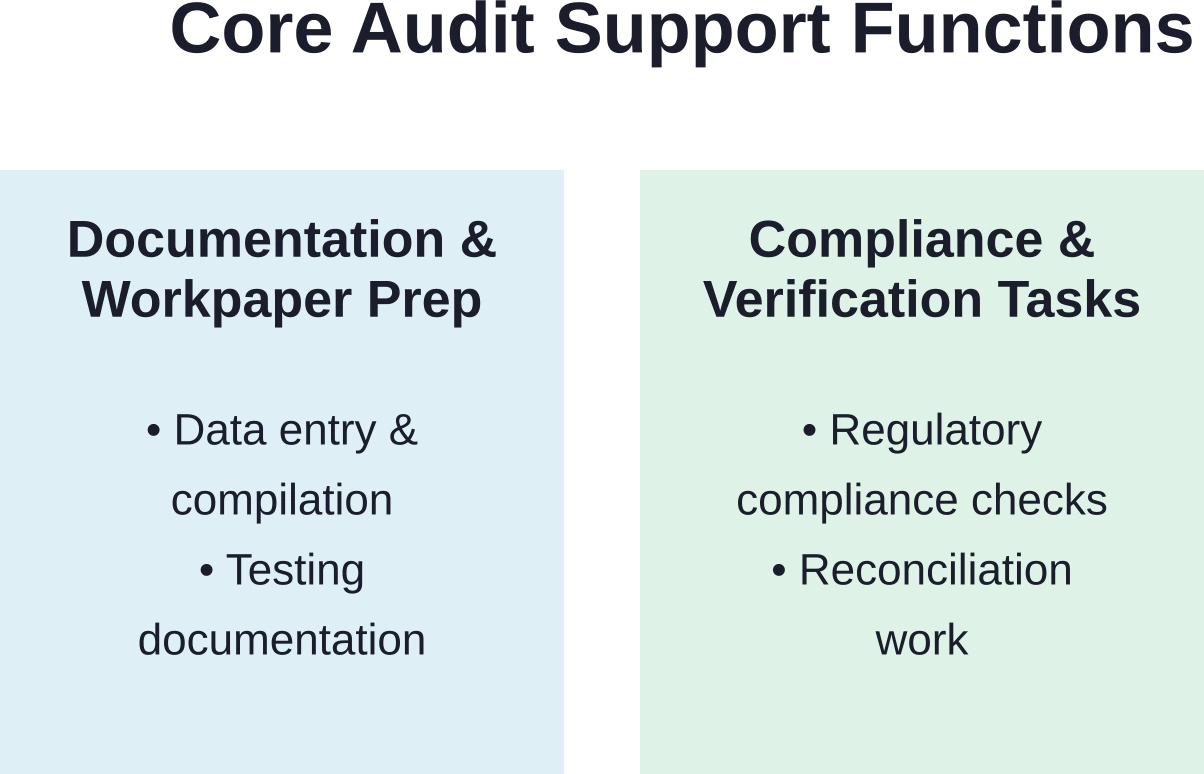
Financial statement analysis, account reconciliations, and audit report formatting also fall into this category. Partners retain responsibility for complex judgments, client relationship management, and final sign-offs. The vendor handles the execution and documentation that supports those decisions.
Benefits of Outsourcing Audit Support
Scalability Without Permanent Headcount
Accounting firms face seasonal fluctuations in audit demand. Year-end brings overwhelming volume; slow seasons leave capacity underutilized. Outsourcing allows firms to scale up during busy periods without the commitment of permanent hires. When demand drops, the external vendor relationship can be adjusted without layoff complications.
Cost Management and Flexibility
Pricing varies significantly based on the service delivery model. Costs range from as little as $4.50 per hour for offshore services to over $200 per hour for onsite arrangements. This flexibility allows firms to match spending to actual workload requirements rather than maintaining fixed staffing costs year-round.
Access to Specialized Expertise
Quality outsourcing providers maintain deep audit expertise across industries and compliance frameworks. Firms gain access to specialized knowledge without building internal teams. This proves particularly valuable for niche audit areas or emerging regulatory requirements.
Improved Client Capacity
With back-end operations handled externally, firms can accept more client engagements. Partners spend less time on administrative work and more time on high-value client relationships and strategic review activities. This expands revenue potential without proportional staffing increases.
Drawbacks and Considerations
Quality Control Risks
External vendors operate independently from your firm's direct oversight. Quality standards, consistency of approach, and adherence to your specific methodologies can vary. Strong vendor selection and ongoing monitoring become critical to mitigate this risk.
Data Security and Confidentiality
Outsourcing means client financial data transfers to external parties. Even with contractual protections and security certifications, firms remain liable for breaches. Vendors claiming ISO 27001 compliance for information security provide some assurance, but due diligence is essential.
Client Relationship Complexities
Transparency about outsourced audit support varies by client and engagement type. Some clients welcome the efficiency; others question independence or quality. Managing client perceptions requires clear communication about vendor credentials and your firm's oversight role.
Audit Independence Considerations
The SEC maintains strict rules on auditor independence. According to SEC regulations, lead and concurring partners must rotate every 5 years with a 5-year time-out period. However, other 'audit partners' (such as lead partners on the audit of an issuer's subsidiaries whose assets or revenues constitute 20% or more of the company's consolidated assets or revenues) must rotate after 7 years and are subject to a 2-year time-out period. Ensure any outsourced vendor arrangement maintains these independence standards.
Cost Structure and Pricing Models
Pricing depends on task complexity, vendor location, service level agreement terms, and volume commitments. Offshore arrangements offer lowest cost but require stronger quality control. Onshore services cost significantly more but minimize supervision overhead.
Beyond hourly rates, consider setup costs, minimum engagement requirements, and pricing structures for fluctuating volumes. Some vendors offer project-based pricing for defined scopes. Others charge retainers plus variable hours. Negotiate terms that align with your firm's cash flow and seasonal patterns.
How to Select the Right Audit Outsourcing Provider
Evaluate Credentials and Compliance Certifications
Look for vendors holding relevant certifications. ISO 9001 for quality management and ISO 27001 for information security provide objective measures of operational standards. AICPA-affiliated providers demonstrate alignment with accounting profession standards. Request detailed proof of compliance—certification numbers, audit dates, and scope documentation.
Assess Industry and Technical Expertise
Does the vendor have deep experience in your target industries? Can they demonstrate expertise with your firm's specific audit software and methodologies? Ask for case studies, client references, and details about their approach to regulatory changes.
Review Quality Assurance Processes
Inquire about their QA framework. How do they ensure accuracy and consistency? What supervision levels do senior auditors provide? How quickly do they address errors or quality issues? Strong vendors maintain documented QA procedures and measurable error rates.
Evaluate Communication and Integration
Real talk: poor communication derails outsourcing arrangements. Test responsiveness during vendor evaluation. Confirm they offer real-time project tracking and accessibility. Assess whether their project management tools integrate with yours. Time zone compatibility matters—can they provide coverage during your critical deadlines?
Clarify Service Level Agreements (SLAs)
Ensure SLAs specify turnaround times, quality standards, escalation procedures, and remedies for non-compliance. Define what constitutes acceptable work. Include provisions for periodic audits of their processes. Clear SLAs protect both parties and establish accountability.

Keep Audit Preparation Organized with NeoWork
Audit support outsourcing should not replace licensed audit work, but it can help companies keep financial records, documentation, and recurring bookkeeping tasks better organized before review. NeoWork supports businesses with bookkeeping and virtual assistant teammates who can help with transaction tracking, account reconciliation support, and financial admin work.
This can be useful when finance teams need cleaner records, better document control, and more consistent support around routine accounting workflows. NeoWork reports a 91% annualized teammate retention rate and a 3.2% candidate selectivity rate, which matters when financial support depends on accuracy, continuity, and familiarity with internal processes.
Audit preparation tasks NeoWork can support:
- bookkeeping and transaction recording
- account reconciliation support
- financial documentation and admin work
- recurring support for finance and operations teams
👉Contact NeoWork to organize audit preparation support, reduce manual finance workload, and keep records easier for your internal team or external advisors to review.
Implementation Best Practices
Start with a pilot project rather than outsourcing your entire audit practice immediately. This allows you to test vendor capabilities, communication quality, and integration with your processes on a limited basis. Use the pilot to refine procedures and confirm the vendor can meet your expectations.
Establish clear documentation of work standards and expectations. Provide detailed instructions for your firm's specific methodologies, software usage, and quality requirements. Regular feedback and periodic quality reviews prevent drift from standards over time.
Maintain adequate partner oversight and review layers. Outsourcing doesn't eliminate your firm's quality responsibility. Partners must remain engaged in supervisory review even when vendors handle execution. This protects audit quality and maintains independence standards.
Regulatory Compliance and Independence
Audit support outsourcing doesn't exempt firms from regulatory requirements. The SEC maintains independence rules applicable to all audit engagement team members. According to SEC regulations, lead and concurring partners must rotate every 5 years with a 5-year time-out period. However, other 'audit partners' (such as lead partners on the audit of an issuer's subsidiaries whose assets or revenues constitute 20% or more of the company's consolidated assets or revenues) must rotate after 7 years and are subject to a 2-year time-out period.
Ensure vendor agreements include provisions for confidentiality, conflict management, and compliance with your firm's independence policies. Some vendors handle work for multiple firms—understanding their client base helps identify potential conflict-of-interest issues.
Document your firm's policies for vendor oversight and the extent of outsourcing. This documentation demonstrates quality control and supports your firm's audit quality claims during regulatory examinations.
Conclusion
Audit support outsourcing represents a legitimate strategy for accounting firms seeking operational flexibility and cost efficiency. When structured thoughtfully with vendor selection rigor and strong internal oversight, outsourcing strengthens capacity without compromising audit quality or independence. The key lies in starting small with pilot projects, maintaining clear communication, establishing measurable SLAs, and keeping partners engaged in quality review.
Firms in today's competitive market face constant pressure to do more with existing resources. Properly implemented audit support outsourcing addresses that challenge while freeing your team to focus on client relationships and high-value audit judgments. The 56% of North American firms already using third-party audit support demonstrate the practice's viability when executed correctly.
Ready to explore outsourcing for your firm? Start by clearly defining which tasks present the best outsourcing opportunities, then evaluate vendors using the selection criteria outlined above. A successful pilot project will reveal whether outsourcing aligns with your firm's goals and culture.
FAQ
Topics
Audit Support Outsourcing Guide: Strategy & Best Practices

Quick Summary: Audit support outsourcing enables accounting firms to delegate back-end audit operations to external vendors, reducing staffing burdens while maintaining compliance. This guide covers what outsourced audit services include, their benefits and drawbacks, cost considerations, and how to select the right provider for your firm's needs.
What Is Audit Support Outsourcing?
Audit support outsourcing involves hiring an external vendor to handle a firm's back-end audit operations. Rather than managing all audit tasks in-house with permanent staff, accounting firms delegate specific functions to specialized service providers. This approach allows firms to scale capacity without permanent hiring commitments.
The practice has grown significantly. According to the 2015 CBOK survey covering 166 countries, 56% of respondents in North America reported using third parties for internal audit activity. The Middle East and North Africa followed with 43%, while South Asia reported 40%, indicating strong global adoption of this model.
Here's the thing though—audit support outsourcing isn't a one-size-fits-all solution. Some firms use it for temporary capacity gaps. Others rely on it as a permanent staffing strategy. The scope and nature of outsourced work varies widely based on firm size, client mix, and internal capabilities.
What Do Outsourced Audit Support Services Cover?
Audit support services encompass a broad range of back-end operations. Documentation review, workpaper preparation, testing procedures, and compliance verification fall within typical scope. External service providers handle repetitive, standardized tasks that don't require partner-level judgment.
Financial statement analysis, account reconciliations, and audit report formatting also fall into this category. Partners retain responsibility for complex judgments, client relationship management, and final sign-offs. The vendor handles the execution and documentation that supports those decisions.
Benefits of Outsourcing Audit Support
Scalability Without Permanent Headcount
Accounting firms face seasonal fluctuations in audit demand. Year-end brings overwhelming volume; slow seasons leave capacity underutilized. Outsourcing allows firms to scale up during busy periods without the commitment of permanent hires. When demand drops, the external vendor relationship can be adjusted without layoff complications.
Cost Management and Flexibility
Pricing varies significantly based on the service delivery model. Costs range from as little as $4.50 per hour for offshore services to over $200 per hour for onsite arrangements. This flexibility allows firms to match spending to actual workload requirements rather than maintaining fixed staffing costs year-round.
Access to Specialized Expertise
Quality outsourcing providers maintain deep audit expertise across industries and compliance frameworks. Firms gain access to specialized knowledge without building internal teams. This proves particularly valuable for niche audit areas or emerging regulatory requirements.
Improved Client Capacity
With back-end operations handled externally, firms can accept more client engagements. Partners spend less time on administrative work and more time on high-value client relationships and strategic review activities. This expands revenue potential without proportional staffing increases.
Drawbacks and Considerations
Quality Control Risks
External vendors operate independently from your firm's direct oversight. Quality standards, consistency of approach, and adherence to your specific methodologies can vary. Strong vendor selection and ongoing monitoring become critical to mitigate this risk.
Data Security and Confidentiality
Outsourcing means client financial data transfers to external parties. Even with contractual protections and security certifications, firms remain liable for breaches. Vendors claiming ISO 27001 compliance for information security provide some assurance, but due diligence is essential.
Client Relationship Complexities
Transparency about outsourced audit support varies by client and engagement type. Some clients welcome the efficiency; others question independence or quality. Managing client perceptions requires clear communication about vendor credentials and your firm's oversight role.
Audit Independence Considerations
The SEC maintains strict rules on auditor independence. According to SEC regulations, lead and concurring partners must rotate every 5 years with a 5-year time-out period. However, other 'audit partners' (such as lead partners on the audit of an issuer's subsidiaries whose assets or revenues constitute 20% or more of the company's consolidated assets or revenues) must rotate after 7 years and are subject to a 2-year time-out period. Ensure any outsourced vendor arrangement maintains these independence standards.
Cost Structure and Pricing Models
Pricing depends on task complexity, vendor location, service level agreement terms, and volume commitments. Offshore arrangements offer lowest cost but require stronger quality control. Onshore services cost significantly more but minimize supervision overhead.
Beyond hourly rates, consider setup costs, minimum engagement requirements, and pricing structures for fluctuating volumes. Some vendors offer project-based pricing for defined scopes. Others charge retainers plus variable hours. Negotiate terms that align with your firm's cash flow and seasonal patterns.
How to Select the Right Audit Outsourcing Provider
Evaluate Credentials and Compliance Certifications
Look for vendors holding relevant certifications. ISO 9001 for quality management and ISO 27001 for information security provide objective measures of operational standards. AICPA-affiliated providers demonstrate alignment with accounting profession standards. Request detailed proof of compliance—certification numbers, audit dates, and scope documentation.
Assess Industry and Technical Expertise
Does the vendor have deep experience in your target industries? Can they demonstrate expertise with your firm's specific audit software and methodologies? Ask for case studies, client references, and details about their approach to regulatory changes.
Review Quality Assurance Processes
Inquire about their QA framework. How do they ensure accuracy and consistency? What supervision levels do senior auditors provide? How quickly do they address errors or quality issues? Strong vendors maintain documented QA procedures and measurable error rates.
Evaluate Communication and Integration
Real talk: poor communication derails outsourcing arrangements. Test responsiveness during vendor evaluation. Confirm they offer real-time project tracking and accessibility. Assess whether their project management tools integrate with yours. Time zone compatibility matters—can they provide coverage during your critical deadlines?
Clarify Service Level Agreements (SLAs)
Ensure SLAs specify turnaround times, quality standards, escalation procedures, and remedies for non-compliance. Define what constitutes acceptable work. Include provisions for periodic audits of their processes. Clear SLAs protect both parties and establish accountability.
Keep Audit Preparation Organized with NeoWork
Audit support outsourcing should not replace licensed audit work, but it can help companies keep financial records, documentation, and recurring bookkeeping tasks better organized before review. NeoWork supports businesses with bookkeeping and virtual assistant teammates who can help with transaction tracking, account reconciliation support, and financial admin work.
This can be useful when finance teams need cleaner records, better document control, and more consistent support around routine accounting workflows. NeoWork reports a 91% annualized teammate retention rate and a 3.2% candidate selectivity rate, which matters when financial support depends on accuracy, continuity, and familiarity with internal processes.
Audit preparation tasks NeoWork can support:
- bookkeeping and transaction recording
- account reconciliation support
- financial documentation and admin work
- recurring support for finance and operations teams
👉Contact NeoWork to organize audit preparation support, reduce manual finance workload, and keep records easier for your internal team or external advisors to review.
Implementation Best Practices
Start with a pilot project rather than outsourcing your entire audit practice immediately. This allows you to test vendor capabilities, communication quality, and integration with your processes on a limited basis. Use the pilot to refine procedures and confirm the vendor can meet your expectations.
Establish clear documentation of work standards and expectations. Provide detailed instructions for your firm's specific methodologies, software usage, and quality requirements. Regular feedback and periodic quality reviews prevent drift from standards over time.
Maintain adequate partner oversight and review layers. Outsourcing doesn't eliminate your firm's quality responsibility. Partners must remain engaged in supervisory review even when vendors handle execution. This protects audit quality and maintains independence standards.
Regulatory Compliance and Independence
Audit support outsourcing doesn't exempt firms from regulatory requirements. The SEC maintains independence rules applicable to all audit engagement team members. According to SEC regulations, lead and concurring partners must rotate every 5 years with a 5-year time-out period. However, other 'audit partners' (such as lead partners on the audit of an issuer's subsidiaries whose assets or revenues constitute 20% or more of the company's consolidated assets or revenues) must rotate after 7 years and are subject to a 2-year time-out period.
Ensure vendor agreements include provisions for confidentiality, conflict management, and compliance with your firm's independence policies. Some vendors handle work for multiple firms—understanding their client base helps identify potential conflict-of-interest issues.
Document your firm's policies for vendor oversight and the extent of outsourcing. This documentation demonstrates quality control and supports your firm's audit quality claims during regulatory examinations.
Conclusion
Audit support outsourcing represents a legitimate strategy for accounting firms seeking operational flexibility and cost efficiency. When structured thoughtfully with vendor selection rigor and strong internal oversight, outsourcing strengthens capacity without compromising audit quality or independence. The key lies in starting small with pilot projects, maintaining clear communication, establishing measurable SLAs, and keeping partners engaged in quality review.
Firms in today's competitive market face constant pressure to do more with existing resources. Properly implemented audit support outsourcing addresses that challenge while freeing your team to focus on client relationships and high-value audit judgments. The 56% of North American firms already using third-party audit support demonstrate the practice's viability when executed correctly.
Ready to explore outsourcing for your firm? Start by clearly defining which tasks present the best outsourcing opportunities, then evaluate vendors using the selection criteria outlined above. A successful pilot project will reveal whether outsourcing aligns with your firm's goals and culture.
FAQ
Topics
Related Blogs
Related Podcasts


.webp)
.webp)



