

.avif)
.avif)

Consulting Staff Augmentation Guide: Models, Costs & Best Practices for 2026


.svg)

Quick Summary: Consulting staff augmentation is a hiring model where a company adds external specialists to its existing team for a defined stretch of time, while keeping full control over how the work gets done. It costs less per hour than traditional consulting but demands more internal management, and it works best when the gap is a skills shortage rather than a strategy or ownership gap. Picking the right model comes down to matching the type of gap to the type of engagement, then setting clear onboarding and communication rules from day one.
Every growing company eventually hits the same wall: there's more work than there are hands to do it, and hiring full-time isn't fast enough — or isn't the right long-term fit. That's usually the moment someone in leadership says "let's just bring in some contractors," and then quickly discovers there are at least three different ways to do that, each with different costs, control levels, and risks.
This guide breaks down what consulting staff augmentation actually is, how it differs from traditional consulting and managed services, what it costs, and how to run an engagement that doesn't fall apart three weeks in. It's written for founders, IT directors, and procurement teams who need a working framework, not a sales pitch.
What Is Consulting Staff Augmentation, Exactly?
Staff augmentation means bringing external professionals into an existing team on a temporary basis to fill a specific skill or capacity gap. The company retains ownership of the project, sets the priorities, and directs the day-to-day work — the augmented staff simply execute inside that structure, much like a temp employee would, except usually at a more senior technical level.
That's the key distinction from consulting: staff augmentation buys hands you direct, while consulting buys a recommendation or deliverable that a firm is accountable for producing on its own terms. Neither is inherently better. They solve different problems.
Why Companies Choose It Over Full-Time Hiring
- Faster time-to-start — often two to four weeks versus two to four months for a full-time hire.
- No long-term payroll, benefits, or severance obligations once the project ends.
- Access to niche skills (a specific cloud platform, a legacy language, a compliance specialty) that aren't needed year-round.
- Flexibility to scale a team up or down as project phases shift.
Staff Augmentation vs Consulting vs Managed Services
These three terms get used almost interchangeably in sales conversations, and that's exactly where budgets go sideways. Each one shifts a different amount of responsibility onto the vendor.
Put simply: staff augmentation usually costs less per hour but requires internal management of the work, while consulting costs more per hour but includes strategy, oversight, and a defined recommendation. Managed services go a step further and hand over the entire operating result, not just the labor.
When Staff Augmentation Actually Makes Sense
Not every gap is a staffing gap. Staff augmentation shines when the roadmap and processes already exist and the only missing piece is capable people to execute against them. It struggles when a company doesn't know what to build yet — that's a consulting problem, not a staffing one.
Good fits include: a product team that needs three extra backend engineers for a six-month migration, a finance department needing a specialist for tax season, or an IT group that needs a security engineer during an audit window. Poor fits include: a company that needs someone to define its entire go-to-market strategy, or one that has no internal technical leadership to direct the augmented staff at all.

Add Staff Augmentation Support with NeoWork
Consulting staff augmentation helps companies add external professionals to existing teams for recurring work, specific projects, or capacity gaps. NeoWork provides remote teammates through individual contributor and dedicated team structures across technical, support, and operational functions. NeoWork handles recruitment, benefits, training, and ongoing engagement, while teammates integrate into the client’s systems and workflows. Its 91% annualized teammate retention rate and 3.2% candidate selectivity rate reflect a focus on selective hiring and longer-term team stability.
NeoWork's staff augmentation model offers:
- individual contributors or dedicated teams
- integration with the client’s tools and processes
- recruitment and ongoing teammate support
Contact NeoWork to build a staff augmentation setup around your team’s current needs.
How Much Does Staff Augmentation Cost?
Rates vary heavily by region, seniority, and specialization, so treat any number here as a directional benchmark rather than a quote — always confirm current rates directly with vendors or platforms serving the target region and skill set.
Broadly, augmented staff based in North America or Western Europe tend to command the highest hourly rates, staff based in Eastern Europe and Latin America sit in a middle band, and staff based in South and Southeast Asia are generally the most cost-efficient — though skill availability and time-zone overlap matter just as much as raw rate when comparing options.
What Actually Drives the Price
- Seniority level — a junior developer and a principal engineer can differ by three to five times in rate.
- Engagement length — short sprints often carry a premium versus multi-month commitments.
- Niche skill scarcity — specialized AI, security, or legacy-system expertise commands a premium regardless of region.
- Vendor overhead — going through a staffing agency versus contracting independently changes the margin baked into the rate.
Direct Hire vs Agency-Sourced Staff Augmentation
There are two practical paths to sourcing augmented staff: contracting individuals directly, or going through a staffing agency or consultancy that manages sourcing, vetting, and often replacement guarantees.
Best Practices for Managing an Augmented Team
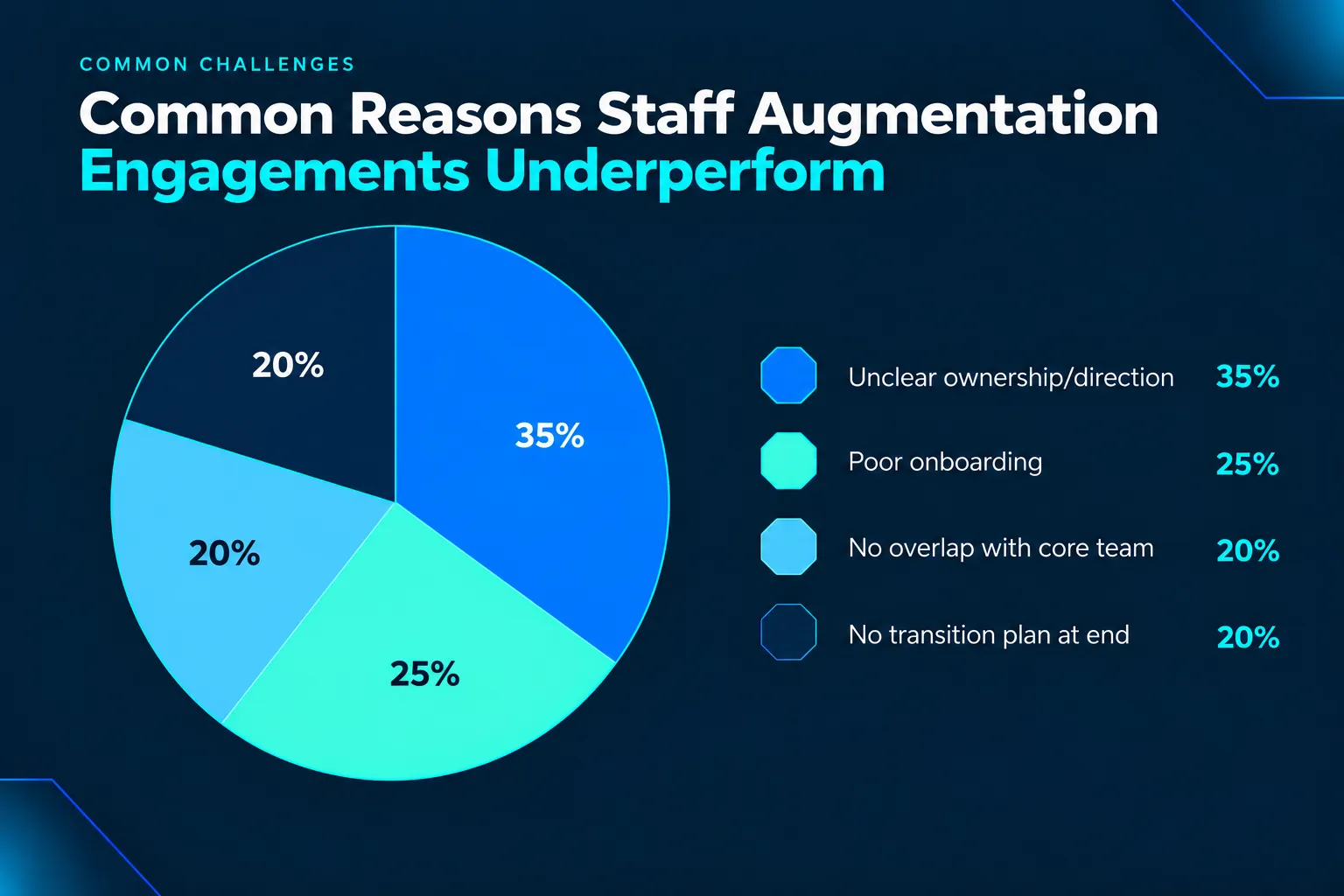
The single biggest failure mode in staff augmentation isn't finding talent — it's managing it once it's in place. Augmented staff aren't full employees, so the usual onboarding rhythms don't automatically apply, and gaps in communication show up fast.
1. Define Ownership Before Day One
Write down exactly who directs the augmented staff, who approves their work, and who they escalate blockers to. Without this, augmented team members either sit idle waiting for direction or start making product decisions that aren't theirs to make.
2. Onboard Like They're Staying a Year
Even a two-month engagement deserves proper access provisioning, documentation, and a walkthrough of tools and codebase conventions. Skipping this to "save time" almost always costs more time later in rework and clarification cycles.
3. Build in Overlap Time With Core Staff
Augmented staff who never interact with full-time team members tend to drift from context and priorities. Even a weekly sync keeps everyone aligned on what's actually changing on the roadmap.
4. Set a Clear End Date and Transition Plan
Know in advance what happens to the work when the engagement ends — handoff to internal staff, extension, or conversion to a longer contract. Ambiguity here creates knowledge gaps right when a project needs stability most.
Risks and Trade-Offs to Plan For
Staff augmentation isn't risk-free just because it's flexible. Knowledge walks out the door when a contract ends unless documentation is enforced along the way. Managing external staff also takes real bandwidth from internal leads — bandwidth that's easy to underestimate when the pitch is "just add people."
There's also a quieter risk: over-relying on augmented staff for so long that it becomes a permanent staffing strategy rather than a temporary bridge. At that point, it's worth asking whether a full-time hire would actually be cheaper and more stable.
How to Choose a Staff Augmentation Vendor
Look past the marketing page and ask for specifics: how do they vet technical skill, what does replacement look like if someone underperforms, and can they provide references from engagements of similar scope. A vendor that can't answer those clearly is a red flag regardless of how polished their pitch deck is.
Key factors to evaluate:
- Technical vetting process: Check how the vendor assesses candidates’ skills, experience, and technical fit before presenting specialists.
- Replacement policies: Clarify what happens if a specialist does not meet expectations and how quickly a replacement can be provided.
- Relevant experience: Ask for examples of similar projects, industries, or team structures they have supported.
- Communication and management: Understand how the vendor handles onboarding, feedback, performance tracking, and day-to-day coordination.
- Pilot engagement options: Start with one or two roles for a short period to evaluate the quality of candidates and the effectiveness of the collaboration before scaling.
A small pilot engagement is often the fastest way to see how well a vendor’s vetting and support processes work in practice before committing to a larger team.
Final Thoughts
Staff augmentation isn't a shortcut around good management — it's a tool that amplifies whatever management already exists. Teams with clear ownership, solid onboarding, and a defined end date tend to get real value out of it. Teams that skip those steps usually end up disappointed and blame the model instead of the process.
Before signing anything, map the actual gap: is it people, is it strategy, or is it an entire outcome someone else should own? Get that right first, then use this guide's frameworks to structure an engagement that actually delivers.
FAQ
Topics
Consulting Staff Augmentation Guide: Models, Costs & Best Practices for 2026

Quick Summary: Consulting staff augmentation is a hiring model where a company adds external specialists to its existing team for a defined stretch of time, while keeping full control over how the work gets done. It costs less per hour than traditional consulting but demands more internal management, and it works best when the gap is a skills shortage rather than a strategy or ownership gap. Picking the right model comes down to matching the type of gap to the type of engagement, then setting clear onboarding and communication rules from day one.
Every growing company eventually hits the same wall: there's more work than there are hands to do it, and hiring full-time isn't fast enough — or isn't the right long-term fit. That's usually the moment someone in leadership says "let's just bring in some contractors," and then quickly discovers there are at least three different ways to do that, each with different costs, control levels, and risks.
This guide breaks down what consulting staff augmentation actually is, how it differs from traditional consulting and managed services, what it costs, and how to run an engagement that doesn't fall apart three weeks in. It's written for founders, IT directors, and procurement teams who need a working framework, not a sales pitch.
What Is Consulting Staff Augmentation, Exactly?
Staff augmentation means bringing external professionals into an existing team on a temporary basis to fill a specific skill or capacity gap. The company retains ownership of the project, sets the priorities, and directs the day-to-day work — the augmented staff simply execute inside that structure, much like a temp employee would, except usually at a more senior technical level.
That's the key distinction from consulting: staff augmentation buys hands you direct, while consulting buys a recommendation or deliverable that a firm is accountable for producing on its own terms. Neither is inherently better. They solve different problems.
Why Companies Choose It Over Full-Time Hiring
- Faster time-to-start — often two to four weeks versus two to four months for a full-time hire.
- No long-term payroll, benefits, or severance obligations once the project ends.
- Access to niche skills (a specific cloud platform, a legacy language, a compliance specialty) that aren't needed year-round.
- Flexibility to scale a team up or down as project phases shift.
Staff Augmentation vs Consulting vs Managed Services
These three terms get used almost interchangeably in sales conversations, and that's exactly where budgets go sideways. Each one shifts a different amount of responsibility onto the vendor.
Put simply: staff augmentation usually costs less per hour but requires internal management of the work, while consulting costs more per hour but includes strategy, oversight, and a defined recommendation. Managed services go a step further and hand over the entire operating result, not just the labor.
When Staff Augmentation Actually Makes Sense
Not every gap is a staffing gap. Staff augmentation shines when the roadmap and processes already exist and the only missing piece is capable people to execute against them. It struggles when a company doesn't know what to build yet — that's a consulting problem, not a staffing one.
Good fits include: a product team that needs three extra backend engineers for a six-month migration, a finance department needing a specialist for tax season, or an IT group that needs a security engineer during an audit window. Poor fits include: a company that needs someone to define its entire go-to-market strategy, or one that has no internal technical leadership to direct the augmented staff at all.
Add Staff Augmentation Support with NeoWork
Consulting staff augmentation helps companies add external professionals to existing teams for recurring work, specific projects, or capacity gaps. NeoWork provides remote teammates through individual contributor and dedicated team structures across technical, support, and operational functions. NeoWork handles recruitment, benefits, training, and ongoing engagement, while teammates integrate into the client’s systems and workflows. Its 91% annualized teammate retention rate and 3.2% candidate selectivity rate reflect a focus on selective hiring and longer-term team stability.
NeoWork's staff augmentation model offers:
- individual contributors or dedicated teams
- integration with the client’s tools and processes
- recruitment and ongoing teammate support
Contact NeoWork to build a staff augmentation setup around your team’s current needs.
How Much Does Staff Augmentation Cost?
Rates vary heavily by region, seniority, and specialization, so treat any number here as a directional benchmark rather than a quote — always confirm current rates directly with vendors or platforms serving the target region and skill set.
Broadly, augmented staff based in North America or Western Europe tend to command the highest hourly rates, staff based in Eastern Europe and Latin America sit in a middle band, and staff based in South and Southeast Asia are generally the most cost-efficient — though skill availability and time-zone overlap matter just as much as raw rate when comparing options.
What Actually Drives the Price
- Seniority level — a junior developer and a principal engineer can differ by three to five times in rate.
- Engagement length — short sprints often carry a premium versus multi-month commitments.
- Niche skill scarcity — specialized AI, security, or legacy-system expertise commands a premium regardless of region.
- Vendor overhead — going through a staffing agency versus contracting independently changes the margin baked into the rate.
Direct Hire vs Agency-Sourced Staff Augmentation
There are two practical paths to sourcing augmented staff: contracting individuals directly, or going through a staffing agency or consultancy that manages sourcing, vetting, and often replacement guarantees.
Best Practices for Managing an Augmented Team
The single biggest failure mode in staff augmentation isn't finding talent — it's managing it once it's in place. Augmented staff aren't full employees, so the usual onboarding rhythms don't automatically apply, and gaps in communication show up fast.
1. Define Ownership Before Day One
Write down exactly who directs the augmented staff, who approves their work, and who they escalate blockers to. Without this, augmented team members either sit idle waiting for direction or start making product decisions that aren't theirs to make.
2. Onboard Like They're Staying a Year
Even a two-month engagement deserves proper access provisioning, documentation, and a walkthrough of tools and codebase conventions. Skipping this to "save time" almost always costs more time later in rework and clarification cycles.
3. Build in Overlap Time With Core Staff
Augmented staff who never interact with full-time team members tend to drift from context and priorities. Even a weekly sync keeps everyone aligned on what's actually changing on the roadmap.
4. Set a Clear End Date and Transition Plan
Know in advance what happens to the work when the engagement ends — handoff to internal staff, extension, or conversion to a longer contract. Ambiguity here creates knowledge gaps right when a project needs stability most.
Risks and Trade-Offs to Plan For
Staff augmentation isn't risk-free just because it's flexible. Knowledge walks out the door when a contract ends unless documentation is enforced along the way. Managing external staff also takes real bandwidth from internal leads — bandwidth that's easy to underestimate when the pitch is "just add people."
There's also a quieter risk: over-relying on augmented staff for so long that it becomes a permanent staffing strategy rather than a temporary bridge. At that point, it's worth asking whether a full-time hire would actually be cheaper and more stable.
How to Choose a Staff Augmentation Vendor
Look past the marketing page and ask for specifics: how do they vet technical skill, what does replacement look like if someone underperforms, and can they provide references from engagements of similar scope. A vendor that can't answer those clearly is a red flag regardless of how polished their pitch deck is.
Key factors to evaluate:
- Technical vetting process: Check how the vendor assesses candidates’ skills, experience, and technical fit before presenting specialists.
- Replacement policies: Clarify what happens if a specialist does not meet expectations and how quickly a replacement can be provided.
- Relevant experience: Ask for examples of similar projects, industries, or team structures they have supported.
- Communication and management: Understand how the vendor handles onboarding, feedback, performance tracking, and day-to-day coordination.
- Pilot engagement options: Start with one or two roles for a short period to evaluate the quality of candidates and the effectiveness of the collaboration before scaling.
A small pilot engagement is often the fastest way to see how well a vendor’s vetting and support processes work in practice before committing to a larger team.
Final Thoughts
Staff augmentation isn't a shortcut around good management — it's a tool that amplifies whatever management already exists. Teams with clear ownership, solid onboarding, and a defined end date tend to get real value out of it. Teams that skip those steps usually end up disappointed and blame the model instead of the process.
Before signing anything, map the actual gap: is it people, is it strategy, or is it an entire outcome someone else should own? Get that right first, then use this guide's frameworks to structure an engagement that actually delivers.
FAQ
Topics
Related Blogs
Related Podcasts


.webp)

.webp)
.webp)



