

.avif)
.avif)

E-commerce BPO Services Guide 2026


.svg)

Quick Summary: E-commerce BPO services enable online retailers to outsource customer support, order processing, and back-office operations to specialized providers, delivering cost savings of 70-90% while improving customer experience. These services are essential for scaling operations efficiently, reducing overhead, and maintaining 24/7 customer responsiveness without building large in-house teams.
What Is E-commerce BPO?
Business Process Outsourcing (BPO) for e-commerce means delegating specific business functions to external service providers. Rather than handling everything in-house, online retailers partner with specialized firms to manage customer service, order fulfillment, data entry, returns processing, and other operational tasks.
E-commerce BPO isn't just about cutting costs. It's about accessing specialized expertise, scaling operations on demand, and freeing internal teams to focus on growth, marketing, and product development. When done right, outsourcing becomes a strategic advantage.
Why E-commerce Businesses Need BPO Services
Running an e-commerce operation requires juggling multiple moving parts simultaneously. Customer inquiries arrive 24/7. Orders need processing within hours. Returns require careful handling. Inventory demands tracking. All of this drains resources and distracts from core business objectives.
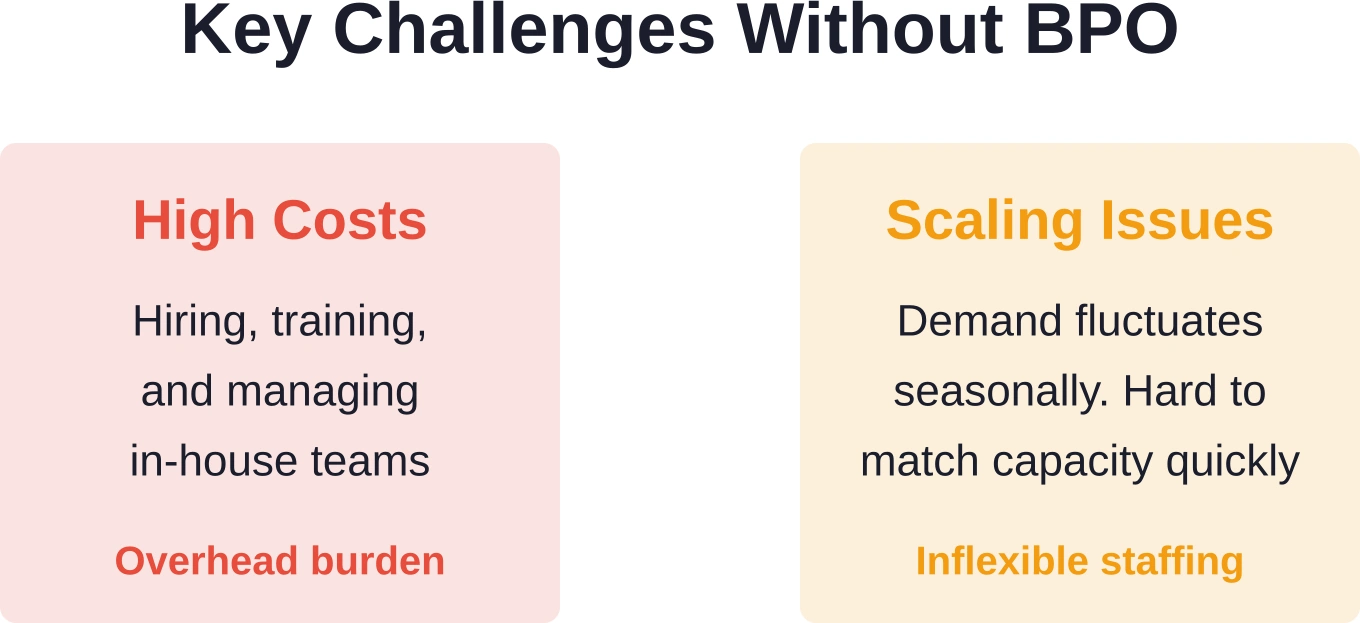
This is where BPO services solve real problems. Companies using comprehensive outsourcing services report average annual growth rates 30% higher than those managing everything in-house. The data speaks clearly: specialization works.
Core E-commerce BPO Services
Customer Service & Support
Most e-commerce BPO providers excel at handling customer inquiries across multiple channels: email, chat, phone, and social media. Response times matter enormously in this space. Best-practice targets include responding to live chat under 1 minute (or seconds) and email within 24 hours. Skilled agents trained on product knowledge provide the kind of personalized support that turns one-time buyers into loyal customers.
Outsourced customer service teams also handle complaints, refund requests, and product questions. When customers feel heard and supported, 68% are willing to pay more for goods and services from those companies. Superior service directly impacts loyalty and lifetime value.
Order Processing & Fulfillment Support
BPO providers manage the backend logistics of e-commerce: order data entry, verification, and coordination with fulfillment centers. They ensure accuracy, catch errors before they become costly mistakes, and track inventory updates in real time. This reduces order delays and incorrect shipments.
Returns & Reverse Logistics
Handling returns is complex, time-consuming, and expensive. BPO teams manage return authorizations, coordinate pickups, inspect returned items, restock inventory, and process refunds. A dedicated team keeps returns from becoming a nightmare scenario that eats into margins.
Data Entry & Back-Office Operations
Behind every e-commerce transaction is data: customer information, payment details, shipping addresses, product codes. BPO services handle data entry, reconciliation, and database management, freeing internal teams from repetitive administrative work that doesn't drive revenue.
Quality Assurance & Performance Monitoring
Professional BPO providers don't just execute tasks—they monitor quality. QA teams review interactions, measure customer satisfaction (CSAT), track response times, and identify training gaps. This continuous improvement cycle ensures service quality remains consistently high.
Financial Impact: The Cost Savings Reality
Numbers tell the story. Companies outsourcing e-commerce operations report cost reductions of 70% to 90% compared to maintaining equivalent in-house capabilities. That's not hyperbole; it's documented across multiple case studies and industry reports.
Beyond direct labor savings, outsourcing eliminates facility costs, equipment purchases, and management overhead. These indirect expenses often exceed salaries but get overlooked in quick calculations.
Scalability & Flexibility
Peak seasons like Black Friday, Cyber Monday, and holiday shopping create chaos. In-house teams can't expand overnight. BPO providers handle this elegantly—they scale up agents during peaks and scale down during lulls. This flexibility prevents overstaffing during quiet periods and understaffing during surges.
Choosing the Right E-commerce BPO Partner
Industry Experience & Specialization
Not all BPO providers are created equal. Look for firms with proven e-commerce experience. They understand the unique demands: multi-channel support, rapid order processing, inventory coordination, and seasonal volatility. Providers serving 4,000+ clients across 50 countries bring global perspective and tested processes.
Technology & Integration Capabilities
Your BPO partner must integrate seamlessly with your existing systems: e-commerce platform, CRM, payment processor, inventory management, and shipping tools. Poor integration creates data silos and operational friction. Ask about API connections, real-time sync capabilities, and reporting dashboards.
Quality Assurance & Performance Metrics
Demands specifics: What QA processes do they follow? How frequently do they audit calls or chats? What's their average CSAT score? How do they measure and report performance? Leading BPO providers maintain strict quality standards and provide transparent performance dashboards so you see exactly what you're getting.
Location & Time Zone Coverage
If you need 24/7 support, choose providers with teams across multiple time zones. Nearshore providers (same continent or region) often offer better cultural alignment and communication than offshore alternatives, though they may cost more. Offshore providers deliver deeper cost savings but require stronger management oversight.
Compliance & Data Security
E-commerce involves sensitive customer data: credit card numbers, addresses, payment details. Ensure your BPO provider is compliant with relevant regulations (PCI DSS for payments, GDPR if you serve EU customers, CCPA for California residents). Ask about their security certifications, data handling practices, and incident response procedures.

Build a Stable Ecommerce Support Team with NeoWork
Ecommerce BPO only works when the team handling customers, orders, support tickets, refunds, and daily store tasks stays consistent. NeoWork fits ecommerce brands that need dedicated support without rebuilding the team every few months.
NeoWork’s main difference is its hiring and retention model. The company reports a 91% annualized teammate retention rate and a 3.2% candidate selectivity rate. For ecommerce teams, that matters because trained agents learn the store, policies, products, tone of voice, and common customer issues over time.
Where NeoWork can support ecommerce operations:
- carefully selected ecommerce support teammates
- lower disruption from constant agent turnover
- support for customer experience, admin, finance, and daily operations
- individual contributors or managed team options
Contact NeoWork to build a reliable ecommerce BPO team that can support daily store operations, improve customer response quality, and reduce the workload on your internal staff.
Common Pitfalls to Avoid
Choosing the wrong partner creates more problems than it solves. Many e-commerce businesses make these mistakes:
- Prioritizing price over quality: The cheapest provider often delivers mediocre service, alienating customers and damaging brand reputation. You get what you pay for.
- Poor onboarding: Jumping into outsourcing without proper knowledge transfer, training, and process documentation leads to mistakes and frustration. Budget time for setup.
- Inadequate communication: Without clear reporting, regular check-ins, and feedback loops, service quality degrades silently. Insist on transparent performance metrics and frequent reviews.
- Overly broad outsourcing: Outsourcing everything—including customer experience decisions and strategic functions—removes your team from direct customer interaction. Keep some functions in-house to maintain brand voice and control.
- Ignoring scalability limitations: Some BPO providers can't handle rapid growth or peak surges. Verify their capacity and flexibility before signing a contract.
Best Practices for E-commerce BPO Success
Set Clear Expectations & SLAs
Define Service Level Agreements (SLAs) in writing. Specify response times, quality benchmarks, uptime guarantees, and escalation procedures. Clear expectations prevent misunderstandings and establish accountability on both sides.
Maintain Regular Communication
Weekly check-ins, monthly reviews, and quarterly business reviews keep the partnership healthy. Share performance data, discuss challenges, celebrate wins, and adjust strategies as needed. Strong partnerships require active engagement.
Invest in Proper Onboarding
Rushing onboarding causes downstream problems. Allocate 4-8 weeks for knowledge transfer, training, and process validation. Document your procedures, product details, brand guidelines, and escalation paths. The upfront investment pays dividends in quality and efficiency.
Monitor Quality Continuously
Don't assume everything's fine. Review call recordings, chat transcripts, email responses, and customer feedback regularly. Identify patterns, provide coaching, and recognize top performers. Continuous monitoring prevents quality decay.
Keep Strategic Functions In-House
Outsource routine execution but keep strategy, customer experience design, and brand decisions internal. Your team should remain involved in service design, product feedback interpretation, and customer insights. This balance optimizes cost while protecting brand integrity.
Future Trends in E-commerce BPO
The BPO landscape continues evolving. Automation, AI, and advanced analytics are transforming how services are delivered. Leading providers are integrating chatbots for routine inquiries, machine learning for quality prediction, and predictive analytics for demand forecasting. The most effective approach combines human expertise with intelligent automation, handling routine tasks automatically while escalating complex issues to skilled agents.
Sustainability and corporate responsibility are also gaining importance. Businesses increasingly expect their BPO partners to maintain ethical labor practices, invest in employee development, and operate responsibly. Choosing a provider aligned with your values strengthens the partnership.
Conclusion
E-commerce BPO services solve real problems: high operational costs, scaling challenges, and the burden of managing 24/7 customer support. Companies using these services achieve cost savings of 70-90%, scale operations on demand, and often improve customer experience compared to in-house alternatives.
Success requires choosing the right partner, setting clear expectations, maintaining active oversight, and keeping strategic functions internal. When executed well, BPO becomes a strategic advantage that fuels growth, improves margins, and enables focus on what matters most: product, marketing, and customer experience innovation.
Ready to explore e-commerce BPO? Start by defining your most painful operational challenge, researching providers with proven e-commerce experience, and requesting proposals. Most reputable BPO firms offer free consultations to understand your needs and outline potential benefits. The right partnership could transform your e-commerce operation.
Frequently Asked Questions
Topics
E-commerce BPO Services Guide 2026

Quick Summary: E-commerce BPO services enable online retailers to outsource customer support, order processing, and back-office operations to specialized providers, delivering cost savings of 70-90% while improving customer experience. These services are essential for scaling operations efficiently, reducing overhead, and maintaining 24/7 customer responsiveness without building large in-house teams.
What Is E-commerce BPO?
Business Process Outsourcing (BPO) for e-commerce means delegating specific business functions to external service providers. Rather than handling everything in-house, online retailers partner with specialized firms to manage customer service, order fulfillment, data entry, returns processing, and other operational tasks.
E-commerce BPO isn't just about cutting costs. It's about accessing specialized expertise, scaling operations on demand, and freeing internal teams to focus on growth, marketing, and product development. When done right, outsourcing becomes a strategic advantage.
Why E-commerce Businesses Need BPO Services
Running an e-commerce operation requires juggling multiple moving parts simultaneously. Customer inquiries arrive 24/7. Orders need processing within hours. Returns require careful handling. Inventory demands tracking. All of this drains resources and distracts from core business objectives.
This is where BPO services solve real problems. Companies using comprehensive outsourcing services report average annual growth rates 30% higher than those managing everything in-house. The data speaks clearly: specialization works.
Core E-commerce BPO Services
Customer Service & Support
Most e-commerce BPO providers excel at handling customer inquiries across multiple channels: email, chat, phone, and social media. Response times matter enormously in this space. Best-practice targets include responding to live chat under 1 minute (or seconds) and email within 24 hours. Skilled agents trained on product knowledge provide the kind of personalized support that turns one-time buyers into loyal customers.
Outsourced customer service teams also handle complaints, refund requests, and product questions. When customers feel heard and supported, 68% are willing to pay more for goods and services from those companies. Superior service directly impacts loyalty and lifetime value.
Order Processing & Fulfillment Support
BPO providers manage the backend logistics of e-commerce: order data entry, verification, and coordination with fulfillment centers. They ensure accuracy, catch errors before they become costly mistakes, and track inventory updates in real time. This reduces order delays and incorrect shipments.
Returns & Reverse Logistics
Handling returns is complex, time-consuming, and expensive. BPO teams manage return authorizations, coordinate pickups, inspect returned items, restock inventory, and process refunds. A dedicated team keeps returns from becoming a nightmare scenario that eats into margins.
Data Entry & Back-Office Operations
Behind every e-commerce transaction is data: customer information, payment details, shipping addresses, product codes. BPO services handle data entry, reconciliation, and database management, freeing internal teams from repetitive administrative work that doesn't drive revenue.
Quality Assurance & Performance Monitoring
Professional BPO providers don't just execute tasks—they monitor quality. QA teams review interactions, measure customer satisfaction (CSAT), track response times, and identify training gaps. This continuous improvement cycle ensures service quality remains consistently high.
Financial Impact: The Cost Savings Reality
Numbers tell the story. Companies outsourcing e-commerce operations report cost reductions of 70% to 90% compared to maintaining equivalent in-house capabilities. That's not hyperbole; it's documented across multiple case studies and industry reports.
Beyond direct labor savings, outsourcing eliminates facility costs, equipment purchases, and management overhead. These indirect expenses often exceed salaries but get overlooked in quick calculations.
Scalability & Flexibility
Peak seasons like Black Friday, Cyber Monday, and holiday shopping create chaos. In-house teams can't expand overnight. BPO providers handle this elegantly—they scale up agents during peaks and scale down during lulls. This flexibility prevents overstaffing during quiet periods and understaffing during surges.
Choosing the Right E-commerce BPO Partner
Industry Experience & Specialization
Not all BPO providers are created equal. Look for firms with proven e-commerce experience. They understand the unique demands: multi-channel support, rapid order processing, inventory coordination, and seasonal volatility. Providers serving 4,000+ clients across 50 countries bring global perspective and tested processes.
Technology & Integration Capabilities
Your BPO partner must integrate seamlessly with your existing systems: e-commerce platform, CRM, payment processor, inventory management, and shipping tools. Poor integration creates data silos and operational friction. Ask about API connections, real-time sync capabilities, and reporting dashboards.
Quality Assurance & Performance Metrics
Demands specifics: What QA processes do they follow? How frequently do they audit calls or chats? What's their average CSAT score? How do they measure and report performance? Leading BPO providers maintain strict quality standards and provide transparent performance dashboards so you see exactly what you're getting.
Location & Time Zone Coverage
If you need 24/7 support, choose providers with teams across multiple time zones. Nearshore providers (same continent or region) often offer better cultural alignment and communication than offshore alternatives, though they may cost more. Offshore providers deliver deeper cost savings but require stronger management oversight.
Compliance & Data Security
E-commerce involves sensitive customer data: credit card numbers, addresses, payment details. Ensure your BPO provider is compliant with relevant regulations (PCI DSS for payments, GDPR if you serve EU customers, CCPA for California residents). Ask about their security certifications, data handling practices, and incident response procedures.
Build a Stable Ecommerce Support Team with NeoWork
Ecommerce BPO only works when the team handling customers, orders, support tickets, refunds, and daily store tasks stays consistent. NeoWork fits ecommerce brands that need dedicated support without rebuilding the team every few months.
NeoWork’s main difference is its hiring and retention model. The company reports a 91% annualized teammate retention rate and a 3.2% candidate selectivity rate. For ecommerce teams, that matters because trained agents learn the store, policies, products, tone of voice, and common customer issues over time.
Where NeoWork can support ecommerce operations:
- carefully selected ecommerce support teammates
- lower disruption from constant agent turnover
- support for customer experience, admin, finance, and daily operations
- individual contributors or managed team options
Contact NeoWork to build a reliable ecommerce BPO team that can support daily store operations, improve customer response quality, and reduce the workload on your internal staff.
Common Pitfalls to Avoid
Choosing the wrong partner creates more problems than it solves. Many e-commerce businesses make these mistakes:
- Prioritizing price over quality: The cheapest provider often delivers mediocre service, alienating customers and damaging brand reputation. You get what you pay for.
- Poor onboarding: Jumping into outsourcing without proper knowledge transfer, training, and process documentation leads to mistakes and frustration. Budget time for setup.
- Inadequate communication: Without clear reporting, regular check-ins, and feedback loops, service quality degrades silently. Insist on transparent performance metrics and frequent reviews.
- Overly broad outsourcing: Outsourcing everything—including customer experience decisions and strategic functions—removes your team from direct customer interaction. Keep some functions in-house to maintain brand voice and control.
- Ignoring scalability limitations: Some BPO providers can't handle rapid growth or peak surges. Verify their capacity and flexibility before signing a contract.
Best Practices for E-commerce BPO Success
Set Clear Expectations & SLAs
Define Service Level Agreements (SLAs) in writing. Specify response times, quality benchmarks, uptime guarantees, and escalation procedures. Clear expectations prevent misunderstandings and establish accountability on both sides.
Maintain Regular Communication
Weekly check-ins, monthly reviews, and quarterly business reviews keep the partnership healthy. Share performance data, discuss challenges, celebrate wins, and adjust strategies as needed. Strong partnerships require active engagement.
Invest in Proper Onboarding
Rushing onboarding causes downstream problems. Allocate 4-8 weeks for knowledge transfer, training, and process validation. Document your procedures, product details, brand guidelines, and escalation paths. The upfront investment pays dividends in quality and efficiency.
Monitor Quality Continuously
Don't assume everything's fine. Review call recordings, chat transcripts, email responses, and customer feedback regularly. Identify patterns, provide coaching, and recognize top performers. Continuous monitoring prevents quality decay.
Keep Strategic Functions In-House
Outsource routine execution but keep strategy, customer experience design, and brand decisions internal. Your team should remain involved in service design, product feedback interpretation, and customer insights. This balance optimizes cost while protecting brand integrity.
Future Trends in E-commerce BPO
The BPO landscape continues evolving. Automation, AI, and advanced analytics are transforming how services are delivered. Leading providers are integrating chatbots for routine inquiries, machine learning for quality prediction, and predictive analytics for demand forecasting. The most effective approach combines human expertise with intelligent automation, handling routine tasks automatically while escalating complex issues to skilled agents.
Sustainability and corporate responsibility are also gaining importance. Businesses increasingly expect their BPO partners to maintain ethical labor practices, invest in employee development, and operate responsibly. Choosing a provider aligned with your values strengthens the partnership.
Conclusion
E-commerce BPO services solve real problems: high operational costs, scaling challenges, and the burden of managing 24/7 customer support. Companies using these services achieve cost savings of 70-90%, scale operations on demand, and often improve customer experience compared to in-house alternatives.
Success requires choosing the right partner, setting clear expectations, maintaining active oversight, and keeping strategic functions internal. When executed well, BPO becomes a strategic advantage that fuels growth, improves margins, and enables focus on what matters most: product, marketing, and customer experience innovation.
Ready to explore e-commerce BPO? Start by defining your most painful operational challenge, researching providers with proven e-commerce experience, and requesting proposals. Most reputable BPO firms offer free consultations to understand your needs and outline potential benefits. The right partnership could transform your e-commerce operation.
Frequently Asked Questions
Topics
Related Blogs
Related Podcasts


.webp)
.webp)



