

.avif)
.avif)

Ecommerce Order Processing Outsourcing Guide 2026


.svg)

Quick Summary: Ecommerce order processing outsourcing involves delegating order management tasks—entry, fulfillment coordination, inventory tracking, customer communication, and returns—to specialized third-party providers. Research shows 70% of businesses cite access to expertise as their top outsourcing reason, while companies that outsource order processing can reduce errors by 90% and cut support costs by 40% compared to in-house operations. The right outsourcing partner helps ecommerce brands scale efficiently, maintain accuracy, and focus resources on growth.
Running an ecommerce business means juggling dozens of moving parts simultaneously. Order entry. Inventory updates. Shipping coordination. Customer inquiries about delivery status. Returns processing. The list never ends.
At some point, managing all these order processing tasks in-house becomes a bottleneck. Growth stalls because teams spend more time firefighting operational issues than building the business.
That's where ecommerce order processing outsourcing enters the picture. By partnering with specialized providers who handle the operational heavy lifting, businesses free up resources to focus on product development, marketing, and strategic growth initiatives.
What Is Ecommerce Order Processing Outsourcing?
Ecommerce order processing outsourcing means delegating the operational tasks involved in managing customer orders to external specialists. This goes beyond simple fulfillment—it encompasses the entire order lifecycle.
The scope typically includes order entry and data management, inventory tracking and coordination, payment processing verification, shipping arrangement and carrier coordination, customer communication throughout the order journey, and returns management including inspection and restocking decisions.
According to data from verified sources, professional order processing teams have reduced order errors by 90% for global retailers. That accuracy level is difficult to maintain with constantly rotating in-house staff or during seasonal volume spikes.
Order processing outsourcing sits within the broader category of supply chain management. As academic sources define it, logistics management plans and controls the efficient flow of goods and related information between origin and consumption points.
Order Processing vs. Fulfillment: Understanding the Difference
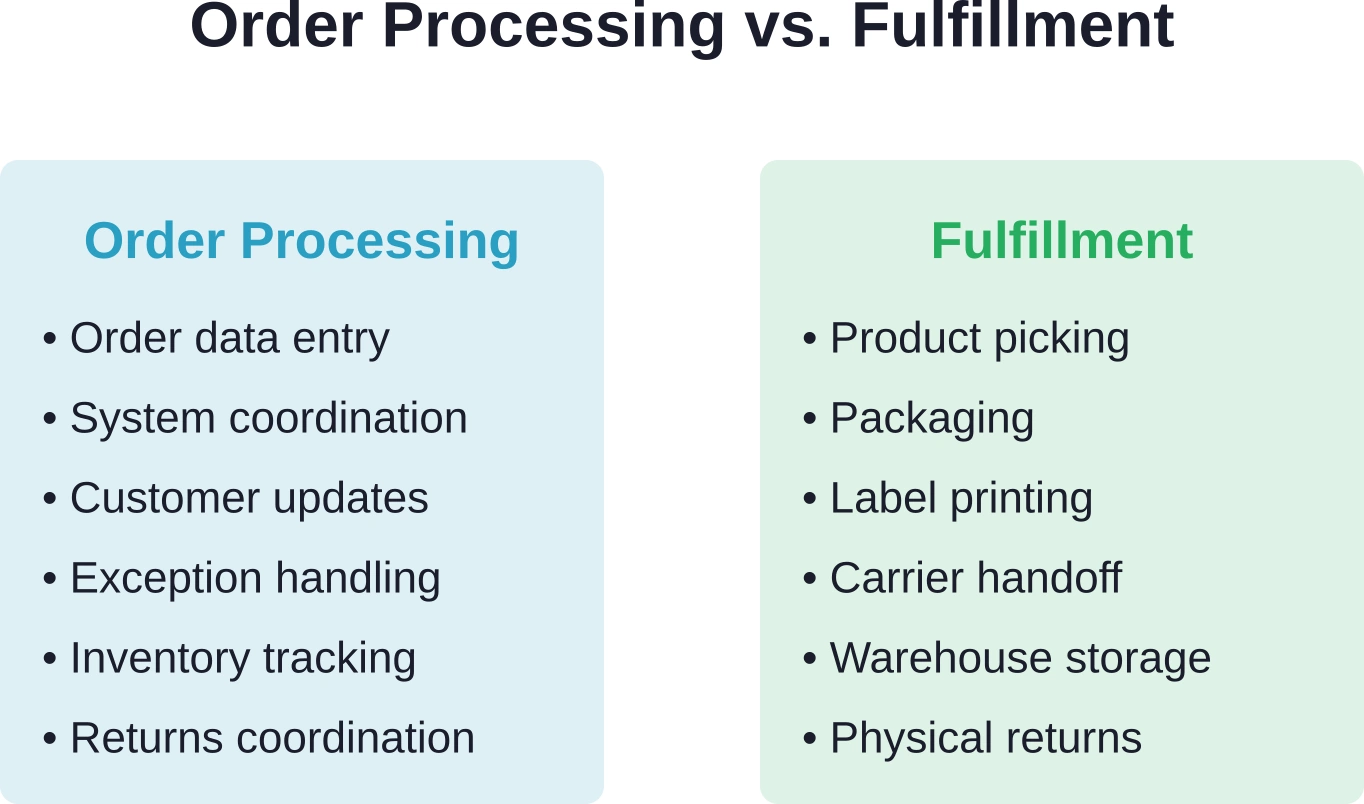
Many businesses confuse order processing with fulfillment. They overlap, but they're not identical.
Fulfillment focuses on the physical handling—picking products from warehouse shelves, packing boxes, printing shipping labels, and handing packages to carriers. It's the tangible execution.
Order processing encompasses the information and coordination layer that makes fulfillment possible. Data entry. System updates. Customer communication. Exception handling when something goes wrong. Coordinating between your ecommerce platform, warehouse management system, and carrier APIs.
Some third-party logistics providers (3PLs) offer both services bundled together. Others specialize in one or the other. Understanding which functions you need helps identify the right partner.
Why Businesses Outsource Order Processing
Research shows 70% of businesses cite access to specialized expertise as their primary reason for outsourcing. That expertise matters enormously in order processing, where mistakes directly impact customer experience and revenue.
Cost Reduction
Support costs drop 40% compared to hiring in-house teams, according to data from multiple verified sources. That reduction comes from several factors.
Outsourcing providers operate at scale across multiple clients, spreading fixed costs for technology infrastructure, training programs, and quality management systems. They've already invested in warehouse management systems, order management platforms, and carrier integrations that would cost individual businesses six figures to implement.
For context, Bureau of Labor Statistics data shows median salaries for supply chain roles: Logisticians earn $80,880, Transportation and Distribution Managers earn $102,010, and Purchasing Managers earn $136,380 annually. Building an in-house team with that expertise requires substantial payroll investment before accounting for benefits, office space, equipment, and ongoing training.
Scalability and Flexibility
Seasonal volume fluctuations pose massive challenges for in-house operations. Black Friday order volume might be 10× the average Tuesday in February. Maintaining staff capacity for peak periods means paying for idle resources during slow months.
Outsourcing providers absorb that variability across their client portfolio. When one client experiences off-season lulls, another hits peak demand. The provider's overall workload stays relatively stable even when individual clients spike or dip.
Access to Specialized Expertise
Professional order processing teams have seen it all. They've handled every exception scenario—incorrect addresses, damaged shipments, customs delays, inventory discrepancies, fraudulent transactions, international shipping complications.
That accumulated experience prevents costly mistakes. A team member who's processed 50,000 orders recognizes patterns and red flags that would slip past someone managing their first hundred.
Focus on Core Business
The opportunity cost of internal order processing is real. Every hour leadership spends troubleshooting shipping problems or training new warehouse staff is an hour not spent on product development, marketing strategy, or customer acquisition.
As retail technology budgets are projected to grow according to recent research, businesses are investing heavily in technology to gain competitive advantage. Order processing, while essential, rarely differentiates brands. Outsourcing lets teams redirect resources toward initiatives that actually drive market positioning.

Keep E-commerce Orders Moving With NeoWork
Order processing can quickly become time-consuming as sales volume grows. NeoWork provides staffing and operational support that can help e-commerce businesses manage order-related tasks and daily workflows more efficiently.
Need Help With E-commerce Order Processing?
NeoWork can help with:
- order management support
- customer communication
- data entry and updates
- back-office operations
👉 Contact NeoWork to discuss your e-commerce support needs.
When to Consider Outsourcing Order Processing
Not every business needs outsourced order processing from day one. Specific operational milestones signal when outsourcing becomes strategically smart.
Growing ecommerce brands typically hit these thresholds around the same time outsourcing makes financial sense:
- Monthly shipping costs exceeding $1,000—the point where 3PL bulk carrier rates become attractive
- Annual revenue approaching or exceeding $5 million—revenue levels that correlate with substantial order volumes
- Order error rates climbing above 2-3%—indicating strain on current processes
- Staff spending more than 30% of time on operational tasks rather than strategic work
- Seasonal volume swings creating staffing headaches twice annually
- International expansion requiring customs expertise and global carrier relationships
That said, some businesses benefit from outsourcing earlier. A startup launching with immediate high volume, a brand expanding internationally from the start, or a company pivoting from B2B to B2C and facing unfamiliar operational requirements might outsource from launch.
Core Functions of Order Processing Outsourcing
Professional order processing services cover multiple interconnected functions. Understanding what's included helps set appropriate expectations and evaluate provider capabilities.
Order Entry and Data Management
Every order starts as data—customer information, product SKUs, quantities, shipping addresses, payment details. That data flows from your ecommerce platform into order management systems, warehouse management systems, accounting software, and carrier platforms.
Manual data entry introduces errors. Professional teams use automated integrations wherever possible, with human verification for exception cases that require judgment calls.
Inventory Coordination
Real-time inventory visibility prevents overselling and customer disappointment. Order processing teams monitor stock levels, coordinate replenishment, and flag low-stock situations before they become stockouts.
When products are stored across multiple warehouses or fulfilled through dropshipping partners, coordination becomes complex. Specialized teams manage that complexity through established protocols and system integrations.
Payment and Fraud Verification
Payment processing seems straightforward until fraud attempts, declined cards, or international transaction complications arise. Experienced teams recognize fraud patterns and know when to escalate suspicious orders versus when to approve edge cases that automated fraud detection incorrectly flagged.
Shipping and Carrier Coordination
Carrier selection impacts both cost and delivery speed. Professional teams know which carriers perform best for specific routes, package sizes, and service level requirements. They've negotiated bulk rates that individual businesses can't access alone.
3PL providers typically offer shipping costs 10-50% lower than standard retail rates according to verified industry data. That discount comes from consolidated volume across multiple clients.
Customer Communication
Customers expect proactive updates. Order confirmation immediately after purchase. Shipping notification with tracking number. Delivery confirmation. Exception notifications if delays occur.
Research indicates that 60% of customers expect responses within 10 minutes. Meeting that standard internally requires round-the-clock staffing. Outsourced teams operating across multiple time zones handle 24/7 coverage naturally.
Returns Management
Returns processing covers reverse logistics operations—return authorization, product inspection, restocking decisions, refund processing, and communication with customers throughout the returns journey.
Given that 92% of consumers will repurchase if returns are easy, professional returns management significantly impacts customer retention. Slow or frustrating returns processes drive customers toward competitors.
B2B vs. B2C Order Processing Differences
Business customers and consumers have different expectations and requirements. Order processing strategies must adapt accordingly.
Outsourcing providers often specialize in one model or the other. A team optimized for high-volume B2C transactions might struggle with B2B's relationship complexity. Conversely, B2B specialists might lack the transaction processing speed B2C requires.
Clarify which model matches your business before evaluating providers. Misalignment here creates frustration on both sides.
Choosing the Right Outsourcing Partner
Not all outsourcing providers deliver the same quality or fit. Several critical factors separate excellent partners from mediocre ones.
Technology Integration Capabilities
The provider must integrate seamlessly with your existing technology stack. That means APIs or native integrations with your ecommerce platform (Shopify, WooCommerce, Magento, BigCommerce, custom solutions), order management system, inventory management software, accounting platforms, and carrier systems.
Ask potential providers: Which platforms do you integrate with natively? How long does integration typically take? Who handles technical implementation—your team or ours? What happens when we add new sales channels?
Geographic Coverage and Time Zones
If you sell internationally, the provider needs expertise in cross-border shipping, customs documentation, and international carrier relationships. They should understand import regulations, duty calculations, and prohibited items for key destination markets.
Time zone coverage matters for customer communication. A provider operating only during US business hours can't deliver the 24/7 support increasingly expected by global customers.
Scalability and Volume Capacity
Can the provider handle your growth trajectory? What happens during seasonal peaks? Do they have sufficient staff and infrastructure to absorb sudden volume increases without quality degradation?
Request specific numbers: What's your current daily order processing capacity? What's your peak capacity? How quickly can you scale up if we double order volume in three months?
Quality Management and Accuracy Metrics
Ask about error rates, quality assurance processes, and performance reporting. The best providers track detailed metrics and share them transparently with clients.
Verified sources report top providers achieving 90% error reduction for clients. That's the benchmark. Anything significantly worse suggests operational or training deficiencies.
Industry Experience
Has the provider worked with businesses similar to yours? Ecommerce order processing differs significantly across industries—fashion, electronics, food and beverage, health and beauty, home goods. Each has unique handling requirements, regulatory considerations, and customer expectations.
Industry-specific experience means the provider already understands your challenges and has established solutions rather than learning on your dime.
Cost Structures and Pricing Models
Outsourcing pricing varies significantly by provider and service scope. Understanding common models helps budget accurately and compare proposals fairly.
Per-Transaction Pricing
Many providers charge a flat fee per order processed—typically ranging from $0.50 to $3.00 per order depending on complexity. Simple B2C orders with standard shipping fall toward the lower end. Complex B2B orders requiring special handling and documentation cost more.
Per-transaction pricing scales naturally with order volume. No orders means no costs, though some providers impose monthly minimums.
Percentage of Order Value
Some providers charge a percentage (commonly 3-8%) of gross merchandise value. This aligns provider incentives with business growth but can become expensive as average order values increase.
Hybrid Models
Many providers combine approaches—a base monthly retainer covering technology access and account management plus per-transaction fees for actual order processing. This gives providers predictable baseline revenue while keeping variable costs aligned with volume.
Additional Cost Considerations
Beyond base processing fees, factor in integration costs (one-time setup, typically $1,000-$10,000 depending on complexity), storage fees if the provider warehouses inventory, shipping costs (passed through at negotiated bulk rates), and returns processing fees (often charged separately from outbound order fees).
Request detailed pricing breakdowns during evaluation. Hidden fees destroy budget forecasts and ROI calculations.
Common Challenges and How to Overcome Them
Even well-planned outsourcing relationships encounter obstacles. Anticipating common issues helps prevent or minimize their impact.
Communication Gaps
When order processing moves outside the organization, information flow becomes critical. Establish clear communication protocols upfront—who contacts whom for various issue types, response time expectations, escalation procedures for urgent problems.
Schedule regular check-ins (weekly initially, then monthly once processes stabilize) to review performance metrics, discuss concerns, and identify improvement opportunities.
Loss of Direct Control
Handing off operational control feels uncomfortable, especially for founders who've managed every detail since launch. But that's precisely the point—freeing bandwidth for strategic work.
Maintain control through well-defined service level agreements (SLAs), regular performance reporting, and clearly documented procedures for exception handling. Trust but verify through metrics.
Integration Complexity
Technical integration challenges delay onboarding and cause ongoing friction. Minimize this by choosing providers with native integrations to your existing platforms or robust API capabilities.
Allocate sufficient time for testing before going live. Process test orders, verify data flows correctly between systems, and confirm edge cases are handled properly. Rushing integration creates problems that take months to untangle.
Cultural and Time Zone Differences
If outsourcing internationally, cultural differences and time zone gaps require thoughtful management. Ensure the provider assigns team members with strong communication skills and appropriate language fluency for your customer base.
Overlap working hours whenever possible. A provider operating only during hours when your team sleeps creates delays for anything requiring collaboration.
The Role of Technology in Modern Order Processing
Technology transforms order processing from manual drudgery into streamlined automation. The best outsourcing providers leverage advanced platforms that individual businesses couldn't justify implementing alone.
- Order management systems centralize order data from multiple sales channels—your website, Amazon, eBay, retail partners—into a single interface. This prevents the disconnected chaos of managing each channel separately.
- Warehouse management systems optimize picking routes, manage inventory locations, and coordinate shipping to maximize efficiency. They track every item's movement from receiving through storage to shipment.
- Automated fraud detection systems analyze transactions in milliseconds, flagging high-risk orders for manual review while approving legitimate purchases instantly. As authoritative research shows, one in five generative AI consumers now uses AI daily, and many treat genAI as a new answer engine—technology adoption is accelerating across retail operations.
- Carrier integration platforms compare rates across multiple carriers, automatically select the most cost-effective option meeting delivery requirements, generate labels, and transmit tracking information back to customers.
- Customer communication automation sends order confirmations, shipping notifications, delivery alerts, and review requests without manual intervention. It reduces support ticket volume by proactively answering the questions customers would otherwise ask.
Measuring Success: Key Performance Indicators
What gets measured gets managed. Track these KPIs to assess outsourcing provider performance and identify improvement opportunities.
Request monthly reporting on these metrics. Performance should improve over time as the provider learns your business specifics and optimizes procedures.
Future Trends in Order Processing Outsourcing
The order processing landscape continues evolving rapidly. Several trends are reshaping how businesses approach outsourcing.
AI and Machine Learning Integration
Artificial intelligence is transforming order processing through predictive analytics that forecast demand and optimize inventory placement, automated exception handling that resolves common issues without human intervention, and intelligent fraud detection that adapts to evolving fraud patterns.
Research on AI adoption shows that retail and consumer goods organizations are investing heavily in AI solutions. However, research also reveals that AI ROI remains elusive for many organizations despite widespread adoption—the gap between individual AI productivity gains and organizational transformation reveals critical barriers to value realization.
Sustainability Focus
Consumers increasingly care about environmental impact. Order processing providers are responding with optimized packaging that reduces materials and shipping weight, consolidated shipments that minimize transportation emissions, and carbon-neutral shipping options for environmentally conscious customers.
Hyper-Personalization
Generic order processing is giving way to personalized experiences. Custom packaging for VIP customers. Personalized notes. Gift wrapping options. Special handling for subscription orders versus one-time purchases. Providers that support these customizations gain competitive advantage.
Distributed Fulfillment Networks
Rather than shipping everything from a single warehouse, distributed networks position inventory closer to customers. This reduces shipping times and costs while improving delivery reliability. Sophisticated providers manage multi-location inventory and intelligently route orders to the optimal fulfillment location.
Conclusion
Ecommerce order processing outsourcing offers growing businesses a strategic path to scale operations without proportional increases in overhead, complexity, or management burden. By delegating operational tasks to specialized providers, brands free internal resources for the strategic initiatives that actually differentiate them in competitive markets.
The data tells a compelling story. Companies that outsource order processing reduce errors by 90%, cut support costs by 40%, and gain access to expertise that would cost over $100,000 annually to build in-house based on Bureau of Labor Statistics salary data for supply chain professionals.
But successful outsourcing isn't automatic. It requires careful provider selection, thoughtful integration planning, clear communication protocols, and ongoing performance management through well-defined KPIs.
Start by honestly assessing whether your business has reached the operational milestones where outsourcing makes strategic sense. If you're spending $1,000+ monthly on shipping, generating substantial order volumes, or struggling with seasonal staffing, outsourcing deserves serious evaluation.
Research providers thoroughly. Prioritize technical integration capabilities, accuracy metrics above 98%, and experience in your specific industry. Request detailed pricing breakdowns and client references. Test with a pilot program before committing your entire operation.
The right outsourcing partner becomes an extension of your team—one that scales with your growth, maintains quality during peaks, and frees your leadership to focus on building the business rather than managing operational details. That's the promise of ecommerce order processing outsourcing when executed thoughtfully.
Frequently Asked Questions
Topics
Ecommerce Order Processing Outsourcing Guide 2026

Quick Summary: Ecommerce order processing outsourcing involves delegating order management tasks—entry, fulfillment coordination, inventory tracking, customer communication, and returns—to specialized third-party providers. Research shows 70% of businesses cite access to expertise as their top outsourcing reason, while companies that outsource order processing can reduce errors by 90% and cut support costs by 40% compared to in-house operations. The right outsourcing partner helps ecommerce brands scale efficiently, maintain accuracy, and focus resources on growth.
Running an ecommerce business means juggling dozens of moving parts simultaneously. Order entry. Inventory updates. Shipping coordination. Customer inquiries about delivery status. Returns processing. The list never ends.
At some point, managing all these order processing tasks in-house becomes a bottleneck. Growth stalls because teams spend more time firefighting operational issues than building the business.
That's where ecommerce order processing outsourcing enters the picture. By partnering with specialized providers who handle the operational heavy lifting, businesses free up resources to focus on product development, marketing, and strategic growth initiatives.
What Is Ecommerce Order Processing Outsourcing?
Ecommerce order processing outsourcing means delegating the operational tasks involved in managing customer orders to external specialists. This goes beyond simple fulfillment—it encompasses the entire order lifecycle.
The scope typically includes order entry and data management, inventory tracking and coordination, payment processing verification, shipping arrangement and carrier coordination, customer communication throughout the order journey, and returns management including inspection and restocking decisions.
According to data from verified sources, professional order processing teams have reduced order errors by 90% for global retailers. That accuracy level is difficult to maintain with constantly rotating in-house staff or during seasonal volume spikes.
Order processing outsourcing sits within the broader category of supply chain management. As academic sources define it, logistics management plans and controls the efficient flow of goods and related information between origin and consumption points.
Order Processing vs. Fulfillment: Understanding the Difference
Many businesses confuse order processing with fulfillment. They overlap, but they're not identical.
Fulfillment focuses on the physical handling—picking products from warehouse shelves, packing boxes, printing shipping labels, and handing packages to carriers. It's the tangible execution.
Order processing encompasses the information and coordination layer that makes fulfillment possible. Data entry. System updates. Customer communication. Exception handling when something goes wrong. Coordinating between your ecommerce platform, warehouse management system, and carrier APIs.
Some third-party logistics providers (3PLs) offer both services bundled together. Others specialize in one or the other. Understanding which functions you need helps identify the right partner.
Why Businesses Outsource Order Processing
Research shows 70% of businesses cite access to specialized expertise as their primary reason for outsourcing. That expertise matters enormously in order processing, where mistakes directly impact customer experience and revenue.
Cost Reduction
Support costs drop 40% compared to hiring in-house teams, according to data from multiple verified sources. That reduction comes from several factors.
Outsourcing providers operate at scale across multiple clients, spreading fixed costs for technology infrastructure, training programs, and quality management systems. They've already invested in warehouse management systems, order management platforms, and carrier integrations that would cost individual businesses six figures to implement.
For context, Bureau of Labor Statistics data shows median salaries for supply chain roles: Logisticians earn $80,880, Transportation and Distribution Managers earn $102,010, and Purchasing Managers earn $136,380 annually. Building an in-house team with that expertise requires substantial payroll investment before accounting for benefits, office space, equipment, and ongoing training.
Scalability and Flexibility
Seasonal volume fluctuations pose massive challenges for in-house operations. Black Friday order volume might be 10× the average Tuesday in February. Maintaining staff capacity for peak periods means paying for idle resources during slow months.
Outsourcing providers absorb that variability across their client portfolio. When one client experiences off-season lulls, another hits peak demand. The provider's overall workload stays relatively stable even when individual clients spike or dip.
Access to Specialized Expertise
Professional order processing teams have seen it all. They've handled every exception scenario—incorrect addresses, damaged shipments, customs delays, inventory discrepancies, fraudulent transactions, international shipping complications.
That accumulated experience prevents costly mistakes. A team member who's processed 50,000 orders recognizes patterns and red flags that would slip past someone managing their first hundred.
Focus on Core Business
The opportunity cost of internal order processing is real. Every hour leadership spends troubleshooting shipping problems or training new warehouse staff is an hour not spent on product development, marketing strategy, or customer acquisition.
As retail technology budgets are projected to grow according to recent research, businesses are investing heavily in technology to gain competitive advantage. Order processing, while essential, rarely differentiates brands. Outsourcing lets teams redirect resources toward initiatives that actually drive market positioning.
Keep E-commerce Orders Moving With NeoWork
Order processing can quickly become time-consuming as sales volume grows. NeoWork provides staffing and operational support that can help e-commerce businesses manage order-related tasks and daily workflows more efficiently.
Need Help With E-commerce Order Processing?
NeoWork can help with:
- order management support
- customer communication
- data entry and updates
- back-office operations
👉 Contact NeoWork to discuss your e-commerce support needs.
When to Consider Outsourcing Order Processing
Not every business needs outsourced order processing from day one. Specific operational milestones signal when outsourcing becomes strategically smart.
Growing ecommerce brands typically hit these thresholds around the same time outsourcing makes financial sense:
- Monthly shipping costs exceeding $1,000—the point where 3PL bulk carrier rates become attractive
- Annual revenue approaching or exceeding $5 million—revenue levels that correlate with substantial order volumes
- Order error rates climbing above 2-3%—indicating strain on current processes
- Staff spending more than 30% of time on operational tasks rather than strategic work
- Seasonal volume swings creating staffing headaches twice annually
- International expansion requiring customs expertise and global carrier relationships
That said, some businesses benefit from outsourcing earlier. A startup launching with immediate high volume, a brand expanding internationally from the start, or a company pivoting from B2B to B2C and facing unfamiliar operational requirements might outsource from launch.
Core Functions of Order Processing Outsourcing
Professional order processing services cover multiple interconnected functions. Understanding what's included helps set appropriate expectations and evaluate provider capabilities.
Order Entry and Data Management
Every order starts as data—customer information, product SKUs, quantities, shipping addresses, payment details. That data flows from your ecommerce platform into order management systems, warehouse management systems, accounting software, and carrier platforms.
Manual data entry introduces errors. Professional teams use automated integrations wherever possible, with human verification for exception cases that require judgment calls.
Inventory Coordination
Real-time inventory visibility prevents overselling and customer disappointment. Order processing teams monitor stock levels, coordinate replenishment, and flag low-stock situations before they become stockouts.
When products are stored across multiple warehouses or fulfilled through dropshipping partners, coordination becomes complex. Specialized teams manage that complexity through established protocols and system integrations.
Payment and Fraud Verification
Payment processing seems straightforward until fraud attempts, declined cards, or international transaction complications arise. Experienced teams recognize fraud patterns and know when to escalate suspicious orders versus when to approve edge cases that automated fraud detection incorrectly flagged.
Shipping and Carrier Coordination
Carrier selection impacts both cost and delivery speed. Professional teams know which carriers perform best for specific routes, package sizes, and service level requirements. They've negotiated bulk rates that individual businesses can't access alone.
3PL providers typically offer shipping costs 10-50% lower than standard retail rates according to verified industry data. That discount comes from consolidated volume across multiple clients.
Customer Communication
Customers expect proactive updates. Order confirmation immediately after purchase. Shipping notification with tracking number. Delivery confirmation. Exception notifications if delays occur.
Research indicates that 60% of customers expect responses within 10 minutes. Meeting that standard internally requires round-the-clock staffing. Outsourced teams operating across multiple time zones handle 24/7 coverage naturally.
Returns Management
Returns processing covers reverse logistics operations—return authorization, product inspection, restocking decisions, refund processing, and communication with customers throughout the returns journey.
Given that 92% of consumers will repurchase if returns are easy, professional returns management significantly impacts customer retention. Slow or frustrating returns processes drive customers toward competitors.
B2B vs. B2C Order Processing Differences
Business customers and consumers have different expectations and requirements. Order processing strategies must adapt accordingly.
Outsourcing providers often specialize in one model or the other. A team optimized for high-volume B2C transactions might struggle with B2B's relationship complexity. Conversely, B2B specialists might lack the transaction processing speed B2C requires.
Clarify which model matches your business before evaluating providers. Misalignment here creates frustration on both sides.
Choosing the Right Outsourcing Partner
Not all outsourcing providers deliver the same quality or fit. Several critical factors separate excellent partners from mediocre ones.
Technology Integration Capabilities
The provider must integrate seamlessly with your existing technology stack. That means APIs or native integrations with your ecommerce platform (Shopify, WooCommerce, Magento, BigCommerce, custom solutions), order management system, inventory management software, accounting platforms, and carrier systems.
Ask potential providers: Which platforms do you integrate with natively? How long does integration typically take? Who handles technical implementation—your team or ours? What happens when we add new sales channels?
Geographic Coverage and Time Zones
If you sell internationally, the provider needs expertise in cross-border shipping, customs documentation, and international carrier relationships. They should understand import regulations, duty calculations, and prohibited items for key destination markets.
Time zone coverage matters for customer communication. A provider operating only during US business hours can't deliver the 24/7 support increasingly expected by global customers.
Scalability and Volume Capacity
Can the provider handle your growth trajectory? What happens during seasonal peaks? Do they have sufficient staff and infrastructure to absorb sudden volume increases without quality degradation?
Request specific numbers: What's your current daily order processing capacity? What's your peak capacity? How quickly can you scale up if we double order volume in three months?
Quality Management and Accuracy Metrics
Ask about error rates, quality assurance processes, and performance reporting. The best providers track detailed metrics and share them transparently with clients.
Verified sources report top providers achieving 90% error reduction for clients. That's the benchmark. Anything significantly worse suggests operational or training deficiencies.
Industry Experience
Has the provider worked with businesses similar to yours? Ecommerce order processing differs significantly across industries—fashion, electronics, food and beverage, health and beauty, home goods. Each has unique handling requirements, regulatory considerations, and customer expectations.
Industry-specific experience means the provider already understands your challenges and has established solutions rather than learning on your dime.
Cost Structures and Pricing Models
Outsourcing pricing varies significantly by provider and service scope. Understanding common models helps budget accurately and compare proposals fairly.
Per-Transaction Pricing
Many providers charge a flat fee per order processed—typically ranging from $0.50 to $3.00 per order depending on complexity. Simple B2C orders with standard shipping fall toward the lower end. Complex B2B orders requiring special handling and documentation cost more.
Per-transaction pricing scales naturally with order volume. No orders means no costs, though some providers impose monthly minimums.
Percentage of Order Value
Some providers charge a percentage (commonly 3-8%) of gross merchandise value. This aligns provider incentives with business growth but can become expensive as average order values increase.
Hybrid Models
Many providers combine approaches—a base monthly retainer covering technology access and account management plus per-transaction fees for actual order processing. This gives providers predictable baseline revenue while keeping variable costs aligned with volume.
Additional Cost Considerations
Beyond base processing fees, factor in integration costs (one-time setup, typically $1,000-$10,000 depending on complexity), storage fees if the provider warehouses inventory, shipping costs (passed through at negotiated bulk rates), and returns processing fees (often charged separately from outbound order fees).
Request detailed pricing breakdowns during evaluation. Hidden fees destroy budget forecasts and ROI calculations.
Common Challenges and How to Overcome Them
Even well-planned outsourcing relationships encounter obstacles. Anticipating common issues helps prevent or minimize their impact.
Communication Gaps
When order processing moves outside the organization, information flow becomes critical. Establish clear communication protocols upfront—who contacts whom for various issue types, response time expectations, escalation procedures for urgent problems.
Schedule regular check-ins (weekly initially, then monthly once processes stabilize) to review performance metrics, discuss concerns, and identify improvement opportunities.
Loss of Direct Control
Handing off operational control feels uncomfortable, especially for founders who've managed every detail since launch. But that's precisely the point—freeing bandwidth for strategic work.
Maintain control through well-defined service level agreements (SLAs), regular performance reporting, and clearly documented procedures for exception handling. Trust but verify through metrics.
Integration Complexity
Technical integration challenges delay onboarding and cause ongoing friction. Minimize this by choosing providers with native integrations to your existing platforms or robust API capabilities.
Allocate sufficient time for testing before going live. Process test orders, verify data flows correctly between systems, and confirm edge cases are handled properly. Rushing integration creates problems that take months to untangle.
Cultural and Time Zone Differences
If outsourcing internationally, cultural differences and time zone gaps require thoughtful management. Ensure the provider assigns team members with strong communication skills and appropriate language fluency for your customer base.
Overlap working hours whenever possible. A provider operating only during hours when your team sleeps creates delays for anything requiring collaboration.
The Role of Technology in Modern Order Processing
Technology transforms order processing from manual drudgery into streamlined automation. The best outsourcing providers leverage advanced platforms that individual businesses couldn't justify implementing alone.
- Order management systems centralize order data from multiple sales channels—your website, Amazon, eBay, retail partners—into a single interface. This prevents the disconnected chaos of managing each channel separately.
- Warehouse management systems optimize picking routes, manage inventory locations, and coordinate shipping to maximize efficiency. They track every item's movement from receiving through storage to shipment.
- Automated fraud detection systems analyze transactions in milliseconds, flagging high-risk orders for manual review while approving legitimate purchases instantly. As authoritative research shows, one in five generative AI consumers now uses AI daily, and many treat genAI as a new answer engine—technology adoption is accelerating across retail operations.
- Carrier integration platforms compare rates across multiple carriers, automatically select the most cost-effective option meeting delivery requirements, generate labels, and transmit tracking information back to customers.
- Customer communication automation sends order confirmations, shipping notifications, delivery alerts, and review requests without manual intervention. It reduces support ticket volume by proactively answering the questions customers would otherwise ask.
Measuring Success: Key Performance Indicators
What gets measured gets managed. Track these KPIs to assess outsourcing provider performance and identify improvement opportunities.
Request monthly reporting on these metrics. Performance should improve over time as the provider learns your business specifics and optimizes procedures.
Future Trends in Order Processing Outsourcing
The order processing landscape continues evolving rapidly. Several trends are reshaping how businesses approach outsourcing.
AI and Machine Learning Integration
Artificial intelligence is transforming order processing through predictive analytics that forecast demand and optimize inventory placement, automated exception handling that resolves common issues without human intervention, and intelligent fraud detection that adapts to evolving fraud patterns.
Research on AI adoption shows that retail and consumer goods organizations are investing heavily in AI solutions. However, research also reveals that AI ROI remains elusive for many organizations despite widespread adoption—the gap between individual AI productivity gains and organizational transformation reveals critical barriers to value realization.
Sustainability Focus
Consumers increasingly care about environmental impact. Order processing providers are responding with optimized packaging that reduces materials and shipping weight, consolidated shipments that minimize transportation emissions, and carbon-neutral shipping options for environmentally conscious customers.
Hyper-Personalization
Generic order processing is giving way to personalized experiences. Custom packaging for VIP customers. Personalized notes. Gift wrapping options. Special handling for subscription orders versus one-time purchases. Providers that support these customizations gain competitive advantage.
Distributed Fulfillment Networks
Rather than shipping everything from a single warehouse, distributed networks position inventory closer to customers. This reduces shipping times and costs while improving delivery reliability. Sophisticated providers manage multi-location inventory and intelligently route orders to the optimal fulfillment location.
Conclusion
Ecommerce order processing outsourcing offers growing businesses a strategic path to scale operations without proportional increases in overhead, complexity, or management burden. By delegating operational tasks to specialized providers, brands free internal resources for the strategic initiatives that actually differentiate them in competitive markets.
The data tells a compelling story. Companies that outsource order processing reduce errors by 90%, cut support costs by 40%, and gain access to expertise that would cost over $100,000 annually to build in-house based on Bureau of Labor Statistics salary data for supply chain professionals.
But successful outsourcing isn't automatic. It requires careful provider selection, thoughtful integration planning, clear communication protocols, and ongoing performance management through well-defined KPIs.
Start by honestly assessing whether your business has reached the operational milestones where outsourcing makes strategic sense. If you're spending $1,000+ monthly on shipping, generating substantial order volumes, or struggling with seasonal staffing, outsourcing deserves serious evaluation.
Research providers thoroughly. Prioritize technical integration capabilities, accuracy metrics above 98%, and experience in your specific industry. Request detailed pricing breakdowns and client references. Test with a pilot program before committing your entire operation.
The right outsourcing partner becomes an extension of your team—one that scales with your growth, maintains quality during peaks, and frees your leadership to focus on building the business rather than managing operational details. That's the promise of ecommerce order processing outsourcing when executed thoughtfully.
Frequently Asked Questions
Topics
Related Blogs
Related Podcasts


.webp)
.webp)



