

.avif)
.avif)

Ecommerce Outsourcing Guide 2026: What to Delegate & Why


.svg)

Quick Summary: Ecommerce outsourcing means handing off specific operational tasks — customer support, fulfillment, content, or tech — to outside specialists so an in-house team can focus on strategy and growth. The right approach starts with auditing repetitive, non-core tasks, choosing between offshore, nearshore, or onshore partners based on budget and communication needs, then scaling gradually with clear performance metrics. Done well, it cuts operating costs by 20-50% and frees founders to focus on product and marketing instead of daily fires.
Running an online store means juggling a hundred moving parts at once — inventory, shipping, returns, customer emails, ad campaigns, product photography. At some point, almost every growing ecommerce brand hits a wall where doing it all in-house stops making sense. That's usually when outsourcing enters the conversation.
This guide walks through what ecommerce outsourcing actually looks like in practice, which tasks make sense to hand off first, how much it typically costs, and how to avoid the mistakes that turn a smart cost-saving move into a customer-experience disaster.
What Is Ecommerce Outsourcing?
Ecommerce outsourcing is the practice of contracting external providers to handle specific functions of an online business instead of building and managing those functions internally. That could mean a third-party logistics (3PL) company handling warehousing and shipping, a call center managing customer tickets, or a freelance team writing product descriptions.
It's not an all-or-nothing decision. Most successful brands outsource selectively — keeping brand strategy, product development, and core decision-making in-house while pushing repetitive or specialized work out the door. The goal isn't to disappear from operations; it's to stop spending founder or team hours on tasks that don't require deep company-specific knowledge.
Why Businesses Outsource Ecommerce Tasks
Cost is the obvious driver, but it's rarely the only one. Here's what actually pushes brands toward outsourcing:
- Cost efficiency — avoiding the overhead of full-time salaries, benefits, office space, and software licenses for functions that don't need a dedicated in-house hire.
- Access to expertise — specialized agencies and 3PLs already have the systems, staff training, and infrastructure a small team would take years to build.
- Scalability — outsourced partners can flex up during peak season (think Black Friday) and scale back down without layoffs.
- Speed to market — launching customer support or fulfillment through an established provider is faster than hiring and training from scratch.
- Focus — founders and core teams get their time back to work on product, brand, and growth strategy instead of ticket queues.
None of this means outsourcing is automatically the right call for every task. It works best when the function is repeatable, measurable, and doesn't require constant access to sensitive strategic decisions.

Scale Ecommerce Operations with NeoWork
Ecommerce outsourcing helps companies manage customer support, order-related workflows, product data, administrative tasks, and recurring back-office work. NeoWork provides remote teammates who can support ecommerce operations within the client’s existing systems and processes. NeoWork handles recruitment, benefits, training, and ongoing engagement, while teammates follow the client’s tools, procedures, and daily priorities. Its 91% annualized teammate retention rate and 3.2% candidate selectivity rate reflect a focus on selective hiring and longer-term team stability.
NeoWork's ecommerce outsourcing model offers:
- customer and back-office support
- integration with the client’s tools and processes
- recruitment and ongoing teammate support
Contact NeoWork to build ecommerce support around your recurring operational needs.
When Should an Ecommerce Business Outsource?
Timing matters more than most brands realize. Outsourcing too early can add cost without much value, while outsourcing too late can leave the internal team overloaded with work that should have been delegated sooner.
Signs It May Be Time to Outsource
Outsourcing may make sense when order volume has outgrown what one or two people can pack and ship, customer support tickets are piling up, or the team is spending more time on admin than on growth.
Audit Tasks Before Hiring
Before adding another full-time employee, review which tasks are repetitive, time-consuming, and easy to measure. A task audit can show whether outsourcing would solve the problem more efficiently than expanding the internal team.
What to Outsource in Ecommerce
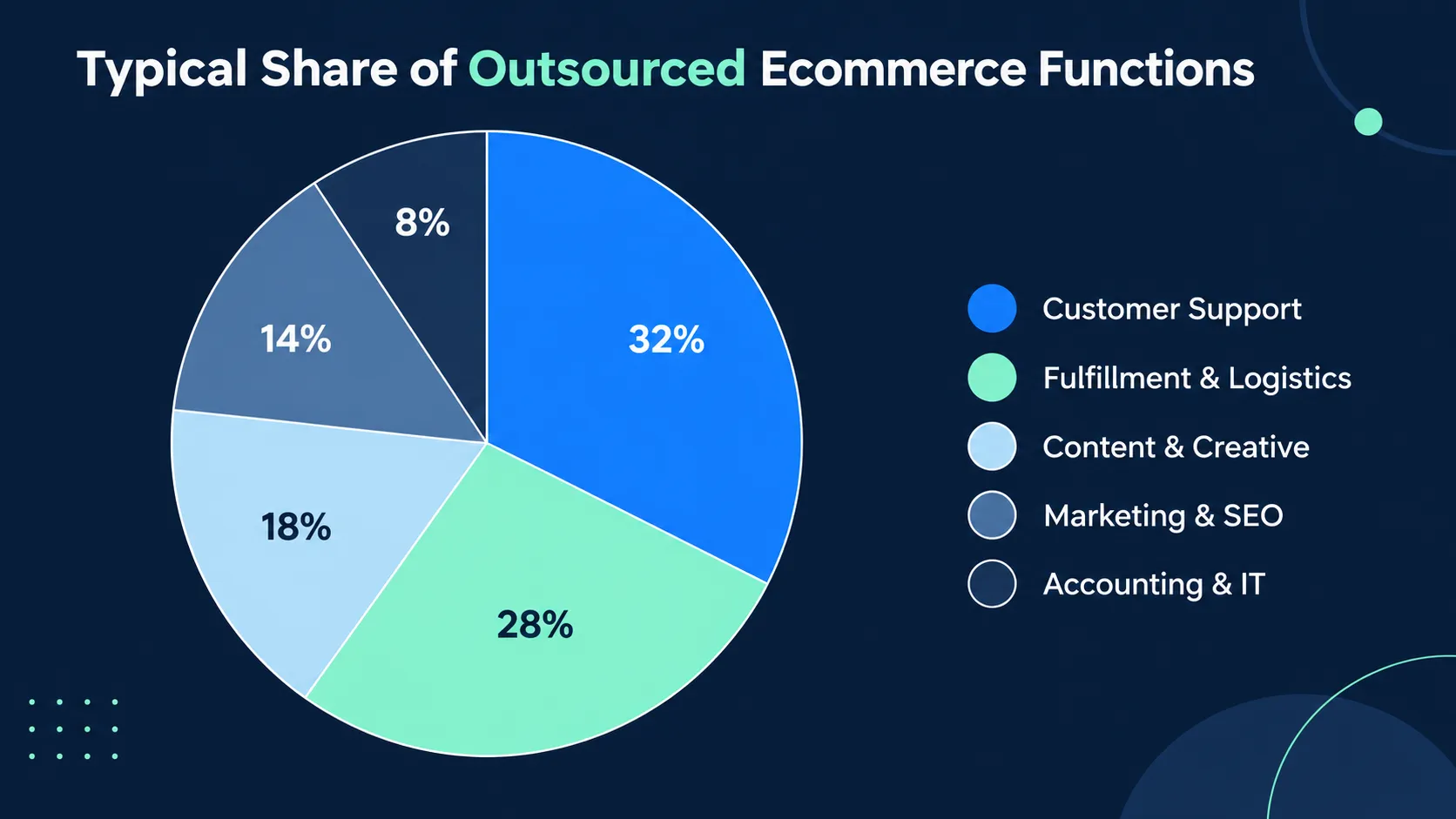
Not every function is equally suited to outsourcing. The table below breaks down the most commonly outsourced ecommerce functions and how ready-made most solutions are.
Roughly speaking, businesses tend to outsource support and fulfillment first, since those are the most operationally heavy and least tied to brand voice decisions.
In-House vs. Outsourced vs. Hybrid
There's no universal winner here — it depends on budget, growth stage, and how much control matters for a given function.
Most mature ecommerce brands eventually land on a hybrid model — a small internal team overseeing strategy and quality, with outsourced partners executing the repeatable parts.
Offshore, Nearshore, or Onshore?
Location matters more for customer-facing outsourcing than for backend work. Offshore providers (often in Asia or Eastern Europe) tend to offer the lowest rates but can introduce time-zone and cultural friction. Nearshore partners — geographically closer, similar time zones — strike a middle ground between cost and communication ease. Onshore outsourcing costs the most but minimizes language and cultural gaps, which matters a lot for support-heavy brands serving demanding markets.
There's no single right answer. A brand selling technical products to a US audience might lean nearshore or onshore for support, while outsourcing warehouse picking and packing to whichever 3PL has the best regional coverage, regardless of location.
How to Choose an Outsourcing Partner
Picking the wrong vendor can cost more than keeping the work in-house. A poor fulfillment partnership, for example, can quickly damage delivery times, customer satisfaction, and reviews. A structured vetting process helps reduce that risk.
Review Service Levels
Ask about average response times, shipping SLAs, accuracy standards, and escalation procedures. Clear performance targets make it easier to hold the provider accountable.
Check Peak-Season Capacity
Find out how the vendor handles sudden order spikes during Black Friday, holiday periods, or product launches. They should be able to scale without causing delays or a drop in service quality.
Confirm Technology Compatibility
The provider should integrate with the existing ecommerce platform, inventory tools, support software, and other systems without requiring a costly rebuild.
Review Contract Flexibility
Ask what happens if the relationship ends. Data, inventory, documentation, and account access should be easy to transfer back to the business or to a new provider. Contract flexibility matters as much as the sales pitch.
How Much Does Ecommerce Outsourcing Cost?
Pricing varies wildly by function, region, and scope, so treat any number here as a ballpark rather than a quote. Customer support outsourcing is often priced per agent-hour or per resolved ticket; fulfillment is typically priced per order plus storage fees; content and marketing work is usually project-based or retainer-based. For exact current pricing, it's worth requesting quotes directly from a shortlist of providers rather than relying on published averages, since rates shift with labor markets and demand.
As a general rule, outsourcing tends to cost less than hiring full-time staff for the same volume of work — but only once volume is high enough to offset setup and management overhead. Below a certain order count or ticket volume, an outsourced contract can actually cost more per unit than a lean in-house setup.

Common Risks and How to Manage Them
- Quality drift — outsourced teams unfamiliar with brand voice can produce inconsistent customer experiences. Fix: detailed style guides and regular quality audits.
- Data security — sharing customer data with third parties introduces compliance risk. Fix: contracts with clear data-handling clauses and access controls.
- Communication gaps — time zones and language differences slow down issue resolution. Fix: overlapping working hours and a single point of contact on both sides.
- Over-dependency — relying on one vendor for a critical function creates a single point of failure. Fix: backup vendor relationships for mission-critical tasks like fulfillment.
None of these risks are reasons to avoid outsourcing altogether. They're reasons to build contracts and processes that catch problems early instead of after a customer complaint goes viral.
Getting Started: A Practical First Step
Start small. Pick one function — customer support during off-hours, or fulfillment for a single warehouse region — and run it as a pilot for 60-90 days with clear success metrics defined upfront. Track response times, error rates, and customer satisfaction scores before and after. If the pilot performs well, expand scope. If it doesn't, the cost of walking away from a small pilot is far lower than unwinding a full-scale outsourced operation gone wrong.
Final Thoughts
Ecommerce outsourcing isn't a one-time decision — it's an ongoing strategy that evolves as a business grows. The brands that get the most out of it treat vendors as extensions of the team, not just cost-cutting measures, and they revisit what's outsourced versus kept in-house as volume and priorities shift.
Start with one function, measure it honestly, and scale from there. The goal isn't to outsource everything — it's to free up enough internal bandwidth to focus on what actually grows the business.
FAQ
Topics
Ecommerce Outsourcing Guide 2026: What to Delegate & Why

Quick Summary: Ecommerce outsourcing means handing off specific operational tasks — customer support, fulfillment, content, or tech — to outside specialists so an in-house team can focus on strategy and growth. The right approach starts with auditing repetitive, non-core tasks, choosing between offshore, nearshore, or onshore partners based on budget and communication needs, then scaling gradually with clear performance metrics. Done well, it cuts operating costs by 20-50% and frees founders to focus on product and marketing instead of daily fires.
Running an online store means juggling a hundred moving parts at once — inventory, shipping, returns, customer emails, ad campaigns, product photography. At some point, almost every growing ecommerce brand hits a wall where doing it all in-house stops making sense. That's usually when outsourcing enters the conversation.
This guide walks through what ecommerce outsourcing actually looks like in practice, which tasks make sense to hand off first, how much it typically costs, and how to avoid the mistakes that turn a smart cost-saving move into a customer-experience disaster.
What Is Ecommerce Outsourcing?
Ecommerce outsourcing is the practice of contracting external providers to handle specific functions of an online business instead of building and managing those functions internally. That could mean a third-party logistics (3PL) company handling warehousing and shipping, a call center managing customer tickets, or a freelance team writing product descriptions.
It's not an all-or-nothing decision. Most successful brands outsource selectively — keeping brand strategy, product development, and core decision-making in-house while pushing repetitive or specialized work out the door. The goal isn't to disappear from operations; it's to stop spending founder or team hours on tasks that don't require deep company-specific knowledge.
Why Businesses Outsource Ecommerce Tasks
Cost is the obvious driver, but it's rarely the only one. Here's what actually pushes brands toward outsourcing:
- Cost efficiency — avoiding the overhead of full-time salaries, benefits, office space, and software licenses for functions that don't need a dedicated in-house hire.
- Access to expertise — specialized agencies and 3PLs already have the systems, staff training, and infrastructure a small team would take years to build.
- Scalability — outsourced partners can flex up during peak season (think Black Friday) and scale back down without layoffs.
- Speed to market — launching customer support or fulfillment through an established provider is faster than hiring and training from scratch.
- Focus — founders and core teams get their time back to work on product, brand, and growth strategy instead of ticket queues.
None of this means outsourcing is automatically the right call for every task. It works best when the function is repeatable, measurable, and doesn't require constant access to sensitive strategic decisions.
Scale Ecommerce Operations with NeoWork
Ecommerce outsourcing helps companies manage customer support, order-related workflows, product data, administrative tasks, and recurring back-office work. NeoWork provides remote teammates who can support ecommerce operations within the client’s existing systems and processes. NeoWork handles recruitment, benefits, training, and ongoing engagement, while teammates follow the client’s tools, procedures, and daily priorities. Its 91% annualized teammate retention rate and 3.2% candidate selectivity rate reflect a focus on selective hiring and longer-term team stability.
NeoWork's ecommerce outsourcing model offers:
- customer and back-office support
- integration with the client’s tools and processes
- recruitment and ongoing teammate support
Contact NeoWork to build ecommerce support around your recurring operational needs.
When Should an Ecommerce Business Outsource?
Timing matters more than most brands realize. Outsourcing too early can add cost without much value, while outsourcing too late can leave the internal team overloaded with work that should have been delegated sooner.
Signs It May Be Time to Outsource
Outsourcing may make sense when order volume has outgrown what one or two people can pack and ship, customer support tickets are piling up, or the team is spending more time on admin than on growth.
Audit Tasks Before Hiring
Before adding another full-time employee, review which tasks are repetitive, time-consuming, and easy to measure. A task audit can show whether outsourcing would solve the problem more efficiently than expanding the internal team.
What to Outsource in Ecommerce
Not every function is equally suited to outsourcing. The table below breaks down the most commonly outsourced ecommerce functions and how ready-made most solutions are.
Roughly speaking, businesses tend to outsource support and fulfillment first, since those are the most operationally heavy and least tied to brand voice decisions.
In-House vs. Outsourced vs. Hybrid
There's no universal winner here — it depends on budget, growth stage, and how much control matters for a given function.
Most mature ecommerce brands eventually land on a hybrid model — a small internal team overseeing strategy and quality, with outsourced partners executing the repeatable parts.
Offshore, Nearshore, or Onshore?
Location matters more for customer-facing outsourcing than for backend work. Offshore providers (often in Asia or Eastern Europe) tend to offer the lowest rates but can introduce time-zone and cultural friction. Nearshore partners — geographically closer, similar time zones — strike a middle ground between cost and communication ease. Onshore outsourcing costs the most but minimizes language and cultural gaps, which matters a lot for support-heavy brands serving demanding markets.
There's no single right answer. A brand selling technical products to a US audience might lean nearshore or onshore for support, while outsourcing warehouse picking and packing to whichever 3PL has the best regional coverage, regardless of location.
How to Choose an Outsourcing Partner
Picking the wrong vendor can cost more than keeping the work in-house. A poor fulfillment partnership, for example, can quickly damage delivery times, customer satisfaction, and reviews. A structured vetting process helps reduce that risk.
Review Service Levels
Ask about average response times, shipping SLAs, accuracy standards, and escalation procedures. Clear performance targets make it easier to hold the provider accountable.
Check Peak-Season Capacity
Find out how the vendor handles sudden order spikes during Black Friday, holiday periods, or product launches. They should be able to scale without causing delays or a drop in service quality.
Confirm Technology Compatibility
The provider should integrate with the existing ecommerce platform, inventory tools, support software, and other systems without requiring a costly rebuild.
Review Contract Flexibility
Ask what happens if the relationship ends. Data, inventory, documentation, and account access should be easy to transfer back to the business or to a new provider. Contract flexibility matters as much as the sales pitch.
How Much Does Ecommerce Outsourcing Cost?
Pricing varies wildly by function, region, and scope, so treat any number here as a ballpark rather than a quote. Customer support outsourcing is often priced per agent-hour or per resolved ticket; fulfillment is typically priced per order plus storage fees; content and marketing work is usually project-based or retainer-based. For exact current pricing, it's worth requesting quotes directly from a shortlist of providers rather than relying on published averages, since rates shift with labor markets and demand.
As a general rule, outsourcing tends to cost less than hiring full-time staff for the same volume of work — but only once volume is high enough to offset setup and management overhead. Below a certain order count or ticket volume, an outsourced contract can actually cost more per unit than a lean in-house setup.
Common Risks and How to Manage Them
- Quality drift — outsourced teams unfamiliar with brand voice can produce inconsistent customer experiences. Fix: detailed style guides and regular quality audits.
- Data security — sharing customer data with third parties introduces compliance risk. Fix: contracts with clear data-handling clauses and access controls.
- Communication gaps — time zones and language differences slow down issue resolution. Fix: overlapping working hours and a single point of contact on both sides.
- Over-dependency — relying on one vendor for a critical function creates a single point of failure. Fix: backup vendor relationships for mission-critical tasks like fulfillment.
None of these risks are reasons to avoid outsourcing altogether. They're reasons to build contracts and processes that catch problems early instead of after a customer complaint goes viral.
Getting Started: A Practical First Step
Start small. Pick one function — customer support during off-hours, or fulfillment for a single warehouse region — and run it as a pilot for 60-90 days with clear success metrics defined upfront. Track response times, error rates, and customer satisfaction scores before and after. If the pilot performs well, expand scope. If it doesn't, the cost of walking away from a small pilot is far lower than unwinding a full-scale outsourced operation gone wrong.
Final Thoughts
Ecommerce outsourcing isn't a one-time decision — it's an ongoing strategy that evolves as a business grows. The brands that get the most out of it treat vendors as extensions of the team, not just cost-cutting measures, and they revisit what's outsourced versus kept in-house as volume and priorities shift.
Start with one function, measure it honestly, and scale from there. The goal isn't to outsource everything — it's to free up enough internal bandwidth to focus on what actually grows the business.
FAQ
Topics
Related Blogs
Related Podcasts


.webp)

.webp)
.webp)



