

.avif)
.avif)

Engineering Staff Augmentation Guide: Scale Your Team in 2026


.svg)

Quick Summary: Engineering staff augmentation is a hiring model where companies add vetted external engineers to their existing in-house team on a temporary or project basis, without the overhead of full-time recruitment. It works best for filling specific skill gaps, handling short-term capacity spikes, or accelerating a roadmap while keeping core architecture and product decisions in-house. Done right, it costs less than traditional hiring and moves faster than agency-built teams, but it requires clear contracts, tight onboarding, and active management to avoid knowledge silos.
Most engineering leaders hit the same wall eventually: the roadmap is bigger than the headcount. Maybe there's a mobile app that needs shipping in six weeks, or a legacy system nobody on the team has touched in years, or simply too many tickets and not enough hands. Full-time hiring takes months. Contractors from a marketplace are hit or miss. That's the gap staff augmentation is built to fill.
This guide breaks down what engineering staff augmentation actually means, how it differs from outsourcing and managed services, when it makes sense (and when it doesn't), what it costs, and how to structure a contract that protects both sides. No fluff — just the practical stuff a CTO or engineering manager needs before signing anything.
What Is Engineering Staff Augmentation?
Engineering staff augmentation is a flexible hiring model where a company brings in external engineers to work alongside its existing team, under its own management, processes, and tools. The augmented engineers typically join daily standups, use the company's codebase and project management software, and report to an internal engineering lead — the main difference from a full-time hire is the contractual relationship and duration.
Unlike outsourcing a whole project to an external vendor, staff augmentation keeps control of architecture, priorities, and code ownership inside the company. The augmented staff act as an extension of the team, not a separate delivery unit.
How It Differs From Outsourcing and Managed Services
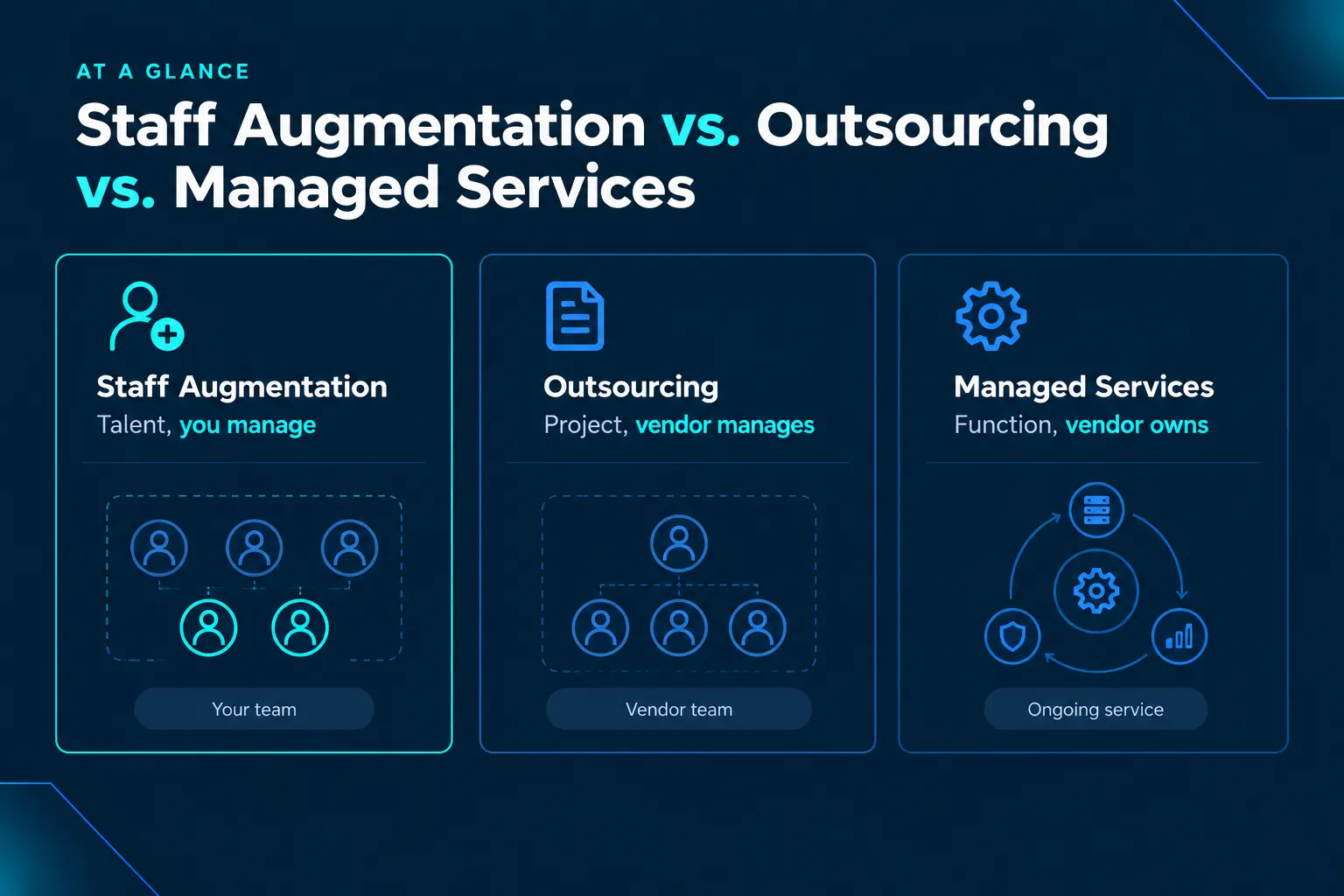
These three models get lumped together constantly, but they solve different problems.
- Staff augmentation: external engineers embedded in your team, managed by you, working on your priorities.
- Outsourcing (project-based): a vendor owns an entire deliverable end-to-end, manages its own team, and hands over a finished product.
- Managed services: a third party takes ongoing responsibility for a function (like infrastructure or QA) with its own processes and SLAs, largely independent of your day-to-day management.
When Engineering Staff Augmentation Makes Sense
Staff augmentation isn't the right fit for every situation, but it tends to shine in a handful of recurring scenarios.
Filling a Narrow Skill Gap
A team might be strong in backend Python but suddenly need a Kubernetes expert for three months to handle a migration. Hiring full-time for a skill the company won't need long-term rarely makes sense. An augmented specialist plugs the gap, transfers knowledge, and rolls off once the migration is stable.
Absorbing a Capacity Spike
Product launches, compliance deadlines, and seasonal traffic surges all create short bursts of demand that don't justify permanent headcount. Augmentation lets a team scale up for eight weeks and scale back down without layoffs.
Bridging a Hiring Freeze or Slow Pipeline
Even with budget approved, filling a senior engineering role can take three to six months. Augmented engineers can hold the line on delivery while recruiting runs in parallel.
When It's the Wrong Tool
Augmentation is a poor fit for building a brand-new core product from scratch with no internal technical leadership, for roles requiring deep, multi-year institutional knowledge from day one, or when a company genuinely just needs a fixed-scope deliverable rather than embedded help. In those cases, a fixed-bid outsourced project or a full-time hire usually wins.
Types of Staff Augmentation Models
Not all staff augmentation looks the same. The right model depends on how much oversight the internal team can provide and how specialized the skill is.
Location also matters. Onshore augmentation offers time zone overlap and easier communication at a higher price; nearshore balances cost and overlap reasonably well; offshore usually costs the least but demands more deliberate async processes. None of these is inherently "better" — the right pick depends on how tightly the augmented engineers need to sync with the core team.

Add Engineering Capacity with NeoWork
Engineering staff augmentation helps companies add remote technical professionals to existing product and development teams. NeoWork provides talent across software engineering, data science, cloud architecture, and other technical functions. NeoWork handles recruitment, benefits, training, and ongoing engagement, while teammates work within the client’s systems, tools, and engineering processes. Its 91% annualized teammate retention rate and 3.2% candidate selectivity rate reflect a focus on selective hiring and longer-term team stability.
NeoWork's engineering staff augmentation model offers:
- engineering and technical professionals
- integration with the client’s tools and processes
- recruitment and ongoing teammate support
Contact NeoWork to add engineering capacity that fits your existing team and development workflow.
Benefits of Engineering Staff Augmentation
The appeal isn't just cost — though cost is real. It's flexibility paired with control.
- Speed: onboarding a vetted engineer typically takes days or weeks, not months.
- Flexibility: scale the team up for a sprint of work and back down without severance conversations.
- Access to niche skills: specialists who'd be hard to justify hiring full-time become accessible on demand.
- Retained control: architecture decisions, code review standards, and product priorities stay with the internal team.
- Lower overhead: no benefits, payroll taxes, or long-term severance liability on the augmented headcount.
That said, it's not free of trade-offs. Turnover on the vendor side can disrupt continuity, knowledge tends to walk out the door when a contract ends unless documentation is enforced, and poor onboarding can leave augmented engineers underutilized for weeks. Weigh those risks honestly before committing.
Cost of Engineering Staff Augmentation
Pricing varies wildly by region, seniority, and specialization, so treat any number here as a rough planning anchor rather than a quote. Onshore senior engineers in the U.S. or Western Europe generally command the highest hourly rates; nearshore talent in Latin America or Eastern Europe often lands in the middle; offshore talent in South or Southeast Asia tends to be the most budget-friendly, though quality varies more by vendor than by region.
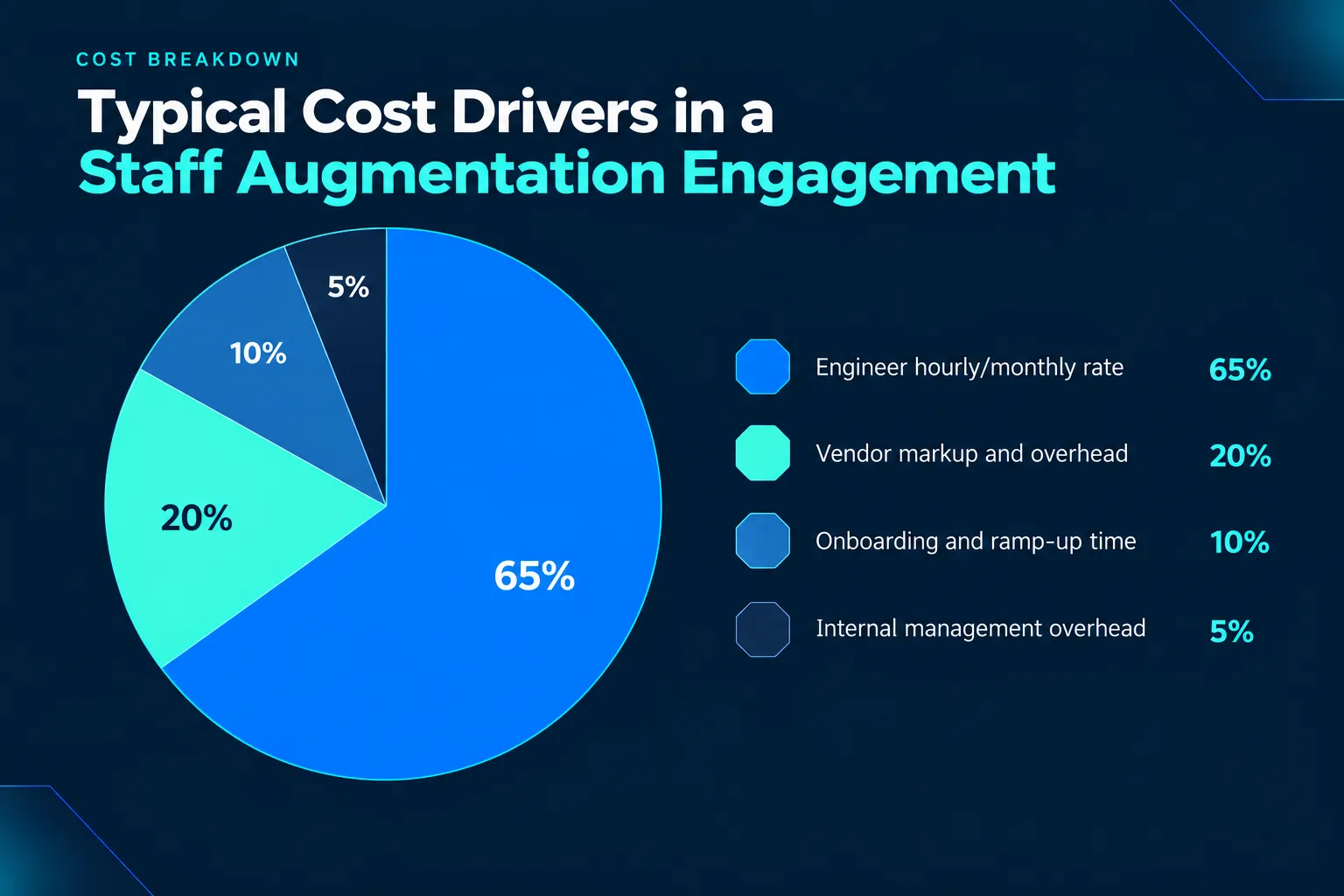
Beyond the hourly or monthly rate, factor in the vendor's markup (typically covering recruiting, HR, and management overhead), any onboarding and ramp-up time that's effectively unbillable productivity, and the cost of internal management time spent coordinating the augmented staff. For a specific budget, request quotes from two or three vetted providers and compare fully-loaded rates — check each vendor's official pricing page for current numbers, since rates shift with market demand.
How to Choose a Staff Augmentation Partner
Not every vendor claiming "vetted engineers" actually vets thoroughly. A few things worth checking before signing anything:
- Technical vetting process: ask exactly how candidates are screened — live coding, system design, or just resume review?
- Replacement policy: what happens if an engineer isn't a fit after two weeks? A serious vendor offers a fast, no-cost swap.
- References: talk to at least one current client, ideally in a similar tech stack.
- Communication practices: confirm overlap hours, English proficiency, and how often status updates happen.
- Data security: verify NDAs, access controls, and compliance certifications relevant to the industry (SOC 2, HIPAA, etc.).
Contracts: MSA and SOW Basics
A solid engineering staff augmentation contract usually pairs two documents. The Master Services Agreement (MSA) sets the overall legal terms — liability, confidentiality, IP ownership, termination clauses — and stays in place across the whole relationship. The Statement of Work (SOW) sits underneath it and spells out the specifics: which engineers, what rate, what duration, what deliverables or scope, and how performance gets measured.
Keep IP assignment language explicit — every line of code the augmented engineer writes should be assigned to the company, not the vendor or the individual. Also nail down termination notice periods; 15 to 30 days is common, giving enough runway to hand off work cleanly.
Best Practices for Managing an Augmented Team
Bringing someone in is the easy part. Getting real value out of them takes deliberate management.
- Assign a clear internal point of contact from day one — don't let new hires float without direction.
- Document onboarding: repo access, coding standards, architecture overviews, and team rituals should exist in writing, not tribal knowledge.
- Include augmented engineers in the same code review and testing standards as full-time staff — no shortcuts.
- Track knowledge transfer actively; require documentation before a contract ends, not after.
- Treat them like team members in retros and planning, not outsiders — engagement drives quality of output.
Final Thoughts
Engineering staff augmentation works best as a precision tool, not a permanent crutch. It's great for closing skill gaps, absorbing short-term spikes, and keeping a roadmap moving while full-time hiring catches up — but it still demands real management attention to pay off. Pick a vendor with a transparent vetting process, lock down IP and termination terms in writing, and treat augmented engineers as full team members from day one. Get those pieces right, and staff augmentation becomes one of the more reliable levers for scaling an engineering org without the long lead time of traditional hiring. Ready to explore options? Start by mapping the exact skill gap or capacity need before reaching out to any vendor — clarity there makes every downstream decision easier.
Frequently Asked Questions
Topics
Engineering Staff Augmentation Guide: Scale Your Team in 2026

Quick Summary: Engineering staff augmentation is a hiring model where companies add vetted external engineers to their existing in-house team on a temporary or project basis, without the overhead of full-time recruitment. It works best for filling specific skill gaps, handling short-term capacity spikes, or accelerating a roadmap while keeping core architecture and product decisions in-house. Done right, it costs less than traditional hiring and moves faster than agency-built teams, but it requires clear contracts, tight onboarding, and active management to avoid knowledge silos.
Most engineering leaders hit the same wall eventually: the roadmap is bigger than the headcount. Maybe there's a mobile app that needs shipping in six weeks, or a legacy system nobody on the team has touched in years, or simply too many tickets and not enough hands. Full-time hiring takes months. Contractors from a marketplace are hit or miss. That's the gap staff augmentation is built to fill.
This guide breaks down what engineering staff augmentation actually means, how it differs from outsourcing and managed services, when it makes sense (and when it doesn't), what it costs, and how to structure a contract that protects both sides. No fluff — just the practical stuff a CTO or engineering manager needs before signing anything.
What Is Engineering Staff Augmentation?
Engineering staff augmentation is a flexible hiring model where a company brings in external engineers to work alongside its existing team, under its own management, processes, and tools. The augmented engineers typically join daily standups, use the company's codebase and project management software, and report to an internal engineering lead — the main difference from a full-time hire is the contractual relationship and duration.
Unlike outsourcing a whole project to an external vendor, staff augmentation keeps control of architecture, priorities, and code ownership inside the company. The augmented staff act as an extension of the team, not a separate delivery unit.
How It Differs From Outsourcing and Managed Services
These three models get lumped together constantly, but they solve different problems.
- Staff augmentation: external engineers embedded in your team, managed by you, working on your priorities.
- Outsourcing (project-based): a vendor owns an entire deliverable end-to-end, manages its own team, and hands over a finished product.
- Managed services: a third party takes ongoing responsibility for a function (like infrastructure or QA) with its own processes and SLAs, largely independent of your day-to-day management.
When Engineering Staff Augmentation Makes Sense
Staff augmentation isn't the right fit for every situation, but it tends to shine in a handful of recurring scenarios.
Filling a Narrow Skill Gap
A team might be strong in backend Python but suddenly need a Kubernetes expert for three months to handle a migration. Hiring full-time for a skill the company won't need long-term rarely makes sense. An augmented specialist plugs the gap, transfers knowledge, and rolls off once the migration is stable.
Absorbing a Capacity Spike
Product launches, compliance deadlines, and seasonal traffic surges all create short bursts of demand that don't justify permanent headcount. Augmentation lets a team scale up for eight weeks and scale back down without layoffs.
Bridging a Hiring Freeze or Slow Pipeline
Even with budget approved, filling a senior engineering role can take three to six months. Augmented engineers can hold the line on delivery while recruiting runs in parallel.
When It's the Wrong Tool
Augmentation is a poor fit for building a brand-new core product from scratch with no internal technical leadership, for roles requiring deep, multi-year institutional knowledge from day one, or when a company genuinely just needs a fixed-scope deliverable rather than embedded help. In those cases, a fixed-bid outsourced project or a full-time hire usually wins.
Types of Staff Augmentation Models
Not all staff augmentation looks the same. The right model depends on how much oversight the internal team can provide and how specialized the skill is.
Location also matters. Onshore augmentation offers time zone overlap and easier communication at a higher price; nearshore balances cost and overlap reasonably well; offshore usually costs the least but demands more deliberate async processes. None of these is inherently "better" — the right pick depends on how tightly the augmented engineers need to sync with the core team.
Add Engineering Capacity with NeoWork
Engineering staff augmentation helps companies add remote technical professionals to existing product and development teams. NeoWork provides talent across software engineering, data science, cloud architecture, and other technical functions. NeoWork handles recruitment, benefits, training, and ongoing engagement, while teammates work within the client’s systems, tools, and engineering processes. Its 91% annualized teammate retention rate and 3.2% candidate selectivity rate reflect a focus on selective hiring and longer-term team stability.
NeoWork's engineering staff augmentation model offers:
- engineering and technical professionals
- integration with the client’s tools and processes
- recruitment and ongoing teammate support
Contact NeoWork to add engineering capacity that fits your existing team and development workflow.
Benefits of Engineering Staff Augmentation
The appeal isn't just cost — though cost is real. It's flexibility paired with control.
- Speed: onboarding a vetted engineer typically takes days or weeks, not months.
- Flexibility: scale the team up for a sprint of work and back down without severance conversations.
- Access to niche skills: specialists who'd be hard to justify hiring full-time become accessible on demand.
- Retained control: architecture decisions, code review standards, and product priorities stay with the internal team.
- Lower overhead: no benefits, payroll taxes, or long-term severance liability on the augmented headcount.
That said, it's not free of trade-offs. Turnover on the vendor side can disrupt continuity, knowledge tends to walk out the door when a contract ends unless documentation is enforced, and poor onboarding can leave augmented engineers underutilized for weeks. Weigh those risks honestly before committing.
Cost of Engineering Staff Augmentation
Pricing varies wildly by region, seniority, and specialization, so treat any number here as a rough planning anchor rather than a quote. Onshore senior engineers in the U.S. or Western Europe generally command the highest hourly rates; nearshore talent in Latin America or Eastern Europe often lands in the middle; offshore talent in South or Southeast Asia tends to be the most budget-friendly, though quality varies more by vendor than by region.
Beyond the hourly or monthly rate, factor in the vendor's markup (typically covering recruiting, HR, and management overhead), any onboarding and ramp-up time that's effectively unbillable productivity, and the cost of internal management time spent coordinating the augmented staff. For a specific budget, request quotes from two or three vetted providers and compare fully-loaded rates — check each vendor's official pricing page for current numbers, since rates shift with market demand.
How to Choose a Staff Augmentation Partner
Not every vendor claiming "vetted engineers" actually vets thoroughly. A few things worth checking before signing anything:
- Technical vetting process: ask exactly how candidates are screened — live coding, system design, or just resume review?
- Replacement policy: what happens if an engineer isn't a fit after two weeks? A serious vendor offers a fast, no-cost swap.
- References: talk to at least one current client, ideally in a similar tech stack.
- Communication practices: confirm overlap hours, English proficiency, and how often status updates happen.
- Data security: verify NDAs, access controls, and compliance certifications relevant to the industry (SOC 2, HIPAA, etc.).
Contracts: MSA and SOW Basics
A solid engineering staff augmentation contract usually pairs two documents. The Master Services Agreement (MSA) sets the overall legal terms — liability, confidentiality, IP ownership, termination clauses — and stays in place across the whole relationship. The Statement of Work (SOW) sits underneath it and spells out the specifics: which engineers, what rate, what duration, what deliverables or scope, and how performance gets measured.
Keep IP assignment language explicit — every line of code the augmented engineer writes should be assigned to the company, not the vendor or the individual. Also nail down termination notice periods; 15 to 30 days is common, giving enough runway to hand off work cleanly.
Best Practices for Managing an Augmented Team
Bringing someone in is the easy part. Getting real value out of them takes deliberate management.
- Assign a clear internal point of contact from day one — don't let new hires float without direction.
- Document onboarding: repo access, coding standards, architecture overviews, and team rituals should exist in writing, not tribal knowledge.
- Include augmented engineers in the same code review and testing standards as full-time staff — no shortcuts.
- Track knowledge transfer actively; require documentation before a contract ends, not after.
- Treat them like team members in retros and planning, not outsiders — engagement drives quality of output.
Final Thoughts
Engineering staff augmentation works best as a precision tool, not a permanent crutch. It's great for closing skill gaps, absorbing short-term spikes, and keeping a roadmap moving while full-time hiring catches up — but it still demands real management attention to pay off. Pick a vendor with a transparent vetting process, lock down IP and termination terms in writing, and treat augmented engineers as full team members from day one. Get those pieces right, and staff augmentation becomes one of the more reliable levers for scaling an engineering org without the long lead time of traditional hiring. Ready to explore options? Start by mapping the exact skill gap or capacity need before reaching out to any vendor — clarity there makes every downstream decision easier.
Frequently Asked Questions
Topics
Related Blogs
Related Podcasts


.webp)

.webp)
.webp)



