

.avif)
.avif)

Financial Analysts Outsourcing Guide for 2026


.svg)

Quick Summary: Outsourcing financial analysts means hiring external professionals or firms to handle tasks like forecasting, budgeting, and reporting instead of building an in-house team. Done right, it cuts costs by 30-50%, gives faster access to specialized skills, and frees leadership to focus on strategy. Done wrong, it creates communication gaps and data security headaches. This guide walks through when it makes sense, how to vet providers, and what it actually costs in 2026.
Building a full in-house finance team is expensive. A single senior financial analyst in the US can cost well over $90,000 a year in salary alone, before benefits, software, and office overhead get added in. That math is exactly why so many startups, mid-market companies, and even large enterprises have turned to outsourcing for financial analysis work.
But outsourcing isn't just about saving money. It's about speed, flexibility, and getting specialized expertise without a year-long hiring process. That said, handing financial data to an outside party is a serious decision, and getting it wrong can be costly. This guide breaks down what financial analyst outsourcing actually involves, who it works best for, and how to do it without regretting it six months later.
What Financial Analyst Outsourcing Actually Means
Financial analyst outsourcing involves contracting external professionals, agencies, or offshore teams to handle analytical work traditionally done by internal staff. That can mean anything from monthly management reporting to full-blown financial modeling for a fundraising round.
It's different from general finance and accounting outsourcing, which usually covers bookkeeping, payroll, and tax prep. Financial analysis outsourcing sits higher up the value chain — it's about interpreting numbers, not just recording them. Think budgeting, variance analysis, cash flow forecasting, KPI dashboards, and investment analysis.
Companies typically outsource this function in one of three ways: hiring a dedicated freelance analyst, contracting a specialized outsourcing firm, or partnering with an offshore team that works as an extension of the internal finance department.
Why Companies Choose to Outsource Financial Analysis
The reasons vary by company size, but a few themes show up again and again. Cost is the obvious one — outsourced talent, especially offshore, often costs a fraction of a full-time hire. Speed matters too. An outsourcing firm can usually staff a project within days, while an internal hire might take two or three months from job posting to first day.
There's also the skills angle. Not every company needs a full-time FP&A specialist, but almost every growing business needs that expertise occasionally — during a raise, an acquisition, or a budgeting cycle. Outsourcing lets a business tap that expertise on demand rather than carrying it as a fixed cost year-round.
What Financial Analysis Tasks Get Outsourced Most
Some tasks translate well to outsourcing; others don't. Anything routine, repeatable, or well-documented tends to outsource cleanly. Highly strategic decisions that require deep company context usually stay in-house, even if the underlying analysis is outsourced.

Expand Financial Analysis Support with NeoWork
Financial analyst outsourcing helps companies add capacity for data preparation, reporting support, financial records, and recurring analysis workflows. NeoWork provides remote teammates who can support finance teams within the client’s existing systems, reporting structure, and approval processes. NeoWork handles recruitment, benefits, training, and ongoing engagement, while clients retain control over priorities and analytical decisions. Its 91% annualized teammate retention rate and 3.2% candidate selectivity rate reflect a focus on selective hiring and longer-term team stability.
NeoWork's financial analyst support model offers:
- financial data and reporting support
- integration with the client’s tools and processes
- recruitment and ongoing teammate support
Contact NeoWork to add financial analyst support that can grow with your finance operations.
How to Evaluate and Hire Outsourced Financial Analysts
Picking the wrong provider is worse than not outsourcing at all — it wastes time, money, and trust. A structured evaluation process helps avoid that.
1. Assess Technical Skills First
Ask for examples of financial models, dashboards, or reports similar to what's needed. Technical fluency in Excel, SQL, or BI tools like Power BI matters, but so does understanding of accounting principles behind the numbers.
2. Review Past Work and References
Case studies and client references reveal more than a polished sales pitch. Look for experience in a similar industry or company stage — a firm that's only worked with enterprises may struggle with startup speed and ambiguity.
3. Test Communication Style Early
Schedule a working call before signing anything. Notice whether the analyst asks clarifying questions or just nods along. Good analysts push back when numbers don't make sense.
4. Run a Paid Trial Project
Before committing to a long-term contract, assign a small, well-scoped project. It's the single best predictor of how a full engagement will go.
Onshore, Offshore, or Nearshore: Picking the Right Model
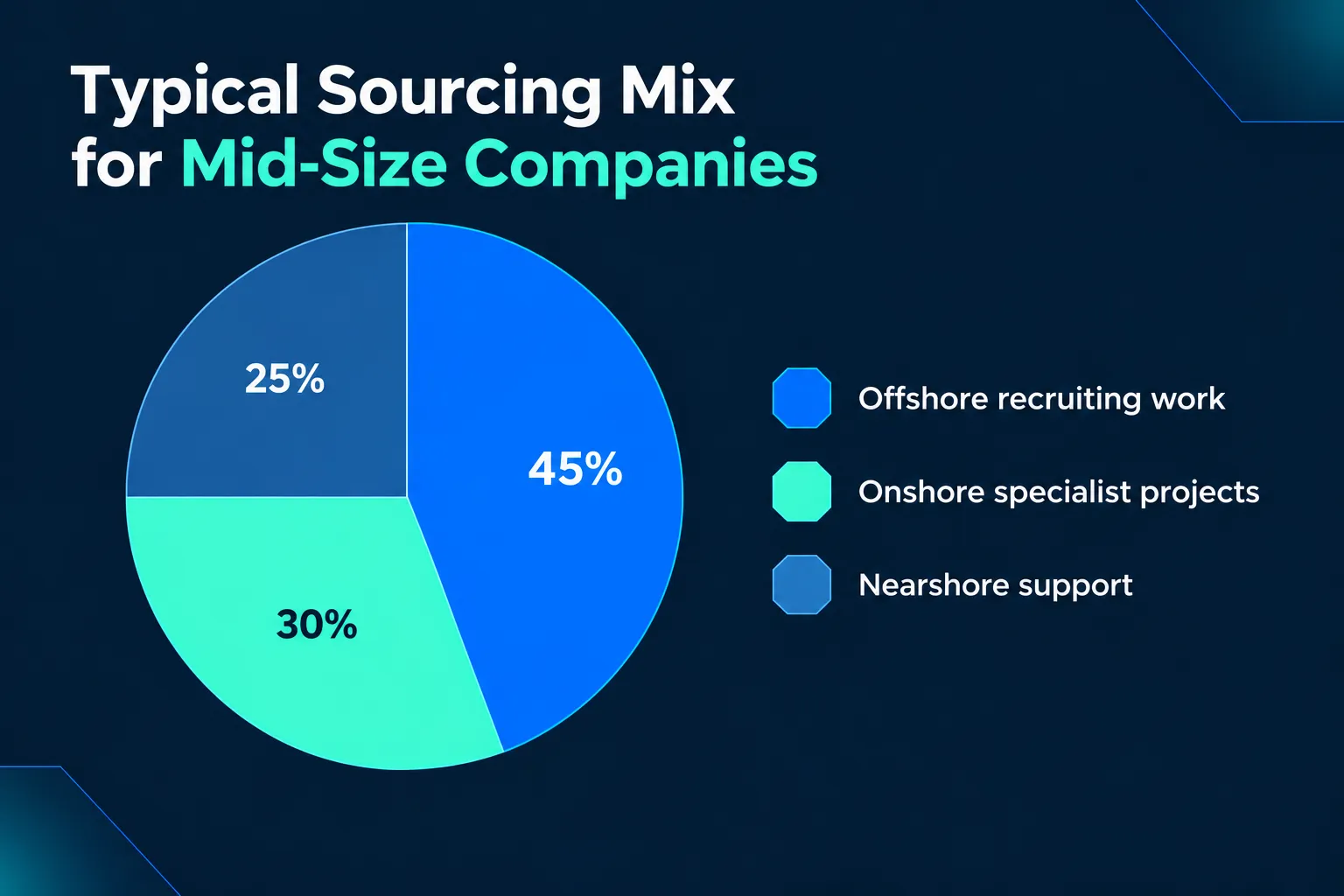
Location shapes cost, availability, and communication ease. Onshore providers cost the most but offer the smoothest collaboration. Offshore providers, often based in regions like South Asia or Eastern Europe, cost significantly less but require more deliberate communication practices. Nearshore sits in between — similar time zones, moderate savings.
Most companies that outsource financial analysis end up blending models: a nearshore or offshore team for recurring reporting, and an onshore specialist for anything investor-facing or highly sensitive.
What Financial Analyst Outsourcing Costs in 2026
Pricing varies widely depending on scope, seniority, and location. As a general guide:
These are general market ranges, not fixed quotes — always check a provider's official pricing page for current rates, since costs shift with demand and specialization.
The Risks Nobody Talks About Enough
Outsourcing isn't a free lunch. Handing sensitive financial data to a third party introduces real risk, and it's worth naming that plainly rather than glossing over it.
- Data security: Financial data is sensitive by nature. Weak vendor security practices can expose a company to breaches or compliance violations.
- Communication gaps: Time zone differences and cultural mismatches can slow decision-making, especially with offshore teams.
- Quality inconsistency: Not every provider delivers the same rigor. Analysis that looks polished isn't always accurate.
- Loss of institutional knowledge: Outsourced analysts don't always retain context the way an internal hire builds over time.
- Vendor dependency: Relying too heavily on one provider creates a single point of failure.
None of these risks are dealbreakers on their own. They're just things to manage through contracts, security requirements, and a clear onboarding process.
Best Practices for Managing an Outsourced Finance Team
- Put data access agreements and NDAs in writing before any file gets shared.
- Standardize reporting templates so output stays consistent across providers.
- Set a recurring check-in cadence — weekly for active projects, biweekly for maintenance work.
- Keep one internal owner accountable for reviewing outsourced work, not just receiving it.
- Use shared dashboards instead of email chains for tracking deliverables and deadlines.
Outsourcing works best when it's treated as a partnership rather than a hand-off. The companies that get the most value tend to stay involved, not disappear until the report lands in their inbox.
Final Thoughts
Outsourcing financial analysis isn't an all-or-nothing decision. Most companies land somewhere in the middle, keeping strategic decisions in-house while sending recurring, well-scoped work to trusted external partners. The key is starting small, testing a provider's fit through a real project, and building clear processes around data handling and communication before scaling the relationship.
Ready to explore outsourcing for the finance function? Start by mapping which tasks eat the most internal time, then request a trial project from two or three providers before committing to anything long-term.
FAQ: Financial Analyst Outsourcing
Topics
Financial Analysts Outsourcing Guide for 2026

Quick Summary: Outsourcing financial analysts means hiring external professionals or firms to handle tasks like forecasting, budgeting, and reporting instead of building an in-house team. Done right, it cuts costs by 30-50%, gives faster access to specialized skills, and frees leadership to focus on strategy. Done wrong, it creates communication gaps and data security headaches. This guide walks through when it makes sense, how to vet providers, and what it actually costs in 2026.
Building a full in-house finance team is expensive. A single senior financial analyst in the US can cost well over $90,000 a year in salary alone, before benefits, software, and office overhead get added in. That math is exactly why so many startups, mid-market companies, and even large enterprises have turned to outsourcing for financial analysis work.
But outsourcing isn't just about saving money. It's about speed, flexibility, and getting specialized expertise without a year-long hiring process. That said, handing financial data to an outside party is a serious decision, and getting it wrong can be costly. This guide breaks down what financial analyst outsourcing actually involves, who it works best for, and how to do it without regretting it six months later.
What Financial Analyst Outsourcing Actually Means
Financial analyst outsourcing involves contracting external professionals, agencies, or offshore teams to handle analytical work traditionally done by internal staff. That can mean anything from monthly management reporting to full-blown financial modeling for a fundraising round.
It's different from general finance and accounting outsourcing, which usually covers bookkeeping, payroll, and tax prep. Financial analysis outsourcing sits higher up the value chain — it's about interpreting numbers, not just recording them. Think budgeting, variance analysis, cash flow forecasting, KPI dashboards, and investment analysis.
Companies typically outsource this function in one of three ways: hiring a dedicated freelance analyst, contracting a specialized outsourcing firm, or partnering with an offshore team that works as an extension of the internal finance department.
Why Companies Choose to Outsource Financial Analysis
The reasons vary by company size, but a few themes show up again and again. Cost is the obvious one — outsourced talent, especially offshore, often costs a fraction of a full-time hire. Speed matters too. An outsourcing firm can usually staff a project within days, while an internal hire might take two or three months from job posting to first day.
There's also the skills angle. Not every company needs a full-time FP&A specialist, but almost every growing business needs that expertise occasionally — during a raise, an acquisition, or a budgeting cycle. Outsourcing lets a business tap that expertise on demand rather than carrying it as a fixed cost year-round.
What Financial Analysis Tasks Get Outsourced Most
Some tasks translate well to outsourcing; others don't. Anything routine, repeatable, or well-documented tends to outsource cleanly. Highly strategic decisions that require deep company context usually stay in-house, even if the underlying analysis is outsourced.
Expand Financial Analysis Support with NeoWork
Financial analyst outsourcing helps companies add capacity for data preparation, reporting support, financial records, and recurring analysis workflows. NeoWork provides remote teammates who can support finance teams within the client’s existing systems, reporting structure, and approval processes. NeoWork handles recruitment, benefits, training, and ongoing engagement, while clients retain control over priorities and analytical decisions. Its 91% annualized teammate retention rate and 3.2% candidate selectivity rate reflect a focus on selective hiring and longer-term team stability.
NeoWork's financial analyst support model offers:
- financial data and reporting support
- integration with the client’s tools and processes
- recruitment and ongoing teammate support
Contact NeoWork to add financial analyst support that can grow with your finance operations.
How to Evaluate and Hire Outsourced Financial Analysts
Picking the wrong provider is worse than not outsourcing at all — it wastes time, money, and trust. A structured evaluation process helps avoid that.
1. Assess Technical Skills First
Ask for examples of financial models, dashboards, or reports similar to what's needed. Technical fluency in Excel, SQL, or BI tools like Power BI matters, but so does understanding of accounting principles behind the numbers.
2. Review Past Work and References
Case studies and client references reveal more than a polished sales pitch. Look for experience in a similar industry or company stage — a firm that's only worked with enterprises may struggle with startup speed and ambiguity.
3. Test Communication Style Early
Schedule a working call before signing anything. Notice whether the analyst asks clarifying questions or just nods along. Good analysts push back when numbers don't make sense.
4. Run a Paid Trial Project
Before committing to a long-term contract, assign a small, well-scoped project. It's the single best predictor of how a full engagement will go.
Onshore, Offshore, or Nearshore: Picking the Right Model
Location shapes cost, availability, and communication ease. Onshore providers cost the most but offer the smoothest collaboration. Offshore providers, often based in regions like South Asia or Eastern Europe, cost significantly less but require more deliberate communication practices. Nearshore sits in between — similar time zones, moderate savings.
Most companies that outsource financial analysis end up blending models: a nearshore or offshore team for recurring reporting, and an onshore specialist for anything investor-facing or highly sensitive.
What Financial Analyst Outsourcing Costs in 2026
Pricing varies widely depending on scope, seniority, and location. As a general guide:
These are general market ranges, not fixed quotes — always check a provider's official pricing page for current rates, since costs shift with demand and specialization.
The Risks Nobody Talks About Enough
Outsourcing isn't a free lunch. Handing sensitive financial data to a third party introduces real risk, and it's worth naming that plainly rather than glossing over it.
- Data security: Financial data is sensitive by nature. Weak vendor security practices can expose a company to breaches or compliance violations.
- Communication gaps: Time zone differences and cultural mismatches can slow decision-making, especially with offshore teams.
- Quality inconsistency: Not every provider delivers the same rigor. Analysis that looks polished isn't always accurate.
- Loss of institutional knowledge: Outsourced analysts don't always retain context the way an internal hire builds over time.
- Vendor dependency: Relying too heavily on one provider creates a single point of failure.
None of these risks are dealbreakers on their own. They're just things to manage through contracts, security requirements, and a clear onboarding process.
Best Practices for Managing an Outsourced Finance Team
- Put data access agreements and NDAs in writing before any file gets shared.
- Standardize reporting templates so output stays consistent across providers.
- Set a recurring check-in cadence — weekly for active projects, biweekly for maintenance work.
- Keep one internal owner accountable for reviewing outsourced work, not just receiving it.
- Use shared dashboards instead of email chains for tracking deliverables and deadlines.
Outsourcing works best when it's treated as a partnership rather than a hand-off. The companies that get the most value tend to stay involved, not disappear until the report lands in their inbox.
Final Thoughts
Outsourcing financial analysis isn't an all-or-nothing decision. Most companies land somewhere in the middle, keeping strategic decisions in-house while sending recurring, well-scoped work to trusted external partners. The key is starting small, testing a provider's fit through a real project, and building clear processes around data handling and communication before scaling the relationship.
Ready to explore outsourcing for the finance function? Start by mapping which tasks eat the most internal time, then request a trial project from two or three providers before committing to anything long-term.
FAQ: Financial Analyst Outsourcing
Topics
Related Blogs
Related Podcasts


.webp)

.webp)
.webp)



