

.avif)
.avif)

Healthcare Back Office Outsourcing Guide 2026


.svg)

Quick Summary: Healthcare back office outsourcing involves delegating administrative tasks like medical billing, claims processing, data entry, and patient scheduling to specialized third-party providers. This guide covers what qualifies as back office work, the benefits of outsourcing (cost savings, improved accuracy, compliance), key services to outsource, and how to choose the right partner while managing risks.
Running a healthcare organization today means juggling patient care with an avalanche of administrative work. Medical billing, insurance claims, data entry, appointment scheduling—these tasks consume resources but don't directly improve patient outcomes.
That's where healthcare back office outsourcing comes in. By delegating administrative functions to specialized providers, healthcare organizations free up internal teams to focus on what matters most: delivering quality patient care.
But outsourcing isn't just about offloading work. The healthcare BPO market was projected to reach USD 417.7 billion in 2025 and grow to USD 694.3 billion by 2030, reflecting a compound annual growth rate of 10.7%. These numbers tell a story about an industry shift toward strategic partnerships that improve efficiency, reduce costs, and maintain compliance.
What Is Healthcare Back Office Outsourcing?
Healthcare back office outsourcing means contracting with third-party providers to handle administrative and operational tasks that support clinical operations but don't involve direct patient care.
These functions typically include:
- Medical billing and coding
- Insurance claims processing and management
- Revenue cycle management
- Data entry and management
- Patient appointment scheduling
- Accounts payable and receivable
- Medical transcription
The distinction between front office and back office matters. Front office functions involve direct patient interaction—reception, initial consultations, customer service. Back office operations work behind the scenes, processing information, managing finances, and ensuring regulatory compliance.
According to the U.S. Department of Health and Human Services Office of Inspector General, state Medicaid agencies have engaged in offshore outsourcing of administrative functions, highlighting how government healthcare programs also leverage external partners for operational efficiency.
Why Healthcare Organizations Outsource Back Office Functions
Healthcare providers face mounting pressure from multiple directions. Rising operational costs, staffing shortages, increasingly complex regulations, and the constant demand for better patient outcomes create a perfect storm.
Outsourcing offers a strategic response to these challenges.
Cost Reduction
Financial pressure hits healthcare organizations hard. Outsourcing can reduce operational costs by up to 30%, according to industry analyses. That's not just marginal savings—that's budget room that can be redirected toward patient care, technology upgrades, or staff development.
Consider the economics. Hiring, training, and retaining in-house staff for specialized administrative roles requires substantial investment. Benefits, office space, equipment, ongoing training—it adds up fast.
Third-party providers spread these costs across multiple clients. They've already invested in infrastructure, training programs, and specialized software. Healthcare organizations pay for services rendered without shouldering the full burden of employment overhead.
Improved Accuracy and Efficiency
Administrative errors cost money. According to data from the American Health Information Management Association, over one-third of hospital executives report claim denial rates nearing 10%. The average denial rework cost per claim reaches approximately $25 for practices and $181 for hospitals.
Specialized outsourcing partners bring expertise. Their staff focus exclusively on specific administrative functions—medical billing, claims processing, coding. This specialization drives accuracy rates that generalist in-house teams struggle to match.
Some healthcare BPO providers achieve approximately 95% coding accuracy with AI-enabled coding and claims management systems. That level of precision directly impacts revenue cycle performance and reduces the costly rework associated with claim denials.
Focus on Core Competencies
Healthcare professionals trained to deliver patient care shouldn't spend their days wrestling with billing software or insurance paperwork. Yet many do.
When administrative tasks consume clinical staff time, patient care quality suffers. Outsourcing administrative functions lets healthcare organizations reallocate internal resources toward clinical excellence, patient experience improvements, and strategic initiatives.
Regulatory Compliance
Healthcare operates in one of the most heavily regulated industries. HIPAA requirements for patient data protection, Medicare and Medicaid billing standards, insurance claim regulations—the compliance landscape constantly evolves.
Centers for Medicare & Medicaid Services (CMS) has adopted standards under HIPAA for electronic transactions, including health plan eligibility benefit inquiry and response. Staying current with these standards requires dedicated attention.
Reputable outsourcing partners maintain compliance as a core competency. They invest in training, security infrastructure, and process updates to meet regulatory requirements. This transfers compliance risk and reduces the burden on internal teams to track every regulatory change.

Support Healthcare Back-Office Operations With NeoWork
Healthcare organizations often manage large volumes of administrative work behind the scenes. NeoWork provides staffing and operational support that can help teams handle routine processes and keep operations running smoothly.
Need Additional Healthcare Back-Office Support?
NeoWork can help with:
- administrative workflows
- records management
- data processing
- operational support tasks
👉 Contact NeoWork to discuss your healthcare support needs.
Key Healthcare Back Office Services to Outsource
Not all back office functions make equal candidates for outsourcing. Some deliver clearer benefits than others. Here's what healthcare organizations commonly outsource and why.
Medical Billing and Coding
Medical billing converts healthcare services into billable claims. Medical coding translates diagnoses, procedures, and services into standardized codes (ICD-10, CPT, HCPSC).
Both require specialized knowledge. Coding errors lead to claim denials, payment delays, and potential compliance issues. Billing mistakes create revenue gaps.
Outsourcing these functions to certified specialists reduces errors and speeds up payment cycles. Providers with expertise in specific medical specialties or payer requirements deliver even better results.
Claims Processing and Management
Insurance claims represent a significant administrative burden. Each claim requires verification, accurate documentation, submission to payers, tracking, and follow-up on denials or partial payments.
The HHS Office of Inspector General found that unclear Medicare requirements led to differing interpretations of inpatient rehabilitation facility documentation, coverage, and billing requirements—illustrating how complex claims management can become.
Outsourced claims management teams handle verification, submission, denial management, and appeals. Their experience with various insurance carriers and payer requirements translates to faster processing and higher approval rates.
Revenue Cycle Management
Revenue cycle management encompasses the entire financial process—from patient registration and insurance verification through final payment collection.
According to research published in the journal of the American Health Information Management Association, unresolved claims denials represent an average annual loss of $5 million for hospitals, representing up to 5 percent of net patient revenue.
Comprehensive revenue cycle outsourcing addresses this through integrated services: eligibility verification, prior authorization, claims submission, payment posting, denial management, patient billing, and collections.
Patient Appointment Scheduling
Appointment scheduling seems straightforward until it isn't. No-shows, last-minute cancellations, double bookings, and coordination across multiple providers create scheduling complexity.
Outsourced scheduling teams handle appointment booking, reminders, rescheduling, and cancellation management. They often work extended hours, providing scheduling access beyond standard office hours.
Data Entry and Medical Records Management
Healthcare generates massive volumes of data. Patient records, test results, insurance information, treatment notes—all need accurate entry and organization.
Data entry outsourcing handles high-volume information processing while maintaining accuracy. This includes updating electronic health records (EHR), scanning and digitizing paper records, and data migration during system transitions.
Medical Transcription
Converting physician voice recordings into written medical reports requires speed and accuracy. Outsourced transcription services provide trained medical transcriptionists familiar with medical terminology, anatomy, and clinical documentation standards.
The Financial Impact: What the Numbers Show
Healthcare outsourcing delivers measurable financial benefits beyond simple cost reduction.
These aren't just abstract numbers. They represent real budget pressure that outsourcing helps alleviate.
CMS identified that Medicare potentially overpaid Medicare Advantage Organizations $462 million based on certain unsupported acute stroke diagnosis codes. Proper coding and documentation—areas where specialized outsourcing partners excel—directly impact payment accuracy.
Navigating Outsourcing Risks and Challenges
Outsourcing isn't risk-free. Healthcare organizations need clear-eyed assessment of potential challenges.
Data Security and HIPAA Compliance
Patient health information represents sensitive data. HIPAA regulations impose strict requirements for data protection, access controls, and breach notification.
Outsourcing partners become business associates under HIPAA, creating shared liability. Healthcare organizations must conduct thorough due diligence on partner security practices, including:
- Data encryption (in transit and at rest)
- Access controls and authentication
- Employee training and background checks
- Incident response procedures
- Regular security audits
The U.S. Department of Health and Human Services Office of Inspector General provides compliance resources and guidance that healthcare providers should reference when evaluating outsourcing partners.
Quality Control and Oversight
Delegating work doesn't mean surrendering accountability. Healthcare organizations remain responsible for the quality of outsourced services.
Effective oversight requires:
- Clear service level agreements (SLAs) with measurable performance metrics
- Regular quality audits and review processes
- Defined escalation procedures for issues
- Ongoing communication and feedback loops
Communication and Cultural Considerations
When outsourcing offshore, language proficiency and cultural alignment matter. The Philippines has become a major healthcare BPO destination, with over 1.2 million employees working in the BPO sector, a 97% literacy rate, and hundreds of thousands of university graduates annually with profound English-speaking skills.
But language proficiency isn't everything. Understanding American healthcare systems, insurance processes, and patient communication norms requires training and experience.
Loss of Direct Control
Outsourcing means relying on external teams for critical functions. Some healthcare administrators struggle with this transition.
Mitigation strategies include:
- Starting with non-critical functions to build trust
- Maintaining hybrid models with some in-house capability
- Choosing partners with transparent reporting and real-time dashboards
- Building strong relationships with outsourcing partner leadership
How to Choose the Right Healthcare Outsourcing Partner
Partner selection makes or breaks outsourcing success. Here's what matters most.
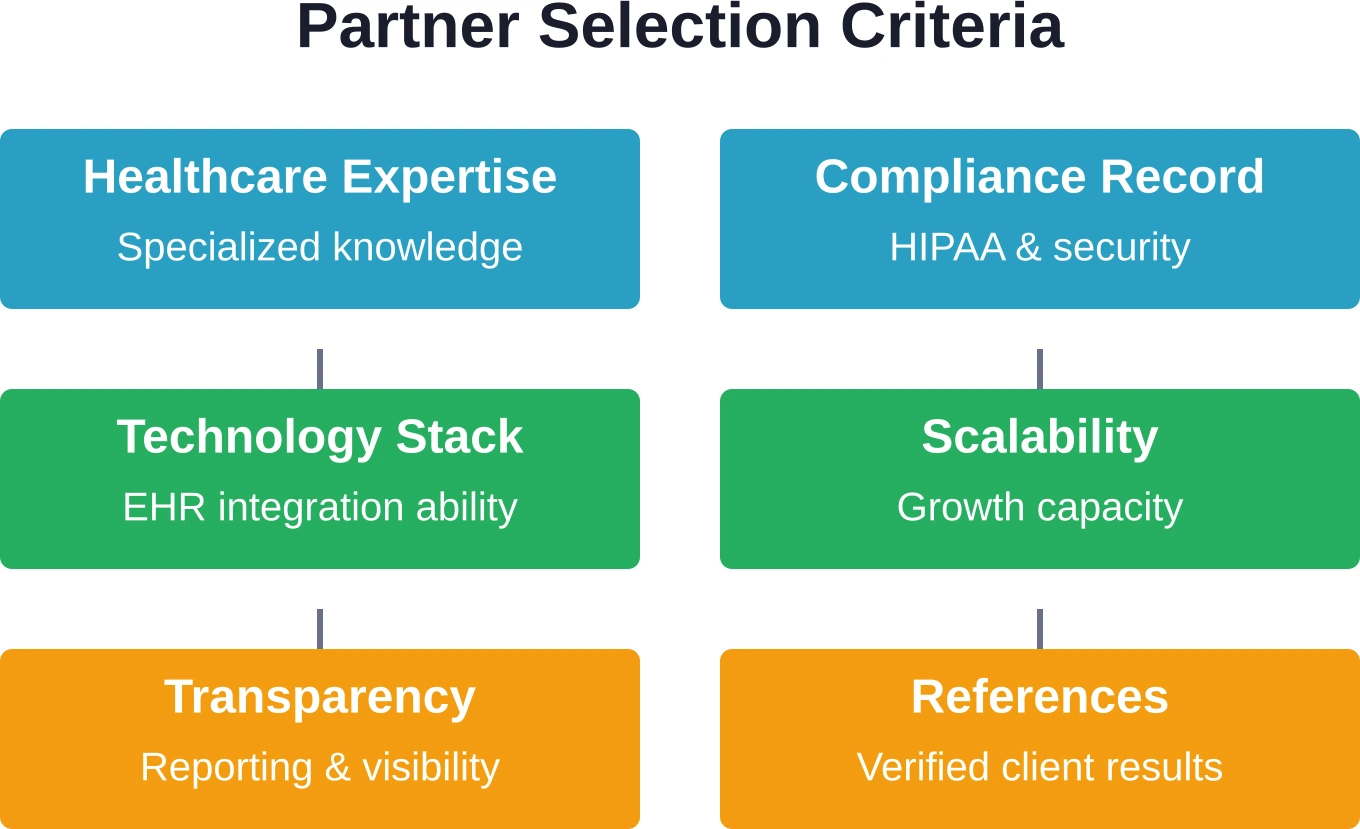
Healthcare-Specific Experience
Generic BPO providers lack the healthcare context necessary for optimal performance. Look for partners with:
- Demonstrated experience in healthcare administrative functions
- Staff certified in medical coding (CPC, CCS credentials)
- Knowledge of major EHR systems and practice management software
- Understanding of insurance verification and authorization processes
Compliance Certifications and Audits
Ask for evidence of compliance programs, not just claims of compliance. Relevant certifications include:
- HIPAA compliance documentation and training programs
- SOC 2 Type II audit reports
- ISO 27001 certification for information security
- HITRUST CSF certification (healthcare-specific security framework)
Technology and Integration Capabilities
Outsourcing partners should integrate smoothly with existing systems. Evaluate:
- EHR and practice management system integration experience
- API capabilities for data exchange
- Use of automation and AI for improved accuracy
- Cloud-based platforms with real-time access
Scalability and Flexibility
Healthcare needs change. Seasonal fluctuations, practice growth, and service expansion require scalable solutions.
Strong partners accommodate volume changes without long lead times or quality degradation. They offer flexible contract terms that allow scope adjustments as needs evolve.
Transparent Communication and Reporting
Real-time visibility into outsourced operations matters. Partners should provide:
- Regular performance reports with key metrics
- Access to dashboards showing work status and volumes
- Dedicated account management
- Clear escalation paths for urgent issues
Client References and Case Studies
Talk to current clients. Ask about:
- Actual performance versus promised service levels
- Responsiveness to issues and problems
- Quality consistency over time
- Contract flexibility and partnership approach
Implementation Best Practices
Successful outsourcing requires thoughtful implementation, not just contract signing.
Start Small and Scale Gradually
Begin with a limited scope pilot project. Test the partner's capabilities and identify process issues before full deployment.
A phased approach might start with medical billing for a single specialty or location, then expand to additional services and sites based on demonstrated success.
Document Processes Thoroughly
Outsourcing partners need comprehensive documentation of current workflows, requirements, and exceptions. The better the documentation, the smoother the transition.
Include:
- Step-by-step process documentation
- Decision trees for common scenarios
- Examples of completed work
- Contact information for subject matter experts
Invest in Training and Knowledge Transfer
Even experienced outsourcing teams need organization-specific training. Plan for:
- Orientation to organizational structure and culture
- Training on specific systems and software
- Review of payer-specific requirements
- Introduction to key internal stakeholders
Establish Clear Metrics and SLAs
Define success measurably. Service level agreements should specify:
- Accuracy rates (e.g., 98% coding accuracy)
- Turnaround times (e.g., claims submitted within 24 hours)
- Response times for inquiries
- Availability and uptime requirements
Include financial consequences for sustained SLA failures to ensure accountability.
Maintain Regular Communication
Schedule standing meetings for performance review, issue resolution, and process improvement. Weekly operational calls and monthly strategic reviews create rhythm and accountability.
The Future of Healthcare Back Office Outsourcing
Healthcare outsourcing continues evolving. Several trends are reshaping the landscape.
AI and Automation Integration
Artificial intelligence increasingly augments human expertise in back office functions. AI applications include:
- Automated coding suggestions based on clinical documentation
- Predictive analytics for claim denial risk
- Natural language processing for medical transcription
- Chatbots for patient appointment scheduling
Medicare payments for remote patient monitoring exceeded $500 million in 2024, reflecting growing technology adoption in healthcare operations.
Value-Based Care Support
As healthcare shifts from fee-for-service to value-based payment models, back office operations must adapt. Outsourcing partners increasingly offer:
- Quality measure tracking and reporting
- Risk adjustment and HCC coding expertise
- Population health data management
- Care coordination support
Increased Regulatory Complexity
CMS continues expanding regulations around surprise billing, price transparency, and payment models. The No Surprises Act implementation requires sophisticated billing and communication processes.
Outsourcing partners absorb the burden of tracking and implementing regulatory changes, reducing compliance risk for healthcare organizations.
Making the Outsourcing Decision
Healthcare back office outsourcing isn't right for every organization or every function. It works best when administrative volume justifies external expertise, internal resources are constrained or costly, specialized knowledge improves outcomes, scalability needs fluctuate, or strategic focus should shift toward core clinical services.
The healthcare landscape continues changing. Rising costs, staffing challenges, regulatory complexity, and technology advancement all push toward strategic partnerships that optimize operational efficiency.
Organizations considering outsourcing should approach the decision methodically. Assess current performance and costs. Identify specific functions creating the biggest pain points. Research potential partners with relevant healthcare experience. Start with limited pilots to validate capabilities. Scale based on demonstrated results.
Done right, healthcare back office outsourcing frees organizations to focus on their mission: delivering excellent patient care. The administrative work still happens—it just happens more efficiently, more accurately, and with less drain on internal resources.
The market growth to an estimated USD 694.3 billion by 2030 reflects healthcare's collective recognition that specialized partners can handle back office operations better than generalist in-house teams.
For healthcare organizations struggling with administrative burden, the question isn't whether outsourcing could help. It's which functions to outsource first and which partner can best deliver the promised benefits.
Start with clear objectives, thorough vetting, and measured implementation. The result should be improved operational efficiency, better financial performance, and more internal capacity focused on what matters most—patient outcomes.
Frequently Asked Questions
Topics
Healthcare Back Office Outsourcing Guide 2026

Quick Summary: Healthcare back office outsourcing involves delegating administrative tasks like medical billing, claims processing, data entry, and patient scheduling to specialized third-party providers. This guide covers what qualifies as back office work, the benefits of outsourcing (cost savings, improved accuracy, compliance), key services to outsource, and how to choose the right partner while managing risks.
Running a healthcare organization today means juggling patient care with an avalanche of administrative work. Medical billing, insurance claims, data entry, appointment scheduling—these tasks consume resources but don't directly improve patient outcomes.
That's where healthcare back office outsourcing comes in. By delegating administrative functions to specialized providers, healthcare organizations free up internal teams to focus on what matters most: delivering quality patient care.
But outsourcing isn't just about offloading work. The healthcare BPO market was projected to reach USD 417.7 billion in 2025 and grow to USD 694.3 billion by 2030, reflecting a compound annual growth rate of 10.7%. These numbers tell a story about an industry shift toward strategic partnerships that improve efficiency, reduce costs, and maintain compliance.
What Is Healthcare Back Office Outsourcing?
Healthcare back office outsourcing means contracting with third-party providers to handle administrative and operational tasks that support clinical operations but don't involve direct patient care.
These functions typically include:
- Medical billing and coding
- Insurance claims processing and management
- Revenue cycle management
- Data entry and management
- Patient appointment scheduling
- Accounts payable and receivable
- Medical transcription
The distinction between front office and back office matters. Front office functions involve direct patient interaction—reception, initial consultations, customer service. Back office operations work behind the scenes, processing information, managing finances, and ensuring regulatory compliance.
According to the U.S. Department of Health and Human Services Office of Inspector General, state Medicaid agencies have engaged in offshore outsourcing of administrative functions, highlighting how government healthcare programs also leverage external partners for operational efficiency.
Why Healthcare Organizations Outsource Back Office Functions
Healthcare providers face mounting pressure from multiple directions. Rising operational costs, staffing shortages, increasingly complex regulations, and the constant demand for better patient outcomes create a perfect storm.
Outsourcing offers a strategic response to these challenges.
Cost Reduction
Financial pressure hits healthcare organizations hard. Outsourcing can reduce operational costs by up to 30%, according to industry analyses. That's not just marginal savings—that's budget room that can be redirected toward patient care, technology upgrades, or staff development.
Consider the economics. Hiring, training, and retaining in-house staff for specialized administrative roles requires substantial investment. Benefits, office space, equipment, ongoing training—it adds up fast.
Third-party providers spread these costs across multiple clients. They've already invested in infrastructure, training programs, and specialized software. Healthcare organizations pay for services rendered without shouldering the full burden of employment overhead.
Improved Accuracy and Efficiency
Administrative errors cost money. According to data from the American Health Information Management Association, over one-third of hospital executives report claim denial rates nearing 10%. The average denial rework cost per claim reaches approximately $25 for practices and $181 for hospitals.
Specialized outsourcing partners bring expertise. Their staff focus exclusively on specific administrative functions—medical billing, claims processing, coding. This specialization drives accuracy rates that generalist in-house teams struggle to match.
Some healthcare BPO providers achieve approximately 95% coding accuracy with AI-enabled coding and claims management systems. That level of precision directly impacts revenue cycle performance and reduces the costly rework associated with claim denials.
Focus on Core Competencies
Healthcare professionals trained to deliver patient care shouldn't spend their days wrestling with billing software or insurance paperwork. Yet many do.
When administrative tasks consume clinical staff time, patient care quality suffers. Outsourcing administrative functions lets healthcare organizations reallocate internal resources toward clinical excellence, patient experience improvements, and strategic initiatives.
Regulatory Compliance
Healthcare operates in one of the most heavily regulated industries. HIPAA requirements for patient data protection, Medicare and Medicaid billing standards, insurance claim regulations—the compliance landscape constantly evolves.
Centers for Medicare & Medicaid Services (CMS) has adopted standards under HIPAA for electronic transactions, including health plan eligibility benefit inquiry and response. Staying current with these standards requires dedicated attention.
Reputable outsourcing partners maintain compliance as a core competency. They invest in training, security infrastructure, and process updates to meet regulatory requirements. This transfers compliance risk and reduces the burden on internal teams to track every regulatory change.
Support Healthcare Back-Office Operations With NeoWork
Healthcare organizations often manage large volumes of administrative work behind the scenes. NeoWork provides staffing and operational support that can help teams handle routine processes and keep operations running smoothly.
Need Additional Healthcare Back-Office Support?
NeoWork can help with:
- administrative workflows
- records management
- data processing
- operational support tasks
👉 Contact NeoWork to discuss your healthcare support needs.
Key Healthcare Back Office Services to Outsource
Not all back office functions make equal candidates for outsourcing. Some deliver clearer benefits than others. Here's what healthcare organizations commonly outsource and why.
Medical Billing and Coding
Medical billing converts healthcare services into billable claims. Medical coding translates diagnoses, procedures, and services into standardized codes (ICD-10, CPT, HCPSC).
Both require specialized knowledge. Coding errors lead to claim denials, payment delays, and potential compliance issues. Billing mistakes create revenue gaps.
Outsourcing these functions to certified specialists reduces errors and speeds up payment cycles. Providers with expertise in specific medical specialties or payer requirements deliver even better results.
Claims Processing and Management
Insurance claims represent a significant administrative burden. Each claim requires verification, accurate documentation, submission to payers, tracking, and follow-up on denials or partial payments.
The HHS Office of Inspector General found that unclear Medicare requirements led to differing interpretations of inpatient rehabilitation facility documentation, coverage, and billing requirements—illustrating how complex claims management can become.
Outsourced claims management teams handle verification, submission, denial management, and appeals. Their experience with various insurance carriers and payer requirements translates to faster processing and higher approval rates.
Revenue Cycle Management
Revenue cycle management encompasses the entire financial process—from patient registration and insurance verification through final payment collection.
According to research published in the journal of the American Health Information Management Association, unresolved claims denials represent an average annual loss of $5 million for hospitals, representing up to 5 percent of net patient revenue.
Comprehensive revenue cycle outsourcing addresses this through integrated services: eligibility verification, prior authorization, claims submission, payment posting, denial management, patient billing, and collections.
Patient Appointment Scheduling
Appointment scheduling seems straightforward until it isn't. No-shows, last-minute cancellations, double bookings, and coordination across multiple providers create scheduling complexity.
Outsourced scheduling teams handle appointment booking, reminders, rescheduling, and cancellation management. They often work extended hours, providing scheduling access beyond standard office hours.
Data Entry and Medical Records Management
Healthcare generates massive volumes of data. Patient records, test results, insurance information, treatment notes—all need accurate entry and organization.
Data entry outsourcing handles high-volume information processing while maintaining accuracy. This includes updating electronic health records (EHR), scanning and digitizing paper records, and data migration during system transitions.
Medical Transcription
Converting physician voice recordings into written medical reports requires speed and accuracy. Outsourced transcription services provide trained medical transcriptionists familiar with medical terminology, anatomy, and clinical documentation standards.
The Financial Impact: What the Numbers Show
Healthcare outsourcing delivers measurable financial benefits beyond simple cost reduction.
These aren't just abstract numbers. They represent real budget pressure that outsourcing helps alleviate.
CMS identified that Medicare potentially overpaid Medicare Advantage Organizations $462 million based on certain unsupported acute stroke diagnosis codes. Proper coding and documentation—areas where specialized outsourcing partners excel—directly impact payment accuracy.
Navigating Outsourcing Risks and Challenges
Outsourcing isn't risk-free. Healthcare organizations need clear-eyed assessment of potential challenges.
Data Security and HIPAA Compliance
Patient health information represents sensitive data. HIPAA regulations impose strict requirements for data protection, access controls, and breach notification.
Outsourcing partners become business associates under HIPAA, creating shared liability. Healthcare organizations must conduct thorough due diligence on partner security practices, including:
- Data encryption (in transit and at rest)
- Access controls and authentication
- Employee training and background checks
- Incident response procedures
- Regular security audits
The U.S. Department of Health and Human Services Office of Inspector General provides compliance resources and guidance that healthcare providers should reference when evaluating outsourcing partners.
Quality Control and Oversight
Delegating work doesn't mean surrendering accountability. Healthcare organizations remain responsible for the quality of outsourced services.
Effective oversight requires:
- Clear service level agreements (SLAs) with measurable performance metrics
- Regular quality audits and review processes
- Defined escalation procedures for issues
- Ongoing communication and feedback loops
Communication and Cultural Considerations
When outsourcing offshore, language proficiency and cultural alignment matter. The Philippines has become a major healthcare BPO destination, with over 1.2 million employees working in the BPO sector, a 97% literacy rate, and hundreds of thousands of university graduates annually with profound English-speaking skills.
But language proficiency isn't everything. Understanding American healthcare systems, insurance processes, and patient communication norms requires training and experience.
Loss of Direct Control
Outsourcing means relying on external teams for critical functions. Some healthcare administrators struggle with this transition.
Mitigation strategies include:
- Starting with non-critical functions to build trust
- Maintaining hybrid models with some in-house capability
- Choosing partners with transparent reporting and real-time dashboards
- Building strong relationships with outsourcing partner leadership
How to Choose the Right Healthcare Outsourcing Partner
Partner selection makes or breaks outsourcing success. Here's what matters most.
Healthcare-Specific Experience
Generic BPO providers lack the healthcare context necessary for optimal performance. Look for partners with:
- Demonstrated experience in healthcare administrative functions
- Staff certified in medical coding (CPC, CCS credentials)
- Knowledge of major EHR systems and practice management software
- Understanding of insurance verification and authorization processes
Compliance Certifications and Audits
Ask for evidence of compliance programs, not just claims of compliance. Relevant certifications include:
- HIPAA compliance documentation and training programs
- SOC 2 Type II audit reports
- ISO 27001 certification for information security
- HITRUST CSF certification (healthcare-specific security framework)
Technology and Integration Capabilities
Outsourcing partners should integrate smoothly with existing systems. Evaluate:
- EHR and practice management system integration experience
- API capabilities for data exchange
- Use of automation and AI for improved accuracy
- Cloud-based platforms with real-time access
Scalability and Flexibility
Healthcare needs change. Seasonal fluctuations, practice growth, and service expansion require scalable solutions.
Strong partners accommodate volume changes without long lead times or quality degradation. They offer flexible contract terms that allow scope adjustments as needs evolve.
Transparent Communication and Reporting
Real-time visibility into outsourced operations matters. Partners should provide:
- Regular performance reports with key metrics
- Access to dashboards showing work status and volumes
- Dedicated account management
- Clear escalation paths for urgent issues
Client References and Case Studies
Talk to current clients. Ask about:
- Actual performance versus promised service levels
- Responsiveness to issues and problems
- Quality consistency over time
- Contract flexibility and partnership approach
Implementation Best Practices
Successful outsourcing requires thoughtful implementation, not just contract signing.
Start Small and Scale Gradually
Begin with a limited scope pilot project. Test the partner's capabilities and identify process issues before full deployment.
A phased approach might start with medical billing for a single specialty or location, then expand to additional services and sites based on demonstrated success.
Document Processes Thoroughly
Outsourcing partners need comprehensive documentation of current workflows, requirements, and exceptions. The better the documentation, the smoother the transition.
Include:
- Step-by-step process documentation
- Decision trees for common scenarios
- Examples of completed work
- Contact information for subject matter experts
Invest in Training and Knowledge Transfer
Even experienced outsourcing teams need organization-specific training. Plan for:
- Orientation to organizational structure and culture
- Training on specific systems and software
- Review of payer-specific requirements
- Introduction to key internal stakeholders
Establish Clear Metrics and SLAs
Define success measurably. Service level agreements should specify:
- Accuracy rates (e.g., 98% coding accuracy)
- Turnaround times (e.g., claims submitted within 24 hours)
- Response times for inquiries
- Availability and uptime requirements
Include financial consequences for sustained SLA failures to ensure accountability.
Maintain Regular Communication
Schedule standing meetings for performance review, issue resolution, and process improvement. Weekly operational calls and monthly strategic reviews create rhythm and accountability.
The Future of Healthcare Back Office Outsourcing
Healthcare outsourcing continues evolving. Several trends are reshaping the landscape.
AI and Automation Integration
Artificial intelligence increasingly augments human expertise in back office functions. AI applications include:
- Automated coding suggestions based on clinical documentation
- Predictive analytics for claim denial risk
- Natural language processing for medical transcription
- Chatbots for patient appointment scheduling
Medicare payments for remote patient monitoring exceeded $500 million in 2024, reflecting growing technology adoption in healthcare operations.
Value-Based Care Support
As healthcare shifts from fee-for-service to value-based payment models, back office operations must adapt. Outsourcing partners increasingly offer:
- Quality measure tracking and reporting
- Risk adjustment and HCC coding expertise
- Population health data management
- Care coordination support
Increased Regulatory Complexity
CMS continues expanding regulations around surprise billing, price transparency, and payment models. The No Surprises Act implementation requires sophisticated billing and communication processes.
Outsourcing partners absorb the burden of tracking and implementing regulatory changes, reducing compliance risk for healthcare organizations.
Making the Outsourcing Decision
Healthcare back office outsourcing isn't right for every organization or every function. It works best when administrative volume justifies external expertise, internal resources are constrained or costly, specialized knowledge improves outcomes, scalability needs fluctuate, or strategic focus should shift toward core clinical services.
The healthcare landscape continues changing. Rising costs, staffing challenges, regulatory complexity, and technology advancement all push toward strategic partnerships that optimize operational efficiency.
Organizations considering outsourcing should approach the decision methodically. Assess current performance and costs. Identify specific functions creating the biggest pain points. Research potential partners with relevant healthcare experience. Start with limited pilots to validate capabilities. Scale based on demonstrated results.
Done right, healthcare back office outsourcing frees organizations to focus on their mission: delivering excellent patient care. The administrative work still happens—it just happens more efficiently, more accurately, and with less drain on internal resources.
The market growth to an estimated USD 694.3 billion by 2030 reflects healthcare's collective recognition that specialized partners can handle back office operations better than generalist in-house teams.
For healthcare organizations struggling with administrative burden, the question isn't whether outsourcing could help. It's which functions to outsource first and which partner can best deliver the promised benefits.
Start with clear objectives, thorough vetting, and measured implementation. The result should be improved operational efficiency, better financial performance, and more internal capacity focused on what matters most—patient outcomes.
Frequently Asked Questions
Topics
Related Blogs
Related Podcasts


.webp)
.webp)



