

.avif)
.avif)

Healthcare Claims Processing Outsourcing Guide 2026


.svg)

Quick Summary: Healthcare claims processing outsourcing transfers billing, coding, and adjudication tasks to specialized third-party vendors, delivering 25–30% cost reductions and up to 40% fewer claim denials. Organizations gain access to certified coders, automated workflows, and compliance expertise while freeing internal staff to focus on patient care. Successful outsourcing requires clear vendor selection criteria, secure data handling protocols, and measurable performance benchmarks.
Healthcare providers face mounting pressure from every direction. Coding standards shift annually. Payer rules multiply. Staff shortages persist. And revenue cycles stretch longer.
Meanwhile, administrative costs consume resources that could support patient care. Claims denials pile up. Cash flow slows.
That's why industry data shows 80% of healthcare leaders are planning to outsource billing and revenue cycle management functions in the coming years. The math is compelling: practices that move claims processing to specialized partners see 25–30% lower operational costs and 40% fewer denials.
But outsourcing isn't plug-and-play. Picking the wrong vendor creates new problems—security gaps, compliance failures, communication breakdowns. This guide walks through everything healthcare organizations need to evaluate, select, and manage claims processing partners successfully.
What Is Healthcare Claims Processing Outsourcing?
Healthcare claims processing outsourcing means transferring some or all billing, coding, adjudication, and collections functions to a specialized external vendor. The partner handles tasks from patient intake and charge capture through claim submission, denial management, and payment posting.
Outsourced services typically cover:
- Medical coding: Certified coders translate diagnoses and procedures into ICD-10, CPT, and HCPCS codes
- Claim preparation: Building clean claims with accurate patient demographics, insurance information, and clinical documentation
- Submission and tracking: Filing claims electronically to payers and monitoring status through adjudication
- Denial management: Identifying rejection reasons, correcting errors, and resubmitting claims with supporting documentation
- Payment posting: Recording payments, applying adjustments, and reconciling accounts
- Patient billing: Generating statements, managing payment plans, and handling inquiries
The Centers for Medicare & Medicaid Services processes billions in claims annually through systems like the Inpatient Prospective Payment System and Hospital Value-Based Purchasing Program. These programs tie reimbursement to quality metrics and accurate coding—raising the stakes for clean claims.
The Business Case Behind Outsourcing
Studies show that practices can reduce billing costs by up to 30% through outsourcing. Here's why those savings materialize:
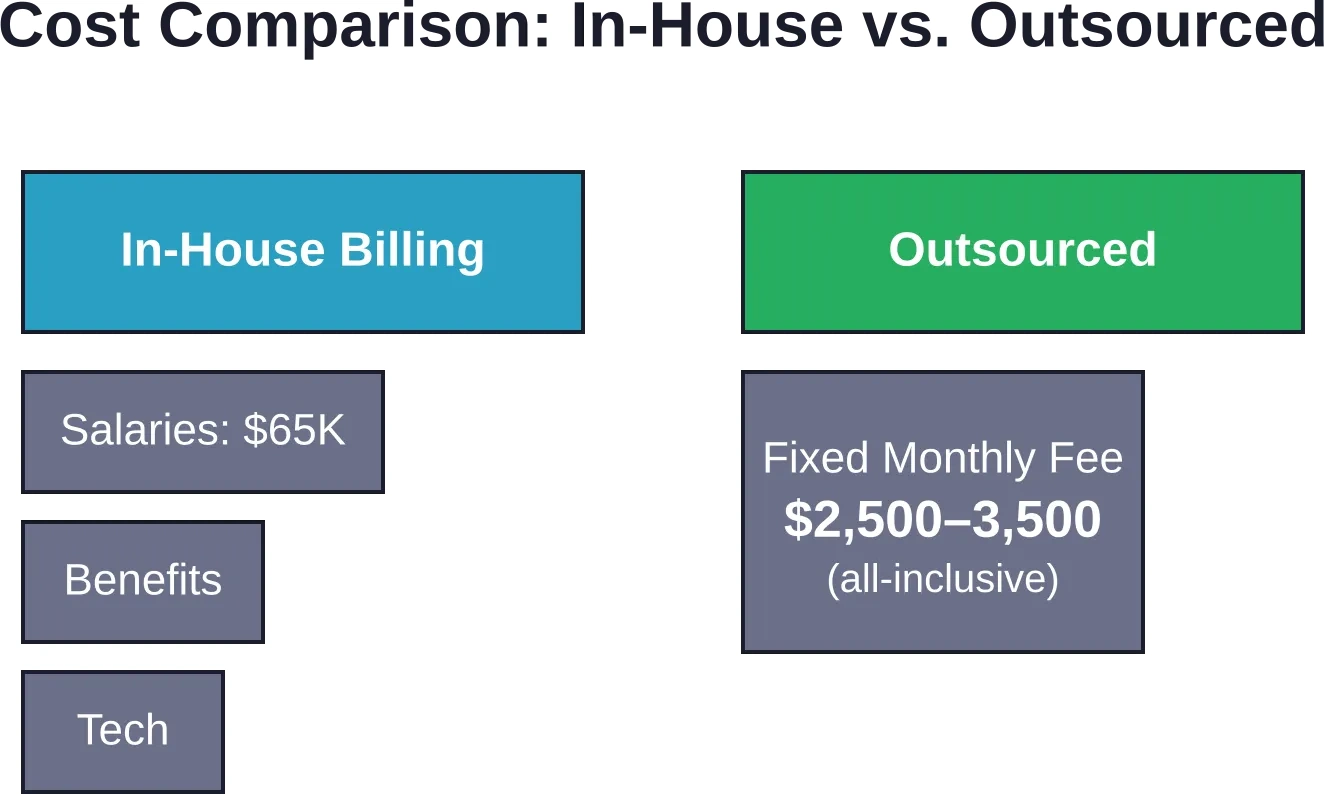
- Labor arbitrage: Vendors employ coders and billing specialists in markets with lower wage structures. A certified coder earning $65,000 annually in-house costs approximately $5,400 monthly ($65,000 ÷ 12). An outsourced equivalent runs $2,500–3,500.
- Scale efficiencies: Vendors spread technology investments, training programs, and compliance infrastructure across dozens of clients. A single practice can't match that unit cost.
- Reduced overhead: No recruitment, benefits, office space, or equipment for billing staff. Fixed monthly fees replace variable personnel expenses.
Research indicates healthcare organizations outsourcing billing see a 20% increase in patient satisfaction. Why? Front-desk staff spend less time wrestling with claims and more time addressing patient questions.
Why Healthcare Providers Outsource Claims Processing
The decision to outsource stems from converging pressures across financial, operational, and regulatory dimensions.
Staffing Shortages and Turnover
Certified medical coders are scarce. The American Academy of Professional Coders estimates demand outpaces supply in most metro markets. When a billing specialist leaves, practices face 8–12 weeks to recruit and onboard a replacement. During that gap, claims pile up and revenue stalls.
Outsourcing transfers that risk. Vendors maintain bench staff and cross-train teams across multiple specialties. If one coder departs, another steps in immediately.
Compliance Complexity
CMS updates payment rules constantly. The Inpatient Prospective Payment System saw proposed revisions for fiscal year 2027, with comment deadlines in June. ICD-10 code sets expand every October. Payers introduce new prior authorization requirements quarterly.
Staying current demands continuous education. Vendors invest in compliance teams, monitor regulatory changes, and push updates to coding staff. Practices gain enterprise-grade compliance infrastructure without building it internally.
Technology Investment
Modern claims processing requires practice management systems, clearinghouses, denial tracking software, and analytics platforms. Licensing and maintaining those tools costs $15,000–50,000 annually for mid-size practices.
Outsourcing partners absorb those costs. They deploy AI-powered coding assistants, automated claim scrubbing, and real-time eligibility verification across their client base.
Cash Flow Acceleration
Industry data shows practices can reduce claim denials by 40% or more through professional billing services. Expert coders understand payer-specific requirements and apply clean-claim discipline. Fewer denials mean faster payment.
Some clients report a 25% improvement in cash flow within months of transitioning to outsourced billing. Clean claims adjudicate in 14–21 days versus 30–45 days for reworked submissions.
Core Components of Outsourced Claims Processing
Effective outsourcing covers the full revenue cycle, not just isolated tasks. Here's what comprehensive services include.
Patient Registration and Insurance Verification
Before any service, vendors verify coverage, check eligibility, and confirm benefits. Real-time checks prevent services from proceeding without authorization.
Charge Capture and Coding
Certified coders review clinical documentation—encounter notes, lab results, procedure reports—and assign diagnosis and procedure codes. They flag incomplete documentation that could trigger denials.
Advanced vendors use AI to suggest codes and cross-check against payer policies. One provider reduced data entry labor by 70% and achieved 98% document classification accuracy using machine learning.
Claim Submission
Vendors scrub claims through automated edits before submission. They check for common errors: missing modifiers, invalid code combinations, incorrect patient demographics.
Electronic submission goes to clearinghouses that route claims to hundreds of payers. Vendors track acknowledgments and rejections in real time.
Denial Management and Appeals
When payers deny claims, vendors analyze denial codes, determine root causes, and initiate appeals. They compile supporting documentation—medical records, peer-reviewed literature, payer policy excerpts—and submit reconsiderations within deadlines.
Sophisticated partners maintain denial databases to identify patterns. If a payer consistently rejects a specific code combination, they proactively adjust future claims.
Payment Posting and Reconciliation
As payments arrive—via electronic remittance or paper checks—vendors post them to patient accounts. They apply contractual adjustments, reconcile underpayments, and flag discrepancies.
Patient Billing and Collections
For balances not covered by insurance, vendors generate patient statements, manage payment plans, and handle inquiries. Some offer online portals where patients view balances and pay electronically.
Cost Structures and Pricing Models
Understanding how vendors charge helps practices budget accurately and compare proposals.
Percentage of Collections
The most common approach charges a percentage of collected revenue, typically ranging from 4% to 10% depending on specialty and claim volume. High-volume primary care might pay 4–6%. Low-volume surgical subspecialties with complex coding often pay 8–10%.
- Pros: Risk-sharing—vendors earn more only when collections increase. No upfront investment.
- Cons: Less predictable month-to-month. Harder to compare vendors if fee percentages differ slightly.
Per-Claim Flat Fee
Vendors charge $3–8 per claim submitted. Simpler specialties pay less; complex claims cost more.
- Pros: Predictable if claim volume is stable. Easy budgeting.
- Cons: Doesn't align vendor incentives with clean-claim discipline. Vendor gets paid even if the claim is denied.
Hybrid Models
Some vendors combine a small percentage (2–3%) with a per-claim fee ($2–4). This balances predictability with performance alignment.
Full-Time Equivalent (FTE) Pricing
For large health systems, vendors offer dedicated staff at a fixed monthly rate per FTE. A billing specialist FTE might cost $3,500–5,000 monthly, depending on experience and location.
Selecting the Right Outsourcing Partner
Not all vendors deliver equal value. Here's how to evaluate candidates rigorously.
Certification and Expertise
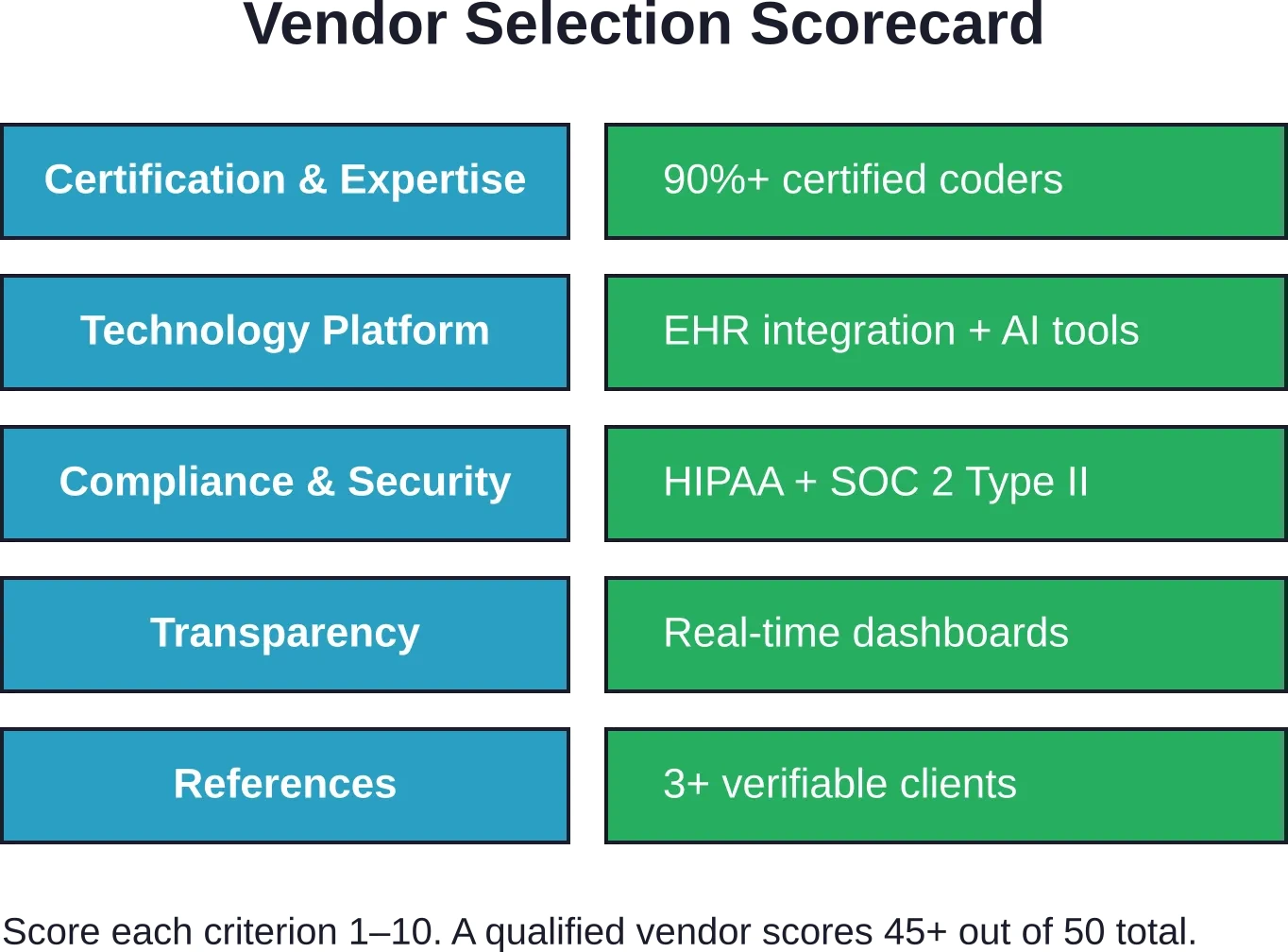
Verify whether coders hold credentials from recognized bodies—Certified Professional Coder (CPC), Certified Coding Specialist (CCS), or equivalent. Ask what percentage of staff are certified and how often they complete continuing education.
Specialty expertise matters. A vendor fluent in orthopedic coding may struggle with behavioral health. Request references from practices in your specialty.
Technology Platform
Tour the vendor's software stack. Look for:
- Integration with your EHR (Epic, Cerner, Athenahealth, etc.)
- Real-time claim status dashboards
- Automated denial tracking and root-cause analytics
- Patient payment portals
- Reporting tools for key metrics (days in A/R, clean claim rate, denial rate)
Ask whether the platform uses AI for coding assistance or claim scrubbing. Advanced vendors deploy machine learning to flag errors before submission.
Compliance and Security
Outsourcing involves transmitting protected health information (PHI). Verify the vendor is HIPAA-compliant. Request:
- Business Associate Agreement (BAA) templates
- SOC 2 Type II audit reports
- Evidence of annual security training for staff
- Encryption protocols for data in transit and at rest
- Disaster recovery and business continuity plans
The HHS Office of Inspector General tracks improper billing. On July 9, 2025, 1st Choice Healthcare agreed to pay $31,263.26 for allegedly submitting false claims for Chronic Care Management minutes not provided. Confirm your vendor maintains audit trails and compliance checks to avoid similar penalties.
Transparency and Reporting
Vendors should provide weekly or monthly reports covering:
- Claims submitted, paid, denied
- Average days in accounts receivable
- Clean claim rate (percentage accepted on first submission)
- Denial reasons and appeal outcomes
- Collections by payer
Insist on access to raw data, not just summary dashboards. You need granular visibility to audit vendor performance.
References and Track Record
Ask for three references from clients of similar size and specialty. During calls, probe:
- How long have they used the vendor?
- What metrics improved after outsourcing?
- How does the vendor handle disputes or errors?
- Would they choose the same vendor again?
Check online reviews and industry forums, but weigh direct references more heavily.
Improve Healthcare Claims Processing with NeoWork

Healthcare claims processing can become difficult to manage when teams are handling billing, insurance coordination, coding-related documentation, reimbursements, denials, and patient account communication at the same time. NeoWork provides medical claims administrators and medical claims specialists who support healthcare revenue cycle workflows. The company reports a 91% annualized teammate retention rate and a 3.2% candidate selectivity rate, which is important for claims work that depends on accuracy, compliance awareness, and stable process knowledge.
Healthcare claims tasks NeoWork can support:
- medical claims administration
- patient billing and reimbursement
- insurance coordination and denial follow-ups
- documentation and account reconciliation
👉Contact NeoWork to build healthcare claims processing support that reduces administrative pressure, keeps billing workflows organized, and gives internal teams more time for patient-facing work.
Implementation and Transition Best Practices
A smooth transition minimizes revenue disruption. Plan for 60–90 days from contract signing to full handoff.
Phase 1: Data Migration and Integration (Weeks 1–4)
The vendor imports historical patient data, payer contracts, and fee schedules. IT teams configure API connections between your EHR and the vendor's platform.
Test integrations with sample claims before going live. Verify patient demographics, insurance details, and clinical codes flow accurately.
Phase 2: Parallel Processing (Weeks 5–8)
Run in-house and outsourced billing simultaneously. Compare outcomes—claim acceptance rates, payment timelines, denial patterns. This validates the vendor's work without risking revenue.
Hold weekly check-ins to address discrepancies quickly.
Phase 3: Full Transition (Weeks 9–12)
Shift all new claims to the vendor. In-house staff resolve remaining legacy claims and transition to supporting roles—prior authorizations, patient communication, credentialing.
Monitor KPIs daily for the first month. Watch for:
- Spikes in denials (may indicate coding errors or payer setup issues)
- Drops in submission volume (could signal data-flow bottlenecks)
- Increases in days in A/R (might reflect payment posting delays)
Ongoing Management
Schedule monthly business reviews with the vendor. Review performance against SLAs, discuss denial trends, and plan process improvements.
Audit a random sample of claims quarterly. Verify coding accuracy and compliance with documentation standards.
Measuring Success: Key Performance Indicators
Define success metrics upfront and track them monthly. Here are the benchmarks that matter.
If any metric falls outside the target range for two consecutive months, escalate to vendor leadership and demand a corrective action plan.
Compliance Considerations in 2026
Healthcare regulations evolve constantly. Outsourcing partners must keep pace.
Medicare and Medicaid Updates
CMS issued the fiscal year 2027 Hospital Inpatient Prospective Payment System and Long-Term Care Hospital Prospective Payment System proposed rules in early 2026. These updates affect payment rates, quality measures, and documentation requirements.
According to an HHS Office of Inspector General report from August 2025, Medicare payments for remote patient monitoring exceeded $500 million in 2024. Billing for these services requires strict adherence to time thresholds and documentation standards. Vendors must train coders on specialty programs as they emerge.
HIPAA and Data Privacy
Every vendor handling PHI is a business associate under HIPAA. That means they must:
- Implement administrative, physical, and technical safeguards
- Report breaches within 60 days
- Allow audits of their security practices
- Limit PHI access to minimum-necessary personnel
Confirm the vendor conducts annual HIPAA training and maintains logs of PHI access.
Fraud and Abuse Risks
The OIG tracks improper billing aggressively. Medicaid agencies made millions in unallowable capitation payments to managed care organizations on behalf of deceased enrollees, per an OIG report (A-04-23-09010) released December 23, 2025. Illinois made unallowable managed care capitation payments on behalf of incarcerated Medicaid enrollees (OIG report A-05-24-00019, December 22, 2025).
Your vendor's coding must be defensible. Request evidence of pre-billing audits and compliance checks. If a payer audit lands on your practice, the vendor should provide documentation and support appeals.
Pros and Cons of Healthcare Claims Processing Outsourcing
No solution is perfect. Here's an honest assessment.
Advantages
- Cost reduction: 25–30% savings on operational costs
- Faster cash flow: 25% improvement in some cases
- Lower denials: 40% reduction with expert coding
- Scalability: Vendors adjust capacity as patient volume fluctuates
- Access to technology: AI tools and analytics platforms included
- Compliance support: Dedicated teams monitor regulatory changes
Disadvantages
- Loss of control: Billing processes happen offsite; less direct oversight
- Data security risks: Transmitting PHI to third parties introduces breach potential
- Communication challenges: Time zones, language barriers, or ticket-based support can slow issue resolution
- Vendor dependency: Switching vendors mid-year disrupts revenue
- Cultural fit: Offshore teams may lack familiarity with U.S. payer nuances
Weigh these factors against your practice's priorities. Smaller practices with limited IT resources often find the advantages outweigh risks. Larger systems with existing billing infrastructure may prefer hybrid models.
Real-World Case Studies
Mid-Size Cardiology Practice
A 12-provider cardiology group in Florida struggled with 28% denial rates and 52 days in A/R. Staff turnover left coding backlogged.
They engaged a vendor specializing in cardiology. Within six months:
- Denial rate dropped to 8%
- Days in A/R fell to 34
- Cash flow increased 22%
- Administrative costs declined 27%
The practice reinvested savings into a patient education program and expanded office hours.
Multi-Specialty Health System
A 200-provider system across five locations faced inconsistent coding quality and compliance gaps. They transitioned to a hybrid model: outsourced coding for low-complexity claims, in-house for complex surgical cases.
Outcomes after 12 months:
- Clean claim rate rose from 89% to 96%
- Cost to collect dropped from 7.2% to 4.8%
- Compliance audit findings reduced by 60%
The hybrid approach preserved in-house expertise for high-stakes claims while offloading routine volume.
Future Trends in Healthcare Claims Outsourcing
Industry shifts will reshape outsourcing over the next five years.
AI and Automation Expansion
Machine learning already flags coding errors and predicts denial risk. Next-generation tools will autonomously correct claims before submission. Vendors investing in AI will deliver faster turnaround and higher accuracy.
Value-Based Care Integration
As payers shift from fee-for-service to value-based models, claims processing must track quality metrics, not just charges. The Hospital Value-Based Purchasing Program ties Medicare payments to performance scores.
Outsourcing partners will expand analytics to monitor patient outcomes, readmission rates, and care gaps alongside traditional billing metrics.
Blockchain for Claims Transparency
Some vendors are piloting blockchain ledgers to create immutable audit trails for claims. This could reduce disputes and accelerate adjudication.
Nearshore and Onshore Growth
Concerns about offshore communication and cultural fit are driving demand for U.S.-based or nearshore (Mexico, Central America) vendors. Expect pricing to rise slightly but with tighter integration.
Taking the Next Step
Healthcare claims processing outsourcing isn't a one-size-fits-all decision. It works brilliantly for practices drowning in administrative overhead or bleeding revenue to denials. It's less compelling for organizations with efficient in-house teams and robust technology.
Start by auditing your current performance. Calculate your denial rate, days in A/R, and cost to collect. If any metric falls short of benchmarks—5% denials, 35 days in A/R, 5% cost to collect—outsourcing deserves serious consideration.
Next, define your requirements. What functions do you want to outsource? What compliance standards must the vendor meet? What reporting do you need?
Then request proposals from three to five vendors. Evaluate them against the scorecard criteria outlined earlier. Check references rigorously. Don't rush—a bad vendor choice creates headaches that outweigh any cost savings.
Finally, pilot with a limited scope if possible. Outsource one location or one specialty for 90 days. Measure results. If performance meets expectations, expand.
The healthcare landscape keeps shifting. Regulations tighten. Payer rules multiply. Staffing challenges persist. Outsourcing won't solve every problem, but for practices that choose the right partner and manage the relationship actively, it delivers measurable financial gains and frees clinical teams to focus on what matters most: patient care.
Frequently Asked Questions
Topics
Healthcare Claims Processing Outsourcing Guide 2026

Quick Summary: Healthcare claims processing outsourcing transfers billing, coding, and adjudication tasks to specialized third-party vendors, delivering 25–30% cost reductions and up to 40% fewer claim denials. Organizations gain access to certified coders, automated workflows, and compliance expertise while freeing internal staff to focus on patient care. Successful outsourcing requires clear vendor selection criteria, secure data handling protocols, and measurable performance benchmarks.
Healthcare providers face mounting pressure from every direction. Coding standards shift annually. Payer rules multiply. Staff shortages persist. And revenue cycles stretch longer.
Meanwhile, administrative costs consume resources that could support patient care. Claims denials pile up. Cash flow slows.
That's why industry data shows 80% of healthcare leaders are planning to outsource billing and revenue cycle management functions in the coming years. The math is compelling: practices that move claims processing to specialized partners see 25–30% lower operational costs and 40% fewer denials.
But outsourcing isn't plug-and-play. Picking the wrong vendor creates new problems—security gaps, compliance failures, communication breakdowns. This guide walks through everything healthcare organizations need to evaluate, select, and manage claims processing partners successfully.
What Is Healthcare Claims Processing Outsourcing?
Healthcare claims processing outsourcing means transferring some or all billing, coding, adjudication, and collections functions to a specialized external vendor. The partner handles tasks from patient intake and charge capture through claim submission, denial management, and payment posting.
Outsourced services typically cover:
- Medical coding: Certified coders translate diagnoses and procedures into ICD-10, CPT, and HCPCS codes
- Claim preparation: Building clean claims with accurate patient demographics, insurance information, and clinical documentation
- Submission and tracking: Filing claims electronically to payers and monitoring status through adjudication
- Denial management: Identifying rejection reasons, correcting errors, and resubmitting claims with supporting documentation
- Payment posting: Recording payments, applying adjustments, and reconciling accounts
- Patient billing: Generating statements, managing payment plans, and handling inquiries
The Centers for Medicare & Medicaid Services processes billions in claims annually through systems like the Inpatient Prospective Payment System and Hospital Value-Based Purchasing Program. These programs tie reimbursement to quality metrics and accurate coding—raising the stakes for clean claims.
The Business Case Behind Outsourcing
Studies show that practices can reduce billing costs by up to 30% through outsourcing. Here's why those savings materialize:
- Labor arbitrage: Vendors employ coders and billing specialists in markets with lower wage structures. A certified coder earning $65,000 annually in-house costs approximately $5,400 monthly ($65,000 ÷ 12). An outsourced equivalent runs $2,500–3,500.
- Scale efficiencies: Vendors spread technology investments, training programs, and compliance infrastructure across dozens of clients. A single practice can't match that unit cost.
- Reduced overhead: No recruitment, benefits, office space, or equipment for billing staff. Fixed monthly fees replace variable personnel expenses.
Research indicates healthcare organizations outsourcing billing see a 20% increase in patient satisfaction. Why? Front-desk staff spend less time wrestling with claims and more time addressing patient questions.
Why Healthcare Providers Outsource Claims Processing
The decision to outsource stems from converging pressures across financial, operational, and regulatory dimensions.
Staffing Shortages and Turnover
Certified medical coders are scarce. The American Academy of Professional Coders estimates demand outpaces supply in most metro markets. When a billing specialist leaves, practices face 8–12 weeks to recruit and onboard a replacement. During that gap, claims pile up and revenue stalls.
Outsourcing transfers that risk. Vendors maintain bench staff and cross-train teams across multiple specialties. If one coder departs, another steps in immediately.
Compliance Complexity
CMS updates payment rules constantly. The Inpatient Prospective Payment System saw proposed revisions for fiscal year 2027, with comment deadlines in June. ICD-10 code sets expand every October. Payers introduce new prior authorization requirements quarterly.
Staying current demands continuous education. Vendors invest in compliance teams, monitor regulatory changes, and push updates to coding staff. Practices gain enterprise-grade compliance infrastructure without building it internally.
Technology Investment
Modern claims processing requires practice management systems, clearinghouses, denial tracking software, and analytics platforms. Licensing and maintaining those tools costs $15,000–50,000 annually for mid-size practices.
Outsourcing partners absorb those costs. They deploy AI-powered coding assistants, automated claim scrubbing, and real-time eligibility verification across their client base.
Cash Flow Acceleration
Industry data shows practices can reduce claim denials by 40% or more through professional billing services. Expert coders understand payer-specific requirements and apply clean-claim discipline. Fewer denials mean faster payment.
Some clients report a 25% improvement in cash flow within months of transitioning to outsourced billing. Clean claims adjudicate in 14–21 days versus 30–45 days for reworked submissions.
Core Components of Outsourced Claims Processing
Effective outsourcing covers the full revenue cycle, not just isolated tasks. Here's what comprehensive services include.
Patient Registration and Insurance Verification
Before any service, vendors verify coverage, check eligibility, and confirm benefits. Real-time checks prevent services from proceeding without authorization.
Charge Capture and Coding
Certified coders review clinical documentation—encounter notes, lab results, procedure reports—and assign diagnosis and procedure codes. They flag incomplete documentation that could trigger denials.
Advanced vendors use AI to suggest codes and cross-check against payer policies. One provider reduced data entry labor by 70% and achieved 98% document classification accuracy using machine learning.
Claim Submission
Vendors scrub claims through automated edits before submission. They check for common errors: missing modifiers, invalid code combinations, incorrect patient demographics.
Electronic submission goes to clearinghouses that route claims to hundreds of payers. Vendors track acknowledgments and rejections in real time.
Denial Management and Appeals
When payers deny claims, vendors analyze denial codes, determine root causes, and initiate appeals. They compile supporting documentation—medical records, peer-reviewed literature, payer policy excerpts—and submit reconsiderations within deadlines.
Sophisticated partners maintain denial databases to identify patterns. If a payer consistently rejects a specific code combination, they proactively adjust future claims.
Payment Posting and Reconciliation
As payments arrive—via electronic remittance or paper checks—vendors post them to patient accounts. They apply contractual adjustments, reconcile underpayments, and flag discrepancies.
Patient Billing and Collections
For balances not covered by insurance, vendors generate patient statements, manage payment plans, and handle inquiries. Some offer online portals where patients view balances and pay electronically.
Cost Structures and Pricing Models
Understanding how vendors charge helps practices budget accurately and compare proposals.
Percentage of Collections
The most common approach charges a percentage of collected revenue, typically ranging from 4% to 10% depending on specialty and claim volume. High-volume primary care might pay 4–6%. Low-volume surgical subspecialties with complex coding often pay 8–10%.
- Pros: Risk-sharing—vendors earn more only when collections increase. No upfront investment.
- Cons: Less predictable month-to-month. Harder to compare vendors if fee percentages differ slightly.
Per-Claim Flat Fee
Vendors charge $3–8 per claim submitted. Simpler specialties pay less; complex claims cost more.
- Pros: Predictable if claim volume is stable. Easy budgeting.
- Cons: Doesn't align vendor incentives with clean-claim discipline. Vendor gets paid even if the claim is denied.
Hybrid Models
Some vendors combine a small percentage (2–3%) with a per-claim fee ($2–4). This balances predictability with performance alignment.
Full-Time Equivalent (FTE) Pricing
For large health systems, vendors offer dedicated staff at a fixed monthly rate per FTE. A billing specialist FTE might cost $3,500–5,000 monthly, depending on experience and location.
Selecting the Right Outsourcing Partner
Not all vendors deliver equal value. Here's how to evaluate candidates rigorously.
Certification and Expertise
Verify whether coders hold credentials from recognized bodies—Certified Professional Coder (CPC), Certified Coding Specialist (CCS), or equivalent. Ask what percentage of staff are certified and how often they complete continuing education.
Specialty expertise matters. A vendor fluent in orthopedic coding may struggle with behavioral health. Request references from practices in your specialty.
Technology Platform
Tour the vendor's software stack. Look for:
- Integration with your EHR (Epic, Cerner, Athenahealth, etc.)
- Real-time claim status dashboards
- Automated denial tracking and root-cause analytics
- Patient payment portals
- Reporting tools for key metrics (days in A/R, clean claim rate, denial rate)
Ask whether the platform uses AI for coding assistance or claim scrubbing. Advanced vendors deploy machine learning to flag errors before submission.
Compliance and Security
Outsourcing involves transmitting protected health information (PHI). Verify the vendor is HIPAA-compliant. Request:
- Business Associate Agreement (BAA) templates
- SOC 2 Type II audit reports
- Evidence of annual security training for staff
- Encryption protocols for data in transit and at rest
- Disaster recovery and business continuity plans
The HHS Office of Inspector General tracks improper billing. On July 9, 2025, 1st Choice Healthcare agreed to pay $31,263.26 for allegedly submitting false claims for Chronic Care Management minutes not provided. Confirm your vendor maintains audit trails and compliance checks to avoid similar penalties.
Transparency and Reporting
Vendors should provide weekly or monthly reports covering:
- Claims submitted, paid, denied
- Average days in accounts receivable
- Clean claim rate (percentage accepted on first submission)
- Denial reasons and appeal outcomes
- Collections by payer
Insist on access to raw data, not just summary dashboards. You need granular visibility to audit vendor performance.
References and Track Record
Ask for three references from clients of similar size and specialty. During calls, probe:
- How long have they used the vendor?
- What metrics improved after outsourcing?
- How does the vendor handle disputes or errors?
- Would they choose the same vendor again?
Check online reviews and industry forums, but weigh direct references more heavily.
Improve Healthcare Claims Processing with NeoWork
Healthcare claims processing can become difficult to manage when teams are handling billing, insurance coordination, coding-related documentation, reimbursements, denials, and patient account communication at the same time. NeoWork provides medical claims administrators and medical claims specialists who support healthcare revenue cycle workflows. The company reports a 91% annualized teammate retention rate and a 3.2% candidate selectivity rate, which is important for claims work that depends on accuracy, compliance awareness, and stable process knowledge.
Healthcare claims tasks NeoWork can support:
- medical claims administration
- patient billing and reimbursement
- insurance coordination and denial follow-ups
- documentation and account reconciliation
👉Contact NeoWork to build healthcare claims processing support that reduces administrative pressure, keeps billing workflows organized, and gives internal teams more time for patient-facing work.
Implementation and Transition Best Practices
A smooth transition minimizes revenue disruption. Plan for 60–90 days from contract signing to full handoff.
Phase 1: Data Migration and Integration (Weeks 1–4)
The vendor imports historical patient data, payer contracts, and fee schedules. IT teams configure API connections between your EHR and the vendor's platform.
Test integrations with sample claims before going live. Verify patient demographics, insurance details, and clinical codes flow accurately.
Phase 2: Parallel Processing (Weeks 5–8)
Run in-house and outsourced billing simultaneously. Compare outcomes—claim acceptance rates, payment timelines, denial patterns. This validates the vendor's work without risking revenue.
Hold weekly check-ins to address discrepancies quickly.
Phase 3: Full Transition (Weeks 9–12)
Shift all new claims to the vendor. In-house staff resolve remaining legacy claims and transition to supporting roles—prior authorizations, patient communication, credentialing.
Monitor KPIs daily for the first month. Watch for:
- Spikes in denials (may indicate coding errors or payer setup issues)
- Drops in submission volume (could signal data-flow bottlenecks)
- Increases in days in A/R (might reflect payment posting delays)
Ongoing Management
Schedule monthly business reviews with the vendor. Review performance against SLAs, discuss denial trends, and plan process improvements.
Audit a random sample of claims quarterly. Verify coding accuracy and compliance with documentation standards.
Measuring Success: Key Performance Indicators
Define success metrics upfront and track them monthly. Here are the benchmarks that matter.
If any metric falls outside the target range for two consecutive months, escalate to vendor leadership and demand a corrective action plan.
Compliance Considerations in 2026
Healthcare regulations evolve constantly. Outsourcing partners must keep pace.
Medicare and Medicaid Updates
CMS issued the fiscal year 2027 Hospital Inpatient Prospective Payment System and Long-Term Care Hospital Prospective Payment System proposed rules in early 2026. These updates affect payment rates, quality measures, and documentation requirements.
According to an HHS Office of Inspector General report from August 2025, Medicare payments for remote patient monitoring exceeded $500 million in 2024. Billing for these services requires strict adherence to time thresholds and documentation standards. Vendors must train coders on specialty programs as they emerge.
HIPAA and Data Privacy
Every vendor handling PHI is a business associate under HIPAA. That means they must:
- Implement administrative, physical, and technical safeguards
- Report breaches within 60 days
- Allow audits of their security practices
- Limit PHI access to minimum-necessary personnel
Confirm the vendor conducts annual HIPAA training and maintains logs of PHI access.
Fraud and Abuse Risks
The OIG tracks improper billing aggressively. Medicaid agencies made millions in unallowable capitation payments to managed care organizations on behalf of deceased enrollees, per an OIG report (A-04-23-09010) released December 23, 2025. Illinois made unallowable managed care capitation payments on behalf of incarcerated Medicaid enrollees (OIG report A-05-24-00019, December 22, 2025).
Your vendor's coding must be defensible. Request evidence of pre-billing audits and compliance checks. If a payer audit lands on your practice, the vendor should provide documentation and support appeals.
Pros and Cons of Healthcare Claims Processing Outsourcing
No solution is perfect. Here's an honest assessment.
Advantages
- Cost reduction: 25–30% savings on operational costs
- Faster cash flow: 25% improvement in some cases
- Lower denials: 40% reduction with expert coding
- Scalability: Vendors adjust capacity as patient volume fluctuates
- Access to technology: AI tools and analytics platforms included
- Compliance support: Dedicated teams monitor regulatory changes
Disadvantages
- Loss of control: Billing processes happen offsite; less direct oversight
- Data security risks: Transmitting PHI to third parties introduces breach potential
- Communication challenges: Time zones, language barriers, or ticket-based support can slow issue resolution
- Vendor dependency: Switching vendors mid-year disrupts revenue
- Cultural fit: Offshore teams may lack familiarity with U.S. payer nuances
Weigh these factors against your practice's priorities. Smaller practices with limited IT resources often find the advantages outweigh risks. Larger systems with existing billing infrastructure may prefer hybrid models.
Real-World Case Studies
Mid-Size Cardiology Practice
A 12-provider cardiology group in Florida struggled with 28% denial rates and 52 days in A/R. Staff turnover left coding backlogged.
They engaged a vendor specializing in cardiology. Within six months:
- Denial rate dropped to 8%
- Days in A/R fell to 34
- Cash flow increased 22%
- Administrative costs declined 27%
The practice reinvested savings into a patient education program and expanded office hours.
Multi-Specialty Health System
A 200-provider system across five locations faced inconsistent coding quality and compliance gaps. They transitioned to a hybrid model: outsourced coding for low-complexity claims, in-house for complex surgical cases.
Outcomes after 12 months:
- Clean claim rate rose from 89% to 96%
- Cost to collect dropped from 7.2% to 4.8%
- Compliance audit findings reduced by 60%
The hybrid approach preserved in-house expertise for high-stakes claims while offloading routine volume.
Future Trends in Healthcare Claims Outsourcing
Industry shifts will reshape outsourcing over the next five years.
AI and Automation Expansion
Machine learning already flags coding errors and predicts denial risk. Next-generation tools will autonomously correct claims before submission. Vendors investing in AI will deliver faster turnaround and higher accuracy.
Value-Based Care Integration
As payers shift from fee-for-service to value-based models, claims processing must track quality metrics, not just charges. The Hospital Value-Based Purchasing Program ties Medicare payments to performance scores.
Outsourcing partners will expand analytics to monitor patient outcomes, readmission rates, and care gaps alongside traditional billing metrics.
Blockchain for Claims Transparency
Some vendors are piloting blockchain ledgers to create immutable audit trails for claims. This could reduce disputes and accelerate adjudication.
Nearshore and Onshore Growth
Concerns about offshore communication and cultural fit are driving demand for U.S.-based or nearshore (Mexico, Central America) vendors. Expect pricing to rise slightly but with tighter integration.
Taking the Next Step
Healthcare claims processing outsourcing isn't a one-size-fits-all decision. It works brilliantly for practices drowning in administrative overhead or bleeding revenue to denials. It's less compelling for organizations with efficient in-house teams and robust technology.
Start by auditing your current performance. Calculate your denial rate, days in A/R, and cost to collect. If any metric falls short of benchmarks—5% denials, 35 days in A/R, 5% cost to collect—outsourcing deserves serious consideration.
Next, define your requirements. What functions do you want to outsource? What compliance standards must the vendor meet? What reporting do you need?
Then request proposals from three to five vendors. Evaluate them against the scorecard criteria outlined earlier. Check references rigorously. Don't rush—a bad vendor choice creates headaches that outweigh any cost savings.
Finally, pilot with a limited scope if possible. Outsource one location or one specialty for 90 days. Measure results. If performance meets expectations, expand.
The healthcare landscape keeps shifting. Regulations tighten. Payer rules multiply. Staffing challenges persist. Outsourcing won't solve every problem, but for practices that choose the right partner and manage the relationship actively, it delivers measurable financial gains and frees clinical teams to focus on what matters most: patient care.
Frequently Asked Questions
Topics
Related Blogs
Related Podcasts


.webp)
.webp)



