

.avif)
.avif)

Healthcare Customer Service Outsourcing Guide 2026


.svg)

Quick Summary: Healthcare customer service outsourcing helps organizations reduce operational costs by 25-30% while improving patient satisfaction and compliance. This guide covers key benefits, selection criteria, compliance requirements, and implementation strategies for healthcare providers considering outsourcing partnerships.
What Is Healthcare Customer Service Outsourcing?
Healthcare customer service outsourcing involves delegating patient communication, scheduling, billing inquiries, and administrative support to specialized third-party providers. Rather than managing these functions in-house, healthcare organizations partner with business process outsourcing (BPO) vendors who handle inbound calls, emails, chats, and other communication channels.
This isn't simply transferring calls to another company. Modern healthcare outsourcing partners use clinical triage protocols, HIPAA-compliant systems, and trained staff who understand healthcare workflows. They handle everything from appointment reminders to prior authorization requests to patient follow-ups.
The healthcare outsourcing market is expanding rapidly. Industry reports estimate the sector could reach $66.3 billion by 2025, driven by provider burnout, staffing shortages, and the demand for 24/7 patient support.
Why Healthcare Organizations Are Outsourcing Now
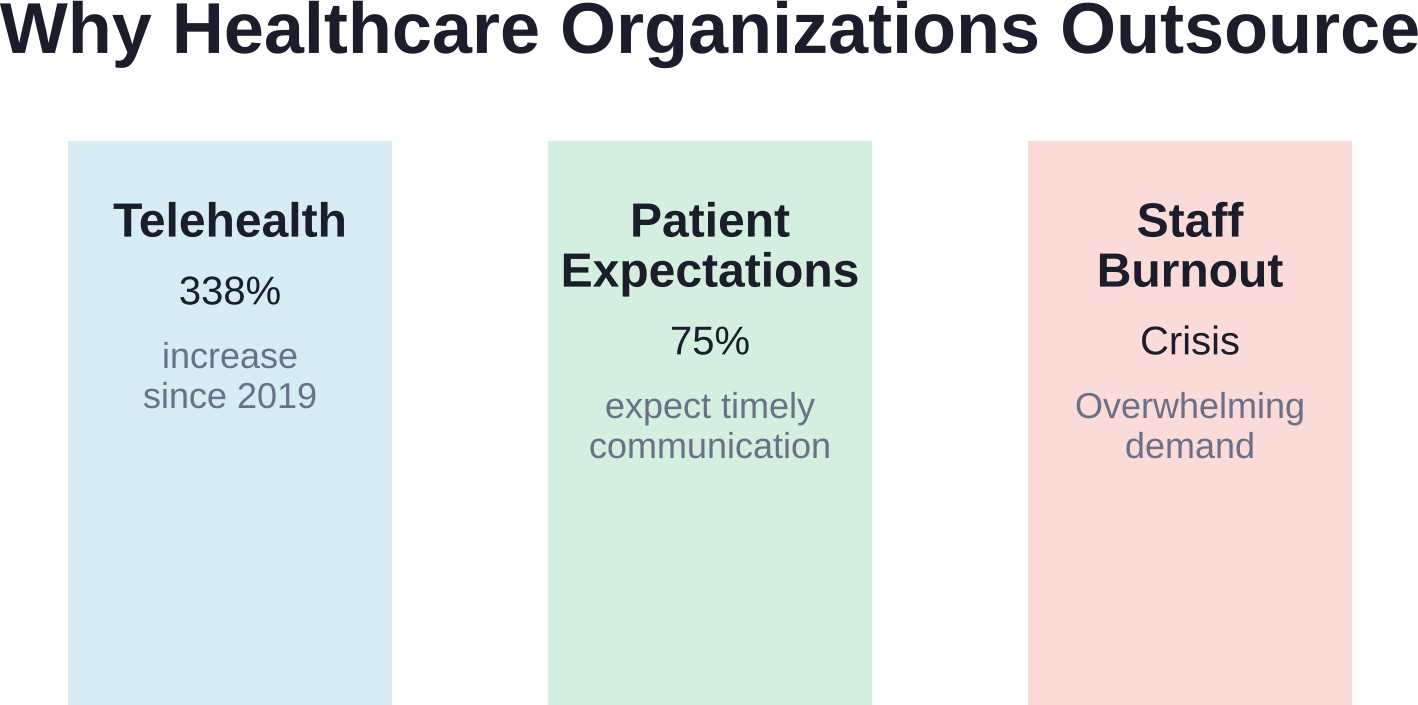
Three major forces are reshaping how healthcare delivers customer service. First, telehealth has exploded—behavioral telehealth visits jumped 45-fold since the pandemic began, and overall telehealth utilization increased 338% since 2019. Each virtual visit generates administrative work that in-house teams struggle to handle.
Second, patient expectations have shifted. Research shows 75% of patients expect timely, personalized communication from their healthcare providers. Poor communication contributes to approximately 80% of serious medical errors, making effective customer service a clinical safety issue, not just an operational one.
Third, staffing is broken. Healthcare administrators report staff burnout at crisis levels. By outsourcing routine inquiries and administrative work, in-house teams can focus on direct patient care rather than fielding 200+ calls daily.
Core Benefits of Healthcare Outsourcing
Cost Reduction
Here's the financial reality: companies that successfully outsource can achieve cost savings of 25% to 30%. For healthcare organizations, these savings can be redirected toward clinical improvements, equipment upgrades, or hiring additional providers.
Personnel costs for healthcare systems typically range from $3.5 to $12 million annually, with most reporting $5–$10 million. Outsourcing can substantially reduce this burden, especially during seasonal surges when hiring temporary staff becomes expensive and inefficient.
24/7 Patient Access
Outsourced call centers operate around the clock. Patients can schedule appointments, refill prescriptions, or ask clinical questions at 2 a.m. on a Sunday—something in-house teams simply can't sustain without catastrophic staffing costs.
This continuous availability improves patient outcomes. Research on nurse telephone triage services shows 95.8% patient satisfaction rates, proving that outsourced clinical support works when properly designed.
Scalability During Peak Demand
Healthcare experiences predictable surges: open enrollment seasons spike inbound calls by 40–50%. Outsourcing partners absorb these peaks without disrupting your core operations. When volume drops, you scale down. In-house teams can't flex this way without laying off employees.
Improved Patient Satisfaction
Appointment reminders alone reduce no-show rates by 29%, which keeps facilities running efficiently and ensures patients receive necessary care. Outsourced providers excel at these high-touch interactions because it's their only job.
One healthcare organization saw a 20% increase in patient bookings after deploying outsourced call center services. Another achieved 30% patient engagement growth with multilingual outsourced support in just six months.
What Functions Should You Outsource?
Not everything belongs with an external vendor. Outsourcing works best for high-volume, rule-based tasks that don't require deep clinical judgment.
Compliance: The Biggest Risk
Healthcare operates under strict regulatory constraints. HIPAA, state privacy laws, CMS billing rules, and the No Surprises Act all apply to customer service. One compliance failure can trigger fines, patient trust erosion, and legal liability.
When evaluating outsourcing partners, compliance must be your first filter. Ask directly:
- Are they HIPAA-compliant and independently audited?
- How do they encrypt patient data in transit and at rest?
- What's their data breach response protocol?
- Do they have cyber liability insurance?
- Are staff members required to pass background checks?
Compliance isn't optional. It's the price of entry.
How to Choose the Right Outsourcing Partner
Step 1: Define Your Requirements
Identify which functions you want to outsource and the volume of inquiries. Are you handling 500 calls daily or 5,000? Do you need multilingual support? Will the partner handle clinical triage or only administrative tasks?
Clarity here prevents mismatches later. A partner optimized for billing support might struggle with nurse triage. A small boutique firm might crumble under 40–50% peak seasonal surges.
Step 2: Verify Compliance Credentials
Request HIPAA business associate agreements (BAAs), compliance certifications, audit reports, and insurance documentation. Legitimate healthcare BPOs expect these questions and have answers ready.
Red flag: vendors who seem unsure about HIPAA or dismiss security questions. They're not ready for healthcare.
Step 3: Evaluate Technology and Integration
Your outsourcing partner's systems must integrate with your EHR, practice management software, and billing system. Poor integration creates data silos, doubled work, and errors.
Ask about their technical stack: APIs, integration time, testing protocols, and rollback procedures if something breaks.
Step 4: Assess Training and Quality
The staff handling patient calls must understand healthcare workflows, medical terminology, and empathetic communication. Generic call center training doesn't cut it.
Request details on their training program, quality assurance metrics, call recording samples, and how they measure performance. CMS standards require average hold times under 2 minutes and disconnection rates below 5%.
Step 5: Start Small and Pilot
Don't move 100% of your volume to a new partner immediately. Pilot one function—maybe appointment scheduling—for 30 days. Measure call quality, patient feedback, integration issues, and staff satisfaction.
This de-risks the transition and reveals hidden problems before they affect your entire operation.

Build Healthcare Customer Support with NeoWork
Healthcare customer service outsourcing works best when support teams can handle patient questions, routine follow-ups, documentation, and administrative requests without creating extra confusion for internal staff. NeoWork supports healthcare companies with dedicated teammates who can take on non-clinical customer service and back-office work.
For healthcare providers, clinics, and healthtech companies, this can include medical customer support, patient follow-ups, insurance verification, claims administration, documentation, and other administrative workflows. NeoWork reports a 91% annualized teammate retention rate and a 3.2% candidate selectivity rate, which matters when support quality depends on accuracy, consistency, and familiarity with internal processes.
Where NeoWork can support healthcare teams:
- medical customer service and patient support
- patient follow-ups and routine communication
- insurance verification and claims administration
- documentation and healthcare back-office tasks
Contact NeoWork to build a healthcare customer service team that can reduce administrative pressure, keep patient communication organized, and support your internal staff more consistently.
Implementation and Transition
Moving to an outsourced model requires careful planning. A poor implementation can temporarily degrade patient experience, frustrate staff, and damage trust.
Best practices: communicate early with your team about why outsourcing is happening (usually cost and capacity, not replacement). Run parallel operations for 1–2 weeks while the vendor handles a subset of calls. Monitor quality, patient feedback, and integration errors daily.
Set clear success metrics upfront. Examples: call quality scores, average handle time, first-call resolution rate, patient satisfaction scores, and compliance audits. If metrics slip below baseline after 60 days, the partner hasn't done their job.
Common Pitfalls to Avoid
Here they are:
- Rushing the vendor selection
- Taking shortcuts on compliance due diligence
- Outsourcing too aggressively and losing the human touch patients value
- Failing to establish clear SLAs (service level agreements) with measurable penalties if targets are missed
The most damaging mistake? Choosing the cheapest vendor. Healthcare outsourcing is a specialized field. Cut-rate BPOs often lack HIPAA expertise, healthcare training, and the technology integration healthcare demands. They'll save you money in month one and cost you millions in compliance issues and patient churn by month six.
The Future of Healthcare Outsourcing
Automation and AI are reshaping this space. Chatbots handle basic eligibility queries. Speech analytics identify at-risk patients. Predictive dialers proactively reach patients before they call you.
But human empathy still matters. Nurse advice lines and clinical triage require trained humans who listen. The future likely blends AI for routine tasks with human agents for complex, clinical, or sensitive conversations.
Healthcare organizations that win will use outsourcing strategically—automating what's automatable, outsourcing what scales efficiently, and keeping high-value, relationship-focused work in-house.
Conclusion
Healthcare customer service outsourcing isn't a luxury anymore—it's becoming necessary. The combination of rising patient expectations, staffing shortages, and regulatory complexity makes in-house support alone unsustainable for most organizations.
The right outsourcing partner can reduce costs by 25–30%, improve patient satisfaction, ensure 24/7 access, and free your team to focus on clinical care. But success requires selecting a specialized, compliance-first vendor who understands healthcare workflows and invests in staff training.
Start by defining what you want to outsource. Verify compliance credentials obsessively. Evaluate technology integration carefully. Then pilot the relationship before full deployment.
Ready to explore outsourcing options? Begin by auditing your current call volume, identifying bottlenecks, and calculating your true cost of operations. Armed with data, you'll negotiate better contracts and measure ROI more accurately. The payoff is worth the effort.
FAQ
Topics
Healthcare Customer Service Outsourcing Guide 2026

Quick Summary: Healthcare customer service outsourcing helps organizations reduce operational costs by 25-30% while improving patient satisfaction and compliance. This guide covers key benefits, selection criteria, compliance requirements, and implementation strategies for healthcare providers considering outsourcing partnerships.
What Is Healthcare Customer Service Outsourcing?
Healthcare customer service outsourcing involves delegating patient communication, scheduling, billing inquiries, and administrative support to specialized third-party providers. Rather than managing these functions in-house, healthcare organizations partner with business process outsourcing (BPO) vendors who handle inbound calls, emails, chats, and other communication channels.
This isn't simply transferring calls to another company. Modern healthcare outsourcing partners use clinical triage protocols, HIPAA-compliant systems, and trained staff who understand healthcare workflows. They handle everything from appointment reminders to prior authorization requests to patient follow-ups.
The healthcare outsourcing market is expanding rapidly. Industry reports estimate the sector could reach $66.3 billion by 2025, driven by provider burnout, staffing shortages, and the demand for 24/7 patient support.
Why Healthcare Organizations Are Outsourcing Now
Three major forces are reshaping how healthcare delivers customer service. First, telehealth has exploded—behavioral telehealth visits jumped 45-fold since the pandemic began, and overall telehealth utilization increased 338% since 2019. Each virtual visit generates administrative work that in-house teams struggle to handle.
Second, patient expectations have shifted. Research shows 75% of patients expect timely, personalized communication from their healthcare providers. Poor communication contributes to approximately 80% of serious medical errors, making effective customer service a clinical safety issue, not just an operational one.
Third, staffing is broken. Healthcare administrators report staff burnout at crisis levels. By outsourcing routine inquiries and administrative work, in-house teams can focus on direct patient care rather than fielding 200+ calls daily.
Core Benefits of Healthcare Outsourcing
Cost Reduction
Here's the financial reality: companies that successfully outsource can achieve cost savings of 25% to 30%. For healthcare organizations, these savings can be redirected toward clinical improvements, equipment upgrades, or hiring additional providers.
Personnel costs for healthcare systems typically range from $3.5 to $12 million annually, with most reporting $5–$10 million. Outsourcing can substantially reduce this burden, especially during seasonal surges when hiring temporary staff becomes expensive and inefficient.
24/7 Patient Access
Outsourced call centers operate around the clock. Patients can schedule appointments, refill prescriptions, or ask clinical questions at 2 a.m. on a Sunday—something in-house teams simply can't sustain without catastrophic staffing costs.
This continuous availability improves patient outcomes. Research on nurse telephone triage services shows 95.8% patient satisfaction rates, proving that outsourced clinical support works when properly designed.
Scalability During Peak Demand
Healthcare experiences predictable surges: open enrollment seasons spike inbound calls by 40–50%. Outsourcing partners absorb these peaks without disrupting your core operations. When volume drops, you scale down. In-house teams can't flex this way without laying off employees.
Improved Patient Satisfaction
Appointment reminders alone reduce no-show rates by 29%, which keeps facilities running efficiently and ensures patients receive necessary care. Outsourced providers excel at these high-touch interactions because it's their only job.
One healthcare organization saw a 20% increase in patient bookings after deploying outsourced call center services. Another achieved 30% patient engagement growth with multilingual outsourced support in just six months.
What Functions Should You Outsource?
Not everything belongs with an external vendor. Outsourcing works best for high-volume, rule-based tasks that don't require deep clinical judgment.
Compliance: The Biggest Risk
Healthcare operates under strict regulatory constraints. HIPAA, state privacy laws, CMS billing rules, and the No Surprises Act all apply to customer service. One compliance failure can trigger fines, patient trust erosion, and legal liability.
When evaluating outsourcing partners, compliance must be your first filter. Ask directly:
- Are they HIPAA-compliant and independently audited?
- How do they encrypt patient data in transit and at rest?
- What's their data breach response protocol?
- Do they have cyber liability insurance?
- Are staff members required to pass background checks?
Compliance isn't optional. It's the price of entry.
How to Choose the Right Outsourcing Partner
Step 1: Define Your Requirements
Identify which functions you want to outsource and the volume of inquiries. Are you handling 500 calls daily or 5,000? Do you need multilingual support? Will the partner handle clinical triage or only administrative tasks?
Clarity here prevents mismatches later. A partner optimized for billing support might struggle with nurse triage. A small boutique firm might crumble under 40–50% peak seasonal surges.
Step 2: Verify Compliance Credentials
Request HIPAA business associate agreements (BAAs), compliance certifications, audit reports, and insurance documentation. Legitimate healthcare BPOs expect these questions and have answers ready.
Red flag: vendors who seem unsure about HIPAA or dismiss security questions. They're not ready for healthcare.
Step 3: Evaluate Technology and Integration
Your outsourcing partner's systems must integrate with your EHR, practice management software, and billing system. Poor integration creates data silos, doubled work, and errors.
Ask about their technical stack: APIs, integration time, testing protocols, and rollback procedures if something breaks.
Step 4: Assess Training and Quality
The staff handling patient calls must understand healthcare workflows, medical terminology, and empathetic communication. Generic call center training doesn't cut it.
Request details on their training program, quality assurance metrics, call recording samples, and how they measure performance. CMS standards require average hold times under 2 minutes and disconnection rates below 5%.
Step 5: Start Small and Pilot
Don't move 100% of your volume to a new partner immediately. Pilot one function—maybe appointment scheduling—for 30 days. Measure call quality, patient feedback, integration issues, and staff satisfaction.
This de-risks the transition and reveals hidden problems before they affect your entire operation.
Build Healthcare Customer Support with NeoWork
Healthcare customer service outsourcing works best when support teams can handle patient questions, routine follow-ups, documentation, and administrative requests without creating extra confusion for internal staff. NeoWork supports healthcare companies with dedicated teammates who can take on non-clinical customer service and back-office work.
For healthcare providers, clinics, and healthtech companies, this can include medical customer support, patient follow-ups, insurance verification, claims administration, documentation, and other administrative workflows. NeoWork reports a 91% annualized teammate retention rate and a 3.2% candidate selectivity rate, which matters when support quality depends on accuracy, consistency, and familiarity with internal processes.
Where NeoWork can support healthcare teams:
- medical customer service and patient support
- patient follow-ups and routine communication
- insurance verification and claims administration
- documentation and healthcare back-office tasks
Contact NeoWork to build a healthcare customer service team that can reduce administrative pressure, keep patient communication organized, and support your internal staff more consistently.
Implementation and Transition
Moving to an outsourced model requires careful planning. A poor implementation can temporarily degrade patient experience, frustrate staff, and damage trust.
Best practices: communicate early with your team about why outsourcing is happening (usually cost and capacity, not replacement). Run parallel operations for 1–2 weeks while the vendor handles a subset of calls. Monitor quality, patient feedback, and integration errors daily.
Set clear success metrics upfront. Examples: call quality scores, average handle time, first-call resolution rate, patient satisfaction scores, and compliance audits. If metrics slip below baseline after 60 days, the partner hasn't done their job.
Common Pitfalls to Avoid
Here they are:
- Rushing the vendor selection
- Taking shortcuts on compliance due diligence
- Outsourcing too aggressively and losing the human touch patients value
- Failing to establish clear SLAs (service level agreements) with measurable penalties if targets are missed
The most damaging mistake? Choosing the cheapest vendor. Healthcare outsourcing is a specialized field. Cut-rate BPOs often lack HIPAA expertise, healthcare training, and the technology integration healthcare demands. They'll save you money in month one and cost you millions in compliance issues and patient churn by month six.
The Future of Healthcare Outsourcing
Automation and AI are reshaping this space. Chatbots handle basic eligibility queries. Speech analytics identify at-risk patients. Predictive dialers proactively reach patients before they call you.
But human empathy still matters. Nurse advice lines and clinical triage require trained humans who listen. The future likely blends AI for routine tasks with human agents for complex, clinical, or sensitive conversations.
Healthcare organizations that win will use outsourcing strategically—automating what's automatable, outsourcing what scales efficiently, and keeping high-value, relationship-focused work in-house.
Conclusion
Healthcare customer service outsourcing isn't a luxury anymore—it's becoming necessary. The combination of rising patient expectations, staffing shortages, and regulatory complexity makes in-house support alone unsustainable for most organizations.
The right outsourcing partner can reduce costs by 25–30%, improve patient satisfaction, ensure 24/7 access, and free your team to focus on clinical care. But success requires selecting a specialized, compliance-first vendor who understands healthcare workflows and invests in staff training.
Start by defining what you want to outsource. Verify compliance credentials obsessively. Evaluate technology integration carefully. Then pilot the relationship before full deployment.
Ready to explore outsourcing options? Begin by auditing your current call volume, identifying bottlenecks, and calculating your true cost of operations. Armed with data, you'll negotiate better contracts and measure ROI more accurately. The payoff is worth the effort.
FAQ
Topics
Related Blogs
Related Podcasts


.webp)
.webp)



