

Updated:
Oct 4
2026
.avif)
.avif)


.svg)

Quick Summary: Healthcare outsourcing means handing administrative or clinical-support functions, think billing, coding, claims, IT, or patient scheduling, to specialized third-party vendors so internal staff can focus on direct patient care. Done right, it cuts operating costs, speeds up revenue cycles, and fills staffing gaps, but it only works when compliance, data security, and vendor oversight are treated as non-negotiable from day one. This guide walks through what to outsource first, what it typically costs, how to vet a HIPAA-compliant partner, and the mistakes that derail most healthcare BPO projects.
Hospitals and clinics are stretched thin. Staffing shortages haven't let up, reimbursement rules keep shifting, and margins keep shrinking. So it's no surprise that outsourcing has quietly become one of the most common cost-control strategies in healthcare administration.
According to MarketsandMarkets research, the global healthcare BPO market is valued at roughly $459.83 billion in 2026 and is projected to reach $735.05 billion by 2031, growing at a compound annual rate of about 9.8% — a sign that this isn't a fringe tactic anymore, it's standard operating procedure for a growing share of providers.
Here's the thing though — not every function belongs outside the building, and not every vendor is equipped to handle protected health information responsibly. This guide breaks down what healthcare outsourcing actually looks like in practice, what it costs, and how to choose a partner without creating new compliance headaches.
Healthcare outsourcing is the practice of contracting external vendors to perform business or clinical-support tasks that would otherwise sit with in-house staff. It covers everything from medical billing and coding to IT helpdesk support, transcription, telehealth staffing, and even remote patient monitoring.
The goal isn't just to save money. It's to let clinical teams spend more time with patients and less time on paperwork, scheduling conflicts, or chasing denied claims. Outsourcing works best when the function is repetitive, specialized, or requires technology and expertise that would be expensive to build internally.
Most outsourcing falls into two broad buckets:
Non-clinical functions are usually the easiest entry point. They carry lower regulatory risk and are easier to measure against clear performance metrics like claim turnaround time or call resolution rate.
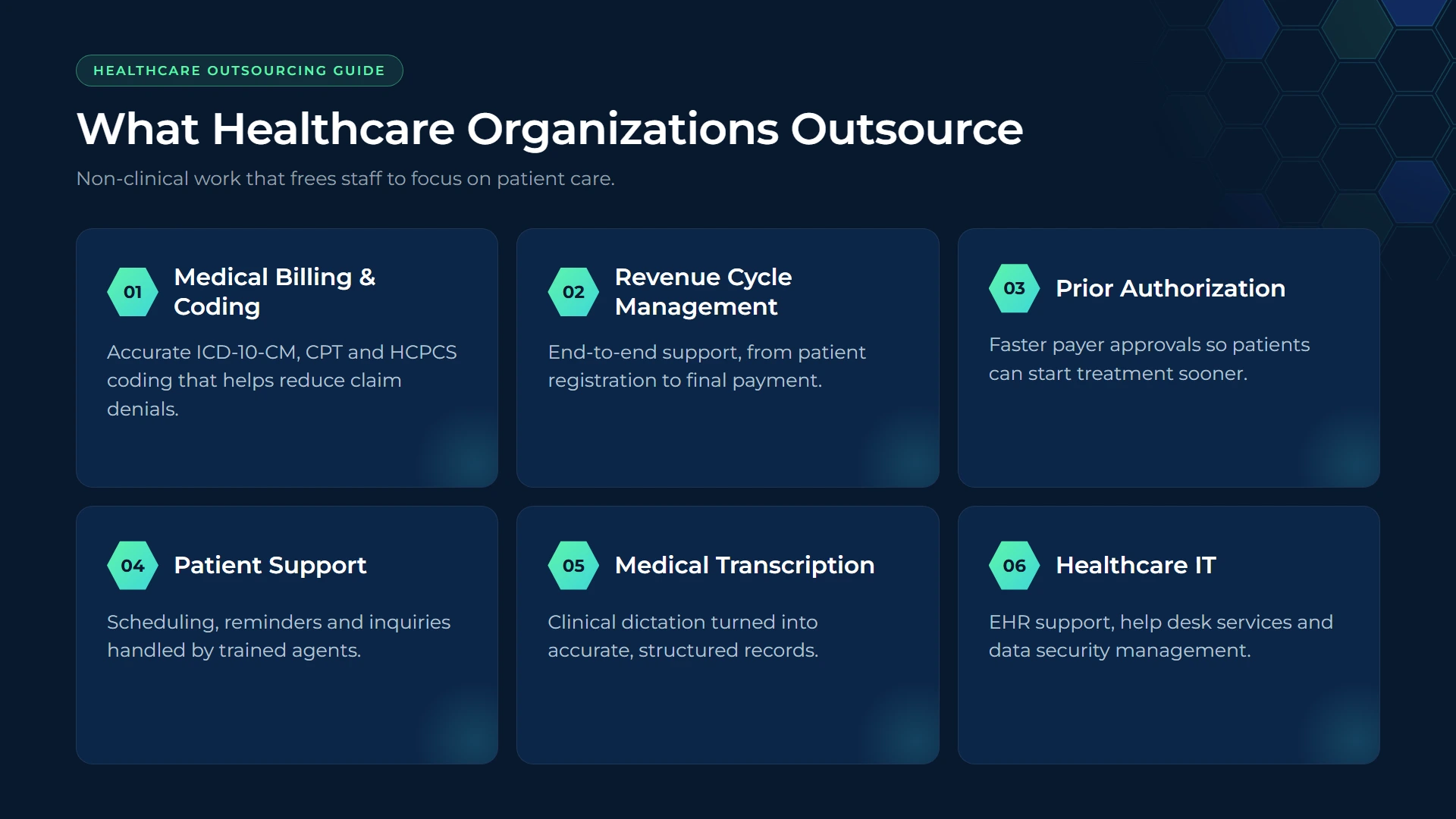
Not every department is a candidate. Decision-makers tend to start with functions that are high-volume, rules-based, and don't require a clinician's judgment in the moment.
Revenue cycle management tends to top the list almost everywhere. Billing errors and slow claims directly hit cash flow, so even modest efficiency gains translate into real dollars recovered.

Healthcare outsourcing helps organizations manage recurring administrative, patient support, data, and back-office workflows without expanding every function internally. At NeoWork, we provide remote teammates who can support healthcare operations within your existing systems and processes. We handle recruitment, benefits, training, and ongoing engagement, while our teammates follow your tools, procedures, and daily priorities. Our 91% annualized teammate retention rate and 3.2% candidate selectivity rate reflect our focus on selective hiring and longer-term team stability.
Our healthcare outsourcing model offers:
Contact NeoWork to add healthcare support that fits your existing operations.
The appeal isn't complicated. Outsourcing tends to deliver value in a handful of predictable ways:
None of this happens automatically, though. Benefits show up only when the vendor relationship is managed with clear metrics and regular oversight — not just signed and forgotten.
Healthcare data is sensitive, and that changes the outsourcing calculus compared to, say, outsourcing customer support for a retail brand. A few risks deserve particular attention:
Any vendor touching protected health information needs a signed Business Associate Agreement (BAA) and a demonstrated security program — encryption, access controls, audit logging, breach notification procedures. Skipping this step isn't just risky, it's a compliance violation waiting to surface.
Outsourced teams, especially offshore ones, need clear escalation paths back to in-house clinical staff. A billing error is annoying; a miscommunication in patient-facing scheduling or telehealth triage can affect care itself.
Switching costs can be steep once a vendor's systems are deeply integrated with internal workflows. Contracts should include clear data portability and transition-assistance clauses from the start, not negotiated after the relationship sours.
Pricing varies widely depending on the function, location of the vendor, and whether it's a per-transaction, per-employee, or percentage-of-collections model. Revenue cycle management vendors, for example, often charge a percentage of collected revenue, typically in the low-to-mid single digits, while IT managed services tend to run on flat monthly retainers.
Offshore and nearshore staffing generally costs less than hiring equivalent in-house roles domestically, sometimes by a wide margin, but the savings should be weighed against time-zone coordination, language considerations, and the extra oversight needed to maintain quality. For current, verifiable pricing benchmarks, it's worth checking directly with shortlisted vendors or industry associations like HFMA, since rates shift with labor markets and technology costs.
Picking a vendor shouldn't be a purely cost-driven decision. A few things matter more than the quoted rate:
Running a 60- to 90-day pilot on a narrow scope, say, one department's billing or a single call queue, is usually smarter than a full-scale rollout. It surfaces integration issues and vendor responsiveness before the stakes get higher.
A few shifts are shaping how organizations approach outsourcing this year:
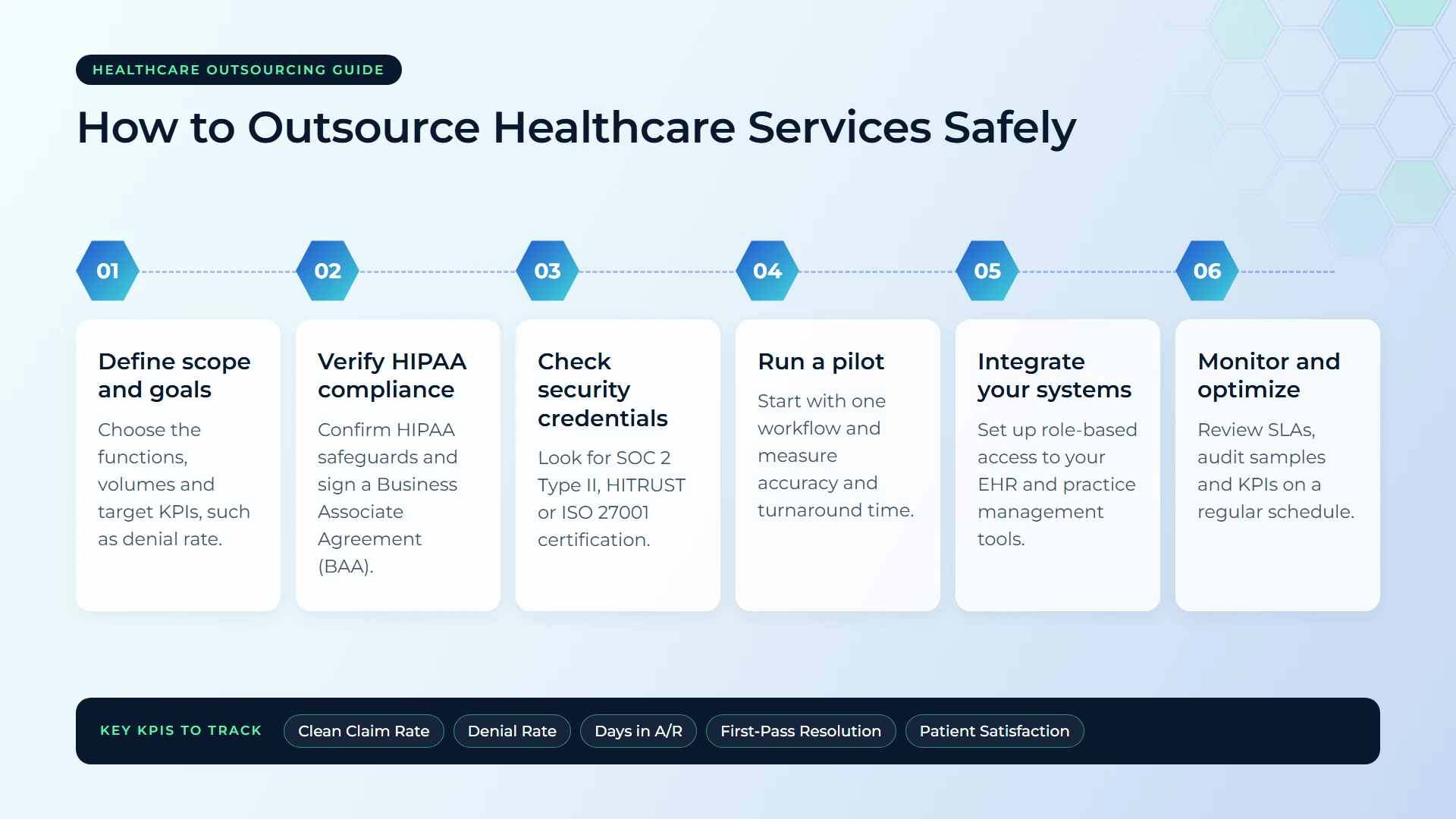
Most failed outsourcing arrangements trace back to a handful of avoidable mistakes:
Healthcare outsourcing isn't a one-size-fits-all decision, and it shouldn't be rushed. The organizations that get the most out of it tend to start small, pick functions with clear metrics, vet partners on compliance before price, and keep an internal owner accountable for the relationship.
Done thoughtfully, outsourcing frees up clinical time, tightens cash flow, and brings in expertise that would be costly to build from scratch. Done carelessly, it creates compliance exposure and vendor dependency that's hard to unwind. Start with a narrow pilot, measure the results, and let the data decide what gets outsourced next.

Quick Summary: Healthcare outsourcing means handing administrative or clinical-support functions, think billing, coding, claims, IT, or patient scheduling, to specialized third-party vendors so internal staff can focus on direct patient care. Done right, it cuts operating costs, speeds up revenue cycles, and fills staffing gaps, but it only works when compliance, data security, and vendor oversight are treated as non-negotiable from day one. This guide walks through what to outsource first, what it typically costs, how to vet a HIPAA-compliant partner, and the mistakes that derail most healthcare BPO projects.
Hospitals and clinics are stretched thin. Staffing shortages haven't let up, reimbursement rules keep shifting, and margins keep shrinking. So it's no surprise that outsourcing has quietly become one of the most common cost-control strategies in healthcare administration.
According to MarketsandMarkets research, the global healthcare BPO market is valued at roughly $459.83 billion in 2026 and is projected to reach $735.05 billion by 2031, growing at a compound annual rate of about 9.8% — a sign that this isn't a fringe tactic anymore, it's standard operating procedure for a growing share of providers.
Here's the thing though — not every function belongs outside the building, and not every vendor is equipped to handle protected health information responsibly. This guide breaks down what healthcare outsourcing actually looks like in practice, what it costs, and how to choose a partner without creating new compliance headaches.
Healthcare outsourcing is the practice of contracting external vendors to perform business or clinical-support tasks that would otherwise sit with in-house staff. It covers everything from medical billing and coding to IT helpdesk support, transcription, telehealth staffing, and even remote patient monitoring.
The goal isn't just to save money. It's to let clinical teams spend more time with patients and less time on paperwork, scheduling conflicts, or chasing denied claims. Outsourcing works best when the function is repetitive, specialized, or requires technology and expertise that would be expensive to build internally.
Most outsourcing falls into two broad buckets:
Non-clinical functions are usually the easiest entry point. They carry lower regulatory risk and are easier to measure against clear performance metrics like claim turnaround time or call resolution rate.
Not every department is a candidate. Decision-makers tend to start with functions that are high-volume, rules-based, and don't require a clinician's judgment in the moment.
Revenue cycle management tends to top the list almost everywhere. Billing errors and slow claims directly hit cash flow, so even modest efficiency gains translate into real dollars recovered.
Healthcare outsourcing helps organizations manage recurring administrative, patient support, data, and back-office workflows without expanding every function internally. At NeoWork, we provide remote teammates who can support healthcare operations within your existing systems and processes. We handle recruitment, benefits, training, and ongoing engagement, while our teammates follow your tools, procedures, and daily priorities. Our 91% annualized teammate retention rate and 3.2% candidate selectivity rate reflect our focus on selective hiring and longer-term team stability.
Our healthcare outsourcing model offers:
Contact NeoWork to add healthcare support that fits your existing operations.
The appeal isn't complicated. Outsourcing tends to deliver value in a handful of predictable ways:
None of this happens automatically, though. Benefits show up only when the vendor relationship is managed with clear metrics and regular oversight — not just signed and forgotten.
Healthcare data is sensitive, and that changes the outsourcing calculus compared to, say, outsourcing customer support for a retail brand. A few risks deserve particular attention:
Any vendor touching protected health information needs a signed Business Associate Agreement (BAA) and a demonstrated security program — encryption, access controls, audit logging, breach notification procedures. Skipping this step isn't just risky, it's a compliance violation waiting to surface.
Outsourced teams, especially offshore ones, need clear escalation paths back to in-house clinical staff. A billing error is annoying; a miscommunication in patient-facing scheduling or telehealth triage can affect care itself.
Switching costs can be steep once a vendor's systems are deeply integrated with internal workflows. Contracts should include clear data portability and transition-assistance clauses from the start, not negotiated after the relationship sours.
Pricing varies widely depending on the function, location of the vendor, and whether it's a per-transaction, per-employee, or percentage-of-collections model. Revenue cycle management vendors, for example, often charge a percentage of collected revenue, typically in the low-to-mid single digits, while IT managed services tend to run on flat monthly retainers.
Offshore and nearshore staffing generally costs less than hiring equivalent in-house roles domestically, sometimes by a wide margin, but the savings should be weighed against time-zone coordination, language considerations, and the extra oversight needed to maintain quality. For current, verifiable pricing benchmarks, it's worth checking directly with shortlisted vendors or industry associations like HFMA, since rates shift with labor markets and technology costs.
Picking a vendor shouldn't be a purely cost-driven decision. A few things matter more than the quoted rate:
Running a 60- to 90-day pilot on a narrow scope, say, one department's billing or a single call queue, is usually smarter than a full-scale rollout. It surfaces integration issues and vendor responsiveness before the stakes get higher.
A few shifts are shaping how organizations approach outsourcing this year:
Most failed outsourcing arrangements trace back to a handful of avoidable mistakes:
Healthcare outsourcing isn't a one-size-fits-all decision, and it shouldn't be rushed. The organizations that get the most out of it tend to start small, pick functions with clear metrics, vet partners on compliance before price, and keep an internal owner accountable for the relationship.
Done thoughtfully, outsourcing frees up clinical time, tightens cash flow, and brings in expertise that would be costly to build from scratch. Done carelessly, it creates compliance exposure and vendor dependency that's hard to unwind. Start with a narrow pilot, measure the results, and let the data decide what gets outsourced next.