

.avif)
.avif)

Insurance Customer Service Outsourcing Guide 2026


.svg)

Quick Summary: Insurance customer service outsourcing transfers support operations to specialized external providers, reducing costs by 40–70% while maintaining service quality. This guide covers what outsourcing entails, key benefits, implementation strategies, and how to choose the right partner for your insurance business.
What Is Insurance Customer Service Outsourcing?
Insurance customer service outsourcing means delegating support functions to external providers rather than managing them in-house. These functions span claims handling, policy inquiries, sales support, and administrative tasks that policyholders encounter every day.
The insurance industry moves fast. Policyholders expect quick answers, personalized support, and seamless communication—especially during claims filing or open enrollment. Many insurers lack the internal capacity to meet these demands consistently while controlling costs.
That's where outsourcing creates value. External providers operate dedicated contact centers with trained staff, technology infrastructure, and 24/7 availability built into their service model.
Why Insurance Companies Outsource Customer Service
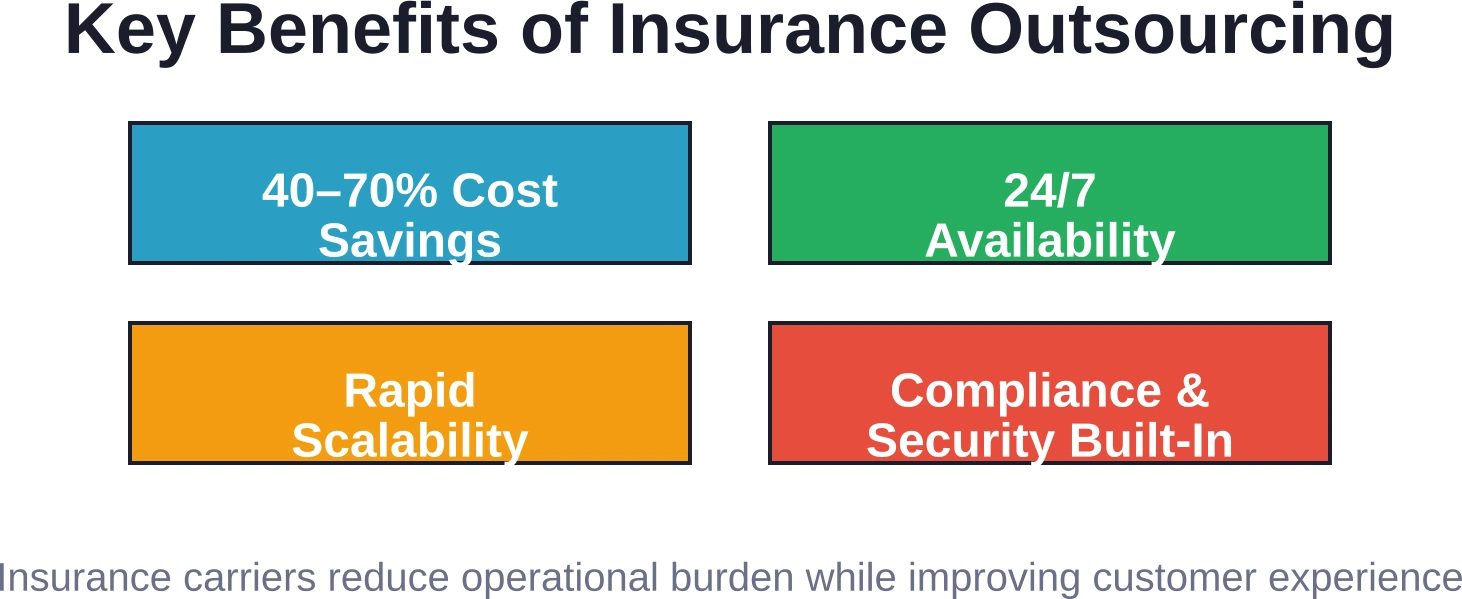
Cost efficiency ranks as the primary driver. Businesses can see cost savings between 40–70%, depending on the region and service scope. Outsourcing eliminates the expense of recruiting, training, benefits, and infrastructure that come with in-house operations.
Scalability matters too. Insurance operations break when volume spikes—open enrollment periods, claims surges, or seasonal peaks strain internal teams. Outsourced providers scale up or down without hiring delays or layoff overhead.
Quality and compliance are secondary benefits that shouldn't be overlooked. Reputable insurance BPO vendors employ compliance-trained staff who understand Gramm-Leach-Bliley Act requirements and FTC safeguards for protecting customer data. The Federal Trade Commission emphasizes that financial institutions—including insurance carriers—must explain information-sharing practices and safeguard sensitive data. Outsourcing partners built around these rules reduce regulatory risk.
Availability and service hours extend beyond what most in-house centers can deliver. Stride across time zones and maintain round-the-clock support without burning out local staff.
Core Services in Insurance Outsourcing
Most outsourced insurance operations handle a broad range of tasks. Claims inquiry and status updates top the list—policyholders want fast answers about claim progress. Policy renewals, coverage changes, and billing questions come next.
Sales support and lead qualification also scale well through outsourcing. Licensed conversion rates reach 33% with trained agents handling inbound calls and outbound campaigns. Customer satisfaction across multiple insurance programs hits 99% CSAT in top-performing operations.
Back-office support includes underwriting assistance, policy processing, and document management. Some carriers outsource data entry and verification work, freeing internal teams for complex decisions.
Outsourcing Models: Onshore, Offshore, and Hybrid
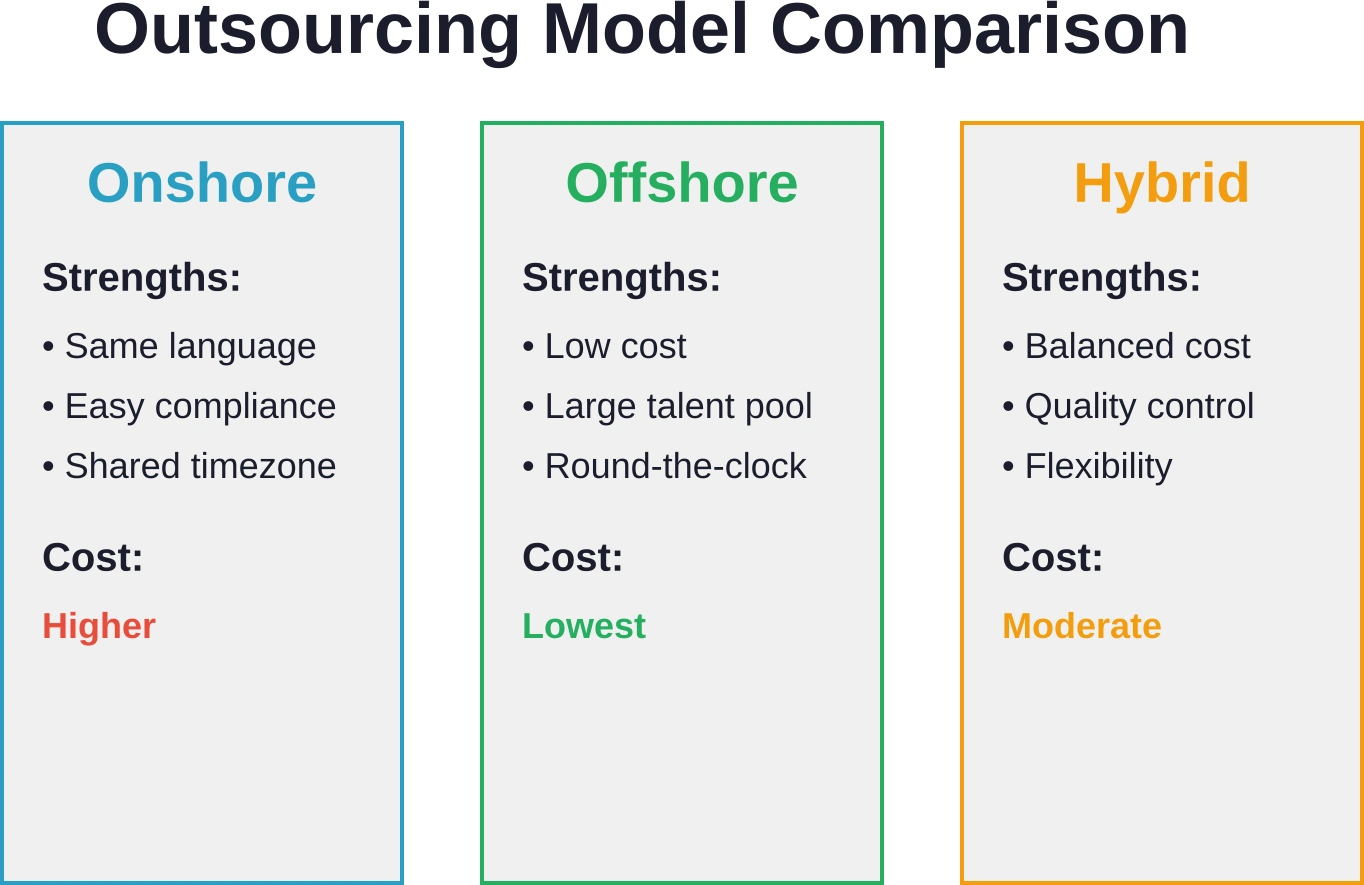
Three primary models shape the outsourcing landscape. Onshore outsourcing partners operate in the same country—easier compliance alignment, shared language, and faster communication. The trade-off? Higher labor costs than offshore alternatives.
Offshore staffing taps talent pools in lower-cost regions like India, the Philippines, or Eastern Europe. Cost savings are substantial, but cultural nuances and time zone challenges require stronger project management.
Hybrid models blend both approaches. Use onshore teams for complex, sensitive interactions and offshore staff for routine inquiries. This balance maximizes savings while protecting quality on high-stakes calls.
How to Evaluate Outsourcing Providers
Not all outsourcing partners are equal:
- Start by verifying compliance credentials: Ask about GLBA certifications, FTC Safeguards Rule compliance, and data protection practices. The FTC requires financial institutions to explain information-sharing practices and protect sensitive personal information—vendors must prove they meet these standards.
- Look at performance metrics: Insurance-specific experience matters—providers handling claims should understand coverage details and policy language. Request references and ask about CSAT scores, average handle time, and first-contact resolution rates.
- Examine technology infrastructure: Can they integrate with your CRM? Do they support omnichannel support (phone, email, chat, social)? Real-world operations answer 85%+ of calls and maintain 24/7/365 availability.
- Culture fit and transparency seal the deal: Choose vendors who communicate openly about challenges and celebrate wins alongside your team.

Strengthen Insurance Customer Service with NeoWork
Insurance customer service outsourcing needs more than basic call handling. Teams often need to manage verification tasks, claims-related communication, documentation, and follow-ups with accuracy. NeoWork can support these workflows through dedicated teammates who handle customer service and administrative work for insurance-related operations.
NeoWork’s model is useful for companies that need steady support instead of constant retraining. The company reports a 91% annualized teammate retention rate and a 3.2% candidate selectivity rate, which helps when insurance service teams need to understand processes, customer expectations, and recurring documentation requirements over time.
Insurance support tasks NeoWork can help with:
- customer service and routine support requests
- insurance verification and claims administration
- documentation, follow-ups, and back-office workflows
- dedicated teammates for ongoing customer operations
Contact NeoWork to build insurance customer service support that keeps routine requests moving, reduces workload for internal teams, and improves consistency across customer communication.
Implementation Steps and Timeline
Rolling out outsourced customer service requires careful planning. Start with a clear scope definition—which services transfer, which remain in-house, and what success metrics matter most.
Next, select your partner and negotiate terms. Build in transition phases rather than a hard cutover. Week one might handle overflow calls; week two expands to standard inquiries; week three takes on complex interactions as confidence grows.
Training and knowledge transfer are critical. Your outsourcing partner needs deep product knowledge, policy details, and your internal processes. Allocate 2–4 weeks for comprehensive training.
Launch monitoring and feedback loops immediately. Track quality metrics, gather customer feedback, and adjust operations in real time. Success doesn't happen overnight, but structured implementation reduces failures and builds momentum.
The Path Forward
Insurance customer service outsourcing isn't a cost-cutting gimmick—it's a strategic move for companies serious about scaling efficiently. Cost savings between 40–70%, combined with 24/7 availability and compliance expertise, create competitive advantages in a crowded market.
But success hinges on vendor selection and careful implementation. Partners must understand insurance operations, maintain security standards aligned with FTC requirements, and deliver measurable quality improvements.
Start small. Test outsourcing with a single service—claims inquiries or renewals. Monitor metrics closely. Expand as confidence grows. The insurance carriers winning today aren't choosing between in-house excellence and outsourced mediocrity. They're architecting hybrid models that combine the best of both worlds.
FAQ: Insurance Customer Service Outsourcing
Topics
Insurance Customer Service Outsourcing Guide 2026

Quick Summary: Insurance customer service outsourcing transfers support operations to specialized external providers, reducing costs by 40–70% while maintaining service quality. This guide covers what outsourcing entails, key benefits, implementation strategies, and how to choose the right partner for your insurance business.
What Is Insurance Customer Service Outsourcing?
Insurance customer service outsourcing means delegating support functions to external providers rather than managing them in-house. These functions span claims handling, policy inquiries, sales support, and administrative tasks that policyholders encounter every day.
The insurance industry moves fast. Policyholders expect quick answers, personalized support, and seamless communication—especially during claims filing or open enrollment. Many insurers lack the internal capacity to meet these demands consistently while controlling costs.
That's where outsourcing creates value. External providers operate dedicated contact centers with trained staff, technology infrastructure, and 24/7 availability built into their service model.
Why Insurance Companies Outsource Customer Service
Cost efficiency ranks as the primary driver. Businesses can see cost savings between 40–70%, depending on the region and service scope. Outsourcing eliminates the expense of recruiting, training, benefits, and infrastructure that come with in-house operations.
Scalability matters too. Insurance operations break when volume spikes—open enrollment periods, claims surges, or seasonal peaks strain internal teams. Outsourced providers scale up or down without hiring delays or layoff overhead.
Quality and compliance are secondary benefits that shouldn't be overlooked. Reputable insurance BPO vendors employ compliance-trained staff who understand Gramm-Leach-Bliley Act requirements and FTC safeguards for protecting customer data. The Federal Trade Commission emphasizes that financial institutions—including insurance carriers—must explain information-sharing practices and safeguard sensitive data. Outsourcing partners built around these rules reduce regulatory risk.
Availability and service hours extend beyond what most in-house centers can deliver. Stride across time zones and maintain round-the-clock support without burning out local staff.
Core Services in Insurance Outsourcing
Most outsourced insurance operations handle a broad range of tasks. Claims inquiry and status updates top the list—policyholders want fast answers about claim progress. Policy renewals, coverage changes, and billing questions come next.
Sales support and lead qualification also scale well through outsourcing. Licensed conversion rates reach 33% with trained agents handling inbound calls and outbound campaigns. Customer satisfaction across multiple insurance programs hits 99% CSAT in top-performing operations.
Back-office support includes underwriting assistance, policy processing, and document management. Some carriers outsource data entry and verification work, freeing internal teams for complex decisions.
Outsourcing Models: Onshore, Offshore, and Hybrid
Three primary models shape the outsourcing landscape. Onshore outsourcing partners operate in the same country—easier compliance alignment, shared language, and faster communication. The trade-off? Higher labor costs than offshore alternatives.
Offshore staffing taps talent pools in lower-cost regions like India, the Philippines, or Eastern Europe. Cost savings are substantial, but cultural nuances and time zone challenges require stronger project management.
Hybrid models blend both approaches. Use onshore teams for complex, sensitive interactions and offshore staff for routine inquiries. This balance maximizes savings while protecting quality on high-stakes calls.
How to Evaluate Outsourcing Providers
Not all outsourcing partners are equal:
- Start by verifying compliance credentials: Ask about GLBA certifications, FTC Safeguards Rule compliance, and data protection practices. The FTC requires financial institutions to explain information-sharing practices and protect sensitive personal information—vendors must prove they meet these standards.
- Look at performance metrics: Insurance-specific experience matters—providers handling claims should understand coverage details and policy language. Request references and ask about CSAT scores, average handle time, and first-contact resolution rates.
- Examine technology infrastructure: Can they integrate with your CRM? Do they support omnichannel support (phone, email, chat, social)? Real-world operations answer 85%+ of calls and maintain 24/7/365 availability.
- Culture fit and transparency seal the deal: Choose vendors who communicate openly about challenges and celebrate wins alongside your team.
Strengthen Insurance Customer Service with NeoWork
Insurance customer service outsourcing needs more than basic call handling. Teams often need to manage verification tasks, claims-related communication, documentation, and follow-ups with accuracy. NeoWork can support these workflows through dedicated teammates who handle customer service and administrative work for insurance-related operations.
NeoWork’s model is useful for companies that need steady support instead of constant retraining. The company reports a 91% annualized teammate retention rate and a 3.2% candidate selectivity rate, which helps when insurance service teams need to understand processes, customer expectations, and recurring documentation requirements over time.
Insurance support tasks NeoWork can help with:
- customer service and routine support requests
- insurance verification and claims administration
- documentation, follow-ups, and back-office workflows
- dedicated teammates for ongoing customer operations
Contact NeoWork to build insurance customer service support that keeps routine requests moving, reduces workload for internal teams, and improves consistency across customer communication.
Implementation Steps and Timeline
Rolling out outsourced customer service requires careful planning. Start with a clear scope definition—which services transfer, which remain in-house, and what success metrics matter most.
Next, select your partner and negotiate terms. Build in transition phases rather than a hard cutover. Week one might handle overflow calls; week two expands to standard inquiries; week three takes on complex interactions as confidence grows.
Training and knowledge transfer are critical. Your outsourcing partner needs deep product knowledge, policy details, and your internal processes. Allocate 2–4 weeks for comprehensive training.
Launch monitoring and feedback loops immediately. Track quality metrics, gather customer feedback, and adjust operations in real time. Success doesn't happen overnight, but structured implementation reduces failures and builds momentum.
The Path Forward
Insurance customer service outsourcing isn't a cost-cutting gimmick—it's a strategic move for companies serious about scaling efficiently. Cost savings between 40–70%, combined with 24/7 availability and compliance expertise, create competitive advantages in a crowded market.
But success hinges on vendor selection and careful implementation. Partners must understand insurance operations, maintain security standards aligned with FTC requirements, and deliver measurable quality improvements.
Start small. Test outsourcing with a single service—claims inquiries or renewals. Monitor metrics closely. Expand as confidence grows. The insurance carriers winning today aren't choosing between in-house excellence and outsourced mediocrity. They're architecting hybrid models that combine the best of both worlds.
FAQ: Insurance Customer Service Outsourcing
Topics
Related Blogs
Related Podcasts


.webp)
.webp)



