

.avif)
.avif)

Insurance Renewal Processing Outsourcing Guide 2026


.svg)

Quick Summary: Insurance renewal processing outsourcing helps carriers, MGAs, and agencies handle the repetitive, high-volume work of renewing policies without expanding internal teams. By transferring renewal workflows—verification, document generation, system updates, customer follow-up—to specialized BPO providers, insurers reduce turnaround time, cut operational costs, and free internal staff for higher-value tasks like underwriting and sales.
Renewal season is where most insurance agencies either prove their operational efficiency or drown in backlog. When policy volumes spike, internal teams face a bottleneck that no amount of overtime can solve. And hiring full-time staff to handle seasonal peaks doesn't make financial sense.
That's where insurance renewal processing outsourcing comes in. It's not about handing over control—it's about scaling intelligently.
This guide walks through what renewal processing outsourcing actually involves, which tasks get transferred, how carriers and agencies structure these engagements, and what to watch for when evaluating providers.
What Is Insurance Renewal Processing Outsourcing
Renewal processing outsourcing means transferring the operational tasks involved in renewing insurance policies to an external service provider. These providers—often called insurance BPO (business process outsourcing) firms—handle the repetitive, rules-based work that eats up time but doesn't require underwriting judgment.
The scope typically includes:
- Policy data verification and update
- Document generation (renewal notices, certificates, declarations)
- System updates across carrier platforms or agency management systems
- Customer follow-up for outstanding information
- Payment processing and tracking
- Endorsement coordination tied to renewals
Carriers, MGAs, wholesalers, and retail agencies all use renewal outsourcing, though the specific workflows vary. A carrier might outsource high-volume personal lines renewals, while an MGA handling specialty commercial risks might focus on documentation and follow-up for complex accounts.
Why Agencies and Carriers Outsource Renewal Processing
Renewals are predictable but labor-intensive. Unlike new business submissions, which require underwriting judgment, most renewal workflows follow established rules. That makes them perfect candidates for outsourcing.
Here's what drives the decision:
Volume Spikes Without Permanent Headcount Increases
Renewal cycles concentrate in specific quarters. Internal teams can't scale flexibly—hiring for peak season means idle capacity the rest of the year. Outsourcing provides elastic capacity.
Cost Reduction Without Quality Trade-Offs
Offshore BPO providers in the Philippines, India, or Latin America offer skilled insurance professionals at a fraction of US salary costs. Typical savings range from 50–70% compared to domestic staffing.
Faster Turnaround and Reduced Lapse Rates
When renewals process faster, customers receive timely notices, and agencies capture renewals before competitors do. Delays drive lapse rates up—outsourcing tightens the cycle.
Internal Team Focus on Revenue-Generating Activities
Producers and underwriters shouldn't spend hours updating policy systems or chasing missing documents. Outsourcing frees them for sales, risk evaluation, and relationship management.

Manage Insurance Renewal Workloads With NeoWork
Insurance renewals often involve documentation, customer communication, data updates, and administrative follow-up. NeoWork provides staffing and operational support that can help organizations manage these recurring tasks.
Need Help With Insurance Renewal Processing?
NeoWork can help with:
- renewal-related administration
- customer communication
- records and document management
- workflow support
👉 Contact NeoWork to discuss your insurance operations needs.
Common Renewal Processing Tasks Outsourced
Not every renewal task gets outsourced. Underwriting decisions, risk re-evaluation, and pricing adjustments typically stay in-house. What moves offshore are the operational steps that execute the renewal once those decisions are made.
Policy Data Verification and Update
BPO teams review existing policy data, flag discrepancies, and update records based on carrier instructions or agency management system rules. This includes address changes, coverage limits, named insureds, and endorsements.
Document Generation and Distribution
Renewal notices, certificates of insurance, declarations pages, invoices—all generated according to templates and distributed via email, portal upload, or physical mail. Outsourced teams handle the production and delivery.
System Entry and Updates
Carriers use proprietary systems; agencies use platforms like Applied Epic, AMS360, or Hawksoft. BPO teams log into these systems and execute updates according to documented procedures. They don't make judgment calls—they follow scripts.
Customer Follow-Up for Missing Information
When a renewal can't complete because of missing documents or unsigned forms, outsourced teams manage outreach. Phone calls, emails, text reminders—whatever the client specifies. They escalate unresolved issues back to internal staff.
Payment Processing and Reconciliation
Tracking premium payments, applying them to the correct accounts, reconciling discrepancies, and flagging non-payment for cancellation—routine financial operations that BPO teams handle daily.
Endorsement Coordination
When a renewal includes mid-term changes or endorsements, outsourced teams process the paperwork, update systems, and generate revised documents. Again, this is execution, not decision-making.
Insurance BPO vs Staff Augmentation vs Full-Service Providers
Renewal outsourcing comes in different flavors. Understanding the distinction helps match the model to operational needs.
Most agencies start with staff augmentation or discrete BPO projects—renewing a specific book of business or handling renewals for one carrier. As trust builds, they expand scope.
Technology Platforms Used in Renewal Outsourcing
BPO providers don't bring their own systems for carrier or agency work—they integrate with existing platforms. That means training on:
- Agency management systems (Applied Epic, AMS360, Hawksoft, EZLynx, QQCatalyst)
- Carrier portals (proprietary platforms for submissions, renewals, endorsements)
- Document management systems (ImageRight, Laserfiche, FileInvite)
- Communication tools (Outlook, Salesforce, carrier-specific CRMs)
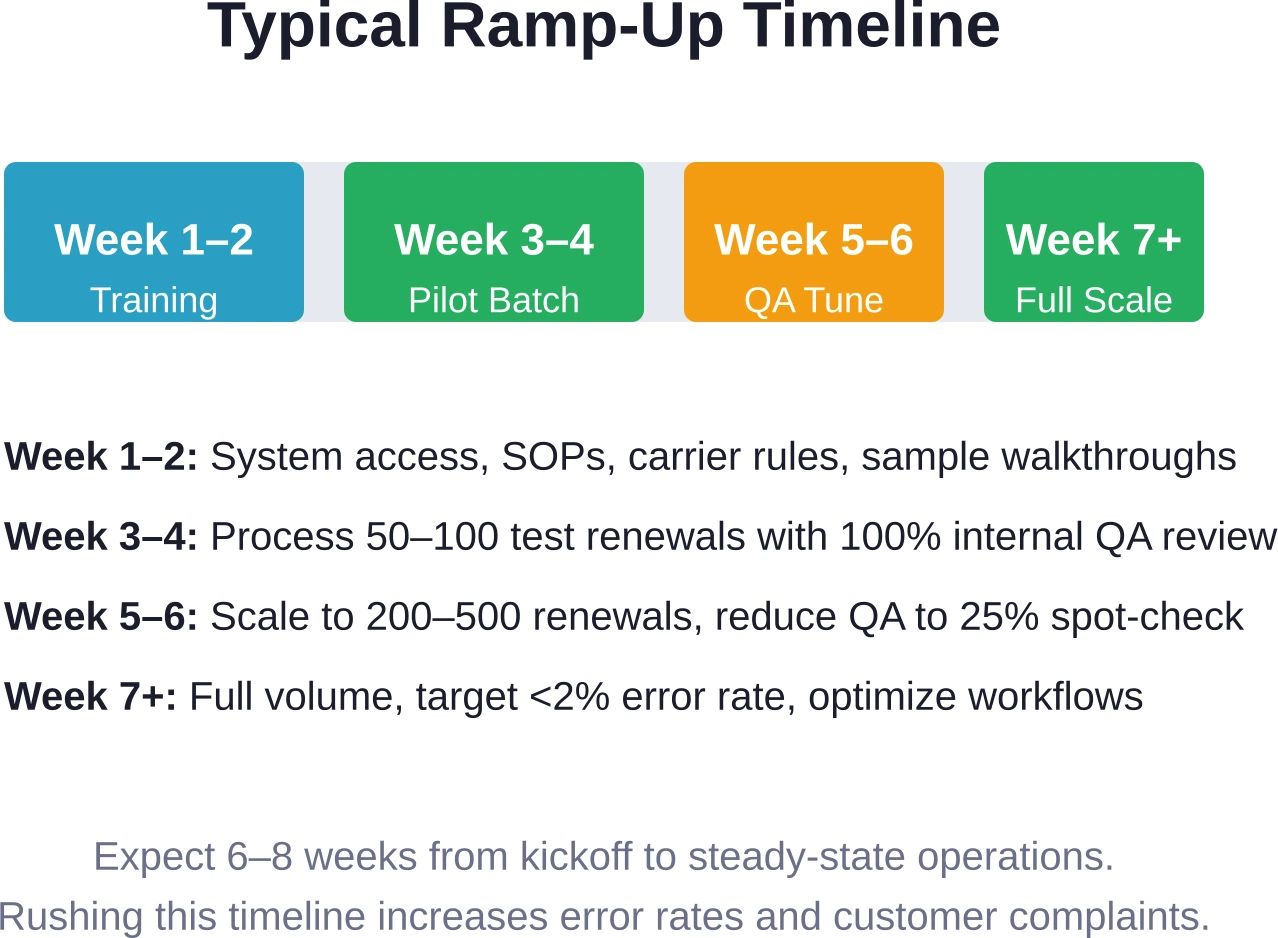
Reputable providers invest in training teams on these platforms before go-live. Expect a 2–4 week ramp-up period for system familiarization, even with experienced insurance staff.
Security and access control matter here. BPO teams log in via VPN, single sign-on, or virtual desktop infrastructure (VDI) to maintain data security and compliance. HIPAA, SOC 2, and ISO 27001 certifications are common baseline requirements.
How to Evaluate Renewal Processing Outsourcing Providers
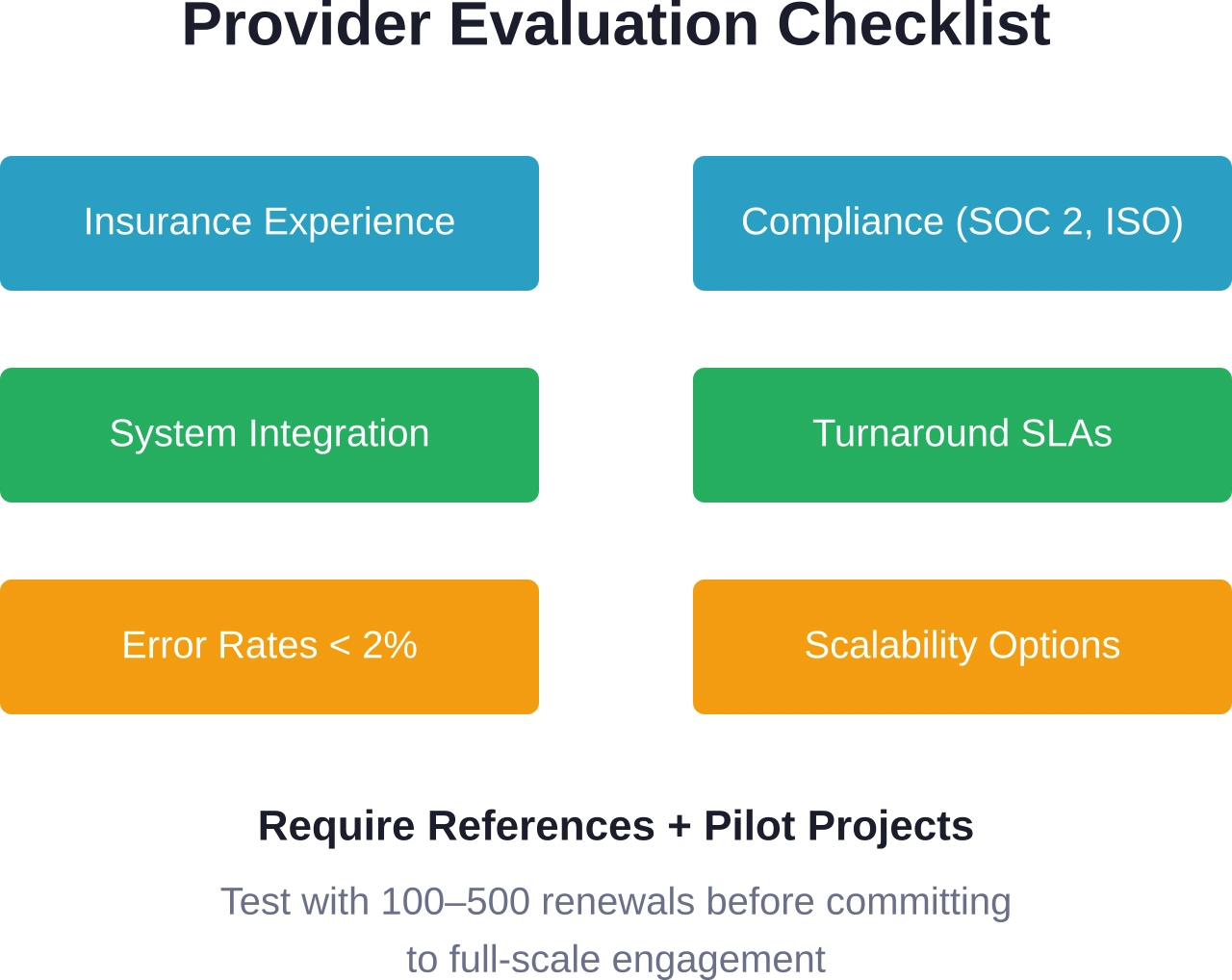
Not all BPO firms understand insurance operations. Selecting the wrong provider leads to errors, delays, and customer complaints. Here's what to assess:
Insurance Industry Experience
Look for providers with a track record in P&C or life insurance, not generic BPO firms pivoting from telecom or retail. Ask for client references in your segment—commercial lines, personal lines, specialty, whatever matches your book.
Compliance and Security Standards
Confirm SOC 2 Type II, ISO 27001, or equivalent. Ask how they handle data residency requirements, especially if operating under state-specific regulations. GDPR compliance matters if handling any EU-connected policies.
Technology Integration Capability
Can they work in your systems without requiring you to change platforms? How do they handle training for proprietary carrier portals? What's their approach to system updates when carriers roll out new versions?
Turnaround Time and SLAs
Renewal processing turnaround times vary depending on complexity. Get specific SLAs in writing. What's the penalty for missed deadlines?
Error Rates and Quality Control
Ask for historical error rates. Well-managed operations aim for error rates below 2% with multi-layer QA. How do they audit work? Who owns corrections?
Scalability and Flexibility
Renewal volume fluctuates. Can the provider scale up for Q4 or mid-year surges? What's the lead time for adding capacity?
Cost Structure and Pricing Models
Renewal outsourcing pricing varies based on complexity, volume, and service model. Here are the common structures:
Per-Transaction Pricing
Pay per renewal processed, varying by complexity and service provider. Personal auto renewals sit at the low end; commercial multi-line packages at the high end.
Full-Time Equivalent (FTE) Pricing
Hire dedicated staff at a monthly rate. Offshore FTE pricing varies by experience level and location. Onshore US-based FTE pricing is typically higher.
Hybrid Models
Combine base FTE capacity with per-transaction overflow pricing. Provides cost predictability with scalability for volume spikes.
Outcome-Based Pricing
Less common, but some providers tie fees to performance metrics—renewal retention rates, turnaround time, error rates. Requires mature operations and strong trust.
Real talk: per-transaction pricing works for unpredictable volumes or pilot projects. FTE pricing makes sense when volume is steady and workflows are complex enough to justify dedicated staff.
When Renewal Outsourcing Makes Sense
Outsourcing isn't right for every agency or carrier. Here's when it fits:
- Volume exceeds internal capacity: Backlog consistently exceeds 5–7 business days, or renewal season creates multi-week delays.
- Cost pressure from growth: Adding headcount strains budget, but growth demands more capacity.
- Staff turnover disrupts operations: High turnover in renewal processing roles creates training drain and knowledge loss.
- Standardized workflows: Renewal processes follow clear rules with minimal exceptions—perfect for outsourcing.
- Technology already in place: Agency management systems or carrier platforms are stable and documented. Outsourcing works poorly when internal systems are chaotic.
Outsourcing struggles when workflows require constant judgment calls, frequent exceptions, or deep customer relationship management. Those tasks stay internal.
Common Challenges and How to Mitigate Them
Renewal outsourcing isn't plug-and-play. Expect friction points:
Communication Gaps and Time Zone Differences
Offshore teams in the Philippines or India operate 12 hours ahead or behind US time zones. Solution: build overlap hours (early morning or late evening shifts) and use asynchronous communication tools like Slack or shared task boards.
Training and Knowledge Transfer
BPO teams need deep familiarity with carrier rules, state regulations, and internal procedures. Plan for 3–4 weeks of structured training with documented SOPs. Record training sessions for future onboarding.
Quality Control During Ramp-Up
Expect higher error rates in the first 30 days. Implement dual QA—outsourced team checks their own work, internal team spot-checks a sample until accuracy stabilizes.
Customer Interaction Concerns
Some agencies worry about customer perception of offshore teams. Mitigation: keep customer-facing communication (calls, complex emails) internal; outsource back-end processing only. Alternatively, hire teams with strong English fluency and provide scripts for routine interactions.
Data Security and Compliance Risk
Transferring policy data offshore raises compliance concerns. Ensure contracts include indemnification clauses, data processing agreements (DPAs), and breach notification terms. Work only with providers holding third-party security certifications.
Measuring Success: KPIs for Renewal Outsourcing
Track these metrics to evaluate whether outsourcing delivers value:
Review these monthly. If error rates stay above 3% past the first quarter, escalate with the provider. If turnaround time creeps up, investigate whether volume exceeded agreed capacity or if training gaps emerged.
Final Thoughts on Renewal Processing Outsourcing
Renewal processing outsourcing works when it solves a specific operational problem—volume exceeding capacity, cost pressure from growth, or staff turnover disrupting workflows. It fails when expectations aren't aligned, training is rushed, or the wrong tasks get outsourced.
Start small. Pick a single carrier or line of business. Run a pilot with 100–200 renewals. Measure error rates, turnaround time, and internal time savings. Scale only after proving the model works.
The goal isn't to eliminate internal staff—it's to free them for work that drives revenue. Renewals are operational hygiene. Get them handled efficiently so producers can sell, underwriters can evaluate risk, and customer service teams can focus on retention.
If backlog is crushing internal capacity or renewal season feels like chaos, outsourcing offers a proven path to operational breathing room. Just make sure the provider understands insurance, not just BPO.
Frequently Asked Questions
Topics
Insurance Renewal Processing Outsourcing Guide 2026

Quick Summary: Insurance renewal processing outsourcing helps carriers, MGAs, and agencies handle the repetitive, high-volume work of renewing policies without expanding internal teams. By transferring renewal workflows—verification, document generation, system updates, customer follow-up—to specialized BPO providers, insurers reduce turnaround time, cut operational costs, and free internal staff for higher-value tasks like underwriting and sales.
Renewal season is where most insurance agencies either prove their operational efficiency or drown in backlog. When policy volumes spike, internal teams face a bottleneck that no amount of overtime can solve. And hiring full-time staff to handle seasonal peaks doesn't make financial sense.
That's where insurance renewal processing outsourcing comes in. It's not about handing over control—it's about scaling intelligently.
This guide walks through what renewal processing outsourcing actually involves, which tasks get transferred, how carriers and agencies structure these engagements, and what to watch for when evaluating providers.
What Is Insurance Renewal Processing Outsourcing
Renewal processing outsourcing means transferring the operational tasks involved in renewing insurance policies to an external service provider. These providers—often called insurance BPO (business process outsourcing) firms—handle the repetitive, rules-based work that eats up time but doesn't require underwriting judgment.
The scope typically includes:
- Policy data verification and update
- Document generation (renewal notices, certificates, declarations)
- System updates across carrier platforms or agency management systems
- Customer follow-up for outstanding information
- Payment processing and tracking
- Endorsement coordination tied to renewals
Carriers, MGAs, wholesalers, and retail agencies all use renewal outsourcing, though the specific workflows vary. A carrier might outsource high-volume personal lines renewals, while an MGA handling specialty commercial risks might focus on documentation and follow-up for complex accounts.
Why Agencies and Carriers Outsource Renewal Processing
Renewals are predictable but labor-intensive. Unlike new business submissions, which require underwriting judgment, most renewal workflows follow established rules. That makes them perfect candidates for outsourcing.
Here's what drives the decision:
Volume Spikes Without Permanent Headcount Increases
Renewal cycles concentrate in specific quarters. Internal teams can't scale flexibly—hiring for peak season means idle capacity the rest of the year. Outsourcing provides elastic capacity.
Cost Reduction Without Quality Trade-Offs
Offshore BPO providers in the Philippines, India, or Latin America offer skilled insurance professionals at a fraction of US salary costs. Typical savings range from 50–70% compared to domestic staffing.
Faster Turnaround and Reduced Lapse Rates
When renewals process faster, customers receive timely notices, and agencies capture renewals before competitors do. Delays drive lapse rates up—outsourcing tightens the cycle.
Internal Team Focus on Revenue-Generating Activities
Producers and underwriters shouldn't spend hours updating policy systems or chasing missing documents. Outsourcing frees them for sales, risk evaluation, and relationship management.
Manage Insurance Renewal Workloads With NeoWork
Insurance renewals often involve documentation, customer communication, data updates, and administrative follow-up. NeoWork provides staffing and operational support that can help organizations manage these recurring tasks.
Need Help With Insurance Renewal Processing?
NeoWork can help with:
- renewal-related administration
- customer communication
- records and document management
- workflow support
👉 Contact NeoWork to discuss your insurance operations needs.
Common Renewal Processing Tasks Outsourced
Not every renewal task gets outsourced. Underwriting decisions, risk re-evaluation, and pricing adjustments typically stay in-house. What moves offshore are the operational steps that execute the renewal once those decisions are made.
Policy Data Verification and Update
BPO teams review existing policy data, flag discrepancies, and update records based on carrier instructions or agency management system rules. This includes address changes, coverage limits, named insureds, and endorsements.
Document Generation and Distribution
Renewal notices, certificates of insurance, declarations pages, invoices—all generated according to templates and distributed via email, portal upload, or physical mail. Outsourced teams handle the production and delivery.
System Entry and Updates
Carriers use proprietary systems; agencies use platforms like Applied Epic, AMS360, or Hawksoft. BPO teams log into these systems and execute updates according to documented procedures. They don't make judgment calls—they follow scripts.
Customer Follow-Up for Missing Information
When a renewal can't complete because of missing documents or unsigned forms, outsourced teams manage outreach. Phone calls, emails, text reminders—whatever the client specifies. They escalate unresolved issues back to internal staff.
Payment Processing and Reconciliation
Tracking premium payments, applying them to the correct accounts, reconciling discrepancies, and flagging non-payment for cancellation—routine financial operations that BPO teams handle daily.
Endorsement Coordination
When a renewal includes mid-term changes or endorsements, outsourced teams process the paperwork, update systems, and generate revised documents. Again, this is execution, not decision-making.
Insurance BPO vs Staff Augmentation vs Full-Service Providers
Renewal outsourcing comes in different flavors. Understanding the distinction helps match the model to operational needs.
Most agencies start with staff augmentation or discrete BPO projects—renewing a specific book of business or handling renewals for one carrier. As trust builds, they expand scope.
Technology Platforms Used in Renewal Outsourcing
BPO providers don't bring their own systems for carrier or agency work—they integrate with existing platforms. That means training on:
- Agency management systems (Applied Epic, AMS360, Hawksoft, EZLynx, QQCatalyst)
- Carrier portals (proprietary platforms for submissions, renewals, endorsements)
- Document management systems (ImageRight, Laserfiche, FileInvite)
- Communication tools (Outlook, Salesforce, carrier-specific CRMs)
Reputable providers invest in training teams on these platforms before go-live. Expect a 2–4 week ramp-up period for system familiarization, even with experienced insurance staff.
Security and access control matter here. BPO teams log in via VPN, single sign-on, or virtual desktop infrastructure (VDI) to maintain data security and compliance. HIPAA, SOC 2, and ISO 27001 certifications are common baseline requirements.
How to Evaluate Renewal Processing Outsourcing Providers
Not all BPO firms understand insurance operations. Selecting the wrong provider leads to errors, delays, and customer complaints. Here's what to assess:
Insurance Industry Experience
Look for providers with a track record in P&C or life insurance, not generic BPO firms pivoting from telecom or retail. Ask for client references in your segment—commercial lines, personal lines, specialty, whatever matches your book.
Compliance and Security Standards
Confirm SOC 2 Type II, ISO 27001, or equivalent. Ask how they handle data residency requirements, especially if operating under state-specific regulations. GDPR compliance matters if handling any EU-connected policies.
Technology Integration Capability
Can they work in your systems without requiring you to change platforms? How do they handle training for proprietary carrier portals? What's their approach to system updates when carriers roll out new versions?
Turnaround Time and SLAs
Renewal processing turnaround times vary depending on complexity. Get specific SLAs in writing. What's the penalty for missed deadlines?
Error Rates and Quality Control
Ask for historical error rates. Well-managed operations aim for error rates below 2% with multi-layer QA. How do they audit work? Who owns corrections?
Scalability and Flexibility
Renewal volume fluctuates. Can the provider scale up for Q4 or mid-year surges? What's the lead time for adding capacity?
Cost Structure and Pricing Models
Renewal outsourcing pricing varies based on complexity, volume, and service model. Here are the common structures:
Per-Transaction Pricing
Pay per renewal processed, varying by complexity and service provider. Personal auto renewals sit at the low end; commercial multi-line packages at the high end.
Full-Time Equivalent (FTE) Pricing
Hire dedicated staff at a monthly rate. Offshore FTE pricing varies by experience level and location. Onshore US-based FTE pricing is typically higher.
Hybrid Models
Combine base FTE capacity with per-transaction overflow pricing. Provides cost predictability with scalability for volume spikes.
Outcome-Based Pricing
Less common, but some providers tie fees to performance metrics—renewal retention rates, turnaround time, error rates. Requires mature operations and strong trust.
Real talk: per-transaction pricing works for unpredictable volumes or pilot projects. FTE pricing makes sense when volume is steady and workflows are complex enough to justify dedicated staff.
When Renewal Outsourcing Makes Sense
Outsourcing isn't right for every agency or carrier. Here's when it fits:
- Volume exceeds internal capacity: Backlog consistently exceeds 5–7 business days, or renewal season creates multi-week delays.
- Cost pressure from growth: Adding headcount strains budget, but growth demands more capacity.
- Staff turnover disrupts operations: High turnover in renewal processing roles creates training drain and knowledge loss.
- Standardized workflows: Renewal processes follow clear rules with minimal exceptions—perfect for outsourcing.
- Technology already in place: Agency management systems or carrier platforms are stable and documented. Outsourcing works poorly when internal systems are chaotic.
Outsourcing struggles when workflows require constant judgment calls, frequent exceptions, or deep customer relationship management. Those tasks stay internal.
Common Challenges and How to Mitigate Them
Renewal outsourcing isn't plug-and-play. Expect friction points:
Communication Gaps and Time Zone Differences
Offshore teams in the Philippines or India operate 12 hours ahead or behind US time zones. Solution: build overlap hours (early morning or late evening shifts) and use asynchronous communication tools like Slack or shared task boards.
Training and Knowledge Transfer
BPO teams need deep familiarity with carrier rules, state regulations, and internal procedures. Plan for 3–4 weeks of structured training with documented SOPs. Record training sessions for future onboarding.
Quality Control During Ramp-Up
Expect higher error rates in the first 30 days. Implement dual QA—outsourced team checks their own work, internal team spot-checks a sample until accuracy stabilizes.
Customer Interaction Concerns
Some agencies worry about customer perception of offshore teams. Mitigation: keep customer-facing communication (calls, complex emails) internal; outsource back-end processing only. Alternatively, hire teams with strong English fluency and provide scripts for routine interactions.
Data Security and Compliance Risk
Transferring policy data offshore raises compliance concerns. Ensure contracts include indemnification clauses, data processing agreements (DPAs), and breach notification terms. Work only with providers holding third-party security certifications.
Measuring Success: KPIs for Renewal Outsourcing
Track these metrics to evaluate whether outsourcing delivers value:
Review these monthly. If error rates stay above 3% past the first quarter, escalate with the provider. If turnaround time creeps up, investigate whether volume exceeded agreed capacity or if training gaps emerged.
Final Thoughts on Renewal Processing Outsourcing
Renewal processing outsourcing works when it solves a specific operational problem—volume exceeding capacity, cost pressure from growth, or staff turnover disrupting workflows. It fails when expectations aren't aligned, training is rushed, or the wrong tasks get outsourced.
Start small. Pick a single carrier or line of business. Run a pilot with 100–200 renewals. Measure error rates, turnaround time, and internal time savings. Scale only after proving the model works.
The goal isn't to eliminate internal staff—it's to free them for work that drives revenue. Renewals are operational hygiene. Get them handled efficiently so producers can sell, underwriters can evaluate risk, and customer service teams can focus on retention.
If backlog is crushing internal capacity or renewal season feels like chaos, outsourcing offers a proven path to operational breathing room. Just make sure the provider understands insurance, not just BPO.
Frequently Asked Questions
Topics
Related Blogs
Related Podcasts


.webp)
.webp)



