

.avif)
.avif)

IT Team Augmentation Guide: Scale Smart in 2026


.svg)

Quick Summary: IT team augmentation lets companies add vetted external developers, testers, or specialists to an in-house team without the overhead of full-time hiring. It works best when a project needs specific skills fast, budgets are tight, or local talent pools are thin. Costs typically run on hourly or monthly rates per engineer, and success hinges on choosing a partner with strong vetting, clear communication processes, and flexible contract terms.
Hiring a full-time developer can take months. Meanwhile, the backlog grows, the roadmap slips, and competitors ship faster. That's the exact pain point IT team augmentation was built to solve.
Instead of running a lengthy recruitment cycle, companies plug pre-vetted engineers directly into their existing team — same tools, same stand-ups, same codebase — often within weeks. This guide walks through what it actually means, how the models differ, what it costs in 2026, and how to pick a partner that won't waste anyone's time.
What Is IT Team Augmentation?
IT team augmentation is a staffing strategy where a business brings in external technical talent — developers, QA engineers, DevOps specialists, data scientists — to work alongside its internal team on a temporary or ongoing basis. The augmented staff report into the company's existing management structure, use the company's processes, and function essentially as embedded team members rather than a separate outsourced unit.
It's sometimes called "staff augmentation" or "resource augmentation," and the terms are used interchangeably across the industry. The core idea stays the same: keep control over the project while renting the missing skill set.
Who Actually Uses It
Startups use it to survive a funding-fueled sprint without inflating headcount permanently. Enterprises use it to bridge skill gaps during platform migrations or cloud transformations. Agencies use it to absorb sudden client demand without overcommitting their permanent bench. Pretty much any organization that writes software eventually bumps into a moment where internal capacity just isn't enough.
Team Augmentation vs. Outsourcing vs. Traditional Hiring
These three models get confused constantly, and picking the wrong one wastes both time and budget. Here's how they actually stack up.
Full outsourcing hands over an entire project's delivery to a third party — the client sets requirements and reviews outcomes, but doesn't manage day-to-day execution. Team augmentation is different: the company keeps its hands on the wheel, just with more drivers helping out.
How IT Team Augmentation Actually Works
The process is fairly linear once a partner is chosen, though the details vary. Most engagements follow the same basic sequence.
The vetting stage matters more than most companies expect. A weak candidate pool means wasted interview cycles and, worse, an engineer who slows the team down instead of speeding it up. Good providers pre-screen for both technical depth and communication skills — someone who can code well but can't explain a blocker in stand-up creates friction fast.
Engagement Models
Not every project needs the same shape of support. Three models dominate the market right now.
Individual augmentation tends to be the cheapest entry point and the easiest to reverse if it doesn't work out. Dedicated teams cost more but pay off when a product needs sustained, predictable capacity over a year or longer.

Build IT Team Capacity with NeoWork
IT team augmentation helps companies add remote technical professionals without building every IT role in-house. NeoWork provides teammates who can support IT, development, cloud, data, and related technical workflows as part of the client’s existing team. NeoWork handles recruitment, benefits, training, and ongoing engagement, while teammates integrate into the client’s systems and daily processes. Its 91% annualized teammate retention rate and 3.2% candidate selectivity rate reflect a focus on selective hiring and longer-term team stability.
NeoWork's IT team augmentation model offers:
- IT and technical support professionals
- integration with the client’s tools and processes
- recruitment and ongoing teammate support
Contact NeoWork to add IT team capacity that can support ongoing technical work and scale with your operations.
Costs in 2026: What to Actually Expect
Pricing varies enormously by region, seniority, and specialization, so treat any number here as a ballpark rather than a quote. Augmented engineers are typically billed hourly or as a flat monthly rate per person, with rates in Eastern Europe and Latin America generally landing lower than North American or Western European rates for comparable seniority. Specialized roles — security engineers, ML specialists, senior architects — command a premium regardless of region. Always request a detailed rate card and confirm what's included (PM overhead, infrastructure, timezone overlap) before signing anything; check a provider's official pricing page for current, region-specific numbers.
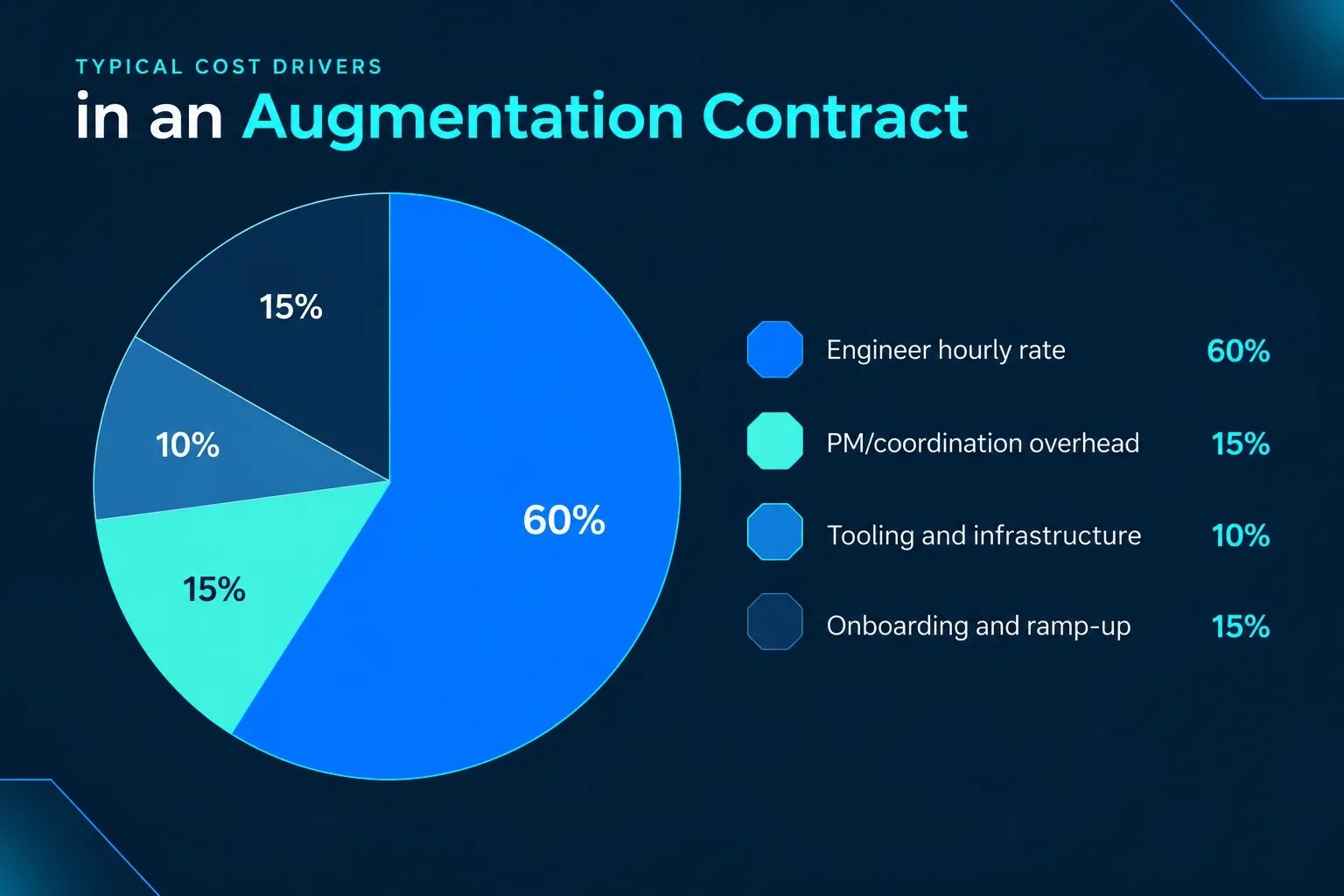
The hidden cost most teams underestimate is ramp-up time. Even a strong senior engineer needs a couple of weeks to understand a codebase's quirks. Budgeting for that dip in early productivity avoids disappointment in the first sprint review.
Benefits Worth Weighing
- Speed: Filling a role in weeks instead of months keeps roadmaps on track.
- Access to niche skills: Rare expertise — say, a specific ML framework — doesn't have to exist on the permanent payroll.
- Cost flexibility: Scaling down between projects avoids the sunk cost of idle full-time staff.
- Retained control: Unlike full outsourcing, the internal team still owns architecture decisions and product direction.
- Lower hiring risk: A bad fit can be swapped out far more easily than a bad full-time hire.
Challenges and How to Handle Them
It's not all upside. Communication gaps across time zones can slow decision-making if nobody plans for overlap hours. Knowledge silos form when augmented staff leave without documenting their work — a written handoff process solves most of that. Culture friction is real too; an engineer parachuted into a team mid-sprint needs a proper onboarding, not just repo access and a Slack invite.
Security is another point that gets overlooked. Augmented staff often need access to production systems or sensitive data, so contracts should spell out NDAs, access controls, and offboarding procedures clearly before day one.
How to Choose the Right Partner
Not all augmentation providers operate the same way, and the difference between a good one and a mediocre one shows up fast in delivery quality. A few things worth checking before signing:
- Ask for references from clients with similar project scope, not just logos on a homepage.
- Confirm the vetting process — technical tests, live coding, communication screening.
- Clarify contract flexibility: can the team scale up or down without penalty clauses?
- Check timezone overlap and English (or relevant language) proficiency for daily collaboration.
- Look for transparency on rates — hidden markups or vague invoicing are red flags.
A short paid trial period, even just a two-week sprint, tells more than any sales call ever will.
When Augmentation Isn't the Right Fit
Augmentation shines for well-defined, medium-term needs. It's a poor fit, though, for roles requiring deep, permanent institutional knowledge — a CTO or head of product, for instance, rarely works as an augmented hire. Early-stage startups still defining their core product sometimes need full-time founders-in-residence rather than rotating contractors. And if internal processes are chaotic, adding external staff without fixing that first usually just adds more chaos, faster.
Final Thoughts
IT team augmentation isn't a silver bullet, but it's a genuinely useful lever when the problem is capacity or skills, not strategy. The companies that get the most out of it treat augmented engineers as real team members — onboarded properly, held to the same standards, and given real ownership — rather than as a stopgap to be ignored between sprints.
Start small if unsure: bring in one or two engineers for a defined sprint, measure how it goes, and scale from there. That approach de-risks the decision while still solving the immediate bottleneck.
FAQ
Topics
IT Team Augmentation Guide: Scale Smart in 2026

Quick Summary: IT team augmentation lets companies add vetted external developers, testers, or specialists to an in-house team without the overhead of full-time hiring. It works best when a project needs specific skills fast, budgets are tight, or local talent pools are thin. Costs typically run on hourly or monthly rates per engineer, and success hinges on choosing a partner with strong vetting, clear communication processes, and flexible contract terms.
Hiring a full-time developer can take months. Meanwhile, the backlog grows, the roadmap slips, and competitors ship faster. That's the exact pain point IT team augmentation was built to solve.
Instead of running a lengthy recruitment cycle, companies plug pre-vetted engineers directly into their existing team — same tools, same stand-ups, same codebase — often within weeks. This guide walks through what it actually means, how the models differ, what it costs in 2026, and how to pick a partner that won't waste anyone's time.
What Is IT Team Augmentation?
IT team augmentation is a staffing strategy where a business brings in external technical talent — developers, QA engineers, DevOps specialists, data scientists — to work alongside its internal team on a temporary or ongoing basis. The augmented staff report into the company's existing management structure, use the company's processes, and function essentially as embedded team members rather than a separate outsourced unit.
It's sometimes called "staff augmentation" or "resource augmentation," and the terms are used interchangeably across the industry. The core idea stays the same: keep control over the project while renting the missing skill set.
Who Actually Uses It
Startups use it to survive a funding-fueled sprint without inflating headcount permanently. Enterprises use it to bridge skill gaps during platform migrations or cloud transformations. Agencies use it to absorb sudden client demand without overcommitting their permanent bench. Pretty much any organization that writes software eventually bumps into a moment where internal capacity just isn't enough.
Team Augmentation vs. Outsourcing vs. Traditional Hiring
These three models get confused constantly, and picking the wrong one wastes both time and budget. Here's how they actually stack up.
Full outsourcing hands over an entire project's delivery to a third party — the client sets requirements and reviews outcomes, but doesn't manage day-to-day execution. Team augmentation is different: the company keeps its hands on the wheel, just with more drivers helping out.
How IT Team Augmentation Actually Works
The process is fairly linear once a partner is chosen, though the details vary. Most engagements follow the same basic sequence.
The vetting stage matters more than most companies expect. A weak candidate pool means wasted interview cycles and, worse, an engineer who slows the team down instead of speeding it up. Good providers pre-screen for both technical depth and communication skills — someone who can code well but can't explain a blocker in stand-up creates friction fast.
Engagement Models
Not every project needs the same shape of support. Three models dominate the market right now.
Individual augmentation tends to be the cheapest entry point and the easiest to reverse if it doesn't work out. Dedicated teams cost more but pay off when a product needs sustained, predictable capacity over a year or longer.
Build IT Team Capacity with NeoWork
IT team augmentation helps companies add remote technical professionals without building every IT role in-house. NeoWork provides teammates who can support IT, development, cloud, data, and related technical workflows as part of the client’s existing team. NeoWork handles recruitment, benefits, training, and ongoing engagement, while teammates integrate into the client’s systems and daily processes. Its 91% annualized teammate retention rate and 3.2% candidate selectivity rate reflect a focus on selective hiring and longer-term team stability.
NeoWork's IT team augmentation model offers:
- IT and technical support professionals
- integration with the client’s tools and processes
- recruitment and ongoing teammate support
Contact NeoWork to add IT team capacity that can support ongoing technical work and scale with your operations.
Costs in 2026: What to Actually Expect
Pricing varies enormously by region, seniority, and specialization, so treat any number here as a ballpark rather than a quote. Augmented engineers are typically billed hourly or as a flat monthly rate per person, with rates in Eastern Europe and Latin America generally landing lower than North American or Western European rates for comparable seniority. Specialized roles — security engineers, ML specialists, senior architects — command a premium regardless of region. Always request a detailed rate card and confirm what's included (PM overhead, infrastructure, timezone overlap) before signing anything; check a provider's official pricing page for current, region-specific numbers.
The hidden cost most teams underestimate is ramp-up time. Even a strong senior engineer needs a couple of weeks to understand a codebase's quirks. Budgeting for that dip in early productivity avoids disappointment in the first sprint review.
Benefits Worth Weighing
- Speed: Filling a role in weeks instead of months keeps roadmaps on track.
- Access to niche skills: Rare expertise — say, a specific ML framework — doesn't have to exist on the permanent payroll.
- Cost flexibility: Scaling down between projects avoids the sunk cost of idle full-time staff.
- Retained control: Unlike full outsourcing, the internal team still owns architecture decisions and product direction.
- Lower hiring risk: A bad fit can be swapped out far more easily than a bad full-time hire.
Challenges and How to Handle Them
It's not all upside. Communication gaps across time zones can slow decision-making if nobody plans for overlap hours. Knowledge silos form when augmented staff leave without documenting their work — a written handoff process solves most of that. Culture friction is real too; an engineer parachuted into a team mid-sprint needs a proper onboarding, not just repo access and a Slack invite.
Security is another point that gets overlooked. Augmented staff often need access to production systems or sensitive data, so contracts should spell out NDAs, access controls, and offboarding procedures clearly before day one.
How to Choose the Right Partner
Not all augmentation providers operate the same way, and the difference between a good one and a mediocre one shows up fast in delivery quality. A few things worth checking before signing:
- Ask for references from clients with similar project scope, not just logos on a homepage.
- Confirm the vetting process — technical tests, live coding, communication screening.
- Clarify contract flexibility: can the team scale up or down without penalty clauses?
- Check timezone overlap and English (or relevant language) proficiency for daily collaboration.
- Look for transparency on rates — hidden markups or vague invoicing are red flags.
A short paid trial period, even just a two-week sprint, tells more than any sales call ever will.
When Augmentation Isn't the Right Fit
Augmentation shines for well-defined, medium-term needs. It's a poor fit, though, for roles requiring deep, permanent institutional knowledge — a CTO or head of product, for instance, rarely works as an augmented hire. Early-stage startups still defining their core product sometimes need full-time founders-in-residence rather than rotating contractors. And if internal processes are chaotic, adding external staff without fixing that first usually just adds more chaos, faster.
Final Thoughts
IT team augmentation isn't a silver bullet, but it's a genuinely useful lever when the problem is capacity or skills, not strategy. The companies that get the most out of it treat augmented engineers as real team members — onboarded properly, held to the same standards, and given real ownership — rather than as a stopgap to be ignored between sprints.
Start small if unsure: bring in one or two engineers for a defined sprint, measure how it goes, and scale from there. That approach de-risks the decision while still solving the immediate bottleneck.
FAQ
Topics
Related Blogs
Related Podcasts


.webp)

.webp)
.webp)



