

.avif)
.avif)

Law Firm Outsourcing Services Guide 2026


.svg)

Quick Summary: Law firm outsourcing services allow legal practices to delegate non-core tasks—document review, legal research, administrative work, finance, and IT—to specialized external providers. This guide explores how outsourcing reduces overhead, improves efficiency, and lets attorneys focus on billable work while maintaining quality and ethical compliance.
Legal work has evolved beyond the traditional in-house model. Over the past two decades, law firms have joined the global shift toward outsourcing—sending everything from document processing to patent preparation overseas or to specialized domestic providers.
According to Harvard Law School research, the trend began in the early 2000s when legal services joined IT support, radiology, and debt collection on the list of work moving offshore. What started as simple data entry has grown into a sophisticated market.
The numbers tell the story. According to Thomson Reuters and the Georgetown Law Center for the Study of the Profession, $6.2 billion is spent annually with legal process outsourcing, e-discovery, and document review service providers.
But here's the thing—not all outsourcing arrangements deliver equal value. Success depends on understanding what services to delegate, how to maintain quality control, and which ethical obligations remain non-negotiable.
What Is Legal Process Outsourcing?
Legal process outsourcing (LPO) refers to the practice of hiring external providers to handle legal tasks that don't require the direct involvement of a licensed attorney—or tasks that can be supervised remotely by one.
This isn't the same as offshoring, though the two terms often get conflated. Offshoring specifically means sending work to providers in other countries, typically to reduce labor costs. Legal process outsourcing is broader—it includes domestic providers, nearshore arrangements, and offshore partnerships.
The work ranges widely. Document review for litigation. Legal research for briefs. Patent application preparation. Contract analysis. Administrative support. Finance and accounting. IT management. Marketing. Even specialized tasks like e-discovery processing.
The common thread? These are functions that, while essential, don't require the expertise of a high-billing attorney sitting in the firm's office.

Add Operational Support to Your Law Firm With NeoWork
Law firms often spend significant time on administrative work that supports legal services. NeoWork provides staffing and operational support that can help firms manage routine tasks and improve day-to-day efficiency.
Need Additional Law Firm Support?
NeoWork can help with:
- legal administrative tasks
- document organization
- client communication
- workflow coordination
👉 Contact NeoWork to discuss your legal support requirements.
Why Law Firms Turn to Outsourcing Services
Cost pressure drives most initial interest. Solo practitioners and small firms feel the squeeze particularly hard—74% of US law firms report spending too much time on administrative tasks that don't generate revenue.
But cost isn't the only factor. Here's what makes outsourcing attractive:
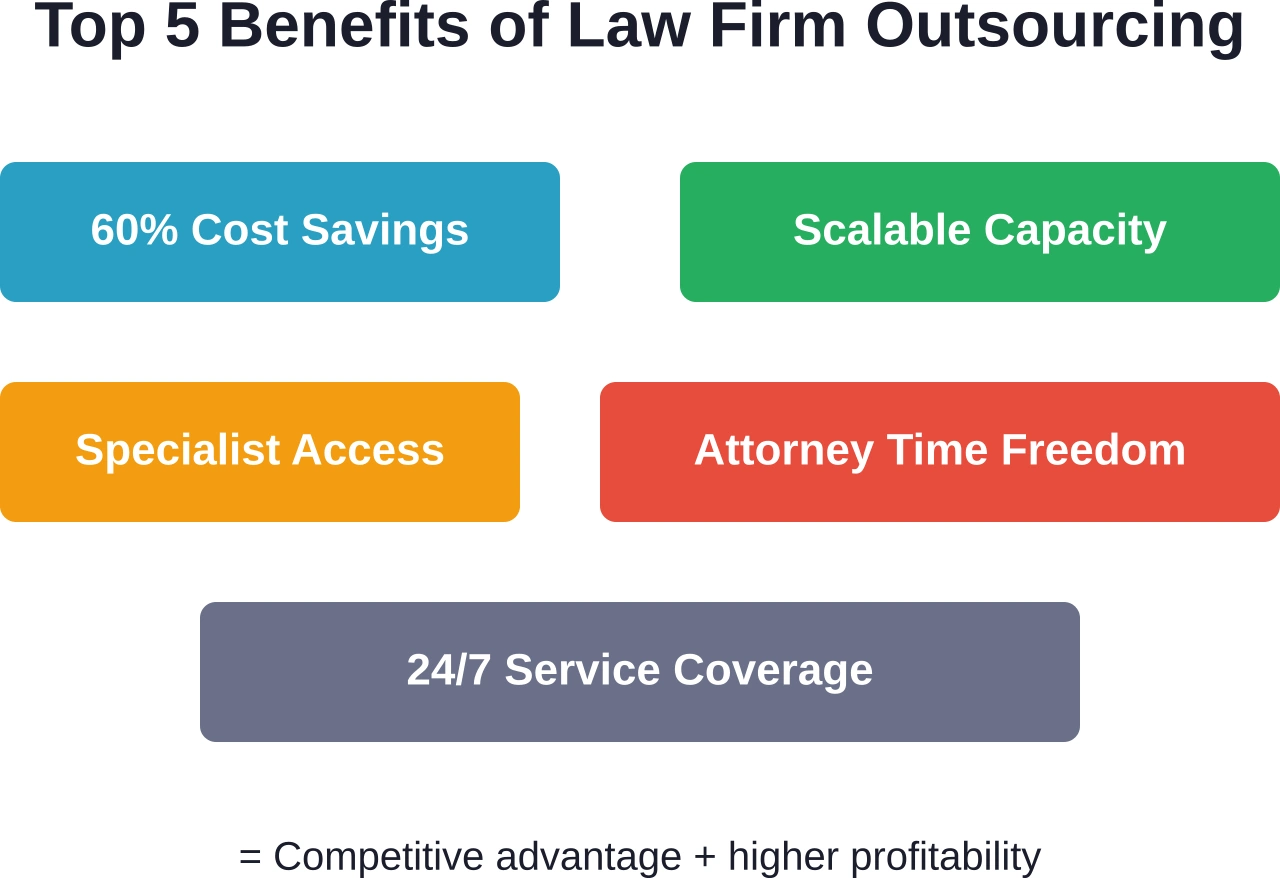
Labor Cost Reduction
Patent application preparation illustrates cost differential benefits. According to research on legal outsourcing, offshore providers can prepare similar applications at substantially lower costs than U.S.-based preparation, with corresponding savings in training and overhead costs.
Industry reports suggest firms can save up to 60% on staffing costs through strategic outsourcing, according to iFIVE Global and other legal outsourcing providers. That's not just offshore—domestic providers with specialized infrastructure and economies of scale offer significant savings compared to hiring full-time staff.
Capacity Expansion Without Fixed Overhead
Hiring an employee means salary, benefits, office space, equipment, training, and management overhead. Outsourcing converts those fixed costs into variable expenses that scale with demand.
When a firm lands a document-heavy case, it can temporarily scale up review capacity without committing to permanent headcount. When the case closes, the expense disappears.
Access to Specialized Expertise
Some tasks require specialized knowledge that doesn't justify a full-time hire. E-discovery technology specialists. Multilingual document reviewers. Forensic accountants. Patent illustrators.
Outsourcing providers maintain deep benches of specialists across disciplines. Firms tap that expertise on demand without building it internally.
Attorney Time Liberation
Real talk: attorneys spend enormous amounts of time on work that doesn't leverage their legal training. Formatting documents. Scheduling depositions. Following up on invoices. Managing software updates.
Delegating those tasks frees attorneys to focus on work that actually requires a law degree—counseling clients, crafting legal strategy, appearing in court, closing deals.
Improved Service Hours and Responsiveness
Offshore providers in different time zones can work while the firm sleeps. A research request submitted at 5 PM Eastern can be completed overnight by a team in India and ready for review the next morning.
That time arbitrage improves turnaround on client deliverables and makes deadlines more manageable.
Most Commonly Outsourced Legal Services
Not every task is a good candidate for outsourcing. The best candidates share certain characteristics: they're repeatable, well-defined, don't require immediate client interaction, and can be quality-checked systematically.
Document Review and E-Discovery
Litigation generates mountains of documents. Someone needs to review them for relevance, privilege, and responsiveness. This work is tedious, time-consuming, and doesn't require senior attorney judgment on every page.
E-discovery and document review represent one of the largest segments of legal outsourcing. Providers use technology-assisted review, predictive coding, and armies of contract attorneys to process documents at scale.
Legal Research and Writing
Researching case law, statutes, and regulations takes hours. Drafting memos summarizing findings takes more hours. Many firms outsource preliminary research, receiving a comprehensive memo that a supervising attorney then reviews and refines.
This works particularly well for routine issues where the legal framework is well-established but application to specific facts requires documentation.
Contract Review and Management
Corporate clients generate contracts constantly—vendor agreements, NDAs, employment offers, lease amendments. Initial review, redlining standard provisions, and flagging unusual terms can be handled by trained contract analysts under attorney supervision.
Patent and Trademark Services
Patent applications involve substantial preparation work—prior art searches, technical drawings, claim drafting, office action responses. This was one of the early success stories for offshore outsourcing, where lawyers with technical backgrounds could prepare applications at a fraction of U.S. costs.
Administrative and Back-Office Functions
These aren't legal tasks per se, but they consume attorney time nonetheless. Intake coordination. Calendar management. Billing and collections. Client communication follow-up. File organization. Many firms outsource these to virtual assistant services or administrative support providers.
Finance and Accounting
Law firms are businesses, and businesses need financial management. Bookkeeping, payroll processing, accounts payable/receivable, financial reporting, tax preparation—all candidates for outsourcing to specialized accounting firms that understand legal industry nuances.
Marketing and Business Development
Content creation, social media management, website maintenance, SEO, email campaigns, graphic design—most attorneys lack both time and expertise for these tasks. Marketing agencies and virtual marketing assistants fill the gap.
IT Support and Cybersecurity
Legal technology grows more complex every year. Practice management software. Document management systems. Client portals. Email security. Data backup. Compliance monitoring. Managed IT service providers handle these systems more reliably and cost-effectively than most firms can manage internally.
Ethical Considerations and Compliance
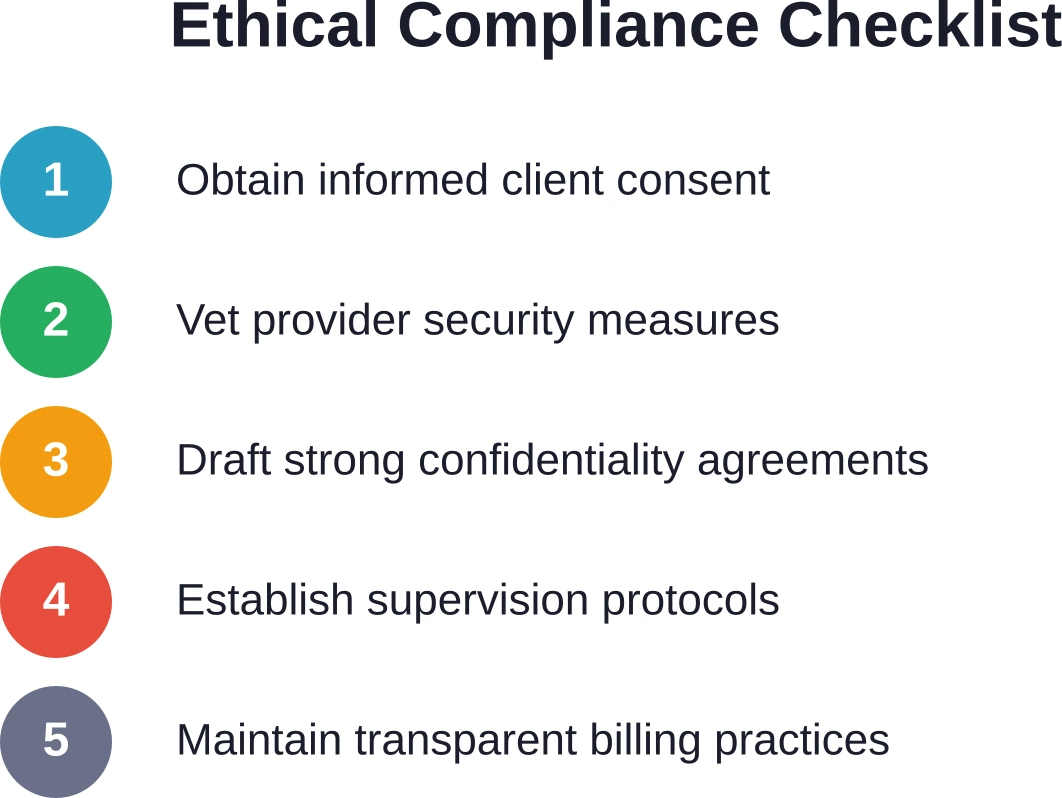
Outsourcing doesn't eliminate attorney responsibility. Law.com's analysis of ethical considerations highlights several non-negotiable obligations.
Client Consent and Communication
Most jurisdictions require informed client consent before outsourcing legal work, particularly when sending work offshore or when the arrangement affects fees. The Texas Disciplinary Rules of Professional Conduct, for example, explicitly address outsourcing obligations.
That consent must be meaningful—clients should understand what work is being outsourced, where it's going, who's performing it, and how their information will be protected.
Supervision and Quality Control
The attorney remains responsible for the work product. Outsourcing doesn't mean abdication. Firms must implement robust supervision protocols, quality review processes, and clear communication channels with providers.
This means vetting providers carefully, establishing clear work standards, reviewing deliverables thoroughly, and providing feedback to improve future performance.
Confidentiality Protection
Client information remains confidential regardless of who handles it. Outsourcing agreements must include strong confidentiality provisions, data security requirements, and clear protocols for information handling.
Firms should evaluate provider security measures—encryption, access controls, employee training, incident response plans. Law.com's coverage emphasizes maintaining information security as a critical outsourcing consideration.
Conflict of Interest Management
Providers working for multiple law firms could create conflicts. Firms must ensure providers have systems to screen for conflicts and prevent information sharing between clients.
Fee Arrangements and Disclosure
Billing for outsourced work requires transparency. Marking up outsourced services beyond the actual cost may require disclosure. Misrepresenting outsourced work as performed by firm attorneys constitutes ethical violation in most jurisdictions.
Choosing the Right Outsourcing Provider
Provider selection makes or breaks an outsourcing arrangement. Law.com's best practices analysis emphasizes due diligence and strategic alignment.
Define Requirements First
Before contacting providers, clarify what needs outsourcing. Which specific tasks? What volume? What quality standards? What turnaround times? What security requirements?
Vague requirements lead to mismatched expectations and disappointing results.
Evaluate Provider Credentials
Look for providers with legal industry experience. Check credentials of their staff—are they trained paralegals, lawyers, or just general contractors? What quality control systems do they maintain?
Ask for references from other law firms. Contact those references and ask pointed questions about quality, reliability, and problem resolution.
Assess Security Infrastructure
Security matters more in legal work than almost any other industry. Evaluate encryption protocols, access controls, employee background checks, facility security, disaster recovery plans, and compliance certifications.
Providers handling sensitive data should meet or exceed the security standards the firm maintains internally.
Test With a Pilot Project
Don't commit to a massive engagement immediately. Start with a small, well-defined project. Evaluate quality, communication, turnaround time, and problem-solving ability.
A successful pilot builds confidence. A problematic pilot reveals issues before they become expensive mistakes.
Establish Clear Communication Channels
How will work be assigned? How will questions be answered? What's the escalation path for urgent issues or quality problems?
The best providers assign dedicated account managers, use project management tools for transparency, and maintain regular check-in schedules.
Review Pricing Structures Carefully
Providers use various pricing models—hourly rates, per-document fees, monthly retainers, project-based pricing. Understand exactly what's included and what costs extra.
Analyses indicate the cheapest option rarely delivers the best value. Focus on cost-effectiveness—the relationship between price and quality delivered.
Implementation Best Practices
Having the right provider is just the beginning. Implementation determines success.
Start Small and Scale Gradually
Resist the temptation to outsource everything at once. Begin with one or two well-defined task categories. Build processes, refine communication, establish quality standards, then expand gradually.
This approach minimizes disruption and allows the firm to learn what works before committing resources broadly.
Document Processes and Standards
Create clear documentation for outsourced tasks—step-by-step procedures, quality standards, formatting requirements, deadline expectations. The more explicit the guidance, the better the results.
This documentation also makes it easier to switch providers if necessary, since processes aren't dependent on institutional knowledge trapped in one vendor relationship.
Invest in Training and Onboarding
Providers need context about the firm's practice areas, client expectations, internal systems, and communication preferences. Allocate time for proper onboarding.
The investment pays dividends in better work product and fewer misunderstandings.
Build Feedback Loops
Establish regular feedback mechanisms—both from attorneys using outsourced services and from providers about process improvements. Quality improves through iteration.
Monitor Performance Metrics
Track key indicators—turnaround time, error rates, client satisfaction, cost per task, revision frequency. Objective data reveals where outsourcing delivers value and where it needs adjustment.
Common Challenges and Solutions
Outsourcing isn't without friction. But most challenges have proven solutions.
Quality Inconsistency
Problem: Work quality varies between projects or over time. Solution: Implement detailed checklists, provide regular feedback, assign dedicated personnel to the firm's work, and conduct periodic quality audits.
Communication Barriers
Problem: Time zones, language differences, or cultural norms create misunderstandings. Solution: Establish overlapping work hours for real-time communication, use video calls to build relationships, document everything in writing, and be explicit rather than assuming shared understanding.
Security Concerns
Problem: Client data moves outside firm control. Solution: Conduct security audits, require encryption for data in transit and at rest, limit access on a need-to-know basis, and include strong contractual protections with audit rights.
Internal Resistance
Problem: Staff worry about job security or resist changing established workflows. Solution: Communicate that outsourcing handles volume overflow and routine tasks, allowing staff to focus on higher-value work. Involve staff in selecting tasks to outsource and choosing providers.
Cost Overruns
Problem: Hidden fees or scope creep push costs beyond budget. Solution: Negotiate fixed-price arrangements for predictable work, establish clear scope boundaries, require approval for additional charges, and monitor invoices carefully.
The Future of Law Firm Outsourcing
The market continues evolving rapidly. Several trends are reshaping outsourcing services:
- Artificial intelligence integration. Providers increasingly combine human expertise with AI tools for document review, contract analysis, and legal research. This hybrid approach delivers speed and cost benefits while maintaining accuracy.
- Specialized niche providers. Rather than general outsourcing firms handling everything, specialized providers focus on specific practice areas—immigration forms, family law document prep, trademark applications. Deep specialization improves quality.
- Collaborative models. Academic research from Case Western Reserve University explores collaborative approaches where U.S. and offshore attorneys work as integrated teams rather than hierarchical vendor relationships.
- Increased regulation. As outsourcing becomes mainstream, bar associations and courts provide more specific guidance on ethical requirements, consent procedures, and supervision standards.
- Nearshoring growth. Some firms are shifting from distant offshore locations to nearshore options in Latin America, balancing cost savings with easier communication and cultural alignment.
Making Outsourcing Work for Your Practice
Law firm outsourcing services have matured from experimental cost-cutting to strategic practice management.
But success requires thoughtful implementation. Firms that rush into outsourcing without proper vetting, clear processes, or ethical compliance risk disappointing results. Those that approach it strategically—starting small, choosing providers carefully, maintaining proper supervision, and refining continuously—discover significant competitive advantages.
The short answer? Outsourcing works when firms treat it as a partnership rather than a transaction, maintain the same standards they'd apply internally, and remember that efficiency gains should enhance client service rather than simply padding margins.
Ready to explore outsourcing for your practice? Start by identifying two or three tasks consuming disproportionate attorney time relative to value generated. Research providers specializing in those services. Interview references. Run a small pilot. Measure results objectively. Then scale what works.
The firms that thrive in 2026 and beyond will be those that focus attorney expertise where it matters most—and strategically delegate everything else.
Frequently Asked Questions
Topics
Law Firm Outsourcing Services Guide 2026

Quick Summary: Law firm outsourcing services allow legal practices to delegate non-core tasks—document review, legal research, administrative work, finance, and IT—to specialized external providers. This guide explores how outsourcing reduces overhead, improves efficiency, and lets attorneys focus on billable work while maintaining quality and ethical compliance.
Legal work has evolved beyond the traditional in-house model. Over the past two decades, law firms have joined the global shift toward outsourcing—sending everything from document processing to patent preparation overseas or to specialized domestic providers.
According to Harvard Law School research, the trend began in the early 2000s when legal services joined IT support, radiology, and debt collection on the list of work moving offshore. What started as simple data entry has grown into a sophisticated market.
The numbers tell the story. According to Thomson Reuters and the Georgetown Law Center for the Study of the Profession, $6.2 billion is spent annually with legal process outsourcing, e-discovery, and document review service providers.
But here's the thing—not all outsourcing arrangements deliver equal value. Success depends on understanding what services to delegate, how to maintain quality control, and which ethical obligations remain non-negotiable.
What Is Legal Process Outsourcing?
Legal process outsourcing (LPO) refers to the practice of hiring external providers to handle legal tasks that don't require the direct involvement of a licensed attorney—or tasks that can be supervised remotely by one.
This isn't the same as offshoring, though the two terms often get conflated. Offshoring specifically means sending work to providers in other countries, typically to reduce labor costs. Legal process outsourcing is broader—it includes domestic providers, nearshore arrangements, and offshore partnerships.
The work ranges widely. Document review for litigation. Legal research for briefs. Patent application preparation. Contract analysis. Administrative support. Finance and accounting. IT management. Marketing. Even specialized tasks like e-discovery processing.
The common thread? These are functions that, while essential, don't require the expertise of a high-billing attorney sitting in the firm's office.
Add Operational Support to Your Law Firm With NeoWork
Law firms often spend significant time on administrative work that supports legal services. NeoWork provides staffing and operational support that can help firms manage routine tasks and improve day-to-day efficiency.
Need Additional Law Firm Support?
NeoWork can help with:
- legal administrative tasks
- document organization
- client communication
- workflow coordination
👉 Contact NeoWork to discuss your legal support requirements.
Why Law Firms Turn to Outsourcing Services
Cost pressure drives most initial interest. Solo practitioners and small firms feel the squeeze particularly hard—74% of US law firms report spending too much time on administrative tasks that don't generate revenue.
But cost isn't the only factor. Here's what makes outsourcing attractive:
Labor Cost Reduction
Patent application preparation illustrates cost differential benefits. According to research on legal outsourcing, offshore providers can prepare similar applications at substantially lower costs than U.S.-based preparation, with corresponding savings in training and overhead costs.
Industry reports suggest firms can save up to 60% on staffing costs through strategic outsourcing, according to iFIVE Global and other legal outsourcing providers. That's not just offshore—domestic providers with specialized infrastructure and economies of scale offer significant savings compared to hiring full-time staff.
Capacity Expansion Without Fixed Overhead
Hiring an employee means salary, benefits, office space, equipment, training, and management overhead. Outsourcing converts those fixed costs into variable expenses that scale with demand.
When a firm lands a document-heavy case, it can temporarily scale up review capacity without committing to permanent headcount. When the case closes, the expense disappears.
Access to Specialized Expertise
Some tasks require specialized knowledge that doesn't justify a full-time hire. E-discovery technology specialists. Multilingual document reviewers. Forensic accountants. Patent illustrators.
Outsourcing providers maintain deep benches of specialists across disciplines. Firms tap that expertise on demand without building it internally.
Attorney Time Liberation
Real talk: attorneys spend enormous amounts of time on work that doesn't leverage their legal training. Formatting documents. Scheduling depositions. Following up on invoices. Managing software updates.
Delegating those tasks frees attorneys to focus on work that actually requires a law degree—counseling clients, crafting legal strategy, appearing in court, closing deals.
Improved Service Hours and Responsiveness
Offshore providers in different time zones can work while the firm sleeps. A research request submitted at 5 PM Eastern can be completed overnight by a team in India and ready for review the next morning.
That time arbitrage improves turnaround on client deliverables and makes deadlines more manageable.
Most Commonly Outsourced Legal Services
Not every task is a good candidate for outsourcing. The best candidates share certain characteristics: they're repeatable, well-defined, don't require immediate client interaction, and can be quality-checked systematically.
Document Review and E-Discovery
Litigation generates mountains of documents. Someone needs to review them for relevance, privilege, and responsiveness. This work is tedious, time-consuming, and doesn't require senior attorney judgment on every page.
E-discovery and document review represent one of the largest segments of legal outsourcing. Providers use technology-assisted review, predictive coding, and armies of contract attorneys to process documents at scale.
Legal Research and Writing
Researching case law, statutes, and regulations takes hours. Drafting memos summarizing findings takes more hours. Many firms outsource preliminary research, receiving a comprehensive memo that a supervising attorney then reviews and refines.
This works particularly well for routine issues where the legal framework is well-established but application to specific facts requires documentation.
Contract Review and Management
Corporate clients generate contracts constantly—vendor agreements, NDAs, employment offers, lease amendments. Initial review, redlining standard provisions, and flagging unusual terms can be handled by trained contract analysts under attorney supervision.
Patent and Trademark Services
Patent applications involve substantial preparation work—prior art searches, technical drawings, claim drafting, office action responses. This was one of the early success stories for offshore outsourcing, where lawyers with technical backgrounds could prepare applications at a fraction of U.S. costs.
Administrative and Back-Office Functions
These aren't legal tasks per se, but they consume attorney time nonetheless. Intake coordination. Calendar management. Billing and collections. Client communication follow-up. File organization. Many firms outsource these to virtual assistant services or administrative support providers.
Finance and Accounting
Law firms are businesses, and businesses need financial management. Bookkeeping, payroll processing, accounts payable/receivable, financial reporting, tax preparation—all candidates for outsourcing to specialized accounting firms that understand legal industry nuances.
Marketing and Business Development
Content creation, social media management, website maintenance, SEO, email campaigns, graphic design—most attorneys lack both time and expertise for these tasks. Marketing agencies and virtual marketing assistants fill the gap.
IT Support and Cybersecurity
Legal technology grows more complex every year. Practice management software. Document management systems. Client portals. Email security. Data backup. Compliance monitoring. Managed IT service providers handle these systems more reliably and cost-effectively than most firms can manage internally.
Ethical Considerations and Compliance
Outsourcing doesn't eliminate attorney responsibility. Law.com's analysis of ethical considerations highlights several non-negotiable obligations.
Client Consent and Communication
Most jurisdictions require informed client consent before outsourcing legal work, particularly when sending work offshore or when the arrangement affects fees. The Texas Disciplinary Rules of Professional Conduct, for example, explicitly address outsourcing obligations.
That consent must be meaningful—clients should understand what work is being outsourced, where it's going, who's performing it, and how their information will be protected.
Supervision and Quality Control
The attorney remains responsible for the work product. Outsourcing doesn't mean abdication. Firms must implement robust supervision protocols, quality review processes, and clear communication channels with providers.
This means vetting providers carefully, establishing clear work standards, reviewing deliverables thoroughly, and providing feedback to improve future performance.
Confidentiality Protection
Client information remains confidential regardless of who handles it. Outsourcing agreements must include strong confidentiality provisions, data security requirements, and clear protocols for information handling.
Firms should evaluate provider security measures—encryption, access controls, employee training, incident response plans. Law.com's coverage emphasizes maintaining information security as a critical outsourcing consideration.
Conflict of Interest Management
Providers working for multiple law firms could create conflicts. Firms must ensure providers have systems to screen for conflicts and prevent information sharing between clients.
Fee Arrangements and Disclosure
Billing for outsourced work requires transparency. Marking up outsourced services beyond the actual cost may require disclosure. Misrepresenting outsourced work as performed by firm attorneys constitutes ethical violation in most jurisdictions.
Choosing the Right Outsourcing Provider
Provider selection makes or breaks an outsourcing arrangement. Law.com's best practices analysis emphasizes due diligence and strategic alignment.
Define Requirements First
Before contacting providers, clarify what needs outsourcing. Which specific tasks? What volume? What quality standards? What turnaround times? What security requirements?
Vague requirements lead to mismatched expectations and disappointing results.
Evaluate Provider Credentials
Look for providers with legal industry experience. Check credentials of their staff—are they trained paralegals, lawyers, or just general contractors? What quality control systems do they maintain?
Ask for references from other law firms. Contact those references and ask pointed questions about quality, reliability, and problem resolution.
Assess Security Infrastructure
Security matters more in legal work than almost any other industry. Evaluate encryption protocols, access controls, employee background checks, facility security, disaster recovery plans, and compliance certifications.
Providers handling sensitive data should meet or exceed the security standards the firm maintains internally.
Test With a Pilot Project
Don't commit to a massive engagement immediately. Start with a small, well-defined project. Evaluate quality, communication, turnaround time, and problem-solving ability.
A successful pilot builds confidence. A problematic pilot reveals issues before they become expensive mistakes.
Establish Clear Communication Channels
How will work be assigned? How will questions be answered? What's the escalation path for urgent issues or quality problems?
The best providers assign dedicated account managers, use project management tools for transparency, and maintain regular check-in schedules.
Review Pricing Structures Carefully
Providers use various pricing models—hourly rates, per-document fees, monthly retainers, project-based pricing. Understand exactly what's included and what costs extra.
Analyses indicate the cheapest option rarely delivers the best value. Focus on cost-effectiveness—the relationship between price and quality delivered.
Implementation Best Practices
Having the right provider is just the beginning. Implementation determines success.
Start Small and Scale Gradually
Resist the temptation to outsource everything at once. Begin with one or two well-defined task categories. Build processes, refine communication, establish quality standards, then expand gradually.
This approach minimizes disruption and allows the firm to learn what works before committing resources broadly.
Document Processes and Standards
Create clear documentation for outsourced tasks—step-by-step procedures, quality standards, formatting requirements, deadline expectations. The more explicit the guidance, the better the results.
This documentation also makes it easier to switch providers if necessary, since processes aren't dependent on institutional knowledge trapped in one vendor relationship.
Invest in Training and Onboarding
Providers need context about the firm's practice areas, client expectations, internal systems, and communication preferences. Allocate time for proper onboarding.
The investment pays dividends in better work product and fewer misunderstandings.
Build Feedback Loops
Establish regular feedback mechanisms—both from attorneys using outsourced services and from providers about process improvements. Quality improves through iteration.
Monitor Performance Metrics
Track key indicators—turnaround time, error rates, client satisfaction, cost per task, revision frequency. Objective data reveals where outsourcing delivers value and where it needs adjustment.
Common Challenges and Solutions
Outsourcing isn't without friction. But most challenges have proven solutions.
Quality Inconsistency
Problem: Work quality varies between projects or over time. Solution: Implement detailed checklists, provide regular feedback, assign dedicated personnel to the firm's work, and conduct periodic quality audits.
Communication Barriers
Problem: Time zones, language differences, or cultural norms create misunderstandings. Solution: Establish overlapping work hours for real-time communication, use video calls to build relationships, document everything in writing, and be explicit rather than assuming shared understanding.
Security Concerns
Problem: Client data moves outside firm control. Solution: Conduct security audits, require encryption for data in transit and at rest, limit access on a need-to-know basis, and include strong contractual protections with audit rights.
Internal Resistance
Problem: Staff worry about job security or resist changing established workflows. Solution: Communicate that outsourcing handles volume overflow and routine tasks, allowing staff to focus on higher-value work. Involve staff in selecting tasks to outsource and choosing providers.
Cost Overruns
Problem: Hidden fees or scope creep push costs beyond budget. Solution: Negotiate fixed-price arrangements for predictable work, establish clear scope boundaries, require approval for additional charges, and monitor invoices carefully.
The Future of Law Firm Outsourcing
The market continues evolving rapidly. Several trends are reshaping outsourcing services:
- Artificial intelligence integration. Providers increasingly combine human expertise with AI tools for document review, contract analysis, and legal research. This hybrid approach delivers speed and cost benefits while maintaining accuracy.
- Specialized niche providers. Rather than general outsourcing firms handling everything, specialized providers focus on specific practice areas—immigration forms, family law document prep, trademark applications. Deep specialization improves quality.
- Collaborative models. Academic research from Case Western Reserve University explores collaborative approaches where U.S. and offshore attorneys work as integrated teams rather than hierarchical vendor relationships.
- Increased regulation. As outsourcing becomes mainstream, bar associations and courts provide more specific guidance on ethical requirements, consent procedures, and supervision standards.
- Nearshoring growth. Some firms are shifting from distant offshore locations to nearshore options in Latin America, balancing cost savings with easier communication and cultural alignment.
Making Outsourcing Work for Your Practice
Law firm outsourcing services have matured from experimental cost-cutting to strategic practice management.
But success requires thoughtful implementation. Firms that rush into outsourcing without proper vetting, clear processes, or ethical compliance risk disappointing results. Those that approach it strategically—starting small, choosing providers carefully, maintaining proper supervision, and refining continuously—discover significant competitive advantages.
The short answer? Outsourcing works when firms treat it as a partnership rather than a transaction, maintain the same standards they'd apply internally, and remember that efficiency gains should enhance client service rather than simply padding margins.
Ready to explore outsourcing for your practice? Start by identifying two or three tasks consuming disproportionate attorney time relative to value generated. Research providers specializing in those services. Interview references. Run a small pilot. Measure results objectively. Then scale what works.
The firms that thrive in 2026 and beyond will be those that focus attorney expertise where it matters most—and strategically delegate everything else.
Frequently Asked Questions
Topics
Related Blogs
Related Podcasts


.webp)
.webp)



