

.avif)
.avif)

Legal Back Office Outsourcing Guide 2026


.svg)

Quick Summary: Legal back office outsourcing enables law firms to delegate administrative and operational tasks to specialized external providers, reducing costs by 30–50%, freeing billable hours, and improving efficiency. This comprehensive guide covers what legal back office outsourcing is, key benefits, implementation strategies, compliance considerations, and how to choose the right provider for your firm's growth.
What Is Legal Back Office Outsourcing?
Legal back office outsourcing refers to delegating administrative, operational, and support functions to external service providers rather than handling them in-house. These tasks range from accounting and billing to HR, IT management, and document processing. It's not about outsourcing legal advice—it's about freeing your lawyers to focus on billable work by letting specialists handle the business side.
The distinction matters. Legal process outsourcing (LPO) covers legal work like research, document review, and e-discovery. Back office outsourcing handles the operational machinery that keeps a firm running: timekeeping, payroll, compliance reporting, and case administration. Many firms use both.
Back office functions are often repetitive, compliance-heavy, and time-consuming. Outsourcing them isn't about cost-cutting—it's about strategic reallocation. A paralegal freed from data entry can focus on case work. An office manager no longer buried in HR paperwork can concentrate on firm growth initiatives.
The Growing Market for Legal Back Office Solutions
The legal process outsourcing market—which includes back office services—reached $15.3 billion globally in 2023 and is projected to reach $132.6 billion by 2033. That's explosive growth, driven by law firms recognizing that outsourcing isn't a sign of weakness—it's a competitive necessity.
What's fueling this expansion? Pressure from clients demanding lower bills, talent shortages making it hard to hire locally, and the realization that non-legal work doesn't require premium attorney salaries. Large enterprises currently account for 64.05% of legal process outsourcing spending, but mid-size and smaller firms are catching up fast.
Asia-Pacific represents 63% of the global LPO market share, primarily because firms can access skilled labor at a fraction of U.S. or European costs. But the trend is global. Even top-tier U.S. firms now outsource routine back office work to nearshore or onshore providers.
Key Benefits of Legal Back Office Outsourcing
Cost Reduction
The primary benefit is financial. Firms can cut costs by 30–50% by outsourcing back office functions, depending on the region and service model. Why? Outsourcing providers operate at scale. They don't need to maintain expensive real estate for every function. A single contract management center can serve 50 firms instead of each firm hiring its own staff.
Beyond labor savings, you eliminate overhead: fewer desks, less IT infrastructure, reduced benefits liability, and lower training costs. A mid-size firm that outsources accounting, HR, and IT support can redirect those savings into attorney recruitment or client development.
Increased Billable Hours
When paralegals and staff aren't processing invoices or managing timesheets, they work on billable tasks. A study cited by industry leaders shows that firms reclaim 10–15 hours per week per staff member when back office work is outsourced. Multiply that across a 20-person firm, and you're looking at 200–300 additional billable hours per week.
For a firm billing at $200/hour for paralegal time, that's $40,000–$60,000 in weekly revenue—just from efficiency gains.
Scalability Without Growth Pains
Outsourcing providers scale with you. Landing a new client doesn't mean hiring new staff immediately. You scale with your vendor, paying only for services used. This is especially valuable for growing firms that can't predict staffing needs six months ahead.
Access to Specialized Expertise
Legal back office work involves compliance frameworks (GDPR, CCPA, HIPAA), accounting standards, and IT security protocols that evolve constantly. Outsourcing partners invest in expertise and training. They're updated on regulatory changes before most firms are aware of them.
A three-person finance team can't match the depth a dedicated outsourcing provider offers. You get access to specialists without hiring them full-time.
Reduced Liability and Compliance Risk
Outsourcing providers carry professional liability insurance and maintain robust data security. They're audited. They're GDPR-compliant, SOC 2-certified, and follow legal industry standards. Your data is often more secure with them than it would be in-house.
What Tasks Should You Outsource?
Not all back office work is created equal. Some tasks are ideal for outsourcing; others benefit from in-house control. Here's a practical breakdown:
A good rule of thumb: if the task is repetitive, rule-based, and doesn't require direct client interaction, it's a candidate for outsourcing.
Compliance and Legal Considerations
Outsourcing comes with regulatory obligations. Firms remain liable for client data, even when vendors handle it. Here are critical compliance areas:
Data Protection and Privacy
GDPR, CCPA, and HIPAA impose strict requirements on data handling. When you outsource, ensure your vendor maintains explicit consent for data processing, implements encryption, and allows individuals rights to access, rectify, and erase their data (the "right to be forgotten").
Ask vendors for SOC 2 Type II certification, data processing agreements (DPAs), and proof of regular security audits. This isn't optional—it's your legal responsibility.
Attorney-Client Privilege
Non-lawyers handling sensitive case information can inadvertently waive privilege. Establish confidentiality agreements with vendors. Ensure they understand that case information is privileged. Some firms require vendors to employ attorneys or paralegals with legal training.
Labor and Employment Laws
When outsourcing to a vendor, that vendor is responsible for payroll, benefits, and labor compliance—not you. But verify they comply with the Fair Labor Standards Act (FLSA), which governs minimum wage, overtime pay, and recordkeeping. If they employ subcontractors or temporary staff, ensure those workers meet wage and labor standards.
Audit and Compliance Oversight
Your outsourcing agreement should grant you the right to audit vendor records and systems. If an audit uncovers errors, establish a clear reimbursement clause. Industry standards suggest vendors reimburse overcharges plus audit costs if the overcharge exceeds a 10% threshold.
How to Choose a Legal Back Office Provider
Selecting the wrong vendor can create more problems than outsourcing solves. Here's a framework for evaluation:
Assess Your Needs First
Define exactly what you want to outsource. Is it accounting only? HR and payroll? IT and records management? The broader your scope, the more you benefit from a single integrated vendor, but make sure they excel in each area.
Verify Industry Expertise
A vendor with 15 years managing law firm operations understands attorney billing cycles, trust account requirements, and legal compliance better than a generic BPO. Ask about their legal industry experience and client references.
Check Security and Certifications
Look for SOC 2 Type II, GDPR compliance, ISO 27001, or equivalent security certifications. Ask about their data centers, encryption standards, disaster recovery, and business continuity plans. This isn't trivial—a breach could destroy your client relationships.
Evaluate Communication and Support
Outsourcing only works if communication is seamless. Can you reach your vendor easily? Do they provide regular reporting and performance metrics? Will they integrate with your existing systems (case management software, accounting tools, etc.)?
Negotiate Service Level Agreements (SLAs)
Don't sign without clear SLAs. Define turnaround times for accounting close-outs, response times for support tickets, and uptime guarantees. Build in escalation procedures and penalties for missed targets.
Compare Pricing Models
Outsourcing vendors typically charge via fixed monthly fees, per-transaction fees, or hybrid models. Fixed fees are predictable but lock you in. Per-transaction fees scale with volume but are unpredictable. Hybrid models offer flexibility—find what works for your firm's cash flow.

Organize Legal Back Office Work with NeoWork
Legal back office outsourcing should support routine legal operations without replacing legal judgment or attorney-led work. NeoWork can help with transcriptionist staff, virtual assistants, records management, document support, and admin tasks that keep legal workflows easier to manage.
This can be useful for law firms, in-house legal teams, and companies that need help with written records, document organization, repetitive admin tasks, and back-office coordination. NeoWork provides transcriptionist staff for legal proceedings, business meetings, and other audio-to-document needs, while its virtual assistant support covers admin and operational work. The company also reports a 91% annualized teammate retention rate and a 3.2% candidate selectivity rate, which matters when legal support depends on consistency, confidentiality, and attention to detail.
Legal back office tasks NeoWork can provide:
- legal transcription and written records
- document and records management support
- admin tasks for legal workflows
- virtual assistant support for routine operations
👉Contact NeoWork to build legal back office support that keeps records, documents, and recurring admin work organized while your legal team stays focused on legal strategy.
Implementation Strategy: Getting Started
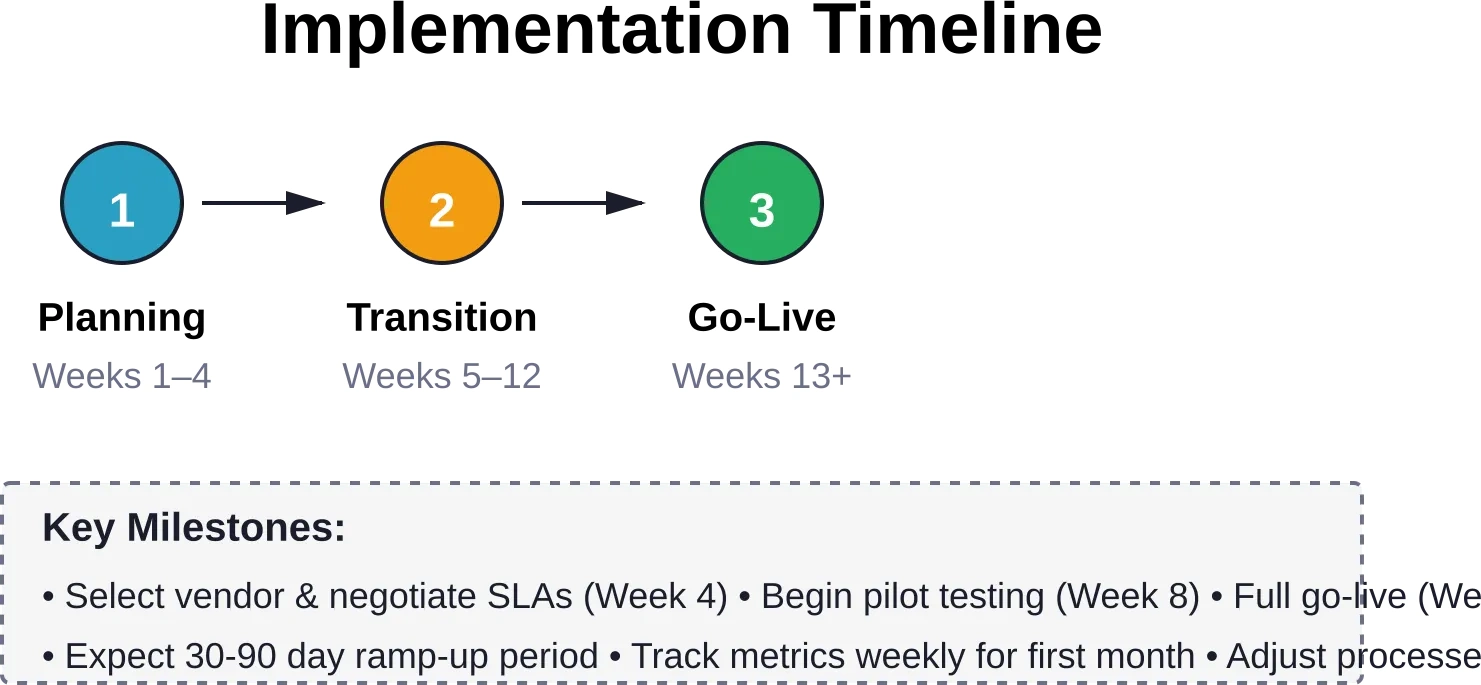
Moving work to an outsourcing vendor requires planning. A poorly executed transition creates chaos. Here's a phased approach:
Phase 1: Planning and Selection (Weeks 1–4)
Audit current processes. Document workflows, identify pain points, and define success metrics. Run an RFP (request for proposal) to 3–5 vendors. Interview finalists and negotiate terms.
Phase 2: Transition and Knowledge Transfer (Weeks 5–12)
Provide detailed documentation of your processes. Assign an internal point person to work with the vendor. Start with a pilot—outsource one function first, not everything simultaneously. This allows you to course-correct before full rollout.
Phase 3: Go-Live and Monitoring (Weeks 13+)
Launch full outsourcing. Track metrics daily for the first month, weekly thereafter. Build in review checkpoints at 30, 90, and 180 days. Be prepared to adjust as you learn what works.
Real talk: the first 90 days will feel slower than in-house. Vendors need time to ramp up. If you set expectations properly and maintain oversight, efficiency gains appear by month four or five.
Measuring Success: Metrics That Matter
After outsourcing, track these metrics to prove ROI:
- Cost Savings: Monthly spend on back office functions before versus after. Target: 30–50% reduction.
- Billable Hours Reclaimed: Hours staff spent on back office work; now redirected to client work. Multiply by your billing rate for revenue impact.
- Processing Time: Days to close accounting, process payroll, or resolve HR issues. Vendors should reduce this by 40–60%.
- Error Rate: Number of billing disputes, payroll errors, or compliance issues per quarter. Target: near-zero after stabilization.
- Staff Satisfaction: Survey staff monthly. Outsourcing should reduce their administrative burden, boosting morale.
- Client Satisfaction: Track client feedback on billing accuracy and responsiveness. Outsourcing shouldn't degrade client experience.
Review these metrics monthly for the first six months, then quarterly. If numbers aren't improving by month three, escalate with your vendor. If they don't improve by month six, consider switching.
Conclusion: The Strategic Advantage of Back Office Outsourcing
Legal back office outsourcing isn't a cost-cutting measure—it's a strategic lever for growth. Firms that outsource administrative work redirect resources toward client development, case strategy, and firm profitability. The math is clear: save 30–50% on back office costs, reclaim 10–15 billable hours per week per staff member, and scale without proportional hiring.
The market is mature. Thousands of firms have outsourced successfully. Compliance frameworks exist. Technology integrations work. The only remaining question is whether your firm will capture this competitive advantage or watch competitors pull ahead.
If your team spends more than 20% of their time on non-billable back office work, outsourcing deserves serious consideration. Start small with a pilot—accounting or HR first. Measure results rigorously. If it works (and the data suggests it will), expand from there.
Ready to explore outsourcing options? Define your pain points, audit current processes, and request proposals from specialized legal back office vendors. The firms building the future of legal practice are already doing this. The question is: will yours be one of them?
Frequently Asked Questions
Topics
Legal Back Office Outsourcing Guide 2026

Quick Summary: Legal back office outsourcing enables law firms to delegate administrative and operational tasks to specialized external providers, reducing costs by 30–50%, freeing billable hours, and improving efficiency. This comprehensive guide covers what legal back office outsourcing is, key benefits, implementation strategies, compliance considerations, and how to choose the right provider for your firm's growth.
What Is Legal Back Office Outsourcing?
Legal back office outsourcing refers to delegating administrative, operational, and support functions to external service providers rather than handling them in-house. These tasks range from accounting and billing to HR, IT management, and document processing. It's not about outsourcing legal advice—it's about freeing your lawyers to focus on billable work by letting specialists handle the business side.
The distinction matters. Legal process outsourcing (LPO) covers legal work like research, document review, and e-discovery. Back office outsourcing handles the operational machinery that keeps a firm running: timekeeping, payroll, compliance reporting, and case administration. Many firms use both.
Back office functions are often repetitive, compliance-heavy, and time-consuming. Outsourcing them isn't about cost-cutting—it's about strategic reallocation. A paralegal freed from data entry can focus on case work. An office manager no longer buried in HR paperwork can concentrate on firm growth initiatives.
The Growing Market for Legal Back Office Solutions
The legal process outsourcing market—which includes back office services—reached $15.3 billion globally in 2023 and is projected to reach $132.6 billion by 2033. That's explosive growth, driven by law firms recognizing that outsourcing isn't a sign of weakness—it's a competitive necessity.
What's fueling this expansion? Pressure from clients demanding lower bills, talent shortages making it hard to hire locally, and the realization that non-legal work doesn't require premium attorney salaries. Large enterprises currently account for 64.05% of legal process outsourcing spending, but mid-size and smaller firms are catching up fast.
Asia-Pacific represents 63% of the global LPO market share, primarily because firms can access skilled labor at a fraction of U.S. or European costs. But the trend is global. Even top-tier U.S. firms now outsource routine back office work to nearshore or onshore providers.
Key Benefits of Legal Back Office Outsourcing
Cost Reduction
The primary benefit is financial. Firms can cut costs by 30–50% by outsourcing back office functions, depending on the region and service model. Why? Outsourcing providers operate at scale. They don't need to maintain expensive real estate for every function. A single contract management center can serve 50 firms instead of each firm hiring its own staff.
Beyond labor savings, you eliminate overhead: fewer desks, less IT infrastructure, reduced benefits liability, and lower training costs. A mid-size firm that outsources accounting, HR, and IT support can redirect those savings into attorney recruitment or client development.
Increased Billable Hours
When paralegals and staff aren't processing invoices or managing timesheets, they work on billable tasks. A study cited by industry leaders shows that firms reclaim 10–15 hours per week per staff member when back office work is outsourced. Multiply that across a 20-person firm, and you're looking at 200–300 additional billable hours per week.
For a firm billing at $200/hour for paralegal time, that's $40,000–$60,000 in weekly revenue—just from efficiency gains.
Scalability Without Growth Pains
Outsourcing providers scale with you. Landing a new client doesn't mean hiring new staff immediately. You scale with your vendor, paying only for services used. This is especially valuable for growing firms that can't predict staffing needs six months ahead.
Access to Specialized Expertise
Legal back office work involves compliance frameworks (GDPR, CCPA, HIPAA), accounting standards, and IT security protocols that evolve constantly. Outsourcing partners invest in expertise and training. They're updated on regulatory changes before most firms are aware of them.
A three-person finance team can't match the depth a dedicated outsourcing provider offers. You get access to specialists without hiring them full-time.
Reduced Liability and Compliance Risk
Outsourcing providers carry professional liability insurance and maintain robust data security. They're audited. They're GDPR-compliant, SOC 2-certified, and follow legal industry standards. Your data is often more secure with them than it would be in-house.
What Tasks Should You Outsource?
Not all back office work is created equal. Some tasks are ideal for outsourcing; others benefit from in-house control. Here's a practical breakdown:
A good rule of thumb: if the task is repetitive, rule-based, and doesn't require direct client interaction, it's a candidate for outsourcing.
Compliance and Legal Considerations
Outsourcing comes with regulatory obligations. Firms remain liable for client data, even when vendors handle it. Here are critical compliance areas:
Data Protection and Privacy
GDPR, CCPA, and HIPAA impose strict requirements on data handling. When you outsource, ensure your vendor maintains explicit consent for data processing, implements encryption, and allows individuals rights to access, rectify, and erase their data (the "right to be forgotten").
Ask vendors for SOC 2 Type II certification, data processing agreements (DPAs), and proof of regular security audits. This isn't optional—it's your legal responsibility.
Attorney-Client Privilege
Non-lawyers handling sensitive case information can inadvertently waive privilege. Establish confidentiality agreements with vendors. Ensure they understand that case information is privileged. Some firms require vendors to employ attorneys or paralegals with legal training.
Labor and Employment Laws
When outsourcing to a vendor, that vendor is responsible for payroll, benefits, and labor compliance—not you. But verify they comply with the Fair Labor Standards Act (FLSA), which governs minimum wage, overtime pay, and recordkeeping. If they employ subcontractors or temporary staff, ensure those workers meet wage and labor standards.
Audit and Compliance Oversight
Your outsourcing agreement should grant you the right to audit vendor records and systems. If an audit uncovers errors, establish a clear reimbursement clause. Industry standards suggest vendors reimburse overcharges plus audit costs if the overcharge exceeds a 10% threshold.
How to Choose a Legal Back Office Provider
Selecting the wrong vendor can create more problems than outsourcing solves. Here's a framework for evaluation:
Assess Your Needs First
Define exactly what you want to outsource. Is it accounting only? HR and payroll? IT and records management? The broader your scope, the more you benefit from a single integrated vendor, but make sure they excel in each area.
Verify Industry Expertise
A vendor with 15 years managing law firm operations understands attorney billing cycles, trust account requirements, and legal compliance better than a generic BPO. Ask about their legal industry experience and client references.
Check Security and Certifications
Look for SOC 2 Type II, GDPR compliance, ISO 27001, or equivalent security certifications. Ask about their data centers, encryption standards, disaster recovery, and business continuity plans. This isn't trivial—a breach could destroy your client relationships.
Evaluate Communication and Support
Outsourcing only works if communication is seamless. Can you reach your vendor easily? Do they provide regular reporting and performance metrics? Will they integrate with your existing systems (case management software, accounting tools, etc.)?
Negotiate Service Level Agreements (SLAs)
Don't sign without clear SLAs. Define turnaround times for accounting close-outs, response times for support tickets, and uptime guarantees. Build in escalation procedures and penalties for missed targets.
Compare Pricing Models
Outsourcing vendors typically charge via fixed monthly fees, per-transaction fees, or hybrid models. Fixed fees are predictable but lock you in. Per-transaction fees scale with volume but are unpredictable. Hybrid models offer flexibility—find what works for your firm's cash flow.
Organize Legal Back Office Work with NeoWork
Legal back office outsourcing should support routine legal operations without replacing legal judgment or attorney-led work. NeoWork can help with transcriptionist staff, virtual assistants, records management, document support, and admin tasks that keep legal workflows easier to manage.
This can be useful for law firms, in-house legal teams, and companies that need help with written records, document organization, repetitive admin tasks, and back-office coordination. NeoWork provides transcriptionist staff for legal proceedings, business meetings, and other audio-to-document needs, while its virtual assistant support covers admin and operational work. The company also reports a 91% annualized teammate retention rate and a 3.2% candidate selectivity rate, which matters when legal support depends on consistency, confidentiality, and attention to detail.
Legal back office tasks NeoWork can provide:
- legal transcription and written records
- document and records management support
- admin tasks for legal workflows
- virtual assistant support for routine operations
👉Contact NeoWork to build legal back office support that keeps records, documents, and recurring admin work organized while your legal team stays focused on legal strategy.
Implementation Strategy: Getting Started
Moving work to an outsourcing vendor requires planning. A poorly executed transition creates chaos. Here's a phased approach:
Phase 1: Planning and Selection (Weeks 1–4)
Audit current processes. Document workflows, identify pain points, and define success metrics. Run an RFP (request for proposal) to 3–5 vendors. Interview finalists and negotiate terms.
Phase 2: Transition and Knowledge Transfer (Weeks 5–12)
Provide detailed documentation of your processes. Assign an internal point person to work with the vendor. Start with a pilot—outsource one function first, not everything simultaneously. This allows you to course-correct before full rollout.
Phase 3: Go-Live and Monitoring (Weeks 13+)
Launch full outsourcing. Track metrics daily for the first month, weekly thereafter. Build in review checkpoints at 30, 90, and 180 days. Be prepared to adjust as you learn what works.
Real talk: the first 90 days will feel slower than in-house. Vendors need time to ramp up. If you set expectations properly and maintain oversight, efficiency gains appear by month four or five.
Measuring Success: Metrics That Matter
After outsourcing, track these metrics to prove ROI:
- Cost Savings: Monthly spend on back office functions before versus after. Target: 30–50% reduction.
- Billable Hours Reclaimed: Hours staff spent on back office work; now redirected to client work. Multiply by your billing rate for revenue impact.
- Processing Time: Days to close accounting, process payroll, or resolve HR issues. Vendors should reduce this by 40–60%.
- Error Rate: Number of billing disputes, payroll errors, or compliance issues per quarter. Target: near-zero after stabilization.
- Staff Satisfaction: Survey staff monthly. Outsourcing should reduce their administrative burden, boosting morale.
- Client Satisfaction: Track client feedback on billing accuracy and responsiveness. Outsourcing shouldn't degrade client experience.
Review these metrics monthly for the first six months, then quarterly. If numbers aren't improving by month three, escalate with your vendor. If they don't improve by month six, consider switching.
Conclusion: The Strategic Advantage of Back Office Outsourcing
Legal back office outsourcing isn't a cost-cutting measure—it's a strategic lever for growth. Firms that outsource administrative work redirect resources toward client development, case strategy, and firm profitability. The math is clear: save 30–50% on back office costs, reclaim 10–15 billable hours per week per staff member, and scale without proportional hiring.
The market is mature. Thousands of firms have outsourced successfully. Compliance frameworks exist. Technology integrations work. The only remaining question is whether your firm will capture this competitive advantage or watch competitors pull ahead.
If your team spends more than 20% of their time on non-billable back office work, outsourcing deserves serious consideration. Start small with a pilot—accounting or HR first. Measure results rigorously. If it works (and the data suggests it will), expand from there.
Ready to explore outsourcing options? Define your pain points, audit current processes, and request proposals from specialized legal back office vendors. The firms building the future of legal practice are already doing this. The question is: will yours be one of them?
Frequently Asked Questions
Topics
Related Blogs
Related Podcasts


.webp)

.webp)
.webp)



