

.avif)
.avif)

Legal Research Outsourcing Guide: Cost Savings & Best Practices


.svg)

Quick Summary: Legal research outsourcing allows law firms to delegate research tasks to specialized external teams, reducing costs by 30–50% while freeing internal resources for high-value work. With 63% of law firms already leveraging outsourcing for legal services, this strategy has become essential for maintaining competitiveness and improving efficiency.
Lawyers spend roughly 30% of their time on legal research and writing. That's significant—time that could be redirected toward client relationships, case strategy, or business development. Legal research outsourcing flips this script by transferring routine research tasks to specialized teams, allowing attorneys to focus on work that drives revenue and builds client value.
But what exactly is legal research outsourcing, and how does it work? More importantly, does it actually deliver the cost savings and efficiency gains that firms claim? This guide breaks down everything modern law practices need to know.
What Is Legal Research Outsourcing?
Legal research outsourcing (LRO) is the practice of delegating legal research and analysis work to external service providers—either onshore, nearshore, or offshore. These providers may be contract attorneys, specialized research firms, or dedicated legal process outsourcing (LPO) companies.
Rather than keeping all research in-house, firms shift specific projects or ongoing research tasks to teams with expertise in statutory analysis, case law research, document review, legal writing, and other foundational legal work. The outsourced team delivers research, memos, briefs, or analysis back to the hiring firm, which supervises quality and client relationships.

NeoWork: Add Administrative Support to Legal Workflows
Legal research projects often involve document review, records organization, information gathering, and case-related administrative work. NeoWork provides staffing and operational support that can help legal teams manage these tasks and maintain organized workflows.
Need Additional Legal Research Support?
NeoWork can help with:
- document and records organization
- legal workflow administration
- information management support
- client communication and scheduling
👉 Contact NeoWork to discuss your legal support requirements.
Core Benefits of Legal Research Outsourcing
Cost Reduction
The most immediate advantage is cost. Firms can reduce expenditures on foundational research by 30–50%, depending on the geographic region where work is outsourced. Nearshoring—outsourcing to regions with high-quality talent but lower labor costs—decouples payroll from hyper-inflated local markets without sacrificing quality.
Instead of hiring full-time on-site staff, firms pay only for the research work they need. This model scales with demand: busy periods require more outsourced hours; slower periods require less.
Capacity and Speed
Outsourced teams can absorb sudden workload spikes without requiring long hiring cycles. Complex cases demanding extensive research no longer bottleneck internal resources. Work gets completed faster because dedicated research teams focus exclusively on analysis and legal writing.
Staff Focus and Retention
By removing routine research tasks, attorneys spend more time on client interaction, case strategy, and business development. This isn't just about productivity—it's about job satisfaction. Lawyers hired for their judgment and expertise feel more engaged when they're not drowning in research.
Expertise Access
Specialized outsourcing providers employ researchers with deep expertise in specific practice areas: tax law, employment law, intellectual property, litigation support. Small and mid-sized firms gain access to this specialized knowledge without recruiting and retaining expensive senior specialists full-time.
How Legal Research Outsourcing Works: The Process
The workflow is straightforward but requires clear communication and oversight.
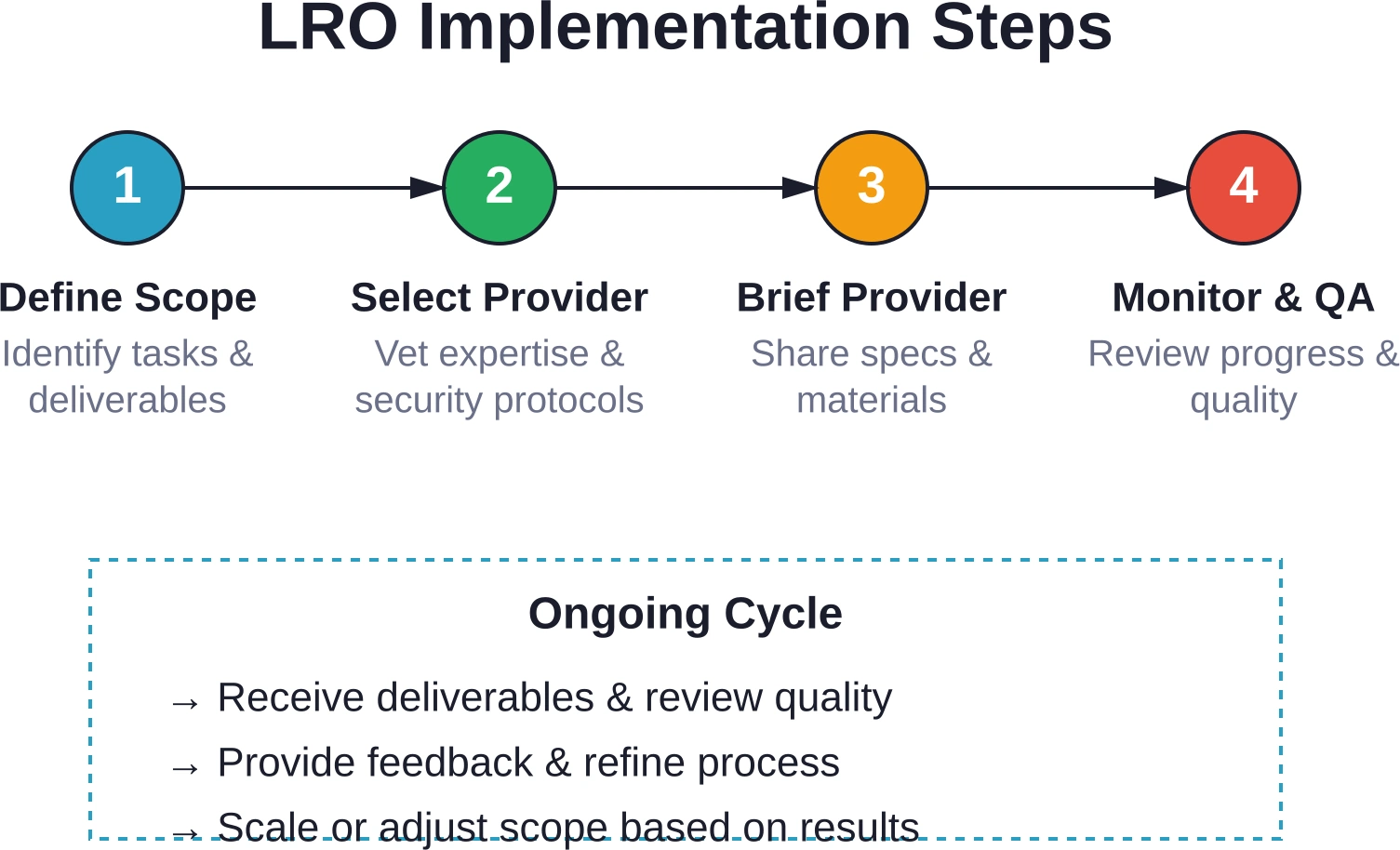
Step 1: Define Scope and Deliverables
Start by identifying exactly what tasks you want to outsource. Are you delegating preliminary legal research for case preparation? Document review? Legal memoranda on specific statutes or case law? The clearer your specifications, the better results you'll receive.
Step 2: Select a Provider
Research potential providers. Look for firms with expertise in your practice area, strong security and confidentiality protocols, and references from other law firms. Check whether they offer onshore, nearshore, or offshore options—each has different cost and communication implications.
Step 3: Brief the Team
Provide detailed project briefs: case facts, legal questions, relevant statutes or prior cases, formatting preferences, and deadlines. The more complete your briefing, the faster the provider produces usable work.
Step 4: Monitor and Ensure Quality
Quality assurance is critical. Review deliverables carefully, provide clear feedback, and establish standards early. This isn't about micromanaging—it's about ensuring the work meets your firm's standards and client expectations.
Ethics, Confidentiality, and Client Consent
Legal outsourcing raises legitimate concerns about confidentiality, privilege, and ethical compliance. Here's what firms need to address:
- Client Communication. Notify clients that their work is being researched by external teams. Most bar associations require disclosure. Make confidentiality part of your engagement letter.
- Data Security. Ensure outsourcing partners have robust security measures: encrypted communications, secure file transfer, access controls, and confidentiality agreements. A data breach isn't just an embarrassment—it's a liability.
- Privilege and Confidentiality. Work-product privilege and attorney-client privilege apply to outsourced research. However, the way you communicate and share materials can affect protection. Establish clear protocols with your provider.
- Regulatory Compliance. Different jurisdictions have varying rules about outsourcing. The Law Society (UK) and bar associations globally have issued guidance on outsourcing practices. Familiarize yourself with requirements in your jurisdiction.
Industry Trends and Future Outlook
Artificial intelligence is transforming legal research outsourcing. Recent data indicates that AI has the potential to automate up to 25% of a lawyer's time, and AI-powered tools have achieved 70% reductions in document review times. These aren't replacing human researchers—they're amplifying their efficiency.
Providers are increasingly embedding AI into research workflows to speed analysis, identify relevant case law automatically, and flag inconsistencies. Firms considering outsourcing should evaluate whether their provider uses AI-assisted tools to improve turnaround time and accuracy.
Additionally, the shift toward nearshoring continues to grow. Instead of offshoring to countries with minimal regulatory overlap, many firms prefer nearshore providers—geographically closer, in similar time zones, with aligned legal systems. This reduces communication friction without sacrificing cost savings.
Selecting the Right Legal Research Outsourcing Provider
Not all providers are equal. When evaluating partners, consider these factors:
Common Pitfalls to Avoid
Even with good intentions, firms sometimes stumble in their outsourcing journey.
- Vague Briefings. Outsourcing providers can't read minds. If your instructions are ambiguous, expect ambiguous results. Invest time in clear, detailed project specifications.
- Ignoring Quality Control. Cost savings mean nothing if the research is unusable or inaccurate. Build QA into your workflow from day one.
- Overloading Small Providers. If you outsource to a boutique firm, don't suddenly demand five major projects simultaneously. Respect their capacity constraints.
- Neglecting Security Protocols. Cutting corners on data protection is never worth the risk. Verify that your provider's security measures match your standards.
- Assuming One Provider Fits All. A provider excellent at contract analysis might struggle with litigation research. Match the provider's strengths to your project type.
Getting Started: A Practical Roadmap
Ready to explore legal research outsourcing? Here's how to begin responsibly:
- Audit your workflow. Identify which tasks consume the most attorney time and which could be safely delegated.
- Start small. Pilot outsourcing on a single, well-scoped project before scaling.
- Document your process. Create templates and guidelines for briefing providers and reviewing deliverables.
- Brief your team. Attorneys and paralegals need to understand the outsourcing workflow and communicate expectations clearly.
- Evaluate and refine. After the pilot, assess results. What worked? What needs adjustment? Use this feedback to scale.
Conclusion
Legal research outsourcing is no longer experimental—it's a core strategy for competitive law firms. With 63% of firms already using outsourcing for legal services, staying isolated by doing all research in-house increasingly limits growth and profitability.
The economics are compelling: 30–50% cost reduction, capacity to handle larger caseloads, and attorney time freed for high-value work. The market is expected to grow steadily, driven by cost pressure, demand for specialized expertise, and advancing AI capabilities.
The key to success isn't outsourcing indiscriminately—it's selecting the right provider, defining clear scope, maintaining rigorous quality control, and ensuring ethical compliance. Start small, learn the process, and scale thoughtfully.
If your firm is drowning in routine research while missing business development opportunities, legal research outsourcing might be exactly the lever you need to unlock growth. The question isn't whether to outsource—it's how to do it right.
FAQ: Legal Research Outsourcing Questions Answered
Topics
Legal Research Outsourcing Guide: Cost Savings & Best Practices

Quick Summary: Legal research outsourcing allows law firms to delegate research tasks to specialized external teams, reducing costs by 30–50% while freeing internal resources for high-value work. With 63% of law firms already leveraging outsourcing for legal services, this strategy has become essential for maintaining competitiveness and improving efficiency.
Lawyers spend roughly 30% of their time on legal research and writing. That's significant—time that could be redirected toward client relationships, case strategy, or business development. Legal research outsourcing flips this script by transferring routine research tasks to specialized teams, allowing attorneys to focus on work that drives revenue and builds client value.
But what exactly is legal research outsourcing, and how does it work? More importantly, does it actually deliver the cost savings and efficiency gains that firms claim? This guide breaks down everything modern law practices need to know.
What Is Legal Research Outsourcing?
Legal research outsourcing (LRO) is the practice of delegating legal research and analysis work to external service providers—either onshore, nearshore, or offshore. These providers may be contract attorneys, specialized research firms, or dedicated legal process outsourcing (LPO) companies.
Rather than keeping all research in-house, firms shift specific projects or ongoing research tasks to teams with expertise in statutory analysis, case law research, document review, legal writing, and other foundational legal work. The outsourced team delivers research, memos, briefs, or analysis back to the hiring firm, which supervises quality and client relationships.
NeoWork: Add Administrative Support to Legal Workflows
Legal research projects often involve document review, records organization, information gathering, and case-related administrative work. NeoWork provides staffing and operational support that can help legal teams manage these tasks and maintain organized workflows.
Need Additional Legal Research Support?
NeoWork can help with:
- document and records organization
- legal workflow administration
- information management support
- client communication and scheduling
👉 Contact NeoWork to discuss your legal support requirements.
Core Benefits of Legal Research Outsourcing
Cost Reduction
The most immediate advantage is cost. Firms can reduce expenditures on foundational research by 30–50%, depending on the geographic region where work is outsourced. Nearshoring—outsourcing to regions with high-quality talent but lower labor costs—decouples payroll from hyper-inflated local markets without sacrificing quality.
Instead of hiring full-time on-site staff, firms pay only for the research work they need. This model scales with demand: busy periods require more outsourced hours; slower periods require less.
Capacity and Speed
Outsourced teams can absorb sudden workload spikes without requiring long hiring cycles. Complex cases demanding extensive research no longer bottleneck internal resources. Work gets completed faster because dedicated research teams focus exclusively on analysis and legal writing.
Staff Focus and Retention
By removing routine research tasks, attorneys spend more time on client interaction, case strategy, and business development. This isn't just about productivity—it's about job satisfaction. Lawyers hired for their judgment and expertise feel more engaged when they're not drowning in research.
Expertise Access
Specialized outsourcing providers employ researchers with deep expertise in specific practice areas: tax law, employment law, intellectual property, litigation support. Small and mid-sized firms gain access to this specialized knowledge without recruiting and retaining expensive senior specialists full-time.
How Legal Research Outsourcing Works: The Process
The workflow is straightforward but requires clear communication and oversight.
Step 1: Define Scope and Deliverables
Start by identifying exactly what tasks you want to outsource. Are you delegating preliminary legal research for case preparation? Document review? Legal memoranda on specific statutes or case law? The clearer your specifications, the better results you'll receive.
Step 2: Select a Provider
Research potential providers. Look for firms with expertise in your practice area, strong security and confidentiality protocols, and references from other law firms. Check whether they offer onshore, nearshore, or offshore options—each has different cost and communication implications.
Step 3: Brief the Team
Provide detailed project briefs: case facts, legal questions, relevant statutes or prior cases, formatting preferences, and deadlines. The more complete your briefing, the faster the provider produces usable work.
Step 4: Monitor and Ensure Quality
Quality assurance is critical. Review deliverables carefully, provide clear feedback, and establish standards early. This isn't about micromanaging—it's about ensuring the work meets your firm's standards and client expectations.
Ethics, Confidentiality, and Client Consent
Legal outsourcing raises legitimate concerns about confidentiality, privilege, and ethical compliance. Here's what firms need to address:
- Client Communication. Notify clients that their work is being researched by external teams. Most bar associations require disclosure. Make confidentiality part of your engagement letter.
- Data Security. Ensure outsourcing partners have robust security measures: encrypted communications, secure file transfer, access controls, and confidentiality agreements. A data breach isn't just an embarrassment—it's a liability.
- Privilege and Confidentiality. Work-product privilege and attorney-client privilege apply to outsourced research. However, the way you communicate and share materials can affect protection. Establish clear protocols with your provider.
- Regulatory Compliance. Different jurisdictions have varying rules about outsourcing. The Law Society (UK) and bar associations globally have issued guidance on outsourcing practices. Familiarize yourself with requirements in your jurisdiction.
Industry Trends and Future Outlook
Artificial intelligence is transforming legal research outsourcing. Recent data indicates that AI has the potential to automate up to 25% of a lawyer's time, and AI-powered tools have achieved 70% reductions in document review times. These aren't replacing human researchers—they're amplifying their efficiency.
Providers are increasingly embedding AI into research workflows to speed analysis, identify relevant case law automatically, and flag inconsistencies. Firms considering outsourcing should evaluate whether their provider uses AI-assisted tools to improve turnaround time and accuracy.
Additionally, the shift toward nearshoring continues to grow. Instead of offshoring to countries with minimal regulatory overlap, many firms prefer nearshore providers—geographically closer, in similar time zones, with aligned legal systems. This reduces communication friction without sacrificing cost savings.
Selecting the Right Legal Research Outsourcing Provider
Not all providers are equal. When evaluating partners, consider these factors:
Common Pitfalls to Avoid
Even with good intentions, firms sometimes stumble in their outsourcing journey.
- Vague Briefings. Outsourcing providers can't read minds. If your instructions are ambiguous, expect ambiguous results. Invest time in clear, detailed project specifications.
- Ignoring Quality Control. Cost savings mean nothing if the research is unusable or inaccurate. Build QA into your workflow from day one.
- Overloading Small Providers. If you outsource to a boutique firm, don't suddenly demand five major projects simultaneously. Respect their capacity constraints.
- Neglecting Security Protocols. Cutting corners on data protection is never worth the risk. Verify that your provider's security measures match your standards.
- Assuming One Provider Fits All. A provider excellent at contract analysis might struggle with litigation research. Match the provider's strengths to your project type.
Getting Started: A Practical Roadmap
Ready to explore legal research outsourcing? Here's how to begin responsibly:
- Audit your workflow. Identify which tasks consume the most attorney time and which could be safely delegated.
- Start small. Pilot outsourcing on a single, well-scoped project before scaling.
- Document your process. Create templates and guidelines for briefing providers and reviewing deliverables.
- Brief your team. Attorneys and paralegals need to understand the outsourcing workflow and communicate expectations clearly.
- Evaluate and refine. After the pilot, assess results. What worked? What needs adjustment? Use this feedback to scale.
Conclusion
Legal research outsourcing is no longer experimental—it's a core strategy for competitive law firms. With 63% of firms already using outsourcing for legal services, staying isolated by doing all research in-house increasingly limits growth and profitability.
The economics are compelling: 30–50% cost reduction, capacity to handle larger caseloads, and attorney time freed for high-value work. The market is expected to grow steadily, driven by cost pressure, demand for specialized expertise, and advancing AI capabilities.
The key to success isn't outsourcing indiscriminately—it's selecting the right provider, defining clear scope, maintaining rigorous quality control, and ensuring ethical compliance. Start small, learn the process, and scale thoughtfully.
If your firm is drowning in routine research while missing business development opportunities, legal research outsourcing might be exactly the lever you need to unlock growth. The question isn't whether to outsource—it's how to do it right.
FAQ: Legal Research Outsourcing Questions Answered
Topics
Related Blogs
Related Podcasts


.webp)
.webp)



